NUCLEAR RECEPTORS
(MOLECULAR STRUCTURE AND MECHANISM OF
ACTION)
NUCLEAR RECEPTORS
“Nuclear receptors are a family of highly conserved transcription in
response to small lipophilic compound.”
Play important role in development, physiology and disease in humans
by regulating gene expression (Protein or amino acid formation)
Estrogen or β-estradiol act upon the nuclear receptor to regulate gene
expression for Female Sex Development
Testosterone or Androgens act upon nuclear receptors to regulate gene
expression for Male Sex Development
STRUCTURE
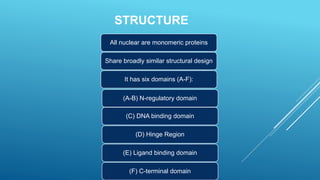
All nuclear are monomeric proteins
Share broadly similar structural design
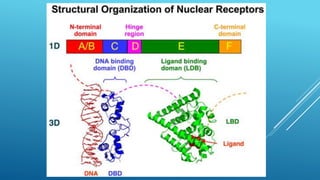
It has six domains (A-F):
(A-B) N-regulatory domain
(C) DNA binding domain
(D) Hinge Region
(E) Ligand binding domain
(F) C-terminal domain
STRUCTURE
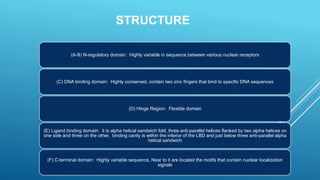
(A-B) N-regulatory domain: Highly variable in sequence between various nuclear receptors
(C) DNA binding domain: Highly conserved, contain two zinc fingers that bind to specific DNA sequences
(D) Hinge Region: Flexible domain
(E) Ligand binding domain: it is alpha helical sandwich fold, three anti-parallel helices flanked by two alpha helices on
one side and three on the other, binding cavity is within the inferior of the LBD and just below three anti-parallel alpha
helical sandwich
(F) C-terminal domain: Highly variable sequence, Near to it are located the motifs that contain nuclear localization
signals
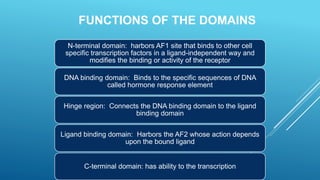
FUNCTIONS OF THE DOMAINS
N-terminal domain: harbors AF1 site that binds to other cell
specific transcription factors in a ligand-independent way and
modifies the binding or activity of the receptor
DNA binding domain: Binds to the specific sequences of DNA
called hormone response element
Hinge region: Connects the DNA binding domain to the ligand
binding domain
Ligand binding domain: Harbors the AF2 whose action depends
upon the bound ligand
C-terminal domain: has ability to the transcription
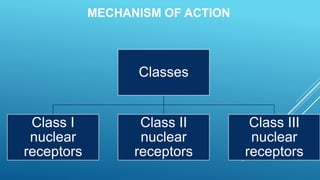
MECHANISM OF ACTION
Classes
Class I
nuclear
receptors
Class II
nuclear
receptors
Class III
nuclear
receptors
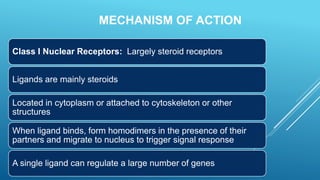
MECHANISM OF ACTION
Class I Nuclear Receptors: Largely steroid receptors
Ligands are mainly steroids
Located in cytoplasm or attached to cytoskeleton or other
structures
When ligand binds, form homodimers in the presence of their
partners and migrate to nucleus to trigger signal response
A single ligand can regulate a large number of genes
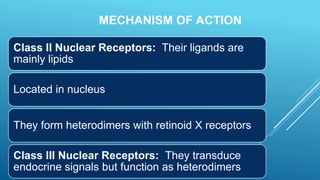
MECHANISM OF ACTION
Class II Nuclear Receptors: Their ligands are
mainly lipids
Located in nucleus
They form heterodimers with retinoid X receptors
Class III Nuclear Receptors: They transduce
endocrine signals but function as heterodimers
Nuclear Receptors
Nuclear Receptors

Nuclear Receptors

  • 2.
  • 3.
    NUCLEAR RECEPTORS “Nuclear receptorsare a family of highly conserved transcription in response to small lipophilic compound.” Play important role in development, physiology and disease in humans by regulating gene expression (Protein or amino acid formation) Estrogen or β-estradiol act upon the nuclear receptor to regulate gene expression for Female Sex Development Testosterone or Androgens act upon nuclear receptors to regulate gene expression for Male Sex Development
  • 4.
    STRUCTURE All nuclear aremonomeric proteins Share broadly similar structural design It has six domains (A-F): (A-B) N-regulatory domain (C) DNA binding domain (D) Hinge Region (E) Ligand binding domain (F) C-terminal domain
  • 5.
    STRUCTURE (A-B) N-regulatory domain:Highly variable in sequence between various nuclear receptors (C) DNA binding domain: Highly conserved, contain two zinc fingers that bind to specific DNA sequences (D) Hinge Region: Flexible domain (E) Ligand binding domain: it is alpha helical sandwich fold, three anti-parallel helices flanked by two alpha helices on one side and three on the other, binding cavity is within the inferior of the LBD and just below three anti-parallel alpha helical sandwich (F) C-terminal domain: Highly variable sequence, Near to it are located the motifs that contain nuclear localization signals
  • 7.
    FUNCTIONS OF THEDOMAINS N-terminal domain: harbors AF1 site that binds to other cell specific transcription factors in a ligand-independent way and modifies the binding or activity of the receptor DNA binding domain: Binds to the specific sequences of DNA called hormone response element Hinge region: Connects the DNA binding domain to the ligand binding domain Ligand binding domain: Harbors the AF2 whose action depends upon the bound ligand C-terminal domain: has ability to the transcription
  • 8.
    MECHANISM OF ACTION Classes ClassI nuclear receptors Class II nuclear receptors Class III nuclear receptors
  • 9.
    MECHANISM OF ACTION ClassI Nuclear Receptors: Largely steroid receptors Ligands are mainly steroids Located in cytoplasm or attached to cytoskeleton or other structures When ligand binds, form homodimers in the presence of their partners and migrate to nucleus to trigger signal response A single ligand can regulate a large number of genes
  • 10.
    MECHANISM OF ACTION ClassII Nuclear Receptors: Their ligands are mainly lipids Located in nucleus They form heterodimers with retinoid X receptors Class III Nuclear Receptors: They transduce endocrine signals but function as heterodimers