NUCLEAR RECEPTORS
PRESENTED BY
DIVYA RANI SHARMA
MPHARM (PHARMACOLOGY)
NUCLEAR RECEPTOR
Nuclear receptors are a family of ligand-regulated
transcription factors that are activated by steroid
hormones, such as oestrogen and progesterone, and
various other lipid soluble signals, including retinoic
acid, oxysterols, and thyroid hormone.
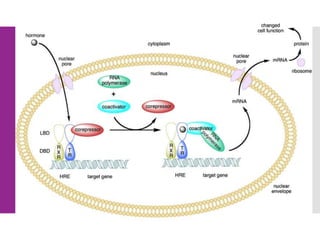
• Unlike most intercellular messengers, the ligands
can cross the plasma membrane and directly
interact with nuclear receptors inside the cell
• Requires a longer period of time for the onset of
action and show long lasting effects.
• They regulate many drug metabolic enzymes and
the receptors malfunctioning may lead to many
illness.
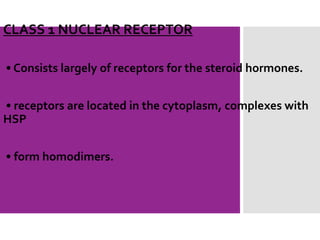
CLASS 1 NUCLEAR RECEPTOR
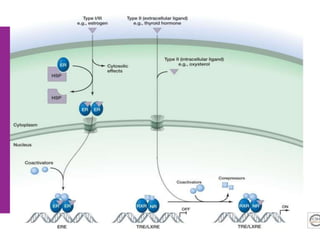
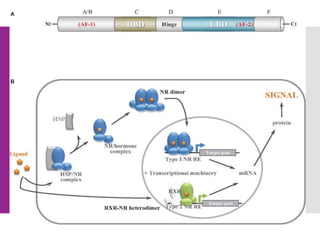
• Consists largely of receptors for the steroid hormones.
• receptors are located in the cytoplasm, complexes with
HSP
• form homodimers.
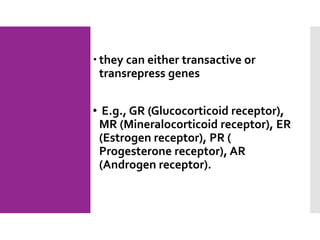
 they can either transactive or
transrepress genes
• E.g., GR (Glucocorticoid receptor),
MR (Mineralocorticoid receptor), ER
(Estrogen receptor), PR (
Progesterone receptor), AR
(Androgen receptor).
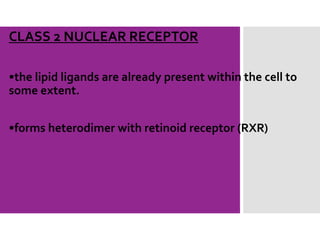
CLASS 2 NUCLEAR RECEPTOR
•the lipid ligands are already present within the cell to
some extent.
•forms heterodimer with retinoid receptor (RXR)
• they function by positive
feedback effects
• E.g., PPAR (Peroxisomes
proliferator activated receptor),
LXR (Liver oxysterol), FXR
(Farsenoid (bile acid) receptor).
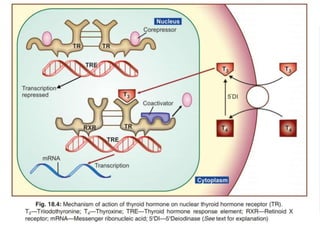
CLASS 3 NUCLEAR RECEPTOR
• Subgroup of class 2 nuclear receptors.
• Forms heterodimers with RXR, but instead of
sensing lipids, play role in endocrine signalling.
• E.g.,Thyroid hormone receptor,Vitamin D receptor,
Retinoic acid receptor.
THANKYOU

Nuclear receptor

  • 1.
    NUCLEAR RECEPTORS PRESENTED BY DIVYARANI SHARMA MPHARM (PHARMACOLOGY)
  • 2.
    NUCLEAR RECEPTOR Nuclear receptorsare a family of ligand-regulated transcription factors that are activated by steroid hormones, such as oestrogen and progesterone, and various other lipid soluble signals, including retinoic acid, oxysterols, and thyroid hormone.
  • 3.
    • Unlike mostintercellular messengers, the ligands can cross the plasma membrane and directly interact with nuclear receptors inside the cell • Requires a longer period of time for the onset of action and show long lasting effects. • They regulate many drug metabolic enzymes and the receptors malfunctioning may lead to many illness.
  • 5.
    CLASS 1 NUCLEARRECEPTOR • Consists largely of receptors for the steroid hormones. • receptors are located in the cytoplasm, complexes with HSP • form homodimers.
  • 6.
     they caneither transactive or transrepress genes • E.g., GR (Glucocorticoid receptor), MR (Mineralocorticoid receptor), ER (Estrogen receptor), PR ( Progesterone receptor), AR (Androgen receptor).
  • 8.
    CLASS 2 NUCLEARRECEPTOR •the lipid ligands are already present within the cell to some extent. •forms heterodimer with retinoid receptor (RXR)
  • 9.
    • they functionby positive feedback effects • E.g., PPAR (Peroxisomes proliferator activated receptor), LXR (Liver oxysterol), FXR (Farsenoid (bile acid) receptor).
  • 11.
    CLASS 3 NUCLEARRECEPTOR • Subgroup of class 2 nuclear receptors. • Forms heterodimers with RXR, but instead of sensing lipids, play role in endocrine signalling. • E.g.,Thyroid hormone receptor,Vitamin D receptor, Retinoic acid receptor.
  • 13.