NUCLEAR RECEPTOR TYPE I
RECEPTOR
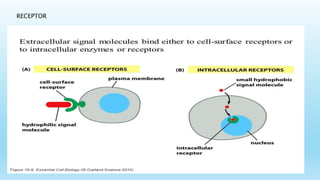
INTRACELLULAR RECEPTORS
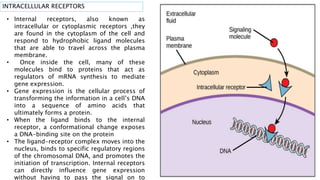
• Internal receptors, also known as
intracellular or cytoplasmic receptors ,they
are found in the cytoplasm of the cell and
respond to hydrophobic ligand molecules
that are able to travel across the plasma
membrane.
• Once inside the cell, many of these
molecules bind to proteins that act as
regulators of mRNA synthesis to mediate
gene expression.
• Gene expression is the cellular process of
transforming the information in a cell’s DNA
into a sequence of amino acids that
ultimately forms a protein.
• When the ligand binds to the internal
receptor, a conformational change exposes
a DNA-binding site on the protein
• The ligand-receptor complex moves into the
nucleus, binds to specific regulatory regions
of the chromosomal DNA, and promotes the
initiation of transcription. Internal receptors
can directly influence gene expression
without having to pass the signal on to
Classification
LIGAND
BASED
MECHANIS
M BASED
• TYPE I
• TYPE II
• TYPE III
• ENDOCRINE
• ADOPTED ORPHANs
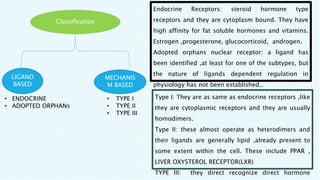
Endocrine Receptors: steroid hormone type
receptors and they are cytoplasm bound. They have
high affinity for fat soluble hormones and vitamins.
Estrogen ,progesterone, glucocorticoid, androgen.
Adopted orphans nuclear receptor: a ligand has
been identified ,at least for one of the subtypes, but
the nature of ligands dependent regulation in
physiology has not been established..
Type I: They are as same as endocrine receptors ,like
they are cytoplasmic receptors and they are usually
homodimers.
Type II: these almost operate as heterodimers and
their ligands are generally lipid ,already present to
some extent within the cell. These include PPAR ,
LIVER OXYSTEROL RECEPTOR(LXR)
TYPE III: they direct recognize direct hormone
STRUCTURE OF NUCLEAR RECEPTORS
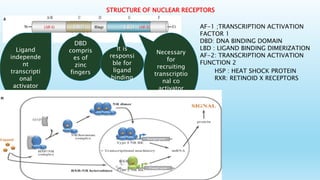
AF-1 ;TRANSCRIPTION ACTIVATION
FACTOR 1
DBD: DNA BINDING DOMAIN
LBD : LIGAND BINDING DIMERIZATION
AF-2: TRANSCRIPTION ACTIVATION
FUNCTION 2
HSP : HEAT SHOCK PROTEIN
RXR: RETINOID X RECEPTORS
Ligand
independe
nt
transcripti
onal
activator
DBD
compris
es of
zinc
fingers
It is
responsi
ble for
ligand
binding
Necessary
for
recruiting
transcriptio
nal co
activator
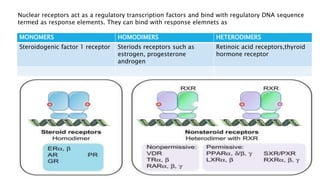
MONOMERS HOMODIMERS HETERODIMERS
Steroidogenic factor 1 receptor Steriods receptors such as
estrogen, progesterone
androgen
Retinoic acid receptors,thyroid
hormone receptor
Nuclear receptors act as a regulatory transcription factors and bind with regulatory DNA sequence
termed as response elements. They can bind with response elemnets as
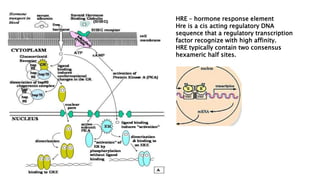
HRE – hormone response element
Hre is a cis acting regulatory DNA
sequence that a regulatory transcription
factor recognize with high affinity.
HRE typically contain two consensus
hexameric half sites.
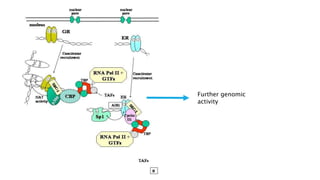
Further genomic
activity

Nuclear receptor

  • 1.
  • 2.
  • 3.
    INTRACELLULAR RECEPTORS • Internalreceptors, also known as intracellular or cytoplasmic receptors ,they are found in the cytoplasm of the cell and respond to hydrophobic ligand molecules that are able to travel across the plasma membrane. • Once inside the cell, many of these molecules bind to proteins that act as regulators of mRNA synthesis to mediate gene expression. • Gene expression is the cellular process of transforming the information in a cell’s DNA into a sequence of amino acids that ultimately forms a protein. • When the ligand binds to the internal receptor, a conformational change exposes a DNA-binding site on the protein • The ligand-receptor complex moves into the nucleus, binds to specific regulatory regions of the chromosomal DNA, and promotes the initiation of transcription. Internal receptors can directly influence gene expression without having to pass the signal on to
  • 4.
    Classification LIGAND BASED MECHANIS M BASED • TYPEI • TYPE II • TYPE III • ENDOCRINE • ADOPTED ORPHANs Endocrine Receptors: steroid hormone type receptors and they are cytoplasm bound. They have high affinity for fat soluble hormones and vitamins. Estrogen ,progesterone, glucocorticoid, androgen. Adopted orphans nuclear receptor: a ligand has been identified ,at least for one of the subtypes, but the nature of ligands dependent regulation in physiology has not been established.. Type I: They are as same as endocrine receptors ,like they are cytoplasmic receptors and they are usually homodimers. Type II: these almost operate as heterodimers and their ligands are generally lipid ,already present to some extent within the cell. These include PPAR , LIVER OXYSTEROL RECEPTOR(LXR) TYPE III: they direct recognize direct hormone
  • 5.
    STRUCTURE OF NUCLEARRECEPTORS AF-1 ;TRANSCRIPTION ACTIVATION FACTOR 1 DBD: DNA BINDING DOMAIN LBD : LIGAND BINDING DIMERIZATION AF-2: TRANSCRIPTION ACTIVATION FUNCTION 2 HSP : HEAT SHOCK PROTEIN RXR: RETINOID X RECEPTORS Ligand independe nt transcripti onal activator DBD compris es of zinc fingers It is responsi ble for ligand binding Necessary for recruiting transcriptio nal co activator
  • 6.
    MONOMERS HOMODIMERS HETERODIMERS Steroidogenicfactor 1 receptor Steriods receptors such as estrogen, progesterone androgen Retinoic acid receptors,thyroid hormone receptor Nuclear receptors act as a regulatory transcription factors and bind with regulatory DNA sequence termed as response elements. They can bind with response elemnets as
  • 7.
    HRE – hormoneresponse element Hre is a cis acting regulatory DNA sequence that a regulatory transcription factor recognize with high affinity. HRE typically contain two consensus hexameric half sites.
  • 8.