05/02/2020 Molecular pharmacology, BY bantayehu 1
Presented to: Dr.Wubayehu ( PHD in
pharmacology; UoG)
Presented by: Bantayehu A
2019 GC
ASSIGNMENT PRESENTATION ON
VOLTAGE GATED ION CHANNELS
BANTAYEHU A 2
๏‚ง Introduction of membrane potassium ion channels
๏‚ง Basic structure of voltage gated ion channels
๏‚ง mechanism of voltage gated ion opening channel
๏‚ง Common (Major) types voltage gated ion channel
๏‚ง Physiological effects of voltage gated ion channels
๏‚ง major disease of human associated with voltage gated channel
(channelopathies)
PERSENTATION OUTLINE
OBJECTIVE
After the end of this presentation students will
be able to;
Define voltage gated ion channel
Understand mechanism of voltage gated ion channel opening
Enumerate the four types of voltage gated ion channel
Describes the structure and effects of voltage gated ion channel
Realize the concept of channelopathies
BANTAYEHU A 3
INTRODUCTION
Ion channels are molecular machines that serve as principal
integrating and regulatory devices for the control of cellular
excitability
Ion channels were first studied and are best known in connection to
the nervous system, especially in the generation and propagation of
action potentials.
There are two major types of ion channel
1. voltage gated and
2. Ligand gated
05/02/2020 Molecular pharmacology, BY bantayehu 4
Contโ€ฆ
๏ƒ˜ Voltage-gated ion channels are a class of trans membrane
proteins that form ion channels that are activated by changes in
the electrical membrane potential near the channel.
๏ƒ˜ The membrane potential alters the conformation of
the channel proteins, regulating their opening and closing
๏ƒ˜ The opening and closing of the channels are triggered by
changing ion concentration, and hence charge gradient,
between the sides of the cell membrane
05/02/2020 Molecular pharmacology, BY bantayehu 5
CONTโ€ฆ
Voltage gated ion channels open in response to voltage (i.e. when
the cell gets depolarized) where as
ligand gated channels open in response to a ligand (some
chemical signal) binding to them.
The Voltage-gated ion channels are responsible for
๏ƒผ maintaining neuronal homeostasis and function
๏ƒผ secretion,
๏ƒผ endocytosis,
๏ƒผ muscle contraction,
๏ƒผ synaptic transmission,
๏ƒผ ciliary control,
๏ƒผ fertilization, etc.
05/02/2020 Molecular pharmacology, BY bantayehu 6
CONTโ€ฆ.
Electrical signals control
๏ƒผ contraction of muscle,
๏ƒผ secretion of hormones,
๏ƒผ sensation of the environment,
๏ƒผ processing of information in the brain, and
๏ƒผ output from the brain to peripheral tissues.
In excitable cells, electrical signals also have an important
influence on :
I. intracellular metabolism and signal transduction,
II. gene expression, protein synthesis and targeting, and
III. protein degradation.
The voltage-gated ion channels are the molecular targets for a
wide range of potent biological toxins, including the gating
modifier toxins that alter the kinetics and voltage dependence of
their activation and inactivation.
05/02/2020 Molecular pharmacology, BY bantayehu 7
DEFINITION OF VOLTAGE GATED ION CHANNEL
Any ion channel that opens and closes in response to changes in
electrical potential across the cell membrane in which the channel
is situated
Voltage-gated ion channels are multisubunit protein complexes
that respond to changes in membrane potential with
conformational changes that lead to
๏‚ง gating, or opening and
๏‚ง closing, of an ion-selective trans membrane pore and
๏‚ง propagation of action potentials in electrically excitable cells.
Molecular dynamics simulations have become a useful tool to
study the molecular basis of ion transport in atomistic models of
voltage-gated ion channels.
05/02/2020 Molecular pharmacology, BY bantayehu 8
VOLTAGE-GATED CHANNEL STRUCTURE
Voltage-gated ion channels are integral membrane proteins.
They have a similar molecular structure that includes a repeating
motif with six membrane-spanning alpha helices
There is also a pore loop that contributes to the selectivity filter
and a charged domain that acts as a voltage sensor.
05/02/2020 Molecular pharmacology, BY bantayehu 9
contโ€ฆ
During depolarization the inner face of the cell membrane
becomes more positive and
the voltage sensor (which carries a positive charge) is thrust
upwards through the membrane by electrostatic repulsion.
This movement induces a conformational change in the channel
complex which opens the pore.
Conductance changes steeply, increasing 150-fold with a 10 mV
shift in membrane potential.
05/02/2020 Molecular pharmacology, BY bantayehu 10
STRUCTURE AND FUNCTION
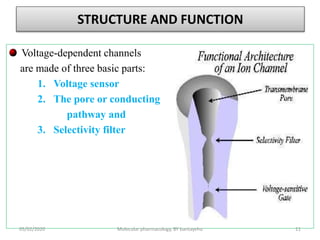
Voltage-dependent channels
are made of three basic parts:
1. Voltage sensor
2. The pore or conducting
pathway and
3. Selectivity filter
05/02/2020 Molecular pharmacology, BY bantayehu 11
Contโ€ฆ
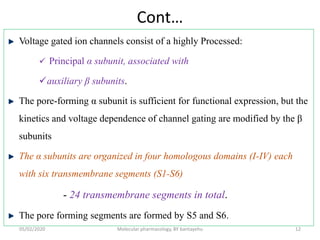
Voltage gated ion channels consist of a highly Processed:
๏ƒผ Principal ฮฑ subunit, associated with
๏ƒผauxiliary ฮฒ subunits.
The pore-forming ฮฑ subunit is sufficient for functional expression, but the
kinetics and voltage dependence of channel gating are modified by the ฮฒ
subunits
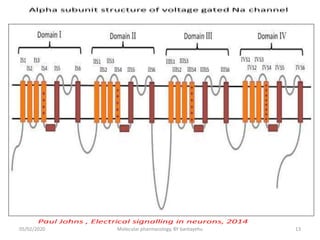
The ฮฑ subunits are organized in four homologous domains (I-IV) each
with six transmembrane segments (S1-S6)
- 24 transmembrane segments in total.
The pore forming segments are formed by S5 and S6.
05/02/2020 Molecular pharmacology, BY bantayehu 12
05/02/2020 Molecular pharmacology, BY bantayehu 13
Discussion on the picture
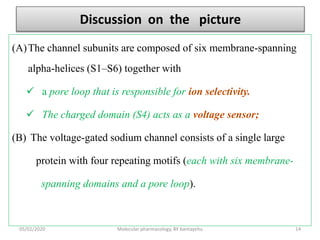
(A)The channel subunits are composed of six membrane-spanning
alpha-helices (S1โ€“S6) together with
๏ƒผ a pore loop that is responsible for ion selectivity.
๏ƒผ The charged domain (S4) acts as a voltage sensor;
(B) The voltage-gated sodium channel consists of a single large
protein with four repeating motifs (each with six membrane-
spanning domains and a pore loop).
05/02/2020 Molecular pharmacology, BY bantayehu 14
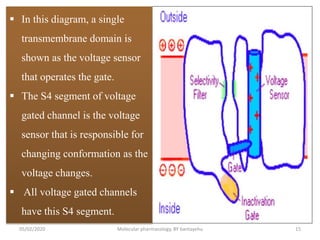
๏‚ง In this diagram, a single
transmembrane domain is
shown as the voltage sensor
that operates the gate.
๏‚ง The S4 segment of voltage
gated channel is the voltage
sensor that is responsible for
changing conformation as the
voltage changes.
๏‚ง All voltage gated channels
have this S4 segment.
05/02/2020 Molecular pharmacology, BY bantayehu 15
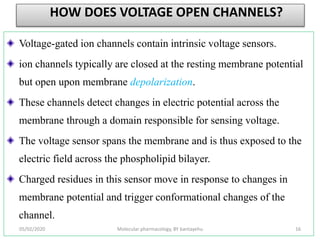
HOW DOES VOLTAGE OPEN CHANNELS?
Voltage-gated ion channels contain intrinsic voltage sensors.
ion channels typically are closed at the resting membrane potential
but open upon membrane depolarization.
These channels detect changes in electric potential across the
membrane through a domain responsible for sensing voltage.
The voltage sensor spans the membrane and is thus exposed to the
electric field across the phospholipid bilayer.
Charged residues in this sensor move in response to changes in
membrane potential and trigger conformational changes of the
channel.
05/02/2020 Molecular pharmacology, BY bantayehu 16
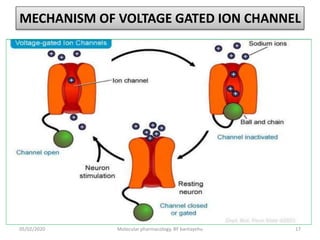
MECHANISM OF VOLTAGE GATED ION CHANNEL
05/02/2020 Molecular pharmacology, BY bantayehu 17
Contโ€ฆ
The S4 segment corresponds to the voltage sensor.
In the voltage-gated ion channels, these gating charges correspond
to several basic, positively charged residues at every third position
in the S4 transmembrane alpha helix.
Each of the four subunits or pseudo subunits of these channels
contain one voltage sensor, and depolarization of the cell
membrane exerts an electrostatic force on the gating charges that
causes the S4 segment to move outward.
The concerted movement of the four S4 segments cooperatively
opens the channel gate
05/02/2020 Molecular pharmacology, BY bantayehu 18
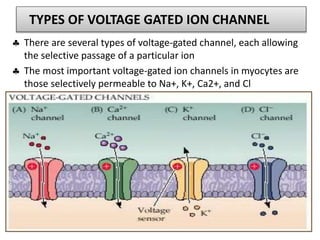
TYPES OF VOLTAGE GATED ION CHANNEL
๏‚ง There are several types of voltage-gated channel, each allowing
the selective passage of a particular ion
๏‚ง The most important voltage-gated ion channels in myocytes are
those selectively permeable to Na+, K+, Ca2+, and Cl
05/02/2020 Molecular pharmacology, BY bantayehu 19
THE FOUR IMPORTANT VOLTAGE GATED ION CHANNEL
1. VOLTAGE GATED SODIUM CHANNELS- 9 members
๏ƒผ Responsible for membrane depolarization in action potential
generation
2. VOLTAGE GATED CALCIUM CHANNELS- 10 members
๏ƒผPlay an important role in both linking muscle excitation with
contraction as well as neuronal excitation with transmitter
release.
3. VOLTAGE GATED POTASSIUM CHANNELS- 40 members
๏ƒผ Role in repolarization of cell membrane after AP
4. VOLTAGE GATED CHLORIDE CHANNEL
๏ƒผAre present in every type of neuron, where they control
excitability, restore the resting membrane potential and help
regulate cell volume are a superfamily of poorly understood
ion channels.
05/02/2020 Molecular pharmacology, BY bantayehu 20
1. VOLTAGE GATED SODIUM CHANNEL
Sodium channels play a central role in physiology:
๏ƒผ they transmit depolarizing impulses rapidly throughout cells and
cell networks, thereby enabling co-ordination of higher
processes ranging from locomotion to cognition.
Elucidation of their fundamental properties in the squid axon
launched modern channel theory.
The work of Hodgkin and Huxley on sodium channels
revolutionized electrophysiology by elegantly dissecting the
elementary processes of gating and permeation
More recently, sodium channels were the first voltage-dependent
ion channels to be cloned
05/02/2020 Molecular pharmacology, BY bantayehu 21
05/02/2020 Molecular pharmacology, BY bantayehu 22
๏ƒ˜ These channels are responsible for the rapid influx of sodium ions
during the action potential in nerve, muscle, and endocrine cells.
๏ƒ˜ Sodium channels mediate fast depolarization and conduct
electrical impulses throughout
๏ƒผ nerve,
๏ƒผ muscle and
๏ƒผ heart.
๏ƒ˜ Sodium channels have a modular architecture, with distinct
regions for the pore and the gates.
๏ƒ˜ At a molecular level, sodium channels are not static: they move
extensively in the course of gating and ion translocation
Contโ€ฆ
๏ƒ˜ Sodium channels bind local anaesthetics (E.g.. LIDOCANINE) and
various toxins.
๏ƒ˜ In some cases, the relevant sites have been partially identified.
๏ƒ˜ Sodium channels are subject to regulation at the levels of
transcription,
๏ƒผsubunit interaction and
๏ƒผpost-translational modification (notably glycosylation
๏ƒผphosphorylation
Na+ channels consist of various subunits, but only the principal (ฮฑ)
subunit is required for function.
05/02/2020 Molecular pharmacology, BY bantayehu 23
Contโ€ฆ
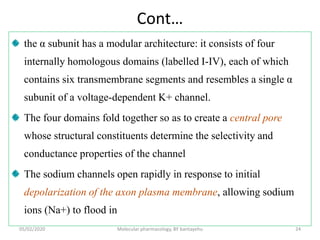
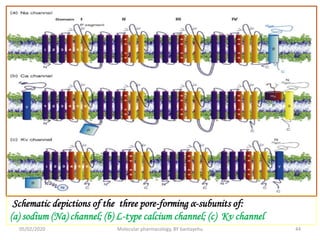
the ฮฑ subunit has a modular architecture: it consists of four
internally homologous domains (labelled I-IV), each of which
contains six transmembrane segments and resembles a single ฮฑ
subunit of a voltage-dependent K+ channel.
The four domains fold together so as to create a central pore
whose structural constituents determine the selectivity and
conductance properties of the channel
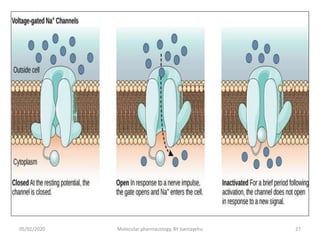
The sodium channels open rapidly in response to initial
depolarization of the axon plasma membrane, allowing sodium
ions (Na+) to flood in
05/02/2020 Molecular pharmacology, BY bantayehu 24
Contโ€ฆ
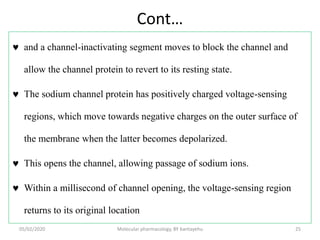
๏‚ฉ and a channel-inactivating segment moves to block the channel and
allow the channel protein to revert to its resting state.
๏‚ฉ The sodium channel protein has positively charged voltage-sensing
regions, which move towards negative charges on the outer surface of
the membrane when the latter becomes depolarized.
๏‚ฉ This opens the channel, allowing passage of sodium ions.
๏‚ฉ Within a millisecond of channel opening, the voltage-sensing region
returns to its original location
05/02/2020 Molecular pharmacology, BY bantayehu 25
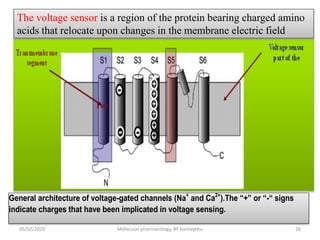
General architecture of voltage-gated channels (Na+
and Ca2+
).The โ€œ+โ€ or โ€œ-โ€œ signs
indicate charges that have been implicated in voltage sensing.
The voltage sensor is a region of the protein bearing charged amino
acids that relocate upon changes in the membrane electric field
05/02/2020 Molecular pharmacology, BY bantayehu 26
con
05/02/2020 Molecular pharmacology, BY bantayehu 27
PHYSIOLOGICAL EFFECT VOLTAGE GATED NA CHANNEL
Dysfunctional NaV channels are implicated in various disorders,
which makes them potential drug targets for their treatment .
Thus a molecular-level understanding the operation of NaV
channels is an important problem in physiology with ramifications
in medicine and pharmacology
05/02/2020 Molecular pharmacology, BY bantayehu 28
Contโ€ฆ
Voltage-gated sodium and calcium channels (NaV and CaV
channels, respectively) are important mediators of many
physiological functions, including
โ€“ propagation of electrical signal,
โ€“ cell excitability,
โ€“ gene transcription,
โ€“ secretion and synaptic transmission,
โ€“ plasticity and muscle contraction .
As might be expected,Na+ channel gives rise to action potentials
of long duration and is one of the targets of:-
๏ƒผ local anesthetics such as benzocaine and lidocaine
05/02/2020 Molecular pharmacology, BY bantayehu 29
2. VOLTAGE GATED POTASSIUM CHANNEL
Voltage-gated K+ channels are one of the key components in
generation and propagation of electrical impulses in nervous
system.
Upon changes in transmembrane potential, these channels open
and allow passive flow of K+ ions from the cell to restore the
membrane potential
The largest and most diverse class of voltage-gated ion channels
are the K+ channels .
๏ƒผ Nearly 100 K+ channel genes are now known, and
๏ƒผ these fall into several distinct groups that differ substantially
in their gating properties
05/02/2020 Molecular pharmacology, BY bantayehu 30
STRUCTURE OF POTASSIUM CHANNELS
Potassium channels contain :
๏ƒผ principal subunits (often called a-subunits), which determine
the structure of the channel, and
๏ƒผ auxiliary subunits (often called b-subunits), which can modify
the properties of the channel.
Most of the known principal subunits express in heterologous
expression systems as functional homo-multimeric channel
complexes.
Potassium channel a-subunits fall into at least eight families based
on predicted structural and functional similarities
05/02/2020 Molecular pharmacology, BY bantayehu 31
Contโ€ฆ
๏ƒ˜ Three of these families
1. Kv,
2. ether-a-go-go-related gene (EAG), gene (KCNH2)
3. and KQT share a common motif of six transmembrane
(TM) domains and are primarily gated by voltage
๏ƒ˜ Two other families,
1. CNG
2. SK/IK, also contain this motif but are gated by cyclic
nucleotides and calcium, respectively.
๏ƒ˜ Three other families of potassium channel Alpha -subunits have
distinct patterns of TM domains.
05/02/2020 Molecular pharmacology, BY bantayehu 32
Contโ€ฆ
๏€ช Kir channels belong to a structural family two TM domains.
๏€ช An eighth functionally diverse family K2p channels contains two
tandem repeats of this inward-rectifier motif
๏€ช Thus, these families could be mainly divided into three groups
termed as
๏‚ง voltage-gated six TM potassium channels (Kv channels),
๏‚ง calcium-activated six/seven TM potassium channels (Kca
channels), and
๏‚ง two TM potassium channels, respectively.
05/02/2020 Molecular pharmacology, BY bantayehu 33
voltage-gated six trans membrane potassium channels
๏‚ง Voltage-gated potassium channels (Kv channels) are the largest
group in potassium channel family, which in humans are encoded
๏ƒ˜by 40 genes and
๏ƒ˜are divided into 12 subfamilies. These include
๏ƒ˜Kv1 (KCNA), Kv2 (KCNB), Kv3 (KCNC), Kv4 (KCND), Kv7
(KCNQ, also named KQT), Kv10, Kv11 (KCNH, also named
EAG) and Kv12.
๏‚ง Kv5, Kv6, Kv8, and Kv9 channels are not functional alone;
๏‚ง they co-assemble with Kv2 subunits and modify their function.
๏‚ง These family members share six TM and are gated by voltage
05/02/2020 Molecular pharmacology, BY bantayehu 34
Contโ€ฆ
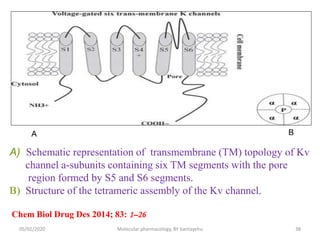
โ€ข All mammalian Kv channels consist of four a-subunits, each
containing six TM a-helical segments, S1โ€“S6, and a P-loop,
which are arranged circumferentially around a central pore as
I. Homotetramers or
II. hetero-tetramers
โ€ข The pore domain (PD) represents a tetramer of two membrane-
spanning a helixes that are connected with each other via a P-
loop, which is responsible for potassium ion selectivity.
05/02/2020 Molecular pharmacology, BY bantayehu 35
Contโ€ฆ
The PD contains a channel gate, which controls ion permeation.
The structure of the gate is a bundle ofovercrossing a helixes at
the cytoplasmic entryway of the channel pore.
These a helices correspond to the S6 helix of Kv channels.
In Kv channels, the pore is covalently linked to four specialized
membrane-embedded peripheral functional modules, voltage-
sensing domains (VSDs), which are comprised of S1โ€“S4
membrane-spanning segments, with four positively charged
arginine residues in the S4 helix
05/02/2020 Molecular pharmacology, BY bantayehu 36
Contโ€ฆ
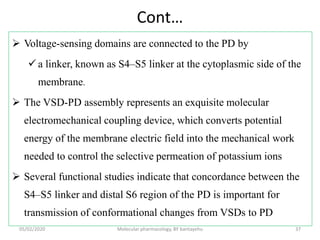
๏ƒ˜ Voltage-sensing domains are connected to the PD by
๏ƒผ a linker, known as S4โ€“S5 linker at the cytoplasmic side of the
membrane.
๏ƒ˜ The VSD-PD assembly represents an exquisite molecular
electromechanical coupling device, which converts potential
energy of the membrane electric field into the mechanical work
needed to control the selective permeation of potassium ions
๏ƒ˜ Several functional studies indicate that concordance between the
S4โ€“S5 linker and distal S6 region of the PD is important for
transmission of conformational changes from VSDs to PD
05/02/2020 Molecular pharmacology, BY bantayehu 37
A) Schematic representation of transmembrane (TM) topology of Kv
channel a-subunits containing six TM segments with the pore
region formed by S5 and S6 segments.
B) Structure of the tetrameric assembly of the Kv channel.
Chem Biol Drug Des 2014; 83: 1โ€“26
05/02/2020 Molecular pharmacology, BY bantayehu 38
05/02/2020 Molecular pharmacology, BY bantayehu 39
Structural Domains Found in Voltage-gated K Channels
๏ƒ˜ Cloning of the Shaker channel provided the first opportunity to analyze
the primary amino acid sequence of a K channel.
๏ƒ˜ Voltage-gated Na or Ca channel proteins are comprised of a large
continuous sequence that codes for four repeated elements, each of
which are homologous to one Shaker protein (Figure 1A).
๏ƒ˜ A single one of these structural elements is believed to span the
membrane six times (Figure 1B)
๏ƒ˜ It is now firmly established that four Shaker proteins are needed to
assemble a functional voltage-gated K channel (KV), thus producing a
structure similar to voltage-gated Na and Ca channels, one that has been
broken up into subunits.
05/02/2020 Molecular pharmacology, BY bantayehu 40
3. VOLTAGE GATED CALCIUM CHANNEL
Voltage-gated calcium channels mediate calcium influx in
response to membrane depolarization and regulate intracellular
processes such as contraction, secretion, neurotransmission.
Like sodium channels, the ฮฑ1 subunit of voltage gated calcium
channels is organized in four homologous domains (I-IV), with six
trans membrane segments (S1-S6) in each.
05/02/2020 Molecular pharmacology, BY bantayehu 41
Calcium Contโ€ฆ
An intracellular ฮฒ subunit and a transmembrane, disulfide-linked
ฮฑ2ฮฒ subunit complex are components of most types of calcium
channels
A ฮณ subunit has also been found in skeletal muscle calcium
channels, and related subunits are expressed in heart and brain.
There are several different kinds of high-voltage-gated calcium
channels (VGCCs).
05/02/2020 Molecular pharmacology, BY bantayehu 42
Calcium Contโ€ฆ
1. N-type channel (Most often found throughout the brain and
peripheral nervous system).
2. P/Q-type channel (Purkinje neurons in the cerebellum)
3. L-type (Skeletal muscle, smooth muscle, bone (osteoblasts),
ventricular myocytes (responsible for prolonged action potential in
cardiac cell), dendrites and dendritic spines of cortical neurones).
Notice: L-type channels are responsible for excitation, contraction
coupling of skeletal, smooth, and cardiac muscle and for
hormone secretion in endocrine cells
05/02/2020 Molecular pharmacology, BY bantayehu 43
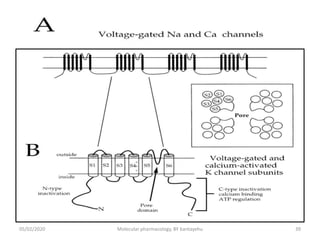
Schematic depictions of the three pore-forming ฮฑ-subunits of:
(a) sodium (Na) channel; (b) L-type calcium channel; (c) Kv channel
05/02/2020 Molecular pharmacology, BY bantayehu 44
CHANNELOPATHIES
Channelopathies are diseases that develop because of defects in ion
channels caused by either genetic or acquired factors.
The following inherited channelopathies are described.
(1) Sodium channelopathies:
๏ƒผ familial generalized epilepsy with febrile seizures plus,
๏ƒผ hyperkalemic periodic paralysis,
๏ƒผ paramyotonias, (hypokalemic periodic paralysis)
05/02/2020 Molecular pharmacology, BY bantayehu 45
Channelopathies contโ€ฆ
(2) potassium channelopathies:
๏ƒผ benign infantile epilepsy, episodic ataxia type 1;
(3) calcium channelopathies:
๏ƒผ episodic ataxia type 2, pinocerebellar ataxia type 6,
๏ƒผ familial hemiplegic migraine,
๏ƒผ hypokalemic periodic paralysis,
๏ƒผ malignant hyperthermia syndrome, congenital stationary
๏ƒผ night blindness;
(4) Chloride channelopathies:
๏ƒผ myotonia congenitas; (delayed relaxation (prolonged
contraction) of the skeletal muscles
05/02/2020 Molecular pharmacology, BY bantayehu 46
๏‚ฉ Voltage gated ion channels open in response to voltage (i.e. when the cell gets
depolarized)
๏‚ฉ Voltage-dependent channels are made of three basic parts: Voltage sensor,
The pore or conducting pathway and Selectivity filter
๏‚ฉ ion channels typically are closed at the resting membrane potential but open
upon membrane depolarization.
๏‚ฉ Voltage gated ion channels consist of a highly Processed:
1. ฮฑ subunit (Principal) associated with
2. ฮฒ subunits(auxiliary)
๏‚ฉ The most important voltage-gated ion channels in are those selectively
permeable to Na+, K+, Ca2+, and Cl
๏‚ฉ The largest and most diverse class of voltage-gated ion channels are the K+
channels .
๏‚ฉ Channelopathies are diseases that develop because of defects in ion channels (
voltage gate ion channels) caused by either genetic or acquired factors.
05/02/2020 Molecular pharmacology, BY bantayehu 47
SUMMARY
Reference
1. William A. Catterall and Teresa M. Swanson ; Structural Basis for Pharmacology of
Voltage-Gated Sodium and Calcium Channels ; April 6, 2015
2. Carlo Guardiani, et al, Different roles for aspartates and glutamates for cation permeation
in bacterial sodium channels;Volume 1861, Issue 2, 1 February 2019, Pages 495-503
3. Anna Fernรกndez-Falgueras,et al, Cardiac Channelopathies and Sudden Death:29 January
,2017
4. Rudiger Kohling and Jakob Wolfart; Oscar Langendorff Institute of Physiology,
University of Rostock, Rostock 18057, Germany, May 9, 2016
5. https://www.slideshare.net/ValenciaFernandes1/ion-channels-71093061,2017
6. Somayeh Mahdavi, and Serdar Kuyucak; Mechanism of Ion Permeation in Mammalian
Voltage-Gated Sodium Channels: August 14, 2015
7. Rรญan W. Manville1, Direct neurotransmitter activation of voltage-gated
potassium channels, (2018) 9:1847
8. Paul Johns , Electrical signalling in neurons; 2014 page 71-80
9. Diane Lipscombe, Cecilia P. Toro, in From Molecules to Networks ions of this important
class of membrane proteins. (Third Edition), 2014
05/02/2020 Molecular pharmacology, BY bantayehu 48
REFERENCE CONTโ€ฆ
10. Brooke RE Association of potassium channel Kv3.4 subunits with pre-
and postsynaptic structures in brainstem and spinal cord; Neuroscience.
2004;126(4):1001-10.
11. Jason Tien,et al, Molecular Properties of Ion Channels; in From Molecules to Networks (Third Edition),
2014
12. M.N. Rasband, J.S. Trimmer, in Encyclopedia of Neuroscience, 2009
Voltage-gated ion channels are responsible for the generation
13 Chuan Tian, Potassium Channels: Structures, Diseases, and
Modulators; Chem Biol Drug Des 2014; 83: 1โ€“26
14 Selvarajan Sandhiya & Steven Aibor Dkhar, Review ArticlePotassium channels in health, disease
& development of channel modulators Indian J Med Res 129, March 2009, pp 223-232
15. Celesia GG, Disorders of membrane channels or channelopathies; 2001
Jan;112(1):2-18
16. William A. etal, Voltage-gated Ion Channels and Gating Modifier Toxins , Department of
Pharmacology, University of Washington, 2007
17. https://www.encyclopedia.com/science/dictionaries-thesauruses-pictures-and- press releases/voltage-
gated-ion-channel
18. https://www.ncbi.nlm.nih.gov/books/NBK10883
19. Mario M., et al, Prokaryotic K+ channels: From crystal structures to
diversity; July, 2005
20. J ohn C. Foreman,& Torben Johansen, Textbook of receptor pharmacology; 2nd ed.; 2003
05/02/2020 Molecular pharmacology, BY bantayehu 49
05/02/2020 Molecular pharmacology, BY bantayehu 50

voltage gated ion channel

  • 1.
    05/02/2020 Molecular pharmacology,BY bantayehu 1 Presented to: Dr.Wubayehu ( PHD in pharmacology; UoG) Presented by: Bantayehu A 2019 GC ASSIGNMENT PRESENTATION ON VOLTAGE GATED ION CHANNELS
  • 2.
    BANTAYEHU A 2 ๏‚งIntroduction of membrane potassium ion channels ๏‚ง Basic structure of voltage gated ion channels ๏‚ง mechanism of voltage gated ion opening channel ๏‚ง Common (Major) types voltage gated ion channel ๏‚ง Physiological effects of voltage gated ion channels ๏‚ง major disease of human associated with voltage gated channel (channelopathies) PERSENTATION OUTLINE
  • 3.
    OBJECTIVE After the endof this presentation students will be able to; Define voltage gated ion channel Understand mechanism of voltage gated ion channel opening Enumerate the four types of voltage gated ion channel Describes the structure and effects of voltage gated ion channel Realize the concept of channelopathies BANTAYEHU A 3
  • 4.
    INTRODUCTION Ion channels aremolecular machines that serve as principal integrating and regulatory devices for the control of cellular excitability Ion channels were first studied and are best known in connection to the nervous system, especially in the generation and propagation of action potentials. There are two major types of ion channel 1. voltage gated and 2. Ligand gated 05/02/2020 Molecular pharmacology, BY bantayehu 4
  • 5.
    Contโ€ฆ ๏ƒ˜ Voltage-gated ionchannels are a class of trans membrane proteins that form ion channels that are activated by changes in the electrical membrane potential near the channel. ๏ƒ˜ The membrane potential alters the conformation of the channel proteins, regulating their opening and closing ๏ƒ˜ The opening and closing of the channels are triggered by changing ion concentration, and hence charge gradient, between the sides of the cell membrane 05/02/2020 Molecular pharmacology, BY bantayehu 5
  • 6.
    CONTโ€ฆ Voltage gated ionchannels open in response to voltage (i.e. when the cell gets depolarized) where as ligand gated channels open in response to a ligand (some chemical signal) binding to them. The Voltage-gated ion channels are responsible for ๏ƒผ maintaining neuronal homeostasis and function ๏ƒผ secretion, ๏ƒผ endocytosis, ๏ƒผ muscle contraction, ๏ƒผ synaptic transmission, ๏ƒผ ciliary control, ๏ƒผ fertilization, etc. 05/02/2020 Molecular pharmacology, BY bantayehu 6
  • 7.
    CONTโ€ฆ. Electrical signals control ๏ƒผcontraction of muscle, ๏ƒผ secretion of hormones, ๏ƒผ sensation of the environment, ๏ƒผ processing of information in the brain, and ๏ƒผ output from the brain to peripheral tissues. In excitable cells, electrical signals also have an important influence on : I. intracellular metabolism and signal transduction, II. gene expression, protein synthesis and targeting, and III. protein degradation. The voltage-gated ion channels are the molecular targets for a wide range of potent biological toxins, including the gating modifier toxins that alter the kinetics and voltage dependence of their activation and inactivation. 05/02/2020 Molecular pharmacology, BY bantayehu 7
  • 8.
    DEFINITION OF VOLTAGEGATED ION CHANNEL Any ion channel that opens and closes in response to changes in electrical potential across the cell membrane in which the channel is situated Voltage-gated ion channels are multisubunit protein complexes that respond to changes in membrane potential with conformational changes that lead to ๏‚ง gating, or opening and ๏‚ง closing, of an ion-selective trans membrane pore and ๏‚ง propagation of action potentials in electrically excitable cells. Molecular dynamics simulations have become a useful tool to study the molecular basis of ion transport in atomistic models of voltage-gated ion channels. 05/02/2020 Molecular pharmacology, BY bantayehu 8
  • 9.
    VOLTAGE-GATED CHANNEL STRUCTURE Voltage-gatedion channels are integral membrane proteins. They have a similar molecular structure that includes a repeating motif with six membrane-spanning alpha helices There is also a pore loop that contributes to the selectivity filter and a charged domain that acts as a voltage sensor. 05/02/2020 Molecular pharmacology, BY bantayehu 9
  • 10.
    contโ€ฆ During depolarization theinner face of the cell membrane becomes more positive and the voltage sensor (which carries a positive charge) is thrust upwards through the membrane by electrostatic repulsion. This movement induces a conformational change in the channel complex which opens the pore. Conductance changes steeply, increasing 150-fold with a 10 mV shift in membrane potential. 05/02/2020 Molecular pharmacology, BY bantayehu 10
  • 11.
    STRUCTURE AND FUNCTION Voltage-dependentchannels are made of three basic parts: 1. Voltage sensor 2. The pore or conducting pathway and 3. Selectivity filter 05/02/2020 Molecular pharmacology, BY bantayehu 11
  • 12.
    Contโ€ฆ Voltage gated ionchannels consist of a highly Processed: ๏ƒผ Principal ฮฑ subunit, associated with ๏ƒผauxiliary ฮฒ subunits. The pore-forming ฮฑ subunit is sufficient for functional expression, but the kinetics and voltage dependence of channel gating are modified by the ฮฒ subunits The ฮฑ subunits are organized in four homologous domains (I-IV) each with six transmembrane segments (S1-S6) - 24 transmembrane segments in total. The pore forming segments are formed by S5 and S6. 05/02/2020 Molecular pharmacology, BY bantayehu 12
  • 13.
  • 14.
    Discussion on thepicture (A)The channel subunits are composed of six membrane-spanning alpha-helices (S1โ€“S6) together with ๏ƒผ a pore loop that is responsible for ion selectivity. ๏ƒผ The charged domain (S4) acts as a voltage sensor; (B) The voltage-gated sodium channel consists of a single large protein with four repeating motifs (each with six membrane- spanning domains and a pore loop). 05/02/2020 Molecular pharmacology, BY bantayehu 14
  • 15.
    ๏‚ง In thisdiagram, a single transmembrane domain is shown as the voltage sensor that operates the gate. ๏‚ง The S4 segment of voltage gated channel is the voltage sensor that is responsible for changing conformation as the voltage changes. ๏‚ง All voltage gated channels have this S4 segment. 05/02/2020 Molecular pharmacology, BY bantayehu 15
  • 16.
    HOW DOES VOLTAGEOPEN CHANNELS? Voltage-gated ion channels contain intrinsic voltage sensors. ion channels typically are closed at the resting membrane potential but open upon membrane depolarization. These channels detect changes in electric potential across the membrane through a domain responsible for sensing voltage. The voltage sensor spans the membrane and is thus exposed to the electric field across the phospholipid bilayer. Charged residues in this sensor move in response to changes in membrane potential and trigger conformational changes of the channel. 05/02/2020 Molecular pharmacology, BY bantayehu 16
  • 17.
    MECHANISM OF VOLTAGEGATED ION CHANNEL 05/02/2020 Molecular pharmacology, BY bantayehu 17
  • 18.
    Contโ€ฆ The S4 segmentcorresponds to the voltage sensor. In the voltage-gated ion channels, these gating charges correspond to several basic, positively charged residues at every third position in the S4 transmembrane alpha helix. Each of the four subunits or pseudo subunits of these channels contain one voltage sensor, and depolarization of the cell membrane exerts an electrostatic force on the gating charges that causes the S4 segment to move outward. The concerted movement of the four S4 segments cooperatively opens the channel gate 05/02/2020 Molecular pharmacology, BY bantayehu 18
  • 19.
    TYPES OF VOLTAGEGATED ION CHANNEL ๏‚ง There are several types of voltage-gated channel, each allowing the selective passage of a particular ion ๏‚ง The most important voltage-gated ion channels in myocytes are those selectively permeable to Na+, K+, Ca2+, and Cl 05/02/2020 Molecular pharmacology, BY bantayehu 19
  • 20.
    THE FOUR IMPORTANTVOLTAGE GATED ION CHANNEL 1. VOLTAGE GATED SODIUM CHANNELS- 9 members ๏ƒผ Responsible for membrane depolarization in action potential generation 2. VOLTAGE GATED CALCIUM CHANNELS- 10 members ๏ƒผPlay an important role in both linking muscle excitation with contraction as well as neuronal excitation with transmitter release. 3. VOLTAGE GATED POTASSIUM CHANNELS- 40 members ๏ƒผ Role in repolarization of cell membrane after AP 4. VOLTAGE GATED CHLORIDE CHANNEL ๏ƒผAre present in every type of neuron, where they control excitability, restore the resting membrane potential and help regulate cell volume are a superfamily of poorly understood ion channels. 05/02/2020 Molecular pharmacology, BY bantayehu 20
  • 21.
    1. VOLTAGE GATEDSODIUM CHANNEL Sodium channels play a central role in physiology: ๏ƒผ they transmit depolarizing impulses rapidly throughout cells and cell networks, thereby enabling co-ordination of higher processes ranging from locomotion to cognition. Elucidation of their fundamental properties in the squid axon launched modern channel theory. The work of Hodgkin and Huxley on sodium channels revolutionized electrophysiology by elegantly dissecting the elementary processes of gating and permeation More recently, sodium channels were the first voltage-dependent ion channels to be cloned 05/02/2020 Molecular pharmacology, BY bantayehu 21
  • 22.
    05/02/2020 Molecular pharmacology,BY bantayehu 22 ๏ƒ˜ These channels are responsible for the rapid influx of sodium ions during the action potential in nerve, muscle, and endocrine cells. ๏ƒ˜ Sodium channels mediate fast depolarization and conduct electrical impulses throughout ๏ƒผ nerve, ๏ƒผ muscle and ๏ƒผ heart. ๏ƒ˜ Sodium channels have a modular architecture, with distinct regions for the pore and the gates. ๏ƒ˜ At a molecular level, sodium channels are not static: they move extensively in the course of gating and ion translocation
  • 23.
    Contโ€ฆ ๏ƒ˜ Sodium channelsbind local anaesthetics (E.g.. LIDOCANINE) and various toxins. ๏ƒ˜ In some cases, the relevant sites have been partially identified. ๏ƒ˜ Sodium channels are subject to regulation at the levels of transcription, ๏ƒผsubunit interaction and ๏ƒผpost-translational modification (notably glycosylation ๏ƒผphosphorylation Na+ channels consist of various subunits, but only the principal (ฮฑ) subunit is required for function. 05/02/2020 Molecular pharmacology, BY bantayehu 23
  • 24.
    Contโ€ฆ the ฮฑ subunithas a modular architecture: it consists of four internally homologous domains (labelled I-IV), each of which contains six transmembrane segments and resembles a single ฮฑ subunit of a voltage-dependent K+ channel. The four domains fold together so as to create a central pore whose structural constituents determine the selectivity and conductance properties of the channel The sodium channels open rapidly in response to initial depolarization of the axon plasma membrane, allowing sodium ions (Na+) to flood in 05/02/2020 Molecular pharmacology, BY bantayehu 24
  • 25.
    Contโ€ฆ ๏‚ฉ and achannel-inactivating segment moves to block the channel and allow the channel protein to revert to its resting state. ๏‚ฉ The sodium channel protein has positively charged voltage-sensing regions, which move towards negative charges on the outer surface of the membrane when the latter becomes depolarized. ๏‚ฉ This opens the channel, allowing passage of sodium ions. ๏‚ฉ Within a millisecond of channel opening, the voltage-sensing region returns to its original location 05/02/2020 Molecular pharmacology, BY bantayehu 25
  • 26.
    General architecture ofvoltage-gated channels (Na+ and Ca2+ ).The โ€œ+โ€ or โ€œ-โ€œ signs indicate charges that have been implicated in voltage sensing. The voltage sensor is a region of the protein bearing charged amino acids that relocate upon changes in the membrane electric field 05/02/2020 Molecular pharmacology, BY bantayehu 26
  • 27.
  • 28.
    PHYSIOLOGICAL EFFECT VOLTAGEGATED NA CHANNEL Dysfunctional NaV channels are implicated in various disorders, which makes them potential drug targets for their treatment . Thus a molecular-level understanding the operation of NaV channels is an important problem in physiology with ramifications in medicine and pharmacology 05/02/2020 Molecular pharmacology, BY bantayehu 28
  • 29.
    Contโ€ฆ Voltage-gated sodium andcalcium channels (NaV and CaV channels, respectively) are important mediators of many physiological functions, including โ€“ propagation of electrical signal, โ€“ cell excitability, โ€“ gene transcription, โ€“ secretion and synaptic transmission, โ€“ plasticity and muscle contraction . As might be expected,Na+ channel gives rise to action potentials of long duration and is one of the targets of:- ๏ƒผ local anesthetics such as benzocaine and lidocaine 05/02/2020 Molecular pharmacology, BY bantayehu 29
  • 30.
    2. VOLTAGE GATEDPOTASSIUM CHANNEL Voltage-gated K+ channels are one of the key components in generation and propagation of electrical impulses in nervous system. Upon changes in transmembrane potential, these channels open and allow passive flow of K+ ions from the cell to restore the membrane potential The largest and most diverse class of voltage-gated ion channels are the K+ channels . ๏ƒผ Nearly 100 K+ channel genes are now known, and ๏ƒผ these fall into several distinct groups that differ substantially in their gating properties 05/02/2020 Molecular pharmacology, BY bantayehu 30
  • 31.
    STRUCTURE OF POTASSIUMCHANNELS Potassium channels contain : ๏ƒผ principal subunits (often called a-subunits), which determine the structure of the channel, and ๏ƒผ auxiliary subunits (often called b-subunits), which can modify the properties of the channel. Most of the known principal subunits express in heterologous expression systems as functional homo-multimeric channel complexes. Potassium channel a-subunits fall into at least eight families based on predicted structural and functional similarities 05/02/2020 Molecular pharmacology, BY bantayehu 31
  • 32.
    Contโ€ฆ ๏ƒ˜ Three ofthese families 1. Kv, 2. ether-a-go-go-related gene (EAG), gene (KCNH2) 3. and KQT share a common motif of six transmembrane (TM) domains and are primarily gated by voltage ๏ƒ˜ Two other families, 1. CNG 2. SK/IK, also contain this motif but are gated by cyclic nucleotides and calcium, respectively. ๏ƒ˜ Three other families of potassium channel Alpha -subunits have distinct patterns of TM domains. 05/02/2020 Molecular pharmacology, BY bantayehu 32
  • 33.
    Contโ€ฆ ๏€ช Kir channelsbelong to a structural family two TM domains. ๏€ช An eighth functionally diverse family K2p channels contains two tandem repeats of this inward-rectifier motif ๏€ช Thus, these families could be mainly divided into three groups termed as ๏‚ง voltage-gated six TM potassium channels (Kv channels), ๏‚ง calcium-activated six/seven TM potassium channels (Kca channels), and ๏‚ง two TM potassium channels, respectively. 05/02/2020 Molecular pharmacology, BY bantayehu 33
  • 34.
    voltage-gated six transmembrane potassium channels ๏‚ง Voltage-gated potassium channels (Kv channels) are the largest group in potassium channel family, which in humans are encoded ๏ƒ˜by 40 genes and ๏ƒ˜are divided into 12 subfamilies. These include ๏ƒ˜Kv1 (KCNA), Kv2 (KCNB), Kv3 (KCNC), Kv4 (KCND), Kv7 (KCNQ, also named KQT), Kv10, Kv11 (KCNH, also named EAG) and Kv12. ๏‚ง Kv5, Kv6, Kv8, and Kv9 channels are not functional alone; ๏‚ง they co-assemble with Kv2 subunits and modify their function. ๏‚ง These family members share six TM and are gated by voltage 05/02/2020 Molecular pharmacology, BY bantayehu 34
  • 35.
    Contโ€ฆ โ€ข All mammalianKv channels consist of four a-subunits, each containing six TM a-helical segments, S1โ€“S6, and a P-loop, which are arranged circumferentially around a central pore as I. Homotetramers or II. hetero-tetramers โ€ข The pore domain (PD) represents a tetramer of two membrane- spanning a helixes that are connected with each other via a P- loop, which is responsible for potassium ion selectivity. 05/02/2020 Molecular pharmacology, BY bantayehu 35
  • 36.
    Contโ€ฆ The PD containsa channel gate, which controls ion permeation. The structure of the gate is a bundle ofovercrossing a helixes at the cytoplasmic entryway of the channel pore. These a helices correspond to the S6 helix of Kv channels. In Kv channels, the pore is covalently linked to four specialized membrane-embedded peripheral functional modules, voltage- sensing domains (VSDs), which are comprised of S1โ€“S4 membrane-spanning segments, with four positively charged arginine residues in the S4 helix 05/02/2020 Molecular pharmacology, BY bantayehu 36
  • 37.
    Contโ€ฆ ๏ƒ˜ Voltage-sensing domainsare connected to the PD by ๏ƒผ a linker, known as S4โ€“S5 linker at the cytoplasmic side of the membrane. ๏ƒ˜ The VSD-PD assembly represents an exquisite molecular electromechanical coupling device, which converts potential energy of the membrane electric field into the mechanical work needed to control the selective permeation of potassium ions ๏ƒ˜ Several functional studies indicate that concordance between the S4โ€“S5 linker and distal S6 region of the PD is important for transmission of conformational changes from VSDs to PD 05/02/2020 Molecular pharmacology, BY bantayehu 37
  • 38.
    A) Schematic representationof transmembrane (TM) topology of Kv channel a-subunits containing six TM segments with the pore region formed by S5 and S6 segments. B) Structure of the tetrameric assembly of the Kv channel. Chem Biol Drug Des 2014; 83: 1โ€“26 05/02/2020 Molecular pharmacology, BY bantayehu 38
  • 39.
  • 40.
    Structural Domains Foundin Voltage-gated K Channels ๏ƒ˜ Cloning of the Shaker channel provided the first opportunity to analyze the primary amino acid sequence of a K channel. ๏ƒ˜ Voltage-gated Na or Ca channel proteins are comprised of a large continuous sequence that codes for four repeated elements, each of which are homologous to one Shaker protein (Figure 1A). ๏ƒ˜ A single one of these structural elements is believed to span the membrane six times (Figure 1B) ๏ƒ˜ It is now firmly established that four Shaker proteins are needed to assemble a functional voltage-gated K channel (KV), thus producing a structure similar to voltage-gated Na and Ca channels, one that has been broken up into subunits. 05/02/2020 Molecular pharmacology, BY bantayehu 40
  • 41.
    3. VOLTAGE GATEDCALCIUM CHANNEL Voltage-gated calcium channels mediate calcium influx in response to membrane depolarization and regulate intracellular processes such as contraction, secretion, neurotransmission. Like sodium channels, the ฮฑ1 subunit of voltage gated calcium channels is organized in four homologous domains (I-IV), with six trans membrane segments (S1-S6) in each. 05/02/2020 Molecular pharmacology, BY bantayehu 41
  • 42.
    Calcium Contโ€ฆ An intracellularฮฒ subunit and a transmembrane, disulfide-linked ฮฑ2ฮฒ subunit complex are components of most types of calcium channels A ฮณ subunit has also been found in skeletal muscle calcium channels, and related subunits are expressed in heart and brain. There are several different kinds of high-voltage-gated calcium channels (VGCCs). 05/02/2020 Molecular pharmacology, BY bantayehu 42
  • 43.
    Calcium Contโ€ฆ 1. N-typechannel (Most often found throughout the brain and peripheral nervous system). 2. P/Q-type channel (Purkinje neurons in the cerebellum) 3. L-type (Skeletal muscle, smooth muscle, bone (osteoblasts), ventricular myocytes (responsible for prolonged action potential in cardiac cell), dendrites and dendritic spines of cortical neurones). Notice: L-type channels are responsible for excitation, contraction coupling of skeletal, smooth, and cardiac muscle and for hormone secretion in endocrine cells 05/02/2020 Molecular pharmacology, BY bantayehu 43
  • 44.
    Schematic depictions ofthe three pore-forming ฮฑ-subunits of: (a) sodium (Na) channel; (b) L-type calcium channel; (c) Kv channel 05/02/2020 Molecular pharmacology, BY bantayehu 44
  • 45.
    CHANNELOPATHIES Channelopathies are diseasesthat develop because of defects in ion channels caused by either genetic or acquired factors. The following inherited channelopathies are described. (1) Sodium channelopathies: ๏ƒผ familial generalized epilepsy with febrile seizures plus, ๏ƒผ hyperkalemic periodic paralysis, ๏ƒผ paramyotonias, (hypokalemic periodic paralysis) 05/02/2020 Molecular pharmacology, BY bantayehu 45
  • 46.
    Channelopathies contโ€ฆ (2) potassiumchannelopathies: ๏ƒผ benign infantile epilepsy, episodic ataxia type 1; (3) calcium channelopathies: ๏ƒผ episodic ataxia type 2, pinocerebellar ataxia type 6, ๏ƒผ familial hemiplegic migraine, ๏ƒผ hypokalemic periodic paralysis, ๏ƒผ malignant hyperthermia syndrome, congenital stationary ๏ƒผ night blindness; (4) Chloride channelopathies: ๏ƒผ myotonia congenitas; (delayed relaxation (prolonged contraction) of the skeletal muscles 05/02/2020 Molecular pharmacology, BY bantayehu 46
  • 47.
    ๏‚ฉ Voltage gatedion channels open in response to voltage (i.e. when the cell gets depolarized) ๏‚ฉ Voltage-dependent channels are made of three basic parts: Voltage sensor, The pore or conducting pathway and Selectivity filter ๏‚ฉ ion channels typically are closed at the resting membrane potential but open upon membrane depolarization. ๏‚ฉ Voltage gated ion channels consist of a highly Processed: 1. ฮฑ subunit (Principal) associated with 2. ฮฒ subunits(auxiliary) ๏‚ฉ The most important voltage-gated ion channels in are those selectively permeable to Na+, K+, Ca2+, and Cl ๏‚ฉ The largest and most diverse class of voltage-gated ion channels are the K+ channels . ๏‚ฉ Channelopathies are diseases that develop because of defects in ion channels ( voltage gate ion channels) caused by either genetic or acquired factors. 05/02/2020 Molecular pharmacology, BY bantayehu 47 SUMMARY
  • 48.
    Reference 1. William A.Catterall and Teresa M. Swanson ; Structural Basis for Pharmacology of Voltage-Gated Sodium and Calcium Channels ; April 6, 2015 2. Carlo Guardiani, et al, Different roles for aspartates and glutamates for cation permeation in bacterial sodium channels;Volume 1861, Issue 2, 1 February 2019, Pages 495-503 3. Anna Fernรกndez-Falgueras,et al, Cardiac Channelopathies and Sudden Death:29 January ,2017 4. Rudiger Kohling and Jakob Wolfart; Oscar Langendorff Institute of Physiology, University of Rostock, Rostock 18057, Germany, May 9, 2016 5. https://www.slideshare.net/ValenciaFernandes1/ion-channels-71093061,2017 6. Somayeh Mahdavi, and Serdar Kuyucak; Mechanism of Ion Permeation in Mammalian Voltage-Gated Sodium Channels: August 14, 2015 7. Rรญan W. Manville1, Direct neurotransmitter activation of voltage-gated potassium channels, (2018) 9:1847 8. Paul Johns , Electrical signalling in neurons; 2014 page 71-80 9. Diane Lipscombe, Cecilia P. Toro, in From Molecules to Networks ions of this important class of membrane proteins. (Third Edition), 2014 05/02/2020 Molecular pharmacology, BY bantayehu 48
  • 49.
    REFERENCE CONTโ€ฆ 10. BrookeRE Association of potassium channel Kv3.4 subunits with pre- and postsynaptic structures in brainstem and spinal cord; Neuroscience. 2004;126(4):1001-10. 11. Jason Tien,et al, Molecular Properties of Ion Channels; in From Molecules to Networks (Third Edition), 2014 12. M.N. Rasband, J.S. Trimmer, in Encyclopedia of Neuroscience, 2009 Voltage-gated ion channels are responsible for the generation 13 Chuan Tian, Potassium Channels: Structures, Diseases, and Modulators; Chem Biol Drug Des 2014; 83: 1โ€“26 14 Selvarajan Sandhiya & Steven Aibor Dkhar, Review ArticlePotassium channels in health, disease & development of channel modulators Indian J Med Res 129, March 2009, pp 223-232 15. Celesia GG, Disorders of membrane channels or channelopathies; 2001 Jan;112(1):2-18 16. William A. etal, Voltage-gated Ion Channels and Gating Modifier Toxins , Department of Pharmacology, University of Washington, 2007 17. https://www.encyclopedia.com/science/dictionaries-thesauruses-pictures-and- press releases/voltage- gated-ion-channel 18. https://www.ncbi.nlm.nih.gov/books/NBK10883 19. Mario M., et al, Prokaryotic K+ channels: From crystal structures to diversity; July, 2005 20. J ohn C. Foreman,& Torben Johansen, Textbook of receptor pharmacology; 2nd ed.; 2003 05/02/2020 Molecular pharmacology, BY bantayehu 49
  • 50.

Editor's Notes

  • #14ย Alpha subunit structure of voltage gated Na channel
  • #49ย https://www.encyclopedia.com/science/dictionaries-thesauruses-pictures-and-press-releases/voltage-gated-ion-channel https://www.ncbi.nlm.nih.gov/books/NBK10883 https://www.ncbi.nlm.nih.gov/books/NBK10883
  • #50ย Mario M., et al, Prokaryotic K+ channels: From crystal structures to diversity; July, 2005