G-PROTEIN COUPLED
RECEPTOR
Moderator
Dr. Dilshad Ali Rizvi Fardan Qadeer
JR II
OVERVIEW:
• WHAT ARE RECEPTORS
• TYPES OF RECEPTORS
• G PROTEIN COUPLED RECEPTORS
• STRUCTURE OF GPCR
• SINGNAL TRANSDUCER MECHANISM
• SECOND MESSENGERS
• RECENT ADVANCES
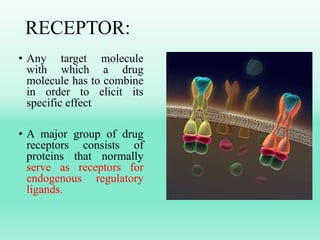
RECEPTOR:
• Any target molecule
with which a drug
molecule has to combine
in order to elicit its
specific effect
• A major group of drug
receptors consists of
proteins that normally
serve as receptors for
endogenous regulatory
ligands.
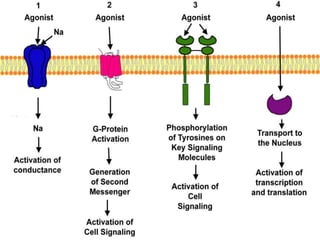
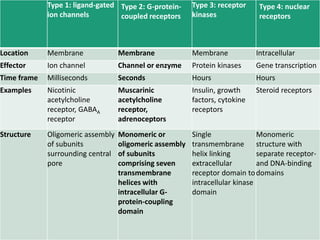
Type 1: ligand-gated
ion channels
Type 2: G-protein-
coupled receptors
Type 3: receptor
kinases
Type 4: nuclear
receptors
Location Membrane Membrane Membrane Intracellular
Effector Ion channel Channel or enzyme Protein kinases Gene transcription
Time frame Milliseconds Seconds Hours Hours
Examples Nicotinic
acetylcholine
receptor, GABAA
receptor
Muscarinic
acetylcholine
receptor,
adrenoceptors
Insulin, growth
factors, cytokine
receptors
Steroid receptors
Structure Oligomeric assembly
of subunits
surrounding central
pore
Monomeric or
oligomeric assembly
of subunits
comprising seven
transmembrane
helices with
intracellular G-
protein-coupling
domain
Single
transmembrane
helix linking
extracellular
receptor domain to
intracellular kinase
domain
Monomeric
structure with
separate receptor-
and DNA-binding
domains
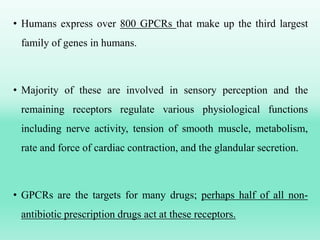
• Humans express over 800 GPCRs that make up the third largest
family of genes in humans.
• Majority of these are involved in sensory perception and the
remaining receptors regulate various physiological functions
including nerve activity, tension of smooth muscle, metabolism,
rate and force of cardiac contraction, and the glandular secretion.
• GPCRs are the targets for many drugs; perhaps half of all non-
antibiotic prescription drugs act at these receptors.
Netter’s illustrated pharmacology
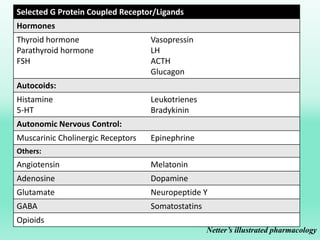
Selected G Protein Coupled Receptor/Ligands
Hormones
Thyroid hormone
Parathyroid hormone
FSH
Vasopressin
LH
ACTH
Glucagon
Autocoids:
Histamine
5-HT
Leukotrienes
Bradykinin
Autonomic Nervous Control:
Muscarinic Cholinergic Receptors Epinephrine
Others:
Angiotensin Melatonin
Adenosine Dopamine
Glutamate Neuropeptide Y
GABA Somatostatins
Opioids
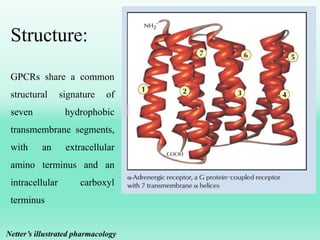
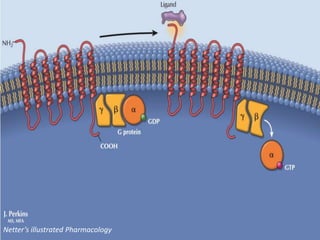
Structure:
GPCRs share a common
structural signature of
seven hydrophobic
transmembrane segments,
with an extracellular
amino terminus and an
intracellular carboxyl
terminus
Netter’s illustrated pharmacology
Netter’s illustrated Pharmacology
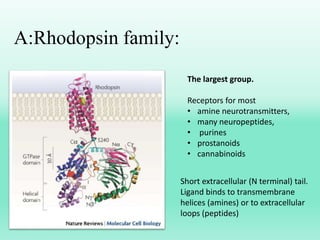
A:Rhodopsin family:
Short extracellular (N terminal) tail.
Ligand binds to transmembrane
helices (amines) or to extracellular
loops (peptides)
The largest group.
Receptors for most
• amine neurotransmitters,
• many neuropeptides,
• purines
• prostanoids
• cannabinoids
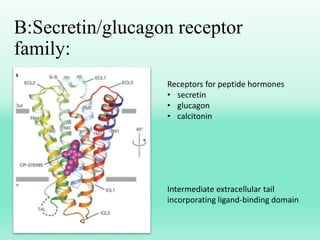
B:Secretin/glucagon receptor
family:
Receptors for peptide hormones
• secretin
• glucagon
• calcitonin
Intermediate extracellular tail
incorporating ligand-binding domain
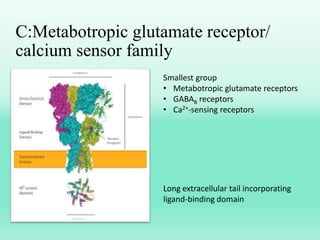
C:Metabotropic glutamate receptor/
calcium sensor family
Smallest group
• Metabotropic glutamate receptors
• GABAB receptors
• Ca2+-sensing receptors
Long extracellular tail incorporating
ligand-binding domain
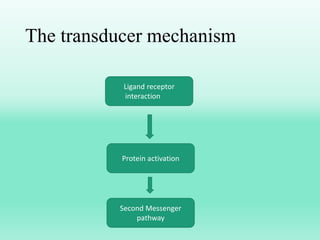
The transducer mechanism
Ligand receptor
interaction
Second Messenger
pathway
Protein activation
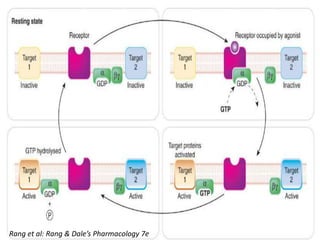
Rang et al: Rang & Dale’s Pharmacology 7e
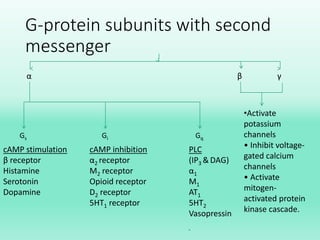
G-protein subunits with second
messenger
β γα
Gs Gi Gq
cAMP stimulation
β receptor
Histamine
Serotonin
Dopamine
cAMP inhibition
α2 receptor
M2 receptor
Opioid receptor
D2 receptor
5HT1 receptor
PLC
(IP3 & DAG)
α1
M1
AT1
5HT2
Vasopressin
•Activate
potassium
channels
• Inhibit voltage-
gated calcium
channels
• Activate
mitogen-
activated protein
kinase cascade.
The adenylyl cyclase system
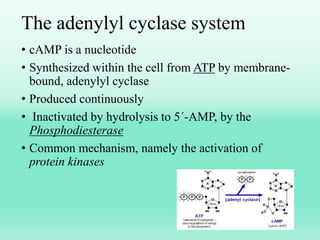
• cAMP is a nucleotide
• Synthesized within the cell from ATP by membrane-
bound, adenylyl cyclase
• Produced continuously
• Inactivated by hydrolysis to 5´-AMP, by the
Phosphodiesterase
• Common mechanism, namely the activation of
protein kinases
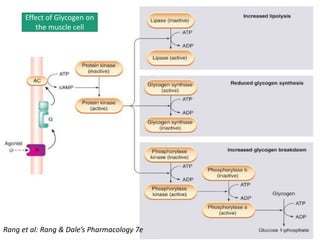
Effect of Glycogen on
the muscle cell
Rang et al: Rang & Dale’s Pharmacology 7e
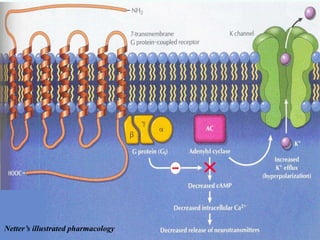
Netter’s illustrated pharmacology
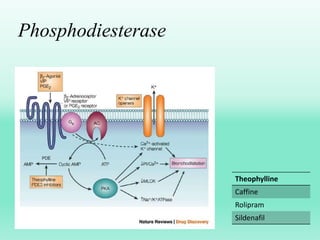
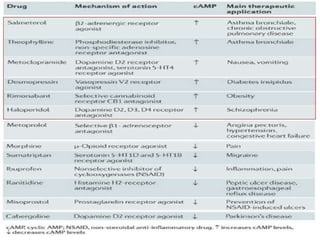
Phosphodiesterase
Theophylline
Caffine
Rolipram
Sildenafil
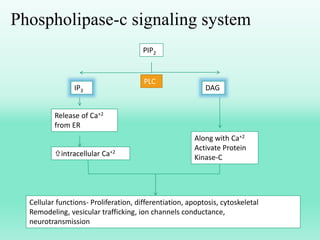
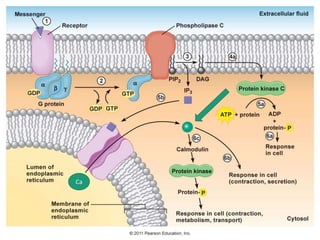
Phospholipase-c signaling system
PIP2
IP3 DAG
Release of Ca+2
from ER
intracellular Ca+2
Along with Ca+2
Activate Protein
Kinase-C
Cellular functions- Proliferation, differentiation, apoptosis, cytoskeletal
Remodeling, vesicular trafficking, ion channels conductance,
neurotransmission
PLC
C
Ca
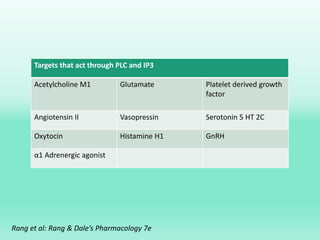
Targets that act through PLC and IP3
Acetylcholine M1 Glutamate Platelet derived growth
factor
Angiotensin II Vasopressin Serotonin 5 HT 2C
Oxytocin Histamine H1 GnRH
α1 Adrenergic agonist
Rang et al: Rang & Dale’s Pharmacology 7e
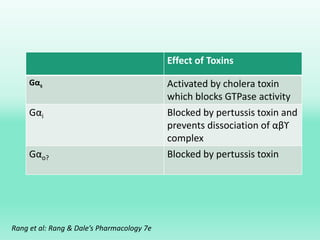
Effect of Toxins
Gαs Activated by cholera toxin
which blocks GTPase activity
Gαi Blocked by pertussis toxin and
prevents dissociation of αβϒ
complex
Gαo? Blocked by pertussis toxin
Rang et al: Rang & Dale’s Pharmacology 7e
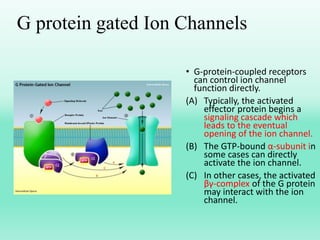
G protein gated Ion Channels
• G-protein-coupled receptors
can control ion channel
function directly.
(A) Typically, the activated
effector protein begins a
signaling cascade which
leads to the eventual
opening of the ion channel.
(B) The GTP-bound α-subunit in
some cases can directly
activate the ion channel.
(C) In other cases, the activated
βγ-complex of the G protein
may interact with the ion
channel.
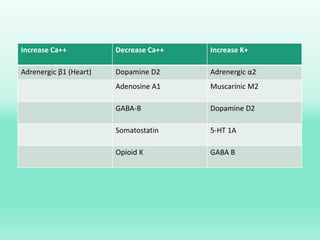
Increase Ca++ Decrease Ca++ Increase K+
Adrenergic β1 (Heart) Dopamine D2 Adrenergic α2
Adenosine A1 Muscarinic M2
GABA-B Dopamine D2
Somatostatin 5-HT 1A
Opioid K GABA B
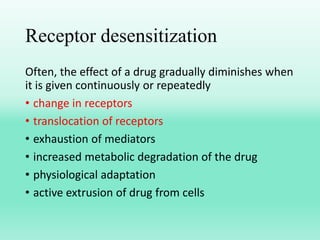
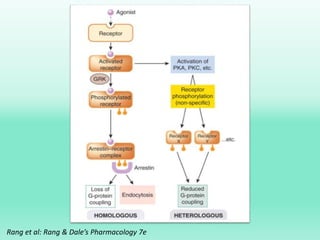
Receptor desensitization
Often, the effect of a drug gradually diminishes when
it is given continuously or repeatedly
• change in receptors
• translocation of receptors
• exhaustion of mediators
• increased metabolic degradation of the drug
• physiological adaptation
• active extrusion of drug from cells
Rang et al: Rang & Dale’s Pharmacology 7e
Recent advances
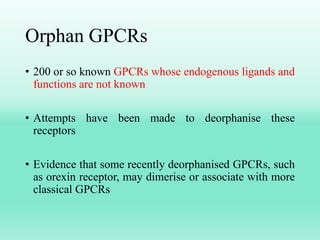
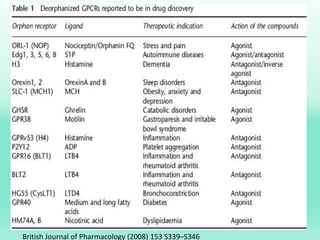
Orphan GPCRs
• 200 or so known GPCRs whose endogenous ligands and
functions are not known
• Attempts have been made to deorphanise these
receptors
• Evidence that some recently deorphanised GPCRs, such
as orexin receptor, may dimerise or associate with more
classical GPCRs
British Journal of Pharmacology (2008) 153 S339–S346
GPCR mutations, disease and
novel drug discovery
• Loss of function mutations in GPCRs involved in the control of
endocrine systems
• Gain of function mutations in GPCRs also cause disease
• Mutations in GPCRs could be responsible for variations in drug
sensitivities among different populations
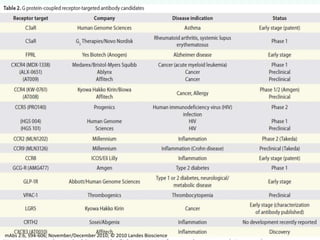
mAbs 2:6, 594-606; November/December 2010; © 2010 Landes Bioscience
G protein coupled receptor

G protein coupled receptor

  • 1.
  • 2.
    OVERVIEW: • WHAT ARERECEPTORS • TYPES OF RECEPTORS • G PROTEIN COUPLED RECEPTORS • STRUCTURE OF GPCR • SINGNAL TRANSDUCER MECHANISM • SECOND MESSENGERS • RECENT ADVANCES
  • 3.
    RECEPTOR: • Any targetmolecule with which a drug molecule has to combine in order to elicit its specific effect • A major group of drug receptors consists of proteins that normally serve as receptors for endogenous regulatory ligands.
  • 5.
    Type 1: ligand-gated ionchannels Type 2: G-protein- coupled receptors Type 3: receptor kinases Type 4: nuclear receptors Location Membrane Membrane Membrane Intracellular Effector Ion channel Channel or enzyme Protein kinases Gene transcription Time frame Milliseconds Seconds Hours Hours Examples Nicotinic acetylcholine receptor, GABAA receptor Muscarinic acetylcholine receptor, adrenoceptors Insulin, growth factors, cytokine receptors Steroid receptors Structure Oligomeric assembly of subunits surrounding central pore Monomeric or oligomeric assembly of subunits comprising seven transmembrane helices with intracellular G- protein-coupling domain Single transmembrane helix linking extracellular receptor domain to intracellular kinase domain Monomeric structure with separate receptor- and DNA-binding domains
  • 6.
    • Humans expressover 800 GPCRs that make up the third largest family of genes in humans. • Majority of these are involved in sensory perception and the remaining receptors regulate various physiological functions including nerve activity, tension of smooth muscle, metabolism, rate and force of cardiac contraction, and the glandular secretion. • GPCRs are the targets for many drugs; perhaps half of all non- antibiotic prescription drugs act at these receptors.
  • 7.
    Netter’s illustrated pharmacology SelectedG Protein Coupled Receptor/Ligands Hormones Thyroid hormone Parathyroid hormone FSH Vasopressin LH ACTH Glucagon Autocoids: Histamine 5-HT Leukotrienes Bradykinin Autonomic Nervous Control: Muscarinic Cholinergic Receptors Epinephrine Others: Angiotensin Melatonin Adenosine Dopamine Glutamate Neuropeptide Y GABA Somatostatins Opioids
  • 8.
    Structure: GPCRs share acommon structural signature of seven hydrophobic transmembrane segments, with an extracellular amino terminus and an intracellular carboxyl terminus Netter’s illustrated pharmacology
  • 9.
  • 10.
    A:Rhodopsin family: Short extracellular(N terminal) tail. Ligand binds to transmembrane helices (amines) or to extracellular loops (peptides) The largest group. Receptors for most • amine neurotransmitters, • many neuropeptides, • purines • prostanoids • cannabinoids
  • 11.
    B:Secretin/glucagon receptor family: Receptors forpeptide hormones • secretin • glucagon • calcitonin Intermediate extracellular tail incorporating ligand-binding domain
  • 12.
    C:Metabotropic glutamate receptor/ calciumsensor family Smallest group • Metabotropic glutamate receptors • GABAB receptors • Ca2+-sensing receptors Long extracellular tail incorporating ligand-binding domain
  • 13.
    The transducer mechanism Ligandreceptor interaction Second Messenger pathway Protein activation
  • 14.
    Rang et al:Rang & Dale’s Pharmacology 7e
  • 15.
    G-protein subunits withsecond messenger β γα Gs Gi Gq cAMP stimulation β receptor Histamine Serotonin Dopamine cAMP inhibition α2 receptor M2 receptor Opioid receptor D2 receptor 5HT1 receptor PLC (IP3 & DAG) α1 M1 AT1 5HT2 Vasopressin •Activate potassium channels • Inhibit voltage- gated calcium channels • Activate mitogen- activated protein kinase cascade.
  • 17.
    The adenylyl cyclasesystem • cAMP is a nucleotide • Synthesized within the cell from ATP by membrane- bound, adenylyl cyclase • Produced continuously • Inactivated by hydrolysis to 5´-AMP, by the Phosphodiesterase • Common mechanism, namely the activation of protein kinases
  • 18.
    Effect of Glycogenon the muscle cell Rang et al: Rang & Dale’s Pharmacology 7e
  • 19.
  • 20.
  • 22.
    Phospholipase-c signaling system PIP2 IP3DAG Release of Ca+2 from ER intracellular Ca+2 Along with Ca+2 Activate Protein Kinase-C Cellular functions- Proliferation, differentiation, apoptosis, cytoskeletal Remodeling, vesicular trafficking, ion channels conductance, neurotransmission PLC
  • 23.
  • 24.
    Targets that actthrough PLC and IP3 Acetylcholine M1 Glutamate Platelet derived growth factor Angiotensin II Vasopressin Serotonin 5 HT 2C Oxytocin Histamine H1 GnRH α1 Adrenergic agonist Rang et al: Rang & Dale’s Pharmacology 7e
  • 25.
    Effect of Toxins GαsActivated by cholera toxin which blocks GTPase activity Gαi Blocked by pertussis toxin and prevents dissociation of αβϒ complex Gαo? Blocked by pertussis toxin Rang et al: Rang & Dale’s Pharmacology 7e
  • 26.
    G protein gatedIon Channels • G-protein-coupled receptors can control ion channel function directly. (A) Typically, the activated effector protein begins a signaling cascade which leads to the eventual opening of the ion channel. (B) The GTP-bound α-subunit in some cases can directly activate the ion channel. (C) In other cases, the activated βγ-complex of the G protein may interact with the ion channel.
  • 27.
    Increase Ca++ DecreaseCa++ Increase K+ Adrenergic β1 (Heart) Dopamine D2 Adrenergic α2 Adenosine A1 Muscarinic M2 GABA-B Dopamine D2 Somatostatin 5-HT 1A Opioid K GABA B
  • 28.
    Receptor desensitization Often, theeffect of a drug gradually diminishes when it is given continuously or repeatedly • change in receptors • translocation of receptors • exhaustion of mediators • increased metabolic degradation of the drug • physiological adaptation • active extrusion of drug from cells
  • 29.
    Rang et al:Rang & Dale’s Pharmacology 7e
  • 30.
  • 31.
    Orphan GPCRs • 200or so known GPCRs whose endogenous ligands and functions are not known • Attempts have been made to deorphanise these receptors • Evidence that some recently deorphanised GPCRs, such as orexin receptor, may dimerise or associate with more classical GPCRs
  • 32.
    British Journal ofPharmacology (2008) 153 S339–S346
  • 33.
    GPCR mutations, diseaseand novel drug discovery • Loss of function mutations in GPCRs involved in the control of endocrine systems • Gain of function mutations in GPCRs also cause disease • Mutations in GPCRs could be responsible for variations in drug sensitivities among different populations
  • 34.
    mAbs 2:6, 594-606;November/December 2010; © 2010 Landes Bioscience

Editor's Notes

  • #16 βγ-mediated effects occur at higher levels of receptor occupancy than α-mediated effects otherwise the action of it is same to alpha
  • #19 These varied effects are, however, all brought about by a common mechanism, namely the activation of protein kinases by cAMP. Protein kinases regulate the function of many different cellular proteins by controlling protein phosphorylation
  • #23 An intracellular enzyme play an imp. Role in signal transduction participate in phosphatidylinositol 4,5-bisphosphonate(PIP2) and lipid signaling in a calcium dependent manner.