
Presented by: Megh Vithalkar
Roll No: 07
1st Year M.Pharm
Department of Pharmacology
Goa College of Pharmacy
1
Contents
Introduction.
What is JAK and STAT.
Components of JAK and STAT.
JAK-STAT pathway.
Negative Regulation.
Clinical Significance.
Drug Targeting JAK-STAT pathway.
References.
2
Introduction
The JAK-STAT signalling pathway is a chain of
interactions between proteins in a cell, and is involved in
processes such as immunity, cell division, cell death and
tumour formation.
This pathway communicates information from chemical
signals outside of a cell to the cell nucleus, resulting in the
activation of genes through a process called transcription.
The large family of cytokine receptors includes receptors
for many kinds of local mediators (collectively called
cytokines), as well as receptors for some hormones, such
as growth hormone and prolactin.
3
These receptors are stably associated with cytoplasmic
tyrosine kinases called Janus kinases (JAKs) (after the two-
faced Roman god), which phosphorylate and activate
transcription regulators called STATs (signal transducers and
activators of transcription).
STAT proteins are located in the cytosol and are referred to as
latent transcription regulators because they migrate into the
nucleus and regulate gene transcription only after they are
activated.
Hence the three key parts of JAK-STAT signalling are:
1. Janus kinases (JAKs),
2. Signal transducer and activator of transcription proteins
(STATs), and
3. Receptors (which bind the chemical signals).
4
What is JAK ?
Full form- Janus Kinase.
It is a Intracellular protein kinase.
Protein kinases catalyse the transfer of phosphate from
ATP (or GTP) to its protein substrates or ligand molecule.
Four member family- Jak1, Jak2, Jak3 and Tyrosine
kinase 2 (Tyk2).
This protein kinase interacts with another protein called
STAT to bring about cell signalling.
5
Primary structure of JAK
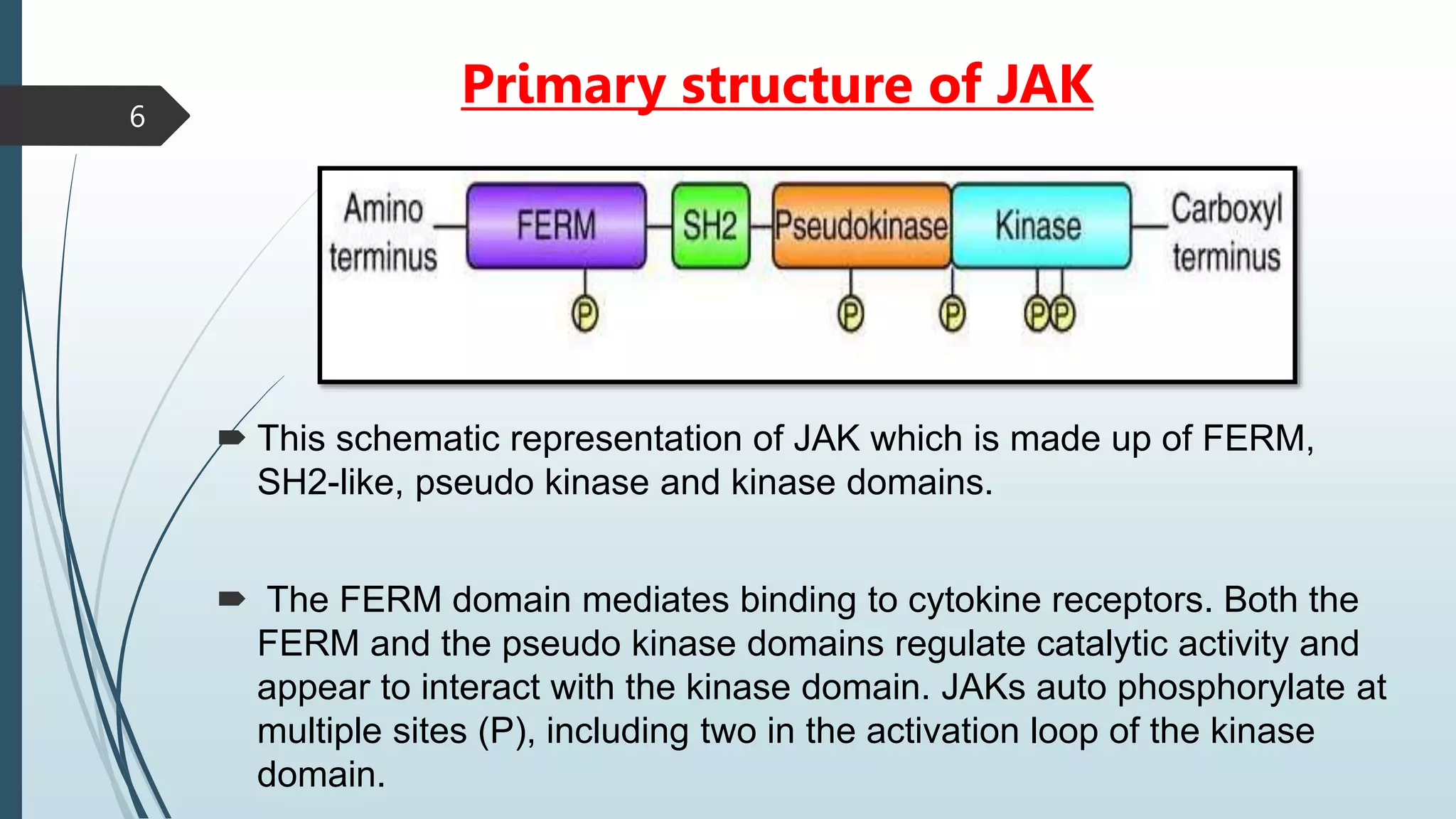
 This schematic representation of JAK which is made up of FERM,
SH2-like, pseudo kinase and kinase domains.
 The FERM domain mediates binding to cytokine receptors. Both the
FERM and the pseudo kinase domains regulate catalytic activity and
appear to interact with the kinase domain. JAKs auto phosphorylate at
multiple sites (P), including two in the activation loop of the kinase
domain.
6
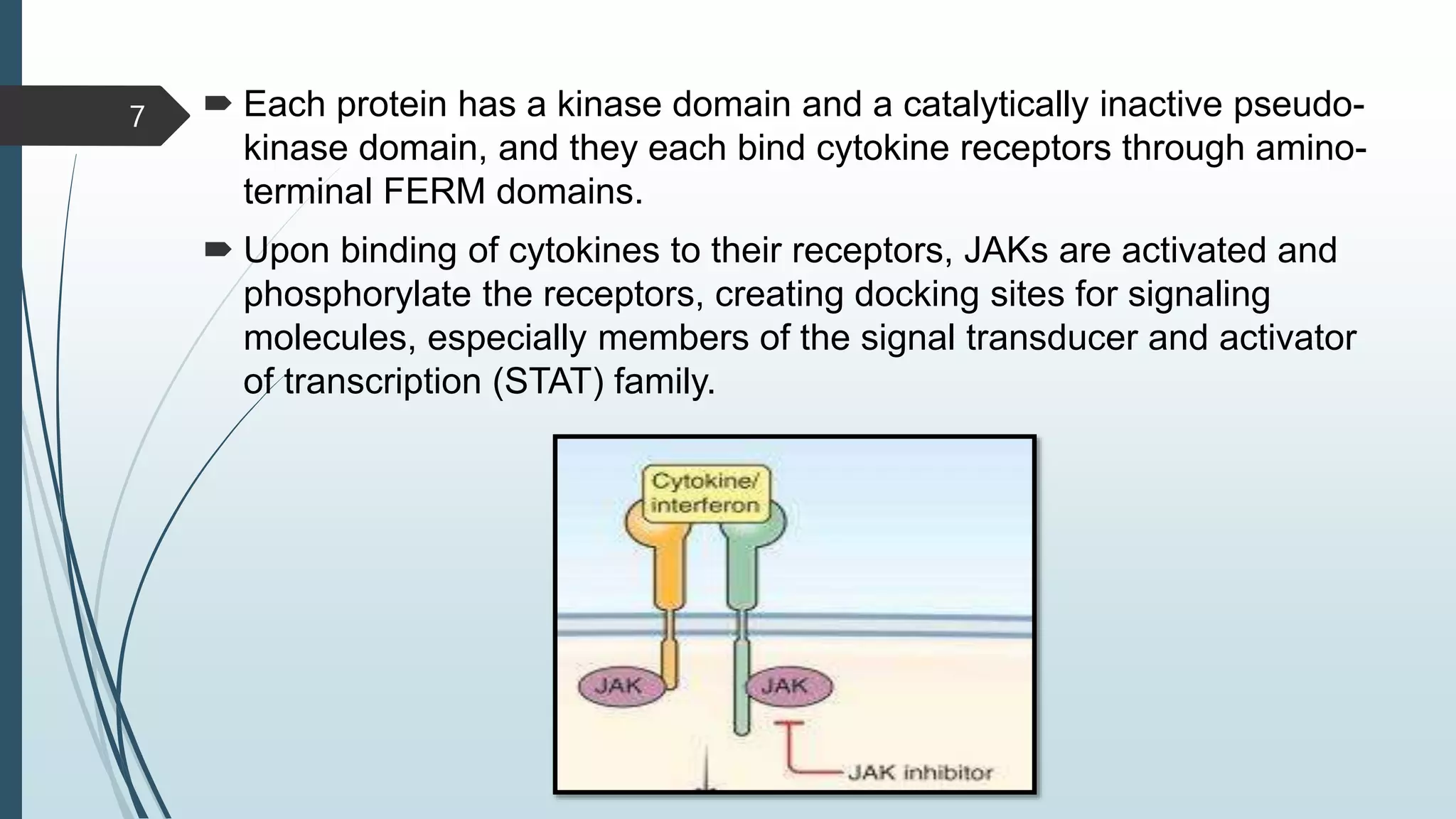
 Each protein has a kinase domain and a catalytically inactive pseudo-
kinase domain, and they each bind cytokine receptors through amino-
terminal FERM domains.
 Upon binding of cytokines to their receptors, JAKs are activated and
phosphorylate the receptors, creating docking sites for signaling
molecules, especially members of the signal transducer and activator
of transcription (STAT) family.
7
JAK Inhibitors
How Do JAK Inhibitors Work?
1. Stop activity and response of one or more JAK
enzymes.
2. JAK inhibitors block JAK enzymes to halt autoimmune
process.
3. Block messages coming from cytokines (proteins that
promote inflammation.
4. JAK inhibitors calm over reactive immune system.
5. Therefore used in Treatment of various Auto immune
disorders.
8
What is STAT ?
Full form- Signal Transducer and Activator of
Transcription.
These protein’s biological activities ultimately regulate
many critical aspects of cell growth, survival and
differentiation.
Family of STAT proteins – STAT1, STAT2, STAT3,
STAT4, STAT5 (A &B) and STAT6.
These proteins are only translocated to the nucleus
upon JAK-mediated phosphorylation and dimerization
following cytokine-induced activation of JAKs.
9
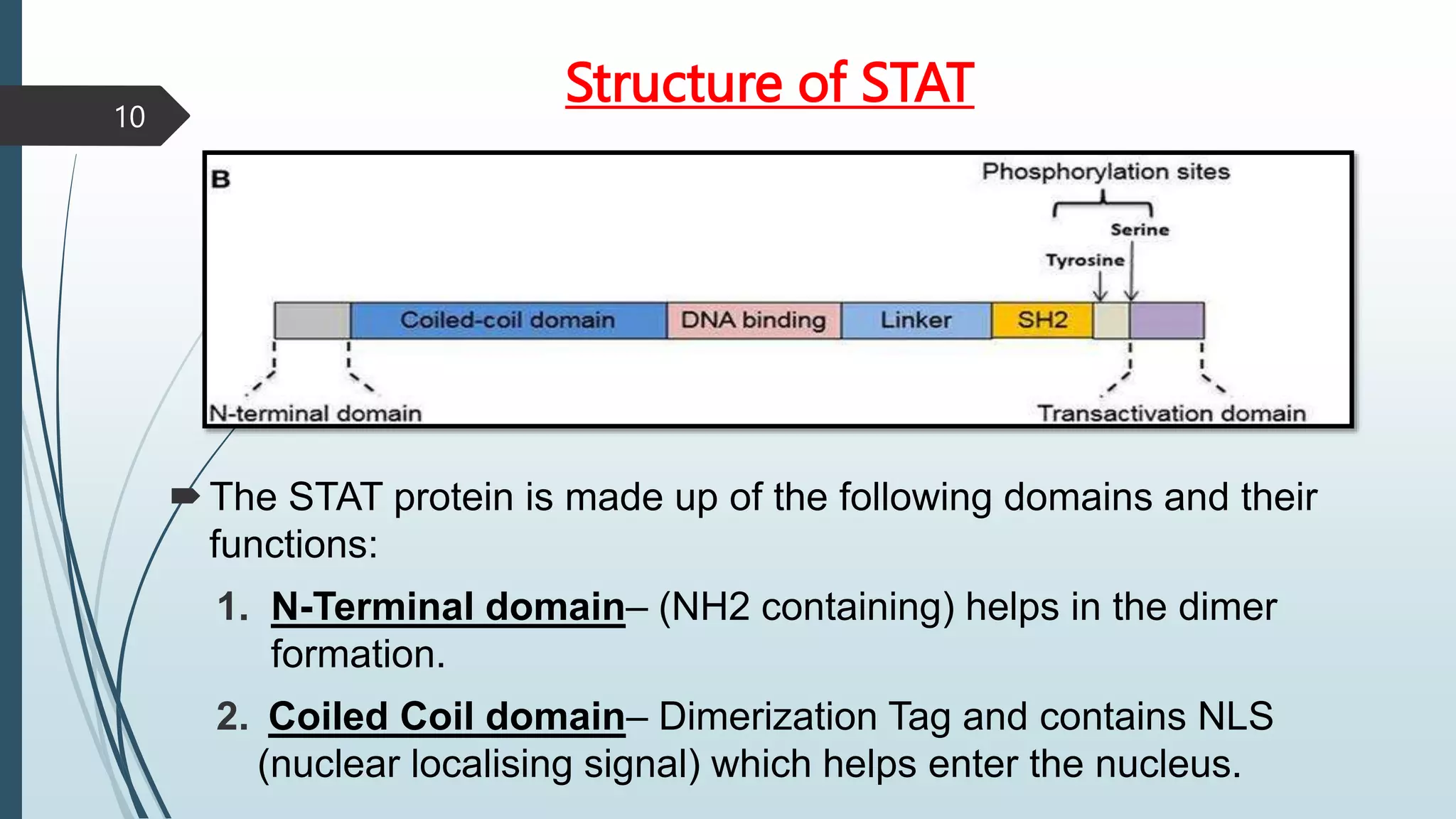
Structure of STAT
The STAT protein is made up of the following domains and their
functions:
1. N-Terminal domain– (NH2 containing) helps in the dimer
formation.
2. Coiled Coil domain– Dimerization Tag and contains NLS
(nuclear localising signal) which helps enter the nucleus.
10
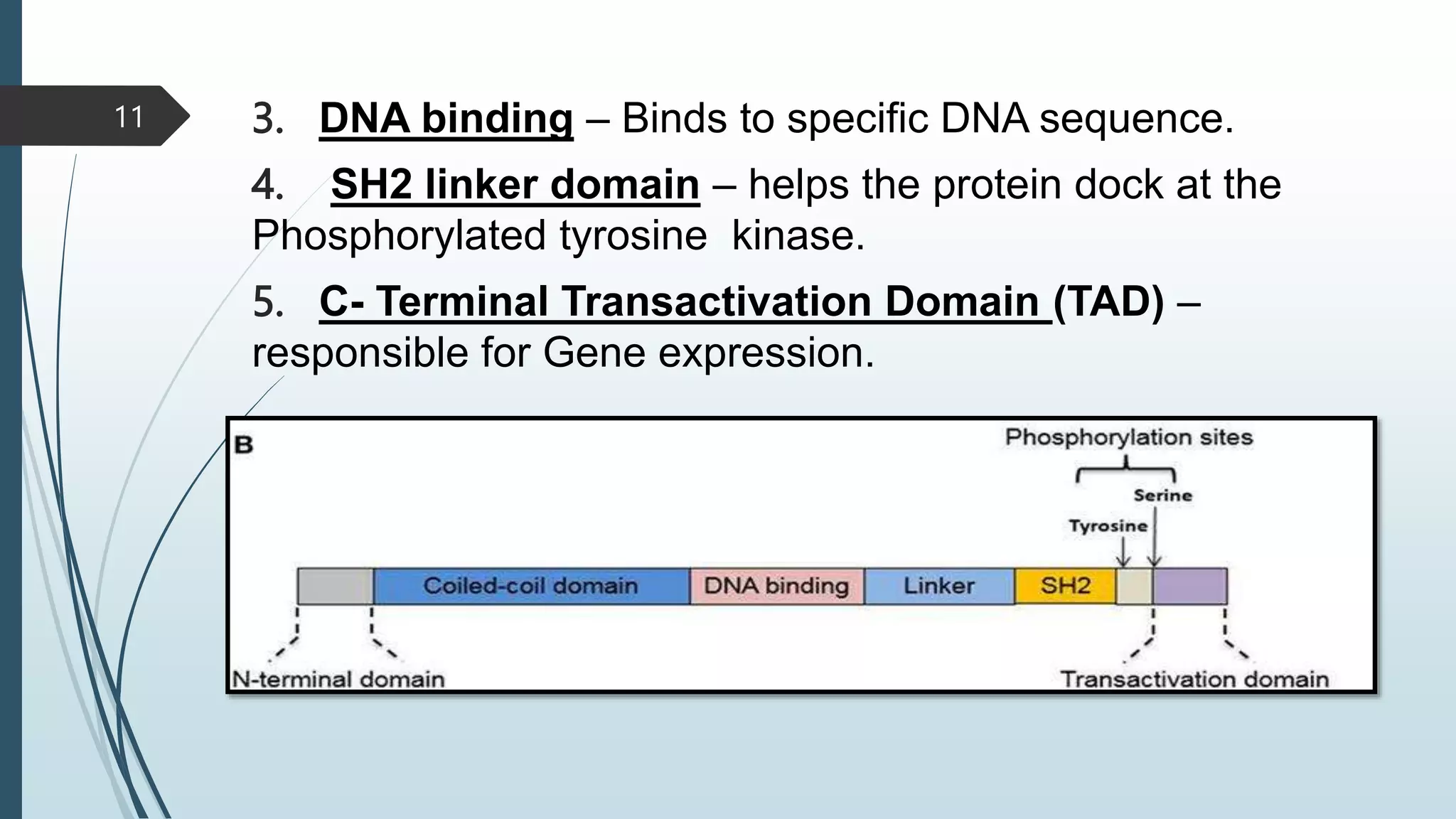
3. DNA binding – Binds to specific DNA sequence.
4. SH2 linker domain – helps the protein dock at the
Phosphorylated tyrosine kinase.
5. C- Terminal Transactivation Domain (TAD) –
responsible for Gene expression.
11
JAK-STAT Pathway
This pathway has a central role in the signalling of
cytokines by regulating cell proliferation, survival,
differentiation and immune response.
The Janus kinase and signal transducer and activator of
transcription (JAK-STAT) pathway is utilized by cytokines
including interleukins, interferons (IFNs), and other
molecules to transmit signals from the cell membrane to
the nucleus.
12
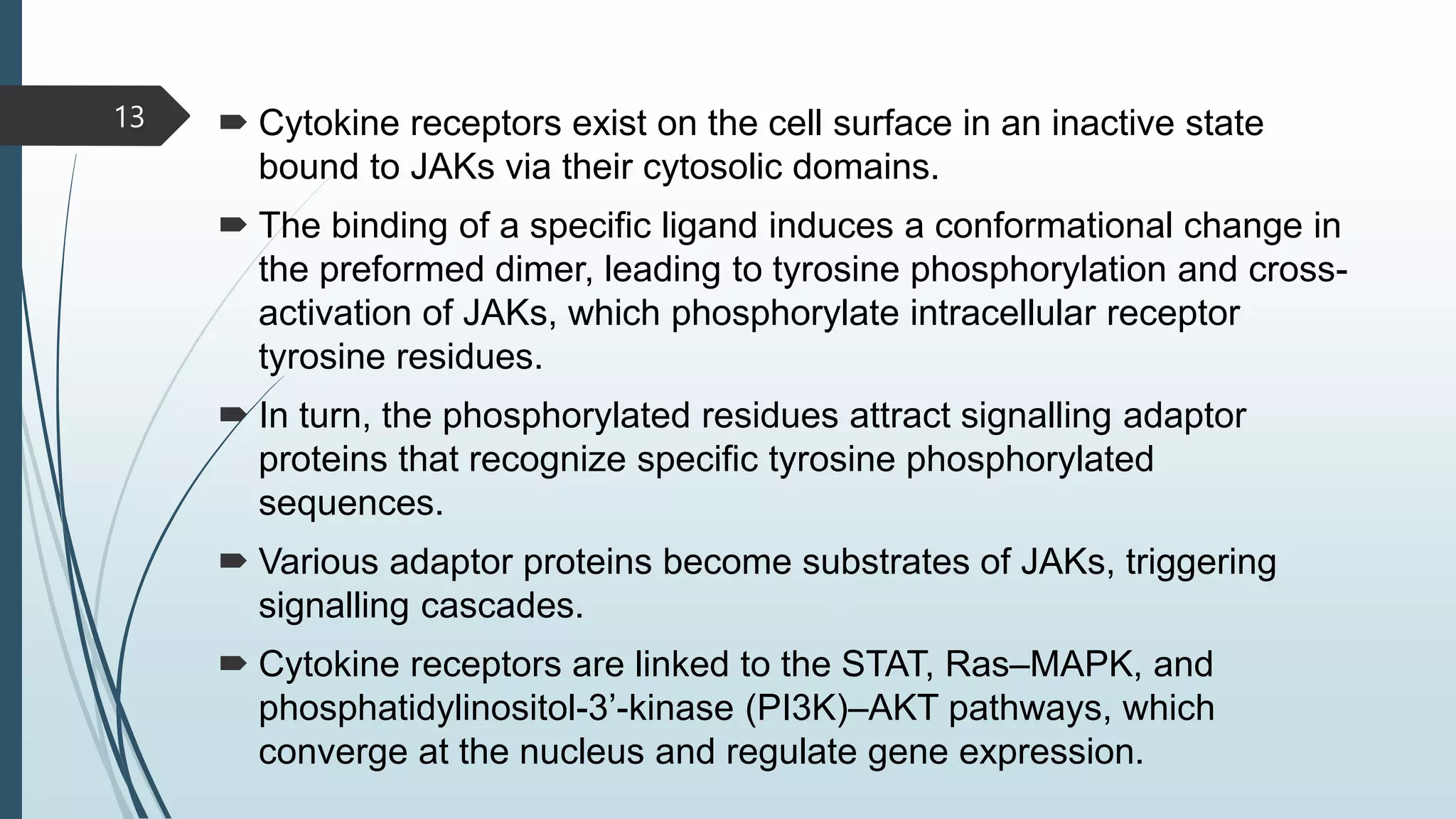
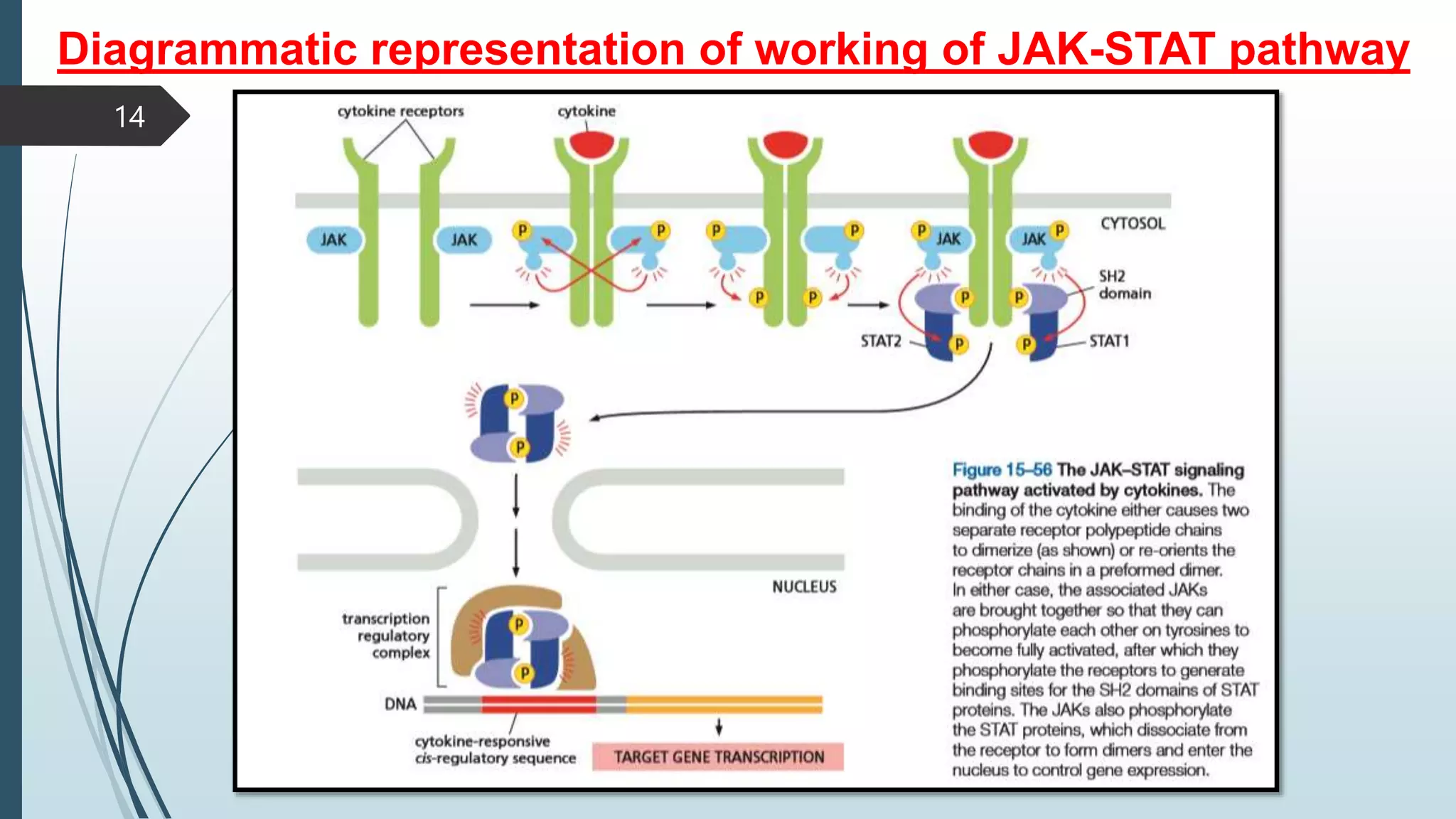
 Cytokine receptors exist on the cell surface in an inactive state
bound to JAKs via their cytosolic domains.
 The binding of a specific ligand induces a conformational change in
the preformed dimer, leading to tyrosine phosphorylation and cross-
activation of JAKs, which phosphorylate intracellular receptor
tyrosine residues.
 In turn, the phosphorylated residues attract signalling adaptor
proteins that recognize specific tyrosine phosphorylated
sequences.
 Various adaptor proteins become substrates of JAKs, triggering
signalling cascades.
 Cytokine receptors are linked to the STAT, Ras–MAPK, and
phosphatidylinositol-3’-kinase (PI3K)–AKT pathways, which
converge at the nucleus and regulate gene expression.
13
Diagrammatic representation of working of JAK-STAT pathway
14
15
Negative Regulation
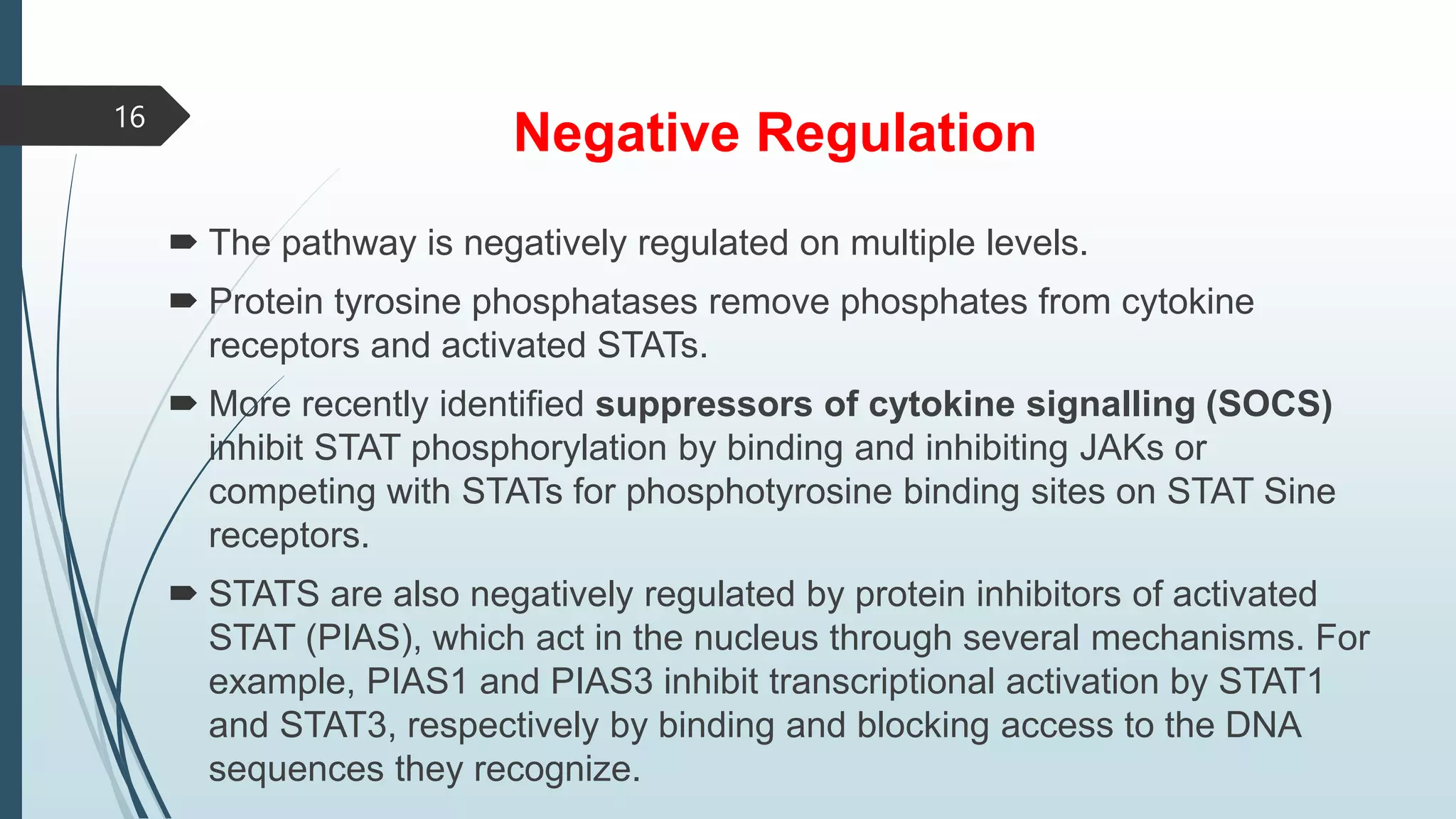
 The pathway is negatively regulated on multiple levels.
 Protein tyrosine phosphatases remove phosphates from cytokine
receptors and activated STATs.
 More recently identified suppressors of cytokine signalling (SOCS)
inhibit STAT phosphorylation by binding and inhibiting JAKs or
competing with STATs for phosphotyrosine binding sites on STAT Sine
receptors.
 STATS are also negatively regulated by protein inhibitors of activated
STAT (PIAS), which act in the nucleus through several mechanisms. For
example, PIAS1 and PIAS3 inhibit transcriptional activation by STAT1
and STAT3, respectively by binding and blocking access to the DNA
sequences they recognize.
16
Clinical Significance
Disrupted or dysregulated JAK-STAT functionality
can result in immune deficiency syndrome and
cancer.
Over activation of the JAK-STAT pathway can cause
cancer by passing apoptosis and cell cycle
checkpoints.
17
Drugs targeting the JAK-STAT pathway
Drugs that target the JAK-STAT pathway are used to turn down
the immune response.
One type of drug that has been approved by the FDA is a cytokine
receptor blocker derived from a monoclonal antibody. Because it is
a protein, this type of drug needs to be injected. An example is
Basiliximab, which is used to prevent transplant rejection.
Basiliximab binds to the IL-2 receptor.
Tofacitinib is a JAK inhibitor that has been approved for the
treatment of rheumatoid arthritis. An advantage of JAK inhibitors
over receptor blocking drugs is that they are small molecule drugs
that can be taken orally.
18
References
“MOLECULAR BIOLOGY OF THE CELL”
By: Bruce Alberts, Alexander Johnson, Julian Lewis, David Morgan, Martin Raff, Keith
Roberts and Peter Walter
Sixth Edition, pp. 863-865
WEBSITES:
 JAK Protein:
https://www.ncbi.nlm.nih.gov/pmc/articles/PMC545791/#!po=1.11111
 STAT Protein:
https://www.ncbi.nlm.nih.gov/pmc/articles/PMC1782085/
 https://www.nature.com/articles/onc2012347
19
20

JAK-STAT Signalling Pathway

  • 1.
    Presented by: MeghVithalkar Roll No: 07 1st Year M.Pharm Department of Pharmacology Goa College of Pharmacy 1
  • 2.
    Contents Introduction. What is JAKand STAT. Components of JAK and STAT. JAK-STAT pathway. Negative Regulation. Clinical Significance. Drug Targeting JAK-STAT pathway. References. 2
  • 3.
    Introduction The JAK-STAT signallingpathway is a chain of interactions between proteins in a cell, and is involved in processes such as immunity, cell division, cell death and tumour formation. This pathway communicates information from chemical signals outside of a cell to the cell nucleus, resulting in the activation of genes through a process called transcription. The large family of cytokine receptors includes receptors for many kinds of local mediators (collectively called cytokines), as well as receptors for some hormones, such as growth hormone and prolactin. 3
  • 4.
    These receptors arestably associated with cytoplasmic tyrosine kinases called Janus kinases (JAKs) (after the two- faced Roman god), which phosphorylate and activate transcription regulators called STATs (signal transducers and activators of transcription). STAT proteins are located in the cytosol and are referred to as latent transcription regulators because they migrate into the nucleus and regulate gene transcription only after they are activated. Hence the three key parts of JAK-STAT signalling are: 1. Janus kinases (JAKs), 2. Signal transducer and activator of transcription proteins (STATs), and 3. Receptors (which bind the chemical signals). 4
  • 5.
    What is JAK? Full form- Janus Kinase. It is a Intracellular protein kinase. Protein kinases catalyse the transfer of phosphate from ATP (or GTP) to its protein substrates or ligand molecule. Four member family- Jak1, Jak2, Jak3 and Tyrosine kinase 2 (Tyk2). This protein kinase interacts with another protein called STAT to bring about cell signalling. 5
  • 6.
    Primary structure ofJAK  This schematic representation of JAK which is made up of FERM, SH2-like, pseudo kinase and kinase domains.  The FERM domain mediates binding to cytokine receptors. Both the FERM and the pseudo kinase domains regulate catalytic activity and appear to interact with the kinase domain. JAKs auto phosphorylate at multiple sites (P), including two in the activation loop of the kinase domain. 6
  • 7.
     Each proteinhas a kinase domain and a catalytically inactive pseudo- kinase domain, and they each bind cytokine receptors through amino- terminal FERM domains.  Upon binding of cytokines to their receptors, JAKs are activated and phosphorylate the receptors, creating docking sites for signaling molecules, especially members of the signal transducer and activator of transcription (STAT) family. 7
  • 8.
    JAK Inhibitors How DoJAK Inhibitors Work? 1. Stop activity and response of one or more JAK enzymes. 2. JAK inhibitors block JAK enzymes to halt autoimmune process. 3. Block messages coming from cytokines (proteins that promote inflammation. 4. JAK inhibitors calm over reactive immune system. 5. Therefore used in Treatment of various Auto immune disorders. 8
  • 9.
    What is STAT? Full form- Signal Transducer and Activator of Transcription. These protein’s biological activities ultimately regulate many critical aspects of cell growth, survival and differentiation. Family of STAT proteins – STAT1, STAT2, STAT3, STAT4, STAT5 (A &B) and STAT6. These proteins are only translocated to the nucleus upon JAK-mediated phosphorylation and dimerization following cytokine-induced activation of JAKs. 9
  • 10.
    Structure of STAT TheSTAT protein is made up of the following domains and their functions: 1. N-Terminal domain– (NH2 containing) helps in the dimer formation. 2. Coiled Coil domain– Dimerization Tag and contains NLS (nuclear localising signal) which helps enter the nucleus. 10
  • 11.
    3. DNA binding– Binds to specific DNA sequence. 4. SH2 linker domain – helps the protein dock at the Phosphorylated tyrosine kinase. 5. C- Terminal Transactivation Domain (TAD) – responsible for Gene expression. 11
  • 12.
    JAK-STAT Pathway This pathwayhas a central role in the signalling of cytokines by regulating cell proliferation, survival, differentiation and immune response. The Janus kinase and signal transducer and activator of transcription (JAK-STAT) pathway is utilized by cytokines including interleukins, interferons (IFNs), and other molecules to transmit signals from the cell membrane to the nucleus. 12
  • 13.
     Cytokine receptorsexist on the cell surface in an inactive state bound to JAKs via their cytosolic domains.  The binding of a specific ligand induces a conformational change in the preformed dimer, leading to tyrosine phosphorylation and cross- activation of JAKs, which phosphorylate intracellular receptor tyrosine residues.  In turn, the phosphorylated residues attract signalling adaptor proteins that recognize specific tyrosine phosphorylated sequences.  Various adaptor proteins become substrates of JAKs, triggering signalling cascades.  Cytokine receptors are linked to the STAT, Ras–MAPK, and phosphatidylinositol-3’-kinase (PI3K)–AKT pathways, which converge at the nucleus and regulate gene expression. 13
  • 14.
    Diagrammatic representation ofworking of JAK-STAT pathway 14
  • 15.
  • 16.
    Negative Regulation  Thepathway is negatively regulated on multiple levels.  Protein tyrosine phosphatases remove phosphates from cytokine receptors and activated STATs.  More recently identified suppressors of cytokine signalling (SOCS) inhibit STAT phosphorylation by binding and inhibiting JAKs or competing with STATs for phosphotyrosine binding sites on STAT Sine receptors.  STATS are also negatively regulated by protein inhibitors of activated STAT (PIAS), which act in the nucleus through several mechanisms. For example, PIAS1 and PIAS3 inhibit transcriptional activation by STAT1 and STAT3, respectively by binding and blocking access to the DNA sequences they recognize. 16
  • 17.
    Clinical Significance Disrupted ordysregulated JAK-STAT functionality can result in immune deficiency syndrome and cancer. Over activation of the JAK-STAT pathway can cause cancer by passing apoptosis and cell cycle checkpoints. 17
  • 18.
    Drugs targeting theJAK-STAT pathway Drugs that target the JAK-STAT pathway are used to turn down the immune response. One type of drug that has been approved by the FDA is a cytokine receptor blocker derived from a monoclonal antibody. Because it is a protein, this type of drug needs to be injected. An example is Basiliximab, which is used to prevent transplant rejection. Basiliximab binds to the IL-2 receptor. Tofacitinib is a JAK inhibitor that has been approved for the treatment of rheumatoid arthritis. An advantage of JAK inhibitors over receptor blocking drugs is that they are small molecule drugs that can be taken orally. 18
  • 19.
    References “MOLECULAR BIOLOGY OFTHE CELL” By: Bruce Alberts, Alexander Johnson, Julian Lewis, David Morgan, Martin Raff, Keith Roberts and Peter Walter Sixth Edition, pp. 863-865 WEBSITES:  JAK Protein: https://www.ncbi.nlm.nih.gov/pmc/articles/PMC545791/#!po=1.11111  STAT Protein: https://www.ncbi.nlm.nih.gov/pmc/articles/PMC1782085/  https://www.nature.com/articles/onc2012347 19
  • 20.