PEPTIC ULCER
Mujahid Nadeem (13612)
Ali Raza (13621)
ArslanTahir (13635)
Ansar Ali Raza (13665)
CONTENTS
 INTRODUCTION
 TYPES
 ETIOLOGY
 PATHOGENESIS
INTRODUCTION
INTRODUCTION
Ulcer
 An ulcer is a discontinuity or break in a bodily
membrane that impedes the organ of which
that membrane is a part from continuing its
normal functions.
Types of Ulcers
Peptic ulcer
i. Esophageal ulcer
ii. Duodenal ulcer
iii. Gastric ulcer
Pressure ulcer
Genital ulcer
Ulcerative dermatitis
Anal fissure
Diabetic foot ulcer
Types of Ulcers (Cont.)
Corneal ulcer
Mouth ulcer
Venous ulcer
Stress ulcer
Ulcerative sarcoidosis
Ulcerative lichen planus
Ulcerative colitis
Ulcerative disposition
Peptic Ulcer
 Also known as “peptic ulcer disease” (PUD)
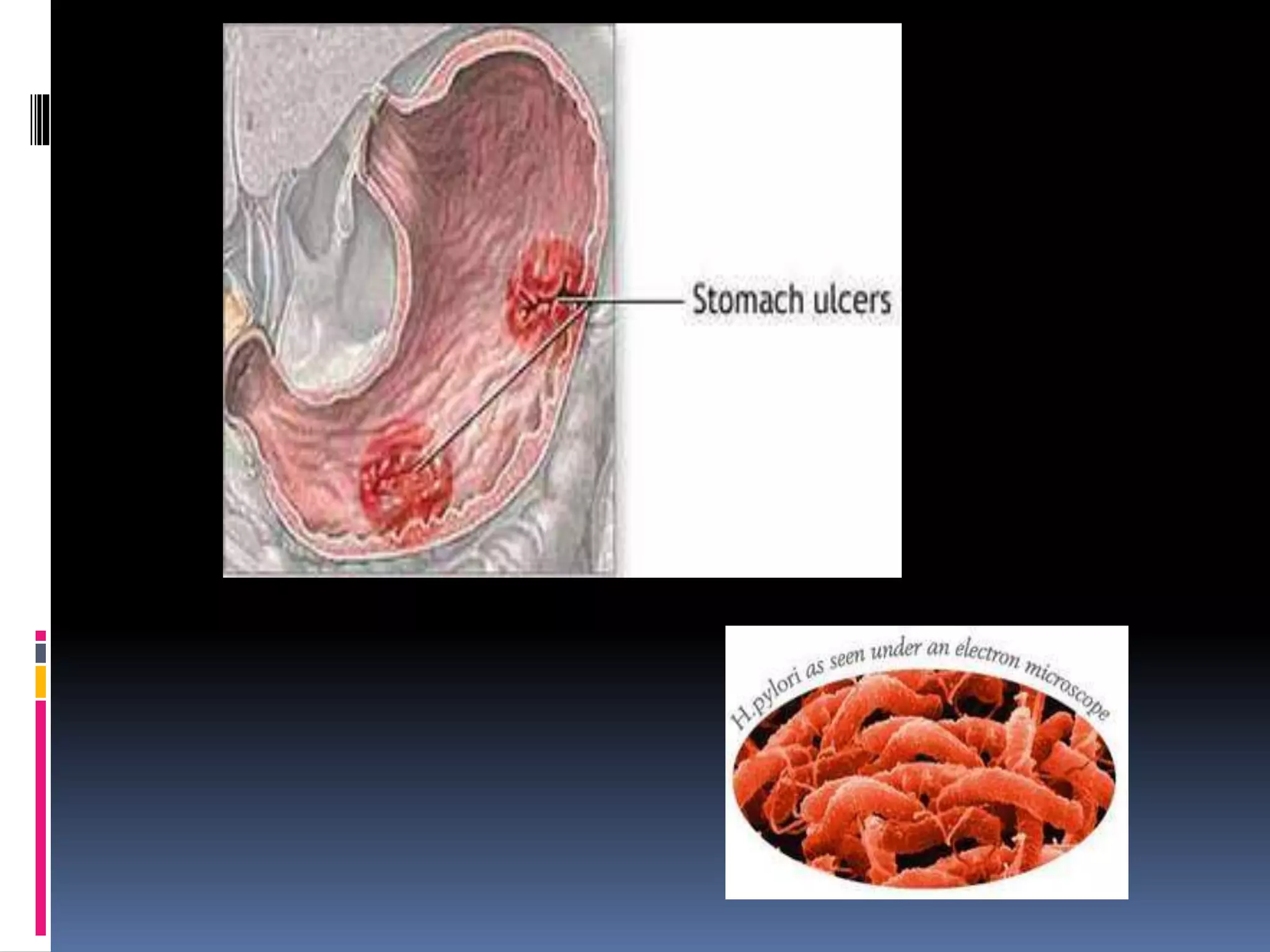
 Peptic ulcer is a break in the lining of the
stomach, first part of the small intestine, or
occasionally the lower esophagus.
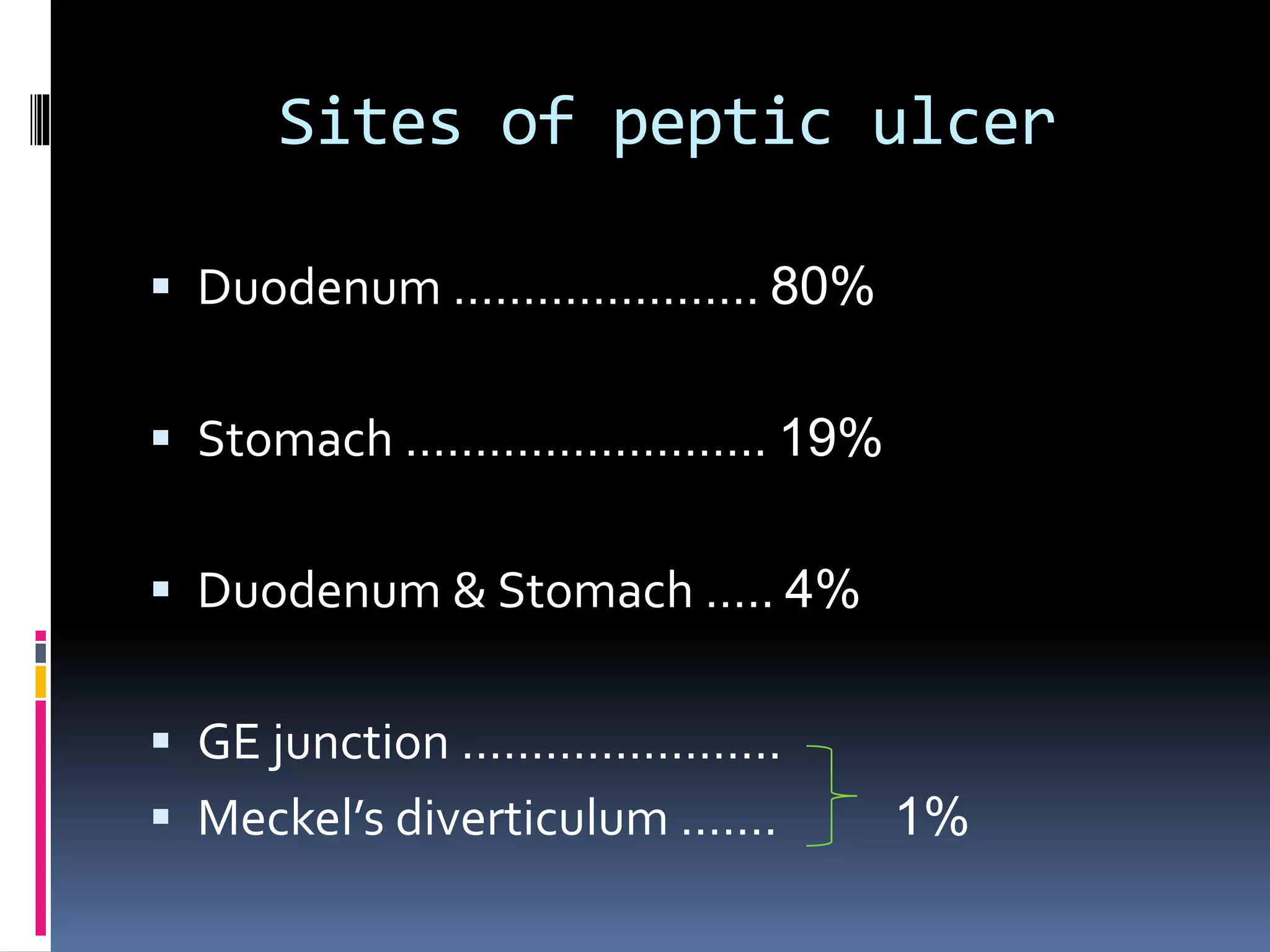
Sites of peptic ulcer
 Duodenum …………….…… 80%
 Stomach …………………….. 19%
 Duodenum & Stomach ….. 4%
 GE junction …………………..
 Meckel’s diverticulum ……. 1%
Occurrence of peptic ulcer
 Serious medical problem
 Approx. 500,000 new cases each year
 5M people affected in USA only
 Mostly occur between 55 ot 65 years of age
 Duodenal ulcer more common in men than
women
 Gastric ulcer more common in women than
men
Occurrence of peptic ulcer
(Cont.)
 Duodenal ulcers are four times more
common than gastric ulcers
 Mortality rates from peptic ulcer are low
 High prevalence
 One of several upper GIT diseases that is
caused ,partially, by gastric acid
 Wide range of symptoms
Symptoms
Abdominal pain
• Located in epigastric area
• Burning in quality
• Occur on an empty stomach 2-4 hours after
meal or at night (nocturnal pain)
• Relieved by antacids
• Tend to wax and wane over months
Symptoms (Cont.)
Perforations
Blotting and abdominal fullness
Nausea and vomiting
Loss of appetite (because of pain)
Weight loss
Stomach obstruction
Heartburn
Hematemesis
Melena
Deep tenderness
TYPES OF
PEPTIC ULCER
Acute Peptic Ulcer
a. Cushing ulcer
b. Curling ulcer
Chronic Peptic Ulcer
a. Duodenal ulcer
b. Gastric ulcer
c. Esophageal ulcer
d. Bleeding ulcer
e. Refractory ulcer
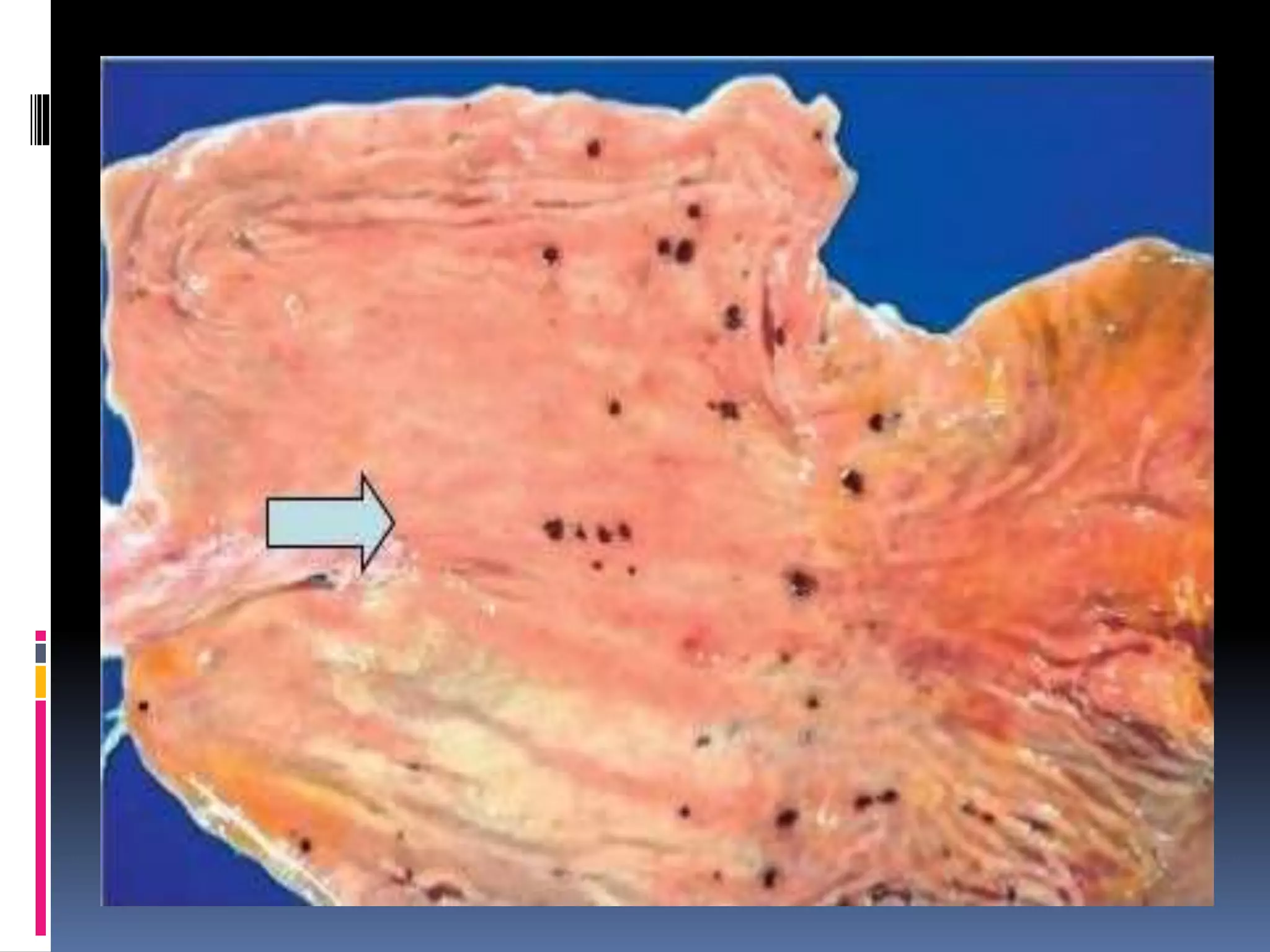
Acute (Stress) Peptic Ulcer
Cushing Ulcer
Gastric, duodenal or esophageal ulcer arising in
patients with intercranial injury or operation
Curling Ulcer
Occuring mosty in the proximal duodenum and
associated with severe burns and trauma
Chronic Peptic Ulcer
Gastric Ulcer
A gastric ulcer is a sore that is on the inside of
the stomach
Causes
 Infection with Helicobecter pylori
 NSAIDs (e.g. aspirin, ibuprofen, diclofenac)
Chronic Peptic Ulcer (Cont.)
Duodenal Ulcer
The peptic ulcer having a sore on the upper part
of small intestine
Causes
 H.pylori
 Damaging of lining of mucosal wall
Chronic Peptic Ulcer (Cont.)
Esophageal Ulcer
 Open sores or lesions in the lining of
esophagus
 Mostly occur in the lower end of esophagus
Causes
 Associated with bad case of chronic gastro
esophageal reflux disease or GERD
Chronic Peptic Ulcer (Cont.)
Bleeding Ulcer
 Internal bleeding is caused by a peptic ulcer
which has been left untreated
 When this happens it is now referred to as
bleeding ulcer
 Most dangerous type of ulcer
Chronic Peptic Ulcer (Cont.)
Refractory Ulcer
These are simply peptic ulcers that have not
healed after at least 3 months of treatment
ETIOLOGY OF
PEPTIC ULCER
What Causes Ulcers?
 No single cause
 End result of an imbalance between digestive
fluids in stomach and duodenum
 Most common cause of ulcer is infection with
a type of bacteria called Helicobacter pylori
(H.pylori)
Factors that can increase
the risk of ulcers
 Use of NSAIDs (such as aspirin, naproxen,
ibuprofen and many others prescription
medicines; even safety-coated aspirin and
aspirin in powder form can cause ulcers
 Excess acid production from gastrinomas
(tumors of acid-producing cells)
Factors that can increase
the risk of ulcers (Cont.)
 Excessive drinking
 Smoking or chewing tobacco
 Serious illness
 Radiation treatment of the area
Who is more likely to get
ulcers?
Those people are more like to get ulcers who:
 Are infected with H.pylori
 Take NSAIDs (aspirin, ibuprofen or naproxen
etc.)
 Have a family history of ulcers
 Have another illness such as liver, kidney or lung
disease
 Drink regularly
Are age 50 or older
How are ulcers treated?
If not properly treated, they can lead to
serious health problems
Ulcers can be treated by following ways:
 Lifestyle changes
 Medication
 Surgery
Lifestyle changes
 Eliminate substrate that can causing ulcers
 Stop drinking and/or smoking
 Stop using NSAIDs
Ulcer Medication
Proton Pump Inhibitors(PPIs)
 Reduce acid level and allow ulcer to heal
 These include:
• Dexlansoprazole,
• Esomeprazole
• Lansoprazole
• Omeprazole
• Pantoprazole
• Rabeprazole
• Omeprazole/sodium bicarbonate etc.
Ulcer Medication (Cont.)
Antibiotics
 Used for H.pylori induced ulcers
 Multiple combinations of antibiotics are used
 Taken for 2-3 weeks along with PPIs
Ulcer Medication
Upper Endoscopy
 Bleeding ulcers can be treated using an
endoscope
Surgery
Surgery is needed if:
 Ulcer creates a hole in the wall of stomach
 There is serious bleeding that cannot be
controlled with an endoscope
How to reduce the risk of
developing ulcers?
 Don’t smoke
 Don’t drink
 Don’t overuse aspirin or NSAIDs
 If you have symptoms of ulcer, contact your
health care provider
PATHOGENESIS
OF PEPTIC
ULCER
H.pylori INDUCED ULCER
Gram negative bacteria produced heat shock proteins
Cytokines, histamine, lipopolysaccharides, certain
enzymes
Phospholipase
Urease, protease, fucosidase etc.
 Urease convert in acidic media urea into ammonia
and carbon dioxide. Ammonia itself cause
destruction of mucosal lining.
 Ammonia cause infection of mucosal lining and
ultimately inflammatory mediators release.
 Cytokines Leukocytes adhesion and
inflammatory reactions starts
Damage mucosa of GIT
Ulcer occurs
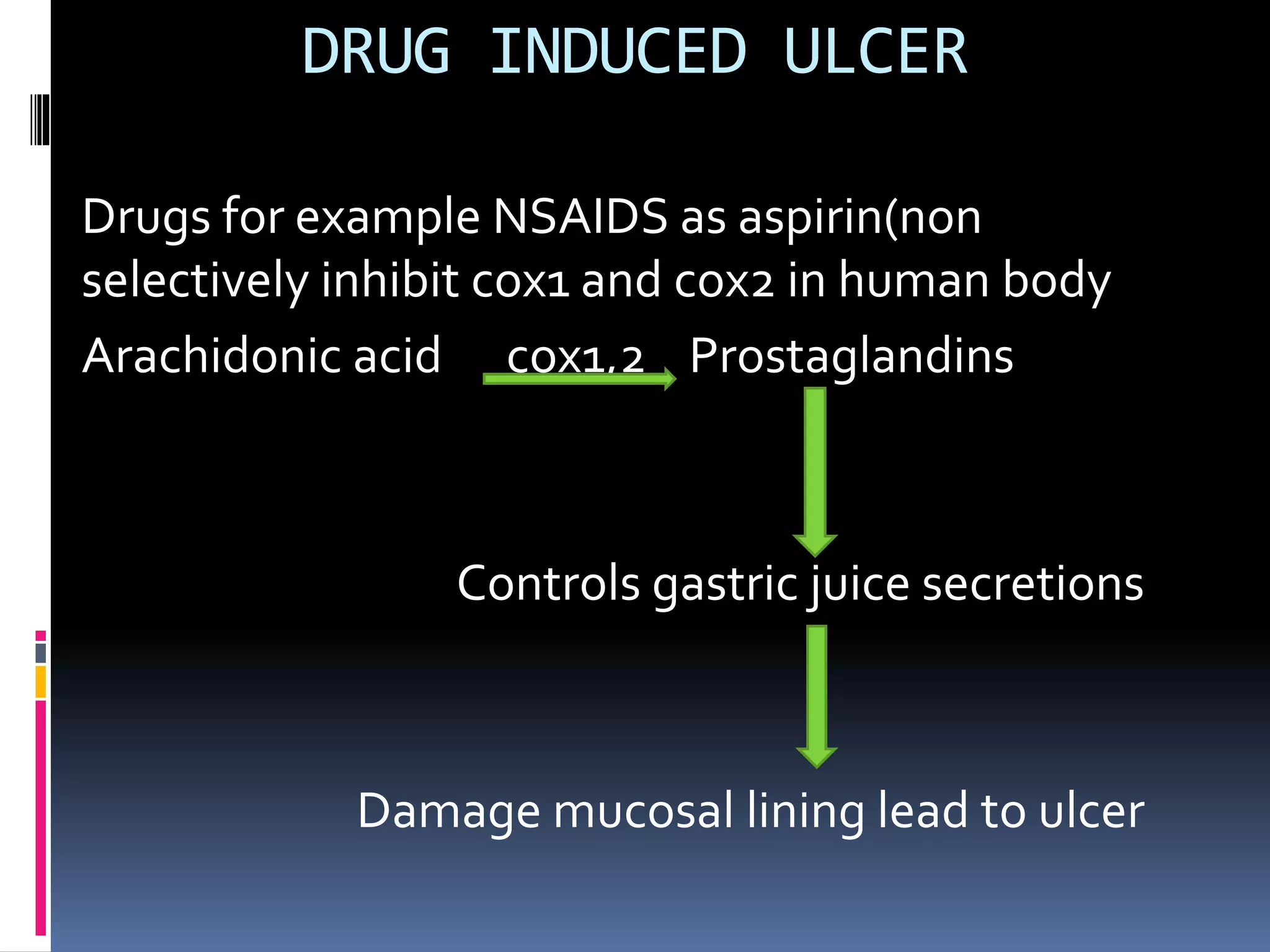
DRUG INDUCED ULCER
Drugs for example NSAIDS as aspirin(non
selectively inhibit cox1 and cox2 in human body
Arachidonic acid cox1,2 Prostaglandins
Controls gastric juice secretions
Damage mucosal lining lead to ulcer
STRESS INDUCED ULCER
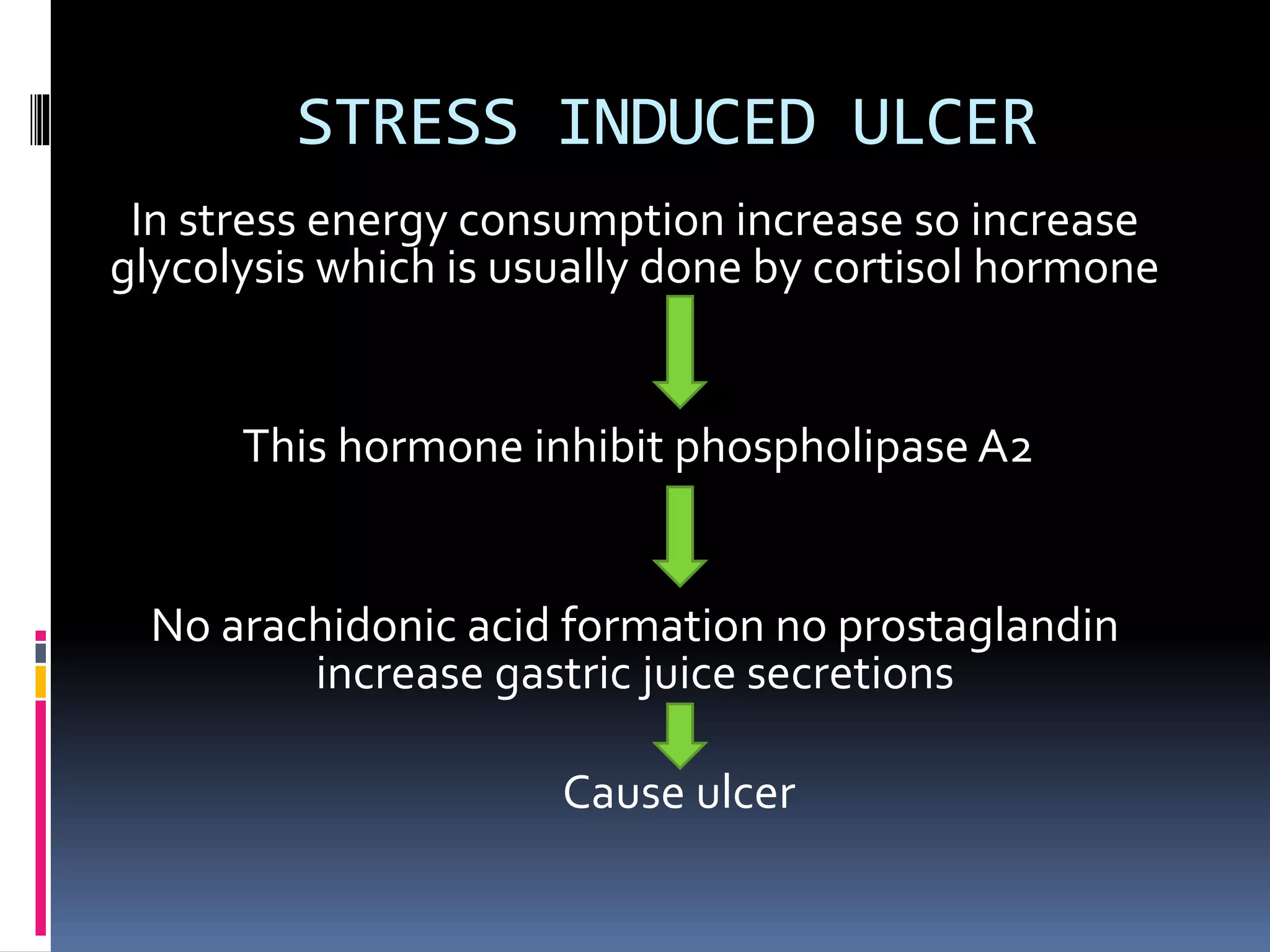
In stress energy consumption increase so increase
glycolysis which is usually done by cortisol hormone
This hormone inhibit phospholipase A2
No arachidonic acid formation no prostaglandin
increase gastric juice secretions
Cause ulcer
STEROIDS INDUCED ULCER
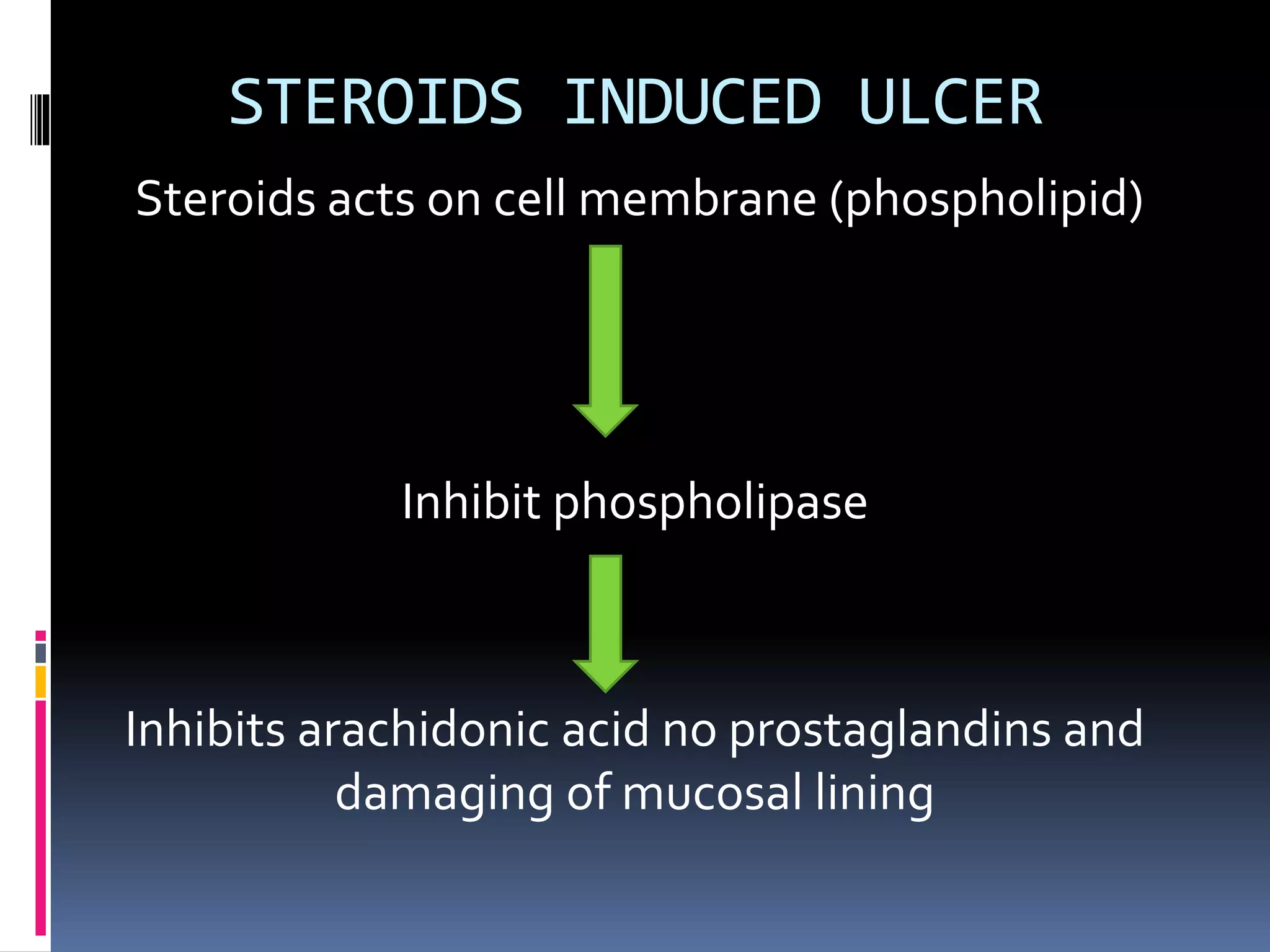
Steroids acts on cell membrane (phospholipid)
Inhibit phospholipase
Inhibits arachidonic acid no prostaglandins and
damaging of mucosal lining
ULCER DUE TO GENETIC DEFECT
Rare genetics occurs some time having blood
group O positive the size of parietal cell is
increase
Increase cell demand as HCL secretions increase
Cause destruction of mucosal lining leading
towards ulcer
ZES(Zollinger-Ellison
Syndrome)
In this syndrome tumor of goblet cell occurs
Abnormal mucus secretions(gastrin acts on
parietal cells)
Increase secretions of gastric juice
Mucosal lining damage
THANKYOU


Pathology of Peptic Ulcer

  • 1.
    PEPTIC ULCER Mujahid Nadeem(13612) Ali Raza (13621) ArslanTahir (13635) Ansar Ali Raza (13665)
  • 2.
    CONTENTS  INTRODUCTION  TYPES ETIOLOGY  PATHOGENESIS
  • 3.
  • 4.
    INTRODUCTION Ulcer  An ulceris a discontinuity or break in a bodily membrane that impedes the organ of which that membrane is a part from continuing its normal functions.
  • 5.
    Types of Ulcers Pepticulcer i. Esophageal ulcer ii. Duodenal ulcer iii. Gastric ulcer Pressure ulcer Genital ulcer Ulcerative dermatitis Anal fissure Diabetic foot ulcer
  • 6.
    Types of Ulcers(Cont.) Corneal ulcer Mouth ulcer Venous ulcer Stress ulcer Ulcerative sarcoidosis Ulcerative lichen planus Ulcerative colitis Ulcerative disposition
  • 7.
    Peptic Ulcer  Alsoknown as “peptic ulcer disease” (PUD)  Peptic ulcer is a break in the lining of the stomach, first part of the small intestine, or occasionally the lower esophagus.
  • 10.
    Sites of pepticulcer  Duodenum …………….…… 80%  Stomach …………………….. 19%  Duodenum & Stomach ….. 4%  GE junction …………………..  Meckel’s diverticulum ……. 1%
  • 12.
    Occurrence of pepticulcer  Serious medical problem  Approx. 500,000 new cases each year  5M people affected in USA only  Mostly occur between 55 ot 65 years of age  Duodenal ulcer more common in men than women  Gastric ulcer more common in women than men
  • 13.
    Occurrence of pepticulcer (Cont.)  Duodenal ulcers are four times more common than gastric ulcers  Mortality rates from peptic ulcer are low  High prevalence  One of several upper GIT diseases that is caused ,partially, by gastric acid  Wide range of symptoms
  • 14.
    Symptoms Abdominal pain • Locatedin epigastric area • Burning in quality • Occur on an empty stomach 2-4 hours after meal or at night (nocturnal pain) • Relieved by antacids • Tend to wax and wane over months
  • 15.
    Symptoms (Cont.) Perforations Blotting andabdominal fullness Nausea and vomiting Loss of appetite (because of pain) Weight loss Stomach obstruction Heartburn Hematemesis Melena Deep tenderness
  • 16.
  • 17.
    Acute Peptic Ulcer a.Cushing ulcer b. Curling ulcer Chronic Peptic Ulcer a. Duodenal ulcer b. Gastric ulcer c. Esophageal ulcer d. Bleeding ulcer e. Refractory ulcer
  • 18.
    Acute (Stress) PepticUlcer Cushing Ulcer Gastric, duodenal or esophageal ulcer arising in patients with intercranial injury or operation Curling Ulcer Occuring mosty in the proximal duodenum and associated with severe burns and trauma
  • 20.
    Chronic Peptic Ulcer GastricUlcer A gastric ulcer is a sore that is on the inside of the stomach Causes  Infection with Helicobecter pylori  NSAIDs (e.g. aspirin, ibuprofen, diclofenac)
  • 21.
    Chronic Peptic Ulcer(Cont.) Duodenal Ulcer The peptic ulcer having a sore on the upper part of small intestine Causes  H.pylori  Damaging of lining of mucosal wall
  • 23.
    Chronic Peptic Ulcer(Cont.) Esophageal Ulcer  Open sores or lesions in the lining of esophagus  Mostly occur in the lower end of esophagus Causes  Associated with bad case of chronic gastro esophageal reflux disease or GERD
  • 25.
    Chronic Peptic Ulcer(Cont.) Bleeding Ulcer  Internal bleeding is caused by a peptic ulcer which has been left untreated  When this happens it is now referred to as bleeding ulcer  Most dangerous type of ulcer
  • 27.
    Chronic Peptic Ulcer(Cont.) Refractory Ulcer These are simply peptic ulcers that have not healed after at least 3 months of treatment
  • 28.
  • 29.
    What Causes Ulcers? No single cause  End result of an imbalance between digestive fluids in stomach and duodenum  Most common cause of ulcer is infection with a type of bacteria called Helicobacter pylori (H.pylori)
  • 30.
    Factors that canincrease the risk of ulcers  Use of NSAIDs (such as aspirin, naproxen, ibuprofen and many others prescription medicines; even safety-coated aspirin and aspirin in powder form can cause ulcers  Excess acid production from gastrinomas (tumors of acid-producing cells)
  • 31.
    Factors that canincrease the risk of ulcers (Cont.)  Excessive drinking  Smoking or chewing tobacco  Serious illness  Radiation treatment of the area
  • 32.
    Who is morelikely to get ulcers? Those people are more like to get ulcers who:  Are infected with H.pylori  Take NSAIDs (aspirin, ibuprofen or naproxen etc.)  Have a family history of ulcers  Have another illness such as liver, kidney or lung disease  Drink regularly Are age 50 or older
  • 33.
    How are ulcerstreated? If not properly treated, they can lead to serious health problems Ulcers can be treated by following ways:  Lifestyle changes  Medication  Surgery
  • 34.
    Lifestyle changes  Eliminatesubstrate that can causing ulcers  Stop drinking and/or smoking  Stop using NSAIDs
  • 35.
    Ulcer Medication Proton PumpInhibitors(PPIs)  Reduce acid level and allow ulcer to heal  These include: • Dexlansoprazole, • Esomeprazole • Lansoprazole • Omeprazole • Pantoprazole • Rabeprazole • Omeprazole/sodium bicarbonate etc.
  • 36.
    Ulcer Medication (Cont.) Antibiotics Used for H.pylori induced ulcers  Multiple combinations of antibiotics are used  Taken for 2-3 weeks along with PPIs
  • 37.
    Ulcer Medication Upper Endoscopy Bleeding ulcers can be treated using an endoscope
  • 38.
    Surgery Surgery is neededif:  Ulcer creates a hole in the wall of stomach  There is serious bleeding that cannot be controlled with an endoscope
  • 39.
    How to reducethe risk of developing ulcers?  Don’t smoke  Don’t drink  Don’t overuse aspirin or NSAIDs  If you have symptoms of ulcer, contact your health care provider
  • 40.
  • 41.
    H.pylori INDUCED ULCER Gramnegative bacteria produced heat shock proteins Cytokines, histamine, lipopolysaccharides, certain enzymes Phospholipase Urease, protease, fucosidase etc.  Urease convert in acidic media urea into ammonia and carbon dioxide. Ammonia itself cause destruction of mucosal lining.
  • 42.
     Ammonia causeinfection of mucosal lining and ultimately inflammatory mediators release.  Cytokines Leukocytes adhesion and inflammatory reactions starts Damage mucosa of GIT Ulcer occurs
  • 44.
    DRUG INDUCED ULCER Drugsfor example NSAIDS as aspirin(non selectively inhibit cox1 and cox2 in human body Arachidonic acid cox1,2 Prostaglandins Controls gastric juice secretions Damage mucosal lining lead to ulcer
  • 45.
    STRESS INDUCED ULCER Instress energy consumption increase so increase glycolysis which is usually done by cortisol hormone This hormone inhibit phospholipase A2 No arachidonic acid formation no prostaglandin increase gastric juice secretions Cause ulcer
  • 46.
    STEROIDS INDUCED ULCER Steroidsacts on cell membrane (phospholipid) Inhibit phospholipase Inhibits arachidonic acid no prostaglandins and damaging of mucosal lining
  • 47.
    ULCER DUE TOGENETIC DEFECT Rare genetics occurs some time having blood group O positive the size of parietal cell is increase Increase cell demand as HCL secretions increase Cause destruction of mucosal lining leading towards ulcer
  • 48.
    ZES(Zollinger-Ellison Syndrome) In this syndrometumor of goblet cell occurs Abnormal mucus secretions(gastrin acts on parietal cells) Increase secretions of gastric juice Mucosal lining damage
  • 51.