Prof. D. R. Wilton
Notes 21Notes 21
Introduction to AntennasIntroduction to Antennas
ECE 3317
[Chapter 7]
Introduction to Antennas
Antennas
An antenna is a device that is used to transmit and/or
receive an electromagnetic wave.
Examples:
 Cell-phone antenna (transmit and receive)
 Wireless LAN antenna (transmit and receive)
 FM radio antenna (receive only)
 Satellite dish antenna (receive only)
 Satellite (possibly separate receive and transmit)
The antenna itself can always transmit or receive, but in
a given application it may be used for just one of these
functions.
Introduction to Antennas (cont.)
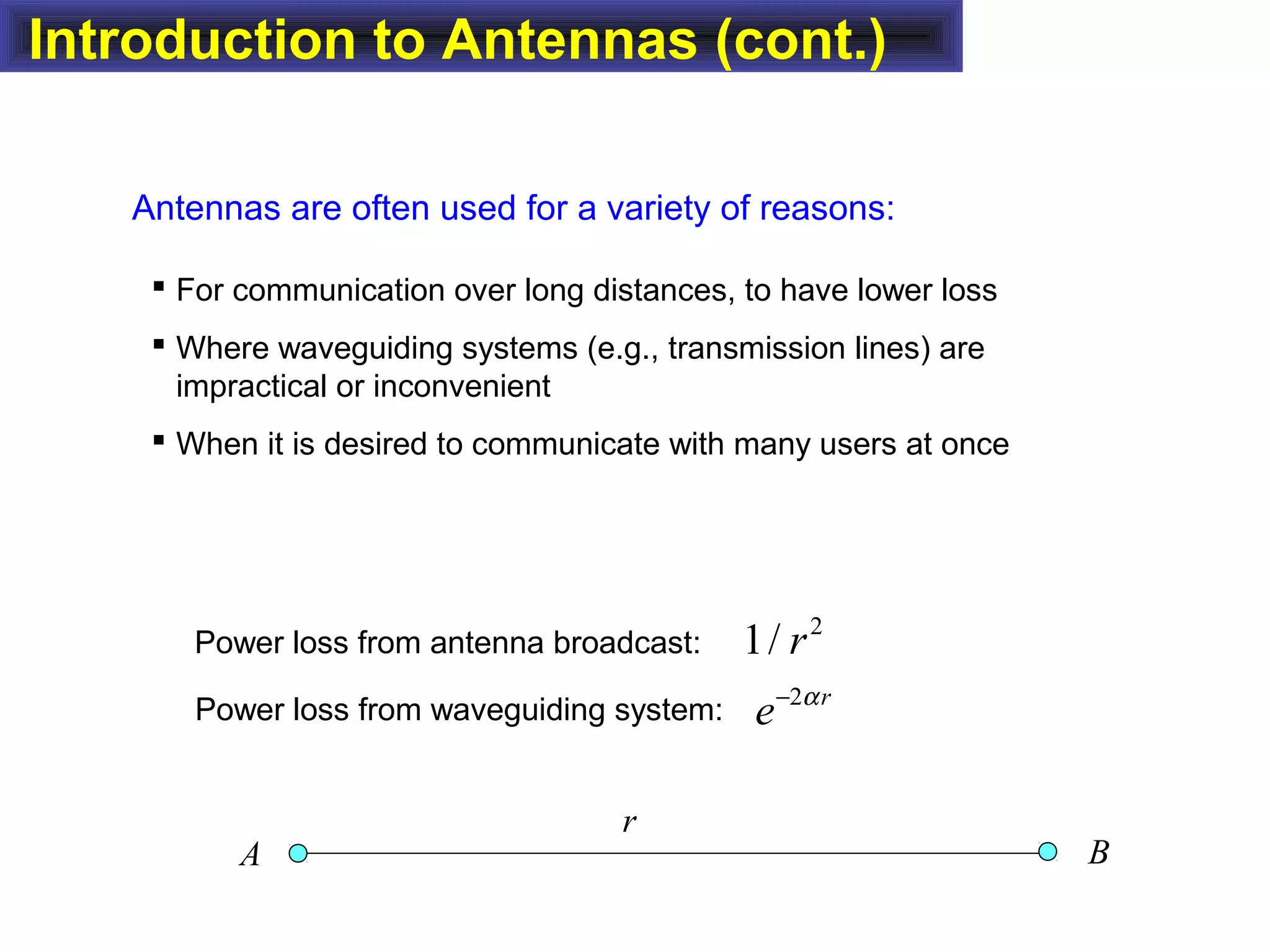
 For communication over long distances, to have lower loss
 Where waveguiding systems (e.g., transmission lines) are
impractical or inconvenient
 When it is desired to communicate with many users at once
Antennas are often used for a variety of reasons:
Power loss from waveguiding system:
Power loss from antenna broadcast:
2
1/ r
2 r
e α−
r
A B
Introduction to Antennas
Main properties of antennas:
 Radiation pattern
 Directivity (how directional the beam is)
 Efficiency (power radiated relative to total input power)
 Polarization (linear, CP)
 Bandwidth (the useable frequency range)
 Input Impedance
An antenna is essentially a matching device between
a transmission line and a wave radiating into some
region of space
Introduction to Antennas (cont.)
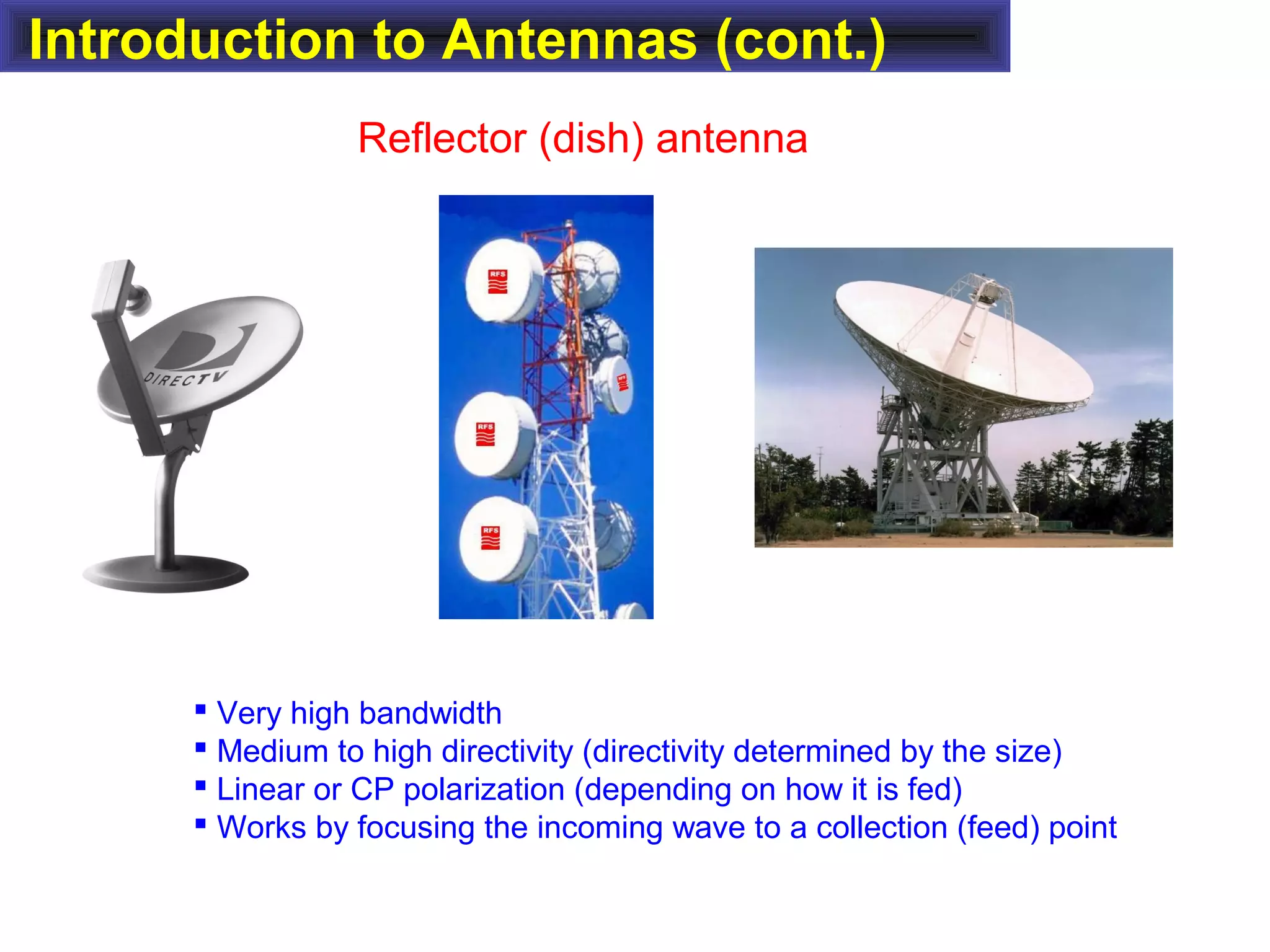
Reflector (dish) antenna
 Very high bandwidth
 Medium to high directivity (directivity determined by the size)
 Linear or CP polarization (depending on how it is fed)
 Works by focusing the incoming wave to a collection (feed) point
Introduction to Antennas (cont.)
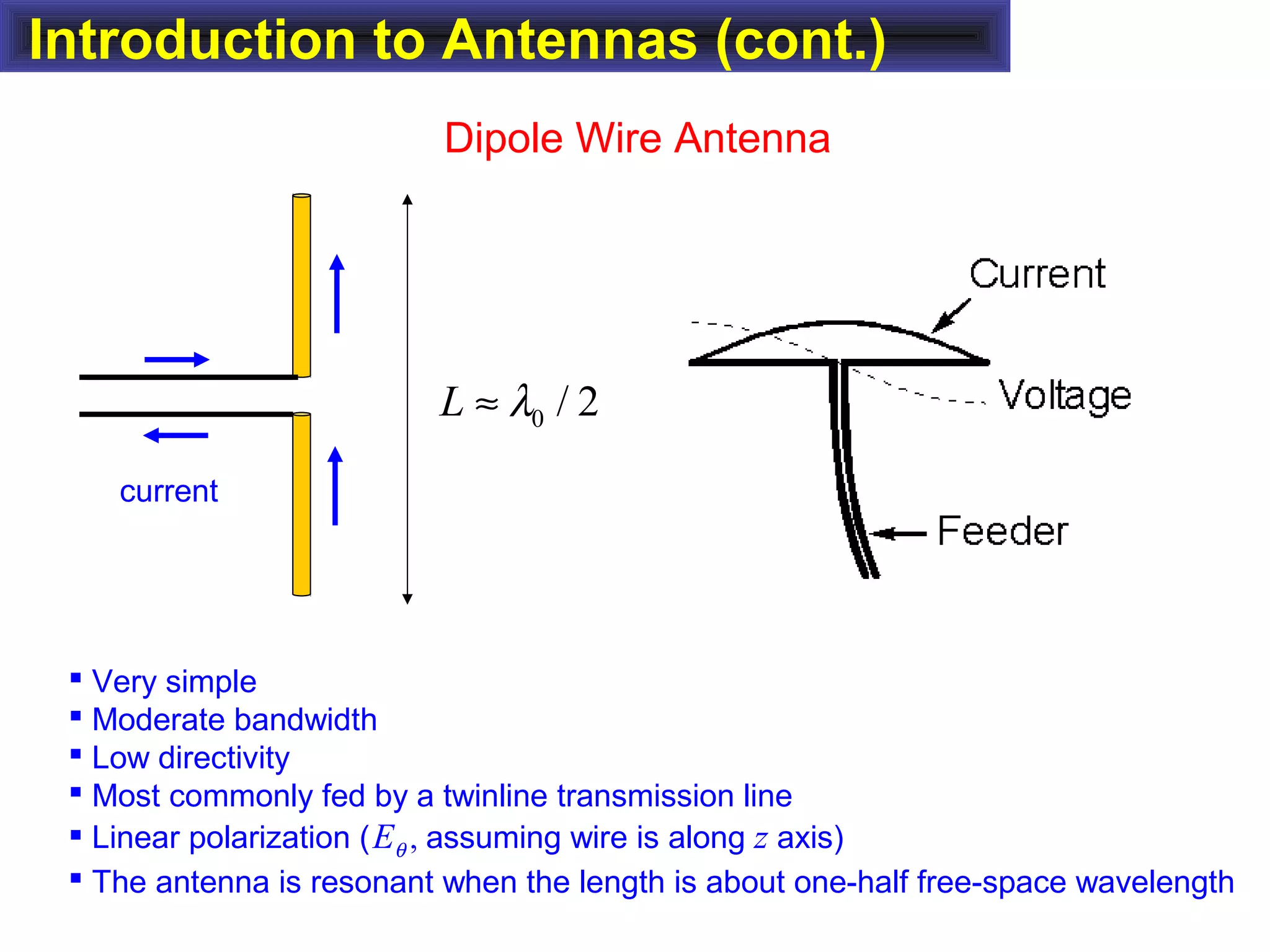
Dipole Wire Antenna
 Very simple
 Moderate bandwidth
 Low directivity
 Most commonly fed by a twinline transmission line
 Linear polarization (Eθ , assuming wire is along z axis)
 The antenna is resonant when the length is about one-half free-space wavelength
current
0 / 2L λ≈
Introduction to Antennas (cont.)
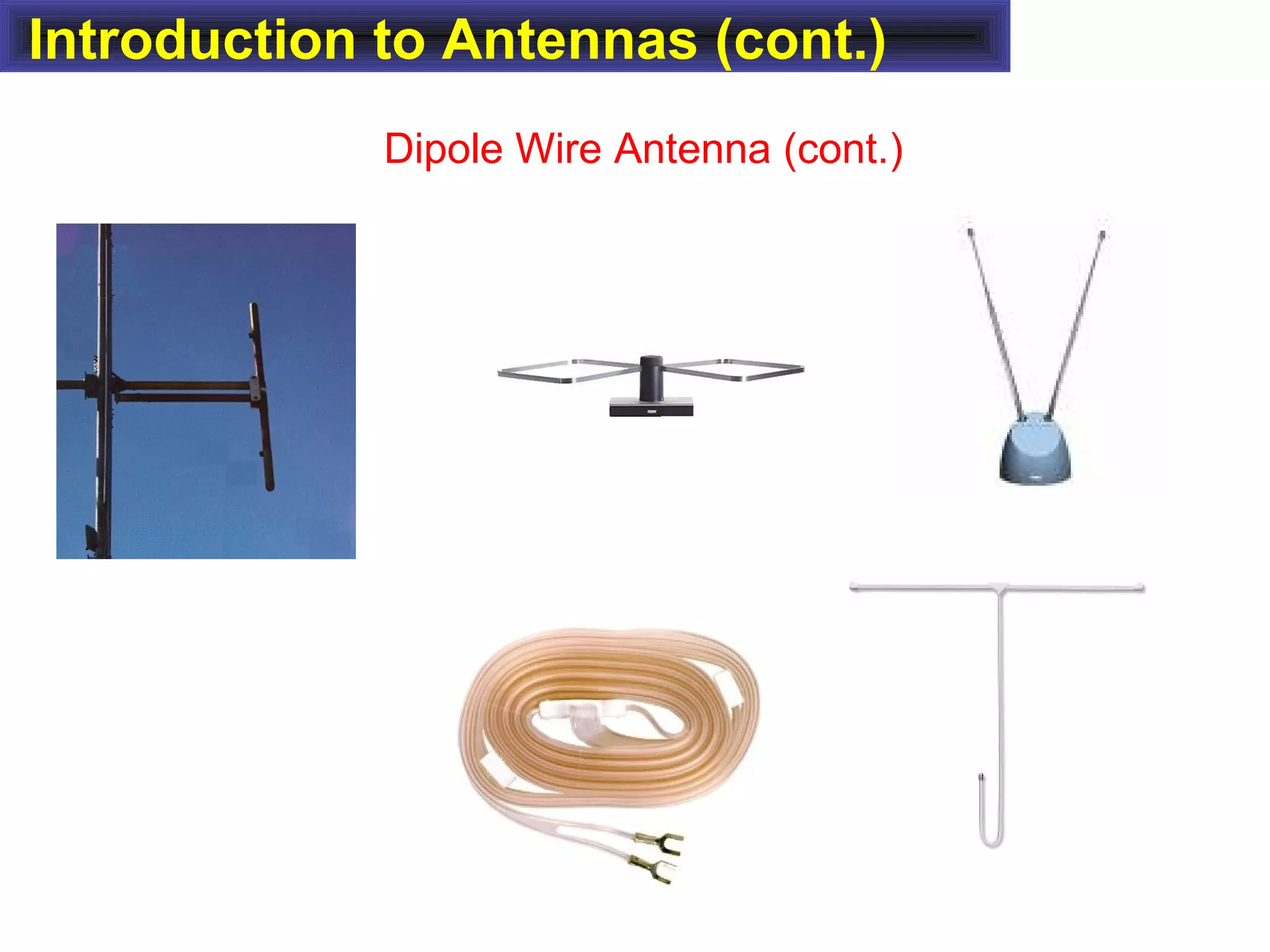
Dipole Wire Antenna (cont.)
Introduction to Antennas (cont.)
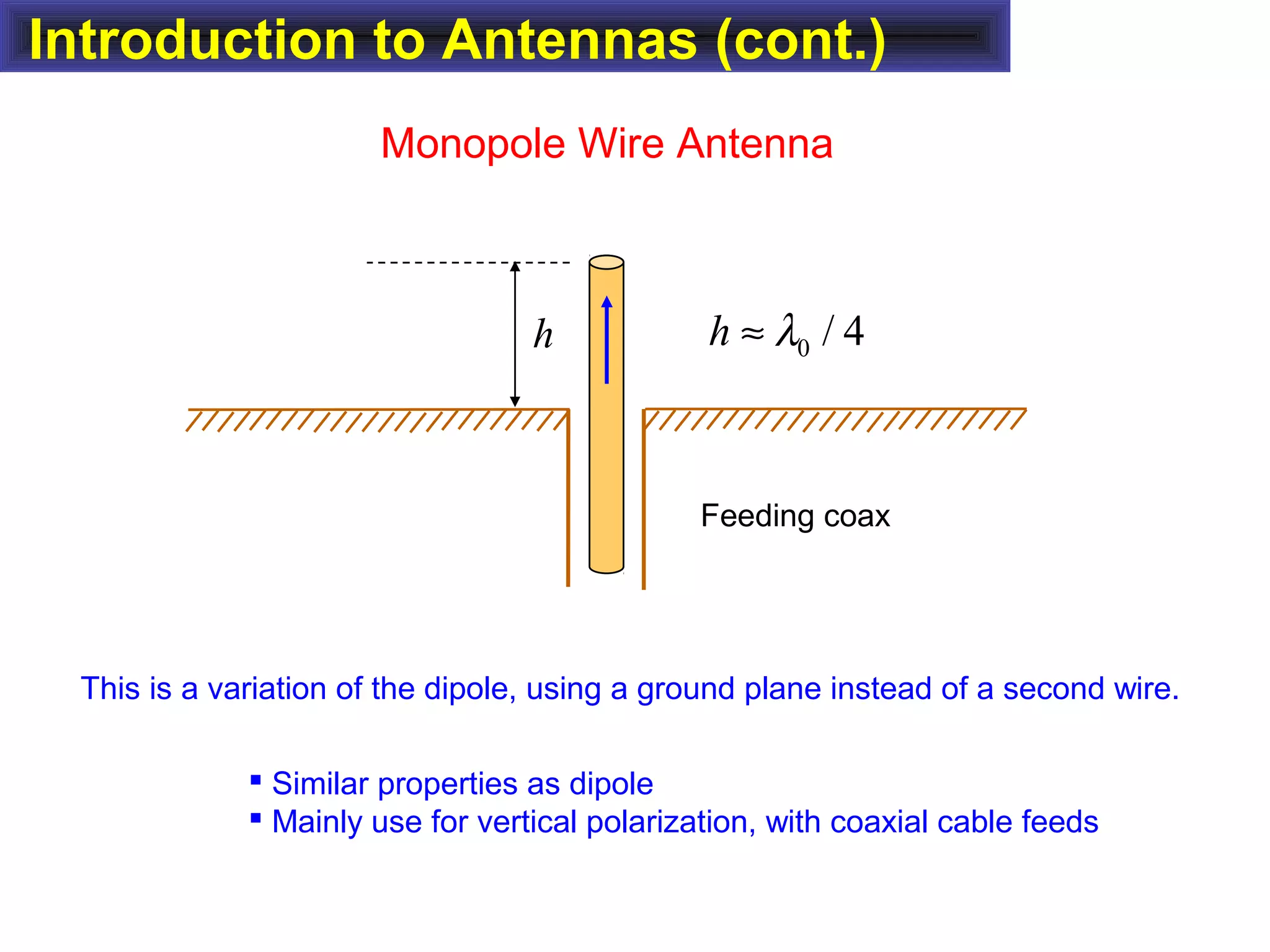
Monopole Wire Antenna
This is a variation of the dipole, using a ground plane instead of a second wire.
h
Feeding coax
0 / 4h λ≈
 Similar properties as dipole
 Mainly use for vertical polarization, with coaxial cable feeds
Introduction to Antennas (cont.)
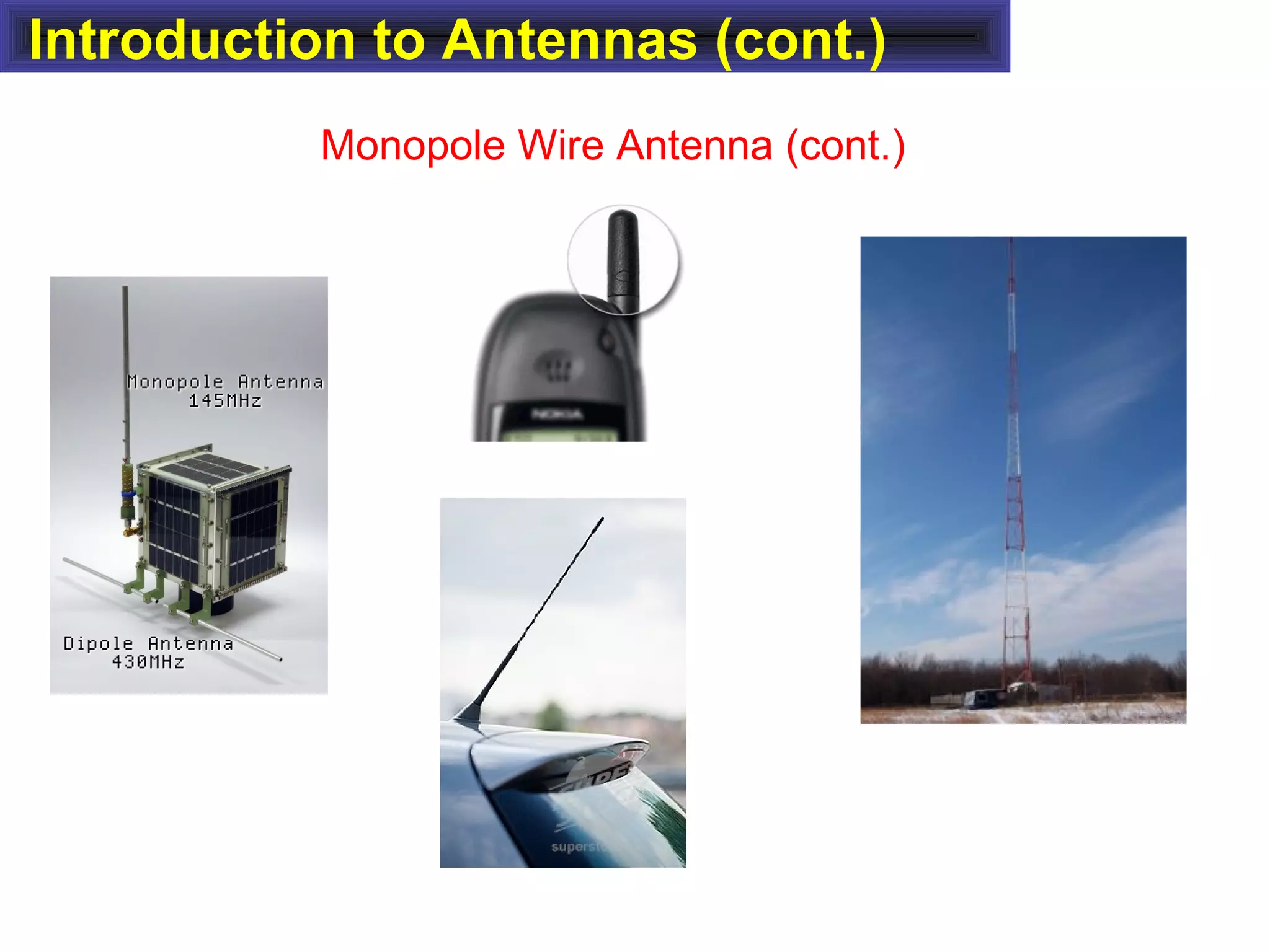
Monopole Wire Antenna (cont.)
Introduction to Antennas (cont.)
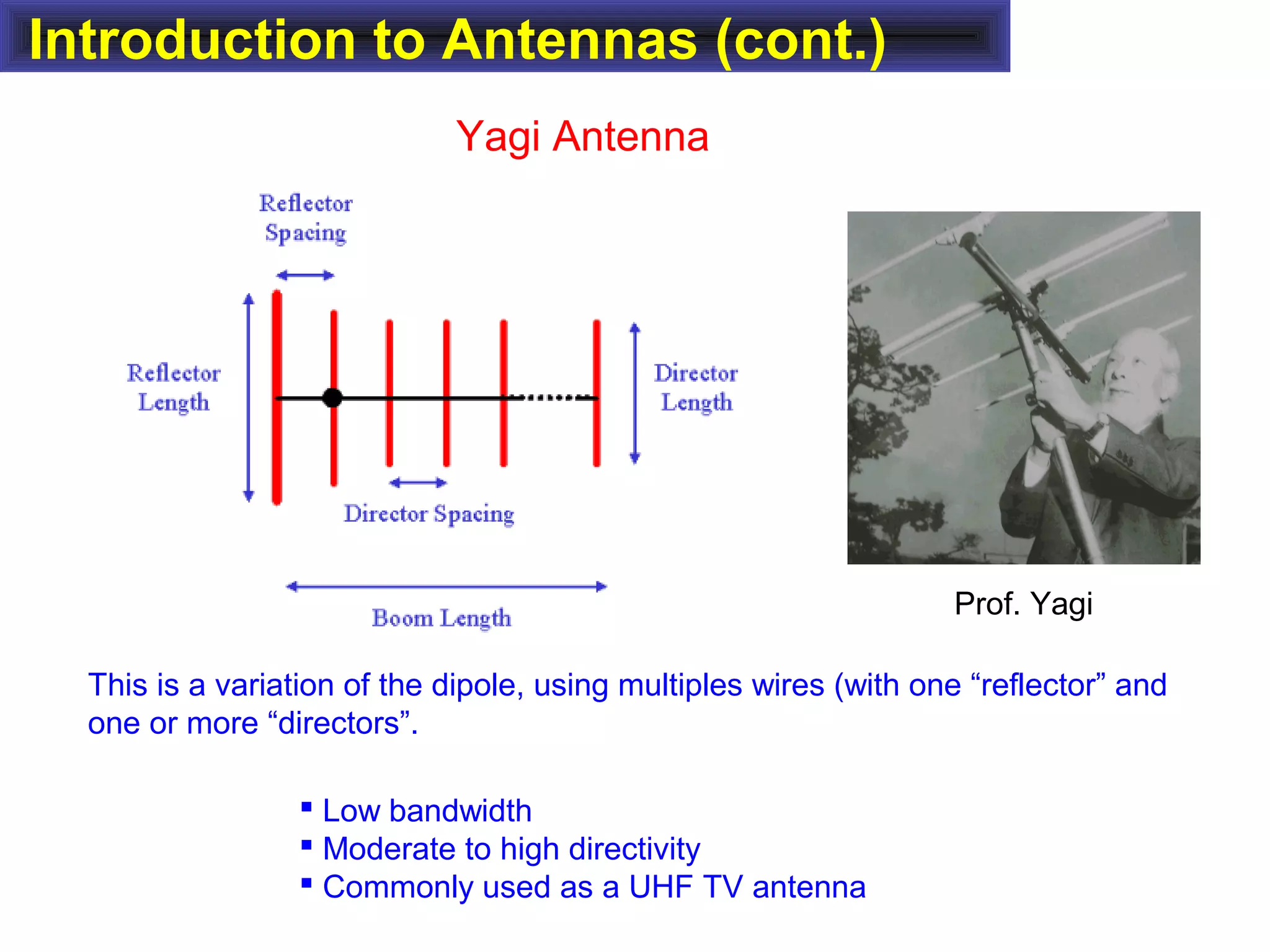
Yagi Antenna
This is a variation of the dipole, using multiples wires (with one “reflector” and
one or more “directors”.
 Low bandwidth
 Moderate to high directivity
 Commonly used as a UHF TV antenna
Prof. Yagi
Introduction to Antennas (cont.)
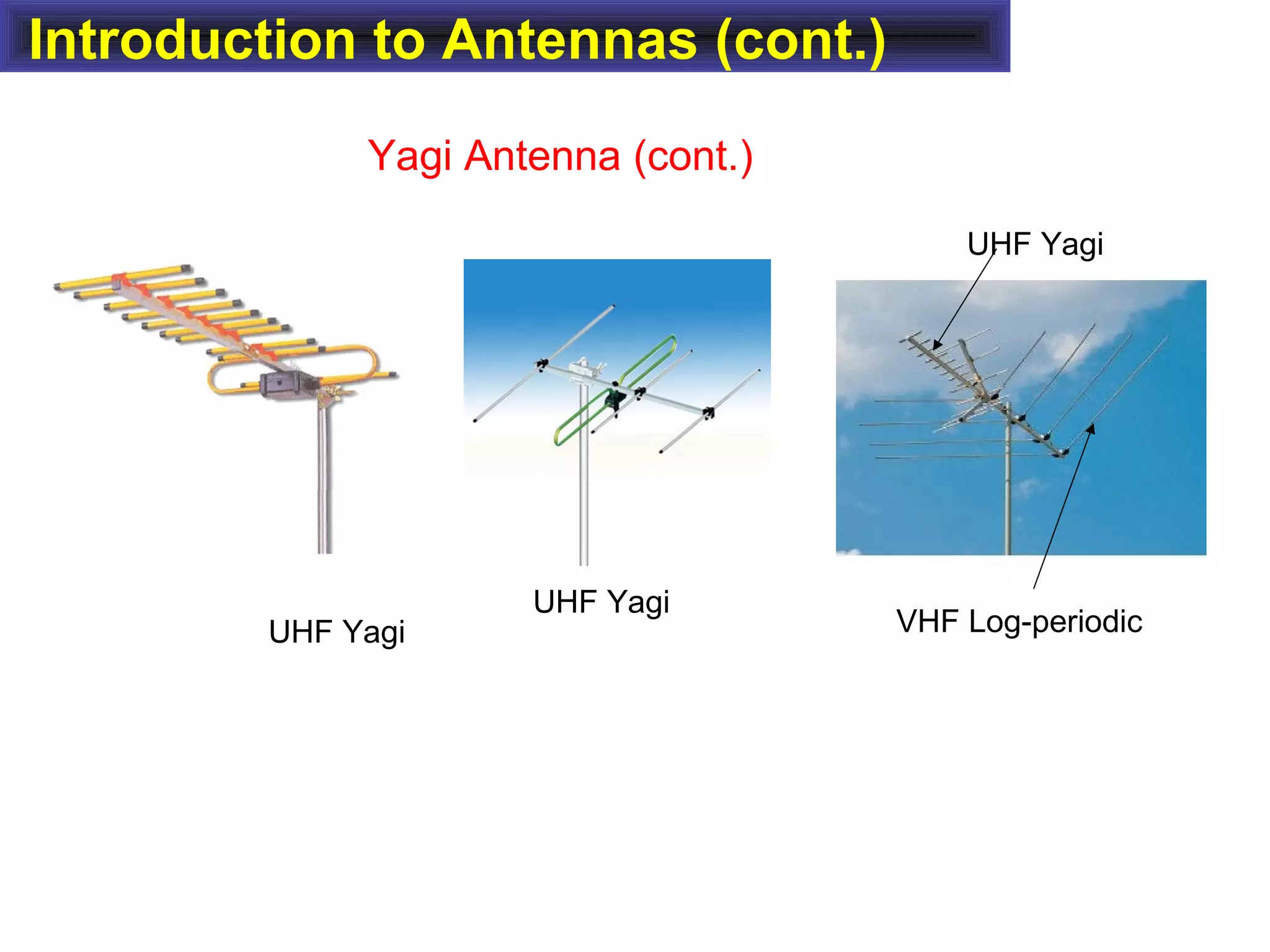
Yagi Antenna (cont.)
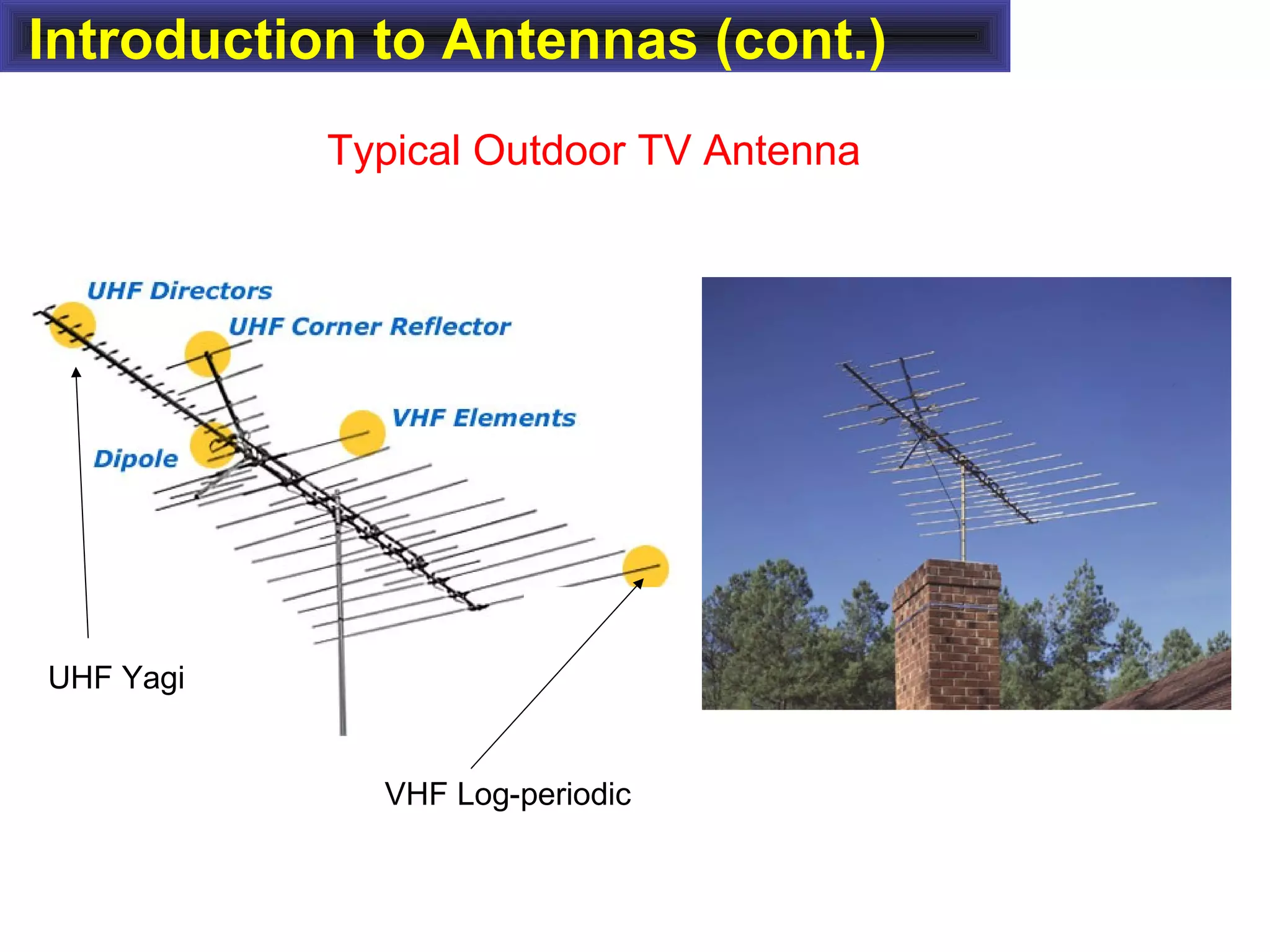
UHF Yagi
VHF Log-periodic
UHF Yagi
UHF Yagi
Introduction to Antennas (cont.)
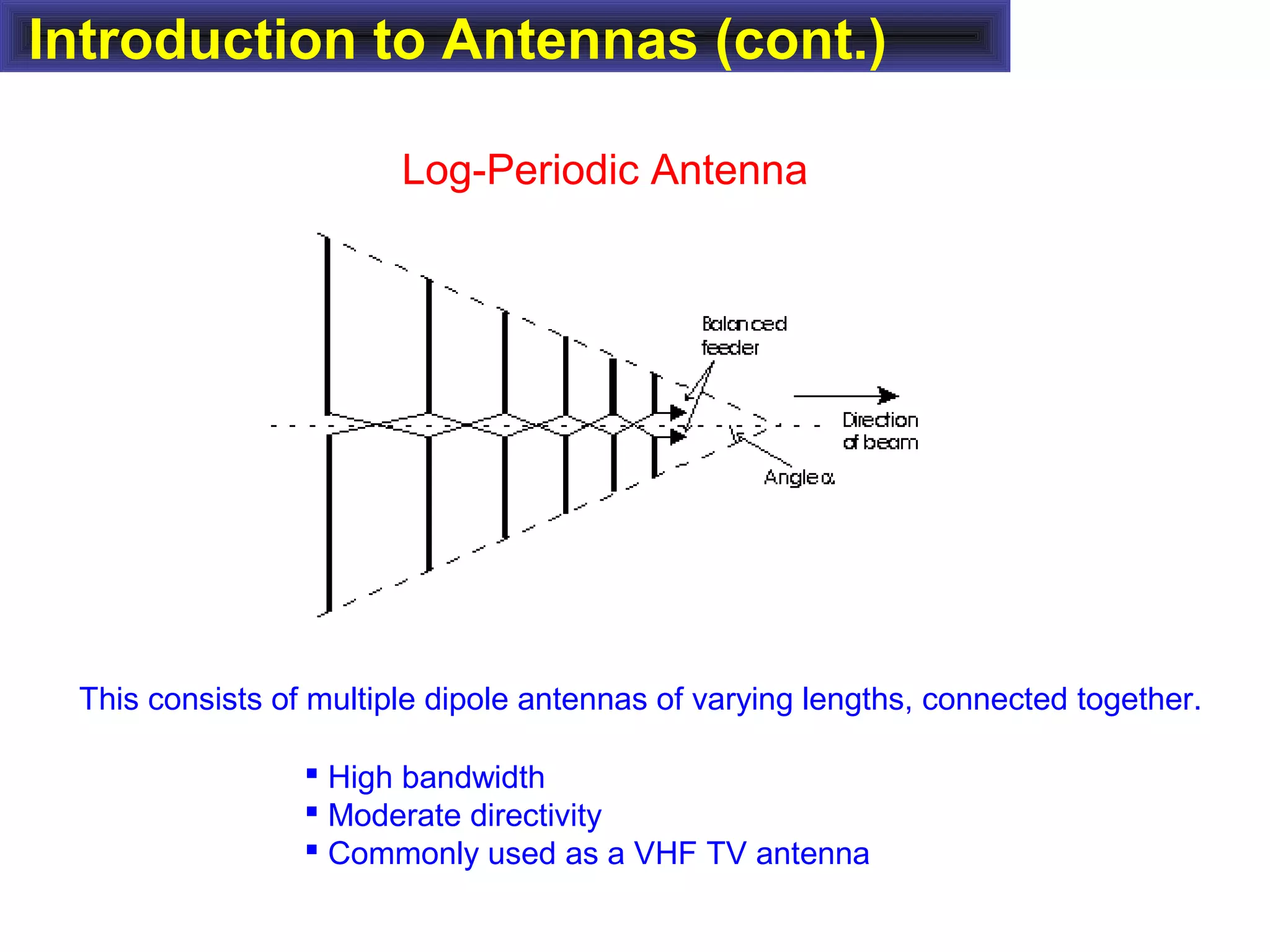
Log-Periodic Antenna
This consists of multiple dipole antennas of varying lengths, connected together.
 High bandwidth
 Moderate directivity
 Commonly used as a VHF TV antenna
Introduction to Antennas (cont.)
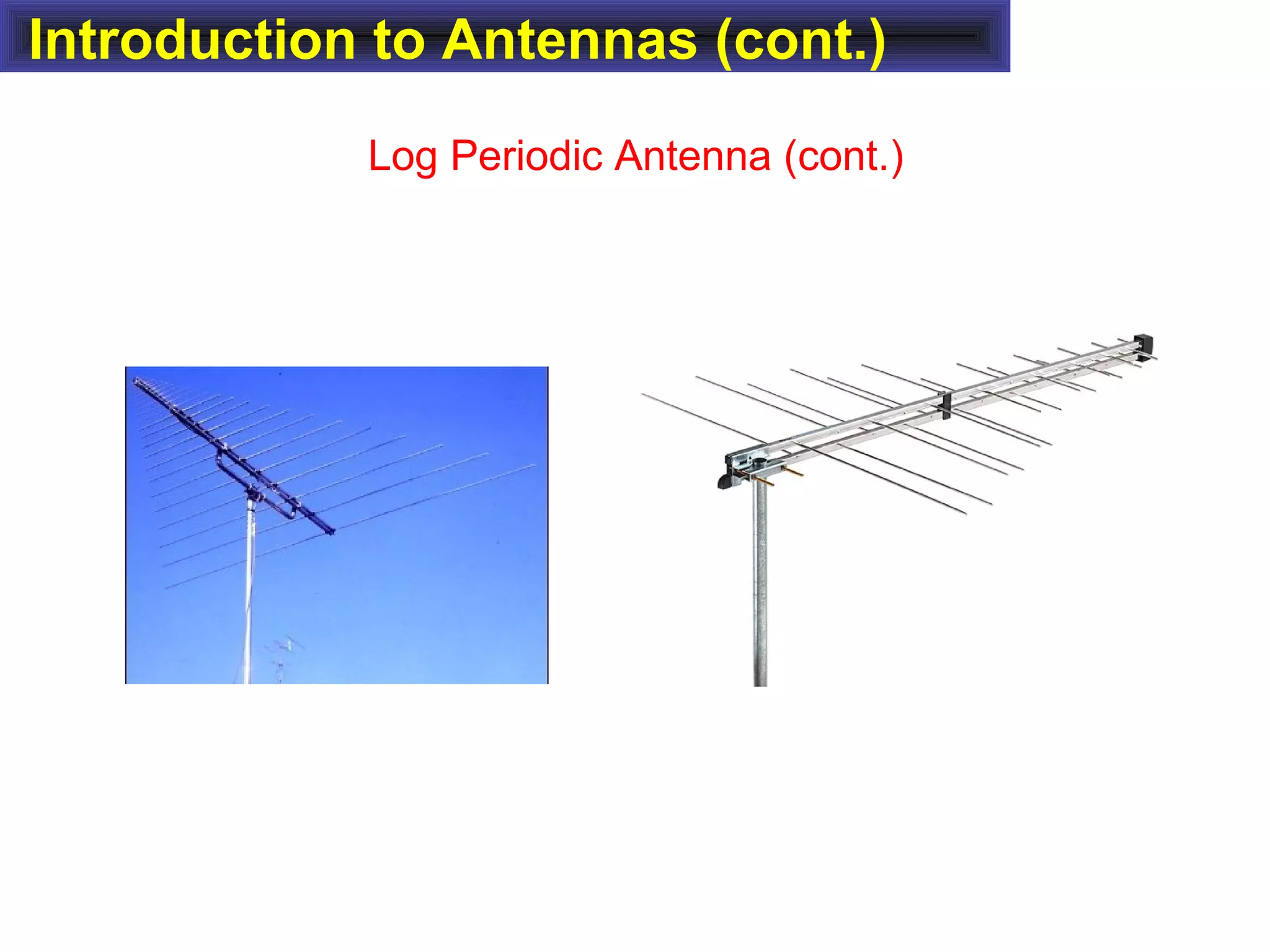
Log Periodic Antenna (cont.)
Introduction to Antennas (cont.)
Typical Outdoor TV Antenna
VHF Log-periodic
UHF Yagi
Introduction to Antennas (cont.)
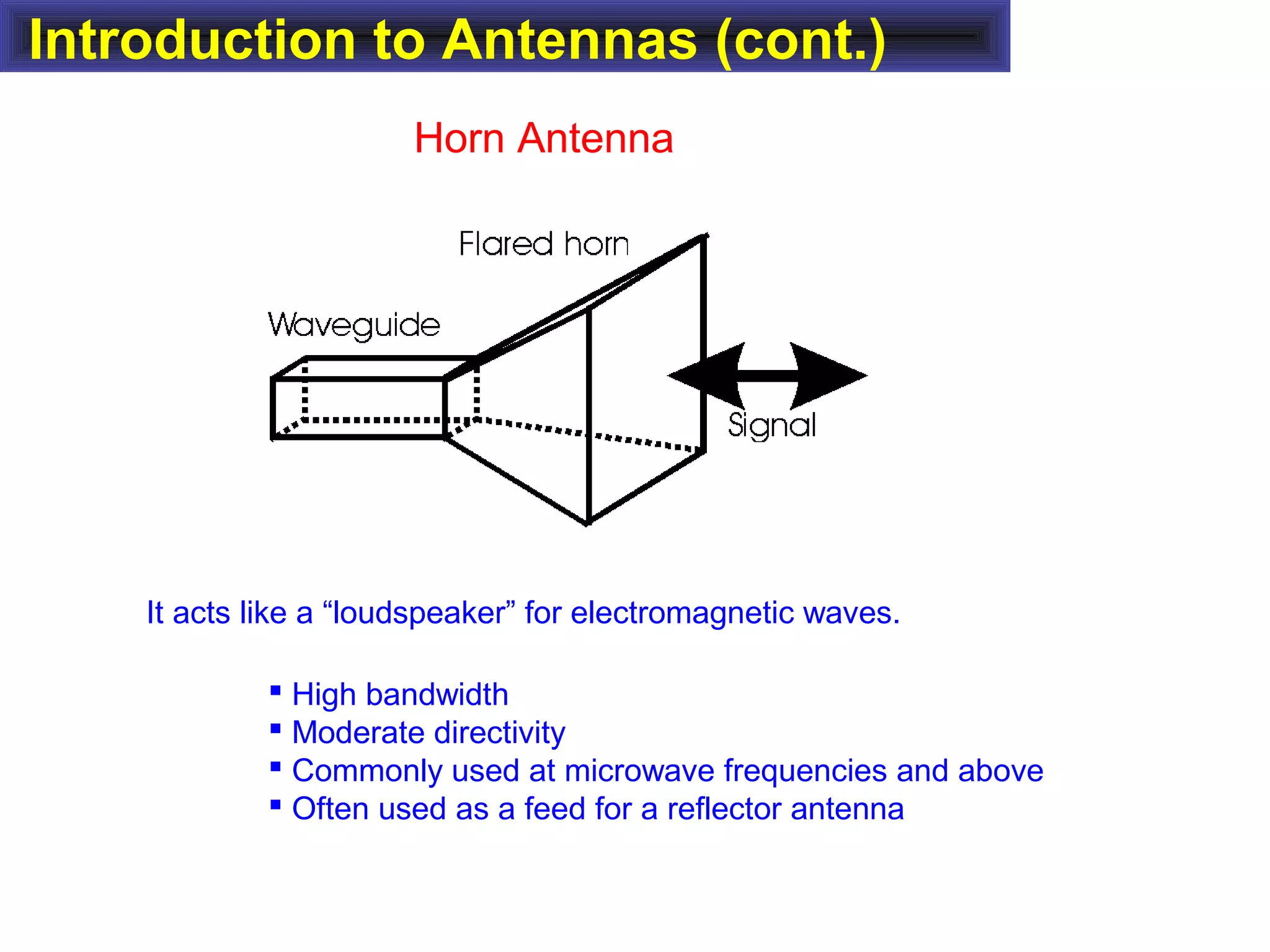
Horn Antenna
It acts like a “loudspeaker” for electromagnetic waves.
 High bandwidth
 Moderate directivity
 Commonly used at microwave frequencies and above
 Often used as a feed for a reflector antenna
Introduction to Antennas (cont.)
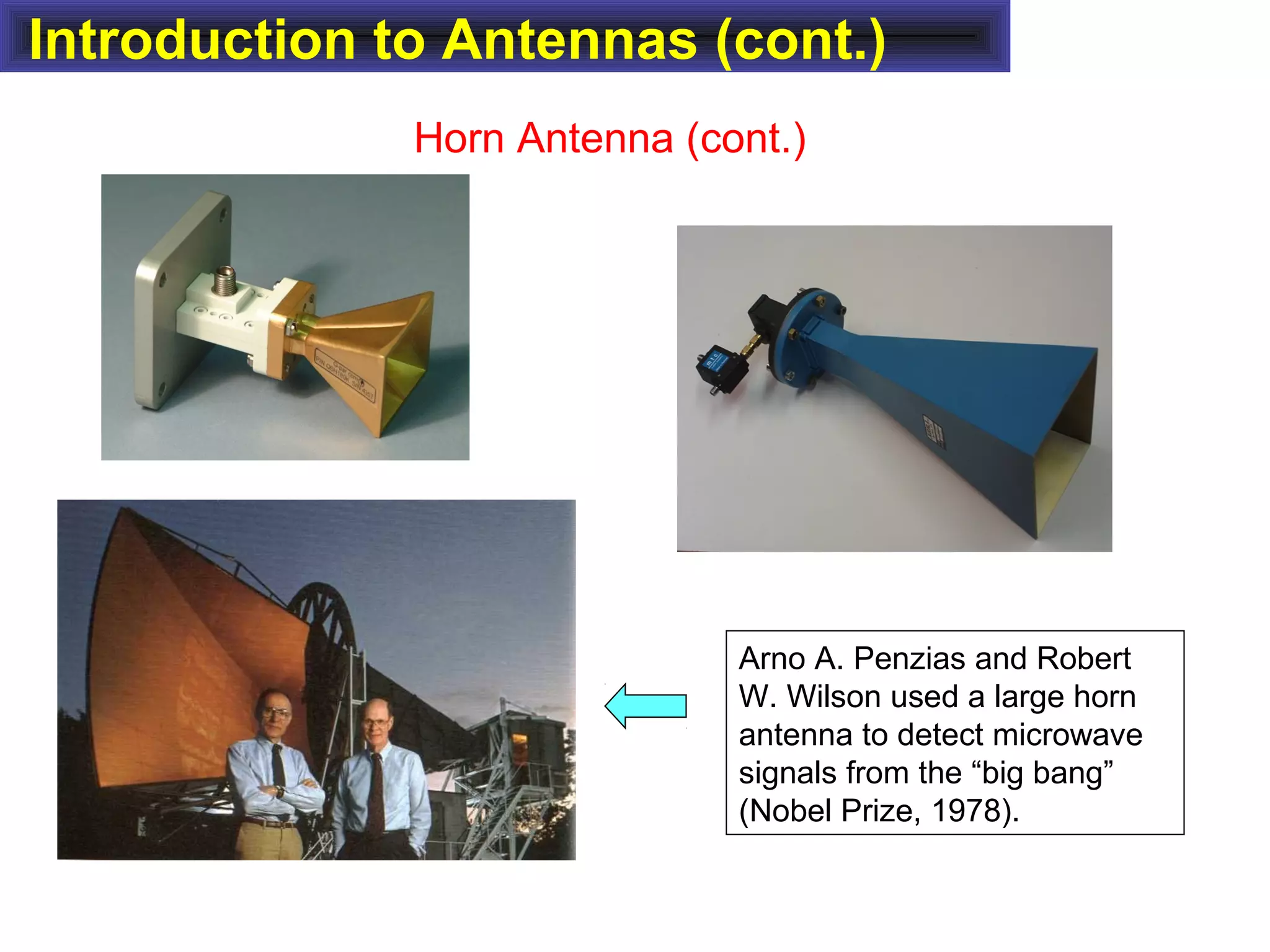
Horn Antenna (cont.)
Arno A. Penzias and Robert
W. Wilson used a large horn
antenna to detect microwave
signals from the “big bang”
(Nobel Prize, 1978).
Introduction to Antennas (cont.)
Horn Antenna (cont.)
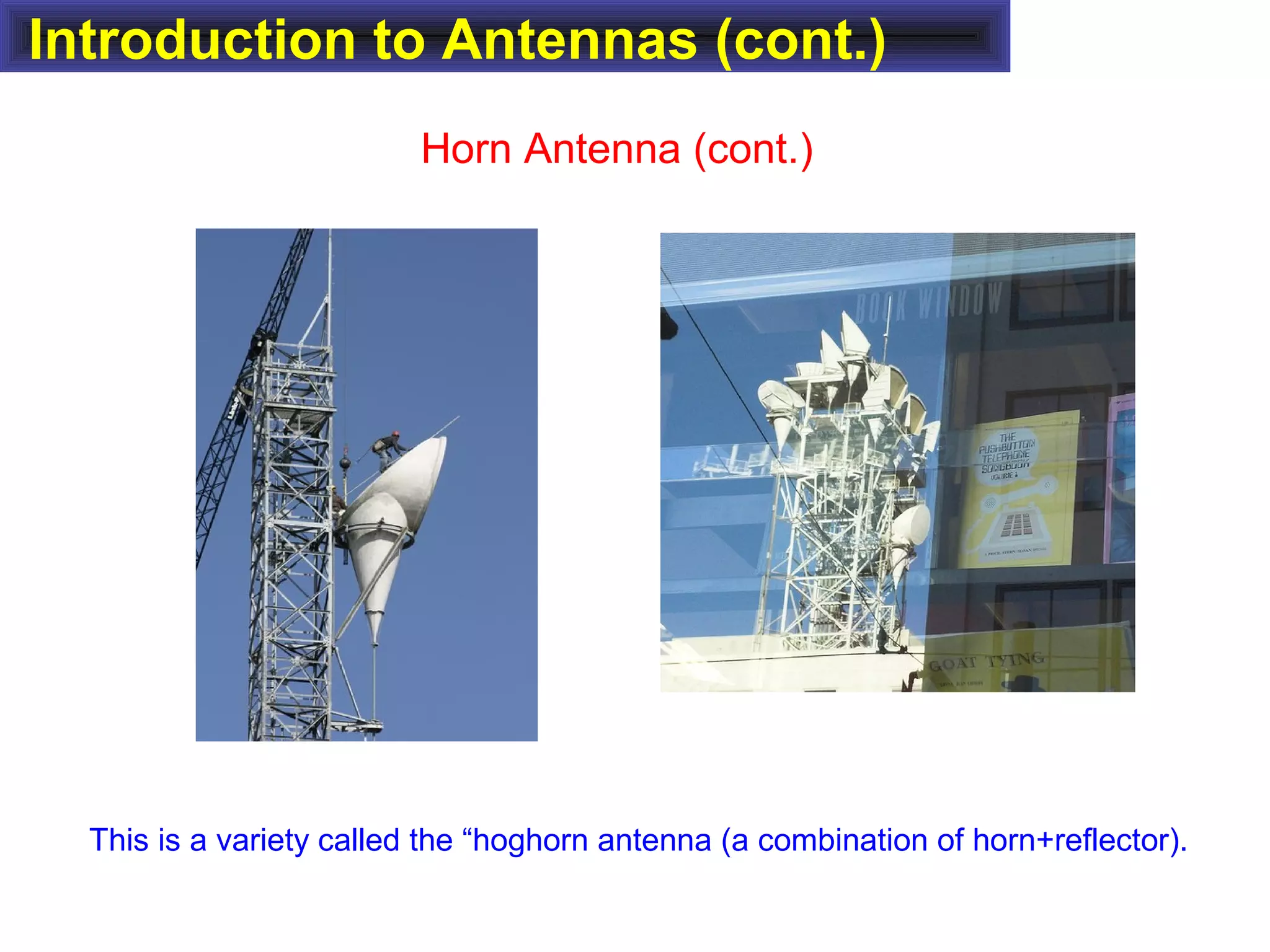
This is a variety called the “hoghorn antenna (a combination of horn+reflector).
Introduction to Antennas (cont.)
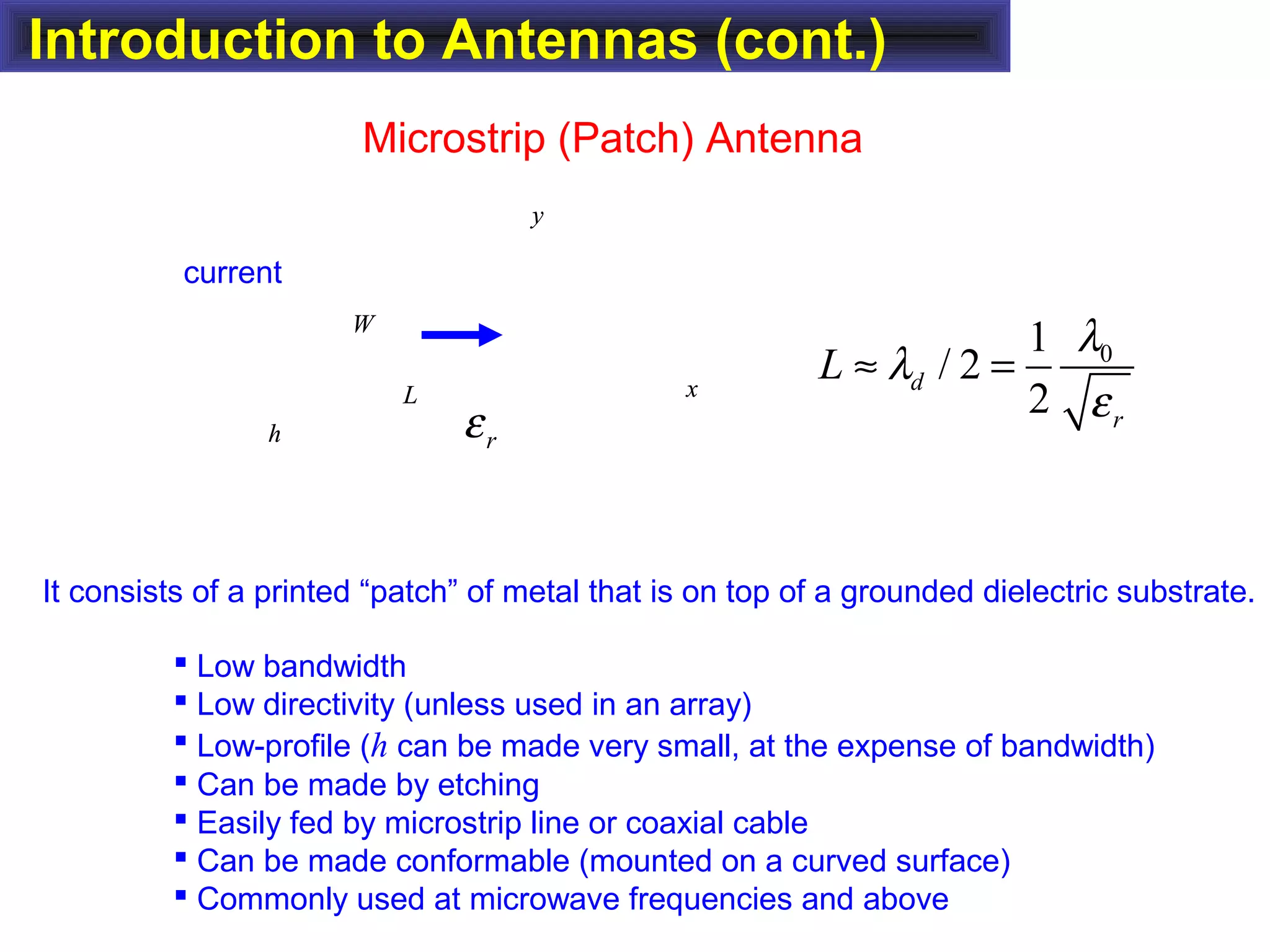
Microstrip (Patch) Antenna
It consists of a printed “patch” of metal that is on top of a grounded dielectric substrate.
 Low bandwidth
 Low directivity (unless used in an array)
 Low-profile (h can be made very small, at the expense of bandwidth)
 Can be made by etching
 Easily fed by microstrip line or coaxial cable
 Can be made conformable (mounted on a curved surface)
 Commonly used at microwave frequencies and above
01
/ 2
2
d
r
L
λ
λ
ε
≈ =x
y
h
L
W
x
y
h
L
W
rε
current
Introduction to Antennas (cont.)
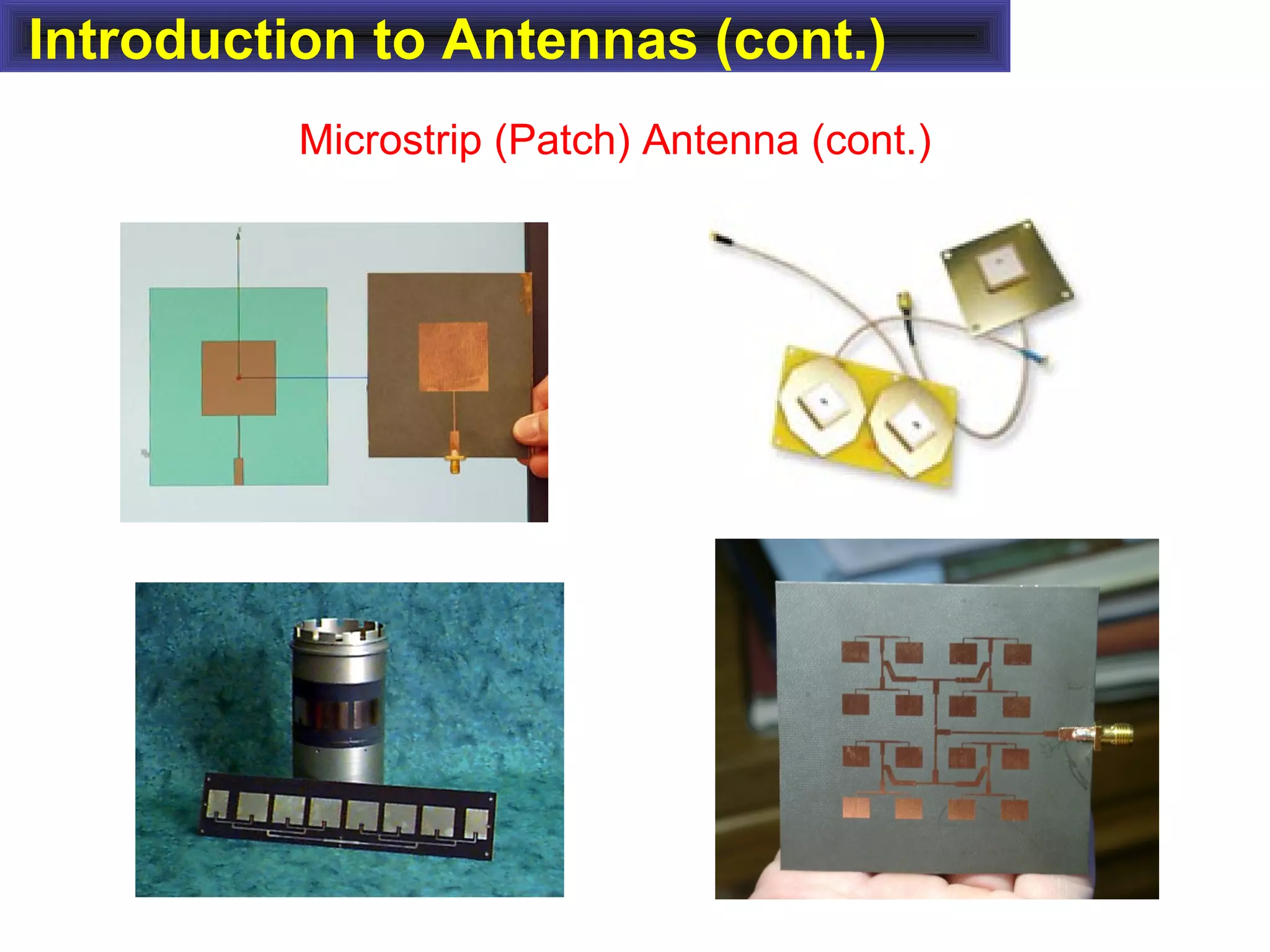
Microstrip (Patch) Antenna (cont.)
Introduction to Antennas (cont.)
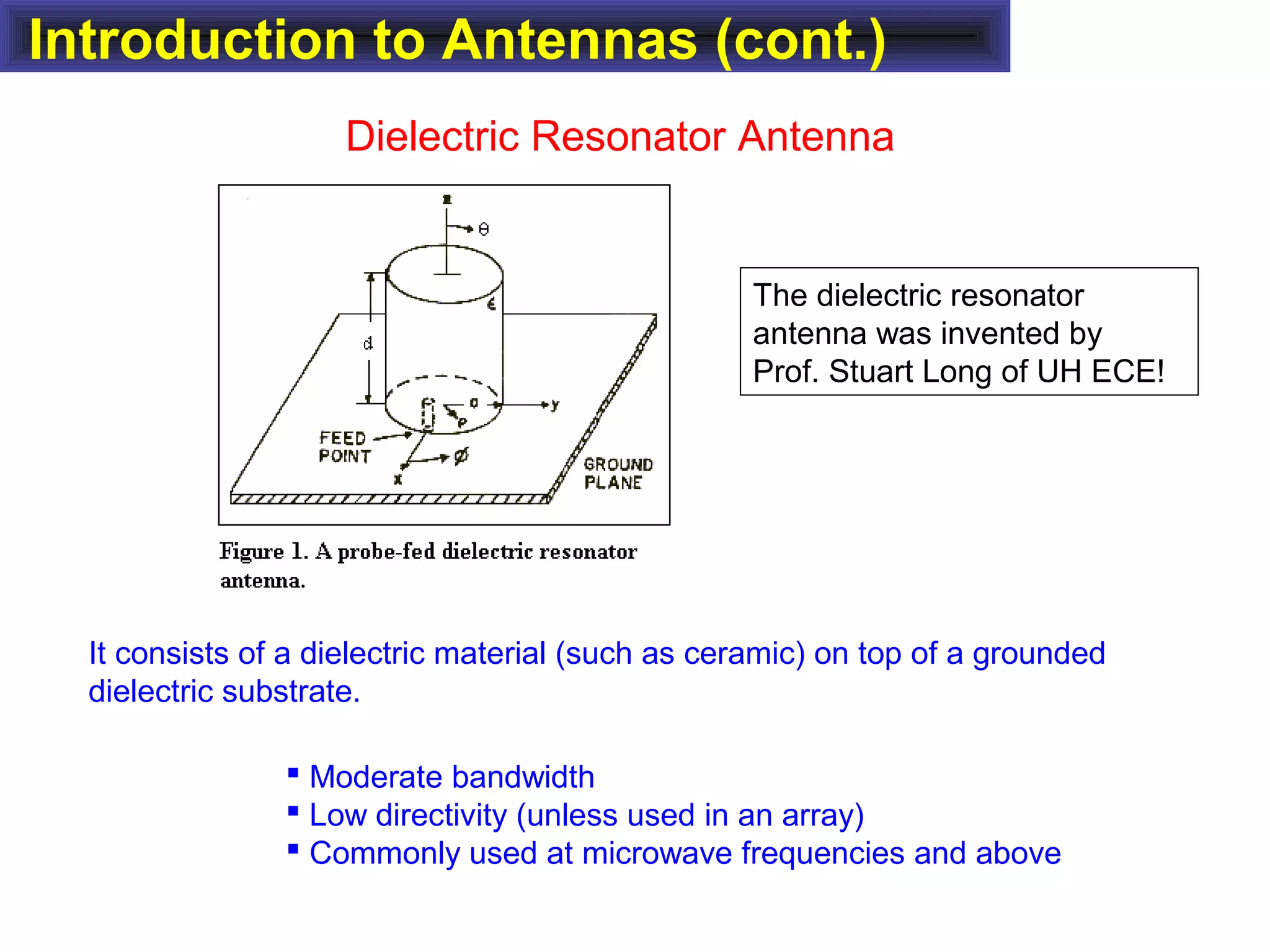
Dielectric Resonator Antenna
It consists of a dielectric material (such as ceramic) on top of a grounded
dielectric substrate.
 Moderate bandwidth
 Low directivity (unless used in an array)
 Commonly used at microwave frequencies and above
The dielectric resonator
antenna was invented by
Prof. Stuart Long of UH ECE!
Introduction to Antennas (cont.)
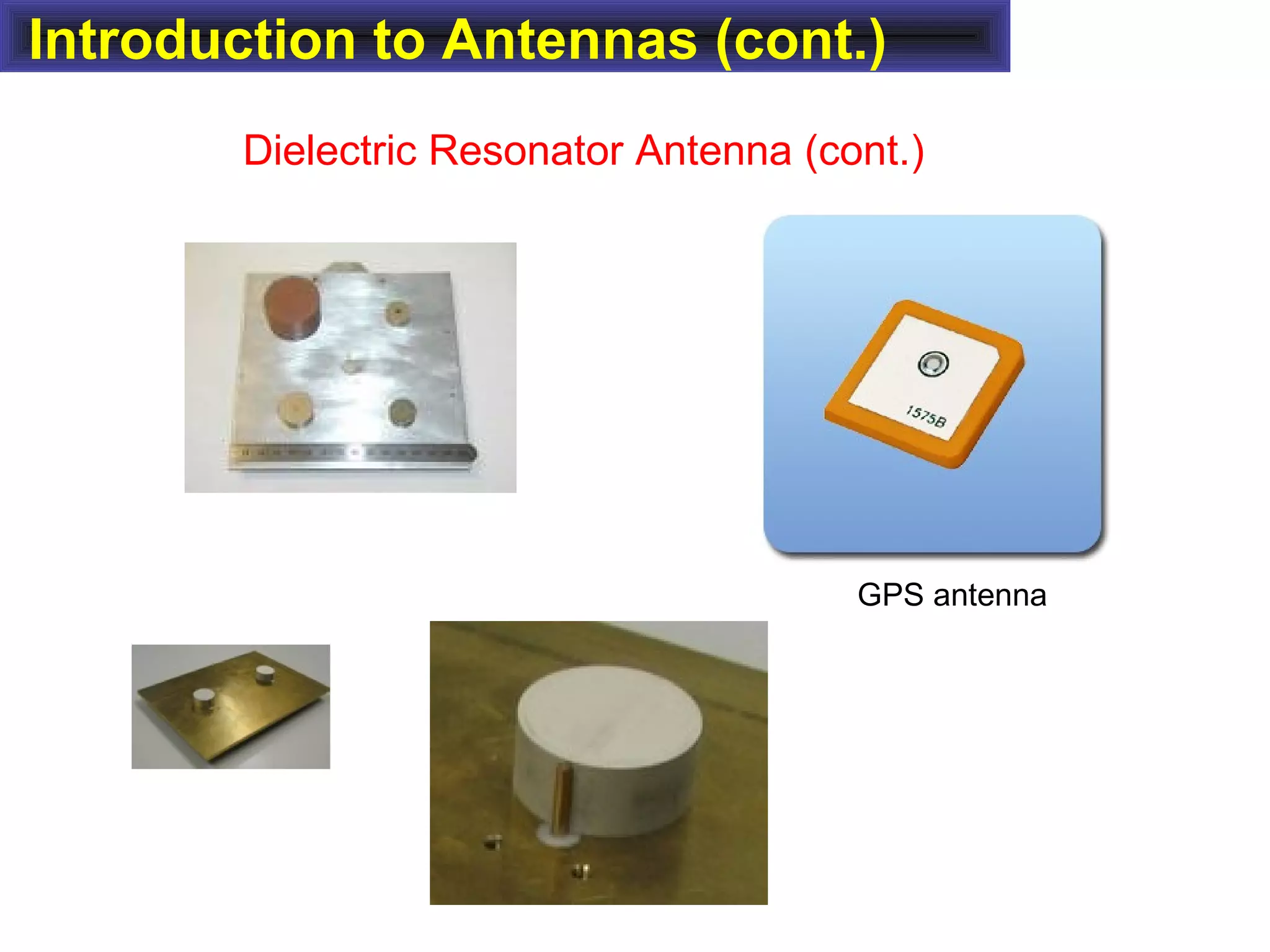
Dielectric Resonator Antenna (cont.)
GPS antenna

Antenna

  • 1.
    Prof. D. R.Wilton Notes 21Notes 21 Introduction to AntennasIntroduction to Antennas ECE 3317 [Chapter 7]
  • 2.
    Introduction to Antennas Antennas Anantenna is a device that is used to transmit and/or receive an electromagnetic wave. Examples:  Cell-phone antenna (transmit and receive)  Wireless LAN antenna (transmit and receive)  FM radio antenna (receive only)  Satellite dish antenna (receive only)  Satellite (possibly separate receive and transmit) The antenna itself can always transmit or receive, but in a given application it may be used for just one of these functions.
  • 3.
    Introduction to Antennas(cont.)  For communication over long distances, to have lower loss  Where waveguiding systems (e.g., transmission lines) are impractical or inconvenient  When it is desired to communicate with many users at once Antennas are often used for a variety of reasons: Power loss from waveguiding system: Power loss from antenna broadcast: 2 1/ r 2 r e α− r A B
  • 4.
    Introduction to Antennas Mainproperties of antennas:  Radiation pattern  Directivity (how directional the beam is)  Efficiency (power radiated relative to total input power)  Polarization (linear, CP)  Bandwidth (the useable frequency range)  Input Impedance An antenna is essentially a matching device between a transmission line and a wave radiating into some region of space
  • 5.
    Introduction to Antennas(cont.) Reflector (dish) antenna  Very high bandwidth  Medium to high directivity (directivity determined by the size)  Linear or CP polarization (depending on how it is fed)  Works by focusing the incoming wave to a collection (feed) point
  • 6.
    Introduction to Antennas(cont.) Dipole Wire Antenna  Very simple  Moderate bandwidth  Low directivity  Most commonly fed by a twinline transmission line  Linear polarization (Eθ , assuming wire is along z axis)  The antenna is resonant when the length is about one-half free-space wavelength current 0 / 2L λ≈
  • 7.
    Introduction to Antennas(cont.) Dipole Wire Antenna (cont.)
  • 8.
    Introduction to Antennas(cont.) Monopole Wire Antenna This is a variation of the dipole, using a ground plane instead of a second wire. h Feeding coax 0 / 4h λ≈  Similar properties as dipole  Mainly use for vertical polarization, with coaxial cable feeds
  • 9.
    Introduction to Antennas(cont.) Monopole Wire Antenna (cont.)
  • 10.
    Introduction to Antennas(cont.) Yagi Antenna This is a variation of the dipole, using multiples wires (with one “reflector” and one or more “directors”.  Low bandwidth  Moderate to high directivity  Commonly used as a UHF TV antenna Prof. Yagi
  • 11.
    Introduction to Antennas(cont.) Yagi Antenna (cont.) UHF Yagi VHF Log-periodic UHF Yagi UHF Yagi
  • 12.
    Introduction to Antennas(cont.) Log-Periodic Antenna This consists of multiple dipole antennas of varying lengths, connected together.  High bandwidth  Moderate directivity  Commonly used as a VHF TV antenna
  • 13.
    Introduction to Antennas(cont.) Log Periodic Antenna (cont.)
  • 14.
    Introduction to Antennas(cont.) Typical Outdoor TV Antenna VHF Log-periodic UHF Yagi
  • 15.
    Introduction to Antennas(cont.) Horn Antenna It acts like a “loudspeaker” for electromagnetic waves.  High bandwidth  Moderate directivity  Commonly used at microwave frequencies and above  Often used as a feed for a reflector antenna
  • 16.
    Introduction to Antennas(cont.) Horn Antenna (cont.) Arno A. Penzias and Robert W. Wilson used a large horn antenna to detect microwave signals from the “big bang” (Nobel Prize, 1978).
  • 17.
    Introduction to Antennas(cont.) Horn Antenna (cont.) This is a variety called the “hoghorn antenna (a combination of horn+reflector).
  • 18.
    Introduction to Antennas(cont.) Microstrip (Patch) Antenna It consists of a printed “patch” of metal that is on top of a grounded dielectric substrate.  Low bandwidth  Low directivity (unless used in an array)  Low-profile (h can be made very small, at the expense of bandwidth)  Can be made by etching  Easily fed by microstrip line or coaxial cable  Can be made conformable (mounted on a curved surface)  Commonly used at microwave frequencies and above 01 / 2 2 d r L λ λ ε ≈ =x y h L W x y h L W rε current
  • 19.
    Introduction to Antennas(cont.) Microstrip (Patch) Antenna (cont.)
  • 20.
    Introduction to Antennas(cont.) Dielectric Resonator Antenna It consists of a dielectric material (such as ceramic) on top of a grounded dielectric substrate.  Moderate bandwidth  Low directivity (unless used in an array)  Commonly used at microwave frequencies and above The dielectric resonator antenna was invented by Prof. Stuart Long of UH ECE!
  • 21.
    Introduction to Antennas(cont.) Dielectric Resonator Antenna (cont.) GPS antenna