Presentation gives by: Sheth Purna K.
EC STUDENT
At VGEC,Chandkheda
Overview
 Introduction
 Description
 Working
 Types
 Advantages
 Disadvantages
 Applications
What is Horn Antenna?
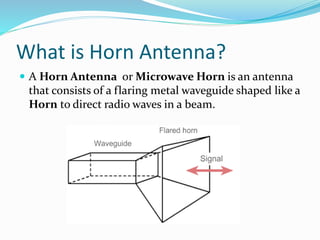
 A Horn Antenna or Microwave Horn is an antenna
that consists of a flaring metal waveguide shaped like a
Horn to direct radio waves in a beam.
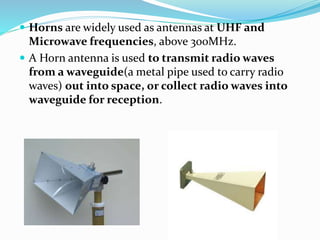
 Horns are widely used as antennas at UHF and
Microwave frequencies, above 300MHz.
 A Horn antenna is used to transmit radio waves
from a waveguide(a metal pipe used to carry radio
waves) out into space, or collect radio waves into
waveguide for reception.
Description
 It typically consists of a short length of rectangular or
cylindrical metal tube (the waveguide), closed at one
end, flaring into an open-ended conical or pyramidal
shaped horn on the other end.
 The radio waves are usually introduced into the
waveguide by a coaxial cable attached to the side,
with the central conductor projecting into the
waveguide to form a quarter-wave monopole
antenna.
 The waves then radiate out the horn end in a narrow
beam.
Working
 Horn Antenna converts the electric power into radio
waves and vise versa.
 It is usually used with a radio transmitter or radio
receiver.
 It provides a gradual transition structure to match the
impedance of a tube to the impedance of free space,
enabling the waves from the tube to radiate efficiently
into space.
Types
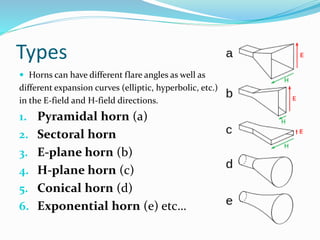
 Horns can have different flare angles as well as
different expansion curves (elliptic, hyperbolic, etc.)
in the E-field and H-field directions.
1. Pyramidal horn (a)
2. Sectoral horn
3. E-plane horn (b)
4. H-plane horn (c)
5. Conical horn (d)
6. Exponential horn (e) etc…
Pyramidal horn
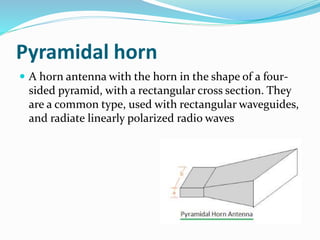
 A horn antenna with the horn in the shape of a four-
sided pyramid, with a rectangular cross section. They
are a common type, used with rectangular waveguides,
and radiate linearly polarized radio waves
Sectoral horn
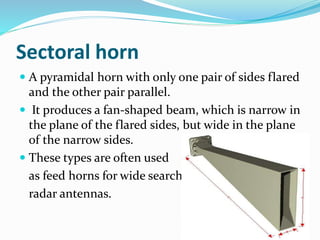
 A pyramidal horn with only one pair of sides flared
and the other pair parallel.
 It produces a fan-shaped beam, which is narrow in
the plane of the flared sides, but wide in the plane
of the narrow sides.
 These types are often used
as feed horns for wide search
radar antennas.
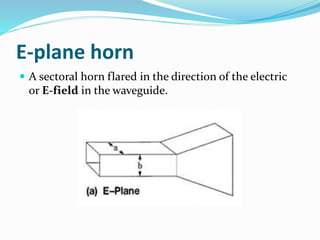
E-plane horn
 A sectoral horn flared in the direction of the electric
or E-field in the waveguide.
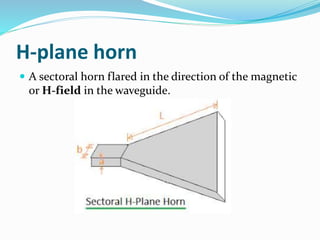
H-plane horn
 A sectoral horn flared in the direction of the magnetic
or H-field in the waveguide.
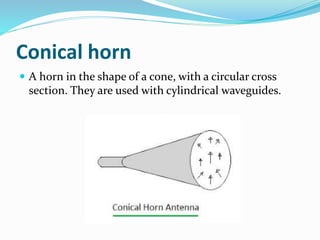
Conical horn
 A horn in the shape of a cone, with a circular cross
section. They are used with cylindrical waveguides.
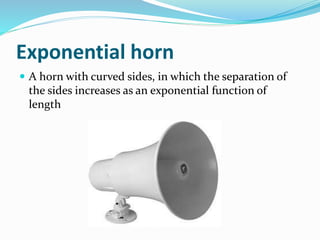
Exponential horn
 A horn with curved sides, in which the separation of
the sides increases as an exponential function of
length
Advantages
 It is simple in construction.
 They can operate over wide range of frequencies.
 Very wide bandwidth, for example allowing it to
operate from 1GHz to 20GHz
 High Directivity
 High Gain
 Support for wide applications
Disadvantages
 Horn antenna radiates energy in spherical wave front
shape, as a result horn antenna does not provide
sharp/directive beam.
 Usually gain of horn antenna is limited to 20dB. This is
due to the fact that in order to increase the gain when
the horn opening is made larger, the length of horn
also becomes excessive.
Applications
 In Satellite and Microwave communication
 In TV base station
 A common element of phase array
 They are used as a feeders(called feed horn) for larger
antenna structures such as parabolic antennas, as
directive antennas for such devices as radar guns,
automatic doors openers, microwave radiometer.
Thank you

Horn antenna

  • 1.
    Presentation gives by:Sheth Purna K. EC STUDENT At VGEC,Chandkheda
  • 2.
    Overview  Introduction  Description Working  Types  Advantages  Disadvantages  Applications
  • 3.
    What is HornAntenna?  A Horn Antenna or Microwave Horn is an antenna that consists of a flaring metal waveguide shaped like a Horn to direct radio waves in a beam.
  • 4.
     Horns arewidely used as antennas at UHF and Microwave frequencies, above 300MHz.  A Horn antenna is used to transmit radio waves from a waveguide(a metal pipe used to carry radio waves) out into space, or collect radio waves into waveguide for reception.
  • 5.
    Description  It typicallyconsists of a short length of rectangular or cylindrical metal tube (the waveguide), closed at one end, flaring into an open-ended conical or pyramidal shaped horn on the other end.  The radio waves are usually introduced into the waveguide by a coaxial cable attached to the side, with the central conductor projecting into the waveguide to form a quarter-wave monopole antenna.  The waves then radiate out the horn end in a narrow beam.
  • 6.
    Working  Horn Antennaconverts the electric power into radio waves and vise versa.  It is usually used with a radio transmitter or radio receiver.  It provides a gradual transition structure to match the impedance of a tube to the impedance of free space, enabling the waves from the tube to radiate efficiently into space.
  • 7.
    Types  Horns canhave different flare angles as well as different expansion curves (elliptic, hyperbolic, etc.) in the E-field and H-field directions. 1. Pyramidal horn (a) 2. Sectoral horn 3. E-plane horn (b) 4. H-plane horn (c) 5. Conical horn (d) 6. Exponential horn (e) etc…
  • 8.
    Pyramidal horn  Ahorn antenna with the horn in the shape of a four- sided pyramid, with a rectangular cross section. They are a common type, used with rectangular waveguides, and radiate linearly polarized radio waves
  • 9.
    Sectoral horn  Apyramidal horn with only one pair of sides flared and the other pair parallel.  It produces a fan-shaped beam, which is narrow in the plane of the flared sides, but wide in the plane of the narrow sides.  These types are often used as feed horns for wide search radar antennas.
  • 10.
    E-plane horn  Asectoral horn flared in the direction of the electric or E-field in the waveguide.
  • 11.
    H-plane horn  Asectoral horn flared in the direction of the magnetic or H-field in the waveguide.
  • 12.
    Conical horn  Ahorn in the shape of a cone, with a circular cross section. They are used with cylindrical waveguides.
  • 13.
    Exponential horn  Ahorn with curved sides, in which the separation of the sides increases as an exponential function of length
  • 14.
    Advantages  It issimple in construction.  They can operate over wide range of frequencies.  Very wide bandwidth, for example allowing it to operate from 1GHz to 20GHz  High Directivity  High Gain  Support for wide applications
  • 15.
    Disadvantages  Horn antennaradiates energy in spherical wave front shape, as a result horn antenna does not provide sharp/directive beam.  Usually gain of horn antenna is limited to 20dB. This is due to the fact that in order to increase the gain when the horn opening is made larger, the length of horn also becomes excessive.
  • 16.
    Applications  In Satelliteand Microwave communication  In TV base station  A common element of phase array  They are used as a feeders(called feed horn) for larger antenna structures such as parabolic antennas, as directive antennas for such devices as radar guns, automatic doors openers, microwave radiometer.
  • 17.