AAVVIIOONNIICCSS 
TTEECCHHNNOOLLOOGGYY 
VVeerryy HHiigghh FFrreeqquueennccyy 
((VVHHFF)) CCoommmmuunniiccaattiioonn 
VHF communication systems are employed largely for controlling air 
traffic. 
These systems are installed in all types of aircraft so the pilot may be 
given information and directions and may request information from air 
traffic control centers, control towers, and flight service stations. 
On the approach to any airport with two-way radio facilities, the pilot 
of an aircraft calls the tower and requests information and landing 
instructions. 
In airline operations and all instrument flights, the flight of an aircraft 
is continuously monitored by air traffic control (ATC), and the aircraft's 
crew is given instructions as necessary to maintain conditions of safe 
flight. 
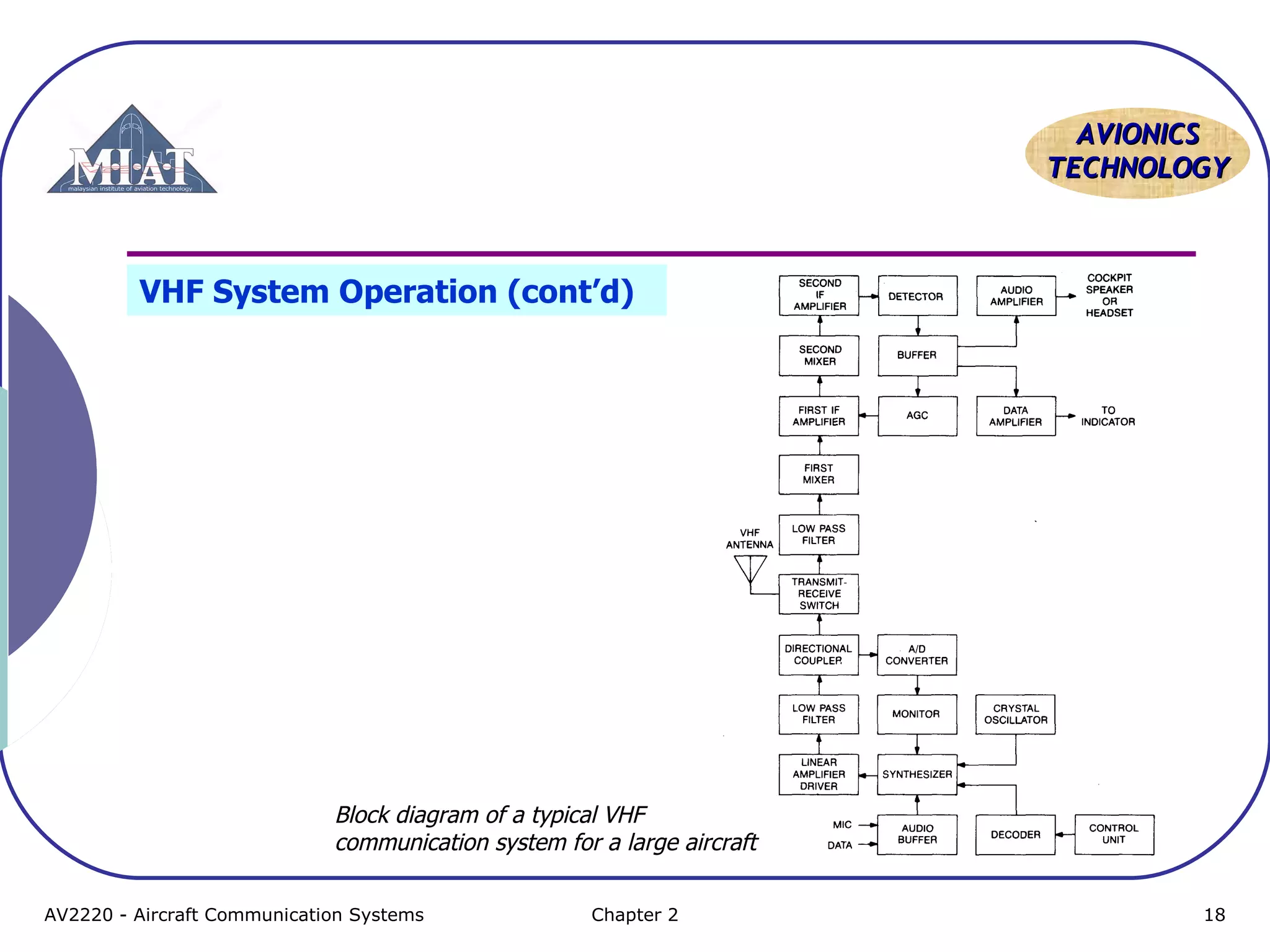
AV2220 - Aircraft Communication Systems Chapter 2 1
AAVVIIOONNIICCSS 
TTEECCHHNNOOLLOOGGYY 
VHF communication systems operate in the frequency range of 118 to 
136.975 MHz. For international operations the frequencies may extend 
to 151.975 MHz. 
The nature of radio-wave propagation at these frequencies is such 
that communication is limited to line-of-sight distances. 
The advantage of VHF communication, however, is that the signals are 
not often distorted or rendered unintelligible by static and other types 
of interference. 
VHF communication radios are currently available with 720, 760, or 
360 channels. 
 The 720- or 760-channel radio is preferred by most pilots owing to 
its versatility in frequency selection. 
AV2220 - Aircraft Communication Systems Chapter 2 2
AAVVIIOONNIICCSS 
TTEECCHHNNOOLLOOGGYY 
In 1976 the FAA changed the minimum frequency spacing for VHF 
systems from 50 to 25 kHz between 118 and 135.975 MHz. 
 This change made the 720- channel radio possible. 
Recently the FAA and FCC authorized the general use of frequencies 
up to 136.975 MHz. 
 This change added 40 channels to increase the selection to 760 
channels. 
 Some older 360-channel radios are still in use; however, they are 
quickly becoming obsolete. 
AV2220 - Aircraft Communication Systems Chapter 2 3
AAVVIIOONNIICCSS 
TTEECCHHNNOOLLOOGGYY 
VHF System Description 
Aircraft VHF communication systems consists of a VHF transceiver, control 
head, antenna, and an interface to the aircraft audio system for access to the 
microphone and cockpit speaker. 
In light aircraft, the transceiver is mounted in the instrument panel and 
contains all the necessary controls and displays. 
In larger aircraft, the control head, which is used for selecting the receiver and 
transmitter frequencies, is usually located in the center console between the 
pilot and copilot, and the transceiver is remotely located in the radio rack aft or 
below the crew station. 
VHF communication transmitters provide AM voice communication transmission 
between aircraft and ground stations or between aircraft. 
AV2220 - Aircraft Communication Systems Chapter 2 4
AAVVIIOONNIICCSS 
TTEECCHHNNOOLLOOGGYY 
VHF System Description (cont’d) 
Because of the nature of VHF radio signals, the average communicating - 
distance from aircraft to ground is: 
 Approximately 30 mi [48 km] when the airplane is flying at 1000 ft [305 m] 
 Approximately 135 mi [217 km] when the airplane is at 10,000 ft [3048 m]. 
Transmitting frequency is determined by the position of the selector switches 
on the VHF control panel. 
The transmitter is tuned at the same time and to the same frequency as the 
receiver. 
The most modern VHF communication radios incorporate the latest digital 
design features. 
In general, the use of microprocessors and digital circuits has allowed for a 50 
percent reduction in parts count and an 80 percent reduction in internal shop 
adjustments as compared with the use of analog circuits. 
AV2220 - Aircraft Communication Systems Chapter 2 5
AAVVIIOONNIICCSS 
TTEECCHHNNOOLLOOGGYY 
VHF System Description (cont’d) 
A modular design of a modern digital system reduces maintenance time by 
providing easy access to all circuit boards and components. 
VHF communication equipment for light aircraft is typically combined with a 
VHF navigation (NAV) radio system. 
The VHF transceiver is a solid-state or digital system that can receive or 
transmit on any one of the 720 channels in the COMM range of frequencies. 
The frequencies are spaced at 25-kHz intervals throughout the range. 
Frequencies are selected simultaneously for both the receiver and the 
transmitter by rotating the frequency selector knobs. 
 The large outer knob is used to change the megahertz portion of the frequency 
display, and the smaller concentric knob changes the kilohertz portion. 
 The small knob will change the frequency in 50-kHz increments when it is 
pushed in and in 25-kHz increments when it is pulled out. 
AV2220 - Aircraft Communication Systems Chapter 2 6
AAVVIIOONNIICCSS 
TTEECCHHNNOOLLOOGGYY 
VHF System Description (cont’d) 
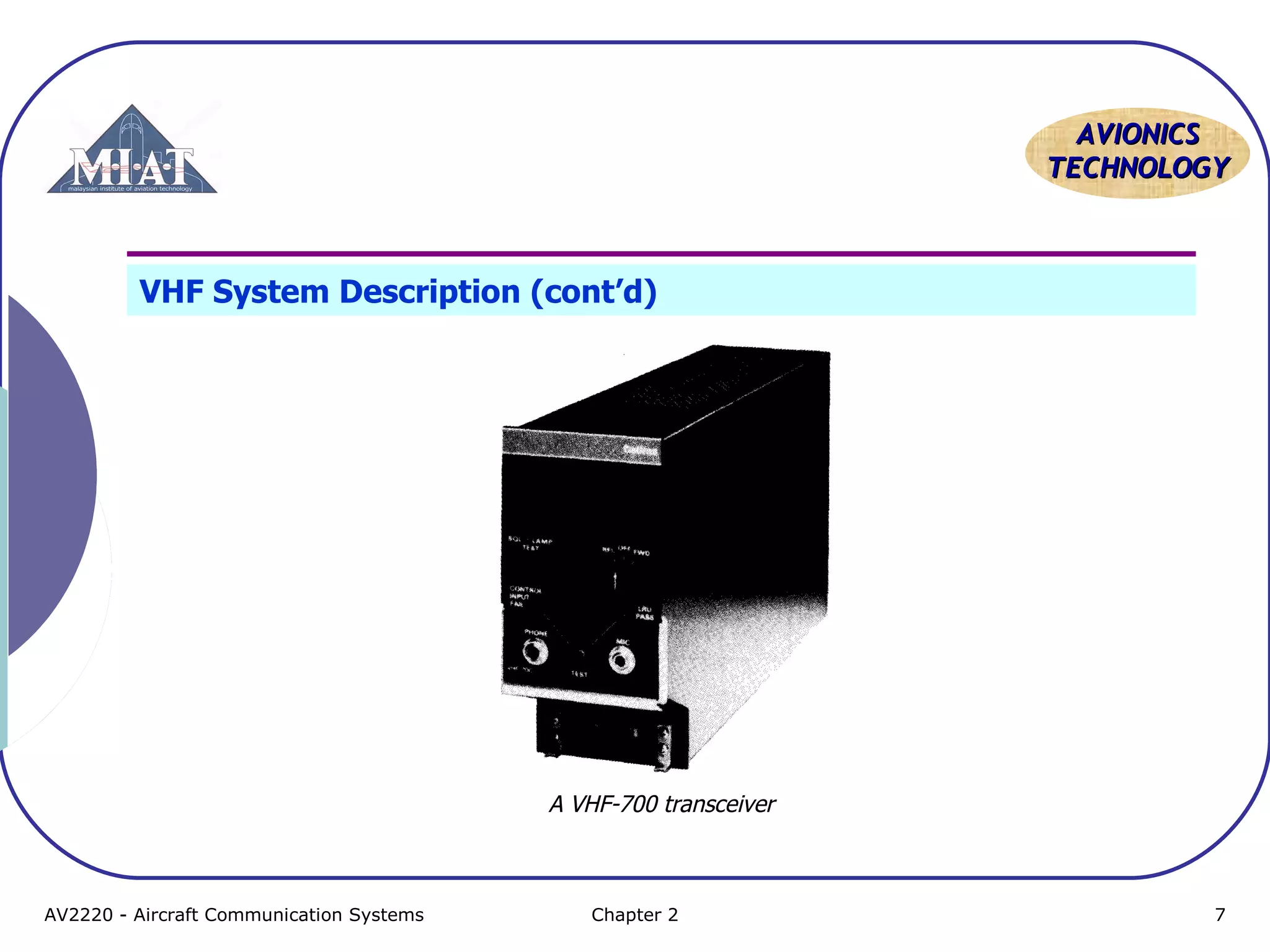
A VHF-700 transceiver 
AV2220 - Aircraft Communication Systems Chapter 2 7
AAVVIIOONNIICCSS 
TTEECCHHNNOOLLOOGGYY 
VHF Transceiver Frequency Selection 
Some control heads employ a universally accepted 2-out-of-5 frequency 
selection scheme. 
Other control heads use a digital serial data bus, such as ARINC 429, to select 
the desired frequency of a remotely-mounted transceiver. 
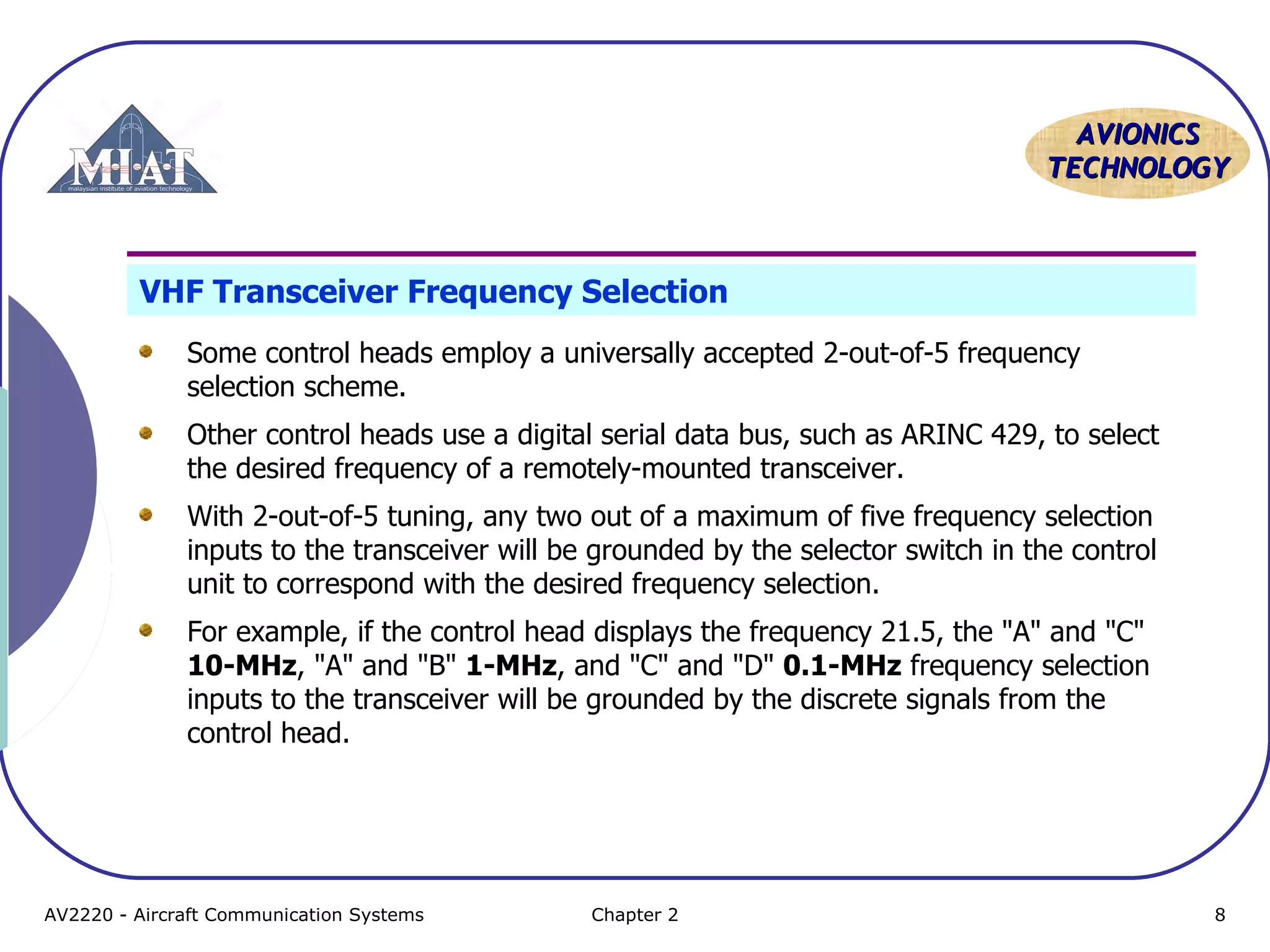
With 2-out-of-5 tuning, any two out of a maximum of five frequency selection 
inputs to the transceiver will be grounded by the selector switch in the control 
unit to correspond with the desired frequency selection. 
For example, if the control head displays the frequency 21.5, the "A" and "C" 
10-MHz, "A" and "B" 1-MHz, and "C" and "D" 0.1-MHz frequency selection 
inputs to the transceiver will be grounded by the discrete signals from the 
control head. 
AV2220 - Aircraft Communication Systems Chapter 2 8
AAVVIIOONNIICCSS 
TTEECCHHNNOOLLOOGGYY 
VHF Transceiver Frequency Selection (cont’d) 
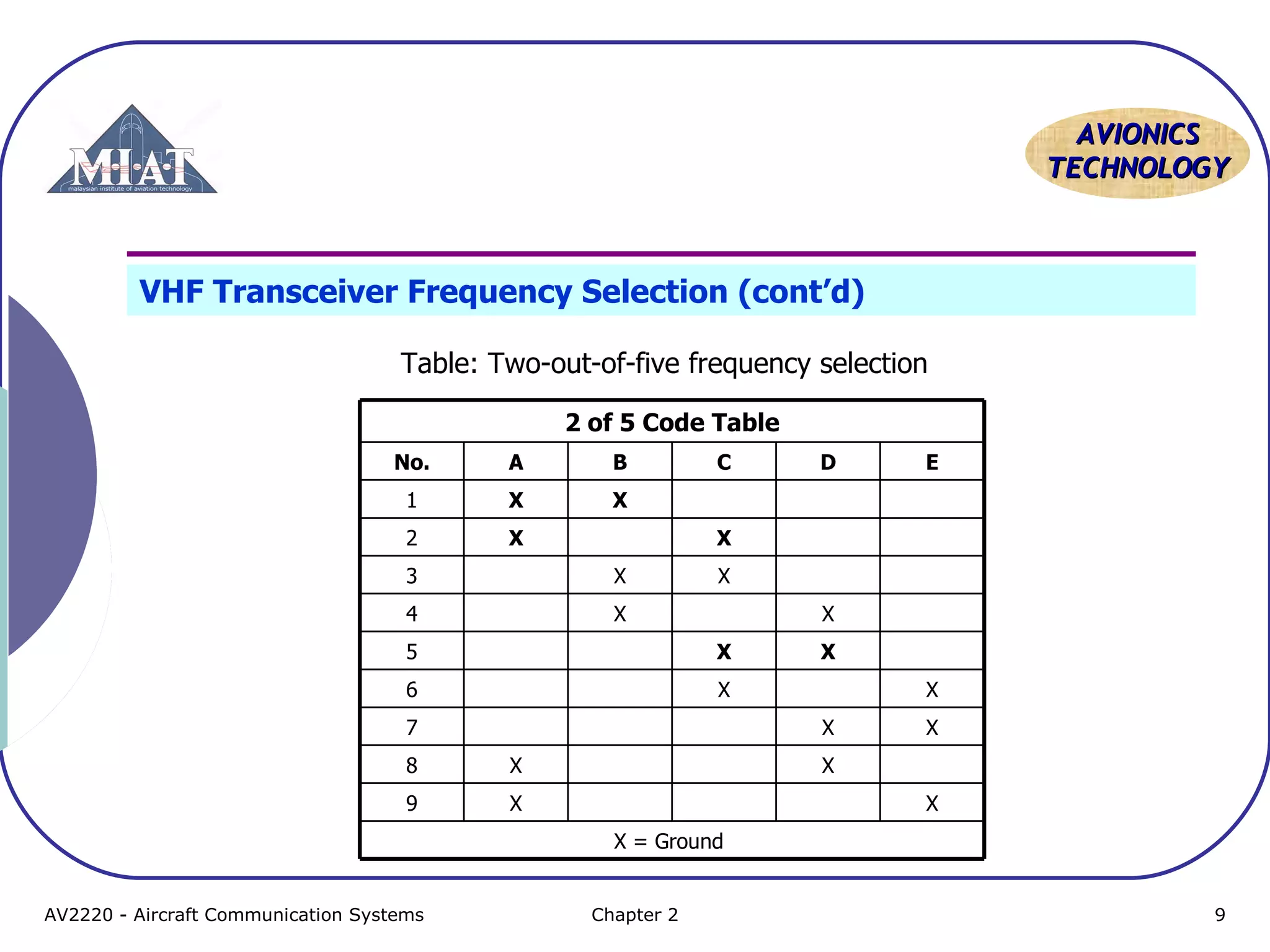
Table: Two-out-of-five frequency selection 
2 of 5 Code Table 
No. A B C D E 
1 X X 
2 X X 
3 X X 
4 X X 
5 X X 
6 X X 
7 X X 
8 X X 
9 X X 
X = Ground 
AV2220 - Aircraft Communication Systems Chapter 2 9
AAVVIIOONNIICCSS 
TTEECCHHNNOOLLOOGGYY 
VHF Transceiver Frequency Selection (cont’d) 
The ARINC 429 serial data bus provides a balanced differential signal using 
nominally zero to 5-volt switching levels from the control head. 
ARINC 429 is also used to send digital data from the avionics equipment to the 
cockpit displays. 
ARINC 429 messages are comprised of 32-bit data words. 
Each bit in the data word is set at either V if no voltage is present, or "1” if +5 
volts DC is present. 
This serial data stream runs across the two-wire bus at speeds of up to 100 
kilobits per second using a command-response protocol. 
The message format requires that a record, consisting of up to 126 data words, 
begin with an initial word that notifies the receiving unit that a message is 
being sent, and ends with a final word that is used to test for errors in the 
record. 
AV2220 - Aircraft Communication Systems Chapter 2 10
AAVVIIOONNIICCSS 
TTEECCHHNNOOLLOOGGYY 
VHF Transceiver Frequency Selection (cont’d) 
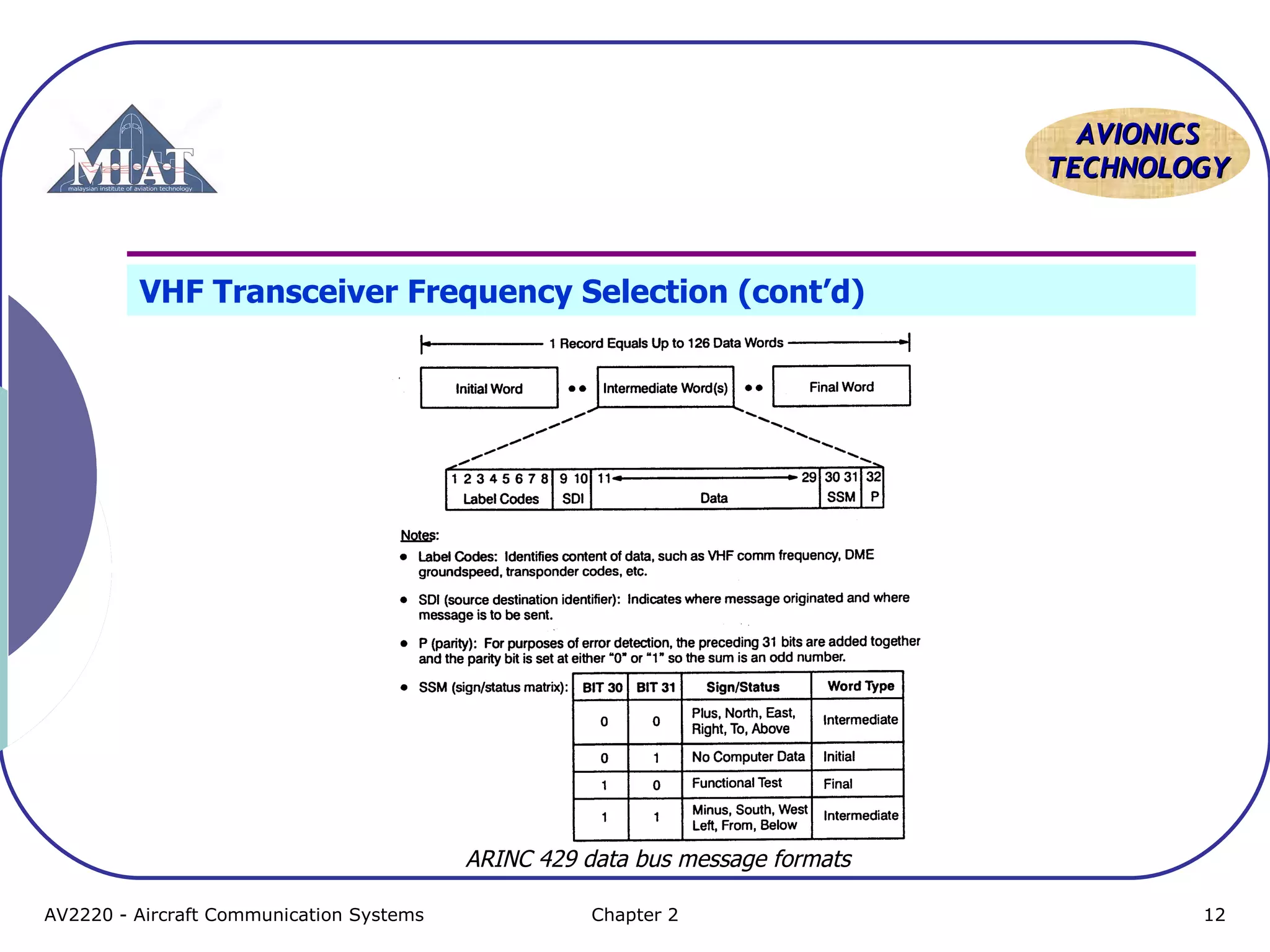
Initial words and final words do not contain data in bits 11 through 29. 
The first 8 bits in the initial word may contain one of the following messages: 
Request to Send, Clear to Send, Data Follows, Data Received OK, Data 
Received Not OK, or Sync Lost. 
The first 8 bits in the final word is the file label, and bits 9 through 29 is the 
error control checksum, which is the addition of bits 9 through 29 in all the 
intermediate words in the record. 
ARINC 429 does not provide for error correction, but only error detection within 
the serial data stream. 
Typically, manufacturers of avionics systems will provide not only ARINC 429, 
but a variation of this format, such as the Collins Commercial Standard 
Digital Bus (CSDB), as their own unique data bus to be used for sending and 
receiving data between only their brands of equipment. 
AV2220 - Aircraft Communication Systems Chapter 2 11
AAVVIIOONNIICCSS 
TTEECCHHNNOOLLOOGGYY 
VHF Transceiver Frequency Selection (cont’d) 
ARINC 429 data bus message formats 
AV2220 - Aircraft Communication Systems Chapter 2 12
AAVVIIOONNIICCSS 
TTEECCHHNNOOLLOOGGYY 
VHF Control Panel 
To tune the transceiver to the 
desired operating frequency, it is 
necessary to first enter the selected 
frequency into the STANDBY 
display. 
The frequency is then activated by 
pushing the transfer button, and 
the word USE will be displayed. 
Another frequency may then be 
entered into the STANDBY mode. 
The STANDBY mode will store the 
selected frequency to allow for a 
"quick switch" of the frequency 
being used by the receiver. 
This becomes very helpful while 
operating an aircraft in crowded 
airspace in which several 
communication frequencies are 
used for air traffic control. 
Control panels for VHF 
communication systems vary in 
design, depending on the 
manufacturer of the equipment and 
the requirements of the aircraft 
manufacturer. 
Typically, the control panel located 
in the flight deck contains the 
frequency selectors and the digital 
displays for the main and standby 
frequencies. 
AV2220 - Aircraft Communication Systems Chapter 2 13
AAVVIIOONNIICCSS 
TTEECCHHNNOOLLOOGGYY 
VHF Control Panel (cont’d) 
Most VHF systems for corporate 
and transport-category aircraft use 
a separate radio control panel, and 
the receiver transmitter (r-t) is 
located in the electric equipment 
center. 
Also on these aircraft, the VHF 
communication radio system is 
often independent of the VHF 
navigation system. 
On light aircraft the r-t and control 
panel are often one unit mounted in 
the instrument panel. 
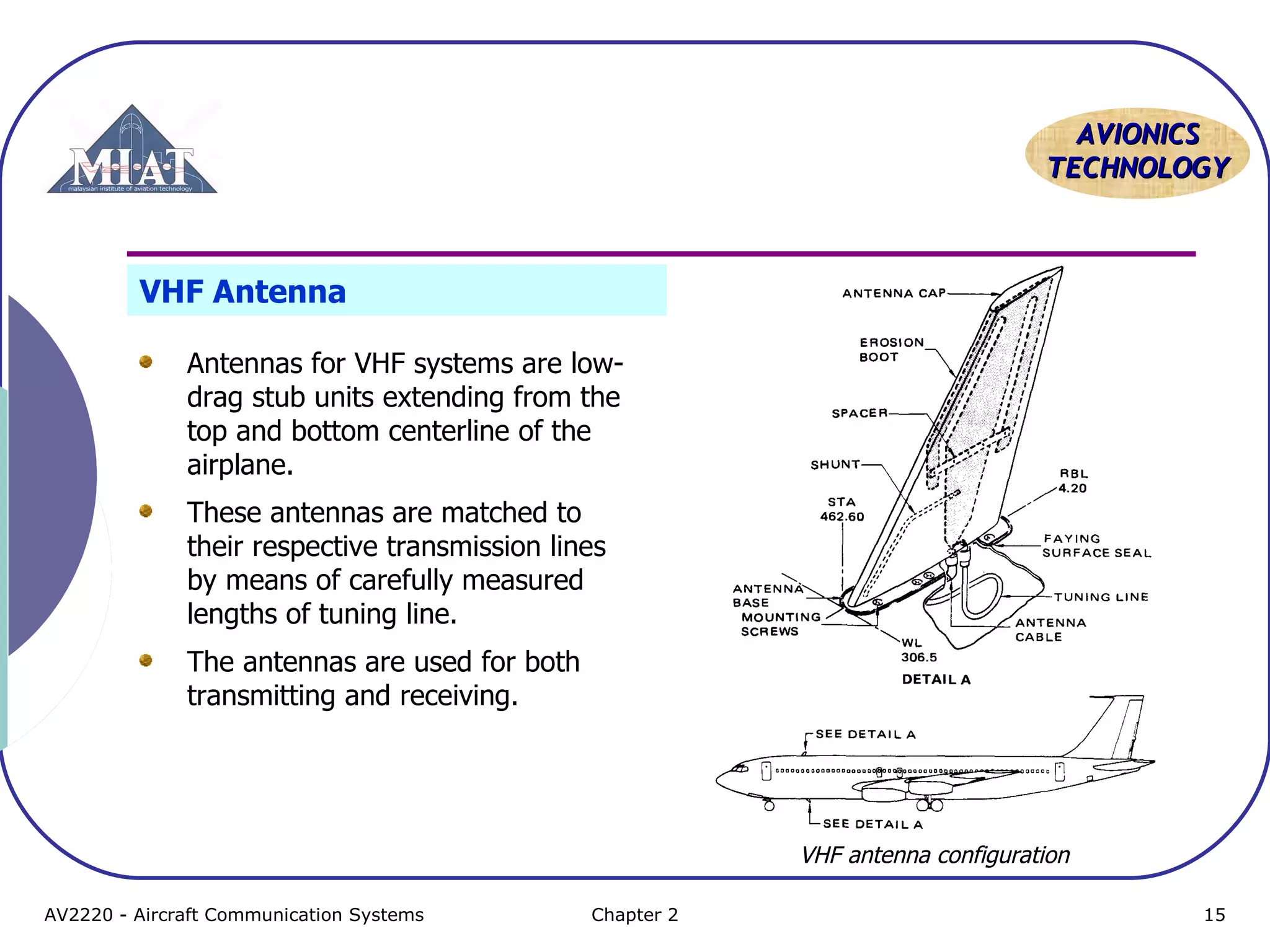
A VHF instrument panel 
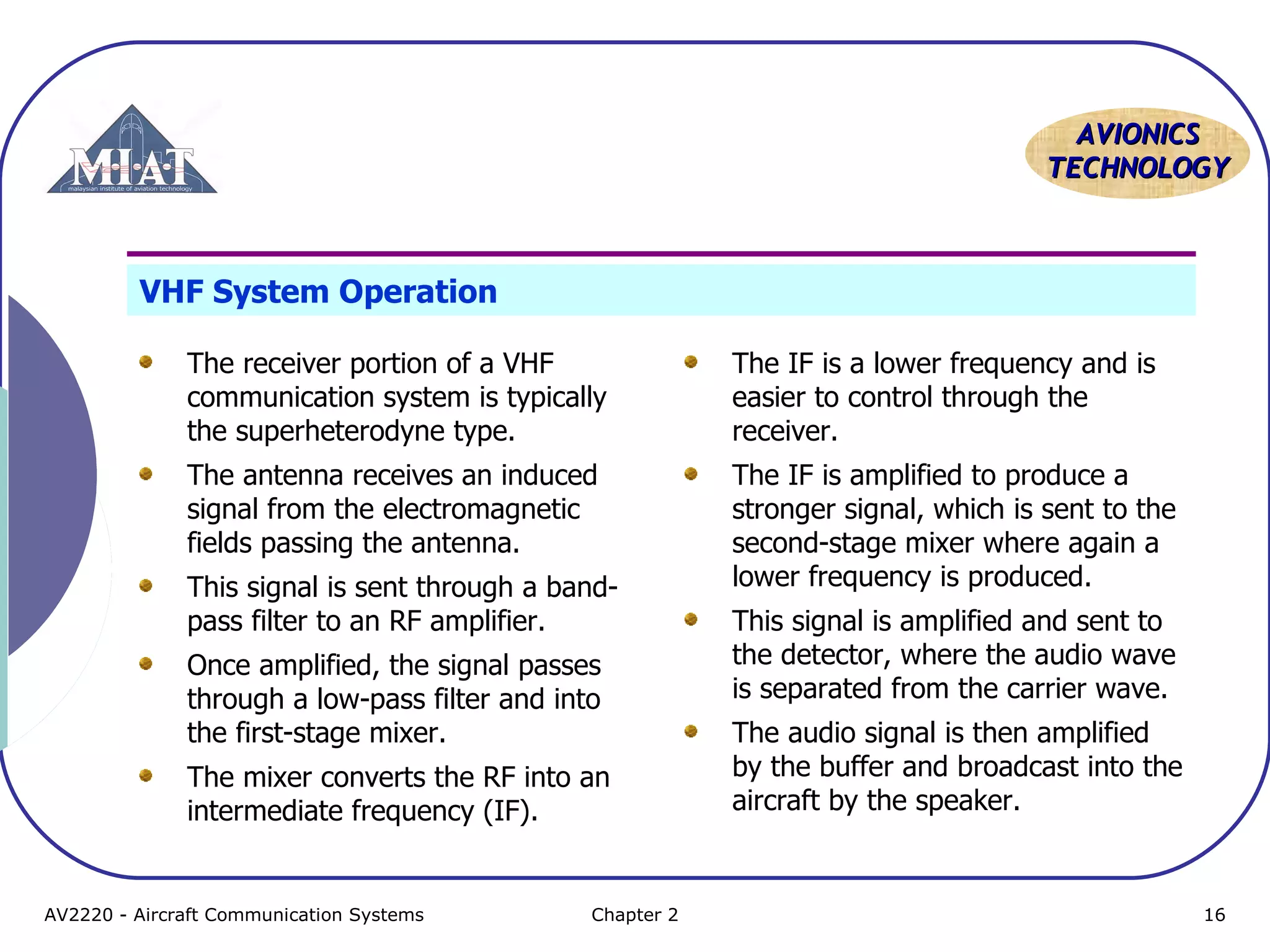
Interior of a VHF communication radio 
AV2220 - Aircraft Communication Systems Chapter 2 14
AAVVIIOONNIICCSS 
TTEECCHHNNOOLLOOGGYY 
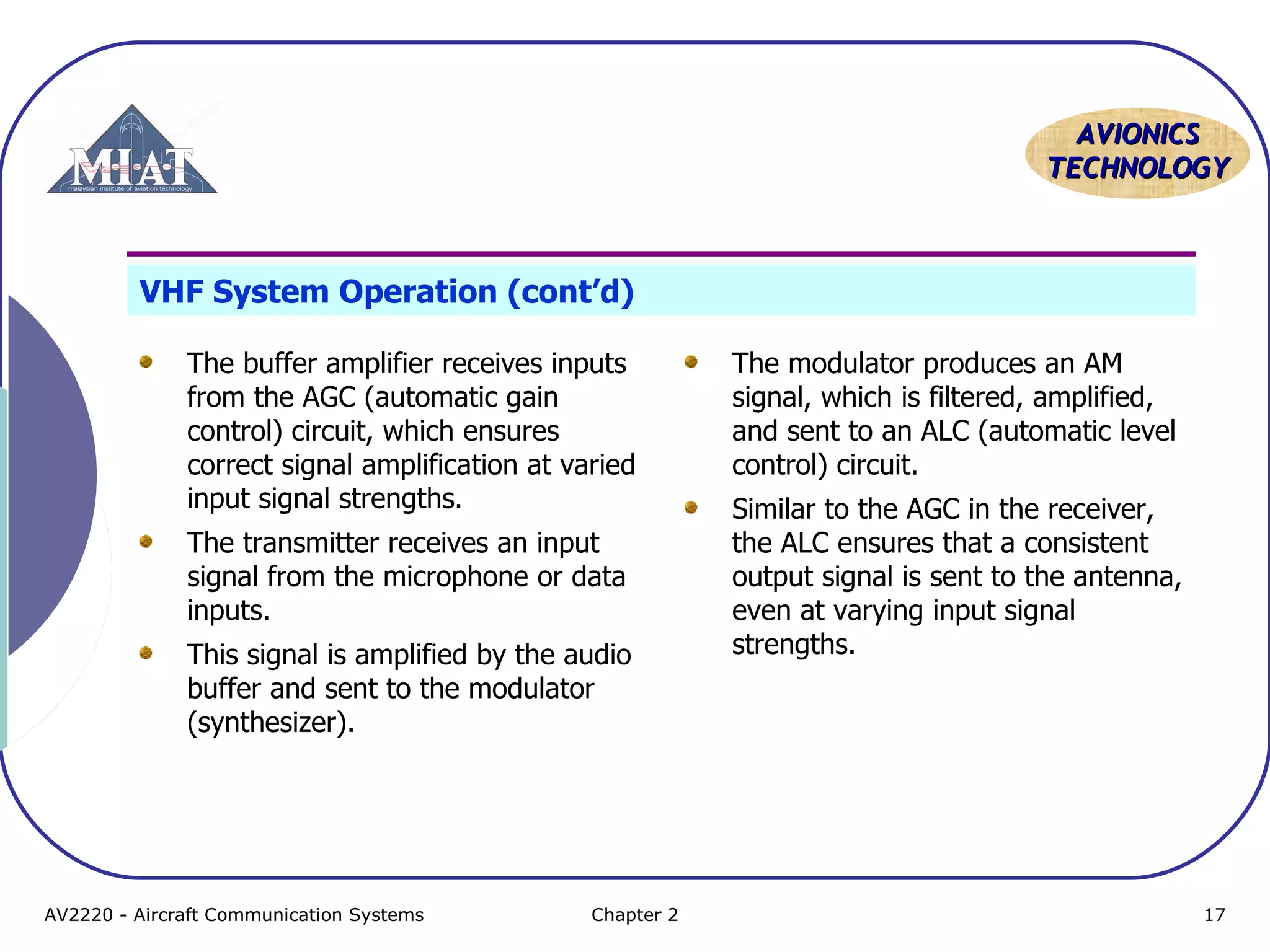
VHF Antenna 
Antennas for VHF systems are low-drag 
stub units extending from the 
top and bottom centerline of the 
airplane. 
These antennas are matched to 
their respective transmission lines 
by means of carefully measured 
lengths of tuning line. 
The antennas are used for both 
transmitting and receiving. 
VHF antenna configuration 
AV2220 - Aircraft Communication Systems Chapter 2 15
AAVVIIOONNIICCSS 
TTEECCHHNNOOLLOOGGYY 
VHF System Operation 
The receiver portion of a VHF 
communication system is typically 
the superheterodyne type. 
The antenna receives an induced 
signal from the electromagnetic 
fields passing the antenna. 
This signal is sent through a band-pass 
filter to an RF amplifier. 
Once amplified, the signal passes 
through a low-pass filter and into 
the first-stage mixer. 
The mixer converts the RF into an 
intermediate frequency (IF). 
The IF is a lower frequency and is 
easier to control through the 
receiver. 
The IF is amplified to produce a 
stronger signal, which is sent to the 
second-stage mixer where again a 
lower frequency is produced. 
This signal is amplified and sent to 
the detector, where the audio wave 
is separated from the carrier wave. 
The audio signal is then amplified 
by the buffer and broadcast into the 
aircraft by the speaker. 
AV2220 - Aircraft Communication Systems Chapter 2 16
AAVVIIOONNIICCSS 
TTEECCHHNNOOLLOOGGYY 
VHF System Operation (cont’d) 
The buffer amplifier receives inputs 
from the AGC (automatic gain 
control) circuit, which ensures 
correct signal amplification at varied 
input signal strengths. 
The transmitter receives an input 
signal from the microphone or data 
inputs. 
This signal is amplified by the audio 
buffer and sent to the modulator 
(synthesizer). 
The modulator produces an AM 
signal, which is filtered, amplified, 
and sent to an ALC (automatic level 
control) circuit. 
Similar to the AGC in the receiver, 
the ALC ensures that a consistent 
output signal is sent to the antenna, 
even at varying input signal 
strengths. 
AV2220 - Aircraft Communication Systems Chapter 2 17
AAVVIIOONNIICCSS 
TTEECCHHNNOOLLOOGGYY 
VHF System Operation (cont’d) 
Block diagram of a typical VHF 
communication system for a large aircraft 
AV2220 - Aircraft Communication Systems Chapter 2 18
AAVVIIOONNIICCSS 
TTEECCHHNNOOLLOOGGYY 
Rockwell Collins VHF-20A Transceiver 
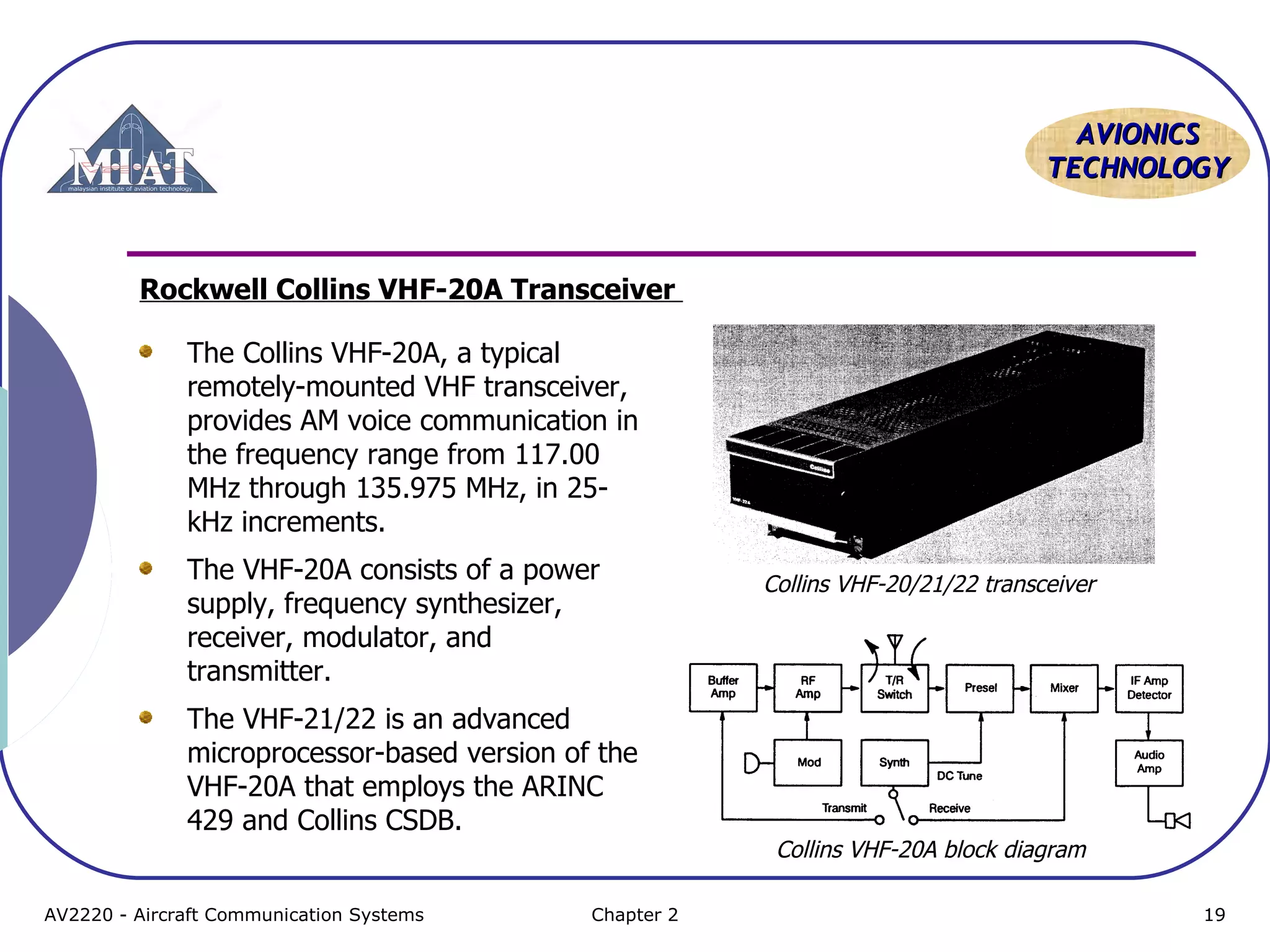
The Collins VHF-20A, a typical 
remotely-mounted VHF transceiver, 
provides AM voice communication in 
the frequency range from 117.00 
MHz through 135.975 MHz, in 25- 
kHz increments. 
The VHF-20A consists of a power 
supply, frequency synthesizer, 
receiver, modulator, and 
transmitter. 
The VHF-21/22 is an advanced 
microprocessor-based version of the 
VHF-20A that employs the ARINC 
429 and Collins CSDB. 
Collins VHF-20/21/22 transceiver 
Collins VHF-20A block diagram 
AV2220 - Aircraft Communication Systems Chapter 2 19
AAVVIIOONNIICCSS 
TTEECCHHNNOOLLOOGGYY 
Rockwell Collins VHF-20A Transceiver (cont’d) 
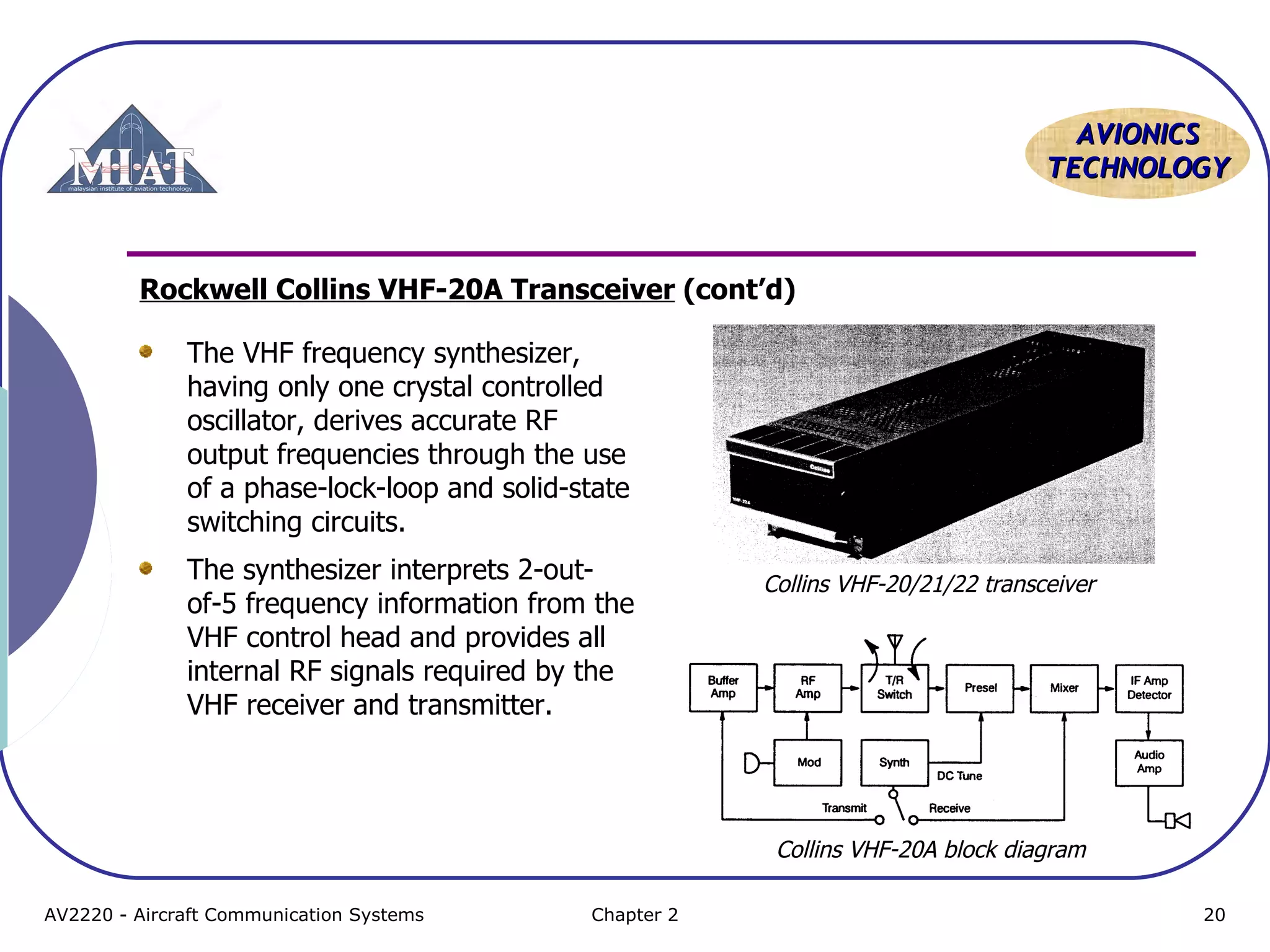
The VHF frequency synthesizer, 
having only one crystal controlled 
oscillator, derives accurate RF 
output frequencies through the use 
of a phase-lock-loop and solid-state 
switching circuits. 
The synthesizer interprets 2-out-of- 
5 frequency information from the 
VHF control head and provides all 
internal RF signals required by the 
VHF receiver and transmitter. 
Collins VHF-20/21/22 transceiver 
Collins VHF-20A block diagram 
AV2220 - Aircraft Communication Systems Chapter 2 20
AAVVIIOONNIICCSS 
TTEECCHHNNOOLLOOGGYY 
Rockwell Collins VHF-20A Transceiver (cont’d) 
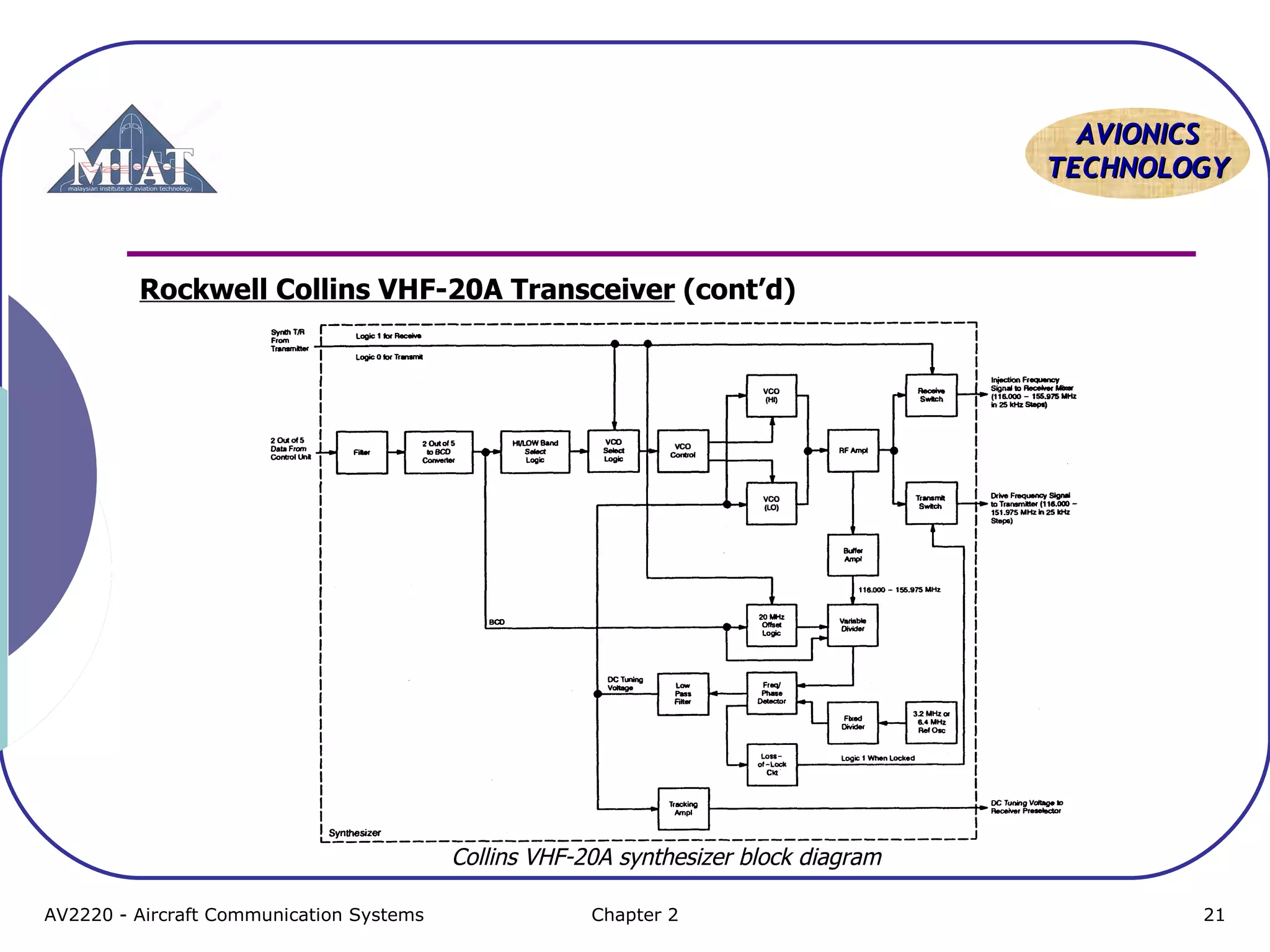
Collins VHF-20A synthesizer block diagram 
AV2220 - Aircraft Communication Systems Chapter 2 21
AAVVIIOONNIICCSS 
TTEECCHHNNOOLLOOGGYY 
Rockwell Collins VHF-20A Transceiver (cont’d) 
In the receive mode, the synthesizer outputs a DC tuning voltage to the 
variable-voltage capacitors in the preselector to eliminate mechanical tuning. 
The synthesizer also applies an injection frequency to the mixer to output a 20- 
MHz IF. 
The 20-MHz IF amplifier, which is AGC controlled, provides the required 
selectivity and signal amplification. 
The detected audio is amplitude and bandpass limited and applied to the audio 
output amplifier. 
Squelch circuits disable the output amplifier if proper signal-to-noise ratio or 
carrier level is not present. 
When the push-to-talk switch on the microphone is applied, the synthesizer 
removes the receiver injection and provides transmitter excitation at the 
selected frequency. 
AV2220 - Aircraft Communication Systems Chapter 2 22
AAVVIIOONNIICCSS 
TTEECCHHNNOOLLOOGGYY 
Rockwell Collins VHF-20A Transceiver (cont’d) 
Power is applied to the transmitter by a +16-volt DC transmit series regulator, 
and the broadband RF amplifiers raise the synthesizer excitation to 20 wafts 
minimum output. 
The RF output is low-pass filtered and applied through the transmit/receive 
switch to the antenna. 
The AM modulator is a variable voltage power supply that varies the transmitter 
drive voltage consistent with the microphone inputs. 
Carrier modulation is detected by a sidetone detector and applied through the 
receiver audio amplifier so the pilot can monitor his or her voice transmissions 
through the aircraft's audio system. 
AV2220 - Aircraft Communication Systems Chapter 2 23
AAVVIIOONNIICCSS 
TTEECCHHNNOOLLOOGGYY 
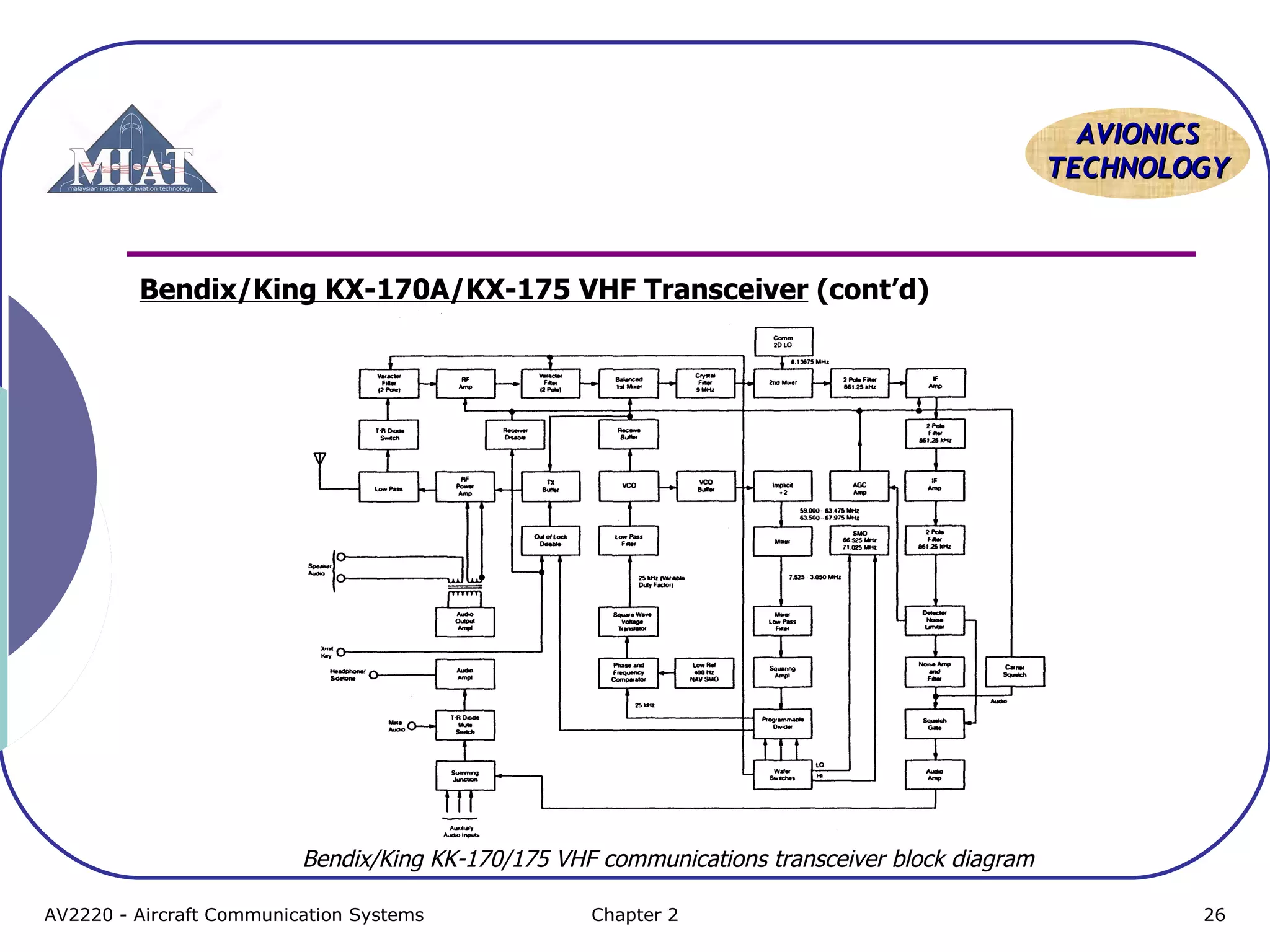
Bendix/King KX-170A/KX-175 VHF Transceiver 
The Bendix/King KX-170A/KX-175 is 
a combination panel-mounted VHF 
communications transceiver and 
navigation receiver that operates on 
either 28-volt or 14-volt DC power. 
The communications section is: 
 Dual-conversion 
 Superheterodyne receiver with a 
9.0-MHz IF 
 861.25-kHz second IF frequency 
 360 channels are synthesized at 
the first mixer 
 Low-side injection is used for 
channels 127.00 MHz to 135.95 
MHz 
 High-side injection for 118.00 
MHz to 126.95 MHz 
Characteristics of Bendix/King 
KX-170A/KX-175 are: 
 The received antenna signal is 
coupled to the preselector 
through a diode transmit/receive 
(T/R) switch. 
 A two-pole, varactor-tuned RF 
filter couples the antenna to the 
RF stage. 
 A second varactor-tuned filter 
couples the amplified RF signal to 
the first mixer and supplies 
additional image and ½ IF 
spurious rejection. 
AV2220 - Aircraft Communication Systems Chapter 2 24
AAVVIIOONNIICCSS 
TTEECCHHNNOOLLOOGGYY 
Bendix/King KX-170A/KX-175 VHF Transceiver (cont’d) 
Characteristics of Bendix/King 
KX-170A/KX-175 are (cont’d): 
 The amplifier RF signal is mixed 
with the synthesized injection 
frequency in a balanced mixer. 
 A two-pole crystal filter couples 
the difference frequency to the 
second mixer and provides image 
and ½ IF selectivity. 
 The 8.13875-MHz crystal 
controlled second local oscillator 
develops injection for the second 
mixer. 
 The second IF contains two 
integrated circuit (I.C.) amplifiers 
with three double-tuned 
interstage networks for additional 
receiver selectivity. 
 An active detector/noise limiter 
provides audio gain, rate noise 
limiting, and 90% AM clipping of 
noise spikes. 
 A two-stage AGC amplifier is 
used to control the gain of the RF 
stage and the first IC amplifier in 
the second IF strips. 
AV2220 - Aircraft Communication Systems Chapter 2 25
AAVVIIOONNIICCSS 
TTEECCHHNNOOLLOOGGYY 
Bendix/King KX-170A/KX-175 VHF Transceiver (cont’d) 
Bendix/King KK-170/175 VHF communications transceiver block diagram 
AV2220 - Aircraft Communication Systems Chapter 2 26
AAVVIIOONNIICCSS 
TTEECCHHNNOOLLOOGGYY 
Bendix/King KX-170A/KX-175 VHF Transceiver (cont’d) 
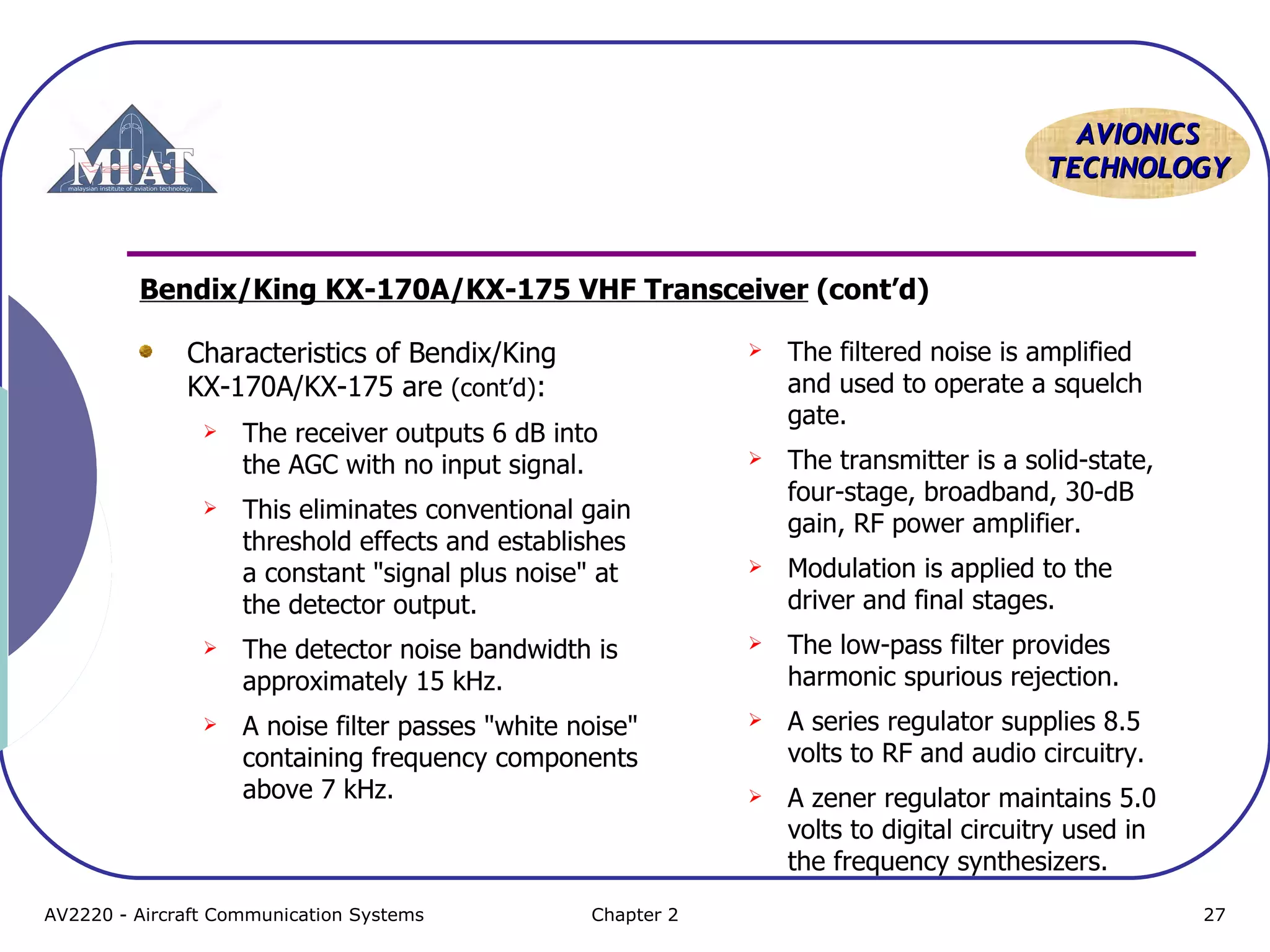
Characteristics of Bendix/King 
KX-170A/KX-175 are (cont’d): 
 The receiver outputs 6 dB into 
the AGC with no input signal. 
 This eliminates conventional gain 
threshold effects and establishes 
a constant "signal plus noise" at 
the detector output. 
 The detector noise bandwidth is 
approximately 15 kHz. 
 A noise filter passes "white noise" 
containing frequency components 
above 7 kHz. 
 The filtered noise is amplified 
and used to operate a squelch 
gate. 
 The transmitter is a solid-state, 
four-stage, broadband, 30-dB 
gain, RF power amplifier. 
 Modulation is applied to the 
driver and final stages. 
 The low-pass filter provides 
harmonic spurious rejection. 
 A series regulator supplies 8.5 
volts to RF and audio circuitry. 
 A zener regulator maintains 5.0 
volts to digital circuitry used in 
the frequency synthesizers. 
AV2220 - Aircraft Communication Systems Chapter 2 27
AAVVIIOONNIICCSS 
TTEECCHHNNOOLLOOGGYY 
AN/ARC-197 VHF Transceiver 
The AN/ARC-197 VHF communication system provides an aircraft with two-way, 
plain voice radio communications in the very high-frequency range. 
Its actual frequency range is from 116.000 to 151.975 MHz. 
In the P-3C aircraft (maritime patrol aircraft), this system interfaces with four of 
the intercommunication stations in the transmit/receive functions. 
The pilot, copilot, TACCO, and NAV/COMM stations can transmit and receive 
over this radio. 
The other stations in the aircraft have received function only. 
AV2220 - Aircraft Communication Systems Chapter 2 28
AAVVIIOONNIICCSS 
TTEECCHHNNOOLLOOGGYY 
AN/ARC-197 VHF Transceiver (cont’d) 
Major Components 
There are three components to the AN/ARC-197 system: 
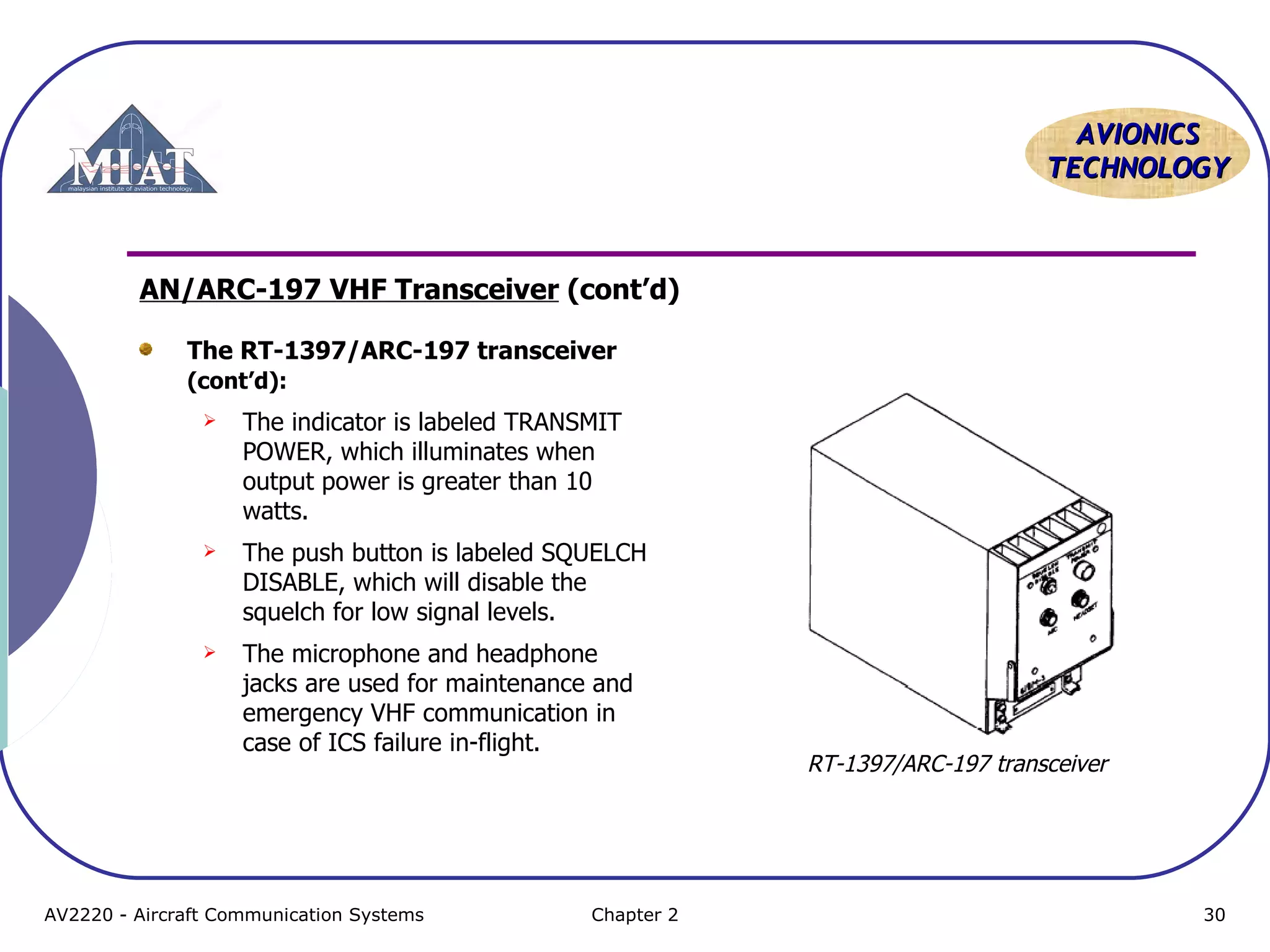
 The RT-1397/ARC-197 transceiver 
 The C-11067/ARC-197 VHF-AM control panel 
 The 949880 VHF antenna 
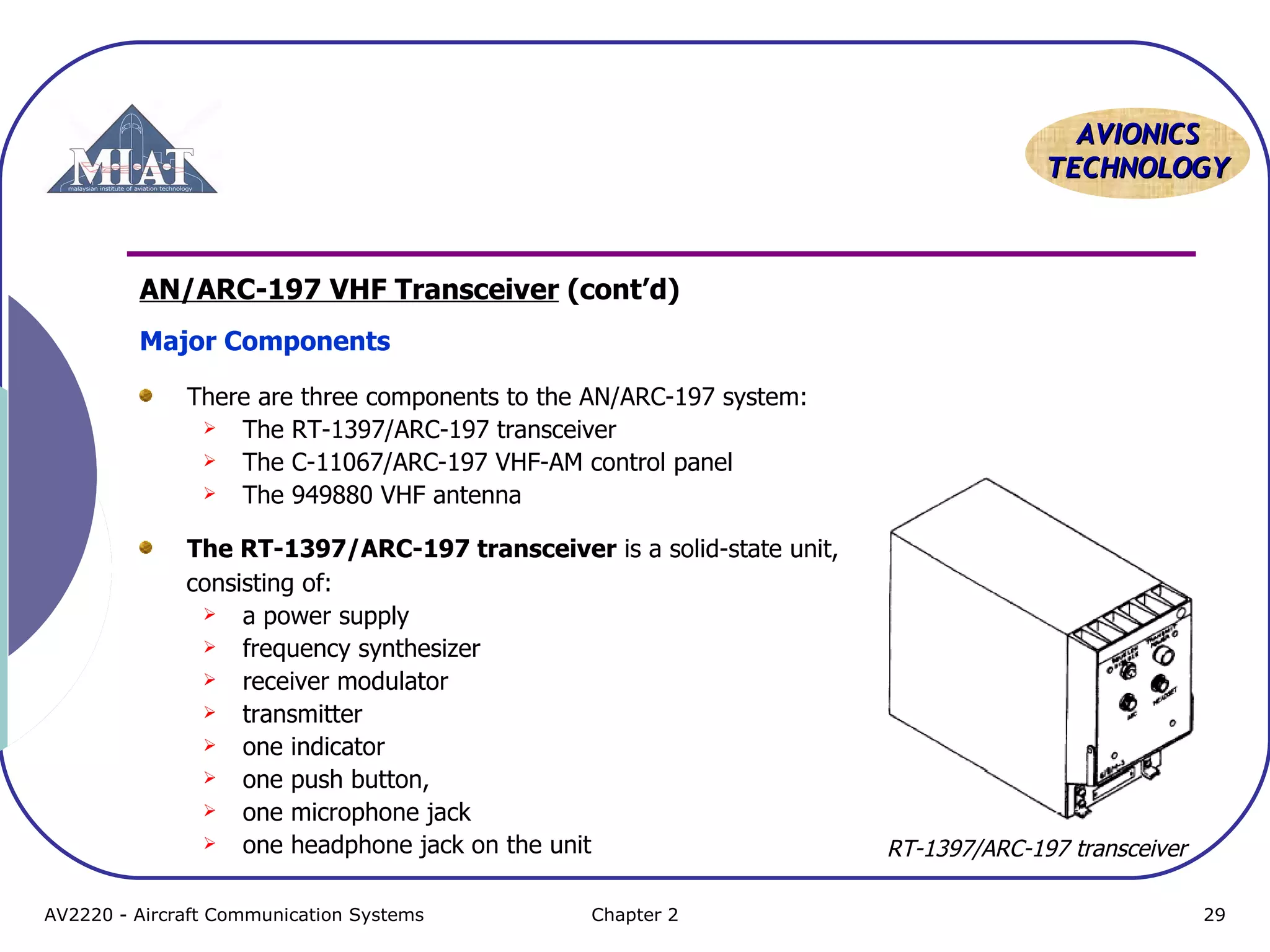
The RT-1397/ARC-197 transceiver is a solid-state unit, 
consisting of: 
 a power supply 
 frequency synthesizer 
 receiver modulator 
 transmitter 
 one indicator 
 one push button, 
 one microphone jack 
 one headphone jack on the unit 
RT-1397/ARC-197 transceiver 
AV2220 - Aircraft Communication Systems Chapter 2 29
AAVVIIOONNIICCSS 
TTEECCHHNNOOLLOOGGYY 
AN/ARC-197 VHF Transceiver (cont’d) 
The RT-1397/ARC-197 transceiver 
(cont’d): 
 The indicator is labeled TRANSMIT 
POWER, which illuminates when 
output power is greater than 10 
watts. 
 The push button is labeled SQUELCH 
DISABLE, which will disable the 
squelch for low signal levels. 
 The microphone and headphone 
jacks are used for maintenance and 
emergency VHF communication in 
case of ICS failure in-flight. 
RT-1397/ARC-197 transceiver 
AV2220 - Aircraft Communication Systems Chapter 2 30
AAVVIIOONNIICCSS 
TTEECCHHNNOOLLOOGGYY 
AN/ARC-197 VHF Transceiver (cont’d) 
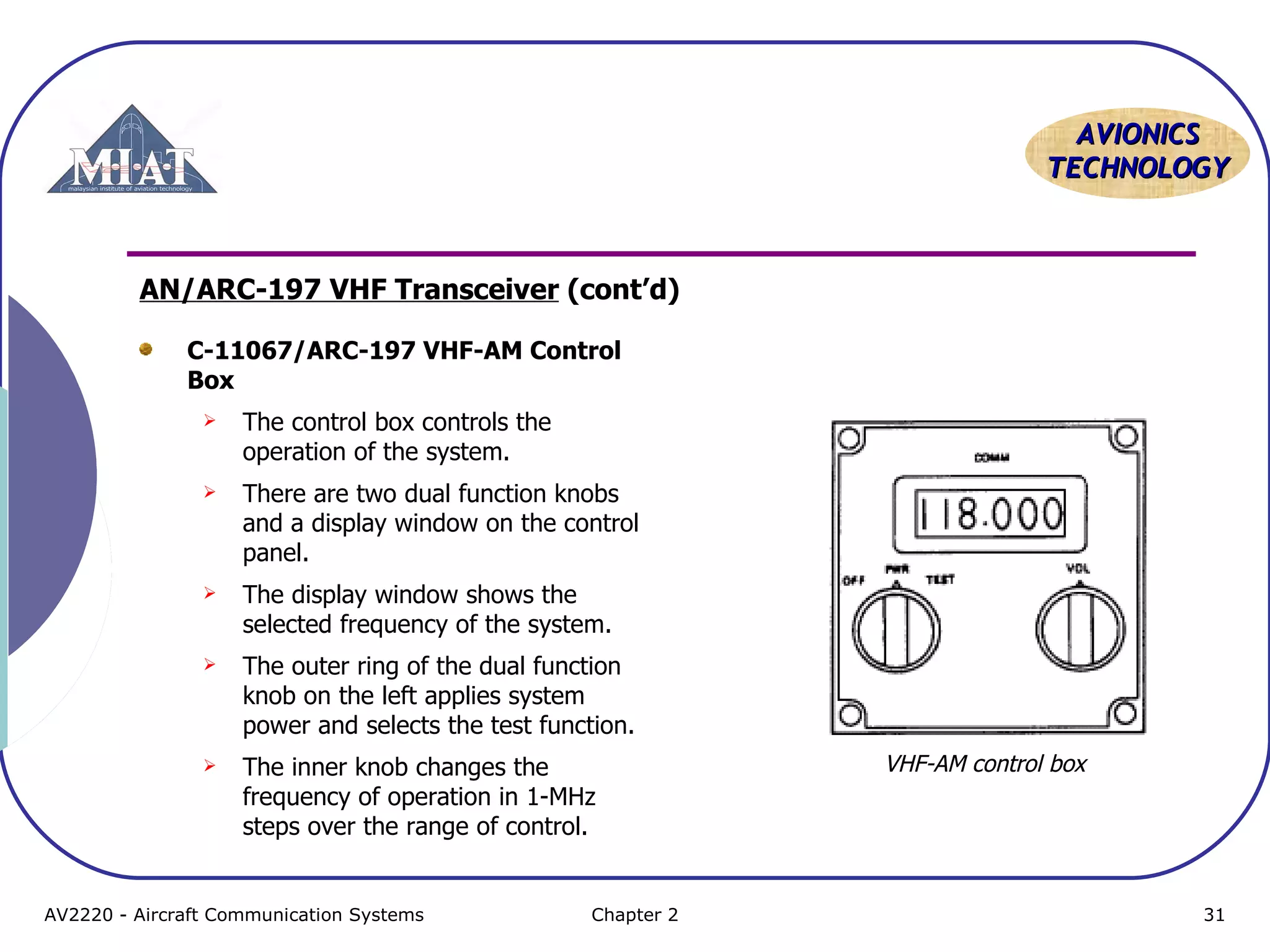
C-11067/ARC-197 VHF-AM Control 
Box 
 The control box controls the 
operation of the system. 
 There are two dual function knobs 
and a display window on the control 
panel. 
 The display window shows the 
selected frequency of the system. 
 The outer ring of the dual function 
knob on the left applies system 
power and selects the test function. 
 The inner knob changes the 
frequency of operation in 1-MHz 
steps over the range of control. 
VHF-AM control box 
AV2220 - Aircraft Communication Systems Chapter 2 31
AAVVIIOONNIICCSS 
TTEECCHHNNOOLLOOGGYY 
AN/ARC-197 VHF Transceiver (cont’d) 
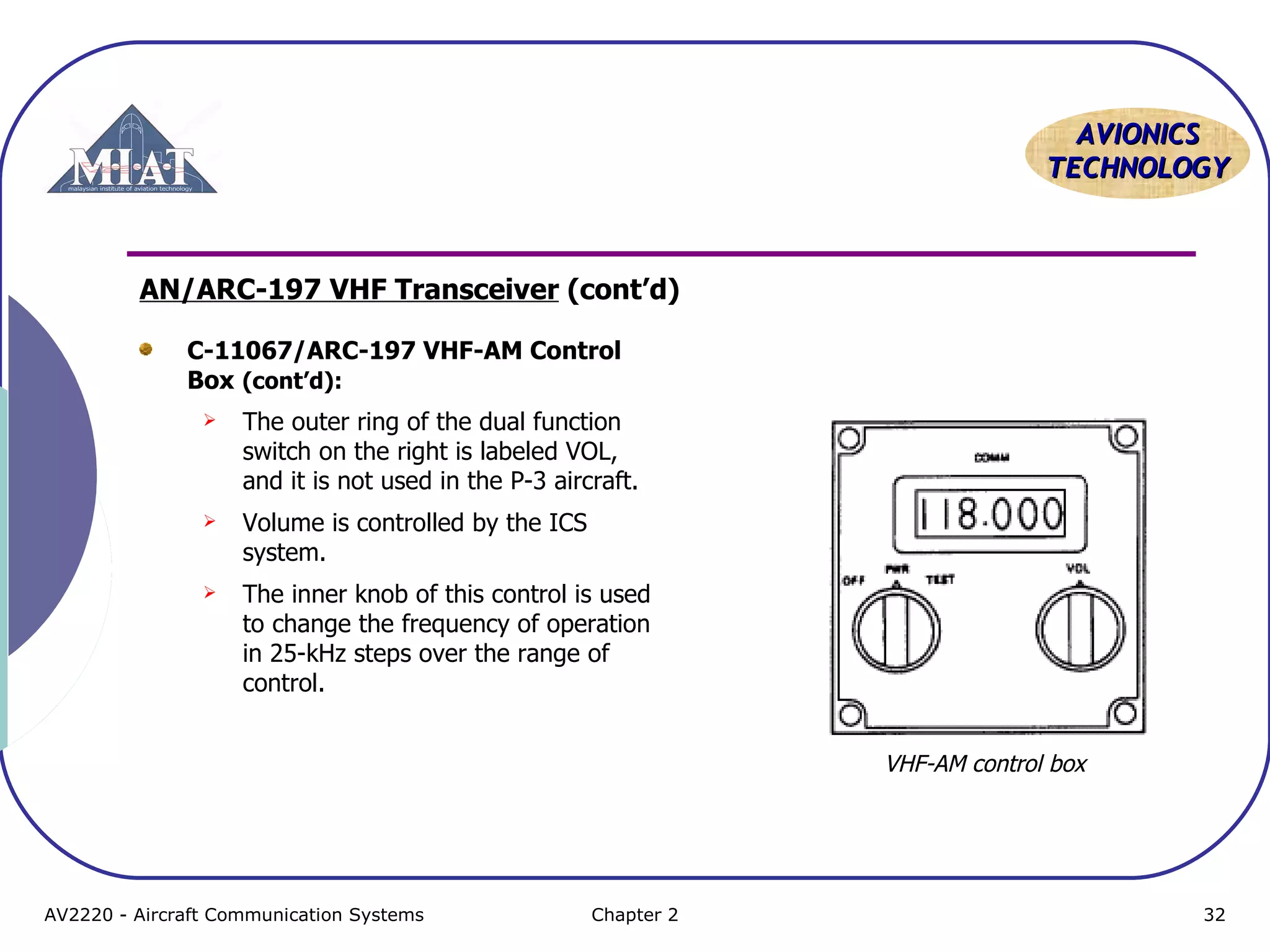
C-11067/ARC-197 VHF-AM Control 
Box (cont’d): 
 The outer ring of the dual function 
switch on the right is labeled VOL, 
and it is not used in the P-3 aircraft. 
 Volume is controlled by the ICS 
system. 
 The inner knob of this control is used 
to change the frequency of operation 
in 25-kHz steps over the range of 
control. 
VHF-AM control box 
AV2220 - Aircraft Communication Systems Chapter 2 32
AAVVIIOONNIICCSS 
TTEECCHHNNOOLLOOGGYY 
AN/ARC-197 VHF Transceiver (cont’d) 
949880 VHF Antenna: 
 The 949880 antenna is located in the 
tailcap on top of the vertical stabilizer 
of the P-3 aircraft. 
 This antenna radiates and receives 
the VHF radio frequency signals. 
 Signals routed to and from the 
antenna go through a VHF bandpass 
filter, which reduces the crosstalk 
between the VHF and UHF systems. 
AV2220 - Aircraft Communication Systems Chapter 2 33
AAVVIIOONNIICCSS 
TTEECCHHNNOOLLOOGGYY 
AN/ARC-197 VHF Transceiver (cont’d) 
Functional Description 
There are two modes of operation with 
the AN/ARC- 197 radio. 
 The receive mode 
 The transmit mode 
Receive Mode: 
 The received RF signals from the 
antenna are routed through the 
filter, and applied to the receiver 
circuits in the transceiver. 
 The frequency selected on the 
control box is applied to the 
frequency synthesizer. 
 The synthesizer uses a single 
phase-locked loop to generate RF 
injection frequencies, in 25-kHz 
steps, from 116.000 to 155.975 
MHz. 
 The RF injection frequencies, along 
with DC tuning voltages, 
electronically tune the receiver to 
the selected frequency. 
 The AM detected audio is applied to 
the audio amplifier circuit. 
 Squelch circuits disable the output 
amplifier if the required signal-to-noise 
ratio or carrier level is not 
present. 
 The output audio is then applied to 
the ICS interconnection box for 
distribution to the various stations. 
AV2220 - Aircraft Communication Systems Chapter 2 34
AAVVIIOONNIICCSS 
TTEECCHHNNOOLLOOGGYY 
AN/ARC-197 VHF Transceiver (cont’d) 
Functional Description (cont’d) 
Transmit Mode: 
 The VHF XMTR control signal from 
any one of the four ICS master 
control panels applies a ground to 
the transceiver as the VHF key 
signal. 
 This VHF key signal provides the 
push-to-talk command to the 
transceiver to switch it from the 
receive to the transmit mode of 
operation. 
 The synthesizer generates 
transmitter drive frequencies from 
116.000 to 155.975 MHz in 25 kHz 
steps. 
 Audio from any of the four ICS 
master control boxes are applied to 
the modulator circuit. 
 The modulator circuit provides 90- 
percent amplitude modulation. 
 The transmitter uses five stages of 
amplifiers to raise the output to 20 
watts. 
 The RF output is routed to the 
antenna, through the filter, for 
radiation. 
 The transceiver also produces a 
sidetone output, which is provided 
to the ICS system in the same 
manner as the receiver audio. 
AV2220 - Aircraft Communication Systems Chapter 2 35

Aircraft Communication Topic 4 vhf communication system

  • 1.
    AAVVIIOONNIICCSS TTEECCHHNNOOLLOOGGYY VVeerryyHHiigghh FFrreeqquueennccyy ((VVHHFF)) CCoommmmuunniiccaattiioonn VHF communication systems are employed largely for controlling air traffic. These systems are installed in all types of aircraft so the pilot may be given information and directions and may request information from air traffic control centers, control towers, and flight service stations. On the approach to any airport with two-way radio facilities, the pilot of an aircraft calls the tower and requests information and landing instructions. In airline operations and all instrument flights, the flight of an aircraft is continuously monitored by air traffic control (ATC), and the aircraft's crew is given instructions as necessary to maintain conditions of safe flight. AV2220 - Aircraft Communication Systems Chapter 2 1
  • 2.
    AAVVIIOONNIICCSS TTEECCHHNNOOLLOOGGYY VHFcommunication systems operate in the frequency range of 118 to 136.975 MHz. For international operations the frequencies may extend to 151.975 MHz. The nature of radio-wave propagation at these frequencies is such that communication is limited to line-of-sight distances. The advantage of VHF communication, however, is that the signals are not often distorted or rendered unintelligible by static and other types of interference. VHF communication radios are currently available with 720, 760, or 360 channels.  The 720- or 760-channel radio is preferred by most pilots owing to its versatility in frequency selection. AV2220 - Aircraft Communication Systems Chapter 2 2
  • 3.
    AAVVIIOONNIICCSS TTEECCHHNNOOLLOOGGYY In1976 the FAA changed the minimum frequency spacing for VHF systems from 50 to 25 kHz between 118 and 135.975 MHz.  This change made the 720- channel radio possible. Recently the FAA and FCC authorized the general use of frequencies up to 136.975 MHz.  This change added 40 channels to increase the selection to 760 channels.  Some older 360-channel radios are still in use; however, they are quickly becoming obsolete. AV2220 - Aircraft Communication Systems Chapter 2 3
  • 4.
    AAVVIIOONNIICCSS TTEECCHHNNOOLLOOGGYY VHFSystem Description Aircraft VHF communication systems consists of a VHF transceiver, control head, antenna, and an interface to the aircraft audio system for access to the microphone and cockpit speaker. In light aircraft, the transceiver is mounted in the instrument panel and contains all the necessary controls and displays. In larger aircraft, the control head, which is used for selecting the receiver and transmitter frequencies, is usually located in the center console between the pilot and copilot, and the transceiver is remotely located in the radio rack aft or below the crew station. VHF communication transmitters provide AM voice communication transmission between aircraft and ground stations or between aircraft. AV2220 - Aircraft Communication Systems Chapter 2 4
  • 5.
    AAVVIIOONNIICCSS TTEECCHHNNOOLLOOGGYY VHFSystem Description (cont’d) Because of the nature of VHF radio signals, the average communicating - distance from aircraft to ground is:  Approximately 30 mi [48 km] when the airplane is flying at 1000 ft [305 m]  Approximately 135 mi [217 km] when the airplane is at 10,000 ft [3048 m]. Transmitting frequency is determined by the position of the selector switches on the VHF control panel. The transmitter is tuned at the same time and to the same frequency as the receiver. The most modern VHF communication radios incorporate the latest digital design features. In general, the use of microprocessors and digital circuits has allowed for a 50 percent reduction in parts count and an 80 percent reduction in internal shop adjustments as compared with the use of analog circuits. AV2220 - Aircraft Communication Systems Chapter 2 5
  • 6.
    AAVVIIOONNIICCSS TTEECCHHNNOOLLOOGGYY VHFSystem Description (cont’d) A modular design of a modern digital system reduces maintenance time by providing easy access to all circuit boards and components. VHF communication equipment for light aircraft is typically combined with a VHF navigation (NAV) radio system. The VHF transceiver is a solid-state or digital system that can receive or transmit on any one of the 720 channels in the COMM range of frequencies. The frequencies are spaced at 25-kHz intervals throughout the range. Frequencies are selected simultaneously for both the receiver and the transmitter by rotating the frequency selector knobs.  The large outer knob is used to change the megahertz portion of the frequency display, and the smaller concentric knob changes the kilohertz portion.  The small knob will change the frequency in 50-kHz increments when it is pushed in and in 25-kHz increments when it is pulled out. AV2220 - Aircraft Communication Systems Chapter 2 6
  • 7.
    AAVVIIOONNIICCSS TTEECCHHNNOOLLOOGGYY VHFSystem Description (cont’d) A VHF-700 transceiver AV2220 - Aircraft Communication Systems Chapter 2 7
  • 8.
    AAVVIIOONNIICCSS TTEECCHHNNOOLLOOGGYY VHFTransceiver Frequency Selection Some control heads employ a universally accepted 2-out-of-5 frequency selection scheme. Other control heads use a digital serial data bus, such as ARINC 429, to select the desired frequency of a remotely-mounted transceiver. With 2-out-of-5 tuning, any two out of a maximum of five frequency selection inputs to the transceiver will be grounded by the selector switch in the control unit to correspond with the desired frequency selection. For example, if the control head displays the frequency 21.5, the "A" and "C" 10-MHz, "A" and "B" 1-MHz, and "C" and "D" 0.1-MHz frequency selection inputs to the transceiver will be grounded by the discrete signals from the control head. AV2220 - Aircraft Communication Systems Chapter 2 8
  • 9.
    AAVVIIOONNIICCSS TTEECCHHNNOOLLOOGGYY VHFTransceiver Frequency Selection (cont’d) Table: Two-out-of-five frequency selection 2 of 5 Code Table No. A B C D E 1 X X 2 X X 3 X X 4 X X 5 X X 6 X X 7 X X 8 X X 9 X X X = Ground AV2220 - Aircraft Communication Systems Chapter 2 9
  • 10.
    AAVVIIOONNIICCSS TTEECCHHNNOOLLOOGGYY VHFTransceiver Frequency Selection (cont’d) The ARINC 429 serial data bus provides a balanced differential signal using nominally zero to 5-volt switching levels from the control head. ARINC 429 is also used to send digital data from the avionics equipment to the cockpit displays. ARINC 429 messages are comprised of 32-bit data words. Each bit in the data word is set at either V if no voltage is present, or "1” if +5 volts DC is present. This serial data stream runs across the two-wire bus at speeds of up to 100 kilobits per second using a command-response protocol. The message format requires that a record, consisting of up to 126 data words, begin with an initial word that notifies the receiving unit that a message is being sent, and ends with a final word that is used to test for errors in the record. AV2220 - Aircraft Communication Systems Chapter 2 10
  • 11.
    AAVVIIOONNIICCSS TTEECCHHNNOOLLOOGGYY VHFTransceiver Frequency Selection (cont’d) Initial words and final words do not contain data in bits 11 through 29. The first 8 bits in the initial word may contain one of the following messages: Request to Send, Clear to Send, Data Follows, Data Received OK, Data Received Not OK, or Sync Lost. The first 8 bits in the final word is the file label, and bits 9 through 29 is the error control checksum, which is the addition of bits 9 through 29 in all the intermediate words in the record. ARINC 429 does not provide for error correction, but only error detection within the serial data stream. Typically, manufacturers of avionics systems will provide not only ARINC 429, but a variation of this format, such as the Collins Commercial Standard Digital Bus (CSDB), as their own unique data bus to be used for sending and receiving data between only their brands of equipment. AV2220 - Aircraft Communication Systems Chapter 2 11
  • 12.
    AAVVIIOONNIICCSS TTEECCHHNNOOLLOOGGYY VHFTransceiver Frequency Selection (cont’d) ARINC 429 data bus message formats AV2220 - Aircraft Communication Systems Chapter 2 12
  • 13.
    AAVVIIOONNIICCSS TTEECCHHNNOOLLOOGGYY VHFControl Panel To tune the transceiver to the desired operating frequency, it is necessary to first enter the selected frequency into the STANDBY display. The frequency is then activated by pushing the transfer button, and the word USE will be displayed. Another frequency may then be entered into the STANDBY mode. The STANDBY mode will store the selected frequency to allow for a "quick switch" of the frequency being used by the receiver. This becomes very helpful while operating an aircraft in crowded airspace in which several communication frequencies are used for air traffic control. Control panels for VHF communication systems vary in design, depending on the manufacturer of the equipment and the requirements of the aircraft manufacturer. Typically, the control panel located in the flight deck contains the frequency selectors and the digital displays for the main and standby frequencies. AV2220 - Aircraft Communication Systems Chapter 2 13
  • 14.
    AAVVIIOONNIICCSS TTEECCHHNNOOLLOOGGYY VHFControl Panel (cont’d) Most VHF systems for corporate and transport-category aircraft use a separate radio control panel, and the receiver transmitter (r-t) is located in the electric equipment center. Also on these aircraft, the VHF communication radio system is often independent of the VHF navigation system. On light aircraft the r-t and control panel are often one unit mounted in the instrument panel. A VHF instrument panel Interior of a VHF communication radio AV2220 - Aircraft Communication Systems Chapter 2 14
  • 15.
    AAVVIIOONNIICCSS TTEECCHHNNOOLLOOGGYY VHFAntenna Antennas for VHF systems are low-drag stub units extending from the top and bottom centerline of the airplane. These antennas are matched to their respective transmission lines by means of carefully measured lengths of tuning line. The antennas are used for both transmitting and receiving. VHF antenna configuration AV2220 - Aircraft Communication Systems Chapter 2 15
  • 16.
    AAVVIIOONNIICCSS TTEECCHHNNOOLLOOGGYY VHFSystem Operation The receiver portion of a VHF communication system is typically the superheterodyne type. The antenna receives an induced signal from the electromagnetic fields passing the antenna. This signal is sent through a band-pass filter to an RF amplifier. Once amplified, the signal passes through a low-pass filter and into the first-stage mixer. The mixer converts the RF into an intermediate frequency (IF). The IF is a lower frequency and is easier to control through the receiver. The IF is amplified to produce a stronger signal, which is sent to the second-stage mixer where again a lower frequency is produced. This signal is amplified and sent to the detector, where the audio wave is separated from the carrier wave. The audio signal is then amplified by the buffer and broadcast into the aircraft by the speaker. AV2220 - Aircraft Communication Systems Chapter 2 16
  • 17.
    AAVVIIOONNIICCSS TTEECCHHNNOOLLOOGGYY VHFSystem Operation (cont’d) The buffer amplifier receives inputs from the AGC (automatic gain control) circuit, which ensures correct signal amplification at varied input signal strengths. The transmitter receives an input signal from the microphone or data inputs. This signal is amplified by the audio buffer and sent to the modulator (synthesizer). The modulator produces an AM signal, which is filtered, amplified, and sent to an ALC (automatic level control) circuit. Similar to the AGC in the receiver, the ALC ensures that a consistent output signal is sent to the antenna, even at varying input signal strengths. AV2220 - Aircraft Communication Systems Chapter 2 17
  • 18.
    AAVVIIOONNIICCSS TTEECCHHNNOOLLOOGGYY VHFSystem Operation (cont’d) Block diagram of a typical VHF communication system for a large aircraft AV2220 - Aircraft Communication Systems Chapter 2 18
  • 19.
    AAVVIIOONNIICCSS TTEECCHHNNOOLLOOGGYY RockwellCollins VHF-20A Transceiver The Collins VHF-20A, a typical remotely-mounted VHF transceiver, provides AM voice communication in the frequency range from 117.00 MHz through 135.975 MHz, in 25- kHz increments. The VHF-20A consists of a power supply, frequency synthesizer, receiver, modulator, and transmitter. The VHF-21/22 is an advanced microprocessor-based version of the VHF-20A that employs the ARINC 429 and Collins CSDB. Collins VHF-20/21/22 transceiver Collins VHF-20A block diagram AV2220 - Aircraft Communication Systems Chapter 2 19
  • 20.
    AAVVIIOONNIICCSS TTEECCHHNNOOLLOOGGYY RockwellCollins VHF-20A Transceiver (cont’d) The VHF frequency synthesizer, having only one crystal controlled oscillator, derives accurate RF output frequencies through the use of a phase-lock-loop and solid-state switching circuits. The synthesizer interprets 2-out-of- 5 frequency information from the VHF control head and provides all internal RF signals required by the VHF receiver and transmitter. Collins VHF-20/21/22 transceiver Collins VHF-20A block diagram AV2220 - Aircraft Communication Systems Chapter 2 20
  • 21.
    AAVVIIOONNIICCSS TTEECCHHNNOOLLOOGGYY RockwellCollins VHF-20A Transceiver (cont’d) Collins VHF-20A synthesizer block diagram AV2220 - Aircraft Communication Systems Chapter 2 21
  • 22.
    AAVVIIOONNIICCSS TTEECCHHNNOOLLOOGGYY RockwellCollins VHF-20A Transceiver (cont’d) In the receive mode, the synthesizer outputs a DC tuning voltage to the variable-voltage capacitors in the preselector to eliminate mechanical tuning. The synthesizer also applies an injection frequency to the mixer to output a 20- MHz IF. The 20-MHz IF amplifier, which is AGC controlled, provides the required selectivity and signal amplification. The detected audio is amplitude and bandpass limited and applied to the audio output amplifier. Squelch circuits disable the output amplifier if proper signal-to-noise ratio or carrier level is not present. When the push-to-talk switch on the microphone is applied, the synthesizer removes the receiver injection and provides transmitter excitation at the selected frequency. AV2220 - Aircraft Communication Systems Chapter 2 22
  • 23.
    AAVVIIOONNIICCSS TTEECCHHNNOOLLOOGGYY RockwellCollins VHF-20A Transceiver (cont’d) Power is applied to the transmitter by a +16-volt DC transmit series regulator, and the broadband RF amplifiers raise the synthesizer excitation to 20 wafts minimum output. The RF output is low-pass filtered and applied through the transmit/receive switch to the antenna. The AM modulator is a variable voltage power supply that varies the transmitter drive voltage consistent with the microphone inputs. Carrier modulation is detected by a sidetone detector and applied through the receiver audio amplifier so the pilot can monitor his or her voice transmissions through the aircraft's audio system. AV2220 - Aircraft Communication Systems Chapter 2 23
  • 24.
    AAVVIIOONNIICCSS TTEECCHHNNOOLLOOGGYY Bendix/KingKX-170A/KX-175 VHF Transceiver The Bendix/King KX-170A/KX-175 is a combination panel-mounted VHF communications transceiver and navigation receiver that operates on either 28-volt or 14-volt DC power. The communications section is:  Dual-conversion  Superheterodyne receiver with a 9.0-MHz IF  861.25-kHz second IF frequency  360 channels are synthesized at the first mixer  Low-side injection is used for channels 127.00 MHz to 135.95 MHz  High-side injection for 118.00 MHz to 126.95 MHz Characteristics of Bendix/King KX-170A/KX-175 are:  The received antenna signal is coupled to the preselector through a diode transmit/receive (T/R) switch.  A two-pole, varactor-tuned RF filter couples the antenna to the RF stage.  A second varactor-tuned filter couples the amplified RF signal to the first mixer and supplies additional image and ½ IF spurious rejection. AV2220 - Aircraft Communication Systems Chapter 2 24
  • 25.
    AAVVIIOONNIICCSS TTEECCHHNNOOLLOOGGYY Bendix/KingKX-170A/KX-175 VHF Transceiver (cont’d) Characteristics of Bendix/King KX-170A/KX-175 are (cont’d):  The amplifier RF signal is mixed with the synthesized injection frequency in a balanced mixer.  A two-pole crystal filter couples the difference frequency to the second mixer and provides image and ½ IF selectivity.  The 8.13875-MHz crystal controlled second local oscillator develops injection for the second mixer.  The second IF contains two integrated circuit (I.C.) amplifiers with three double-tuned interstage networks for additional receiver selectivity.  An active detector/noise limiter provides audio gain, rate noise limiting, and 90% AM clipping of noise spikes.  A two-stage AGC amplifier is used to control the gain of the RF stage and the first IC amplifier in the second IF strips. AV2220 - Aircraft Communication Systems Chapter 2 25
  • 26.
    AAVVIIOONNIICCSS TTEECCHHNNOOLLOOGGYY Bendix/KingKX-170A/KX-175 VHF Transceiver (cont’d) Bendix/King KK-170/175 VHF communications transceiver block diagram AV2220 - Aircraft Communication Systems Chapter 2 26
  • 27.
    AAVVIIOONNIICCSS TTEECCHHNNOOLLOOGGYY Bendix/KingKX-170A/KX-175 VHF Transceiver (cont’d) Characteristics of Bendix/King KX-170A/KX-175 are (cont’d):  The receiver outputs 6 dB into the AGC with no input signal.  This eliminates conventional gain threshold effects and establishes a constant "signal plus noise" at the detector output.  The detector noise bandwidth is approximately 15 kHz.  A noise filter passes "white noise" containing frequency components above 7 kHz.  The filtered noise is amplified and used to operate a squelch gate.  The transmitter is a solid-state, four-stage, broadband, 30-dB gain, RF power amplifier.  Modulation is applied to the driver and final stages.  The low-pass filter provides harmonic spurious rejection.  A series regulator supplies 8.5 volts to RF and audio circuitry.  A zener regulator maintains 5.0 volts to digital circuitry used in the frequency synthesizers. AV2220 - Aircraft Communication Systems Chapter 2 27
  • 28.
    AAVVIIOONNIICCSS TTEECCHHNNOOLLOOGGYY AN/ARC-197VHF Transceiver The AN/ARC-197 VHF communication system provides an aircraft with two-way, plain voice radio communications in the very high-frequency range. Its actual frequency range is from 116.000 to 151.975 MHz. In the P-3C aircraft (maritime patrol aircraft), this system interfaces with four of the intercommunication stations in the transmit/receive functions. The pilot, copilot, TACCO, and NAV/COMM stations can transmit and receive over this radio. The other stations in the aircraft have received function only. AV2220 - Aircraft Communication Systems Chapter 2 28
  • 29.
    AAVVIIOONNIICCSS TTEECCHHNNOOLLOOGGYY AN/ARC-197VHF Transceiver (cont’d) Major Components There are three components to the AN/ARC-197 system:  The RT-1397/ARC-197 transceiver  The C-11067/ARC-197 VHF-AM control panel  The 949880 VHF antenna The RT-1397/ARC-197 transceiver is a solid-state unit, consisting of:  a power supply  frequency synthesizer  receiver modulator  transmitter  one indicator  one push button,  one microphone jack  one headphone jack on the unit RT-1397/ARC-197 transceiver AV2220 - Aircraft Communication Systems Chapter 2 29
  • 30.
    AAVVIIOONNIICCSS TTEECCHHNNOOLLOOGGYY AN/ARC-197VHF Transceiver (cont’d) The RT-1397/ARC-197 transceiver (cont’d):  The indicator is labeled TRANSMIT POWER, which illuminates when output power is greater than 10 watts.  The push button is labeled SQUELCH DISABLE, which will disable the squelch for low signal levels.  The microphone and headphone jacks are used for maintenance and emergency VHF communication in case of ICS failure in-flight. RT-1397/ARC-197 transceiver AV2220 - Aircraft Communication Systems Chapter 2 30
  • 31.
    AAVVIIOONNIICCSS TTEECCHHNNOOLLOOGGYY AN/ARC-197VHF Transceiver (cont’d) C-11067/ARC-197 VHF-AM Control Box  The control box controls the operation of the system.  There are two dual function knobs and a display window on the control panel.  The display window shows the selected frequency of the system.  The outer ring of the dual function knob on the left applies system power and selects the test function.  The inner knob changes the frequency of operation in 1-MHz steps over the range of control. VHF-AM control box AV2220 - Aircraft Communication Systems Chapter 2 31
  • 32.
    AAVVIIOONNIICCSS TTEECCHHNNOOLLOOGGYY AN/ARC-197VHF Transceiver (cont’d) C-11067/ARC-197 VHF-AM Control Box (cont’d):  The outer ring of the dual function switch on the right is labeled VOL, and it is not used in the P-3 aircraft.  Volume is controlled by the ICS system.  The inner knob of this control is used to change the frequency of operation in 25-kHz steps over the range of control. VHF-AM control box AV2220 - Aircraft Communication Systems Chapter 2 32
  • 33.
    AAVVIIOONNIICCSS TTEECCHHNNOOLLOOGGYY AN/ARC-197VHF Transceiver (cont’d) 949880 VHF Antenna:  The 949880 antenna is located in the tailcap on top of the vertical stabilizer of the P-3 aircraft.  This antenna radiates and receives the VHF radio frequency signals.  Signals routed to and from the antenna go through a VHF bandpass filter, which reduces the crosstalk between the VHF and UHF systems. AV2220 - Aircraft Communication Systems Chapter 2 33
  • 34.
    AAVVIIOONNIICCSS TTEECCHHNNOOLLOOGGYY AN/ARC-197VHF Transceiver (cont’d) Functional Description There are two modes of operation with the AN/ARC- 197 radio.  The receive mode  The transmit mode Receive Mode:  The received RF signals from the antenna are routed through the filter, and applied to the receiver circuits in the transceiver.  The frequency selected on the control box is applied to the frequency synthesizer.  The synthesizer uses a single phase-locked loop to generate RF injection frequencies, in 25-kHz steps, from 116.000 to 155.975 MHz.  The RF injection frequencies, along with DC tuning voltages, electronically tune the receiver to the selected frequency.  The AM detected audio is applied to the audio amplifier circuit.  Squelch circuits disable the output amplifier if the required signal-to-noise ratio or carrier level is not present.  The output audio is then applied to the ICS interconnection box for distribution to the various stations. AV2220 - Aircraft Communication Systems Chapter 2 34
  • 35.
    AAVVIIOONNIICCSS TTEECCHHNNOOLLOOGGYY AN/ARC-197VHF Transceiver (cont’d) Functional Description (cont’d) Transmit Mode:  The VHF XMTR control signal from any one of the four ICS master control panels applies a ground to the transceiver as the VHF key signal.  This VHF key signal provides the push-to-talk command to the transceiver to switch it from the receive to the transmit mode of operation.  The synthesizer generates transmitter drive frequencies from 116.000 to 155.975 MHz in 25 kHz steps.  Audio from any of the four ICS master control boxes are applied to the modulator circuit.  The modulator circuit provides 90- percent amplitude modulation.  The transmitter uses five stages of amplifiers to raise the output to 20 watts.  The RF output is routed to the antenna, through the filter, for radiation.  The transceiver also produces a sidetone output, which is provided to the ICS system in the same manner as the receiver audio. AV2220 - Aircraft Communication Systems Chapter 2 35