Chapter 11
Critical Chain Project
Scheduling
11-01
Copyright © 2013 Pearson Education, Inc. Publishing as Prentice Hall
Chapter 11 Learning Objectives
After completing this chapter, students will be
able to:
 Understand the differences between common cause
and special cause variation in organizations.
 Recognize the three ways in which project teams
inflate the amount of safety for all project tasks.
 Understand the four ways in which additional project
task safety can be wasted.
11-02
Copyright © 2013 Pearson Education, Inc. Publishing as Prentice Hall
Chapter 11 Learning Objectives
After completing this chapter, students will be
able to:
Distinguish between critical path and critical
chain project scheduling techniques.
Understand how critical chain methodology
resolves project resource conflicts.
Apply critical chain project management to
project priorities.
11-03
Copyright © 2013 Pearson Education, Inc. Publishing as Prentice Hall
Theory of Constraints &
Critical Chain Project Scheduling
A constraint limits any system’s output.
The Goal – Goldratt
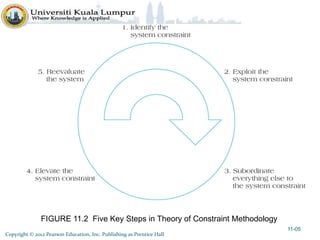
TOC Methodology
1. Identify the constraint
2. Exploit the constraint
3. Subordinate the system
4. Elevate the constraint
5. Repeat the process
11-04
FIGURE 11.2 Five Key Steps in Theory of Constraint Methodology
11-05
Copyright © 2012 Pearson Education, Inc. Publishing as Prentice Hall
Copyright © 2013 Pearson Education, Inc. Publishing as Prentice Hall
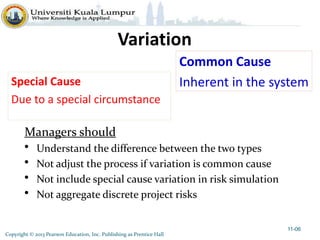
Variation
Common Cause
Inherent in the system
11-06
Special Cause
Due to a special circumstance
Managers should
• Understand the difference between the two types
• Not adjust the process if variation is common cause
• Not include special cause variation in risk simulation
• Not aggregate discrete project risks
Copyright © 2013 Pearson Education, Inc. Publishing as Prentice Hall
CCPM and the Causes of Project
Delay
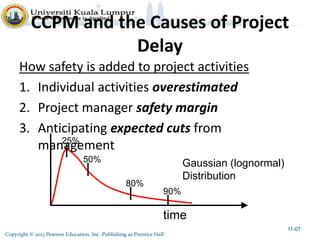
How safety is added to project activities
1. Individual activities overestimated
2. Project manager safety margin
3. Anticipating expected cuts from
management
11-07
time
25%
50%
80%
90%
Gaussian (lognormal)
Distribution
Copyright © 2013 Pearson Education, Inc. Publishing as Prentice Hall
Wasting Extra Safety Margin
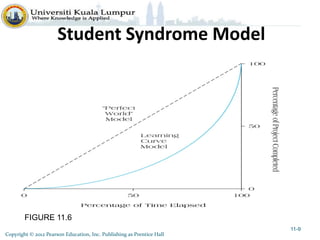
1. The Student Syndrome
a. Immediate deadlines
b. Padded estimates
c. High demand
2. Failure to pass along positive variation
a. Other tasks
b. Overestimation penalty
c. Perfectionism
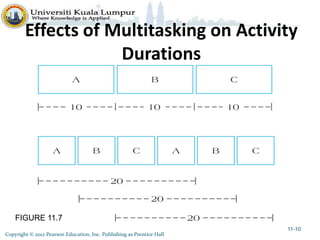
3. Multitasking
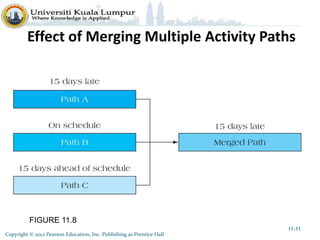
4. Path Merging 11-08
FIGURE 11.6
Student Syndrome Model
11-9
Copyright © 2012 Pearson Education, Inc. Publishing as Prentice Hall
Effects of Multitasking on Activity
Durations
11-10
FIGURE 11.7
Copyright © 2012 Pearson Education, Inc. Publishing as Prentice Hall
FIGURE 11.8
Effect of Merging Multiple Activity Paths
11-11
Copyright © 2012 Pearson Education, Inc. Publishing as Prentice Hall
Copyright © 2013 Pearson Education, Inc. Publishing as Prentice Hall
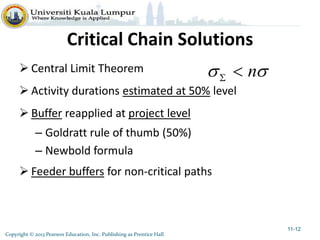
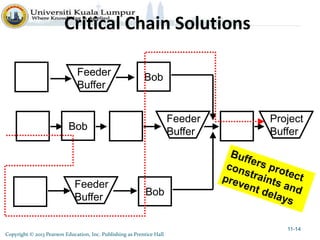
Critical Chain Solutions
 Central Limit Theorem
 Activity durations estimated at 50% level
 Buffer reapplied at project level
– Goldratt rule of thumb (50%)
– Newbold formula
 Feeder buffers for non-critical paths
11-12
n  
Copyright © 2013 Pearson Education, Inc. Publishing as Prentice Hall
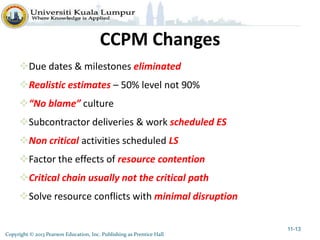
CCPM Changes
Due dates & milestones eliminated
Realistic estimates – 50% level not 90%
“No blame” culture
Subcontractor deliveries & work scheduled ES
Non critical activities scheduled LS
Factor the effects of resource contention
Critical chain usually not the critical path
Solve resource conflicts with minimal disruption
11-13
Copyright © 2013 Pearson Education, Inc. Publishing as Prentice Hall
Critical Chain Solutions
11-14
Bob
Feeder
Buffer
Feeder
Buffer
Feeder
Buffer
Project
BufferBob
Bob
Copyright © 2013 Pearson Education, Inc. Publishing as Prentice Hall
Critical Chain Project Portfolios
Drum – system-wide constraint that sets the
beat for the firm’s throughput
–company policy
–one person
–a department/work unit
–a resource
• Capacity constraint buffer – safety margin
between projects
• Drum buffer – extra safety before the 11-15
Copyright © 2013 Pearson Education, Inc. Publishing as Prentice Hall
Applying CCPM to Project
Portfolios
1. Identify the drum
2. Exploit the drum
a. Prepare a schedule for each project
b. Determine priority for the drum
c. Create the drum schedule
3. Subordinate the project schedules (next
slide)
4. Elevate the capacity of the drum
5. Go back to step 2
11-16
Copyright © 2013 Pearson Education, Inc. Publishing as Prentice Hall
Subordinating Project Schedules
Schedule projects based on drum
Designate critical chain
Insert capacity constraint buffers
Resolve any conflicts
Insert drum buffers so the constraint is not
starved
11-17
Copyright © 2013 Pearson Education, Inc. Publishing as Prentice Hall
CCPM Critiques
 No milestones used
 Not significantly different from PERT
 Unproven at the portfolio level
 Anecdotal support only
 Incomplete solution
 Overestimation of activity duration padding
 Cultural changes unattainable 11-18
Copyright © 2013 Pearson Education, Inc. Publishing as Prentice Hall
Summary
 Understand the differences between common cause and special
cause variation in organizations.
 Recognize the three ways in which project teams inflate the amount
of safety for all project tasks.
 Understand the four ways in which additional project task safety can
be wasted.
 Distinguish between critical path and critical chain project
scheduling techniques.
 Understand how critical chain methodology resolves project
resource conflicts.
 Apply critical chain project management to project priorities.
11-19
11-20
Copyright © 2013 Pearson Education, Inc. Publishing as Prentice Hall

Project Management Ch11 Project Scheduling Critical Chain

  • 1.
    Chapter 11 Critical ChainProject Scheduling 11-01
  • 2.
    Copyright © 2013Pearson Education, Inc. Publishing as Prentice Hall Chapter 11 Learning Objectives After completing this chapter, students will be able to:  Understand the differences between common cause and special cause variation in organizations.  Recognize the three ways in which project teams inflate the amount of safety for all project tasks.  Understand the four ways in which additional project task safety can be wasted. 11-02
  • 3.
    Copyright © 2013Pearson Education, Inc. Publishing as Prentice Hall Chapter 11 Learning Objectives After completing this chapter, students will be able to: Distinguish between critical path and critical chain project scheduling techniques. Understand how critical chain methodology resolves project resource conflicts. Apply critical chain project management to project priorities. 11-03
  • 4.
    Copyright © 2013Pearson Education, Inc. Publishing as Prentice Hall Theory of Constraints & Critical Chain Project Scheduling A constraint limits any system’s output. The Goal – Goldratt TOC Methodology 1. Identify the constraint 2. Exploit the constraint 3. Subordinate the system 4. Elevate the constraint 5. Repeat the process 11-04
  • 5.
    FIGURE 11.2 FiveKey Steps in Theory of Constraint Methodology 11-05 Copyright © 2012 Pearson Education, Inc. Publishing as Prentice Hall
  • 6.
    Copyright © 2013Pearson Education, Inc. Publishing as Prentice Hall Variation Common Cause Inherent in the system 11-06 Special Cause Due to a special circumstance Managers should • Understand the difference between the two types • Not adjust the process if variation is common cause • Not include special cause variation in risk simulation • Not aggregate discrete project risks
  • 7.
    Copyright © 2013Pearson Education, Inc. Publishing as Prentice Hall CCPM and the Causes of Project Delay How safety is added to project activities 1. Individual activities overestimated 2. Project manager safety margin 3. Anticipating expected cuts from management 11-07 time 25% 50% 80% 90% Gaussian (lognormal) Distribution
  • 8.
    Copyright © 2013Pearson Education, Inc. Publishing as Prentice Hall Wasting Extra Safety Margin 1. The Student Syndrome a. Immediate deadlines b. Padded estimates c. High demand 2. Failure to pass along positive variation a. Other tasks b. Overestimation penalty c. Perfectionism 3. Multitasking 4. Path Merging 11-08
  • 9.
    FIGURE 11.6 Student SyndromeModel 11-9 Copyright © 2012 Pearson Education, Inc. Publishing as Prentice Hall
  • 10.
    Effects of Multitaskingon Activity Durations 11-10 FIGURE 11.7 Copyright © 2012 Pearson Education, Inc. Publishing as Prentice Hall
  • 11.
    FIGURE 11.8 Effect ofMerging Multiple Activity Paths 11-11 Copyright © 2012 Pearson Education, Inc. Publishing as Prentice Hall
  • 12.
    Copyright © 2013Pearson Education, Inc. Publishing as Prentice Hall Critical Chain Solutions  Central Limit Theorem  Activity durations estimated at 50% level  Buffer reapplied at project level – Goldratt rule of thumb (50%) – Newbold formula  Feeder buffers for non-critical paths 11-12 n  
  • 13.
    Copyright © 2013Pearson Education, Inc. Publishing as Prentice Hall CCPM Changes Due dates & milestones eliminated Realistic estimates – 50% level not 90% “No blame” culture Subcontractor deliveries & work scheduled ES Non critical activities scheduled LS Factor the effects of resource contention Critical chain usually not the critical path Solve resource conflicts with minimal disruption 11-13
  • 14.
    Copyright © 2013Pearson Education, Inc. Publishing as Prentice Hall Critical Chain Solutions 11-14 Bob Feeder Buffer Feeder Buffer Feeder Buffer Project BufferBob Bob
  • 15.
    Copyright © 2013Pearson Education, Inc. Publishing as Prentice Hall Critical Chain Project Portfolios Drum – system-wide constraint that sets the beat for the firm’s throughput –company policy –one person –a department/work unit –a resource • Capacity constraint buffer – safety margin between projects • Drum buffer – extra safety before the 11-15
  • 16.
    Copyright © 2013Pearson Education, Inc. Publishing as Prentice Hall Applying CCPM to Project Portfolios 1. Identify the drum 2. Exploit the drum a. Prepare a schedule for each project b. Determine priority for the drum c. Create the drum schedule 3. Subordinate the project schedules (next slide) 4. Elevate the capacity of the drum 5. Go back to step 2 11-16
  • 17.
    Copyright © 2013Pearson Education, Inc. Publishing as Prentice Hall Subordinating Project Schedules Schedule projects based on drum Designate critical chain Insert capacity constraint buffers Resolve any conflicts Insert drum buffers so the constraint is not starved 11-17
  • 18.
    Copyright © 2013Pearson Education, Inc. Publishing as Prentice Hall CCPM Critiques  No milestones used  Not significantly different from PERT  Unproven at the portfolio level  Anecdotal support only  Incomplete solution  Overestimation of activity duration padding  Cultural changes unattainable 11-18
  • 19.
    Copyright © 2013Pearson Education, Inc. Publishing as Prentice Hall Summary  Understand the differences between common cause and special cause variation in organizations.  Recognize the three ways in which project teams inflate the amount of safety for all project tasks.  Understand the four ways in which additional project task safety can be wasted.  Distinguish between critical path and critical chain project scheduling techniques.  Understand how critical chain methodology resolves project resource conflicts.  Apply critical chain project management to project priorities. 11-19
  • 20.
    11-20 Copyright © 2013Pearson Education, Inc. Publishing as Prentice Hall