AAVVIIOONNIICCSS 
RRaaddiioo WWaavveess TTEECCHHNNOOLLOOGGYY 
Radio is a method of transmitting intelligence from one location to 
another by means of electromagnetic radiation. 
The first radios installed in airplanes were used for communications 
and it was only much later that navigational radio systems were 
developed. 
Radio systems for other purposes have also been developed, 
especially in the last 20 to 30 years. 
AV2220 - Aircraft Communication Systems Chapter 1 1
AAVVIIOONNIICCSS 
TTEECCHHNNOOLLOOGGYY 
Some of the uses for radio in modern aircraft can be categorized as 
follows. 
 Communications ‑ Both voice and data. 
 Navigation ‑ Many different systems are in use today. 
 ATC Radar ‑ The Air Traffic Control system relies on radar. 
 Weather Avoidance ‑ Used to avoid areas of adverse weather. 
 Approach Aids ‑ A specialized type of navigation to guide an aircraft 
down to the runway in bad weather. 
 Altitude Measurement ‑ Gives precise alti­tude 
above ground level. 
 Airborne Collision Avoidance ‑ Warns the pilot of nearby aircraft. 
AV2220 - Aircraft Communication Systems Chapter 1 2
AAVVIIOONNIICCSS 
TTEECCHHNNOOLLOOGGYY 
Radio Wave Spectrum 
The RF portion of the electromagnetic wave spectrum extends from 
approximately 3 kHz to 300 GHz. 
Table radio frequency bands: 
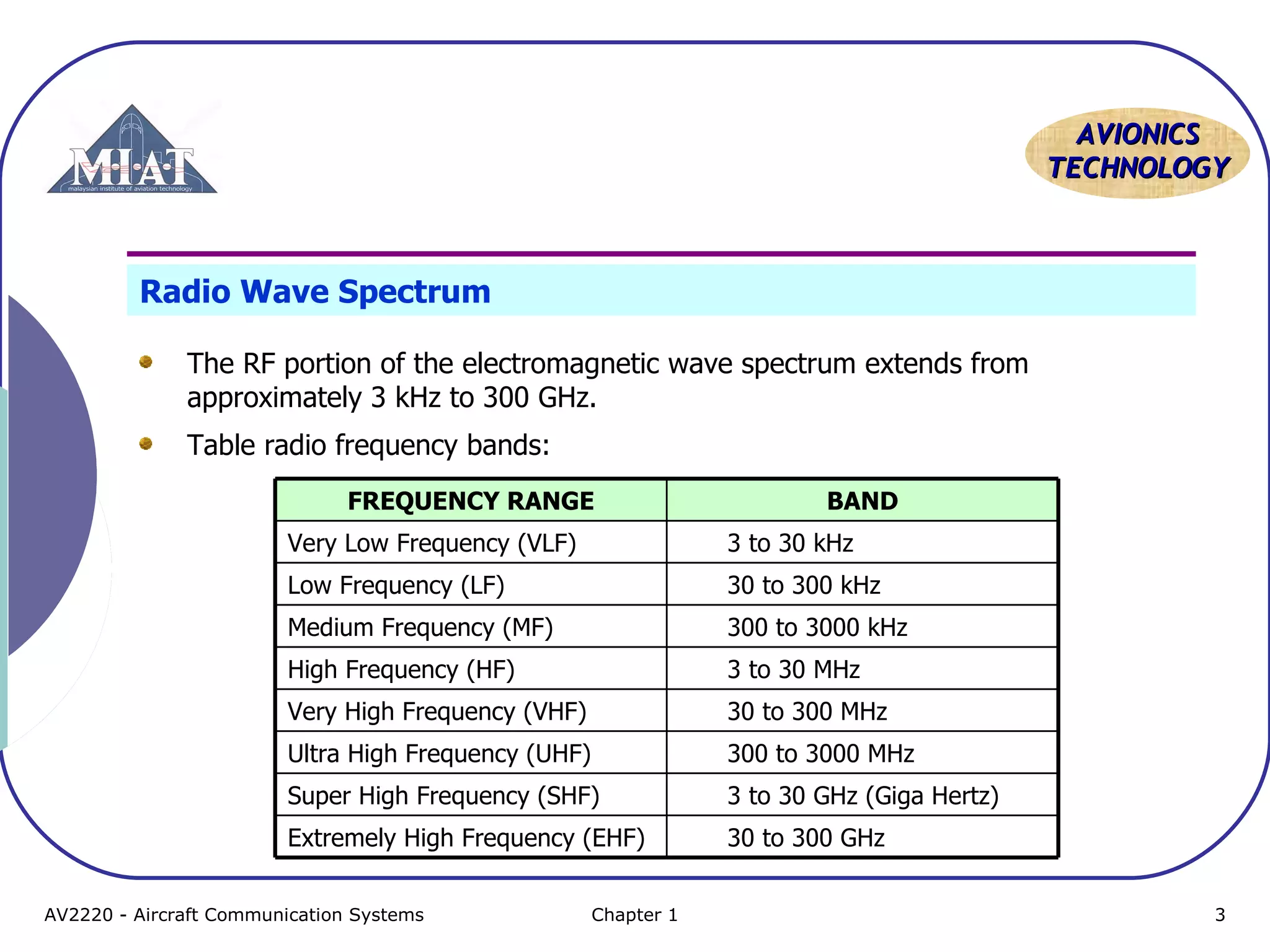
FREQUENCY RANGE BAND 
Very Low Frequency (VLF) 3 to 30 kHz 
Low Frequency (LF) 30 to 300 kHz 
Medium Frequency (MF) 300 to 3000 kHz 
High Frequency (HF) 3 to 30 MHz 
Very High Frequency (VHF) 30 to 300 MHz 
Ultra High Frequency (UHF) 300 to 3000 MHz 
Super High Frequency (SHF) 3 to 30 GHz (Giga Hertz) 
Extremely High Frequency (EHF) 30 to 300 GHz 
AV2220 - Aircraft Communication Systems Chapter 1 3
AAVVIIOONNIICCSS 
TTEECCHHNNOOLLOOGGYY 
Radio Wave Spectrum (cont’d) 
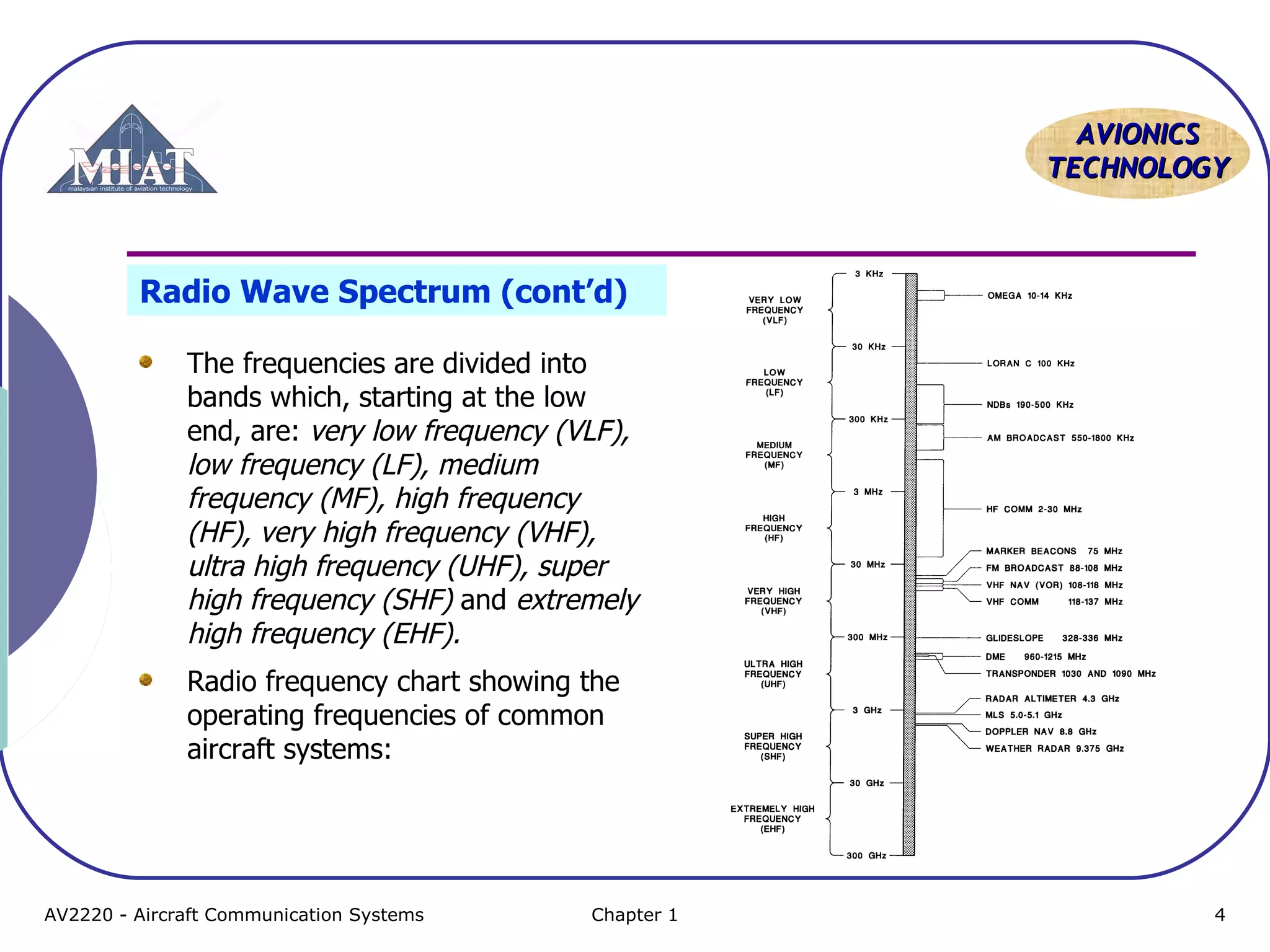
The frequencies are divided into 
bands which, starting at the low 
end, are: very low frequency (VLF), 
low frequency (LF), medium 
frequency (MF), high frequency 
(HF), very high frequency (VHF), 
ultra high frequency (UHF), super 
high frequency (SHF) and extremely 
high frequency (EHF). 
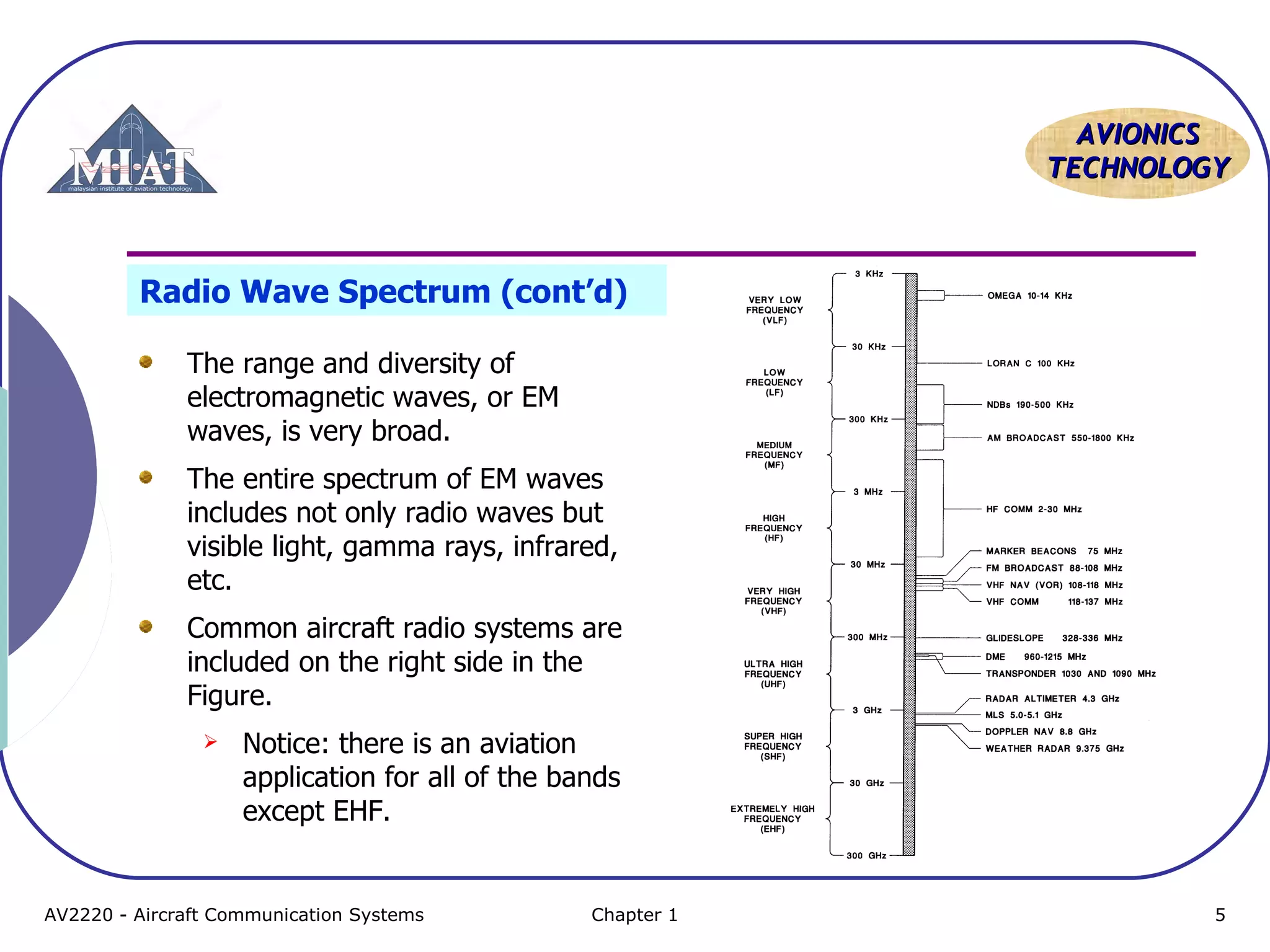
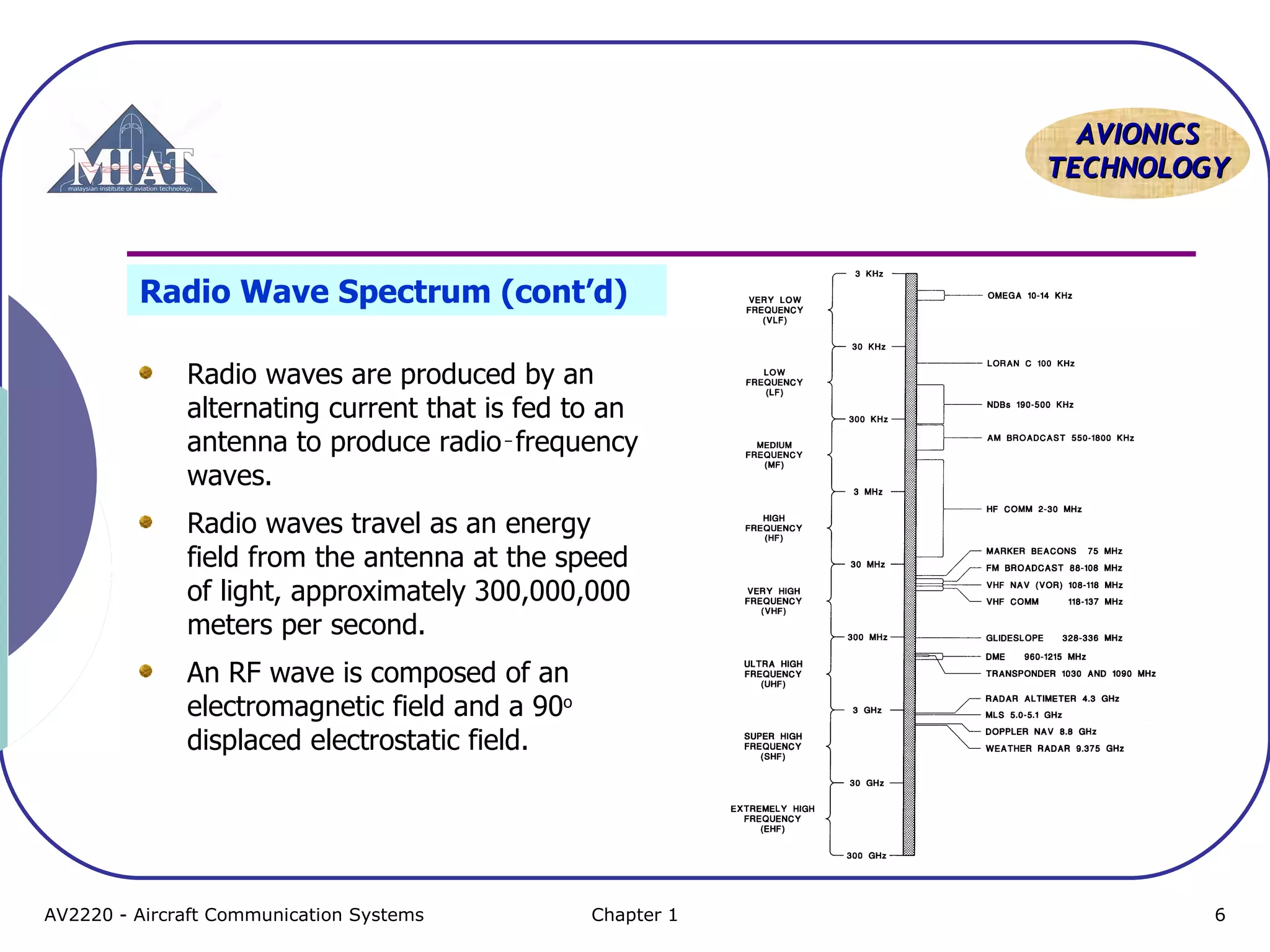
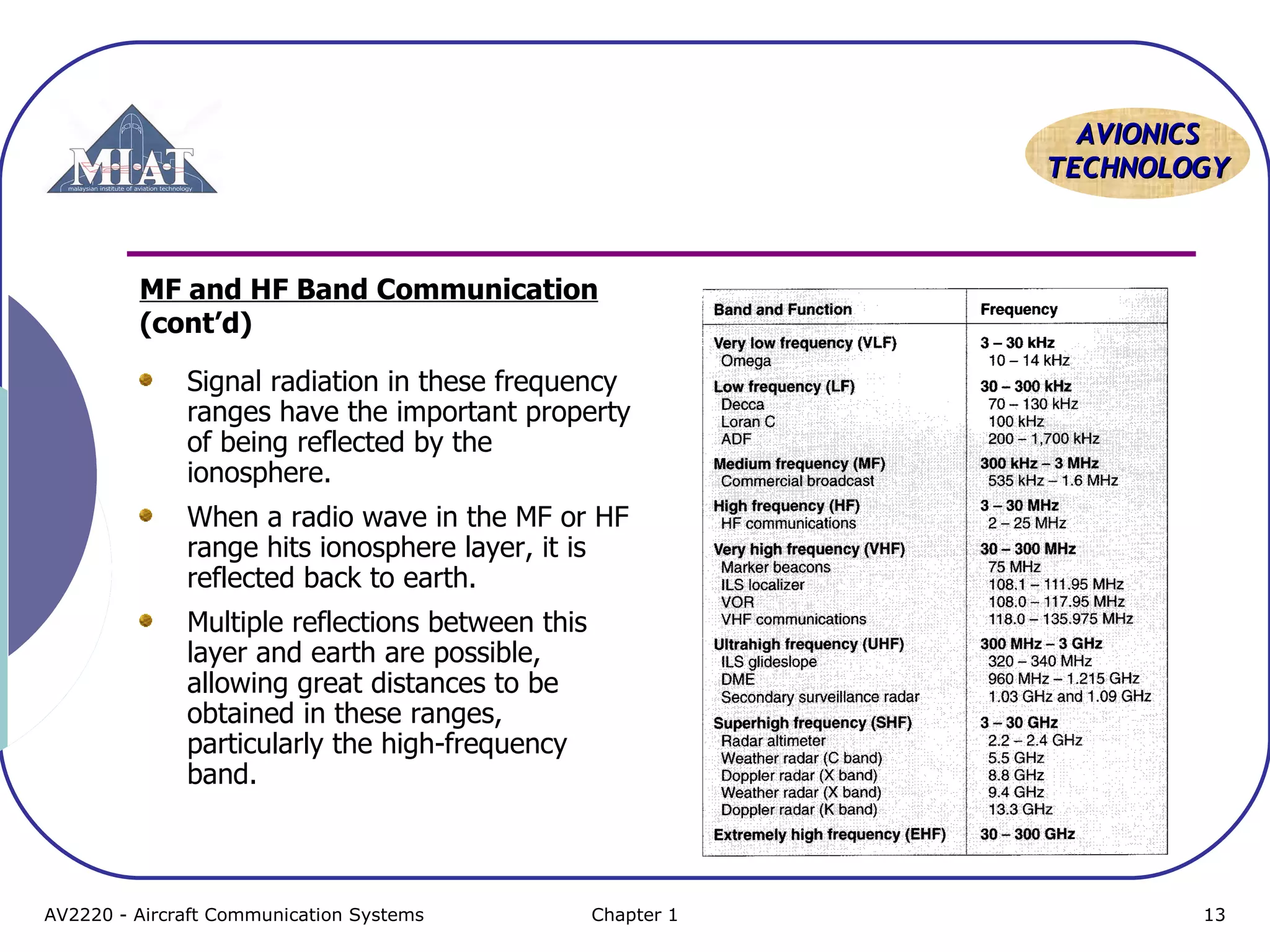
Radio frequency chart showing the 
operating frequencies of common 
aircraft systems: 
AV2220 - Aircraft Communication Systems Chapter 1 4
AAVVIIOONNIICCSS 
TTEECCHHNNOOLLOOGGYY 
Radio Wave Spectrum (cont’d) 
The range and diversity of 
electromagnetic waves, or EM 
waves, is very broad. 
The entire spectrum of EM waves 
includes not only radio waves but 
visible light, gamma rays, infrared, 
etc. 
Common aircraft radio systems are 
included on the right side in the 
Figure. 
 Notice: there is an aviation 
application for all of the bands 
except EHF. 
AV2220 - Aircraft Communication Systems Chapter 1 5
AAVVIIOONNIICCSS 
TTEECCHHNNOOLLOOGGYY 
Radio Wave Spectrum (cont’d) 
Radio waves are produced by an 
alternating current that is fed to an 
antenna to produce radio‑frequency 
waves. 
Radio waves travel as an energy 
field from the antenna at the speed 
of light, approximately 300,000,000 
meters per second. 
An RF wave is composed of an 
electromagnetic field and a 90o 
displaced electrostatic field. 
AV2220 - Aircraft Communication Systems Chapter 1 6
AAVVIIOONNIICCSS 
TTEECCHHNNOOLLOOGGYY 
Radio Wave Spectrum (cont’d) 
The polarization of an RF wave is 
determined by the direction of the 
lines of force in the electromagnetic 
field. 
The direction of these lines of force 
is dependent on the polarization of 
the radiating element. 
 A vertical antenna produces a 
vertically polarized wave 
 A horizontal antenna emits a 
horizontally polarized wave. 
Simple vertical antennas have 
omnidirectional characteristics in 
that they transmit and receive in a 
360o pattern, 
 They are used for 
communication. 
Horizontally polarized antennas 
are basically directional, 
 They are primarily used for 
navigation. 
AV2220 - Aircraft Communication Systems Chapter 1 7
AAVVIIOONNIICCSS 
TTEECCHHNNOOLLOOGGYY 
Radio Wave Spectrum (cont’d) 
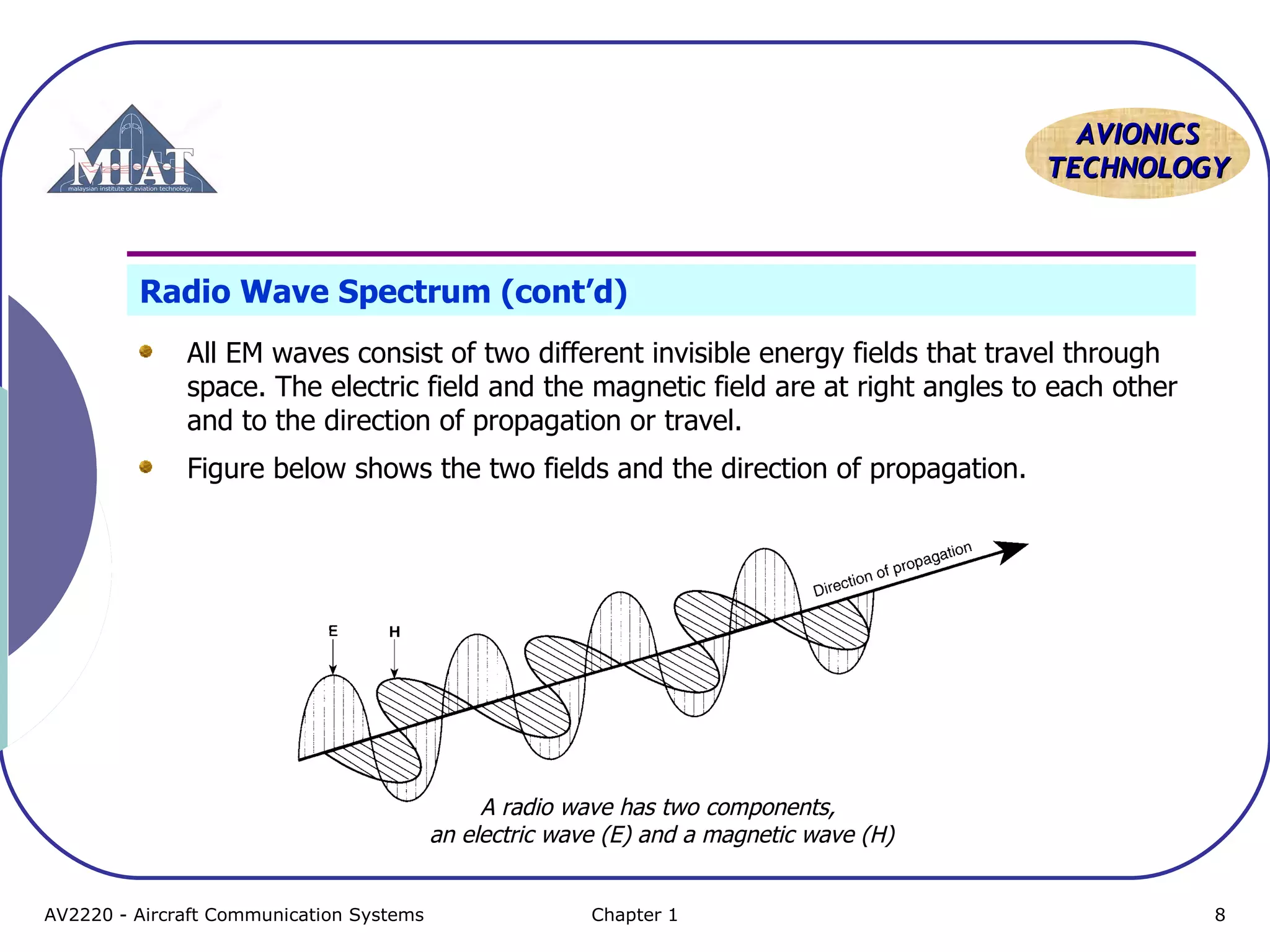
All EM waves consist of two different invisible energy fields that travel through 
space. The electric field and the magnetic field are at right angles to each other 
and to the direction of propagation or travel. 
Figure below shows the two fields and the direction of propagation. 
A radio wave has two components, 
an electric wave (E) and a magnetic wave (H) 
AV2220 - Aircraft Communication Systems Chapter 1 8
AAVVIIOONNIICCSS 
TTEECCHHNNOOLLOOGGYY 
Radio Wave Spectrum (cont’d) 
Radio waves are produced when a 
radio frequency electrical signal is 
sent down a conductor to an 
antenna. 
The antenna transforms the 
electrical signal into EM waves 
which propagate outward from the 
antenna through space. 
The EM waves travel through space 
at the velocity of light, which is 
186,284 miles per second or 
300,000,000 meters per second. 
The basic operating frequency of a 
radio is called the carrier frequency, 
 the signal carries the data or 
information that needs to be 
transmitted from one place to 
another. 
The wavelength of an EM wave is 
the distance from peak to peak for 
the invisible waves in the electric 
and magnetic fields. 
Wavelength is measured in meters 
and it is inversely proportional to 
the frequency. 
The wavelength in meters can be 
found by dividing the constant 
300,000,000 by the frequency in 
hertz. 
AV2220 - Aircraft Communication Systems Chapter 1 9
AAVVIIOONNIICCSS 
TTEECCHHNNOOLLOOGGYY 
Frequency Band Use 
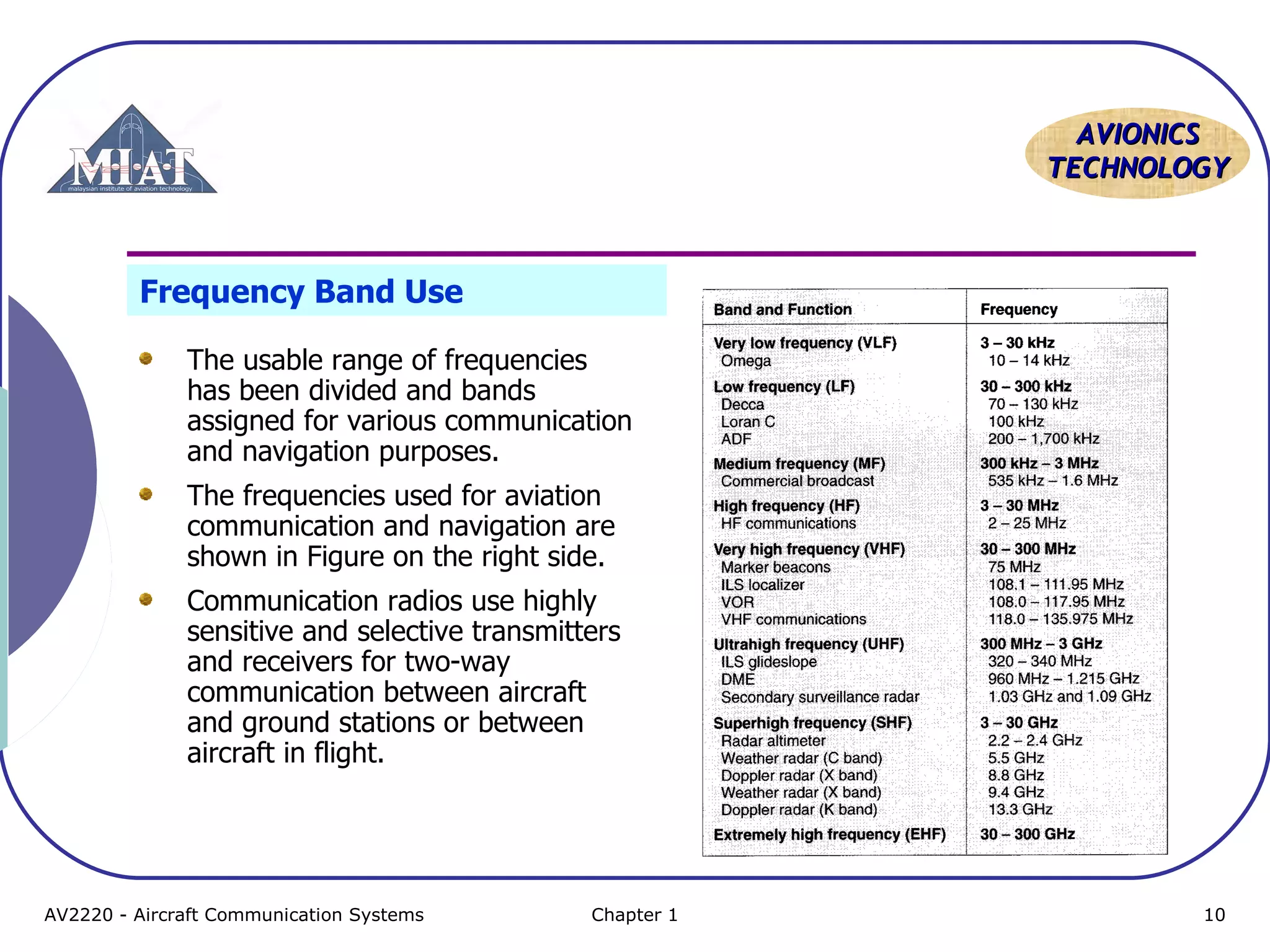
The usable range of frequencies 
has been divided and bands 
assigned for various communication 
and navigation purposes. 
The frequencies used for aviation 
communication and navigation are 
shown in Figure on the right side. 
Communication radios use highly 
sensitive and selective transmitters 
and receivers for two-way 
communication between aircraft 
and ground stations or between 
aircraft in flight. 
AV2220 - Aircraft Communication Systems Chapter 1 10
AAVVIIOONNIICCSS 
TTEECCHHNNOOLLOOGGYY 
VLF and LF Band Communication 
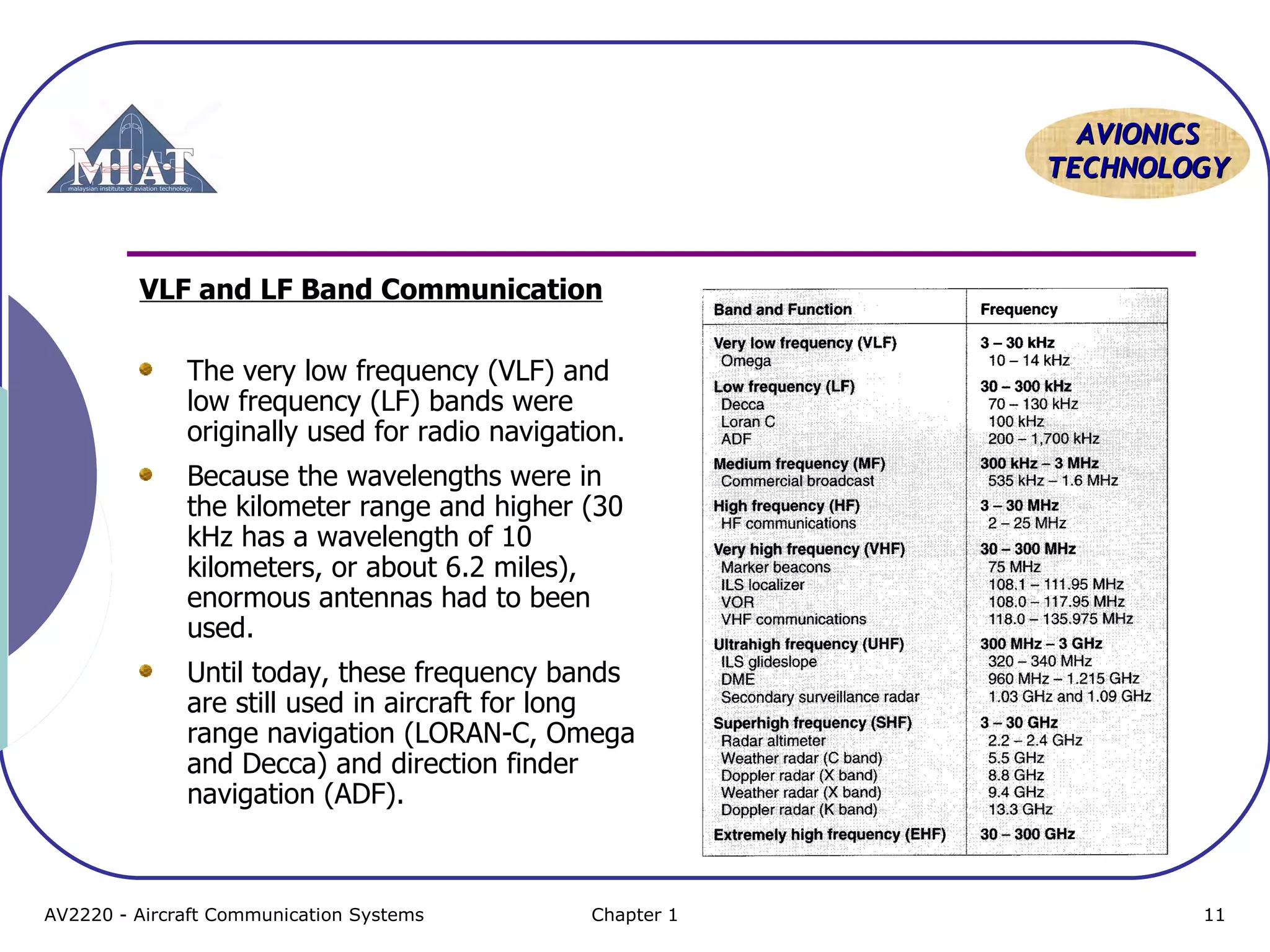
The very low frequency (VLF) and 
low frequency (LF) bands were 
originally used for radio navigation. 
Because the wavelengths were in 
the kilometer range and higher (30 
kHz has a wavelength of 10 
kilometers, or about 6.2 miles), 
enormous antennas had to been 
used. 
Until today, these frequency bands 
are still used in aircraft for long 
range navigation (LORAN-C, Omega 
and Decca) and direction finder 
navigation (ADF). 
AV2220 - Aircraft Communication Systems Chapter 1 11
AAVVIIOONNIICCSS 
TTEECCHHNNOOLLOOGGYY 
MF and HF Band Communication 
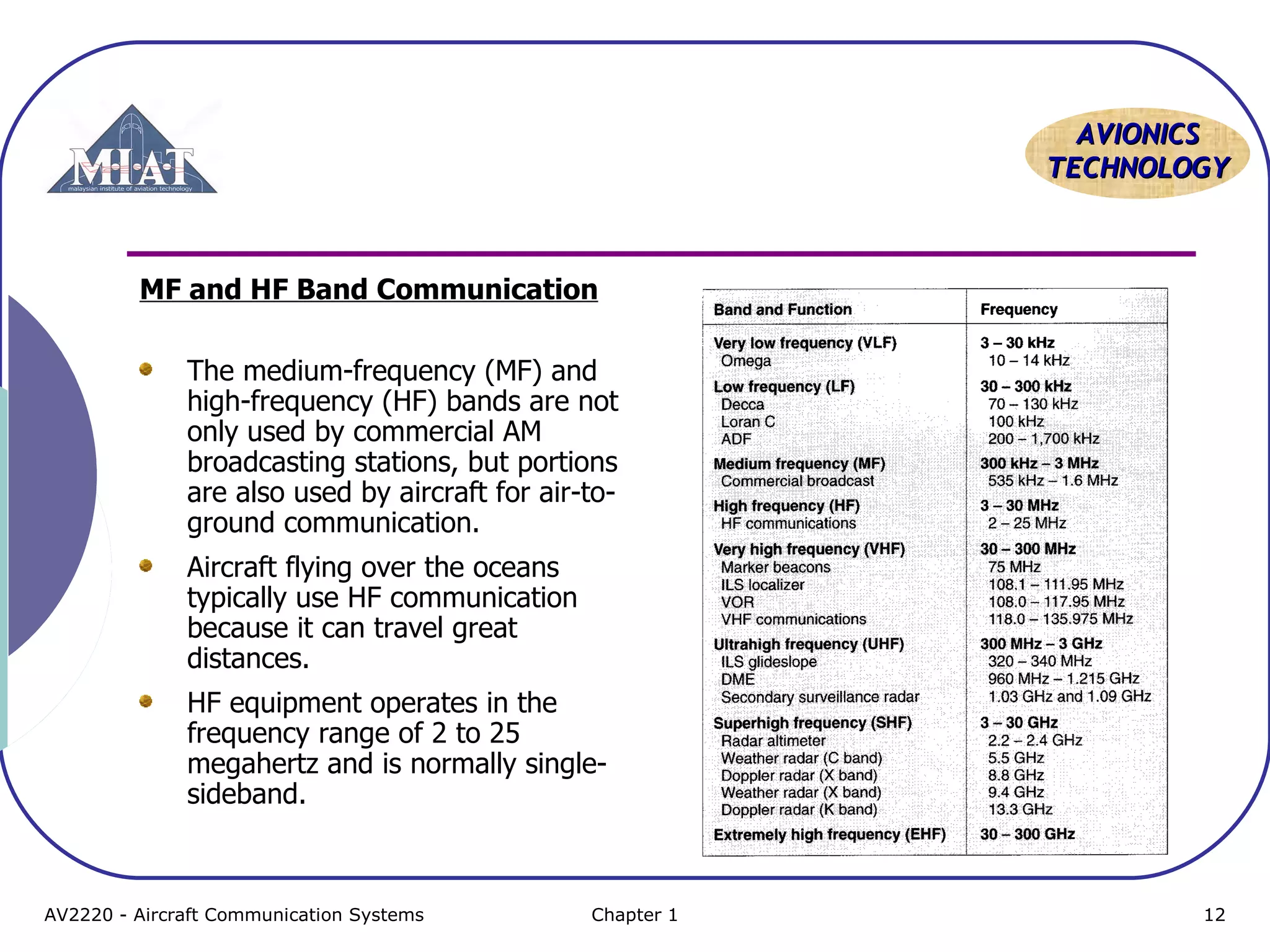
The medium-frequency (MF) and 
high-frequency (HF) bands are not 
only used by commercial AM 
broadcasting stations, but portions 
are also used by aircraft for air-to-ground 
communication. 
Aircraft flying over the oceans 
typically use HF communication 
because it can travel great 
distances. 
HF equipment operates in the 
frequency range of 2 to 25 
megahertz and is normally single-sideband. 
AV2220 - Aircraft Communication Systems Chapter 1 12
AAVVIIOONNIICCSS 
TTEECCHHNNOOLLOOGGYY 
MF and HF Band Communication 
(cont’d) 
Signal radiation in these frequency 
ranges have the important property 
of being reflected by the 
ionosphere. 
When a radio wave in the MF or HF 
range hits ionosphere layer, it is 
reflected back to earth. 
Multiple reflections between this 
layer and earth are possible, 
allowing great distances to be 
obtained in these ranges, 
particularly the high-frequency 
band. 
AV2220 - Aircraft Communication Systems Chapter 1 13
AAVVIIOONNIICCSS 
TTEECCHHNNOOLLOOGGYY 
MF and HF Band Communication 
(cont’d) 
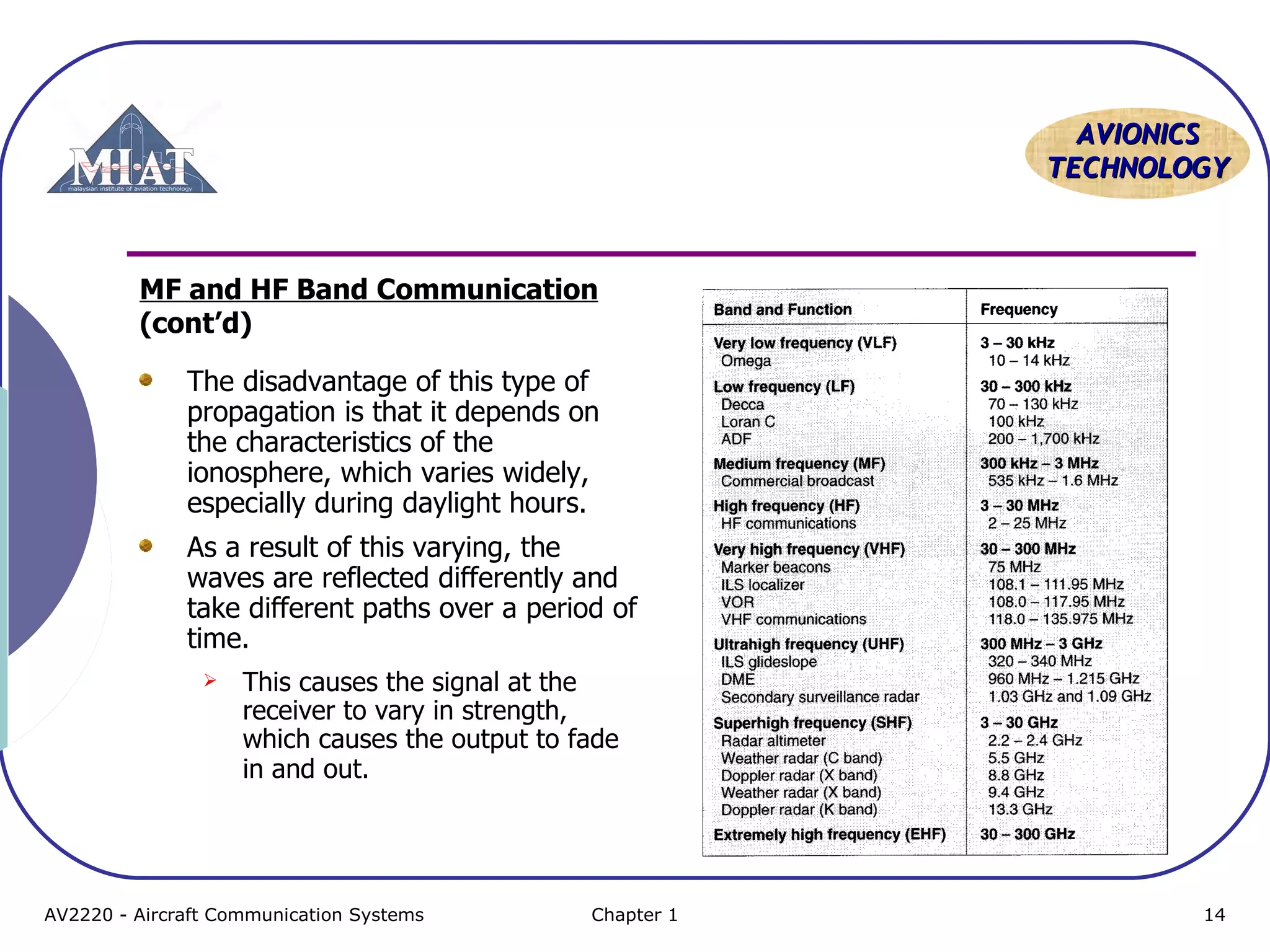
The disadvantage of this type of 
propagation is that it depends on 
the characteristics of the 
ionosphere, which varies widely, 
especially during daylight hours. 
As a result of this varying, the 
waves are reflected differently and 
take different paths over a period of 
time. 
 This causes the signal at the 
receiver to vary in strength, 
which causes the output to fade 
in and out. 
AV2220 - Aircraft Communication Systems Chapter 1 14
AAVVIIOONNIICCSS 
TTEECCHHNNOOLLOOGGYY 
VHF and UHF Band Communication 
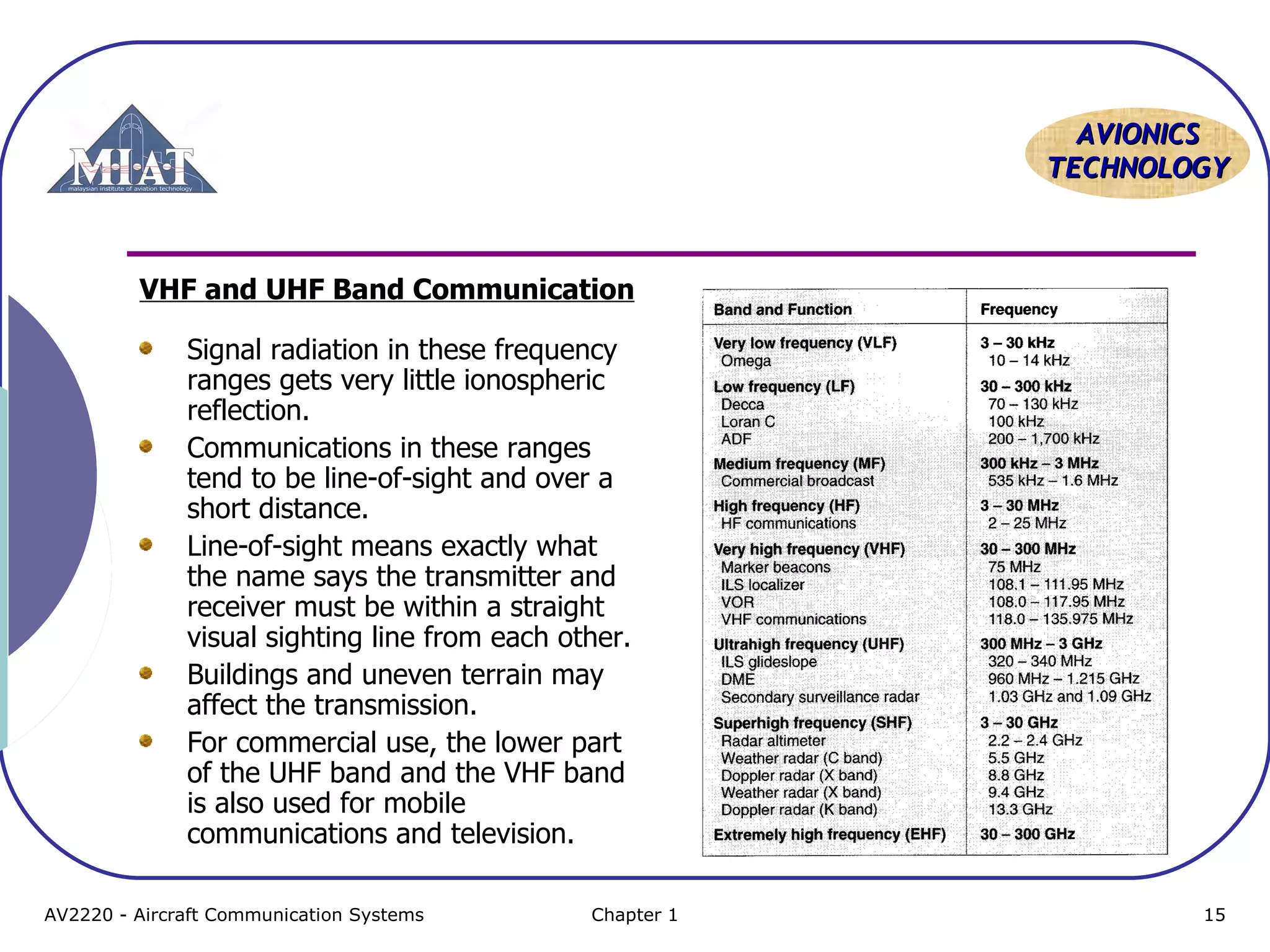
Signal radiation in these frequency 
ranges gets very little ionospheric 
reflection. 
Communications in these ranges 
tend to be line-of-sight and over a 
short distance. 
Line-of-sight means exactly what 
the name says the transmitter and 
receiver must be within a straight 
visual sighting line from each other. 
Buildings and uneven terrain may 
affect the transmission. 
For commercial use, the lower part 
of the UHF band and the VHF band 
is also used for mobile 
communications and television. 
AV2220 - Aircraft Communication Systems Chapter 1 15
AAVVIIOONNIICCSS 
TTEECCHHNNOOLLOOGGYY 
VHF and UHF Band Communication 
(cont’d) 
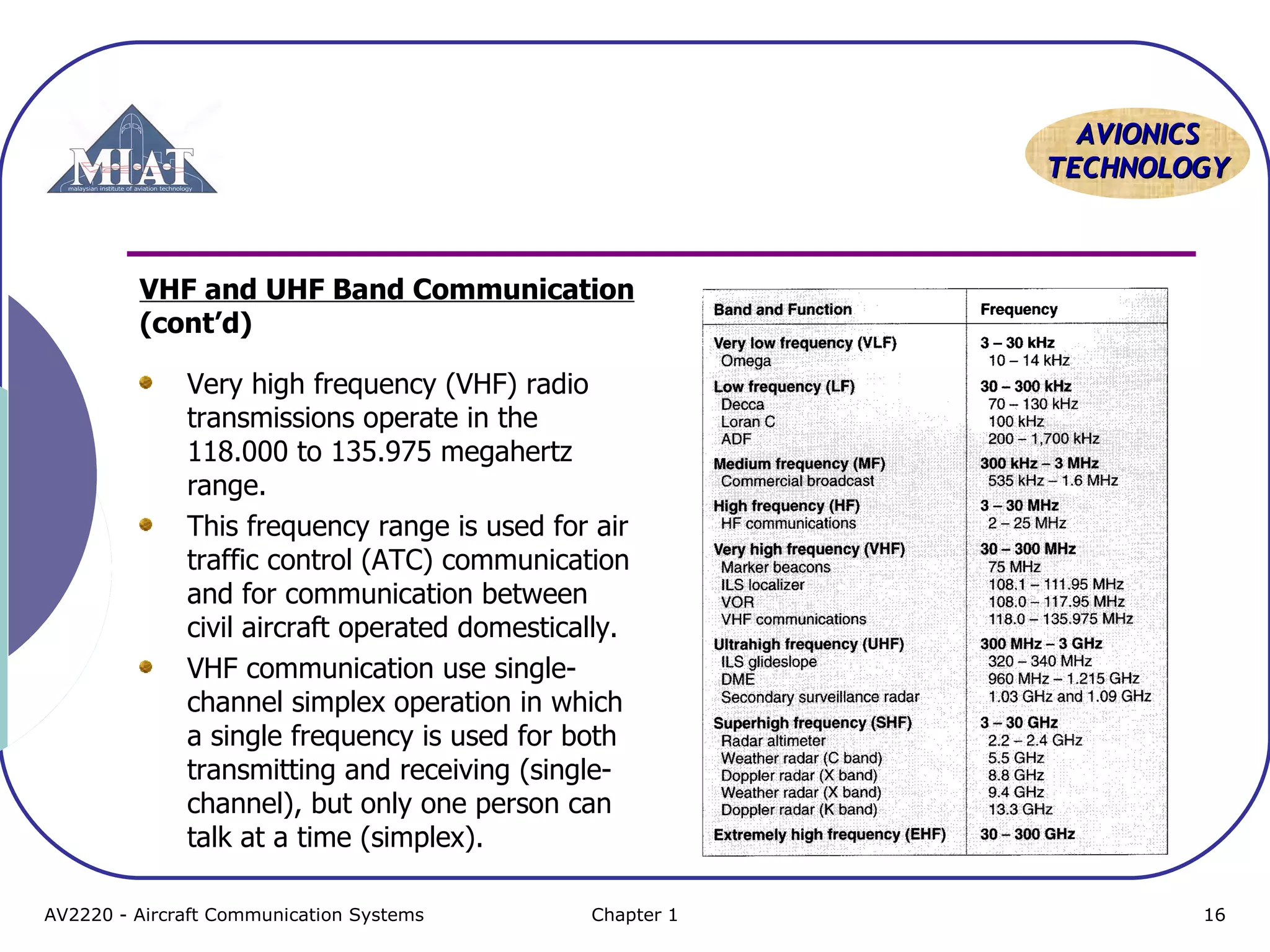
Very high frequency (VHF) radio 
transmissions operate in the 
118.000 to 135.975 megahertz 
range. 
This frequency range is used for air 
traffic control (ATC) communication 
and for communication between 
civil aircraft operated domestically. 
VHF communication use single-channel 
simplex operation in which 
a single frequency is used for both 
transmitting and receiving (single-channel), 
but only one person can 
talk at a time (simplex). 
AV2220 - Aircraft Communication Systems Chapter 1 16

Topic 1 basic radio wave properties

  • 1.
    AAVVIIOONNIICCSS RRaaddiioo WWaavveessTTEECCHHNNOOLLOOGGYY Radio is a method of transmitting intelligence from one location to another by means of electromagnetic radiation. The first radios installed in airplanes were used for communications and it was only much later that navigational radio systems were developed. Radio systems for other purposes have also been developed, especially in the last 20 to 30 years. AV2220 - Aircraft Communication Systems Chapter 1 1
  • 2.
    AAVVIIOONNIICCSS TTEECCHHNNOOLLOOGGYY Someof the uses for radio in modern aircraft can be categorized as follows.  Communications ‑ Both voice and data.  Navigation ‑ Many different systems are in use today.  ATC Radar ‑ The Air Traffic Control system relies on radar.  Weather Avoidance ‑ Used to avoid areas of adverse weather.  Approach Aids ‑ A specialized type of navigation to guide an aircraft down to the runway in bad weather.  Altitude Measurement ‑ Gives precise alti­tude above ground level.  Airborne Collision Avoidance ‑ Warns the pilot of nearby aircraft. AV2220 - Aircraft Communication Systems Chapter 1 2
  • 3.
    AAVVIIOONNIICCSS TTEECCHHNNOOLLOOGGYY RadioWave Spectrum The RF portion of the electromagnetic wave spectrum extends from approximately 3 kHz to 300 GHz. Table radio frequency bands: FREQUENCY RANGE BAND Very Low Frequency (VLF) 3 to 30 kHz Low Frequency (LF) 30 to 300 kHz Medium Frequency (MF) 300 to 3000 kHz High Frequency (HF) 3 to 30 MHz Very High Frequency (VHF) 30 to 300 MHz Ultra High Frequency (UHF) 300 to 3000 MHz Super High Frequency (SHF) 3 to 30 GHz (Giga Hertz) Extremely High Frequency (EHF) 30 to 300 GHz AV2220 - Aircraft Communication Systems Chapter 1 3
  • 4.
    AAVVIIOONNIICCSS TTEECCHHNNOOLLOOGGYY RadioWave Spectrum (cont’d) The frequencies are divided into bands which, starting at the low end, are: very low frequency (VLF), low frequency (LF), medium frequency (MF), high frequency (HF), very high frequency (VHF), ultra high frequency (UHF), super high frequency (SHF) and extremely high frequency (EHF). Radio frequency chart showing the operating frequencies of common aircraft systems: AV2220 - Aircraft Communication Systems Chapter 1 4
  • 5.
    AAVVIIOONNIICCSS TTEECCHHNNOOLLOOGGYY RadioWave Spectrum (cont’d) The range and diversity of electromagnetic waves, or EM waves, is very broad. The entire spectrum of EM waves includes not only radio waves but visible light, gamma rays, infrared, etc. Common aircraft radio systems are included on the right side in the Figure.  Notice: there is an aviation application for all of the bands except EHF. AV2220 - Aircraft Communication Systems Chapter 1 5
  • 6.
    AAVVIIOONNIICCSS TTEECCHHNNOOLLOOGGYY RadioWave Spectrum (cont’d) Radio waves are produced by an alternating current that is fed to an antenna to produce radio‑frequency waves. Radio waves travel as an energy field from the antenna at the speed of light, approximately 300,000,000 meters per second. An RF wave is composed of an electromagnetic field and a 90o displaced electrostatic field. AV2220 - Aircraft Communication Systems Chapter 1 6
  • 7.
    AAVVIIOONNIICCSS TTEECCHHNNOOLLOOGGYY RadioWave Spectrum (cont’d) The polarization of an RF wave is determined by the direction of the lines of force in the electromagnetic field. The direction of these lines of force is dependent on the polarization of the radiating element.  A vertical antenna produces a vertically polarized wave  A horizontal antenna emits a horizontally polarized wave. Simple vertical antennas have omnidirectional characteristics in that they transmit and receive in a 360o pattern,  They are used for communication. Horizontally polarized antennas are basically directional,  They are primarily used for navigation. AV2220 - Aircraft Communication Systems Chapter 1 7
  • 8.
    AAVVIIOONNIICCSS TTEECCHHNNOOLLOOGGYY RadioWave Spectrum (cont’d) All EM waves consist of two different invisible energy fields that travel through space. The electric field and the magnetic field are at right angles to each other and to the direction of propagation or travel. Figure below shows the two fields and the direction of propagation. A radio wave has two components, an electric wave (E) and a magnetic wave (H) AV2220 - Aircraft Communication Systems Chapter 1 8
  • 9.
    AAVVIIOONNIICCSS TTEECCHHNNOOLLOOGGYY RadioWave Spectrum (cont’d) Radio waves are produced when a radio frequency electrical signal is sent down a conductor to an antenna. The antenna transforms the electrical signal into EM waves which propagate outward from the antenna through space. The EM waves travel through space at the velocity of light, which is 186,284 miles per second or 300,000,000 meters per second. The basic operating frequency of a radio is called the carrier frequency,  the signal carries the data or information that needs to be transmitted from one place to another. The wavelength of an EM wave is the distance from peak to peak for the invisible waves in the electric and magnetic fields. Wavelength is measured in meters and it is inversely proportional to the frequency. The wavelength in meters can be found by dividing the constant 300,000,000 by the frequency in hertz. AV2220 - Aircraft Communication Systems Chapter 1 9
  • 10.
    AAVVIIOONNIICCSS TTEECCHHNNOOLLOOGGYY FrequencyBand Use The usable range of frequencies has been divided and bands assigned for various communication and navigation purposes. The frequencies used for aviation communication and navigation are shown in Figure on the right side. Communication radios use highly sensitive and selective transmitters and receivers for two-way communication between aircraft and ground stations or between aircraft in flight. AV2220 - Aircraft Communication Systems Chapter 1 10
  • 11.
    AAVVIIOONNIICCSS TTEECCHHNNOOLLOOGGYY VLFand LF Band Communication The very low frequency (VLF) and low frequency (LF) bands were originally used for radio navigation. Because the wavelengths were in the kilometer range and higher (30 kHz has a wavelength of 10 kilometers, or about 6.2 miles), enormous antennas had to been used. Until today, these frequency bands are still used in aircraft for long range navigation (LORAN-C, Omega and Decca) and direction finder navigation (ADF). AV2220 - Aircraft Communication Systems Chapter 1 11
  • 12.
    AAVVIIOONNIICCSS TTEECCHHNNOOLLOOGGYY MFand HF Band Communication The medium-frequency (MF) and high-frequency (HF) bands are not only used by commercial AM broadcasting stations, but portions are also used by aircraft for air-to-ground communication. Aircraft flying over the oceans typically use HF communication because it can travel great distances. HF equipment operates in the frequency range of 2 to 25 megahertz and is normally single-sideband. AV2220 - Aircraft Communication Systems Chapter 1 12
  • 13.
    AAVVIIOONNIICCSS TTEECCHHNNOOLLOOGGYY MFand HF Band Communication (cont’d) Signal radiation in these frequency ranges have the important property of being reflected by the ionosphere. When a radio wave in the MF or HF range hits ionosphere layer, it is reflected back to earth. Multiple reflections between this layer and earth are possible, allowing great distances to be obtained in these ranges, particularly the high-frequency band. AV2220 - Aircraft Communication Systems Chapter 1 13
  • 14.
    AAVVIIOONNIICCSS TTEECCHHNNOOLLOOGGYY MFand HF Band Communication (cont’d) The disadvantage of this type of propagation is that it depends on the characteristics of the ionosphere, which varies widely, especially during daylight hours. As a result of this varying, the waves are reflected differently and take different paths over a period of time.  This causes the signal at the receiver to vary in strength, which causes the output to fade in and out. AV2220 - Aircraft Communication Systems Chapter 1 14
  • 15.
    AAVVIIOONNIICCSS TTEECCHHNNOOLLOOGGYY VHFand UHF Band Communication Signal radiation in these frequency ranges gets very little ionospheric reflection. Communications in these ranges tend to be line-of-sight and over a short distance. Line-of-sight means exactly what the name says the transmitter and receiver must be within a straight visual sighting line from each other. Buildings and uneven terrain may affect the transmission. For commercial use, the lower part of the UHF band and the VHF band is also used for mobile communications and television. AV2220 - Aircraft Communication Systems Chapter 1 15
  • 16.
    AAVVIIOONNIICCSS TTEECCHHNNOOLLOOGGYY VHFand UHF Band Communication (cont’d) Very high frequency (VHF) radio transmissions operate in the 118.000 to 135.975 megahertz range. This frequency range is used for air traffic control (ATC) communication and for communication between civil aircraft operated domestically. VHF communication use single-channel simplex operation in which a single frequency is used for both transmitting and receiving (single-channel), but only one person can talk at a time (simplex). AV2220 - Aircraft Communication Systems Chapter 1 16