Antenna
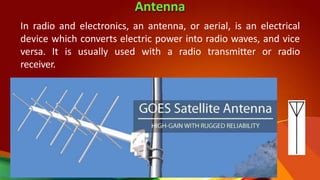
In radio and electronics, an antenna, or aerial, is an electrical
device which converts electric power into radio waves, and vice
versa. It is usually used with a radio transmitter or radio
receiver.
Antenna
Categories
Antenna
According to their applications and
technology available, antennas generally fall
in one of two categories:
1. Omnidirectional
2. Directional
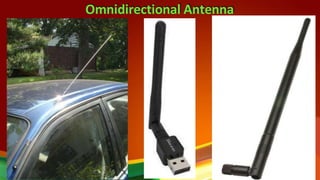
Omnidirectional Antenna
only weakly directional antennas which receive or radiate
more or less in all directions. These are employed when
the relative position of the other station is unknown or
arbitrary. They are also used at lower frequencies where a
directional antenna would be too large, or simply to cut
costs in applications where a directional antenna isn't
required.
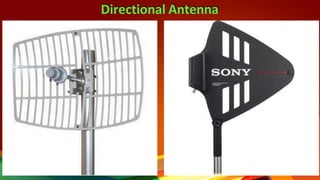
Directional Antenna
Directional Antenna
Directional or beam antennas which are
intended to preferentially radiate or receive in
a particular direction or directional pattern.
FUNDAMENTAL PARAMETERS OF ANTENNAS
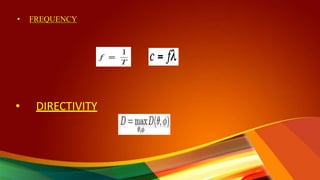
• FREQUENCY
• DIRECTIVITY
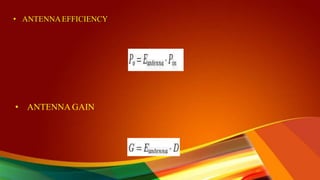
• ANTENNAEFFICIENCY
• ANTENNAGAIN
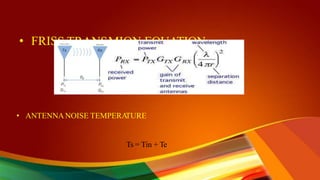
• FRISS TRANSMISSION EQUATION
• ANTENNANOISE TEMPERA
TURE
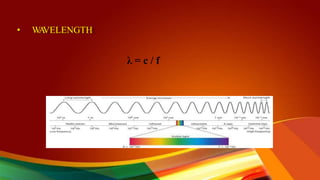
• WAVELENGTH
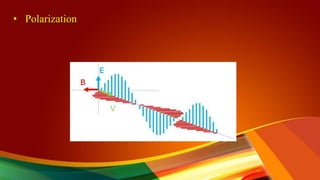
• POLARIZATION
• FREQUENCY
• DIRECTIVITY
• ANTENNAEFFICIENCY
• ANTENNA GAIN
• FRISS TRANSMION EQUATION
• ANTENNANOISE TEMPERA
TURE
Ts = Tin + Te
• W
A
VELENGTH
λ = c / f
• Polarization
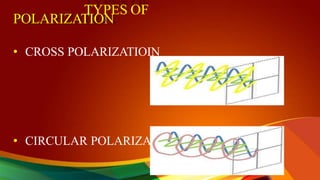
TYPES OF
POLARIZATION
• CROSS POLARIZATIOIN
• CIRCULAR POLARIZATION
TYPES OFANTENNAS
• TRA
VELLING W
A
VE ANTENNAS
• LOG-PERIODIC ANTENNAS
• APERTUREANTENNAS
• WIREANTENNAS
• REFLECTOR ANTENNAS
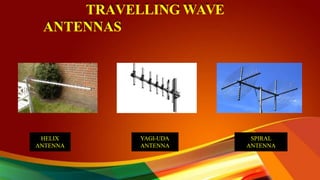
TRAVELLING WAVE
ANTENNAS
HELIX
ANTENNA
YAGI-UDA
ANTENNA
SPIRAL
ANTENNA
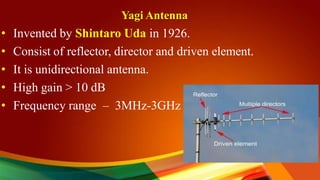
Yagi Antenna
• Invented by Shintaro Uda in 1926.
• Consist of reflector, director and driven element.
• It is unidirectional antenna.
• High gain > 10 dB
• Frequency range – 3MHz-3GHz
Yagi – Uda (Advantages)
• High gain and good front to back ratio.
• It has narrow bandwidth.
• It is fixed frequency device.
• Greater directivity due to director and reflector.
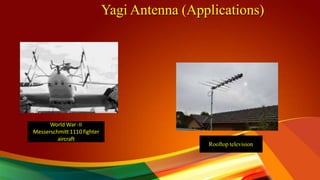
Yagi Antenna (Applications)
World War -II
Messerschmitt 1110 fighter
aircraft
Rooftop television
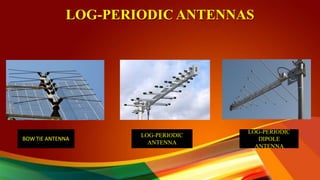
LOG-PERIODIC ANTENNAS
BOW TIE ANTENNA
LOG-PERIODIC
ANTENNA
LOG-PERIODIC
DIPOLE
ANTENNA
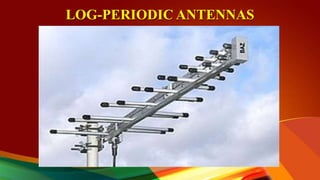
LOG-PERIODIC ANTENNAS
Log-Periodic Antenna
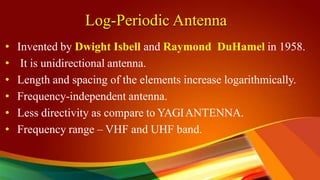
• Invented by Dwight Isbell and Raymond DuHamel in 1958.
• It is unidirectional antenna.
• Length and spacing of the elements increase logarithmically.
• Frequency-independent antenna.
• Less directivity as compare to YAGIANTENNA.
• Frequency range – VHF and UHF band.
Log-Periodic Antenna (Advantages)
• It is broadband antenna.
• It is unidirectional antenna.
• It is frequency independent antenna.
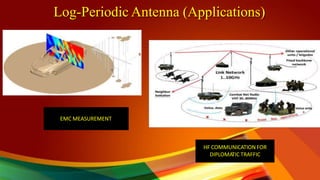
Log-Periodic Antenna (Applications)
EMC MEASUREMENT
HF COMMUNICATION FOR
DIPLOMATIC TRAFFIC
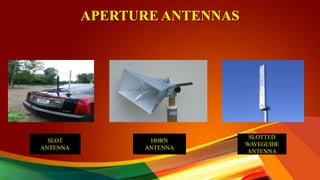
APERTURE ANTENNAS
SLOTTED
WAVEGUIDE
ANTENNA
SLOT
ANTENNA
HORN
ANTENNA
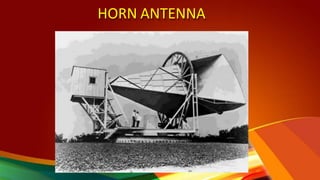
HORN ANTENNA
HORN ANTENNA
• Constructed by Indian radio researcher
Jagadish Chandra Bose in 1897.
• Transmit radio waves from a waveguide or collect radio
waves into a waveguide for reception.
• Frequency-range above 300MHz.
• Widely used satellite dishes and radio telescopes.
Horn Antenna (Advantages)
• No resonant elements.
• Operate over a wide range of frequencies.
• Usable bandwidth 1GHz to 20GHz.
• Gain ranges upto 25 dB,with 10 -20 dB typical.
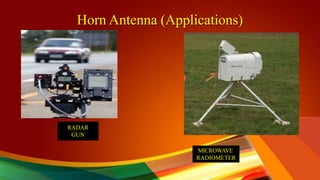
Horn Antenna (Applications)
MICROWAVE
RADIOMETER
RADAR
GUN
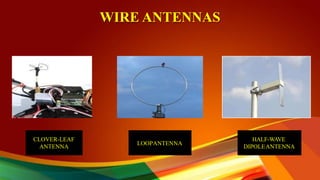
WIRE ANTENNAS
LOOPANTENNA
CLOVER-LEAF
ANTENNA
HALF-WAVE
DIPOLEANTENNA
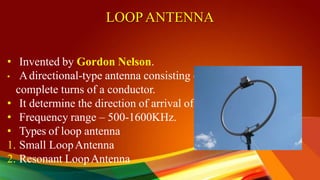
LOOPANTENNA
• Invented by Gordon Nelson.
• Adirectional-type antenna consisting of one or more
complete turns of a conductor.
• It determine the direction of arrival of radio signals.
• Frequency range – 500-1600KHz.
• Types of loop antenna
1. Small LoopAntenna
2. Resonant LoopAntenna
Loop Antenna (Advantages)
• Variety of configurations are possible.
• Choose from multiple shapes.
• Exhibits the same radiation pattern as a dipole.
• Potential gain of up to 2 dB.
• Variety of orientations are possible.
• Easy to build & inexpensive.
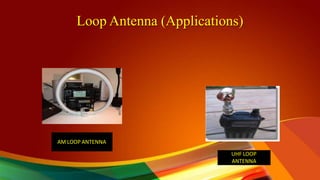
Loop Antenna (Applications)
AM LOOP ANTENNA
UHF LOOP
ANTENNA
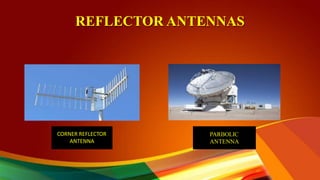
REFLECTOR ANTENNAS
CORNER REFLECTOR
ANTENNA
PARBOLIC
ANTENNA
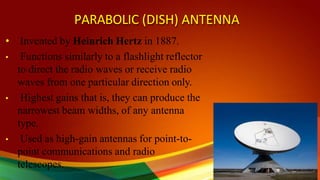
PARABOLIC (DISH) ANTENNA
• Invented by Heinrich Hertz in 1887.
• Functions similarly to a flashlight reflector
to direct the radio waves or receive radio
waves from one particular direction only.
• Highest gains that is, they can produce the
narrowest beam widths, of any antenna
type.
• Used as high-gain antennas for point-to-
point communications and radio
telescopes.
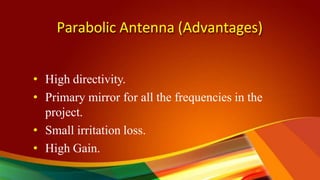
Parabolic Antenna (Advantages)
• High directivity.
• Primary mirror for all the frequencies in the
project.
• Small irritation loss.
• High Gain.
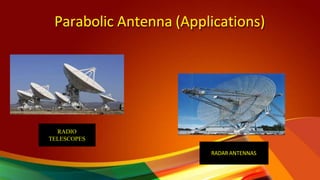
Parabolic Antenna (Applications)
RADIO
TELESCOPES
RADAR ANTENNAS
Conclusion
• Antennas plays an important role in our daily life.
• Antenna are used to convert electrical energy to
electromagnetic energy.
• All the antennas are very useful in all the application such
as transmitter and receiver.
• It is impossible to transmit or recieve our signal without
the use of antenna at the transmitter and receiver ends.

antennasystem-190928171019.pptx