
Prepared by:
Dr. E. Gayathiri
Department of Plant Biology and Plant Biotechnology
Guru Nanak College,
Learning Objectives
Overview:
Introduction
Thallus Structure
Structure of a cell of
Nostoc
Reproduction in Nostoc
Importance of
Cyanobacteria
Kingdom: Monera.
Class: Cyanophyceae
Order: Nostocales
Family: Nostocaceae
Genus: Nostoc
It is blue-green algae.
Nostoc is common as terrestrial and subaerial cyanobacteria.
NOSTOC
Distributed in
alkaline soils
moist rocks
water ponds
streams
and lakes.
Nostoc colony is jelly-like mass.
Filaments are embedded in this mass.
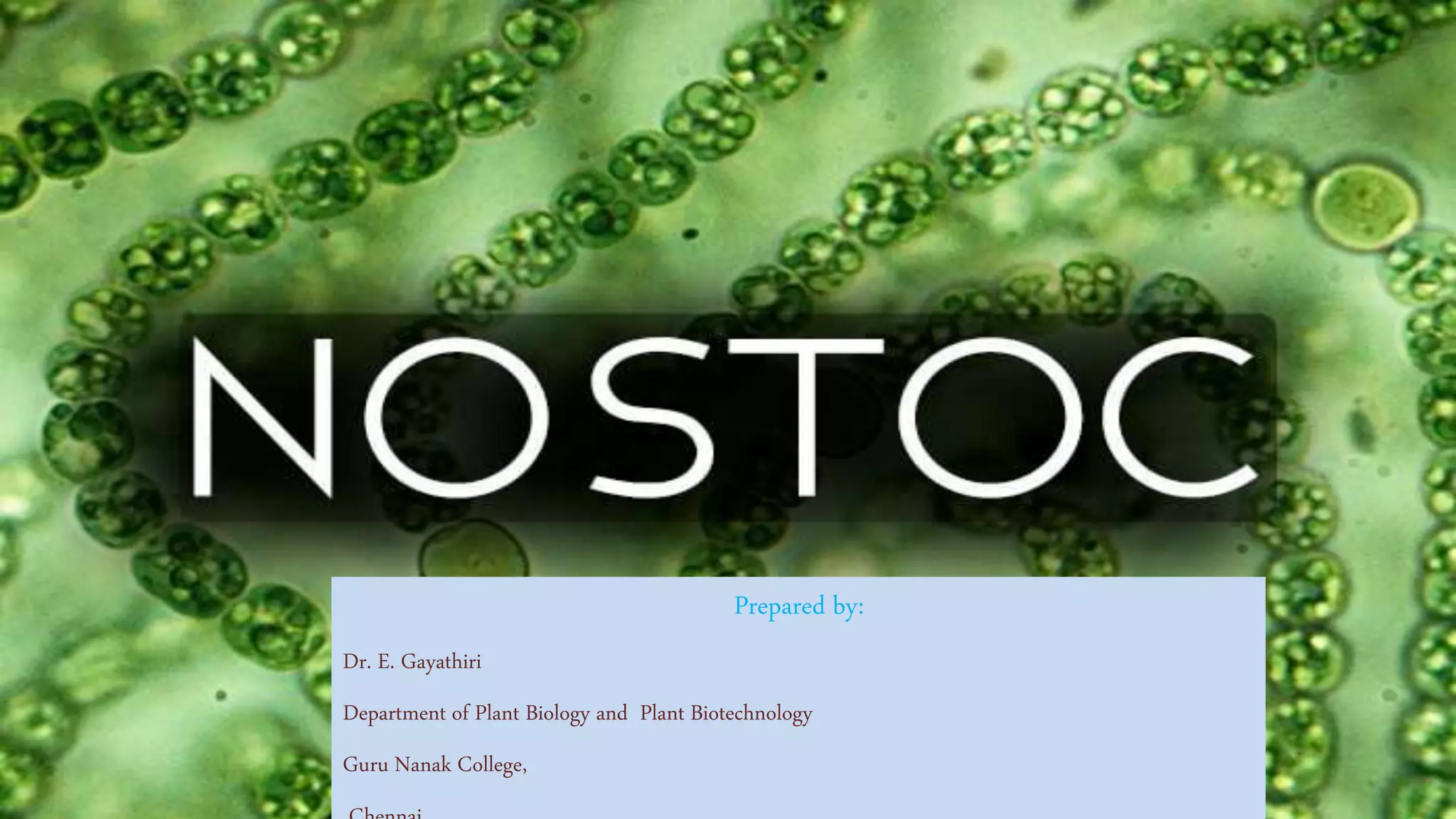
The individual filament is called trichome,
unbranched and appears bead-like structure.
Thallus Structure
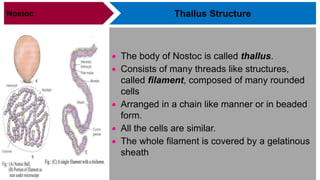
 The body of Nostoc is called thallus.
 Consists of many threads like structures,
called filament, composed of many rounded
cells
 Arranged in a chain like manner or in beaded
form.
 All the cells are similar.
 The whole filament is covered by a gelatinous
sheath
Nostoc
Thallus Structure
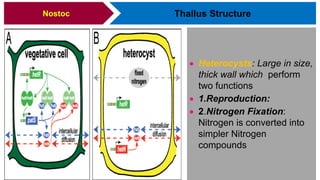
 Heterocysts: Large in size,
thick wall which perform
two functions
 1.Reproduction:
 2.Nitrogen Fixation:
Nitrogen is converted into
simpler Nitrogen
compounds
Nostoc
TRICHOMES
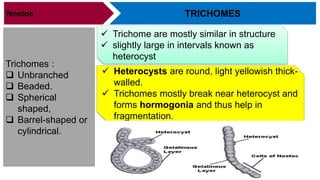
Trichomes :
 Unbranched
 Beaded.
 Spherical
shaped,
 Barrel-shaped or
cylindrical.
Nostoc
 Trichome are mostly similar in structure
 slightly large in intervals known as
heterocyst
 Heterocysts are round, light yellowish thick-
walled.
 Trichomes mostly break near heterocyst and
forms hormogonia and thus help in
fragmentation.
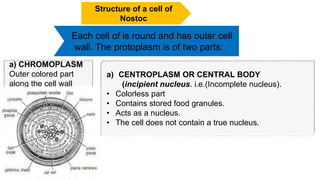
a) CHROMOPLASM
Outer colored part
along the cell wall
Each cell of is round and has outer cell
wall. The protoplasm is of two parts:
Structure of a cell of
Nostoc
a) CENTROPLASM OR CENTRAL BODY
(incipient nucleus. i.e.(Incomplete nucleus).
• Colorless part
• Contains stored food granules.
• Acts as a nucleus.
• The cell does not contain a true nucleus.
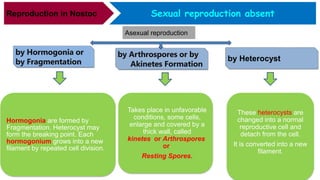
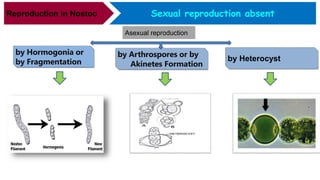
Sexual reproduction absentReproduction in Nostoc
Asexual reproduction
by Hormogonia or
by Fragmentation
Hormogonia are formed by
Fragmentation. Heterocyst may
form the breaking point. Each
hormogonium grows into a new
filament by repeated cell division.
by Arthrospores or by
Akinetes Formation
Takes place in unfavorable
conditions, some cells,
enlarge and covered by a
thick wall, called
kinetes or Arthrospores
or
Resting Spores.
These heterocysts are
changed into a normal
reproductive cell and
detach from the cell.
It is converted into a new
filament.
by Heterocyst
Sexual reproduction absentReproduction in Nostoc
Asexual reproduction
by Hormogonia or
by Fragmentation
by Arthrospores or by
Akinetes Formation
by Heterocyst
Nutrition in Nostoc
It is Autotroph in nature.
Cyanobacteria (Blue, Green Algae) use carbon
dioxide and release oxygen during
photosynthesis, so environment becomes fresh
and is used by aquatic animals.
They take part in Nitrogen Fixation.
Importance of
Cyanobacteria
Nostoc thallus , structure and reproduction

Nostoc thallus , structure and reproduction

  • 1.
    Prepared by: Dr. E.Gayathiri Department of Plant Biology and Plant Biotechnology Guru Nanak College,
  • 2.
    Learning Objectives Overview: Introduction Thallus Structure Structureof a cell of Nostoc Reproduction in Nostoc Importance of Cyanobacteria
  • 3.
    Kingdom: Monera. Class: Cyanophyceae Order:Nostocales Family: Nostocaceae Genus: Nostoc It is blue-green algae. Nostoc is common as terrestrial and subaerial cyanobacteria. NOSTOC Distributed in alkaline soils moist rocks water ponds streams and lakes. Nostoc colony is jelly-like mass. Filaments are embedded in this mass. The individual filament is called trichome, unbranched and appears bead-like structure.
  • 4.
    Thallus Structure  Thebody of Nostoc is called thallus.  Consists of many threads like structures, called filament, composed of many rounded cells  Arranged in a chain like manner or in beaded form.  All the cells are similar.  The whole filament is covered by a gelatinous sheath Nostoc
  • 5.
    Thallus Structure  Heterocysts:Large in size, thick wall which perform two functions  1.Reproduction:  2.Nitrogen Fixation: Nitrogen is converted into simpler Nitrogen compounds Nostoc
  • 6.
    TRICHOMES Trichomes :  Unbranched Beaded.  Spherical shaped,  Barrel-shaped or cylindrical. Nostoc  Trichome are mostly similar in structure  slightly large in intervals known as heterocyst  Heterocysts are round, light yellowish thick- walled.  Trichomes mostly break near heterocyst and forms hormogonia and thus help in fragmentation.
  • 7.
    a) CHROMOPLASM Outer coloredpart along the cell wall Each cell of is round and has outer cell wall. The protoplasm is of two parts: Structure of a cell of Nostoc a) CENTROPLASM OR CENTRAL BODY (incipient nucleus. i.e.(Incomplete nucleus). • Colorless part • Contains stored food granules. • Acts as a nucleus. • The cell does not contain a true nucleus.
  • 8.
    Sexual reproduction absentReproductionin Nostoc Asexual reproduction by Hormogonia or by Fragmentation Hormogonia are formed by Fragmentation. Heterocyst may form the breaking point. Each hormogonium grows into a new filament by repeated cell division. by Arthrospores or by Akinetes Formation Takes place in unfavorable conditions, some cells, enlarge and covered by a thick wall, called kinetes or Arthrospores or Resting Spores. These heterocysts are changed into a normal reproductive cell and detach from the cell. It is converted into a new filament. by Heterocyst
  • 9.
    Sexual reproduction absentReproductionin Nostoc Asexual reproduction by Hormogonia or by Fragmentation by Arthrospores or by Akinetes Formation by Heterocyst
  • 10.
    Nutrition in Nostoc Itis Autotroph in nature. Cyanobacteria (Blue, Green Algae) use carbon dioxide and release oxygen during photosynthesis, so environment becomes fresh and is used by aquatic animals. They take part in Nitrogen Fixation. Importance of Cyanobacteria