Presented by – Vikas Kumar
A0999320037
MSc. First semester
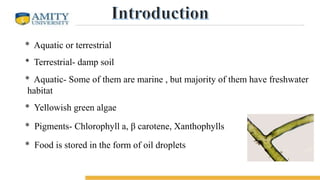
* Aquatic or terrestrial
* Terrestrial- damp soil
* Aquatic- Some of them are marine , but majority of them have freshwater
habitat
* Yellowish green algae
* Pigments- Chlorophyll a, β carotene, Xanthophylls
* Food is stored in the form of oil droplets
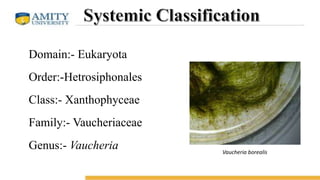
Domain:- Eukaryota
Order:-Hetrosiphonales
Class:- Xanthophyceae
Family:- Vaucheriaceae
Genus:- Vaucheria Vaucheria borealis
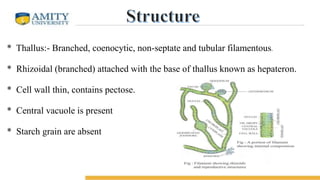
* Thallus:- Branched, coenocytic, non-septate and tubular filamentous.
* Rhizoidal (branched) attached with the base of thallus known as hepateron.
* Cell wall thin, contains pectose.
* Central vacuole is present
* Starch grain are absent
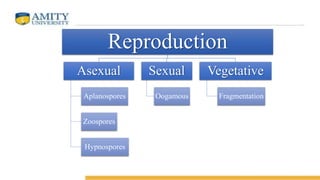
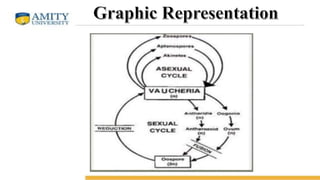
Reproduction
Asexual
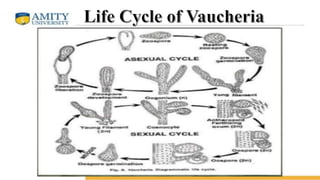
Aplanospores
Zoospores
Hypnospores
Sexual
Oogamous
Vegetative
Fragmentation
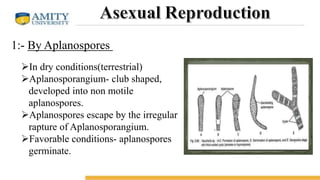
1:- By Aplanospores
In dry conditions(terrestrial)
Aplanosporangium- club shaped,
developed into non motile
aplanospores.
Aplanospores escape by the irregular
rapture of Aplanosporangium.
Favorable conditions- aplanospores
germinate.
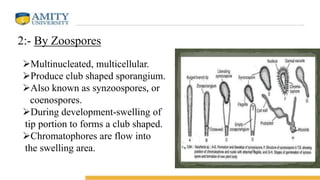
2:- By Zoospores
Multinucleated, multicellular.
Produce club shaped sporangium.
Also known as synzoospores, or
coenospores.
During development-swelling of
tip portion to forms a club shaped.
Chromatophores are flow into
the swelling area.
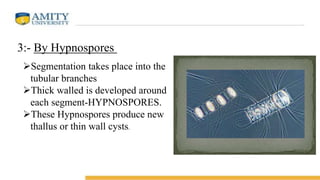
3:- By Hypnospores
Segmentation takes place into the
tubular branches
Thick walled is developed around
each segment-HYPNOSPORES.
These Hypnospores produce new
thallus or thin wall cysts.
Vegetative Reproduction in Vaucheria takes place
by fragmentation.
The thallus break into smaller fragments due
to mechanical injury or insect bites etc.
The broken fragment develops thick wall and
later, develops into new thallus.
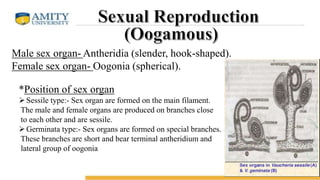
Male sex organ- Antheridia (slender, hook-shaped).
Female sex organ- Oogonia (spherical).
*Position of sex organ
Sessile type:- Sex organ are formed on the main filament.
The male and female organs are produced on branches close
to each other and are sessile.
Germinata type:- Sex organs are formed on special branches.
These branches are short and bear terminal antheridium and
lateral group of oogonia
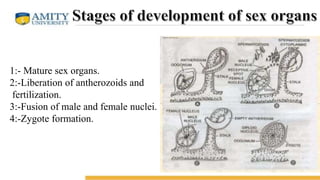
1:- Mature sex organs.
2:-Liberation of antherozoids and
fertilization.
3:-Fusion of male and female nuclei.
4:-Zygote formation.
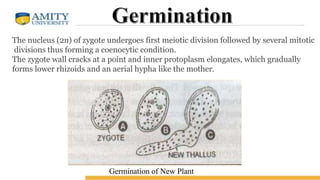
The nucleus (2n) of zygote undergoes first meiotic division followed by several mitotic
divisions thus forming a coenocytic condition.
The zygote wall cracks at a point and inner protoplasm elongates, which gradually
forms lower rhizoids and an aerial hypha like the mother.
Germination of New Plant
Thank You!!!