

Prepared by:
Dr. Sangeeta Das, Assistant Professor, Bahona College, Jorhat, Assam, India
CHLAMYDOMONAS
Occurrence of Chlamydomonas:
•Chlamydomonas is a large genus and is
found almost in all places. It is
represented by about 400 species
(Prescott, 1969).
•It is mainly found in fresh water rich in
nitrogen salts and organic matter.
•It is also found in stagnant water of
ponds, pools, ditches, water tanks,
sewage tanks and in slow running water.
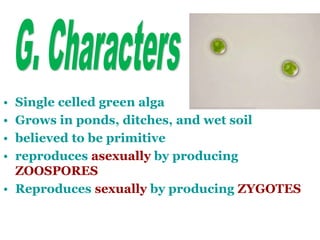
• Single celled green alga
• Grows in ponds, ditches, and wet soil
• believed to be primitive
• reproduces asexually by producing
ZOOSPORES
• Reproduces sexually by producing ZYGOTES
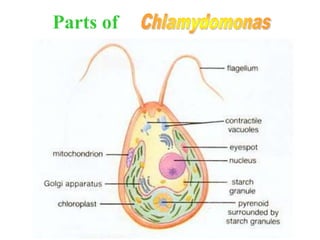
Parts of
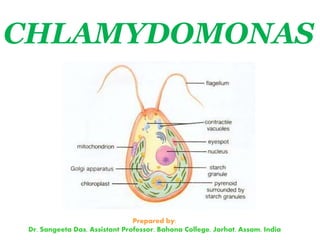
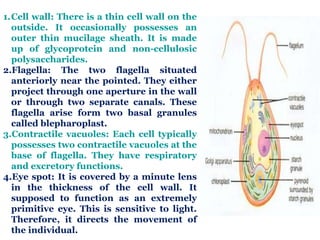
1.Cell wall: There is a thin cell wall on the
outside. It occasionally possesses an
outer thin mucilage sheath. It is made
up of glycoprotein and non-cellulosic
polysaccharides.
2.Flagella: The two flagella situated
anteriorly near the pointed. They either
project through one aperture in the wall
or through two separate canals. These
flagella arise form two basal granules
called blepharoplast.
3.Contractile vacuoles: Each cell typically
possesses two contractile vacuoles at the
base of flagella. They have respiratory
and excretory functions.
4.Eye spot: It is covered by a minute lens
in the thickness of the cell wall. It
supposed to function as an extremely
primitive eye. This is sensitive to light.
Therefore, it directs the movement of
the individual.
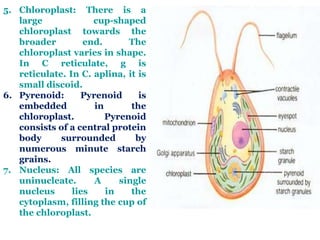
5. Chloroplast: There is a
large cup-shaped
chloroplast towards the
broader end. The
chloroplast varies in shape.
In C reticulate, g is
reticulate. In C. aplina, it is
small discoid.
6. Pyrenoid: Pyrenoid is
embedded in the
chloroplast. Pyrenoid
consists of a central protein
body surrounded by
numerous minute starch
grains.
7. Nucleus: All species are
uninucleate. A single
nucleus lies in the
cytoplasm, filling the cup of
the chloroplast.
Reproduction:
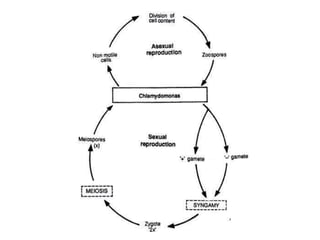
Both asexual and sexual reproductions occur in Chlamydomonas.
Asexual reproduction:
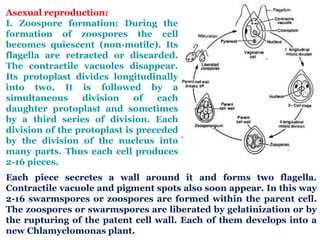
I. Zoospore formation: During the
formation of zoospores the cell
becomes quiescent (non-motile). Its
flagella are retracted or discarded.
The contractile vacuoles disappear.
Its protoplast divides longitudinally
into two. It is followed by a
simultaneous division of each
daughter protoplast and sometimes
by a third series of division. Each
division of the protoplast is preceded
by the division of the nucleus into
many parts. Thus each cell produces
2-16 pieces.
Each piece secretes a wall around it and forms two flagella.
Contractile vacuole and pigment spots also soon appear. In this way
2-16 swarmspores or zoospores are formed within the parent cell.
The zoospores or swarmspores are liberated by gelatinization or by
the rupturing of the patent cell wall. Each of them develops into a
new Chlamyclomonas plant.
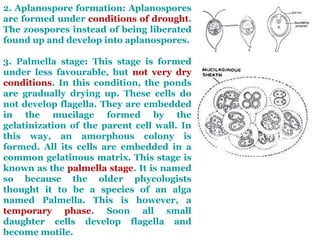
2. Aplanospore formation: Aplanospores
are formed under conditions of drought.
The zoospores instead of being liberated
found up and develop into aplanospores.
3. Palmella stage: This stage is formed
under less favourable, but not very dry
conditions. In this condition, the ponds
are gradually drying up. These cells do
not develop flagella. They are embedded
in the mucilage formed by the
gelatinization of the parent cell wall. In
this way, an amorphous colony is
formed. All its cells are embedded in a
common gelatinous matrix. This stage is
known as the palmella stage. It is named
so because the older phycologists
thought it to be a species of an alga
named Palmella. This is however, a
temporary phase. Soon all small
daughter cells develop flagella and
become motile.
Sexual reproduction:
The sexual reproduction may be isogamy to anisogamy and
oogamy.
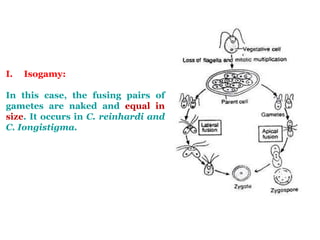
I. Isogamy:
In this case, the fusing pairs of
gametes are naked and equal in
size. It occurs in C. reinhardi and
C. Iongistigma.
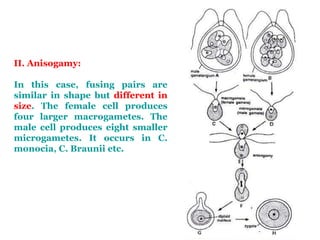
II. Anisogamy:
In this case, fusing pairs are
similar in shape but different in
size. The female cell produces
four larger macrogametes. The
male cell produces eight smaller
microgametes. It occurs in C.
monocia, C. Braunii etc.
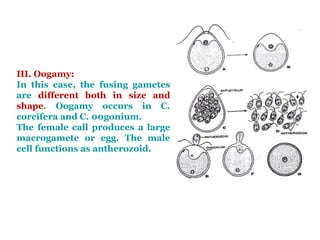
III. Oogamy:
In this case, the fusing gametes
are different both in size and
shape. Oogamy occurs in C.
corcifera and C. 00gonium.
The female call produces a large
macrogamete or egg. The male
cell functions as antherozoid.
Use:
Chlamydomonas is used as a model organism for research on
answering fundamental questions in cell and molecular biology.
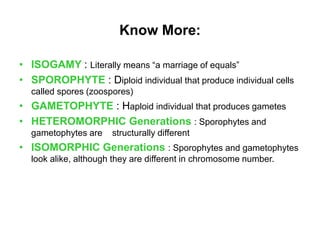
Know More:
• ISOGAMY : Literally means “a marriage of equals”
• SPOROPHYTE : Diploid individual that produce individual cells
called spores (zoospores)
• GAMETOPHYTE : Haploid individual that produces gametes
• HETEROMORPHIC Generations : Sporophytes and
gametophytes are structurally different
• ISOMORPHIC Generations : Sporophytes and gametophytes
look alike, although they are different in chromosome number.
THANK
YOU

Chlamydomonas

  • 1.
    Prepared by: Dr. SangeetaDas, Assistant Professor, Bahona College, Jorhat, Assam, India CHLAMYDOMONAS
  • 3.
    Occurrence of Chlamydomonas: •Chlamydomonasis a large genus and is found almost in all places. It is represented by about 400 species (Prescott, 1969). •It is mainly found in fresh water rich in nitrogen salts and organic matter. •It is also found in stagnant water of ponds, pools, ditches, water tanks, sewage tanks and in slow running water.
  • 4.
    • Single celledgreen alga • Grows in ponds, ditches, and wet soil • believed to be primitive • reproduces asexually by producing ZOOSPORES • Reproduces sexually by producing ZYGOTES
  • 5.
  • 6.
    1.Cell wall: Thereis a thin cell wall on the outside. It occasionally possesses an outer thin mucilage sheath. It is made up of glycoprotein and non-cellulosic polysaccharides. 2.Flagella: The two flagella situated anteriorly near the pointed. They either project through one aperture in the wall or through two separate canals. These flagella arise form two basal granules called blepharoplast. 3.Contractile vacuoles: Each cell typically possesses two contractile vacuoles at the base of flagella. They have respiratory and excretory functions. 4.Eye spot: It is covered by a minute lens in the thickness of the cell wall. It supposed to function as an extremely primitive eye. This is sensitive to light. Therefore, it directs the movement of the individual.
  • 7.
    5. Chloroplast: Thereis a large cup-shaped chloroplast towards the broader end. The chloroplast varies in shape. In C reticulate, g is reticulate. In C. aplina, it is small discoid. 6. Pyrenoid: Pyrenoid is embedded in the chloroplast. Pyrenoid consists of a central protein body surrounded by numerous minute starch grains. 7. Nucleus: All species are uninucleate. A single nucleus lies in the cytoplasm, filling the cup of the chloroplast.
  • 8.
    Reproduction: Both asexual andsexual reproductions occur in Chlamydomonas.
  • 9.
    Asexual reproduction: I. Zoosporeformation: During the formation of zoospores the cell becomes quiescent (non-motile). Its flagella are retracted or discarded. The contractile vacuoles disappear. Its protoplast divides longitudinally into two. It is followed by a simultaneous division of each daughter protoplast and sometimes by a third series of division. Each division of the protoplast is preceded by the division of the nucleus into many parts. Thus each cell produces 2-16 pieces. Each piece secretes a wall around it and forms two flagella. Contractile vacuole and pigment spots also soon appear. In this way 2-16 swarmspores or zoospores are formed within the parent cell. The zoospores or swarmspores are liberated by gelatinization or by the rupturing of the patent cell wall. Each of them develops into a new Chlamyclomonas plant.
  • 10.
    2. Aplanospore formation:Aplanospores are formed under conditions of drought. The zoospores instead of being liberated found up and develop into aplanospores. 3. Palmella stage: This stage is formed under less favourable, but not very dry conditions. In this condition, the ponds are gradually drying up. These cells do not develop flagella. They are embedded in the mucilage formed by the gelatinization of the parent cell wall. In this way, an amorphous colony is formed. All its cells are embedded in a common gelatinous matrix. This stage is known as the palmella stage. It is named so because the older phycologists thought it to be a species of an alga named Palmella. This is however, a temporary phase. Soon all small daughter cells develop flagella and become motile.
  • 11.
    Sexual reproduction: The sexualreproduction may be isogamy to anisogamy and oogamy.
  • 12.
    I. Isogamy: In thiscase, the fusing pairs of gametes are naked and equal in size. It occurs in C. reinhardi and C. Iongistigma.
  • 13.
    II. Anisogamy: In thiscase, fusing pairs are similar in shape but different in size. The female cell produces four larger macrogametes. The male cell produces eight smaller microgametes. It occurs in C. monocia, C. Braunii etc.
  • 14.
    III. Oogamy: In thiscase, the fusing gametes are different both in size and shape. Oogamy occurs in C. corcifera and C. 00gonium. The female call produces a large macrogamete or egg. The male cell functions as antherozoid.
  • 17.
    Use: Chlamydomonas is usedas a model organism for research on answering fundamental questions in cell and molecular biology.
  • 18.
    Know More: • ISOGAMY: Literally means “a marriage of equals” • SPOROPHYTE : Diploid individual that produce individual cells called spores (zoospores) • GAMETOPHYTE : Haploid individual that produces gametes • HETEROMORPHIC Generations : Sporophytes and gametophytes are structurally different • ISOMORPHIC Generations : Sporophytes and gametophytes look alike, although they are different in chromosome number.
  • 19.