ALGAE
What is algae?
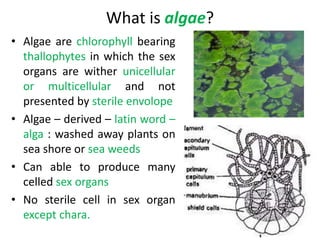
• Algae are chlorophyll bearing
thallophytes in which the sex
organs are wither unicellular
or multicellular and not
presented by sterile envolope
• Algae – derived – latin word –
alga : washed away plants on
sea shore or sea weeds
• Can able to produce many
celled sex organs
• No sterile cell in sex organ
except chara.
• The study of algae is called algology or
phycology.
• Phycology – Greek word phycos – meaning
sea weeds
• First introduced by Linnaeus in 1754
• Algae – Greek word – Phykos
• Chinese – Tsau
• Hawaii – Limu
• Roman – Fucus
• Tamil - Pasigal
Salient features of algae
• Live in moist and aquatic habitats
• Unicellular or multicellular
• Plant body is thalloid
• Presence of chlorophyll and other
photosynthetic pigments in chromatophores
• Autotrophic in nutrition
• Cells may be uninucleate or multinucleate
• Cell wall rich in cellulose
• Cells motile due to the presence of flagella or
cilia
• Reserve food – starch
• Reproduction –
• Primitive algae – vegetative methods
• Higher forms – sexual and asexual
reproduction
• Asexual reproduction – motile zoospores
• In unicellular – entire organisms act as a
gametes
• In multicellular – gametes produced from
unicellular and multicellular gametangium [no
sterile jacket]
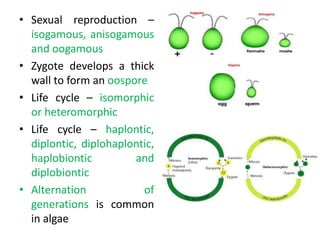
• Sexual reproduction –
isogamous, anisogamous
and oogamous
• Zygote develops a thick
wall to form an oospore
• Life cycle – isomorphic
or heteromorphic
• Life cycle – haplontic,
diplontic, diplohaplontic,
haplobiontic and
diplobiontic
• Alternation of
generations is common
in algae
Habits and Habitats of algae
• On the basis of habitats in which algae are
growing, there are seven groups –
»Aquatic algae
»Edaphic algae
»Aerial algae
»Cryophytic algae
»Symbiotic or endophytic algae
»Endozoic algae
»Parasitic algae
Aquatic algae
• Also called as hydrophilous algae
• Submerged or free – floating
• Living in fresh waters – ponds, rivers,
springs etc.
• Some in salt water – seas and oceans
• Still waters – ponds, pools etc Eg:
Zygnema, Oedogonium etc.
• Running water – Eg: Vaucheria and
Cladophora
Types of aquatic algae
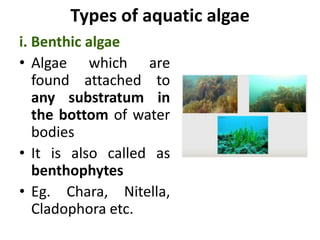
i. Benthic algae
• Algae which are
found attached to
any substratum in
the bottom of water
bodies
• It is also called as
benthophytes
• Eg. Chara, Nitella,
Cladophora etc.
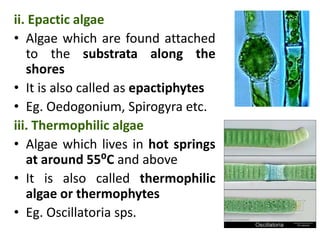
ii. Epactic algae
• Algae which are found attached
to the substrata along the
shores
• It is also called as epactiphytes
• Eg. Oedogonium, Spirogyra etc.
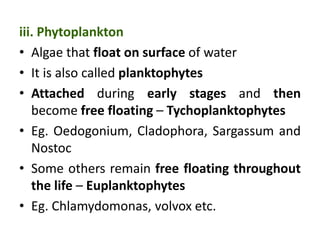
iii. Thermophilic algae
• Algae which lives in hot springs
at around 55⁰C and above
• It is also called thermophilic
algae or thermophytes
• Eg. Oscillatoria sps.
iii. Phytoplankton
• Algae that float on surface of water
• It is also called planktophytes
• Attached during early stages and then
become free floating – Tychoplanktophytes
• Eg. Oedogonium, Cladophora, Sargassum and
Nostoc
• Some others remain free floating throughout
the life – Euplanktophytes
• Eg. Chlamydomonas, volvox etc.
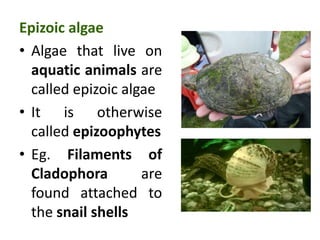
Epizoic algae
• Algae that live on
aquatic animals are
called epizoic algae
• It is otherwise
called epizoophytes
• Eg. Filaments of
Cladophora are
found attached to
the snail shells
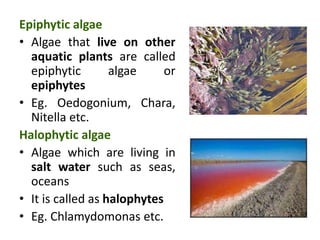
Epiphytic algae
• Algae that live on other
aquatic plants are called
epiphytic algae or
epiphytes
• Eg. Oedogonium, Chara,
Nitella etc.
Halophytic algae
• Algae which are living in
salt water such as seas,
oceans
• It is called as halophytes
• Eg. Chlamydomonas etc.
Edaphic algae
• Algae which are living in or
on the moist soils
• It is also called
edaphophytes or terrestrial
algae
• Some sps. live in the suface
of soil where organic matter
is abundant – saprophytes
epiterranean. Eg. Vaucheria
• Algae which live bolow the
soil surface – cryptophytes
[subterranean]. Eg.
Anabaena, Nostoc etc.
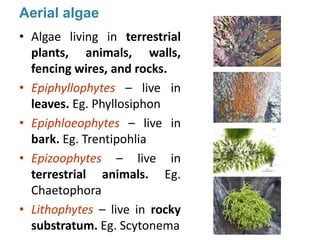
Aerial algae
• Algae living in terrestrial
plants, animals, walls,
fencing wires, and rocks.
• Epiphyllophytes – live in
leaves. Eg. Phyllosiphon
• Epiphloeophytes – live in
bark. Eg. Trentipohlia
• Epizoophytes – live in
terrestrial animals. Eg.
Chaetophora
• Lithophytes – live in rocky
substratum. Eg. Scytonema
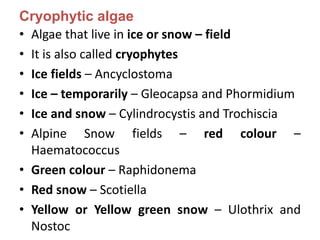
Cryophytic algae
• Algae that live in ice or snow – field
• It is also called cryophytes
• Ice fields – Ancyclostoma
• Ice – temporarily – Gleocapsa and Phormidium
• Ice and snow – Cylindrocystis and Trochiscia
• Alpine Snow fields – red colour –
Haematococcus
• Green colour – Raphidonema
• Red snow – Scotiella
• Yellow or Yellow green snow – Ulothrix and
Nostoc
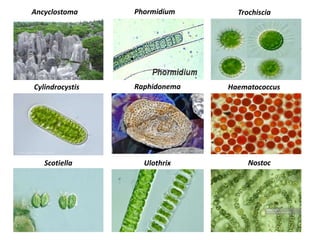
Ancyclostoma TrochisciaPhormidium
Cylindrocystis Raphidonema Haematococcus
Scotiella Ulothrix Nostoc
Symbiotic or endophytic algae
• Algae that live in symbiotic association with
other plants
• It is called as symbionts or endophytes Eg.
Lichen.
• Some algae seems to be lichen Eg. Chrococcus,
Microsystis, Chlorella, Cytonema etc.
• Anabaena azollae – leaf tissue of aquatic fern
Azolla [Gymnosperm]
• A. cycade – corrolloid roots of Cycas
[Gymnosperm]
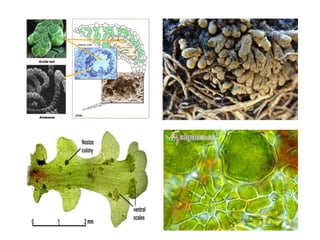
• Nostoc – cavities in the thallus of anthoceros
[Bryophytes]
• Chlorochytrium – inside Lemna [Angiosperm]
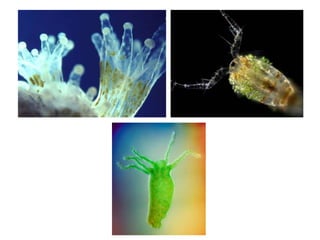
Endozoic algae
• Algae that live in the aquatic animals
• It is called endozoic algae or
endozoophytes
• Zooxanthellae is found in fresh water
sponges
• Zoochlorella – inside the body of Hydra
• Characium – seen in some body of insect
larvae
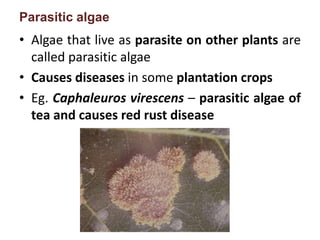
Parasitic algae
• Algae that live as parasite on other plants are
called parasitic algae
• Causes diseases in some plantation crops
• Eg. Caphaleuros virescens – parasitic algae of
tea and causes red rust disease
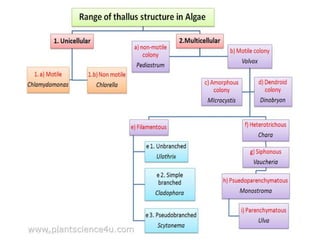
Range of thallus structure in Algae
I. Unicellular Algae: It is of two types
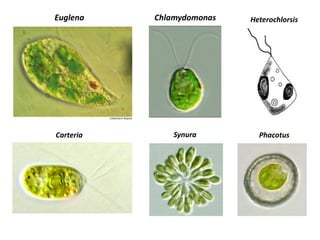
a. Motile forms or flagellated forms
a) Freely moving in water by flagella
b) They are of many shapes – spherical, oblong
or pear shaped and circular – Ex.
Chlamydomonas
c) Some are dorsiventrally differentiated
– Ex. Phacus
d) The number of flagella may to one to more
and it may be equal or unequal
• Euglena – one flagellum at its anterior
• Chlamydomonas – two flagella at its front end
• Heterochlorsis – two flagella and unequal
• Botrydiopsis – two flagella
i. acronematic or whiplash
ii. pantonematic
• Peridium – two flagella
»arises from transverse furrow and encircles
the cell
»arises from longitudinal furrow and faces
backward
• Trichloris – three flagella
• Carteria – four flagella
• Chloraster – five flagella
• Pocillomonas – six flagella
Amoeboid forms or periplasts or naked forms
• In some forms there is no true cell wall so that the
shape of the cells is flexible. Eg. Heterochloris
mutalis
Rhizopodial forms
• Some motile cells after shedding their flagella long
develop delicate cytoplasmic process called
rhizopodium. Eg. Synura
Encapsulated forms
• Some motile unicells are enclosed by thick,
variously shaped envolope. Eg. Phacotus
Colourless forms
• Some saprophytic motile unicells remain colourless
Euglena
Euglena Chlamydomonas Heterochlorsis
Carteria Synura Phacotus
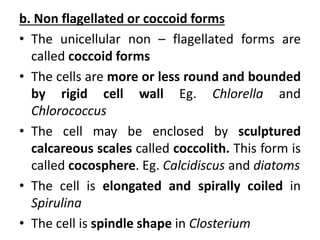
b. Non flagellated or coccoid forms
• The unicellular non – flagellated forms are
called coccoid forms
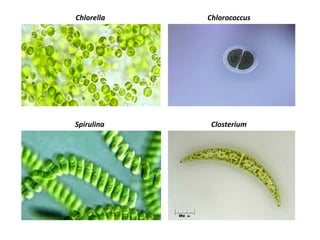
• The cells are more or less round and bounded
by rigid cell wall Eg. Chlorella and
Chlorococcus
• The cell may be enclosed by sculptured
calcareous scales called coccolith. This form is
called cocosphere. Eg. Calcidiscus and diatoms
• The cell is elongated and spirally coiled in
Spirulina
• The cell is spindle shape in Closterium
Chlorella Chlorococcus
Spirulina Closterium
II. Multicellular Algae (or) colonial forms:
A group of individual cells of a species living in a
habitat is called a colony. It is of two types
a. Motile colonial forms (or) Coenobial forms
• Colony in juvenile and mature stages remains constant –
coenobium
• It is called as motile coenobium
• Motile Eg. Volvox, Gonium, Pandorina etc.
• A Volvox colony has many Chlamydomonas cells
interconnected by protoplasmic connections
• The surface of the colony is covered with mucilage –
lamella and the center remains hollow at several regions.
It is called hollow type coenobium
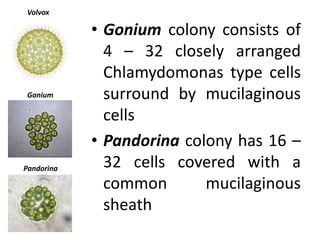
• Gonium colony consists of
4 – 32 closely arranged
Chlamydomonas type cells
surround by mucilaginous
cells
• Pandorina colony has 16 –
32 cells covered with a
common mucilaginous
sheath
Volvox
Pandorina
Gonium
b. Non Motile colonial forms
• If the individual cells are
non – flagellated, the
coenobium remains non –
motile. Eg. Hydrodictyon,
Pediastrum, Senedesmus
etc.
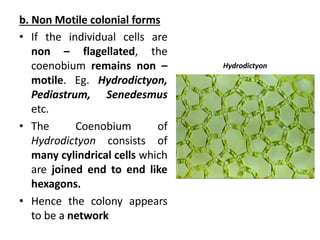
• The Coenobium of
Hydrodictyon consists of
many cylindrical cells which
are joined end to end like
hexagons.
• Hence the colony appears
to be a network
Hydrodictyon
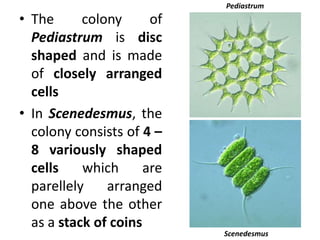
• The colony of
Pediastrum is disc
shaped and is made
of closely arranged
cells
• In Scenedesmus, the
colony consists of 4 –
8 variously shaped
cells which are
parellely arranged
one above the other
as a stack of coins
Pediastrum
Scenedesmus
c. Palmelloid forms or Amorphous forms
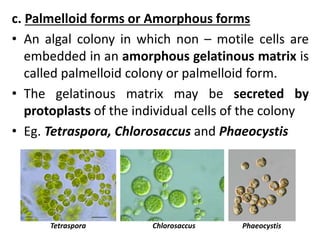
• An algal colony in which non – motile cells are
embedded in an amorphous gelatinous matrix is
called palmelloid colony or palmelloid form.
• The gelatinous matrix may be secreted by
protoplasts of the individual cells of the colony
• Eg. Tetraspora, Chlorosaccus and Phaeocystis
Tetraspora Chlorosaccus Phaeocystis
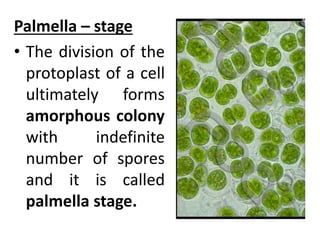
Palmella – stage
• The division of the
protoplast of a cell
ultimately forms
amorphous colony
with indefinite
number of spores
and it is called
palmella stage.
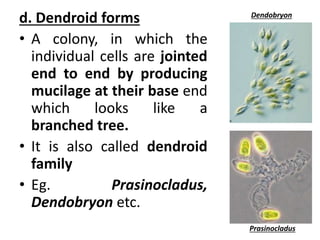
d. Dendroid forms
• A colony, in which the
individual cells are jointed
end to end by producing
mucilage at their base end
which looks like a
branched tree.
• It is also called dendroid
family
• Eg. Prasinocladus,
Dendobryon etc.
Dendobryon
Prasinocladus
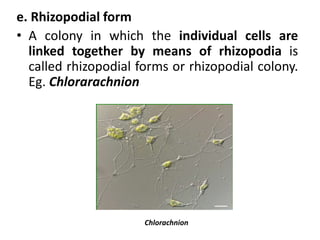
e. Rhizopodial form
• A colony in which the individual cells are
linked together by means of rhizopodia is
called rhizopodial forms or rhizopodial colony.
Eg. Chlorarachnion
Chlorachnion
f. Filamentous forms
• An algal thallus in which cells
are arranged in linear row
and are joined end to end by
middle lamella is called a
filament or filamentous form
Uniseriate filament – The
filament is made of single
row of cells. Eg. Ulothrix,
Oedogonium. [prokaryotic
cells]
Multiseriate filament – The
cells are arranged in more
than one linear row. Eg. Ulva
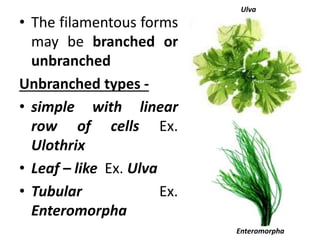
• The filamentous forms
may be branched or
unbranched
Unbranched types -
• simple with linear
row of cells Ex.
Ulothrix
• Leaf – like Ex. Ulva
• Tubular Ex.
Enteromorpha
Ulva
Enteromorpha
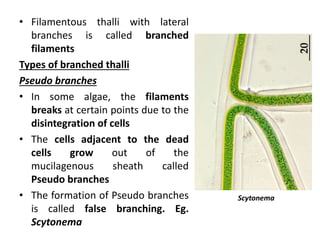
• Filamentous thalli with lateral
branches is called branched
filaments
Types of branched thalli
Pseudo branches
• In some algae, the filaments
breaks at certain points due to the
disintegration of cells
• The cells adjacent to the dead
cells grow out of the
mucilagenous sheath called
Pseudo branches
• The formation of Pseudo branches
is called false branching. Eg.
Scytonema
Scytonema
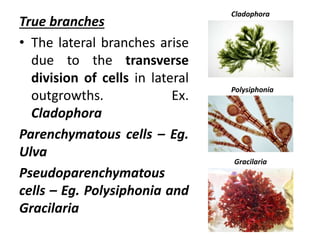
True branches
• The lateral branches arise
due to the transverse
division of cells in lateral
outgrowths. Ex.
Cladophora
Parenchymatous cells – Eg.
Ulva
Pseudoparenchymatous
cells – Eg. Polysiphonia and
Gracilaria
Cladophora
Polysiphonia
Gracilaria
g. Heterotrichous forms
• The filaments which contains both prostrate
system and erect system is called
heterotrichous form
• Hetero – different; trichous – filament
• The thallus was differentiated into creeping
system and projecting system
• Creeping system – consists of branched
filaments attached to the substratum
• Projecting system – arises from the creeping
system and grows erect
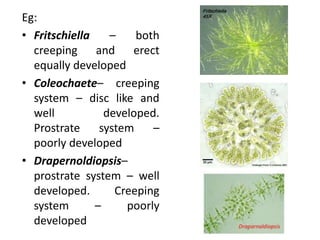
Eg:
• Fritschiella – both
creeping and erect
equally developed
• Coleochaete– creeping
system – disc like and
well developed.
Prostrate system –
poorly developed
• Drapernoldiopsis–
prostrate system – well
developed. Creeping
system – poorly
developed
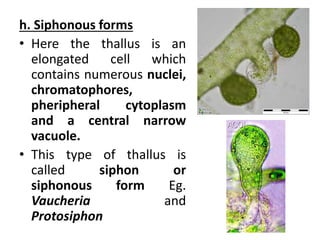
h. Siphonous forms
• Here the thallus is an
elongated cell which
contains numerous nuclei,
chromatophores,
pheripheral cytoplasm
and a central narrow
vacuole.
• This type of thallus is
called siphon or
siphonous form Eg.
Vaucheria and
Protosiphon
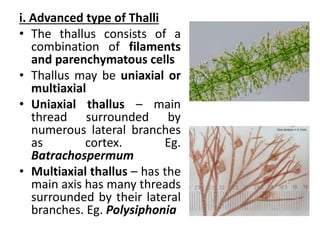
i. Advanced type of Thalli
• The thallus consists of a
combination of filaments
and parenchymatous cells
• Thallus may be uniaxial or
multiaxial
• Uniaxial thallus – main
thread surrounded by
numerous lateral branches
as cortex. Eg.
Batrachospermum
• Multiaxial thallus – has the
main axis has many threads
surrounded by their lateral
branches. Eg. Polysiphonia
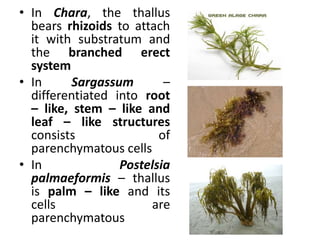
• In Chara, the thallus
bears rhizoids to attach
it with substratum and
the branched erect
system
• In Sargassum –
differentiated into root
– like, stem – like and
leaf – like structures
consists of
parenchymatous cells
• In Postelsia
palmaeformis – thallus
is palm – like and its
cells are
parenchymatous
Evolution of Thallus in Algae
• Acco’ to evolutionary theories, the motile
unicells are the simple and primitive type
of thalli
• The coccoid forms developed from the
flagellated forms by shedding their flagella
• The colonial forms developed by the
aggregation of motile or non – motile
forms
• The filamentous forms evolved from
unicells by the joining of many cells end to
end
• The leaf – like filamentous thalli evolved
from the uniseriate simple filaments by
lateral and transverse divisions of their
constituent cells.
• Heterotrichous filaments have evolved
from simple filamentous forms due to
the repeated cell division and
aggregation of resulting filaments.
• Heterotrichous forms are considered to
be the ancestors of advanced type of
thalli
THANK YOU

Algae

  • 1.
  • 2.
    What is algae? •Algae are chlorophyll bearing thallophytes in which the sex organs are wither unicellular or multicellular and not presented by sterile envolope • Algae – derived – latin word – alga : washed away plants on sea shore or sea weeds • Can able to produce many celled sex organs • No sterile cell in sex organ except chara.
  • 3.
    • The studyof algae is called algology or phycology. • Phycology – Greek word phycos – meaning sea weeds • First introduced by Linnaeus in 1754 • Algae – Greek word – Phykos • Chinese – Tsau • Hawaii – Limu • Roman – Fucus • Tamil - Pasigal
  • 4.
    Salient features ofalgae • Live in moist and aquatic habitats • Unicellular or multicellular • Plant body is thalloid • Presence of chlorophyll and other photosynthetic pigments in chromatophores • Autotrophic in nutrition • Cells may be uninucleate or multinucleate • Cell wall rich in cellulose • Cells motile due to the presence of flagella or cilia
  • 5.
    • Reserve food– starch • Reproduction – • Primitive algae – vegetative methods • Higher forms – sexual and asexual reproduction • Asexual reproduction – motile zoospores • In unicellular – entire organisms act as a gametes • In multicellular – gametes produced from unicellular and multicellular gametangium [no sterile jacket]
  • 6.
    • Sexual reproduction– isogamous, anisogamous and oogamous • Zygote develops a thick wall to form an oospore • Life cycle – isomorphic or heteromorphic • Life cycle – haplontic, diplontic, diplohaplontic, haplobiontic and diplobiontic • Alternation of generations is common in algae
  • 7.
    Habits and Habitatsof algae • On the basis of habitats in which algae are growing, there are seven groups – »Aquatic algae »Edaphic algae »Aerial algae »Cryophytic algae »Symbiotic or endophytic algae »Endozoic algae »Parasitic algae
  • 8.
    Aquatic algae • Alsocalled as hydrophilous algae • Submerged or free – floating • Living in fresh waters – ponds, rivers, springs etc. • Some in salt water – seas and oceans • Still waters – ponds, pools etc Eg: Zygnema, Oedogonium etc. • Running water – Eg: Vaucheria and Cladophora
  • 9.
    Types of aquaticalgae i. Benthic algae • Algae which are found attached to any substratum in the bottom of water bodies • It is also called as benthophytes • Eg. Chara, Nitella, Cladophora etc.
  • 10.
    ii. Epactic algae •Algae which are found attached to the substrata along the shores • It is also called as epactiphytes • Eg. Oedogonium, Spirogyra etc. iii. Thermophilic algae • Algae which lives in hot springs at around 55⁰C and above • It is also called thermophilic algae or thermophytes • Eg. Oscillatoria sps.
  • 11.
    iii. Phytoplankton • Algaethat float on surface of water • It is also called planktophytes • Attached during early stages and then become free floating – Tychoplanktophytes • Eg. Oedogonium, Cladophora, Sargassum and Nostoc • Some others remain free floating throughout the life – Euplanktophytes • Eg. Chlamydomonas, volvox etc.
  • 12.
    Epizoic algae • Algaethat live on aquatic animals are called epizoic algae • It is otherwise called epizoophytes • Eg. Filaments of Cladophora are found attached to the snail shells
  • 13.
    Epiphytic algae • Algaethat live on other aquatic plants are called epiphytic algae or epiphytes • Eg. Oedogonium, Chara, Nitella etc. Halophytic algae • Algae which are living in salt water such as seas, oceans • It is called as halophytes • Eg. Chlamydomonas etc.
  • 14.
    Edaphic algae • Algaewhich are living in or on the moist soils • It is also called edaphophytes or terrestrial algae • Some sps. live in the suface of soil where organic matter is abundant – saprophytes epiterranean. Eg. Vaucheria • Algae which live bolow the soil surface – cryptophytes [subterranean]. Eg. Anabaena, Nostoc etc.
  • 15.
    Aerial algae • Algaeliving in terrestrial plants, animals, walls, fencing wires, and rocks. • Epiphyllophytes – live in leaves. Eg. Phyllosiphon • Epiphloeophytes – live in bark. Eg. Trentipohlia • Epizoophytes – live in terrestrial animals. Eg. Chaetophora • Lithophytes – live in rocky substratum. Eg. Scytonema
  • 16.
    Cryophytic algae • Algaethat live in ice or snow – field • It is also called cryophytes • Ice fields – Ancyclostoma • Ice – temporarily – Gleocapsa and Phormidium • Ice and snow – Cylindrocystis and Trochiscia • Alpine Snow fields – red colour – Haematococcus • Green colour – Raphidonema • Red snow – Scotiella • Yellow or Yellow green snow – Ulothrix and Nostoc
  • 17.
    Ancyclostoma TrochisciaPhormidium Cylindrocystis RaphidonemaHaematococcus Scotiella Ulothrix Nostoc
  • 18.
    Symbiotic or endophyticalgae • Algae that live in symbiotic association with other plants • It is called as symbionts or endophytes Eg. Lichen. • Some algae seems to be lichen Eg. Chrococcus, Microsystis, Chlorella, Cytonema etc. • Anabaena azollae – leaf tissue of aquatic fern Azolla [Gymnosperm] • A. cycade – corrolloid roots of Cycas [Gymnosperm] • Nostoc – cavities in the thallus of anthoceros [Bryophytes] • Chlorochytrium – inside Lemna [Angiosperm]
  • 20.
    Endozoic algae • Algaethat live in the aquatic animals • It is called endozoic algae or endozoophytes • Zooxanthellae is found in fresh water sponges • Zoochlorella – inside the body of Hydra • Characium – seen in some body of insect larvae
  • 22.
    Parasitic algae • Algaethat live as parasite on other plants are called parasitic algae • Causes diseases in some plantation crops • Eg. Caphaleuros virescens – parasitic algae of tea and causes red rust disease
  • 23.
    Range of thallusstructure in Algae
  • 25.
    I. Unicellular Algae:It is of two types a. Motile forms or flagellated forms a) Freely moving in water by flagella b) They are of many shapes – spherical, oblong or pear shaped and circular – Ex. Chlamydomonas c) Some are dorsiventrally differentiated – Ex. Phacus d) The number of flagella may to one to more and it may be equal or unequal
  • 26.
    • Euglena –one flagellum at its anterior • Chlamydomonas – two flagella at its front end • Heterochlorsis – two flagella and unequal • Botrydiopsis – two flagella i. acronematic or whiplash ii. pantonematic • Peridium – two flagella »arises from transverse furrow and encircles the cell »arises from longitudinal furrow and faces backward • Trichloris – three flagella • Carteria – four flagella • Chloraster – five flagella • Pocillomonas – six flagella
  • 27.
    Amoeboid forms orperiplasts or naked forms • In some forms there is no true cell wall so that the shape of the cells is flexible. Eg. Heterochloris mutalis Rhizopodial forms • Some motile cells after shedding their flagella long develop delicate cytoplasmic process called rhizopodium. Eg. Synura Encapsulated forms • Some motile unicells are enclosed by thick, variously shaped envolope. Eg. Phacotus Colourless forms • Some saprophytic motile unicells remain colourless
  • 28.
  • 29.
    b. Non flagellatedor coccoid forms • The unicellular non – flagellated forms are called coccoid forms • The cells are more or less round and bounded by rigid cell wall Eg. Chlorella and Chlorococcus • The cell may be enclosed by sculptured calcareous scales called coccolith. This form is called cocosphere. Eg. Calcidiscus and diatoms • The cell is elongated and spirally coiled in Spirulina • The cell is spindle shape in Closterium
  • 30.
  • 31.
    II. Multicellular Algae(or) colonial forms: A group of individual cells of a species living in a habitat is called a colony. It is of two types a. Motile colonial forms (or) Coenobial forms • Colony in juvenile and mature stages remains constant – coenobium • It is called as motile coenobium • Motile Eg. Volvox, Gonium, Pandorina etc. • A Volvox colony has many Chlamydomonas cells interconnected by protoplasmic connections • The surface of the colony is covered with mucilage – lamella and the center remains hollow at several regions. It is called hollow type coenobium
  • 32.
    • Gonium colonyconsists of 4 – 32 closely arranged Chlamydomonas type cells surround by mucilaginous cells • Pandorina colony has 16 – 32 cells covered with a common mucilaginous sheath Volvox Pandorina Gonium
  • 33.
    b. Non Motilecolonial forms • If the individual cells are non – flagellated, the coenobium remains non – motile. Eg. Hydrodictyon, Pediastrum, Senedesmus etc. • The Coenobium of Hydrodictyon consists of many cylindrical cells which are joined end to end like hexagons. • Hence the colony appears to be a network Hydrodictyon
  • 34.
    • The colonyof Pediastrum is disc shaped and is made of closely arranged cells • In Scenedesmus, the colony consists of 4 – 8 variously shaped cells which are parellely arranged one above the other as a stack of coins Pediastrum Scenedesmus
  • 35.
    c. Palmelloid formsor Amorphous forms • An algal colony in which non – motile cells are embedded in an amorphous gelatinous matrix is called palmelloid colony or palmelloid form. • The gelatinous matrix may be secreted by protoplasts of the individual cells of the colony • Eg. Tetraspora, Chlorosaccus and Phaeocystis Tetraspora Chlorosaccus Phaeocystis
  • 36.
    Palmella – stage •The division of the protoplast of a cell ultimately forms amorphous colony with indefinite number of spores and it is called palmella stage.
  • 37.
    d. Dendroid forms •A colony, in which the individual cells are jointed end to end by producing mucilage at their base end which looks like a branched tree. • It is also called dendroid family • Eg. Prasinocladus, Dendobryon etc. Dendobryon Prasinocladus
  • 38.
    e. Rhizopodial form •A colony in which the individual cells are linked together by means of rhizopodia is called rhizopodial forms or rhizopodial colony. Eg. Chlorarachnion Chlorachnion
  • 39.
    f. Filamentous forms •An algal thallus in which cells are arranged in linear row and are joined end to end by middle lamella is called a filament or filamentous form Uniseriate filament – The filament is made of single row of cells. Eg. Ulothrix, Oedogonium. [prokaryotic cells] Multiseriate filament – The cells are arranged in more than one linear row. Eg. Ulva
  • 40.
    • The filamentousforms may be branched or unbranched Unbranched types - • simple with linear row of cells Ex. Ulothrix • Leaf – like Ex. Ulva • Tubular Ex. Enteromorpha Ulva Enteromorpha
  • 41.
    • Filamentous thalliwith lateral branches is called branched filaments Types of branched thalli Pseudo branches • In some algae, the filaments breaks at certain points due to the disintegration of cells • The cells adjacent to the dead cells grow out of the mucilagenous sheath called Pseudo branches • The formation of Pseudo branches is called false branching. Eg. Scytonema Scytonema
  • 42.
    True branches • Thelateral branches arise due to the transverse division of cells in lateral outgrowths. Ex. Cladophora Parenchymatous cells – Eg. Ulva Pseudoparenchymatous cells – Eg. Polysiphonia and Gracilaria Cladophora Polysiphonia Gracilaria
  • 43.
    g. Heterotrichous forms •The filaments which contains both prostrate system and erect system is called heterotrichous form • Hetero – different; trichous – filament • The thallus was differentiated into creeping system and projecting system • Creeping system – consists of branched filaments attached to the substratum • Projecting system – arises from the creeping system and grows erect
  • 44.
    Eg: • Fritschiella –both creeping and erect equally developed • Coleochaete– creeping system – disc like and well developed. Prostrate system – poorly developed • Drapernoldiopsis– prostrate system – well developed. Creeping system – poorly developed
  • 45.
    h. Siphonous forms •Here the thallus is an elongated cell which contains numerous nuclei, chromatophores, pheripheral cytoplasm and a central narrow vacuole. • This type of thallus is called siphon or siphonous form Eg. Vaucheria and Protosiphon
  • 46.
    i. Advanced typeof Thalli • The thallus consists of a combination of filaments and parenchymatous cells • Thallus may be uniaxial or multiaxial • Uniaxial thallus – main thread surrounded by numerous lateral branches as cortex. Eg. Batrachospermum • Multiaxial thallus – has the main axis has many threads surrounded by their lateral branches. Eg. Polysiphonia
  • 47.
    • In Chara,the thallus bears rhizoids to attach it with substratum and the branched erect system • In Sargassum – differentiated into root – like, stem – like and leaf – like structures consists of parenchymatous cells • In Postelsia palmaeformis – thallus is palm – like and its cells are parenchymatous
  • 48.
    Evolution of Thallusin Algae • Acco’ to evolutionary theories, the motile unicells are the simple and primitive type of thalli • The coccoid forms developed from the flagellated forms by shedding their flagella • The colonial forms developed by the aggregation of motile or non – motile forms • The filamentous forms evolved from unicells by the joining of many cells end to end
  • 49.
    • The leaf– like filamentous thalli evolved from the uniseriate simple filaments by lateral and transverse divisions of their constituent cells. • Heterotrichous filaments have evolved from simple filamentous forms due to the repeated cell division and aggregation of resulting filaments. • Heterotrichous forms are considered to be the ancestors of advanced type of thalli
  • 50.