CYNOBACTERIA
B.SC 1ST YEAR
Introduction
to the
Cyanobacteria
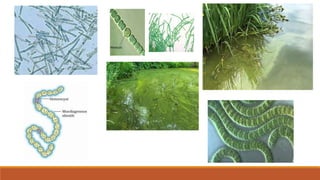
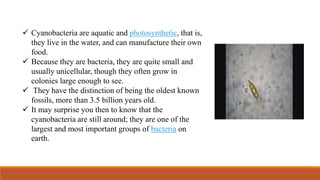
 Cyanobacteria are aquatic and photosynthetic, that is,
they live in the water, and can manufacture their own
food.
 Because they are bacteria, they are quite small and
usually unicellular, though they often grow in
colonies large enough to see.
 They have the distinction of being the oldest known
fossils, more than 3.5 billion years old.
 It may surprise you then to know that the
cyanobacteria are still around; they are one of the
largest and most important groups of bacteria on
earth.
 Many Proterozoic oil deposits are attributed to the activity of cyanobacteria.
 They are also important providers of nitrogen fertilizer in the cultivation of rice
and beans.
 The cyanobacteria have also been tremendously important in shaping the course
of evolution and ecological change throughout earth's history.
 The oxygen atmosphere that we depend on was generated by numerous
cyanobacteria during the Archaean and Proterozoic Eras.
 Before that time, the atmosphere had a very different chemistry, unsuitable for
life as we know it today.
 The other great contribution of the cyanobacteria is the origin of plants.
 The chloroplast with which plants make food for themselves is actually a
cyanobacterium living within the plant's cells.
 Sometime in the late Proterozoic, or in the early Cambrian, cyanobacteria
began to take up residence within certain eukaryote cells, making food for the
eukaryote host in return for a home.
 This event is known as endosymbiosis, and is also the origin of the
eukaryotic mitochondrion.
 Because they are photosynthetic and aquatic, cyanobacteria are often called
"blue-green algae"
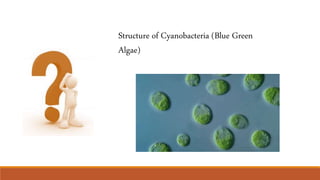
Structure of Cyanobacteria (Blue Green
Algae)
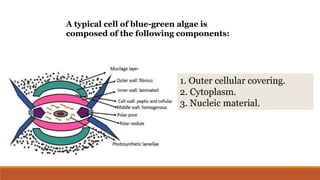
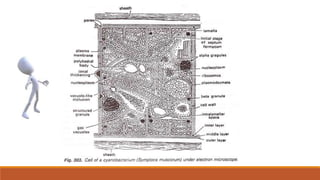
A typical cell of blue-green algae is
composed of the following components:
1. Outer cellular covering.
2. Cytoplasm.
3. Nucleic material.
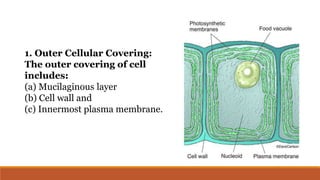
1. Outer Cellular Covering:
The outer covering of cell
includes:
(a) Mucilaginous layer
(b) Cell wall and
(c) Innermost plasma membrane.
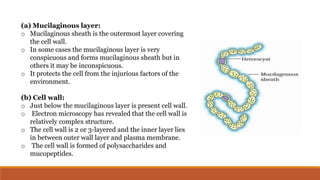
(a) Mucilaginous layer:
o Mucilaginous sheath is the outermost layer covering
the cell wall.
o In some cases the mucilaginous layer is very
conspicuous and forms mucilaginous sheath but in
others it may be inconspicuous.
o It protects the cell from the injurious factors of the
environment.
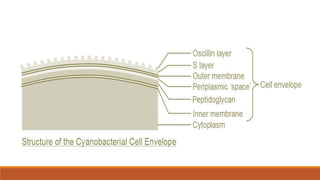
(b) Cell wall:
o Just below the mucilaginous layer is present cell wall.
o Electron microscopy has revealed that the cell wall is
relatively complex structure.
o The cell wall is 2 or 3-layered and the inner layer lies
in between outer wall layer and plasma membrane.
o The cell wall is formed of polysaccharides and
mucopeptides.
(c) Plasma membrane:
o The plasma membrane is selectively permeable
living membrane enclosing the cytoplasm and is
lipoproteinic in nature.
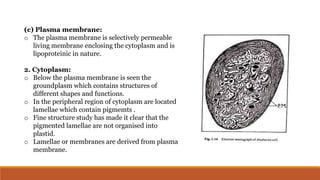
2. Cytoplasm:
o Below the plasma membrane is seen the
groundplasm which contains structures of
different shapes and functions.
o In the peripheral region of cytoplasm are located
lamellae which contain pigmemts .
o Fine structure study has made it clear that the
pigmented lamellae are not organised into
plastid.
o Lamellae or membranes are derived from plasma
membrane.
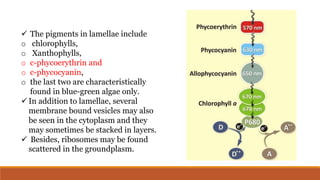
 The pigments in lamellae include
o chlorophylls,
o Xanthophylls,
o c-phycoerythrin and
o c-phycocyanin,
o the last two are characteristically
found in blue-green algae only.
 In addition to lamellae, several
membrane bound vesicles may also
be seen in the cytoplasm and they
may sometimes be stacked in layers.
 Besides, ribosomes may be found
scattered in the groundplasm.
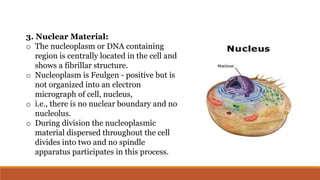
3. Nuclear Material:
o The nucleoplasm or DNA containing
region is centrally located in the cell and
shows a fibrillar structure.
o Nucleoplasm is Feulgen - positive but is
not organized into an electron
micrograph of cell, nucleus,
o i.e., there is no nuclear boundary and no
nucleolus.
o During division the nucleoplasmic
material dispersed throughout the cell
divides into two and no spindle
apparatus participates in this process.
Nostoc Structure
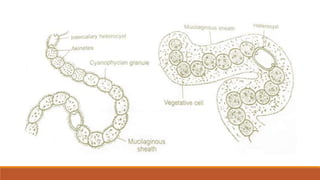
•Nostoc are filamentous and unbranched.
•Numerous filaments are found in a gelatinous mass as a colony. The colonies
may be as big as an egg.
•The filament consists of a chain of cells, which appear like a bead. They are
called trichomes
•Cells are oval, spherical or cylindrical
•Some of the cells in the filament are differentiated, they are
called heterocyst. They are sites for nitrogen fixation. Nitrogenase enzyme
fixes nitrogen
•Each filament is covered in a mucilaginous sheath, which is a protective layer.
It absorbs and retains water.
•Colonies are of different shapes, sizes and colours. They are mostly greenish
or bluish-green in colour and also have red-brown or yellow-green colour
•Each cell has a thick cell wall made up of peptidoglycan
•The cytoplasm of a cell is differentiated into outer coloured
due to peripherally arranged chromoplast and inner clear
cytoplasm
•Cells have various pigments. Cells contain chlorophyll (green
pigment). Phycocyanin (blue) and phycoerythrin (red) are also
present
•Inner cytoplasm contains incipient nucleus or a nuclear body,
DNA is without histones
Nostoc Reproduction
 Nostoc reproduce vegetatively or asexually by spore formation.
 The vegetative reproduction is by fragmentation.
 Small colonies can grow attached to a large colony and later form
separated colonies.
 Hormogonia are short and free filaments.
 They are formed when a filament breaks.
 It retains the gelatinous sheath. New trichomes are developed inside
the colony.
Asexual reproduction is by the formation of resting spores known
as akinetes.
Some of the cells become thick-walled due to accumulation of
food. They can withstand unfavourable conditions for many
years.
Under favourable conditions, they germinate to form a new
filament.
Nostoc also reproduce by heterocysts.
Heterocysts separate from the filament. They divide and
germinate into a new filament.
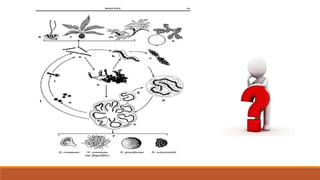
The life cycle of Nostoc is given as follows:
1. Initially, fresh thalli present having thin colourless envelopes.
2. After 8 weeks, macroscopic spherical and subspherical forms of the thalli are
observed.
o When observed under the microscope, trichomes with heterocytes were found.
3. Next, the thalli released hormogonia along with heterocytes.
4. Hormogonia developed envelope and thereby formed colonies- increased and
formed large thalli.
5. These growing thalli formed buds.
o Aseriate phase starts-->coiling of trichome--> compact mass of cells.
6. Detachment of trichomes at a mature stage and formation of akinetes( enclosed
in a sheath).
Ecological Importance
•Nostoc are important for their nitrogen-fixing ability.
o They are used in paddy fields and are also used to increase the nutrient value of soil
•They are rich in proteins and vitamin C and are used as a delicacy in various Asian
countries, e.g. N. flagelliforme, N. commune, etc.
•N. muscorum has shown to accumulate polyhydroxy butyrate, which is a precursor of
plastic. It may have useful application in the industry
•Cyanobacteria can convert CO2 to biofuels. Nostoc have shown to produce hydrogen
•They can be used for bioremediation of wastewater and degrade environmental pollutants
•Various species, e.g. N. muscorum, N. commune, N. insulare, etc. extracts have shown
antibacterial or antiviral activity and may be used in future to prepare drugs
Cynobacteria - A Blue Green Algae

Cynobacteria - A Blue Green Algae

  • 1.
  • 3.
  • 4.
     Cyanobacteria areaquatic and photosynthetic, that is, they live in the water, and can manufacture their own food.  Because they are bacteria, they are quite small and usually unicellular, though they often grow in colonies large enough to see.  They have the distinction of being the oldest known fossils, more than 3.5 billion years old.  It may surprise you then to know that the cyanobacteria are still around; they are one of the largest and most important groups of bacteria on earth.
  • 5.
     Many Proterozoicoil deposits are attributed to the activity of cyanobacteria.  They are also important providers of nitrogen fertilizer in the cultivation of rice and beans.  The cyanobacteria have also been tremendously important in shaping the course of evolution and ecological change throughout earth's history.  The oxygen atmosphere that we depend on was generated by numerous cyanobacteria during the Archaean and Proterozoic Eras.  Before that time, the atmosphere had a very different chemistry, unsuitable for life as we know it today.
  • 6.
     The othergreat contribution of the cyanobacteria is the origin of plants.  The chloroplast with which plants make food for themselves is actually a cyanobacterium living within the plant's cells.  Sometime in the late Proterozoic, or in the early Cambrian, cyanobacteria began to take up residence within certain eukaryote cells, making food for the eukaryote host in return for a home.  This event is known as endosymbiosis, and is also the origin of the eukaryotic mitochondrion.  Because they are photosynthetic and aquatic, cyanobacteria are often called "blue-green algae"
  • 7.
    Structure of Cyanobacteria(Blue Green Algae)
  • 8.
    A typical cellof blue-green algae is composed of the following components: 1. Outer cellular covering. 2. Cytoplasm. 3. Nucleic material.
  • 9.
    1. Outer CellularCovering: The outer covering of cell includes: (a) Mucilaginous layer (b) Cell wall and (c) Innermost plasma membrane.
  • 10.
    (a) Mucilaginous layer: oMucilaginous sheath is the outermost layer covering the cell wall. o In some cases the mucilaginous layer is very conspicuous and forms mucilaginous sheath but in others it may be inconspicuous. o It protects the cell from the injurious factors of the environment. (b) Cell wall: o Just below the mucilaginous layer is present cell wall. o Electron microscopy has revealed that the cell wall is relatively complex structure. o The cell wall is 2 or 3-layered and the inner layer lies in between outer wall layer and plasma membrane. o The cell wall is formed of polysaccharides and mucopeptides.
  • 12.
    (c) Plasma membrane: oThe plasma membrane is selectively permeable living membrane enclosing the cytoplasm and is lipoproteinic in nature. 2. Cytoplasm: o Below the plasma membrane is seen the groundplasm which contains structures of different shapes and functions. o In the peripheral region of cytoplasm are located lamellae which contain pigmemts . o Fine structure study has made it clear that the pigmented lamellae are not organised into plastid. o Lamellae or membranes are derived from plasma membrane.
  • 13.
     The pigmentsin lamellae include o chlorophylls, o Xanthophylls, o c-phycoerythrin and o c-phycocyanin, o the last two are characteristically found in blue-green algae only.  In addition to lamellae, several membrane bound vesicles may also be seen in the cytoplasm and they may sometimes be stacked in layers.  Besides, ribosomes may be found scattered in the groundplasm.
  • 14.
    3. Nuclear Material: oThe nucleoplasm or DNA containing region is centrally located in the cell and shows a fibrillar structure. o Nucleoplasm is Feulgen - positive but is not organized into an electron micrograph of cell, nucleus, o i.e., there is no nuclear boundary and no nucleolus. o During division the nucleoplasmic material dispersed throughout the cell divides into two and no spindle apparatus participates in this process.
  • 18.
    Nostoc Structure •Nostoc arefilamentous and unbranched. •Numerous filaments are found in a gelatinous mass as a colony. The colonies may be as big as an egg. •The filament consists of a chain of cells, which appear like a bead. They are called trichomes •Cells are oval, spherical or cylindrical •Some of the cells in the filament are differentiated, they are called heterocyst. They are sites for nitrogen fixation. Nitrogenase enzyme fixes nitrogen •Each filament is covered in a mucilaginous sheath, which is a protective layer. It absorbs and retains water. •Colonies are of different shapes, sizes and colours. They are mostly greenish or bluish-green in colour and also have red-brown or yellow-green colour
  • 19.
    •Each cell hasa thick cell wall made up of peptidoglycan •The cytoplasm of a cell is differentiated into outer coloured due to peripherally arranged chromoplast and inner clear cytoplasm •Cells have various pigments. Cells contain chlorophyll (green pigment). Phycocyanin (blue) and phycoerythrin (red) are also present •Inner cytoplasm contains incipient nucleus or a nuclear body, DNA is without histones
  • 20.
    Nostoc Reproduction  Nostocreproduce vegetatively or asexually by spore formation.  The vegetative reproduction is by fragmentation.  Small colonies can grow attached to a large colony and later form separated colonies.  Hormogonia are short and free filaments.  They are formed when a filament breaks.  It retains the gelatinous sheath. New trichomes are developed inside the colony.
  • 21.
    Asexual reproduction isby the formation of resting spores known as akinetes. Some of the cells become thick-walled due to accumulation of food. They can withstand unfavourable conditions for many years. Under favourable conditions, they germinate to form a new filament. Nostoc also reproduce by heterocysts. Heterocysts separate from the filament. They divide and germinate into a new filament.
  • 22.
    The life cycleof Nostoc is given as follows: 1. Initially, fresh thalli present having thin colourless envelopes. 2. After 8 weeks, macroscopic spherical and subspherical forms of the thalli are observed. o When observed under the microscope, trichomes with heterocytes were found. 3. Next, the thalli released hormogonia along with heterocytes. 4. Hormogonia developed envelope and thereby formed colonies- increased and formed large thalli. 5. These growing thalli formed buds. o Aseriate phase starts-->coiling of trichome--> compact mass of cells. 6. Detachment of trichomes at a mature stage and formation of akinetes( enclosed in a sheath).
  • 24.
    Ecological Importance •Nostoc areimportant for their nitrogen-fixing ability. o They are used in paddy fields and are also used to increase the nutrient value of soil •They are rich in proteins and vitamin C and are used as a delicacy in various Asian countries, e.g. N. flagelliforme, N. commune, etc. •N. muscorum has shown to accumulate polyhydroxy butyrate, which is a precursor of plastic. It may have useful application in the industry •Cyanobacteria can convert CO2 to biofuels. Nostoc have shown to produce hydrogen •They can be used for bioremediation of wastewater and degrade environmental pollutants •Various species, e.g. N. muscorum, N. commune, N. insulare, etc. extracts have shown antibacterial or antiviral activity and may be used in future to prepare drugs