Norton's Theorem (5.3, 8.8) Dr. Holbert March 20, 2006 ECE201 Lect-14
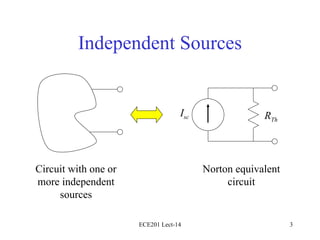
Introduction Any Thevenin equivalent circuit is in turn equivalent to a current source in parallel with a resistor [source transformation]. A current source in parallel with a resistor is called a Norton equivalent circuit. Finding a Norton equivalent circuit requires essentially the same process as finding a Thevenin equivalent circuit. ECE201 Lect-14
Independent Sources ECE201 Lect-14 Circuit with one or more independent sources R Th Norton equivalent circuit I sc
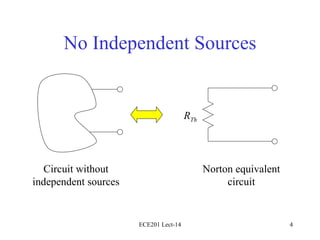
No Independent Sources ECE201 Lect-14 Circuit without independent sources R Th Norton equivalent circuit
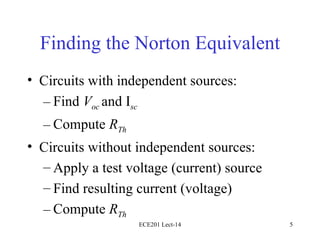
Finding the Norton Equivalent Circuits with independent sources: Find  V oc  and I sc Compute  R Th Circuits without independent sources: Apply a test voltage (current) source Find resulting current (voltage) Compute  R Th   ECE201 Lect-14
Example: Strain Gauge Strain is the amount of deformation of a body due to an applied force-it is defined as the fractional change in length. Strain can be positive (tensile) or negative (compressive). One type of strain gauge is made of a foil grid on a thin backing. ECE201 Lect-14
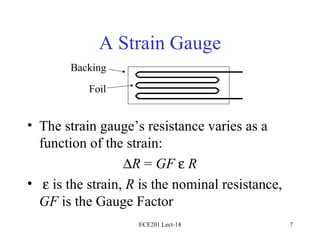
A Strain Gauge The strain gauge’s resistance varies as a function of the strain:  R  =  GF      R    is the strain,  R  is the nominal resistance,  GF  is the Gauge Factor ECE201 Lect-14 Backing Foil
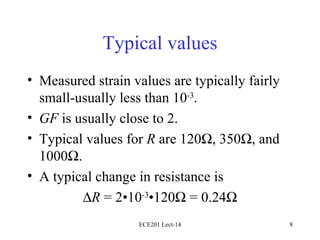
Typical values Measured strain values are typically fairly small-usually less than 10 -3 . GF  is usually close to 2. Typical values for  R  are 120  , 350  , and 1000  . A typical change in resistance is   R  = 2•10 -3 •120   = 0.24  ECE201 Lect-14
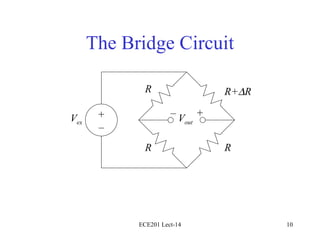
Measuring Small Changes in  R To measure such small changes in resistance, the strain gauge is placed in a Wheatstone bridge circuit. The bridge circuit uses an excitation voltage source and produces a voltage that depends on   R . ECE201 Lect-14
The Bridge Circuit ECE201 Lect-14 R+  R V ex R R R + – V out + –
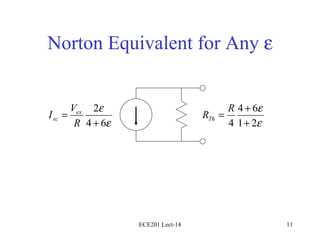
Norton Equivalent for Any   ECE201 Lect-14
Thevenin/Norton Analysis 1. Pick a good breaking point in the circuit (cannot split a dependent source and its control variable).  2.  Thevenin : Compute the open circuit voltage,  V OC . Norton : Compute the short circuit current,  I SC . For case 3( b ) both  V OC =0 and  I SC =0 [so skip step 2] ECE201 Lect-14
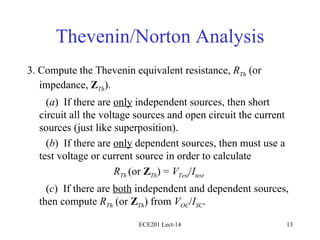
Thevenin/Norton Analysis 3. Compute the Thevenin equivalent resistance,  R Th  (or impedance,  Z Th ).  ( a )  If there are  only  independent sources, then short circuit all the voltage sources and open circuit the current sources (just like superposition).  ( b )  If there are  only  dependent sources, then must use a test voltage or current source in order to calculate R Th  (or  Z Th ) =  V Test / I test ( c )  If there are  both  independent and dependent sources, then compute  R Th  (or  Z Th ) from  V OC / I SC . ECE201 Lect-14
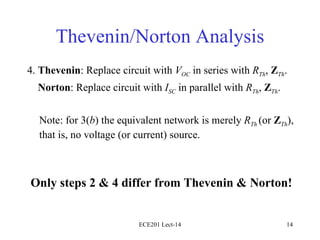
Thevenin/Norton Analysis 4.  Thevenin : Replace circuit with  V OC  in series with  R Th ,  Z Th . Norton : Replace circuit with  I SC  in parallel with  R Th ,  Z Th . Note: for 3( b ) the equivalent network is merely  R Th  (or  Z Th ), that is, no voltage (or current) source. Only steps 2 & 4 differ from Thevenin & Norton! ECE201 Lect-14

Nortans Theorem

  • 1.
    Norton's Theorem (5.3,8.8) Dr. Holbert March 20, 2006 ECE201 Lect-14
  • 2.
    Introduction Any Theveninequivalent circuit is in turn equivalent to a current source in parallel with a resistor [source transformation]. A current source in parallel with a resistor is called a Norton equivalent circuit. Finding a Norton equivalent circuit requires essentially the same process as finding a Thevenin equivalent circuit. ECE201 Lect-14
  • 3.
    Independent Sources ECE201Lect-14 Circuit with one or more independent sources R Th Norton equivalent circuit I sc
  • 4.
    No Independent SourcesECE201 Lect-14 Circuit without independent sources R Th Norton equivalent circuit
  • 5.
    Finding the NortonEquivalent Circuits with independent sources: Find V oc and I sc Compute R Th Circuits without independent sources: Apply a test voltage (current) source Find resulting current (voltage) Compute R Th ECE201 Lect-14
  • 6.
    Example: Strain GaugeStrain is the amount of deformation of a body due to an applied force-it is defined as the fractional change in length. Strain can be positive (tensile) or negative (compressive). One type of strain gauge is made of a foil grid on a thin backing. ECE201 Lect-14
  • 7.
    A Strain GaugeThe strain gauge’s resistance varies as a function of the strain:  R = GF  R  is the strain, R is the nominal resistance, GF is the Gauge Factor ECE201 Lect-14 Backing Foil
  • 8.
    Typical values Measuredstrain values are typically fairly small-usually less than 10 -3 . GF is usually close to 2. Typical values for R are 120  , 350  , and 1000  . A typical change in resistance is  R = 2•10 -3 •120  = 0.24  ECE201 Lect-14
  • 9.
    Measuring Small Changesin R To measure such small changes in resistance, the strain gauge is placed in a Wheatstone bridge circuit. The bridge circuit uses an excitation voltage source and produces a voltage that depends on  R . ECE201 Lect-14
  • 10.
    The Bridge CircuitECE201 Lect-14 R+  R V ex R R R + – V out + –
  • 11.
    Norton Equivalent forAny  ECE201 Lect-14
  • 12.
    Thevenin/Norton Analysis 1.Pick a good breaking point in the circuit (cannot split a dependent source and its control variable). 2. Thevenin : Compute the open circuit voltage, V OC . Norton : Compute the short circuit current, I SC . For case 3( b ) both V OC =0 and I SC =0 [so skip step 2] ECE201 Lect-14
  • 13.
    Thevenin/Norton Analysis 3.Compute the Thevenin equivalent resistance, R Th (or impedance, Z Th ). ( a ) If there are only independent sources, then short circuit all the voltage sources and open circuit the current sources (just like superposition). ( b ) If there are only dependent sources, then must use a test voltage or current source in order to calculate R Th (or Z Th ) = V Test / I test ( c ) If there are both independent and dependent sources, then compute R Th (or Z Th ) from V OC / I SC . ECE201 Lect-14
  • 14.
    Thevenin/Norton Analysis 4. Thevenin : Replace circuit with V OC in series with R Th , Z Th . Norton : Replace circuit with I SC in parallel with R Th , Z Th . Note: for 3( b ) the equivalent network is merely R Th (or Z Th ), that is, no voltage (or current) source. Only steps 2 & 4 differ from Thevenin & Norton! ECE201 Lect-14