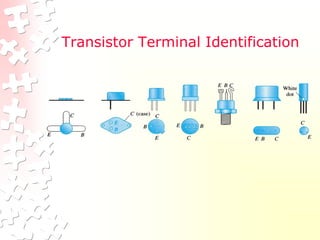
Bipolar Junction Transistors (BJTs) are three-terminal semiconductor devices that use both holes and electrons to conduct current. There are two types, NPN and PNP, which are constructed from alternating layers of N-type and P-type semiconductor material. BJTs can be used as amplifiers and switches by applying forward or reverse bias to the base-emitter and base-collector junctions. Key parameters specified in datasheets include maximum voltage, current, power dissipation, and current gain (beta). Proper biasing is required to operate the BJT in its active region for amplification applications.