AC Fundamentals
Power in AC circuits
AC Fundamentals : Power in AC circuits
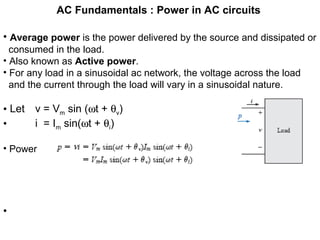
• Average power is the power delivered by the source and dissipated or
consumed in the load.
• Also known as Active power.
• For any load in a sinusoidal ac network, the voltage across the load
and the current through the load will vary in a sinusoidal nature.
• Let v = Vm sin (ωt + θv)
• i = Im sin(ωt + θi)
• Power
•
AC Fundamentals : Power in AC circuits
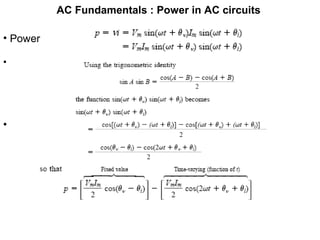
• Power
•
•
AC Fundamentals : Power in AC circuits
•
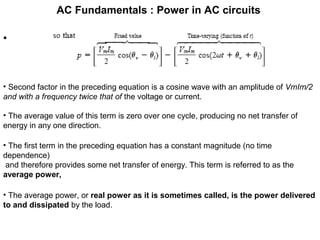
• Second factor in the preceding equation is a cosine wave with an amplitude of VmIm/2
and with a frequency twice that of the voltage or current.
• The average value of this term is zero over one cycle, producing no net transfer of
energy in any one direction.
• The first term in the preceding equation has a constant magnitude (no time
dependence)
and therefore provides some net transfer of energy. This term is referred to as the
average power,
• The average power, or real power as it is sometimes called, is the power delivered
to and dissipated by the load.
AC Fundamentals : Power in AC circuits
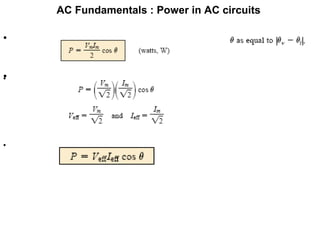
•
•
•
•
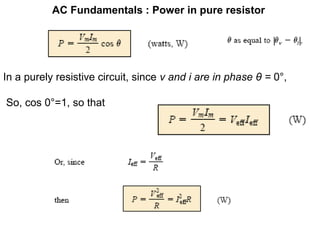
AC Fundamentals : Power in pure resistor
In a purely resistive circuit, since v and i are in phase θ = 0°,
So, cos 0°=1, so that
AC Fundamentals : Power in pure inductor and capacitor
The average power or power dissipated by the ideal inductor is zero watts
The average power or power dissipated by the ideal capacitor is zero watts.
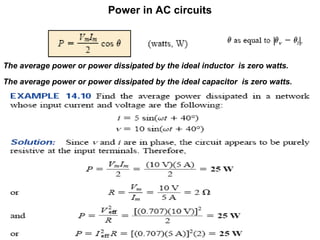
Power in AC circuits
The average power or power dissipated by the ideal inductor is zero watts.
The average power or power dissipated by the ideal capacitor is zero watts.
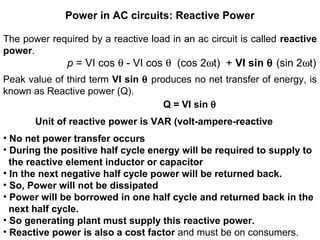
Power in AC circuits: Reactive Power
The power required by a reactive load in an ac circuit is called reactive
power.
p = VI cos θ - VI cos θ (cos 2ωt) + VI sin θ (sin 2ωt)
Peak value of third term VI sin θ produces no net transfer of energy, is
known as Reactive power (Q).
Q = VI sin θ
Unit of reactive power is VAR (volt-ampere-reactive
• No net power transfer occurs
• During the positive half cycle energy will be required to supply to
the reactive element inductor or capacitor
• In the next negative half cycle power will be returned back.
• So, Power will not be dissipated
• Power will be borrowed in one half cycle and returned back in the
next half cycle.
• So generating plant must supply this reactive power.
• Reactive power is also a cost factor and must be on consumers.
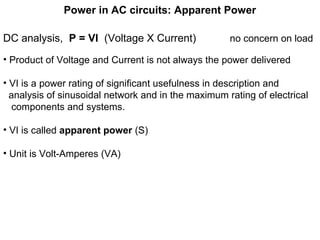
Power in AC circuits: Apparent Power
DC analysis, P = VI (Voltage X Current) no concern on load
• Product of Voltage and Current is not always the power delivered
• VI is a power rating of significant usefulness in description and
analysis of sinusoidal network and in the maximum rating of electrical
components and systems.
• VI is called apparent power (S)
• Unit is Volt-Amperes (VA)
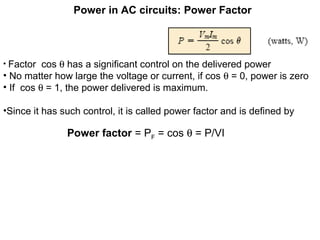
Power in AC circuits: Power Factor
• Factor cos θ has a significant control on the delivered power
• No matter how large the voltage or current, if cos θ = 0, power is zero
• If cos θ = 1, the power delivered is maximum.
•Since it has such control, it is called power factor and is defined by
Power factor = PF = cos θ = P/VI
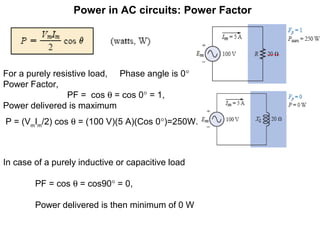
Power in AC circuits: Power Factor
For a purely resistive load, Phase angle is 0°
Power Factor,
PF = cos θ = cos 0° = 1,
Power delivered is maximum
P = (Vm
Im
/2) cos θ = (100 V)(5 A)(Cos 0°)=250W.
In case of a purely inductive or capacitive load
PF = cos θ = cos90° = 0,
Power delivered is then minimum of 0 W
Power in AC circuits: Power Factor
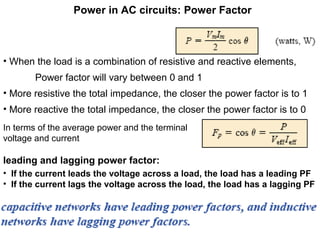
• When the load is a combination of resistive and reactive elements,
Power factor will vary between 0 and 1
• More resistive the total impedance, the closer the power factor is to 1
• More reactive the total impedance, the closer the power factor is to 0
In terms of the average power and the terminal
voltage and current
leading and lagging power factor:
• If the current leads the voltage across a load, the load has a leading PF
• If the current lags the voltage across the load, the load has a lagging PF
Power in AC circuits: Power Factor
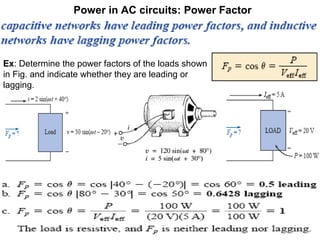
Ex: Determine the power factors of the loads shown
in Fig. and indicate whether they are leading or
lagging.

Ac fundamentals 3 power in ac circuits

  • 1.
  • 2.
    AC Fundamentals :Power in AC circuits • Average power is the power delivered by the source and dissipated or consumed in the load. • Also known as Active power. • For any load in a sinusoidal ac network, the voltage across the load and the current through the load will vary in a sinusoidal nature. • Let v = Vm sin (ωt + θv) • i = Im sin(ωt + θi) • Power •
  • 3.
    AC Fundamentals :Power in AC circuits • Power • •
  • 4.
    AC Fundamentals :Power in AC circuits • • Second factor in the preceding equation is a cosine wave with an amplitude of VmIm/2 and with a frequency twice that of the voltage or current. • The average value of this term is zero over one cycle, producing no net transfer of energy in any one direction. • The first term in the preceding equation has a constant magnitude (no time dependence) and therefore provides some net transfer of energy. This term is referred to as the average power, • The average power, or real power as it is sometimes called, is the power delivered to and dissipated by the load.
  • 5.
    AC Fundamentals :Power in AC circuits • • • •
  • 6.
    AC Fundamentals :Power in pure resistor In a purely resistive circuit, since v and i are in phase θ = 0°, So, cos 0°=1, so that
  • 7.
    AC Fundamentals :Power in pure inductor and capacitor The average power or power dissipated by the ideal inductor is zero watts The average power or power dissipated by the ideal capacitor is zero watts.
  • 8.
    Power in ACcircuits The average power or power dissipated by the ideal inductor is zero watts. The average power or power dissipated by the ideal capacitor is zero watts.
  • 9.
    Power in ACcircuits: Reactive Power The power required by a reactive load in an ac circuit is called reactive power. p = VI cos θ - VI cos θ (cos 2ωt) + VI sin θ (sin 2ωt) Peak value of third term VI sin θ produces no net transfer of energy, is known as Reactive power (Q). Q = VI sin θ Unit of reactive power is VAR (volt-ampere-reactive • No net power transfer occurs • During the positive half cycle energy will be required to supply to the reactive element inductor or capacitor • In the next negative half cycle power will be returned back. • So, Power will not be dissipated • Power will be borrowed in one half cycle and returned back in the next half cycle. • So generating plant must supply this reactive power. • Reactive power is also a cost factor and must be on consumers.
  • 10.
    Power in ACcircuits: Apparent Power DC analysis, P = VI (Voltage X Current) no concern on load • Product of Voltage and Current is not always the power delivered • VI is a power rating of significant usefulness in description and analysis of sinusoidal network and in the maximum rating of electrical components and systems. • VI is called apparent power (S) • Unit is Volt-Amperes (VA)
  • 11.
    Power in ACcircuits: Power Factor • Factor cos θ has a significant control on the delivered power • No matter how large the voltage or current, if cos θ = 0, power is zero • If cos θ = 1, the power delivered is maximum. •Since it has such control, it is called power factor and is defined by Power factor = PF = cos θ = P/VI
  • 12.
    Power in ACcircuits: Power Factor For a purely resistive load, Phase angle is 0° Power Factor, PF = cos θ = cos 0° = 1, Power delivered is maximum P = (Vm Im /2) cos θ = (100 V)(5 A)(Cos 0°)=250W. In case of a purely inductive or capacitive load PF = cos θ = cos90° = 0, Power delivered is then minimum of 0 W
  • 13.
    Power in ACcircuits: Power Factor • When the load is a combination of resistive and reactive elements, Power factor will vary between 0 and 1 • More resistive the total impedance, the closer the power factor is to 1 • More reactive the total impedance, the closer the power factor is to 0 In terms of the average power and the terminal voltage and current leading and lagging power factor: • If the current leads the voltage across a load, the load has a leading PF • If the current lags the voltage across the load, the load has a lagging PF
  • 14.
    Power in ACcircuits: Power Factor Ex: Determine the power factors of the loads shown in Fig. and indicate whether they are leading or lagging.