INTRODUCTION TO TEXTILE
MANUFACTURING
(TXT-175)
By: Nirmal Malik
Session # 6
FIBER TO YARN
YARN
Continuous strand of fibers grouped or twisted together and
used to construct textile fabrics. Yarns are made from both
natural and synthetic fibers
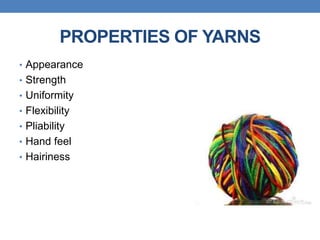
PROPERTIES OF YARNS
• Appearance
• Strength
• Uniformity
• Flexibility
• Pliability
• Hand feel
• Hairiness
YARN FORMATION FLOW CHART
Fiber Plucking
• Manual
• Automated
Ginning and Lap Formation
• Separation of cotton fibers from its seed.
• Manual and Automated.
• Reduce moisture content. (Dryers)
• Removes foreign matter. (Cleaning equipment)
• Improve fiber quality.
• Compressed into bales weighing approximately 500 pounds.
• Cotton is then moved to a warehouse for storage until it is
shipped to a textile mill for use.
Blow Room Processes
TASKS OF BLOWROOM
OPENING
• Bale opening
• Loses hard lumps of fiber.
CLEANING
• Removes trash, such as dirt, leaves, burrs and remaining
seeds.
• Cleaning efficiency should be optimized not maximized
BLENDING
• Uniformity of quality.
• Even feed of material to the card.
Blow Room Processes
Carding
• Heart of the spinning mill
• Well carded is half spun.
TASKS OF CARDING
• Opening to individual fibers
• Removes remaining impurities.
• Detangles fibers.
• Straightens fibers.
• Necessary for all staple fibers.
• Arranging the fibers in parallel fashion is called carding.
Carding
Doubling
• After carding, several slivers are combined.
• This results in a relatively narrow lap of compactly placed
staple fibers.
• Narrower sliver is formed.
Combing
• For fine yarns.
• Additional straightening process
• Fine tooth combs straighten the fibers until they are
arranged in parallel fashion and all noils or neps are
completely separated from long fibers.
• Not for man made fibers.
• Wastes 25% of the card sliver.
TASKS OF COMBING
• Smoothens fiber.
• Separates long fibers from short fibers.
• Arranged in flat bundles.
Drawing
• Combining of several slivers for drawing or drafting.
• Eliminates irregularities.
• Longer and thinner slivers.
• Passed through slubber.
• First twist is added.
• Collected in Roving cans.
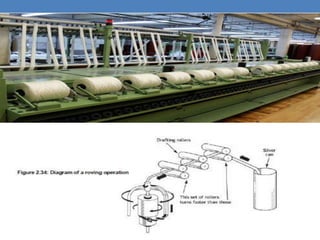
Roving
• Further drawing out and twisting takes place.
• Fine as pencil lead.
• Two stages: Intermediate and fine.
• Final drawing out process.
• Enough twist for holding fibers together but have no tensile
strength.
• Change sliver in to thinner sliver for the convenience of
subsequent processes
TASKS OF ROVING
• Drafting the sliver in to a roving
• Insert a twist in to the roving
• Wind the roving in a bobbin
Spinning
• The act or process of converting staple or short lengths of
fiber, as cotton or rayon, into continuous yarn or thread.
• The extrusion of a solution of fiber forming substances
through holes in a spinneret to form filaments.
Fiber to yarn lecture

Fiber to yarn lecture

  • 1.
  • 2.
  • 3.
  • 4.
    YARN Continuous strand offibers grouped or twisted together and used to construct textile fabrics. Yarns are made from both natural and synthetic fibers
  • 5.
    PROPERTIES OF YARNS •Appearance • Strength • Uniformity • Flexibility • Pliability • Hand feel • Hairiness
  • 6.
  • 7.
  • 8.
    Ginning and LapFormation • Separation of cotton fibers from its seed. • Manual and Automated. • Reduce moisture content. (Dryers) • Removes foreign matter. (Cleaning equipment) • Improve fiber quality. • Compressed into bales weighing approximately 500 pounds. • Cotton is then moved to a warehouse for storage until it is shipped to a textile mill for use.
  • 10.
    Blow Room Processes TASKSOF BLOWROOM OPENING • Bale opening • Loses hard lumps of fiber. CLEANING • Removes trash, such as dirt, leaves, burrs and remaining seeds. • Cleaning efficiency should be optimized not maximized BLENDING • Uniformity of quality. • Even feed of material to the card.
  • 11.
  • 12.
    Carding • Heart ofthe spinning mill • Well carded is half spun. TASKS OF CARDING • Opening to individual fibers • Removes remaining impurities. • Detangles fibers. • Straightens fibers. • Necessary for all staple fibers. • Arranging the fibers in parallel fashion is called carding.
  • 13.
  • 14.
    Doubling • After carding,several slivers are combined. • This results in a relatively narrow lap of compactly placed staple fibers. • Narrower sliver is formed.
  • 15.
    Combing • For fineyarns. • Additional straightening process • Fine tooth combs straighten the fibers until they are arranged in parallel fashion and all noils or neps are completely separated from long fibers. • Not for man made fibers. • Wastes 25% of the card sliver. TASKS OF COMBING • Smoothens fiber. • Separates long fibers from short fibers. • Arranged in flat bundles.
  • 17.
    Drawing • Combining ofseveral slivers for drawing or drafting. • Eliminates irregularities. • Longer and thinner slivers. • Passed through slubber. • First twist is added. • Collected in Roving cans.
  • 19.
    Roving • Further drawingout and twisting takes place. • Fine as pencil lead. • Two stages: Intermediate and fine. • Final drawing out process. • Enough twist for holding fibers together but have no tensile strength. • Change sliver in to thinner sliver for the convenience of subsequent processes TASKS OF ROVING • Drafting the sliver in to a roving • Insert a twist in to the roving • Wind the roving in a bobbin
  • 21.
    Spinning • The actor process of converting staple or short lengths of fiber, as cotton or rayon, into continuous yarn or thread. • The extrusion of a solution of fiber forming substances through holes in a spinneret to form filaments.