YARN FAULTS AND THEIR CONTROL
YARN FAULTS , CAUSES AND ITS REMEDIES
 SLUBS
 NEPS
 SNARL
 THICK&THINK PLACES
 SOFT YARN
 OIL STAINED YARN
 CRACKERS
YARN FAULTS , CAUSES AND ITS REMEDIES
 BAD PIECING
 OILY SLUB
 KITTY YARN
 HAIRINESS
 FOREIGN MATTERS
 SPUN IN FLY
 CORK SCREW YARN
SLUBS
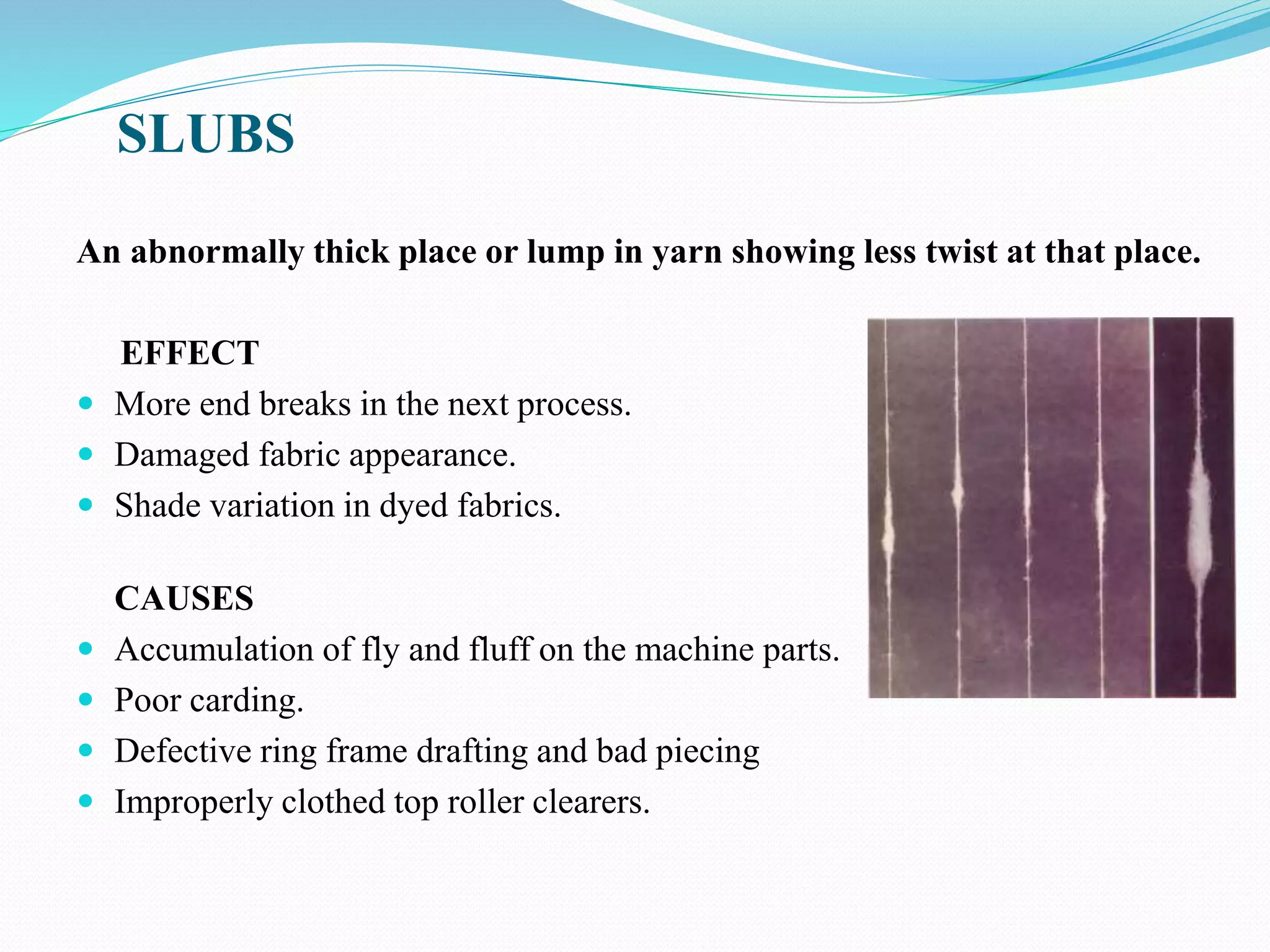
An abnormally thick place or lump in yarn showing less twist at that place.
EFFECT
 More end breaks in the next process.
 Damaged fabric appearance.
 Shade variation in dyed fabrics.
CAUSES
 Accumulation of fly and fluff on the machine parts.
 Poor carding.
 Defective ring frame drafting and bad piecing
 Improperly clothed top roller clearers.
SLUBS
RECTIFICATION
 Machine surfaces to be maintained clean.
 Proper functioning of pnemafil/roller clearers to be ensured.
 Broken teeth gear wheel to be avoided and proper meshing to be ensured.
 Better fiber individualisation at cards to be achieved.
 Optimum top roller pressure &back zone
 Setting at ring frame to be maintained.
NEPS
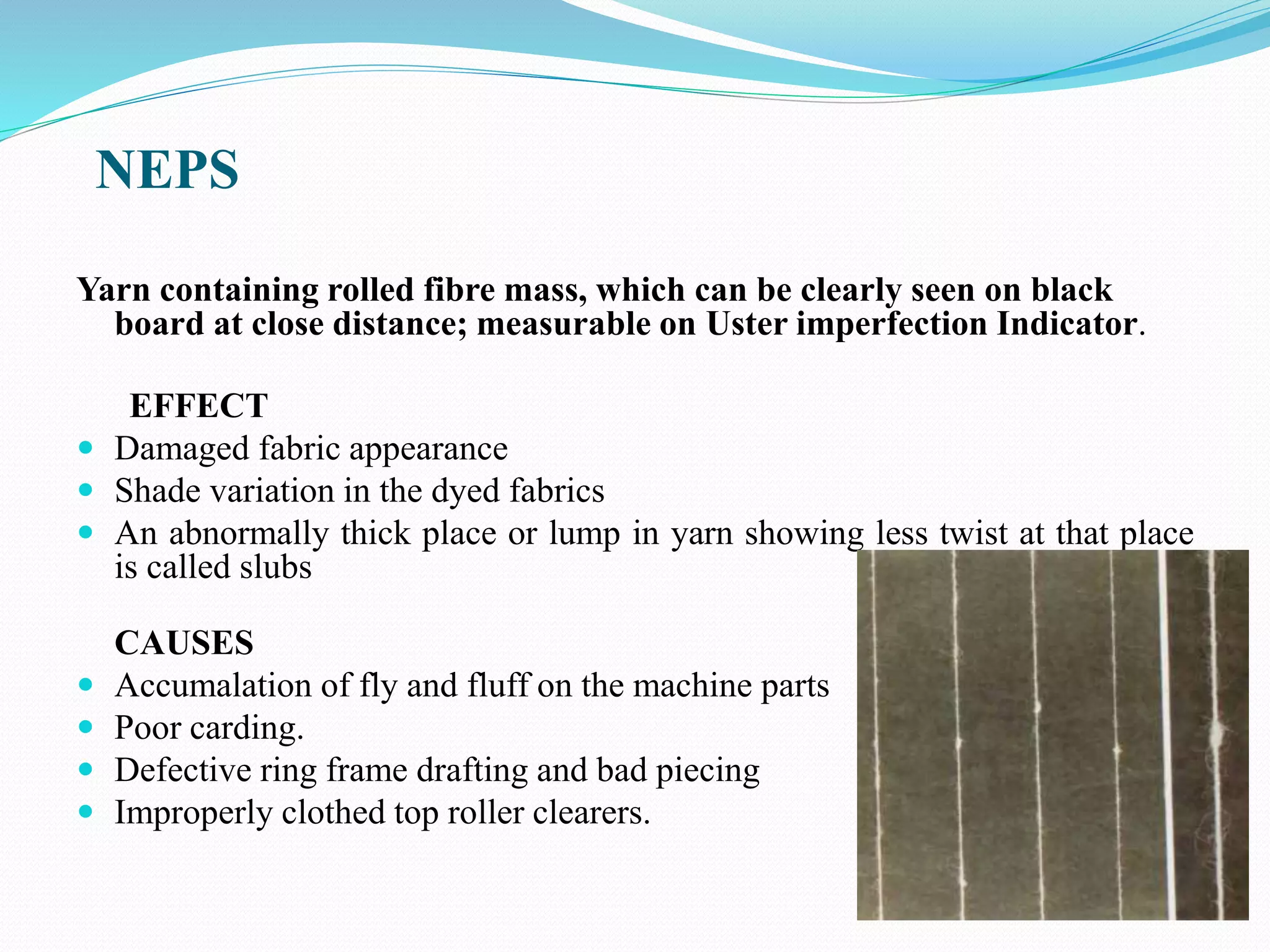
Yarn containing rolled fibre mass, which can be clearly seen on black
board at close distance; measurable on Uster imperfection Indicator.
EFFECT
 Damaged fabric appearance
 Shade variation in the dyed fabrics
 An abnormally thick place or lump in yarn showing less twist at that place
is called slubs
CAUSES
 Accumalation of fly and fluff on the machine parts
 Poor carding.
 Defective ring frame drafting and bad piecing
 Improperly clothed top roller clearers.
NEPS
RECTIFICATION
 Machine surfaces to be maintained clean.
 Proper functioning of pnemafil/roller clearers to be ensured.
 Broken teeth gear wheel to be avoided and proper meshing to be ensured.
 Better fiber individualisation at cards to be achieved.
SNARL
Yarn with kinks(twisted onto itself) due to insuffcient tension after twisting
EFFECT
 Entanglement with adjacent ends causing a break
 Damaged fabric appearance
 Shade variation in dyed fabrics
 Improper meshing of gear wheels
 Mixing of cottons varying widely in fiber lengths and use of immature
cottons
CAUSES
 Higher than normal twist in the yarn
 Presence of too many long thin places in the yarn
SNARL
RECTIFICATION
 Optimum twist to be used for the type of cotton processed
 Drafting parameters to minimise thin places in the yarn to be adopted
 The yarn to be conditioned
 Correct tension weights and slub catcher settings to be employed at winding
THICK AND THIN PLACES
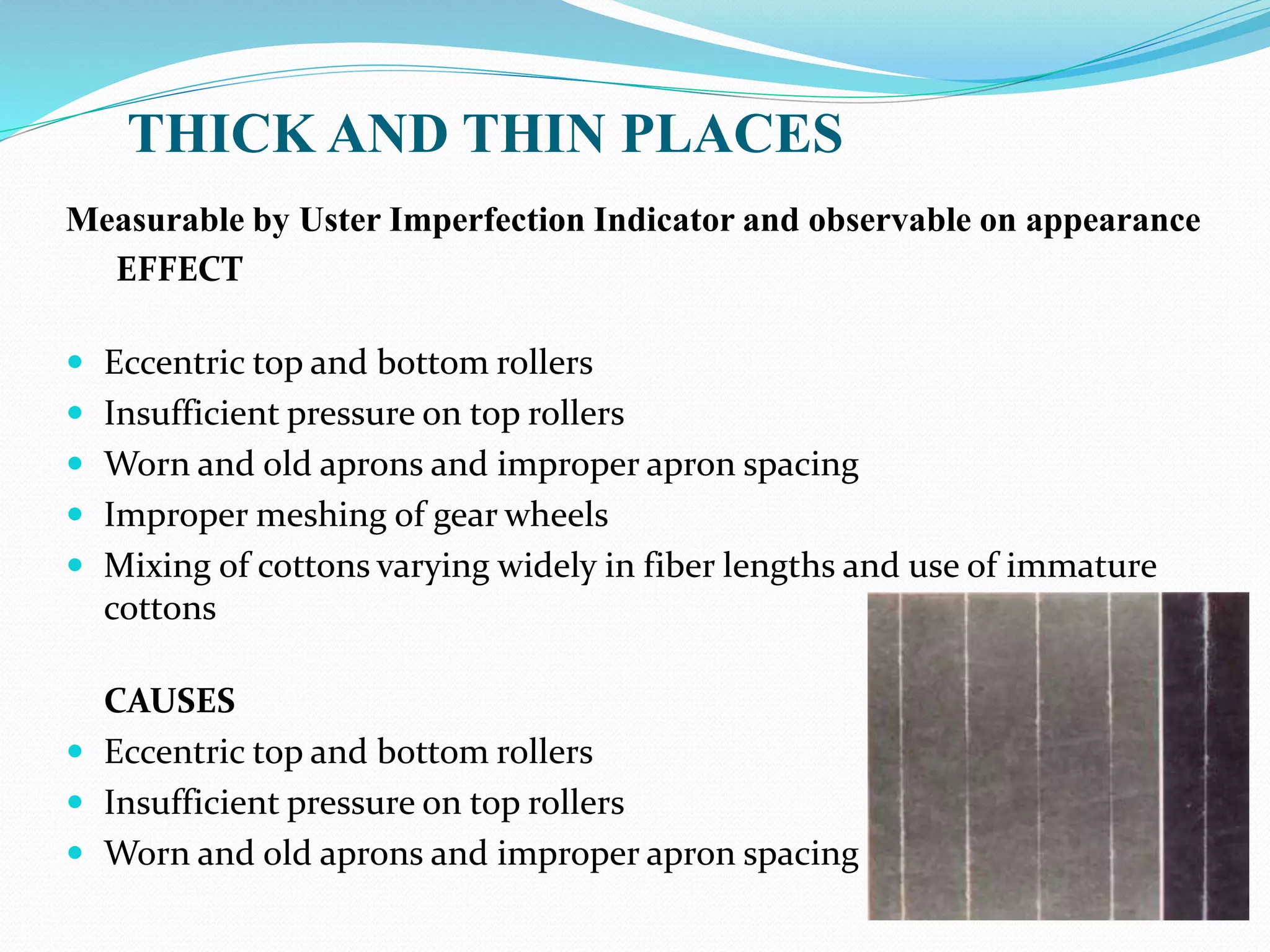
Measurable by Uster Imperfection Indicator and observable on appearance
EFFECT
 Eccentric top and bottom rollers
 Insufficient pressure on top rollers
 Worn and old aprons and improper apron spacing
 Improper meshing of gear wheels
 Mixing of cottons varying widely in fiber lengths and use of immature
cottons
CAUSES
 Eccentric top and bottom rollers
 Insufficient pressure on top rollers
 Worn and old aprons and improper apron spacing
THICK AND THIN PLACES
 Improper meshing of gear wheels
 Mixing of cottons varying widely in fibre lengths and use of immature
cottons
RECTIFICATION
 Eccentric top and bottom rollers to be avoided
 Top arm pressure checking schedules to be Maintained strictly
 Wide variation in the properties of cottons used in the mixing to be avoided
 Better fiber individualisation at cards to be achieved.
 Correct spacers to be utilised
SOFT YARN
Yarn which is weak indicating lesser twist
EFFECT
 More end breaks in subsequent processes
 Shade variation in dyed fabrics
CAUSES
 Slack tapes dirty jockey pulleys
 Improper bobbin feed on the spls
 Less twist in the yarn
 Bad clearing at the travellar
SOFT YARN
RECTIFICATION
 Vibration of bobbins on the spindles to be avoided
 Proper yarn clearing to be ensured
 Periodic replacement of worn rings and travellars to be effected
OIL STAINED YARN
Yarn stained with oil
EFFECT
 Damaged fabric appearance
 Occurrence of black spot in fabric
CAUSES
 Careless oil in the moving parts,over head pulleys etc
 Piecings made with oily or dirty fingers
 Careless material handlings
OIL STAINED YARN
RECTIFICATION
 Appropriate material handling procedures to be followed
 Oilers to trained in proper method of lubrication
 Clean containers to be utilised for material transportation
CRACKERS
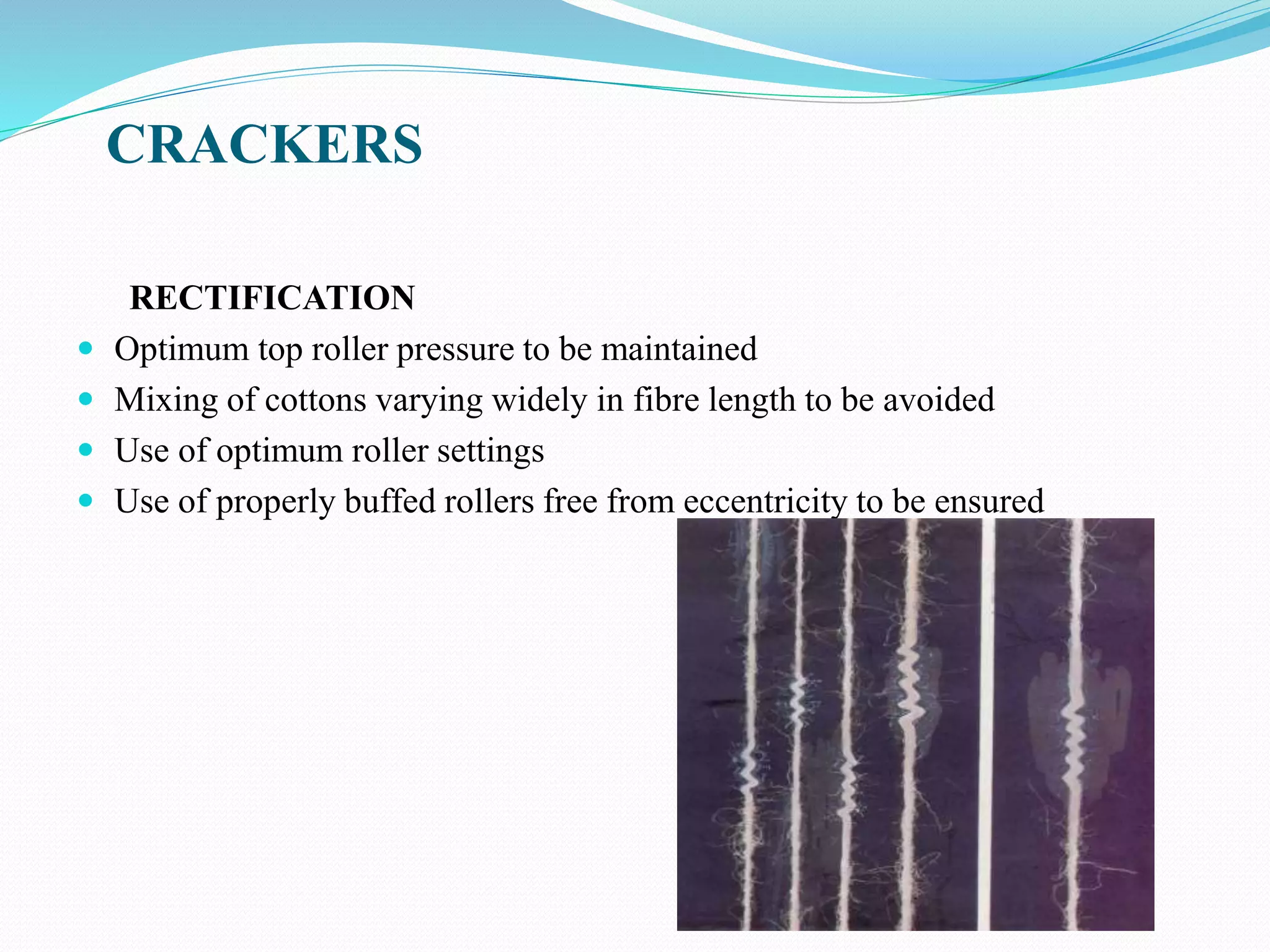
Very small snarl-like places in the yarn which disappear when pulled with
enough tension or Yarn with spring -likeshape
EFFECT
 More breaks in winding
 More noticable in polyester and cotton blendedyarns
CAUSES
 Mixing of cottons of widely differing staple length
 Closer roller settings
 Eccentric top and bottom rollers
 Non optimum temperature and relative humidity in the spiinning shed
 Over spinning of cottons
CRACKERS
RECTIFICATION
 Optimum top roller pressure to be maintained
 Mixing of cottons varying widely in fibre length to be avoided
 Use of optimum roller settings
 Use of properly buffed rollers free from eccentricity to be ensured
BAD PIECING
Unduly thick piecing in yarn caused by over End piecing
EFFECT
 More end breaks in subsequent process
 Increase in hard waste
CAUSES
 Wrong method of piecing and over end piecing
 Twisting the ends instead of knotting
RECTIFICATION
 Tenters to be trained in proper methods of piecing
 Separators to be provided
 Excessive end breaks in spinning to be avoided
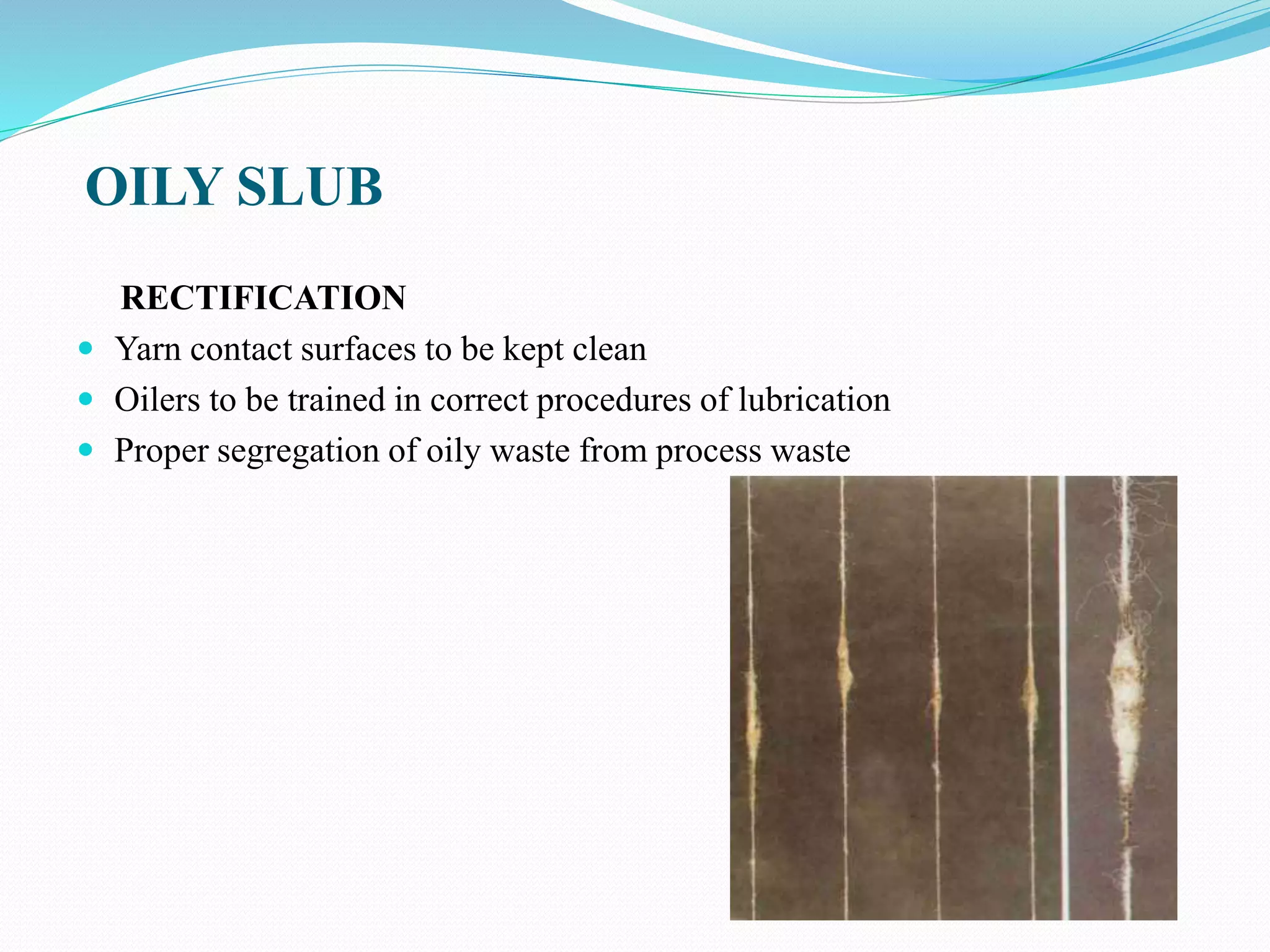
OILY SLUB
Slub in the yarn stained with oil
EFFECT
 More end breaks in the ensuring process
 Damaged fabric appearance
 Shade variation in dyed fabrics
CAUSES
 Accumulation of oily fluff on machinery parts
 Poor methods of lubrication in preparatory processes
 Negligence in segregating the oily waste from process waste
OILY SLUB
RECTIFICATION
 Yarn contact surfaces to be kept clean
 Oilers to be trained in correct procedures of lubrication
 Proper segregation of oily waste from process waste
KITTY YARN
EFFECT
 Damaged fabric appearance
 Production of specks during dyeing
 Needle breaks during knitting
 Poor performance during winding
CAUSES
 Ineffective cleaning in Blow room and cards
 Use of cottons with high trash and too many seed coat fragments
RECTIFICATION
 Cleaning efficiency of blow room and cards to be improved
 Optimum humidity in the departments to be ensured
HAIRINESS
Protrusion of fibre ends from the main yarn structure
EFFECT
 More end breaks in winding
 Uneven fabric surface
 Beads formation in the fabric in the case of polyester/cotton blends
CAUSES
 Use of cottons differing widely in the properties in the same mixing
 Use of worn rings and lighter travellars
 Maintaining low relative humidity, closer roller settings and very high
spindle speeds
HAIRINESS
RECTIFICATION
 Use of travellars of correct size and shape and rings in good condition to be
ensured
 Periodic replacement of travellars and suitable
 Roller settings to be maintained
 Optimum relative humidity to be maintained in the spinning room
 Wide variation in the properties of cottons used in the mixing to be avoided
FOREIGN MATTERS
Metallic parts, jute flannel and other similar foreign matters spun along
with yarn
EFFECT
 Breaks during winding
 Formation of holes and stains in cloth
 Damaged fabric appearance
CAUSES
 Improper handling of travellers
 Improper preparation of mixings
RECTIFICATION
 Removal of foreign matters(such as jute fibres,colour cloth bits) to be ensured during
preparation of mixing
 Installation of permanent magnets at proper
 Places in blow room lines to be ensured
SPUN IN FLY
Fly or fluff either spun along with the yarn or loosely embedded on the
yarn
EFFECT
 More breaks in winding
CAUSES
 Accumulation of fluff over machine parts
 Fanning by workers
 Failure of over head cleaners
 Malfunctioning of humidification plant

RECTIFICATION
 Machinery surfaces to be kept clean by using roller pickers
 Performance of over head cleaners and humidification plants to be closely
monitored
CORK SCREW YARN
It is a double yarn which one yarn is straight and other is coiled over it
EFFECT
 Breaks during winding
 Causes streaks in the fabric
CAUSES
 Feeding of two ends (instead of one ) in ring frame
 Lashing -in ends in ring frame
RECTIFICATION
 Tenters are to be trained in piecing methods(or) practices
 Pneumafil ducts to be kept clean and properly set

Yarn faults , causes and its remedies

  • 1.
    YARN FAULTS ANDTHEIR CONTROL
  • 2.
    YARN FAULTS ,CAUSES AND ITS REMEDIES  SLUBS  NEPS  SNARL  THICK&THINK PLACES  SOFT YARN  OIL STAINED YARN  CRACKERS
  • 3.
    YARN FAULTS ,CAUSES AND ITS REMEDIES  BAD PIECING  OILY SLUB  KITTY YARN  HAIRINESS  FOREIGN MATTERS  SPUN IN FLY  CORK SCREW YARN
  • 4.
    SLUBS An abnormally thickplace or lump in yarn showing less twist at that place. EFFECT  More end breaks in the next process.  Damaged fabric appearance.  Shade variation in dyed fabrics. CAUSES  Accumulation of fly and fluff on the machine parts.  Poor carding.  Defective ring frame drafting and bad piecing  Improperly clothed top roller clearers.
  • 5.
    SLUBS RECTIFICATION  Machine surfacesto be maintained clean.  Proper functioning of pnemafil/roller clearers to be ensured.  Broken teeth gear wheel to be avoided and proper meshing to be ensured.  Better fiber individualisation at cards to be achieved.  Optimum top roller pressure &back zone  Setting at ring frame to be maintained.
  • 6.
    NEPS Yarn containing rolledfibre mass, which can be clearly seen on black board at close distance; measurable on Uster imperfection Indicator. EFFECT  Damaged fabric appearance  Shade variation in the dyed fabrics  An abnormally thick place or lump in yarn showing less twist at that place is called slubs CAUSES  Accumalation of fly and fluff on the machine parts  Poor carding.  Defective ring frame drafting and bad piecing  Improperly clothed top roller clearers.
  • 7.
    NEPS RECTIFICATION  Machine surfacesto be maintained clean.  Proper functioning of pnemafil/roller clearers to be ensured.  Broken teeth gear wheel to be avoided and proper meshing to be ensured.  Better fiber individualisation at cards to be achieved.
  • 8.
    SNARL Yarn with kinks(twistedonto itself) due to insuffcient tension after twisting EFFECT  Entanglement with adjacent ends causing a break  Damaged fabric appearance  Shade variation in dyed fabrics  Improper meshing of gear wheels  Mixing of cottons varying widely in fiber lengths and use of immature cottons CAUSES  Higher than normal twist in the yarn  Presence of too many long thin places in the yarn
  • 9.
    SNARL RECTIFICATION  Optimum twistto be used for the type of cotton processed  Drafting parameters to minimise thin places in the yarn to be adopted  The yarn to be conditioned  Correct tension weights and slub catcher settings to be employed at winding
  • 10.
    THICK AND THINPLACES Measurable by Uster Imperfection Indicator and observable on appearance EFFECT  Eccentric top and bottom rollers  Insufficient pressure on top rollers  Worn and old aprons and improper apron spacing  Improper meshing of gear wheels  Mixing of cottons varying widely in fiber lengths and use of immature cottons CAUSES  Eccentric top and bottom rollers  Insufficient pressure on top rollers  Worn and old aprons and improper apron spacing
  • 11.
    THICK AND THINPLACES  Improper meshing of gear wheels  Mixing of cottons varying widely in fibre lengths and use of immature cottons RECTIFICATION  Eccentric top and bottom rollers to be avoided  Top arm pressure checking schedules to be Maintained strictly  Wide variation in the properties of cottons used in the mixing to be avoided  Better fiber individualisation at cards to be achieved.  Correct spacers to be utilised
  • 12.
    SOFT YARN Yarn whichis weak indicating lesser twist EFFECT  More end breaks in subsequent processes  Shade variation in dyed fabrics CAUSES  Slack tapes dirty jockey pulleys  Improper bobbin feed on the spls  Less twist in the yarn  Bad clearing at the travellar
  • 13.
    SOFT YARN RECTIFICATION  Vibrationof bobbins on the spindles to be avoided  Proper yarn clearing to be ensured  Periodic replacement of worn rings and travellars to be effected
  • 14.
    OIL STAINED YARN Yarnstained with oil EFFECT  Damaged fabric appearance  Occurrence of black spot in fabric CAUSES  Careless oil in the moving parts,over head pulleys etc  Piecings made with oily or dirty fingers  Careless material handlings
  • 15.
    OIL STAINED YARN RECTIFICATION Appropriate material handling procedures to be followed  Oilers to trained in proper method of lubrication  Clean containers to be utilised for material transportation
  • 16.
    CRACKERS Very small snarl-likeplaces in the yarn which disappear when pulled with enough tension or Yarn with spring -likeshape EFFECT  More breaks in winding  More noticable in polyester and cotton blendedyarns CAUSES  Mixing of cottons of widely differing staple length  Closer roller settings  Eccentric top and bottom rollers  Non optimum temperature and relative humidity in the spiinning shed  Over spinning of cottons
  • 17.
    CRACKERS RECTIFICATION  Optimum toproller pressure to be maintained  Mixing of cottons varying widely in fibre length to be avoided  Use of optimum roller settings  Use of properly buffed rollers free from eccentricity to be ensured
  • 18.
    BAD PIECING Unduly thickpiecing in yarn caused by over End piecing EFFECT  More end breaks in subsequent process  Increase in hard waste CAUSES  Wrong method of piecing and over end piecing  Twisting the ends instead of knotting RECTIFICATION  Tenters to be trained in proper methods of piecing  Separators to be provided  Excessive end breaks in spinning to be avoided
  • 19.
    OILY SLUB Slub inthe yarn stained with oil EFFECT  More end breaks in the ensuring process  Damaged fabric appearance  Shade variation in dyed fabrics CAUSES  Accumulation of oily fluff on machinery parts  Poor methods of lubrication in preparatory processes  Negligence in segregating the oily waste from process waste
  • 20.
    OILY SLUB RECTIFICATION  Yarncontact surfaces to be kept clean  Oilers to be trained in correct procedures of lubrication  Proper segregation of oily waste from process waste
  • 21.
    KITTY YARN EFFECT  Damagedfabric appearance  Production of specks during dyeing  Needle breaks during knitting  Poor performance during winding CAUSES  Ineffective cleaning in Blow room and cards  Use of cottons with high trash and too many seed coat fragments RECTIFICATION  Cleaning efficiency of blow room and cards to be improved  Optimum humidity in the departments to be ensured
  • 22.
    HAIRINESS Protrusion of fibreends from the main yarn structure EFFECT  More end breaks in winding  Uneven fabric surface  Beads formation in the fabric in the case of polyester/cotton blends CAUSES  Use of cottons differing widely in the properties in the same mixing  Use of worn rings and lighter travellars  Maintaining low relative humidity, closer roller settings and very high spindle speeds
  • 23.
    HAIRINESS RECTIFICATION  Use oftravellars of correct size and shape and rings in good condition to be ensured  Periodic replacement of travellars and suitable  Roller settings to be maintained  Optimum relative humidity to be maintained in the spinning room  Wide variation in the properties of cottons used in the mixing to be avoided
  • 24.
    FOREIGN MATTERS Metallic parts,jute flannel and other similar foreign matters spun along with yarn EFFECT  Breaks during winding  Formation of holes and stains in cloth  Damaged fabric appearance CAUSES  Improper handling of travellers  Improper preparation of mixings RECTIFICATION  Removal of foreign matters(such as jute fibres,colour cloth bits) to be ensured during preparation of mixing  Installation of permanent magnets at proper  Places in blow room lines to be ensured
  • 25.
    SPUN IN FLY Flyor fluff either spun along with the yarn or loosely embedded on the yarn EFFECT  More breaks in winding CAUSES  Accumulation of fluff over machine parts  Fanning by workers  Failure of over head cleaners  Malfunctioning of humidification plant  RECTIFICATION  Machinery surfaces to be kept clean by using roller pickers  Performance of over head cleaners and humidification plants to be closely monitored
  • 26.
    CORK SCREW YARN Itis a double yarn which one yarn is straight and other is coiled over it EFFECT  Breaks during winding  Causes streaks in the fabric CAUSES  Feeding of two ends (instead of one ) in ring frame  Lashing -in ends in ring frame RECTIFICATION  Tenters are to be trained in piecing methods(or) practices  Pneumafil ducts to be kept clean and properly set