INSTITUTE OF CHEMICAL TECHNOLOGY
MUMBAI
BY- KANHAYA LAL KUMAWAT
FIBRES USED IN TECHNICAL TEXTILES
What are Technical Textiles?
 Textile Institute Manchester defines technical textiles in the following words:
"Materials and products intended for end-uses other than non-protective clothing,
household furnishing, and floor covering, where the fabric or fibrous component is
selected principally but not exclusively for its performance and properties as opposed to
its aesthetic or decorative characteristics" (Textile Terms and Definitions, TI,
Manchester, 10theEd.)
Technical Textiles can also be defined as:
Technical textiles are materials meeting high technical
and quality requirements (mechanical, thermal, electrical,
durability...) giving them the ability to offer technical functions"
Fibres used in Technical textiles:
 Conventional fibres
 High strength and high modulus organic fibres
 High chemical and combustion resistant fibres
 High performance inorganic fibres
 Ultra fine and novelty fibres
Conventional fibres
 Natural fibres:-
1. Cotton
2. Wool
3. Flax
4. Jute
5. Hemp
6. Ramie
7. Silk
Conventional fibres contd…
Regenerated fibres:
1. Viscose rayon
2. Lyocell
 Synthetic fibres:
1. Nylon
2. Nylon 6,6
3. Polyester
4. Polyacrylic fibres
5. PP, PE, Elastane fibres
High strength and high modulus organic
fibres:
 Dyneema or spectra: Weight for weight this fibre genus is claimed to be
15 times stronger than steel and twice as strong as aromatic polyamides
such as Kevlar. It is also low in density, chemically inert and abrasion
resistant.
High strength and high modulus organic
fibres:
 Other high tenacity and high modulus fibres include the isotropically
spun Technora (Teijin) and Supara, based upon para-aramid
copolymers, with slightly lower maximum strength and modulus
values than Kevlar.
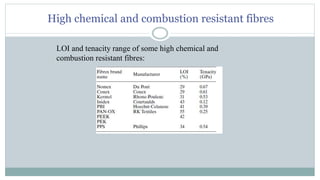
High chemical and combustion resistant fibres
LOI and tenacity range of some high chemical and
combustion resistant fibres:
High performance inorganic fibres
 Glass
 Asbestos
 Carbon
 Inorganic fibres are produced in microcrystalline form and not more in
the normal textile-fibre form.
Ultra fine and novelty fibres:
Ultra-fine or microfibres were developed partly because of improved
precision in engineering techniques and better production controls, and
partly because of the need for lightweight, soft waterproof fabrics that
eliminate the more conventional coating or lamination processes.
These are usually made from polyester and nylon polymers.
Ultra fine and novelty fibres contd…
 Cripy 65 is a scented fibre produced by Mitsubishi Rayon (R) who have
enclosed a fragrant essence in isolated cavities along the length of
hollow polyester fibres.
 The scent is gradually released to give a consistent and pleasant aroma
Major 10 fibres used in technical textiles :
Polyethylene
Polyester
Nylon
Carbon
Polypropylene
Glass
Viscose
Metal
Acrylic and
Protein
Polyethylene fibre
It has the following properties:-
Very good ultra violet resistance
Excellent electrical and chemical resistance
 Low moisture absorption level
 Very good abrasion resistance
 Low specific gravity
 Higher energy is needed to break because of specific modulus and
high specific strength
Applications of polyethylene
• Medical implants
• Cable and marine ropes
• Sail cloth
• Composites like Pressure vessel boat hulls, sports equipment, impact shields
• Fish netting
• Concrete reinforcement
• Protective clothing
• Can be used in radar protective cover because of its low dielectric constant
• Can be used as a lining material of a pond which collects evaporation of water and containment
from industrial plants
• Useful in geotextile applications
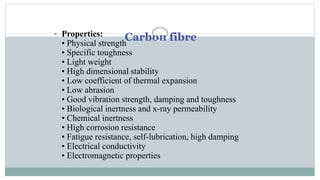
Carbon fibre• Properties:
• Physical strength
• Specific toughness
• Light weight
• High dimensional stability
• Low coefficient of thermal expansion
• Low abrasion
• Good vibration strength, damping and toughness
• Biological inertness and x-ray permeability
• Chemical inertness
• High corrosion resistance
• Fatigue resistance, self-lubrication, high damping
• Electrical conductivity
• Electromagnetic properties
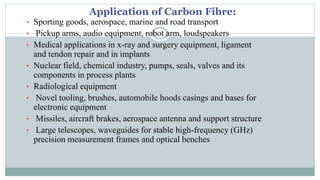
Application of Carbon Fibre:
• Sporting goods, aerospace, marine and road transport
• Pickup arms, audio equipment, robot arm, loudspeakers
• Medical applications in x-ray and surgery equipment, ligament
and tendon repair and in implants
• Nuclear field, chemical industry, pumps, seals, valves and its
components in process plants
• Radiological equipment
• Novel tooling, brushes, automobile hoods casings and bases for
electronic equipment
• Missiles, aircraft brakes, aerospace antenna and support structure
• Large telescopes, waveguides for stable high-frequency (GHz)
precision measurement frames and optical benches
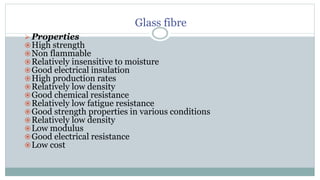
Glass fibre
 Properties
High strength
Non flammable
Relatively insensitive to moisture
Good electrical insulation
High production rates
Relatively low density
Good chemical resistance
Relatively low fatigue resistance
Good strength properties in various conditions
Relatively low density
Low modulus
Good electrical resistance
Low cost
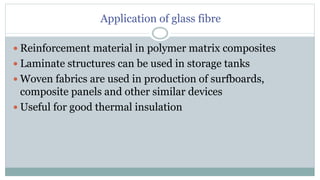
Application of glass fibre
 Reinforcement material in polymer matrix composites
 Laminate structures can be used in storage tanks
 Woven fabrics are used in production of surfboards,
composite panels and other similar devices
 Useful for good thermal insulation
Metal fibre
Properties:
 Good thermal and electrical conduction
 Wear resistance and corrosion
 Elastic module and high intensity
 Protection from magnetism and static and radiation
 Better shield effect
Applications of metal fiber
 Automotive manufacturing
 Petro chemistry
 Environmental protection
 Automobile safe gasbag
 Shield dress of protection from magnetism
 Bulletproof vests
 Anti-fake material
 Dust proof ultra clean clothes
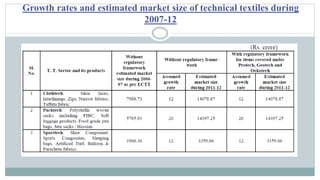
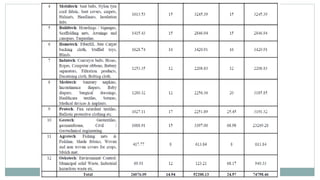
Growth rates and estimated market size of technical textiles during
2007-12
THANK YOU

Technical textile Fibres used in technical textiles

  • 1.
    INSTITUTE OF CHEMICALTECHNOLOGY MUMBAI BY- KANHAYA LAL KUMAWAT FIBRES USED IN TECHNICAL TEXTILES
  • 2.
    What are TechnicalTextiles?  Textile Institute Manchester defines technical textiles in the following words: "Materials and products intended for end-uses other than non-protective clothing, household furnishing, and floor covering, where the fabric or fibrous component is selected principally but not exclusively for its performance and properties as opposed to its aesthetic or decorative characteristics" (Textile Terms and Definitions, TI, Manchester, 10theEd.)
  • 3.
    Technical Textiles canalso be defined as: Technical textiles are materials meeting high technical and quality requirements (mechanical, thermal, electrical, durability...) giving them the ability to offer technical functions"
  • 4.
    Fibres used inTechnical textiles:  Conventional fibres  High strength and high modulus organic fibres  High chemical and combustion resistant fibres  High performance inorganic fibres  Ultra fine and novelty fibres
  • 5.
    Conventional fibres  Naturalfibres:- 1. Cotton 2. Wool 3. Flax 4. Jute 5. Hemp 6. Ramie 7. Silk
  • 6.
    Conventional fibres contd… Regeneratedfibres: 1. Viscose rayon 2. Lyocell  Synthetic fibres: 1. Nylon 2. Nylon 6,6 3. Polyester 4. Polyacrylic fibres 5. PP, PE, Elastane fibres
  • 7.
    High strength andhigh modulus organic fibres:  Dyneema or spectra: Weight for weight this fibre genus is claimed to be 15 times stronger than steel and twice as strong as aromatic polyamides such as Kevlar. It is also low in density, chemically inert and abrasion resistant.
  • 8.
    High strength andhigh modulus organic fibres:  Other high tenacity and high modulus fibres include the isotropically spun Technora (Teijin) and Supara, based upon para-aramid copolymers, with slightly lower maximum strength and modulus values than Kevlar.
  • 9.
    High chemical andcombustion resistant fibres LOI and tenacity range of some high chemical and combustion resistant fibres:
  • 10.
    High performance inorganicfibres  Glass  Asbestos  Carbon  Inorganic fibres are produced in microcrystalline form and not more in the normal textile-fibre form.
  • 11.
    Ultra fine andnovelty fibres: Ultra-fine or microfibres were developed partly because of improved precision in engineering techniques and better production controls, and partly because of the need for lightweight, soft waterproof fabrics that eliminate the more conventional coating or lamination processes. These are usually made from polyester and nylon polymers.
  • 12.
    Ultra fine andnovelty fibres contd…  Cripy 65 is a scented fibre produced by Mitsubishi Rayon (R) who have enclosed a fragrant essence in isolated cavities along the length of hollow polyester fibres.  The scent is gradually released to give a consistent and pleasant aroma
  • 13.
    Major 10 fibresused in technical textiles : Polyethylene Polyester Nylon Carbon Polypropylene Glass Viscose Metal Acrylic and Protein
  • 14.
    Polyethylene fibre It hasthe following properties:- Very good ultra violet resistance Excellent electrical and chemical resistance  Low moisture absorption level  Very good abrasion resistance  Low specific gravity  Higher energy is needed to break because of specific modulus and high specific strength
  • 15.
    Applications of polyethylene •Medical implants • Cable and marine ropes • Sail cloth • Composites like Pressure vessel boat hulls, sports equipment, impact shields • Fish netting • Concrete reinforcement • Protective clothing • Can be used in radar protective cover because of its low dielectric constant • Can be used as a lining material of a pond which collects evaporation of water and containment from industrial plants • Useful in geotextile applications
  • 16.
    Carbon fibre• Properties: •Physical strength • Specific toughness • Light weight • High dimensional stability • Low coefficient of thermal expansion • Low abrasion • Good vibration strength, damping and toughness • Biological inertness and x-ray permeability • Chemical inertness • High corrosion resistance • Fatigue resistance, self-lubrication, high damping • Electrical conductivity • Electromagnetic properties
  • 17.
    Application of CarbonFibre: • Sporting goods, aerospace, marine and road transport • Pickup arms, audio equipment, robot arm, loudspeakers • Medical applications in x-ray and surgery equipment, ligament and tendon repair and in implants • Nuclear field, chemical industry, pumps, seals, valves and its components in process plants • Radiological equipment • Novel tooling, brushes, automobile hoods casings and bases for electronic equipment • Missiles, aircraft brakes, aerospace antenna and support structure • Large telescopes, waveguides for stable high-frequency (GHz) precision measurement frames and optical benches
  • 18.
    Glass fibre  Properties Highstrength Non flammable Relatively insensitive to moisture Good electrical insulation High production rates Relatively low density Good chemical resistance Relatively low fatigue resistance Good strength properties in various conditions Relatively low density Low modulus Good electrical resistance Low cost
  • 19.
    Application of glassfibre  Reinforcement material in polymer matrix composites  Laminate structures can be used in storage tanks  Woven fabrics are used in production of surfboards, composite panels and other similar devices  Useful for good thermal insulation
  • 20.
    Metal fibre Properties:  Goodthermal and electrical conduction  Wear resistance and corrosion  Elastic module and high intensity  Protection from magnetism and static and radiation  Better shield effect
  • 21.
    Applications of metalfiber  Automotive manufacturing  Petro chemistry  Environmental protection  Automobile safe gasbag  Shield dress of protection from magnetism  Bulletproof vests  Anti-fake material  Dust proof ultra clean clothes
  • 22.
    Growth rates andestimated market size of technical textiles during 2007-12
  • 24.