NIV in Acute
Respiratory Failure
PR Waheed Shouman
Chest Department
Zagazig University
Egypt
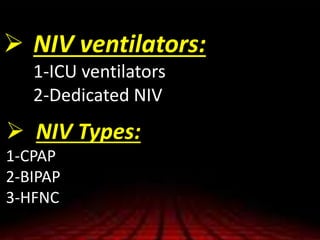
 NIV ventilators:
1-ICU ventilators
2-Dedicated NIV
 NIV Types:
1-CPAP
2-BIPAP
3-HFNC
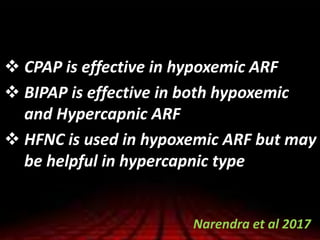
 CPAP is effective in hypoxemic ARF
 BIPAP is effective in both hypoxemic
and Hypercapnic ARF
 HFNC is used in hypoxemic ARF but may
be helpful in hypercapnic type
Narendra et al 2017
Mechanism of HFNC:
1. Correction of hypoxemia by O2 supply
2. Dead space washout
3. Small level of positive airway pressure
4. ??????????
Narendra et al 2017
 NIV decrease WOB (~60%)through:
1. Counteract intrinsic PEEP
2. Decrease patient contribution to transpulmonary
pressure generation
3. Overcome atelectasis
4. Decrease O2 by respiratory muscles
Leading to:
1. Improved V/Q
2. Improved oxygenation
3. Improved CO2 removal Narendra et al 2017
NIV
 Leaks are the main problem of NIV
 Dedicated NIV machines are better than ICU
ventilators as regard synchrony
 It should be evaluated for efficacy within one hour
of initiation
Carteaux et al 2012
NIV masks
 Nasal mask
 Nasal pillows
 Oronasal mask
 Full face mask
 Helmet
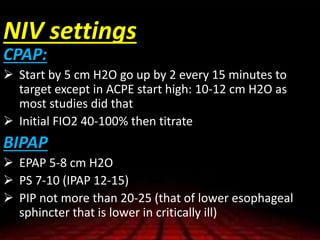
NIV settings
CPAP:
 Start by 5 cm H2O go up by 2 every 15 minutes to
target except in ACPE start high: 10-12 cm H2O as
most studies did that
 Initial FIO2 40-100% then titrate
BIPAP
 EPAP 5-8 cm H2O
 PS 7-10 (IPAP 12-15)
 PIP not more than 20-25 (that of lower esophageal
sphincter that is lower in critically ill)
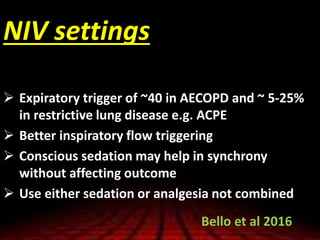
NIV settings
 Expiratory trigger of ~40 in AECOPD and ~ 5-25%
in restrictive lung disease e.g. ACPE
 Better inspiratory flow triggering
 Conscious sedation may help in synchrony
without affecting outcome
 Use either sedation or analgesia not combined
Bello et al 2016
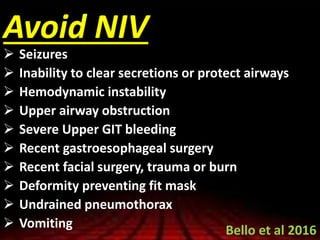
Avoid NIV
 Seizures
 Inability to clear secretions or protect airways
 Hemodynamic instability
 Upper airway obstruction
 Severe Upper GIT bleeding
 Recent gastroesophageal surgery
 Recent facial surgery, trauma or burn
 Deformity preventing fit mask
 Undrained pneumothorax
 Vomiting Bello et al 2016
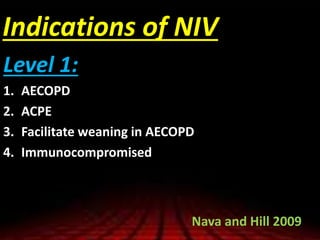
Indications of NIV
Level 1:
1. AECOPD
2. ACPE
3. Facilitate weaning in AECOPD
4. Immunocompromised
Nava and Hill 2009
Indications of NIV
Level 2:
1. DO not intubate patients
2. Extubation failure
3. CAP
4. Perioperative ARF
5. Prevent ARF in AEBA
Nava and Hill 2009
 33% of hospitalized patients die although of
appropriate treatment
 NIV is one of the most effective treatment to
improve outcome in these patients
 NIV spare life of one of each 4 patients
hospitalized with AECOPD
COPD
 Most evidence is derived from studies
using BIPAP
 BIPAP should be started early in these
patients
 It is helpful even with patients with pH
less than 7.35
Narendra et al 2017
COPD
NIV failure in COPD
 Lower pH (less than 7.25)
 Greater disease severity (APACHE II)
 Asynchrony
 Greater leak
 Slow correction of hypercapnia in 1-4 hours
Bello et al 2016
AE of Non COPD Hypercapnic ARF
 OSA and OHV are better than COPD
 Non-COPD respond better than COPD in worse
acidosis
 Effective in slowly progressive NMD as Duchenne
dystrophy and ALS
 Ineffective in rapidly progressive NMD as MG,
GBS, and inflammatory neuropathies
Gregoretti et al 2015
Acute Exacerbation of Cardiogenic
Pulmonary Edema (ACPE)
 In-hospital death ~12%
 NIV spared intubation in one of each 8
patients
 NIV decrease LV afterload
 NIV Decrease preload (venous return)
 NIV helps Redistribution of lung water
 Recruit collapse alveoli
Narendra et al 2017
ACPE
 Previously, it was considered that only CPAP
carries better prognosis
 Previously, BIPAP was considered as having high
death rate due to aggravated cardiac ischemia
 Now, Both carry the same good response
(evidence-based)
 ACPE with hypercapnia have better prognosis
with BIPAP
Narendra et al 2017
NIV failure in ACPE
 Higher class Killip classification
 Lower LVEF
 Higher BNP
 More positive fluid balance in the 1st 24 h
Luo et al 2017
Immunocompromised patients
 Patients with hematologic malignancies have
similar outcome with both NIV and IMV
 50% success rate
 Conclusion : try it
Altered Mental status
 Consensus report : do not use in GSC less than 8
(can’t protect airways)
 But in large study of 958 patients : no change in
rate of intubation between patients with GCS <8
or >8
 NIV best results are in patients with altered
mental status due to AECOPD
NIV in perioperative settings
 Prevent or treat ARF
 Reduce pneumonia
 Prevent or treat atelectasis
 Decrease reintubation
 Decrease overall mortality
 Helpful in all (cardiac, thoracic and abdominal
surgeries)
Trauma Patients
 NIV decrease intubation rate, LOS and
complications
 No set standard criteria
 Not to be used when patients need IMV
 Conclusion: Further studies are needed
Hua and Shah 2014
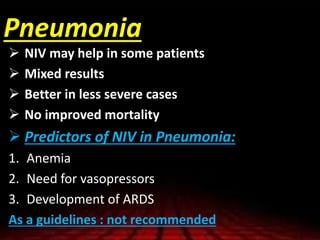
Pneumonia
 NIV may help in some patients
 Mixed results
 Better in less severe cases
 No improved mortality
 Predictors of NIV in Pneumonia:
1. Anemia
2. Need for vasopressors
3. Development of ARDS
As a guidelines : not recommended
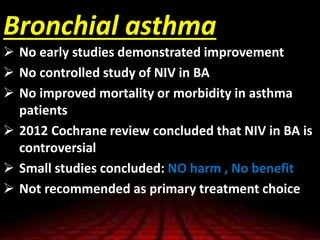
Bronchial asthma
 No early studies demonstrated improvement
 No controlled study of NIV in BA
 No improved mortality or morbidity in asthma
patients
 2012 Cochrane review concluded that NIV in BA is
controversial
 Small studies concluded: NO harm , No benefit
 Not recommended as primary treatment choice
ARDS
 Failure rate 50% with more mortality in failed
cases
 Conclusion: Don’t use it
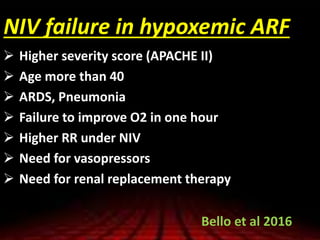
NIV failure in hypoxemic ARF
 Higher severity score (APACHE II)
 Age more than 40
 ARDS, Pneumonia
 Failure to improve O2 in one hour
 Higher RR under NIV
 Need for vasopressors
 Need for renal replacement therapy
Bello et al 2016
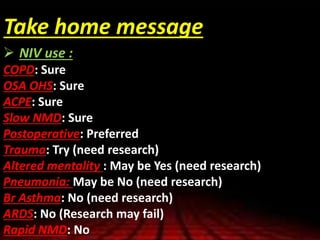
Take home message
 NIV use :
COPD: Sure
OSA OHS: Sure
ACPE: Sure
Slow NMD: Sure
Postoperative: Preferred
Trauma: Try (need research)
Altered mentality : May be Yes (need research)
Pneumonia: May be No (need research)
Br Asthma: No (need research)
ARDS: No (Research may fail)
Rapid NMD: No
NIV in Acute Respiratory Failure

NIV in Acute Respiratory Failure

  • 1.
    NIV in Acute RespiratoryFailure PR Waheed Shouman Chest Department Zagazig University Egypt
  • 2.
     NIV ventilators: 1-ICUventilators 2-Dedicated NIV  NIV Types: 1-CPAP 2-BIPAP 3-HFNC
  • 3.
     CPAP iseffective in hypoxemic ARF  BIPAP is effective in both hypoxemic and Hypercapnic ARF  HFNC is used in hypoxemic ARF but may be helpful in hypercapnic type Narendra et al 2017
  • 4.
    Mechanism of HFNC: 1.Correction of hypoxemia by O2 supply 2. Dead space washout 3. Small level of positive airway pressure 4. ?????????? Narendra et al 2017
  • 5.
     NIV decreaseWOB (~60%)through: 1. Counteract intrinsic PEEP 2. Decrease patient contribution to transpulmonary pressure generation 3. Overcome atelectasis 4. Decrease O2 by respiratory muscles Leading to: 1. Improved V/Q 2. Improved oxygenation 3. Improved CO2 removal Narendra et al 2017
  • 6.
    NIV  Leaks arethe main problem of NIV  Dedicated NIV machines are better than ICU ventilators as regard synchrony  It should be evaluated for efficacy within one hour of initiation Carteaux et al 2012
  • 7.
    NIV masks  Nasalmask  Nasal pillows  Oronasal mask  Full face mask  Helmet
  • 8.
    NIV settings CPAP:  Startby 5 cm H2O go up by 2 every 15 minutes to target except in ACPE start high: 10-12 cm H2O as most studies did that  Initial FIO2 40-100% then titrate BIPAP  EPAP 5-8 cm H2O  PS 7-10 (IPAP 12-15)  PIP not more than 20-25 (that of lower esophageal sphincter that is lower in critically ill)
  • 9.
    NIV settings  Expiratorytrigger of ~40 in AECOPD and ~ 5-25% in restrictive lung disease e.g. ACPE  Better inspiratory flow triggering  Conscious sedation may help in synchrony without affecting outcome  Use either sedation or analgesia not combined Bello et al 2016
  • 10.
    Avoid NIV  Seizures Inability to clear secretions or protect airways  Hemodynamic instability  Upper airway obstruction  Severe Upper GIT bleeding  Recent gastroesophageal surgery  Recent facial surgery, trauma or burn  Deformity preventing fit mask  Undrained pneumothorax  Vomiting Bello et al 2016
  • 11.
    Indications of NIV Level1: 1. AECOPD 2. ACPE 3. Facilitate weaning in AECOPD 4. Immunocompromised Nava and Hill 2009
  • 12.
    Indications of NIV Level2: 1. DO not intubate patients 2. Extubation failure 3. CAP 4. Perioperative ARF 5. Prevent ARF in AEBA Nava and Hill 2009
  • 13.
     33% ofhospitalized patients die although of appropriate treatment  NIV is one of the most effective treatment to improve outcome in these patients  NIV spare life of one of each 4 patients hospitalized with AECOPD COPD
  • 14.
     Most evidenceis derived from studies using BIPAP  BIPAP should be started early in these patients  It is helpful even with patients with pH less than 7.35 Narendra et al 2017 COPD
  • 15.
    NIV failure inCOPD  Lower pH (less than 7.25)  Greater disease severity (APACHE II)  Asynchrony  Greater leak  Slow correction of hypercapnia in 1-4 hours Bello et al 2016
  • 16.
    AE of NonCOPD Hypercapnic ARF  OSA and OHV are better than COPD  Non-COPD respond better than COPD in worse acidosis  Effective in slowly progressive NMD as Duchenne dystrophy and ALS  Ineffective in rapidly progressive NMD as MG, GBS, and inflammatory neuropathies Gregoretti et al 2015
  • 17.
    Acute Exacerbation ofCardiogenic Pulmonary Edema (ACPE)  In-hospital death ~12%  NIV spared intubation in one of each 8 patients  NIV decrease LV afterload  NIV Decrease preload (venous return)  NIV helps Redistribution of lung water  Recruit collapse alveoli Narendra et al 2017
  • 18.
    ACPE  Previously, itwas considered that only CPAP carries better prognosis  Previously, BIPAP was considered as having high death rate due to aggravated cardiac ischemia  Now, Both carry the same good response (evidence-based)  ACPE with hypercapnia have better prognosis with BIPAP Narendra et al 2017
  • 19.
    NIV failure inACPE  Higher class Killip classification  Lower LVEF  Higher BNP  More positive fluid balance in the 1st 24 h Luo et al 2017
  • 20.
    Immunocompromised patients  Patientswith hematologic malignancies have similar outcome with both NIV and IMV  50% success rate  Conclusion : try it
  • 21.
    Altered Mental status Consensus report : do not use in GSC less than 8 (can’t protect airways)  But in large study of 958 patients : no change in rate of intubation between patients with GCS <8 or >8  NIV best results are in patients with altered mental status due to AECOPD
  • 22.
    NIV in perioperativesettings  Prevent or treat ARF  Reduce pneumonia  Prevent or treat atelectasis  Decrease reintubation  Decrease overall mortality  Helpful in all (cardiac, thoracic and abdominal surgeries)
  • 23.
    Trauma Patients  NIVdecrease intubation rate, LOS and complications  No set standard criteria  Not to be used when patients need IMV  Conclusion: Further studies are needed Hua and Shah 2014
  • 24.
    Pneumonia  NIV mayhelp in some patients  Mixed results  Better in less severe cases  No improved mortality  Predictors of NIV in Pneumonia: 1. Anemia 2. Need for vasopressors 3. Development of ARDS As a guidelines : not recommended
  • 25.
    Bronchial asthma  Noearly studies demonstrated improvement  No controlled study of NIV in BA  No improved mortality or morbidity in asthma patients  2012 Cochrane review concluded that NIV in BA is controversial  Small studies concluded: NO harm , No benefit  Not recommended as primary treatment choice
  • 26.
    ARDS  Failure rate50% with more mortality in failed cases  Conclusion: Don’t use it
  • 27.
    NIV failure inhypoxemic ARF  Higher severity score (APACHE II)  Age more than 40  ARDS, Pneumonia  Failure to improve O2 in one hour  Higher RR under NIV  Need for vasopressors  Need for renal replacement therapy Bello et al 2016
  • 28.
    Take home message NIV use : COPD: Sure OSA OHS: Sure ACPE: Sure Slow NMD: Sure Postoperative: Preferred Trauma: Try (need research) Altered mentality : May be Yes (need research) Pneumonia: May be No (need research) Br Asthma: No (need research) ARDS: No (Research may fail) Rapid NMD: No