Noninvasive Ventilation in COPD:
From Acute to Chronic
Wei-Chih Chen, MD
Department of Chest Medicine, Taipei Veterans General Hospital
Institute of Emergency and Critical Care Medicine, National Yang-Ming University
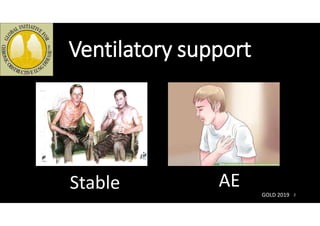
Ventilatory support
2
Stable AE
GOLD 2019
Role of NIV in AECOPD
AECOPD + acute respiratory failure
NIPPV
Standard of care in hospitalized patients
Mortality↓
Morbidity↓
3GOLD 2019
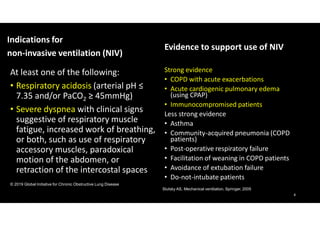
Indications for
non-invasive ventilation (NIV)
At least one of the following:
• Respiratory acidosis (arterial pH ≤
7.35 and/or PaCO2 ≥ 45mmHg)
• Severe dyspnea with clinical signs
suggestive of respiratory muscle
fatigue, increased work of breathing,
or both, such as use of respiratory
accessory muscles, paradoxical
motion of the abdomen, or
retraction of the intercostal spaces
Evidence to support use of NIV
Strong evidence
• COPD with acute exacerbations
• Acute cardiogenic pulmonary edema
(using CPAP)
• Immunocompromised patients
Less strong evidence
• Asthma
• Community-acquired pneumonia (COPD
patients)
• Post-operative respiratory failure
• Facilitation of weaning in COPD patients
• Avoidance of extubation failure
• Do-not-intubate patients
4
© 2019 Global Initiative for Chronic Obstructive Lung Disease
Slutsky AS, Mechanical ventilation, Springer, 2005
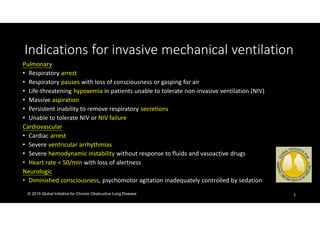
Indications for invasive mechanical ventilation
Pulmonary
• Respiratory arrest
• Respiratory pauses with loss of consciousness or gasping for air
• Life-threatening hypoxemia in patients unable to tolerate non-invasive ventilation (NIV)
• Massive aspiration
• Persistent inability to remove respiratory secretions
• Unable to tolerate NIV or NIV failure
Cardiovascular
• Cardiac arrest
• Severe ventricular arrhythmias
• Severe hemodynamic instability without response to fluids and vasoactive drugs
• Heart rate < 50/min with loss of alertness
Neurologic
• Diminished consciousness, psychomotor agitation inadequately controlled by sedation
5© 2019 Global Initiative for Chronic Obstructive Lung Disease
General aspect of mechanical ventilation
• Oxygenation
FiO2
PEEP
• Ventilation
Tidal volume, respiratory rate
Minute ventilation
• Monitoring and alarm system
6
Target
• Keep pH > 7.3
PaCO2 < 50 mmHg
PaO2 > 55 mmHg, SpO2 > 88%
• To decrease work of breathing
• Lung protection
Keep plateau pressure < 30 cmH2O
7
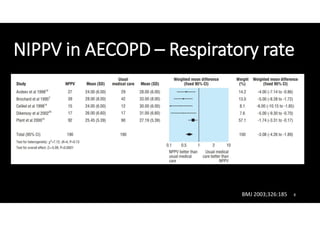
NIPPV in AECOPD – Respiratory rate
8BMJ 2003;326:185
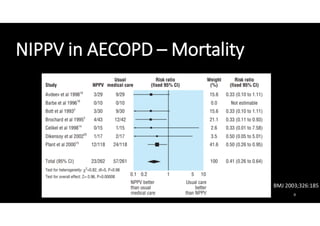
NIPPV in AECOPD – Mortality
9
BMJ 2003;326:185
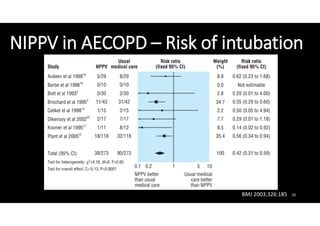
NIPPV in AECOPD – Risk of intubation
10BMJ 2003;326:185
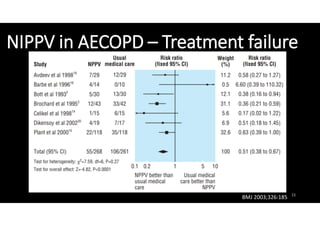
NIPPV in AECOPD – Treatment failure
11
BMJ 2003;326:185
12
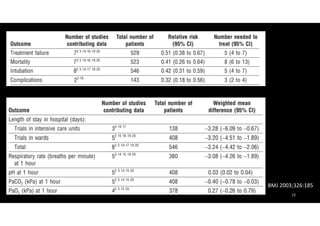
BMJ 2003;326:185
13
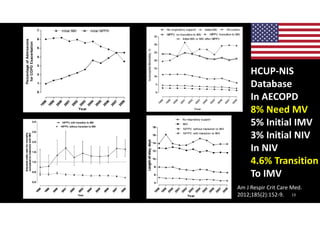
HCUP-NIS
Database
In AECOPD
8% Need MV
5% Initial IMV
3% Initial NIV
In NIV
4.6% Transition
To IMV
Am J Respir Crit Care Med.
2012;185(2):152-9.
14
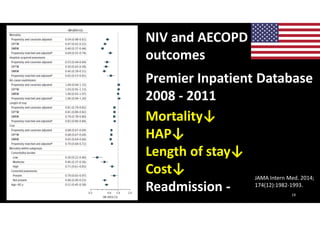
NIV and AECOPD
outcomes
Mortality↓
HAP↓
Length of stay↓
Cost↓
Readmission -
Premier Inpatient Database
2008 - 2011
JAMA Intern Med. 2014;
174(12):1982-1993.
Role of NIV in stable COPD
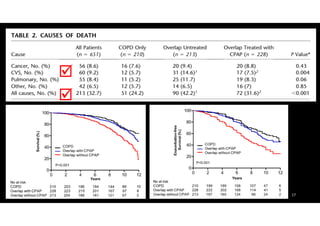
COPD + Obstructive sleep apnea
CPAP
Survival↑
Hospital admission↓
15GOLD 2019
16
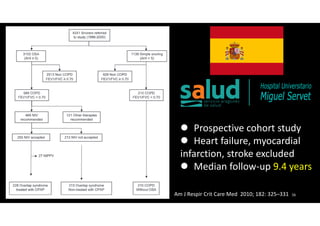
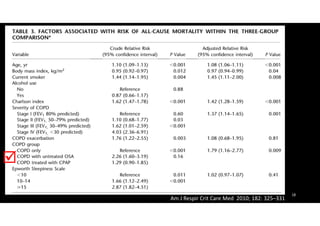
Prospective cohort study
Heart failure, myocardial
infarction, stroke excluded
Median follow-up 9.4 years
Am J Respir Crit Care Med 2010; 182: 325–331
17
18
Am J Respir Crit Care Med 2010; 182: 325–331
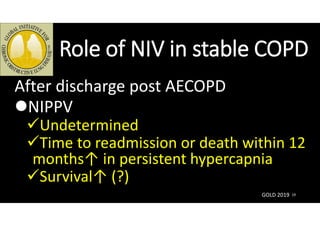
Role of NIV in stable COPD
After discharge post AECOPD
NIPPV
Undetermined
Time to readmission or death within 12
months↑ in persistent hypercapnia
Survival↑ (?)
19GOLD 2019
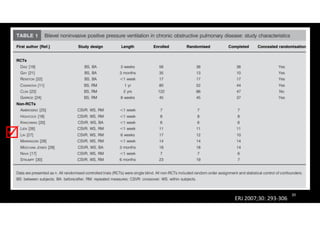
20
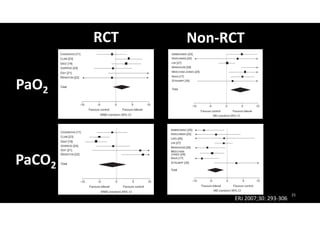
ERJ 2007;30: 293-306
21
RCT Non-RCT
PaO2
PaCO2
ERJ 2007;30: 293-306
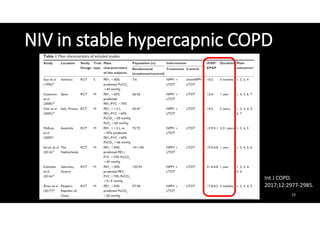
NIV in stable hypercapnic COPD
22
Int J COPD.
2017;12:2977-2985.
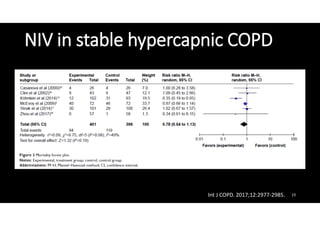
NIV in stable hypercapnic COPD
23Int J COPD. 2017;12:2977-2985.
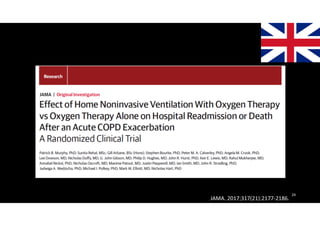
24
JAMA. 2017;317(21):2177-2186.
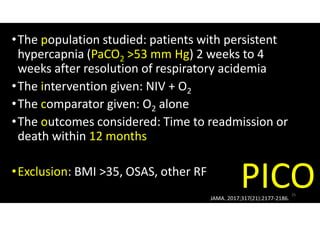
•The population studied: patients with persistent
hypercapnia (PaCO2 >53 mm Hg) 2 weeks to 4
weeks after resolution of respiratory acidemia
•The intervention given: NIV + O2
•The comparator given: O2 alone
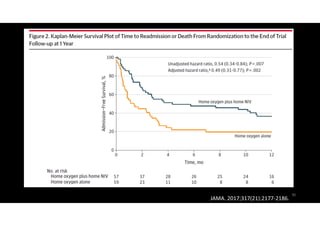
•The outcomes considered: Time to readmission or
death within 12 months
•Exclusion: BMI >35, OSAS, other RF
25
PICOJAMA. 2017;317(21):2177-2186.
26
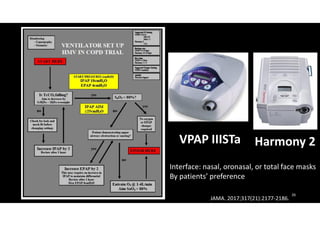
VPAP IIISTa Harmony 2
Interface: nasal, oronasal, or total face masks
By patients’ preference
JAMA. 2017;317(21):2177-2186.
27
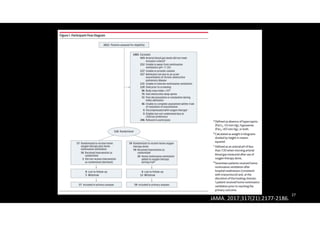
JAMA. 2017;317(21):2177-2186.
28
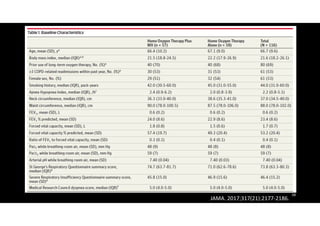
JAMA. 2017;317(21):2177-2186.
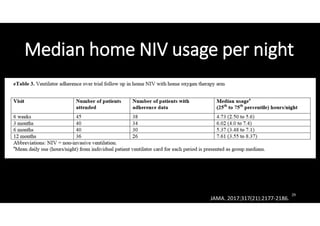
Median home NIV usage per night
29
JAMA. 2017;317(21):2177-2186.
30
JAMA. 2017;317(21):2177-2186.
31
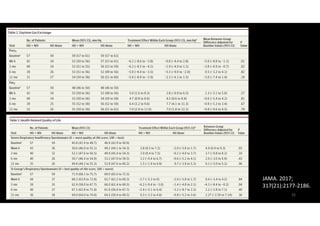
JAMA. 2017;
317(21):2177-2186.
NIV in COPD
32
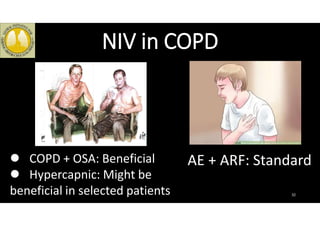
COPD + OSA: Beneficial
Hypercapnic: Might be
beneficial in selected patients
AE + ARF: Standard
陳威志醫師
臺北榮總胸腔部
陽明大學醫學系暨急重症醫學研究所
wiji.chen@gmail.com

NIV in COPD

  • 1.
    Noninvasive Ventilation inCOPD: From Acute to Chronic Wei-Chih Chen, MD Department of Chest Medicine, Taipei Veterans General Hospital Institute of Emergency and Critical Care Medicine, National Yang-Ming University
  • 2.
  • 3.
    Role of NIVin AECOPD AECOPD + acute respiratory failure NIPPV Standard of care in hospitalized patients Mortality↓ Morbidity↓ 3GOLD 2019
  • 4.
    Indications for non-invasive ventilation(NIV) At least one of the following: • Respiratory acidosis (arterial pH ≤ 7.35 and/or PaCO2 ≥ 45mmHg) • Severe dyspnea with clinical signs suggestive of respiratory muscle fatigue, increased work of breathing, or both, such as use of respiratory accessory muscles, paradoxical motion of the abdomen, or retraction of the intercostal spaces Evidence to support use of NIV Strong evidence • COPD with acute exacerbations • Acute cardiogenic pulmonary edema (using CPAP) • Immunocompromised patients Less strong evidence • Asthma • Community-acquired pneumonia (COPD patients) • Post-operative respiratory failure • Facilitation of weaning in COPD patients • Avoidance of extubation failure • Do-not-intubate patients 4 © 2019 Global Initiative for Chronic Obstructive Lung Disease Slutsky AS, Mechanical ventilation, Springer, 2005
  • 5.
    Indications for invasivemechanical ventilation Pulmonary • Respiratory arrest • Respiratory pauses with loss of consciousness or gasping for air • Life-threatening hypoxemia in patients unable to tolerate non-invasive ventilation (NIV) • Massive aspiration • Persistent inability to remove respiratory secretions • Unable to tolerate NIV or NIV failure Cardiovascular • Cardiac arrest • Severe ventricular arrhythmias • Severe hemodynamic instability without response to fluids and vasoactive drugs • Heart rate < 50/min with loss of alertness Neurologic • Diminished consciousness, psychomotor agitation inadequately controlled by sedation 5© 2019 Global Initiative for Chronic Obstructive Lung Disease
  • 6.
    General aspect ofmechanical ventilation • Oxygenation FiO2 PEEP • Ventilation Tidal volume, respiratory rate Minute ventilation • Monitoring and alarm system 6
  • 7.
    Target • Keep pH> 7.3 PaCO2 < 50 mmHg PaO2 > 55 mmHg, SpO2 > 88% • To decrease work of breathing • Lung protection Keep plateau pressure < 30 cmH2O 7
  • 8.
    NIPPV in AECOPD– Respiratory rate 8BMJ 2003;326:185
  • 9.
    NIPPV in AECOPD– Mortality 9 BMJ 2003;326:185
  • 10.
    NIPPV in AECOPD– Risk of intubation 10BMJ 2003;326:185
  • 11.
    NIPPV in AECOPD– Treatment failure 11 BMJ 2003;326:185
  • 12.
  • 13.
    13 HCUP-NIS Database In AECOPD 8% NeedMV 5% Initial IMV 3% Initial NIV In NIV 4.6% Transition To IMV Am J Respir Crit Care Med. 2012;185(2):152-9.
  • 14.
    14 NIV and AECOPD outcomes Mortality↓ HAP↓ Lengthof stay↓ Cost↓ Readmission - Premier Inpatient Database 2008 - 2011 JAMA Intern Med. 2014; 174(12):1982-1993.
  • 15.
    Role of NIVin stable COPD COPD + Obstructive sleep apnea CPAP Survival↑ Hospital admission↓ 15GOLD 2019
  • 16.
    16 Prospective cohort study Heartfailure, myocardial infarction, stroke excluded Median follow-up 9.4 years Am J Respir Crit Care Med 2010; 182: 325–331
  • 17.
  • 18.
    18 Am J RespirCrit Care Med 2010; 182: 325–331
  • 19.
    Role of NIVin stable COPD After discharge post AECOPD NIPPV Undetermined Time to readmission or death within 12 months↑ in persistent hypercapnia Survival↑ (?) 19GOLD 2019
  • 20.
  • 21.
  • 22.
    NIV in stablehypercapnic COPD 22 Int J COPD. 2017;12:2977-2985.
  • 23.
    NIV in stablehypercapnic COPD 23Int J COPD. 2017;12:2977-2985.
  • 24.
  • 25.
    •The population studied:patients with persistent hypercapnia (PaCO2 >53 mm Hg) 2 weeks to 4 weeks after resolution of respiratory acidemia •The intervention given: NIV + O2 •The comparator given: O2 alone •The outcomes considered: Time to readmission or death within 12 months •Exclusion: BMI >35, OSAS, other RF 25 PICOJAMA. 2017;317(21):2177-2186.
  • 26.
    26 VPAP IIISTa Harmony2 Interface: nasal, oronasal, or total face masks By patients’ preference JAMA. 2017;317(21):2177-2186.
  • 27.
  • 28.
  • 29.
    Median home NIVusage per night 29 JAMA. 2017;317(21):2177-2186.
  • 30.
  • 31.
  • 32.
    NIV in COPD 32 COPD+ OSA: Beneficial Hypercapnic: Might be beneficial in selected patients AE + ARF: Standard
  • 33.