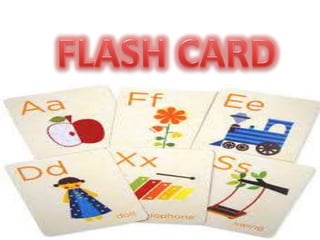

Flash card is a series of card each having a picture with a
message which are arranged on top of one another in the
order of showing. These flash card may be used along with
Other graphic aid such as poster, chart,
etc to make the lesson effective . commonly used
for 5-15 members.
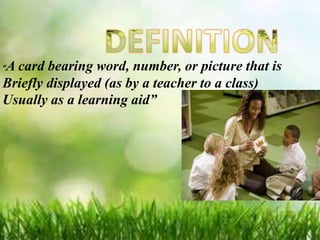
“A card bearing word, number, or picture that is
Briefly displayed (as by a teacher to a class)
Usually as a learning aid”
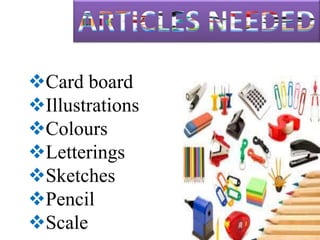
Card board
Illustrations
Colours
Letterings
Sketches
Pencil
Scale
Collect information
Select the essential points
Sort item in logical sequence
Visualize one idea on one card
Cut chart paper into 4 equal parts to get the card
Cut out pictures, photographs from the publication
printed chart, posters and can be pasted. And also
cartoon pictures can be drawn.
“Colour creates interest in the human mind.
So select colours to fit the background to
provide good contrast. But do not use too
many colours.”
The best flash card are those which need few or no words
It is better to use capital letters
It is better to limit the caption to five or six word
Write the talking point on the back of the card
Write the point on the right hand corner
of the backside
For the first card , while the talking point
on the last one, for the second one, on the
back of the first. Repeat until whole series
is finished.
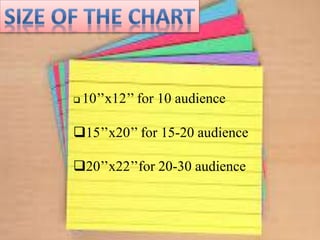
 10’’x12’’ for 10 audience
15’’x20’’ for 15-20 audience
20’’x22’’for 20-30 audience
It is not worth to use too many flash card in a set. Best
to limit the number of flash card to 10-20 for one talk.
While preparing flash card:-for each card make a
rough layout on an ordinary sheet of paper of the same
size of the card.
Remember that everyone who sees the card must be able
to understand the illustration quickly and easily so do
not use complicated drawing.
The idea on the flash card should be brief
It should be large enough for every one to see.
Be adopted to local condition
Each card present only one idea
Orient in such a way that while showing a card the
interest of the audience is aroused and maintained.
Rehearse the presentation several times before trying
them on the audience.
Do not allow anyone to sit more than 20 feet away
from the teacher.
Arrange the card logically or sequentially
Hold the card to chest high so that audience can see well
Turn the different angles so that everyone can see clearly
Explain the first card with the aid of the talking point
written on the back of the last card.
Slip no 1 card behind the stack flashing no.2 and
explain no.2 with the aid of the points written on the
back of the no.1. Repeat until the whole series is
finished
Be a good showman , do not be clumsy while showing
the card
Stress important points. Do not hesitate to repeat the
card when doubt arises on that particular card.
If necessary present it again
Summarize the main point at the end of the talk
Pass the whole stock of card to a member of the
audience at either end of the row. Ask him to look at
the top card and pass it on
After every one has seen the cards individually
invite questions and answer to them. Make sure
that you know the answer.
When larger card are used card may be slipped
behind the set or remove it and place it face on nearby
table. Use pointer. Do not cover the matter with hand.
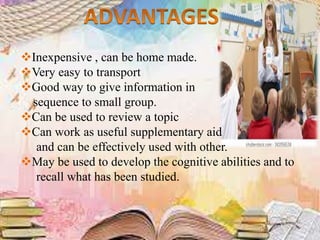
Inexpensive , can be home made.
Very easy to transport
Good way to give information in
sequence to small group.
Can be used to review a topic
Can work as useful supplementary aid
and can be effectively used with other.
May be used to develop the cognitive abilities and to
recall what has been studied.
Deteriorate with constant use.
Some artistic ability is required if making home made
flash card.
Easy to get out of sequence.
Limited to small group.
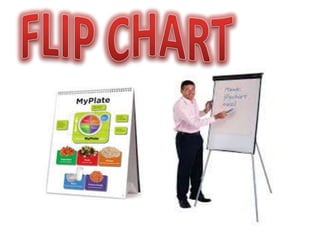
Flip chart are like flash cards but fastened together. It
resembles an album of drawing, picture, chart or even
calendar . It can be used for 15-30 people ; bound
together with ring or string. They flip over in sequence.
It can be used to teach things like child care, feeding
basic food group etc.
Card board sized 50cm x 85cm or usually larger
than 21cm x27cm.
Illustration , pictures, photos, cuttings
colour paper
Colours
Lettering
Sketches
Pencil
Scale
Paint and brush
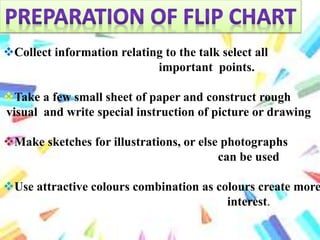
Collect information relating to the talk select all
important points.
Take a few small sheet of paper and construct rough
visual and write special instruction of picture or drawing
Make sketches for illustrations, or else photographs
can be used
Use attractive colours combination as colours create more
interest.
A simple form of flip book can be made
by merely stapling sheet of paper
together at the top or punching holes
and connecting them with a card like
photo album.
Inexpensive, can be home made.
Very easy to transport
Good way to give information in sequence because they
are bound, illustrations stay in sequence.
Can be used for a large group.
Deteriorate rapidly
Some artistic ability is required if making homemade
flip chart
Can confuse audience with too much or too little
information
CONCLUSION
The audiovisual aids can play a powerful
role in enhancing the impact and memorability
of the presentation. When used properly, they
can entertain and enliven the audience while
increasing their receptivity and recall.
Leena.l
Iyr MSc

Flash card & flip chart

  • 3.
    Flash card isa series of card each having a picture with a message which are arranged on top of one another in the order of showing. These flash card may be used along with Other graphic aid such as poster, chart, etc to make the lesson effective . commonly used for 5-15 members.
  • 4.
    “A card bearingword, number, or picture that is Briefly displayed (as by a teacher to a class) Usually as a learning aid”
  • 5.
  • 6.
    Collect information Select theessential points Sort item in logical sequence Visualize one idea on one card
  • 7.
    Cut chart paperinto 4 equal parts to get the card Cut out pictures, photographs from the publication printed chart, posters and can be pasted. And also cartoon pictures can be drawn.
  • 8.
    “Colour creates interestin the human mind. So select colours to fit the background to provide good contrast. But do not use too many colours.”
  • 9.
    The best flashcard are those which need few or no words It is better to use capital letters It is better to limit the caption to five or six word Write the talking point on the back of the card Write the point on the right hand corner of the backside For the first card , while the talking point on the last one, for the second one, on the back of the first. Repeat until whole series is finished.
  • 10.
     10’’x12’’ for10 audience 15’’x20’’ for 15-20 audience 20’’x22’’for 20-30 audience
  • 11.
    It is notworth to use too many flash card in a set. Best to limit the number of flash card to 10-20 for one talk. While preparing flash card:-for each card make a rough layout on an ordinary sheet of paper of the same size of the card. Remember that everyone who sees the card must be able to understand the illustration quickly and easily so do not use complicated drawing. The idea on the flash card should be brief It should be large enough for every one to see. Be adopted to local condition Each card present only one idea
  • 12.
    Orient in sucha way that while showing a card the interest of the audience is aroused and maintained. Rehearse the presentation several times before trying them on the audience. Do not allow anyone to sit more than 20 feet away from the teacher. Arrange the card logically or sequentially Hold the card to chest high so that audience can see well Turn the different angles so that everyone can see clearly Explain the first card with the aid of the talking point written on the back of the last card.
  • 13.
    Slip no 1card behind the stack flashing no.2 and explain no.2 with the aid of the points written on the back of the no.1. Repeat until the whole series is finished Be a good showman , do not be clumsy while showing the card Stress important points. Do not hesitate to repeat the card when doubt arises on that particular card. If necessary present it again Summarize the main point at the end of the talk Pass the whole stock of card to a member of the audience at either end of the row. Ask him to look at the top card and pass it on
  • 14.
    After every onehas seen the cards individually invite questions and answer to them. Make sure that you know the answer. When larger card are used card may be slipped behind the set or remove it and place it face on nearby table. Use pointer. Do not cover the matter with hand.
  • 15.
    Inexpensive , canbe home made. Very easy to transport Good way to give information in sequence to small group. Can be used to review a topic Can work as useful supplementary aid and can be effectively used with other. May be used to develop the cognitive abilities and to recall what has been studied.
  • 16.
    Deteriorate with constantuse. Some artistic ability is required if making home made flash card. Easy to get out of sequence. Limited to small group.
  • 18.
    Flip chart arelike flash cards but fastened together. It resembles an album of drawing, picture, chart or even calendar . It can be used for 15-30 people ; bound together with ring or string. They flip over in sequence. It can be used to teach things like child care, feeding basic food group etc.
  • 19.
    Card board sized50cm x 85cm or usually larger than 21cm x27cm. Illustration , pictures, photos, cuttings colour paper Colours Lettering Sketches Pencil Scale Paint and brush
  • 20.
    Collect information relatingto the talk select all important points. Take a few small sheet of paper and construct rough visual and write special instruction of picture or drawing Make sketches for illustrations, or else photographs can be used Use attractive colours combination as colours create more interest.
  • 21.
    A simple formof flip book can be made by merely stapling sheet of paper together at the top or punching holes and connecting them with a card like photo album.
  • 22.
    Inexpensive, can behome made. Very easy to transport Good way to give information in sequence because they are bound, illustrations stay in sequence. Can be used for a large group.
  • 23.
    Deteriorate rapidly Some artisticability is required if making homemade flip chart Can confuse audience with too much or too little information
  • 24.
    CONCLUSION The audiovisual aidscan play a powerful role in enhancing the impact and memorability of the presentation. When used properly, they can entertain and enliven the audience while increasing their receptivity and recall.
  • 25.