PREPARATION OF INEXPENSIVE
INSTRUCTIONAL MATERIALS
Educational Technology Department,
School of Science and Technology Education (SSTE),
Federal University of Technology, Minna
(c) 2024
Prof. GAMBARI, Amosa Isiaka
E-mail: gambari@futminna.edu.ng
Phone No: +234 803 689 7955
(D) MODELS
• When the use of real thing is not possible, an
alternative is provided. A model is any realistic
representation of the real thing.
• It is the best, easily and quickly recognizable
replica of real thing. A model may be larger,
smaller, or the same size as the object’s it,
represents.
• It may be complete in detail or simplified for
instructional purposes. In fact, models can
provide learning experiences that real things
cannot provide. For instance, important detail
can he accented with colour.
• Some models can be dismantled to provide
interior views not possible with the real things.
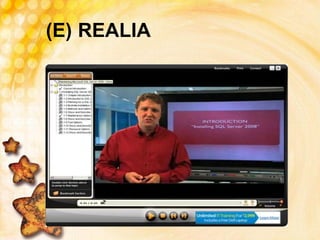
(E) REALIA
(E) REALIA
• These are real things, specimen, artifacts.
Objects or events are best visualized as
real things. For example: Collection of
birds, insects, plants etc. Specimen are
objects which are representative of a group
or class of similar objects for example: soil
and rock specimen The problems which
some people encounter in recognising and
understanding unfamiliar objects are
minimized with the use of real things. They
are the best instructional materials and, as
much as possible teachers should go for
them. They are useful in all subjects.
Merits of Realia
• There are often considerable advantages
to be gained from letting learners see or
handle the real thing as opposed to a
mere representation. For instance, real
things
• (i) Provide first-hand information; present
objects or events exactly as they are.
• (ii) Stimulate the sensory organs because
they can be handled, tested and
manipulated.
Cont…
(iv) Enhance skill acquisition e.g. driving,
typing, etc.
(v) Clarify abstract ideals and assist the
learners understand facts.
(vi) Bridge the gap between theory and
practice, enable learners become familiar
with them, see them as part of their
environment, relate them to their life
problems and activities.
(vii) Stimulate imagination and discovery;
enable students to organize ideas and build
Demerits of Realia
• In many cases, the use of real things will be
practicable on of:
• (i) Availability: sometimes the real things may
not be readily available particularly the ones that
are seasonal e.g, fruits, animals, events,
attempts to get them at the wrong period of the
year may be futile.
• (ii) Accessibility: Sometimes real things may be
accessible, difficult to reach at e.g. the inner
organs of a human being.
• (iii) Safety: Some real things are harmful e.g.
snake, virus, etc are too dangerous to have
Cont…
• (iv) Expense: Some are too expensive to
purchase and maintain.
• (v) Size: Some real things like bacteria are
too small to be visualised without a special
aid- while some are too bulky to be brought
into the classroom.
• (vi) Static: Some are immovable, too bulky
to move into the classroom e.g. river,
mountain.
• (vii) Storage: may sometimes be
difficult.
E. PUPPET
• Puppetry is a most modern teaching technique
through which the subjects such as languages,
cultural activities and social studies can be
taught successfully. Puppets are easy to
construct. It needs very little expenses. Puppets,
if skillfully used could improve the teacher’s
ability in his profession. Use of puppetry falls into
four main categories namely: the teacher can
use Puppets to:
(i) portray characters and personality
(ii) write suitable stories for use in the puppet
theatre;
(iii) make a puppet stage;
(iv) the actual staging of the plays.
(G) EDUCATIONAL BOARDS
(G) EDUCATIONAL
BOARDS
• One of the group of non-projected display
media that to be considered are the various
educational boards viz: chalkboard, flannel
board, bulletin board, etc.
(i) Chalk Board
• The chalkboard (or blackboard as it was called
until it was realized that such boards were very
seldom black any longer) is the oldest and most
commonly used boards at all levels of
education. It is so much a part of classrooms
that it has become a symbol for teaching-
learning process.
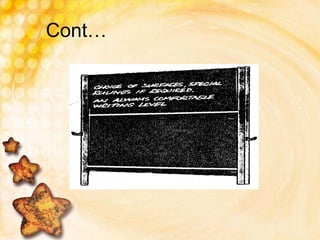
Types of Chalkboard
• Chalkboard has developed from the wall forms
to more innovative types e.g. roller, magnetic,
etc.
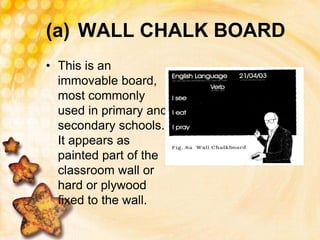
(a) WALL CHALK BOARD
• This is an
immovable board,
most commonly
used in primary and
secondary schools.
It appears as
painted part of the
classroom wall or
hard or plywood
fixed to the wall.
Cont…
• Apart from being readily available cheap and
durable, also provides larger working area
and good writing surface. Its two major
disadvantages are that:
(i)It is limited to the room in which it is fixed, and
(ii) Most often exposes the work not yet needed.
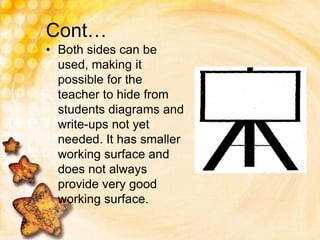
(b) Mobile Chalk Board
• This appears as sheet of wood on permanent
stand, or on mobile stand e.g. easel.
• It could also stand be painted skin, leather
material or brown paper with hanging
facilities.
• Mobile chalkboard is an all purpose board
commonly called supplementary or portable
board.
• It is used for both outdoor and indoor
instruction.
Cont…
• Both sides can be
used, making it
possible for the
teacher to hide from
students diagrams and
write-ups not yet
needed. It has smaller
working surface and
does not always
provide very good
working surface.
Cont…
• (c) Pulley Chalkboard
• This is also called revolving surface board. It
has multiple surfaces with a roller mechanism.
White and special surfaces are in institutions of
higher learning. It is also ideal for conference
rooms and theatres.
• It is used for both projection and other lessons
without necessarily cleaning off the previous
ones. It is however more expensive than wall or
mobile chalkboards.
Cont…
Merits of Chalkboard
• The chalkboard, though the oldest material
has continued to persist in classrooms for
the following reasons:
(i) It is versatile as it is used for various
purposes in the course of a lesson.
(ii) It is economical - inexpensive and easy
to acquire, maintain, stands the tastes of
time; and readily available for use and re-
use.
(iii) It is adaptable to all levels of learners,
Cont…
• (iv)It is attention compelling and allows a
simultaneous visualization by every
member of the audience.
• (v) It permits changes and re-arrangement
of materials when needed.
• (vi)It is a means of displaying impromptu
material (words, equations, diagrams etc)
that have become necessary due to an
unexpected turn in a lesson.
Demerits of Chalkboard
(i) Chalkboard does not allow
permanent storage of information for
future reference.
(ii) Commencement of next lesson usually
requires the cleaning of the chalkboard.
Note that this is one of the outstanding
advantages of overhead projector over
chalkboard - as it is more sensible to
produce a permanent copy of the
drawings and write-ups make in the
course of a lesson for future uses.
Cont…
(iii) Using chalkboard compels the teacher to
talk much hence the term 'talk - chalk'.
(iv) A lot of chalk is usually emitted on the
teacher especially if it is wiped in zig-zag
manner; cleaning in a horizontal side -
ways strokes or vertical downwards
strokes control this.
(v) Chalkboard is not ideal for a very large
group instruction because people at the far
back cannot see the write-ups clearly.
(d) Magnetic Board
• This is another evolution of the chalkboard. It
has surface made of Ferro - magnetic material -
enamel steel back. It’s covered with a thin layer
of dark coloured. Vitreous particles. It works on
the principles of magnetism. It uses chalk and
accepts magnetic accessories for illustrations.
The visuals could be print, light weight models
and realia backed with magnets.
Cont…
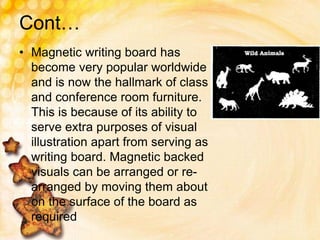
• Magnetic writing board has
become very popular worldwide
and is now the hallmark of class
and conference room furniture.
This is because of its ability to
serve extra purposes of visual
illustration apart from serving as
writing board. Magnetic backed
visuals can be arranged or re-
arranged by moving them about
on the surface of the board as
required
(e) Marker Board
• Is also known as white board. It consists of large
sheets of white or light coloured plastic material
with a surface texture suitable for writing or drawing
on using felt pens, markers or crayons, and can be
used in much the same way as chalkboard. It has
advantages viz:
(i)It does not mess up the user as is the case when
chalk is used.
(ii) A much wider range of colours and tone strengths
can be used, and the resulting display is invariably
sharper, better defined and cleaner than is possible
using chalk.
(iii) Unlike chalkboard, white boards can double up as
Cont…
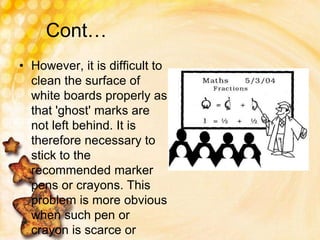
• However, it is difficult to
clean the surface of
white boards properly as
that 'ghost' marks are
not left behind. It is
therefore necessary to
stick to the
recommended marker
pens or crayons. This
problem is more obvious
when such pen or
crayon is scarce or
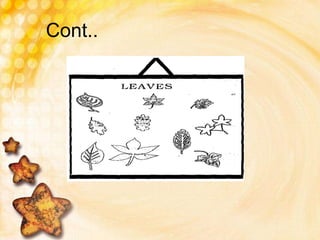
(f) Flannel Board
• The flannel board (which is also known as the
cloth board, felt board, flannel-graph) relies on
the fact that shapes cut out of felt, flannel or
similar fabrics will adhere to display surfaces
covered with like material, hence the name cloth
board. Such system can be used both to create
permanent or semi-permanent wall-mounted
displays, but their most important application is in
situations requiring the movement or re-
arrangement of pieces.
Cont..
Cont…
• Merits
• (i) Flannel board is easy to construct and
relatively cheap.
• (ii) It is durable.
• (iii) Storage is simply.
• (iv) It lends itself to versatile display of visuals in
all subjects at any level of education.
• (v) Utilization is easy and does not require
electricity.
• (vi) It permits the re-arrangement of visuals if
needed.
Cont…
(vii) It promotes learner's interest and active
participation in a lesson.
(viii) It saves the time that could have been used
on chalkboard drawing.
(ix) It leaves the user neat and smart, as chalk is
not required.
(x) Teachers that are poor at drawing on the
chalkboard are saved from the embarrassment
of drawing, cleaning and drawing again.
Cont…
• Demerits
• (i) Flannel board is not as common as
chalkboard.
• (ii) Under emergency situation, visual display is
not possible as it takes some time to prepare.
• (iii) Visual displays are sometimes blown
off by wind resulting into noise interference in
the lesson.
Cont…
• (g) Bulletin Board
• This is one of the least expensive boards. It
could be a wall-space, or special pin-tack board.
It could be permanently fixed to the wall or
movable on legs or easel. Glass frame and key
add beauty and protect the materials posted. It is
commonly-used to display student's work,
supplement information, and review materials. It
offers visual alternatives when students are
bored from looking at the teacher, chalkboard or
walls.
Cont…
• Bulletin board enhances class participation as
students enjoy planning and preparing it and
the visual materials. The effectiveness of this
board is more when out-dated information is
timely replaced with current ones. Visuals on
the bulletin board are changed as the lesson
themes develop.
2. EDT 403 Sci. Edu. 2023 Session - Lecture 2.pptx

2. EDT 403 Sci. Edu. 2023 Session - Lecture 2.pptx

  • 1.
    PREPARATION OF INEXPENSIVE INSTRUCTIONALMATERIALS Educational Technology Department, School of Science and Technology Education (SSTE), Federal University of Technology, Minna (c) 2024 Prof. GAMBARI, Amosa Isiaka E-mail: gambari@futminna.edu.ng Phone No: +234 803 689 7955
  • 2.
  • 3.
    • When theuse of real thing is not possible, an alternative is provided. A model is any realistic representation of the real thing. • It is the best, easily and quickly recognizable replica of real thing. A model may be larger, smaller, or the same size as the object’s it, represents. • It may be complete in detail or simplified for instructional purposes. In fact, models can provide learning experiences that real things cannot provide. For instance, important detail can he accented with colour. • Some models can be dismantled to provide interior views not possible with the real things.
  • 4.
  • 5.
    (E) REALIA • Theseare real things, specimen, artifacts. Objects or events are best visualized as real things. For example: Collection of birds, insects, plants etc. Specimen are objects which are representative of a group or class of similar objects for example: soil and rock specimen The problems which some people encounter in recognising and understanding unfamiliar objects are minimized with the use of real things. They are the best instructional materials and, as much as possible teachers should go for them. They are useful in all subjects.
  • 6.
    Merits of Realia •There are often considerable advantages to be gained from letting learners see or handle the real thing as opposed to a mere representation. For instance, real things • (i) Provide first-hand information; present objects or events exactly as they are. • (ii) Stimulate the sensory organs because they can be handled, tested and manipulated.
  • 7.
    Cont… (iv) Enhance skillacquisition e.g. driving, typing, etc. (v) Clarify abstract ideals and assist the learners understand facts. (vi) Bridge the gap between theory and practice, enable learners become familiar with them, see them as part of their environment, relate them to their life problems and activities. (vii) Stimulate imagination and discovery; enable students to organize ideas and build
  • 8.
    Demerits of Realia •In many cases, the use of real things will be practicable on of: • (i) Availability: sometimes the real things may not be readily available particularly the ones that are seasonal e.g, fruits, animals, events, attempts to get them at the wrong period of the year may be futile. • (ii) Accessibility: Sometimes real things may be accessible, difficult to reach at e.g. the inner organs of a human being. • (iii) Safety: Some real things are harmful e.g. snake, virus, etc are too dangerous to have
  • 9.
    Cont… • (iv) Expense:Some are too expensive to purchase and maintain. • (v) Size: Some real things like bacteria are too small to be visualised without a special aid- while some are too bulky to be brought into the classroom. • (vi) Static: Some are immovable, too bulky to move into the classroom e.g. river, mountain. • (vii) Storage: may sometimes be difficult.
  • 10.
  • 11.
    • Puppetry isa most modern teaching technique through which the subjects such as languages, cultural activities and social studies can be taught successfully. Puppets are easy to construct. It needs very little expenses. Puppets, if skillfully used could improve the teacher’s ability in his profession. Use of puppetry falls into four main categories namely: the teacher can use Puppets to: (i) portray characters and personality (ii) write suitable stories for use in the puppet theatre; (iii) make a puppet stage; (iv) the actual staging of the plays.
  • 12.
  • 13.
    (G) EDUCATIONAL BOARDS • Oneof the group of non-projected display media that to be considered are the various educational boards viz: chalkboard, flannel board, bulletin board, etc.
  • 14.
    (i) Chalk Board •The chalkboard (or blackboard as it was called until it was realized that such boards were very seldom black any longer) is the oldest and most commonly used boards at all levels of education. It is so much a part of classrooms that it has become a symbol for teaching- learning process.
  • 15.
    Types of Chalkboard •Chalkboard has developed from the wall forms to more innovative types e.g. roller, magnetic, etc.
  • 16.
    (a) WALL CHALKBOARD • This is an immovable board, most commonly used in primary and secondary schools. It appears as painted part of the classroom wall or hard or plywood fixed to the wall.

  • 17.
    Cont… • Apart frombeing readily available cheap and durable, also provides larger working area and good writing surface. Its two major disadvantages are that: (i)It is limited to the room in which it is fixed, and (ii) Most often exposes the work not yet needed.
  • 18.
    (b) Mobile ChalkBoard • This appears as sheet of wood on permanent stand, or on mobile stand e.g. easel. • It could also stand be painted skin, leather material or brown paper with hanging facilities. • Mobile chalkboard is an all purpose board commonly called supplementary or portable board. • It is used for both outdoor and indoor instruction.
  • 19.
    Cont… • Both sidescan be used, making it possible for the teacher to hide from students diagrams and write-ups not yet needed. It has smaller working surface and does not always provide very good working surface.
  • 20.
    Cont… • (c) PulleyChalkboard • This is also called revolving surface board. It has multiple surfaces with a roller mechanism. White and special surfaces are in institutions of higher learning. It is also ideal for conference rooms and theatres. • It is used for both projection and other lessons without necessarily cleaning off the previous ones. It is however more expensive than wall or mobile chalkboards.
  • 21.
  • 22.
    Merits of Chalkboard •The chalkboard, though the oldest material has continued to persist in classrooms for the following reasons: (i) It is versatile as it is used for various purposes in the course of a lesson. (ii) It is economical - inexpensive and easy to acquire, maintain, stands the tastes of time; and readily available for use and re- use. (iii) It is adaptable to all levels of learners,
  • 23.
    Cont… • (iv)It isattention compelling and allows a simultaneous visualization by every member of the audience. • (v) It permits changes and re-arrangement of materials when needed. • (vi)It is a means of displaying impromptu material (words, equations, diagrams etc) that have become necessary due to an unexpected turn in a lesson.
  • 24.
    Demerits of Chalkboard (i)Chalkboard does not allow permanent storage of information for future reference. (ii) Commencement of next lesson usually requires the cleaning of the chalkboard. Note that this is one of the outstanding advantages of overhead projector over chalkboard - as it is more sensible to produce a permanent copy of the drawings and write-ups make in the course of a lesson for future uses.
  • 25.
    Cont… (iii) Using chalkboardcompels the teacher to talk much hence the term 'talk - chalk'. (iv) A lot of chalk is usually emitted on the teacher especially if it is wiped in zig-zag manner; cleaning in a horizontal side - ways strokes or vertical downwards strokes control this. (v) Chalkboard is not ideal for a very large group instruction because people at the far back cannot see the write-ups clearly.
  • 26.
    (d) Magnetic Board •This is another evolution of the chalkboard. It has surface made of Ferro - magnetic material - enamel steel back. It’s covered with a thin layer of dark coloured. Vitreous particles. It works on the principles of magnetism. It uses chalk and accepts magnetic accessories for illustrations. The visuals could be print, light weight models and realia backed with magnets.
  • 27.
    Cont… • Magnetic writingboard has become very popular worldwide and is now the hallmark of class and conference room furniture. This is because of its ability to serve extra purposes of visual illustration apart from serving as writing board. Magnetic backed visuals can be arranged or re- arranged by moving them about on the surface of the board as required
  • 28.
    (e) Marker Board •Is also known as white board. It consists of large sheets of white or light coloured plastic material with a surface texture suitable for writing or drawing on using felt pens, markers or crayons, and can be used in much the same way as chalkboard. It has advantages viz: (i)It does not mess up the user as is the case when chalk is used. (ii) A much wider range of colours and tone strengths can be used, and the resulting display is invariably sharper, better defined and cleaner than is possible using chalk. (iii) Unlike chalkboard, white boards can double up as
  • 29.
    Cont… • However, itis difficult to clean the surface of white boards properly as that 'ghost' marks are not left behind. It is therefore necessary to stick to the recommended marker pens or crayons. This problem is more obvious when such pen or crayon is scarce or
  • 30.
    (f) Flannel Board •The flannel board (which is also known as the cloth board, felt board, flannel-graph) relies on the fact that shapes cut out of felt, flannel or similar fabrics will adhere to display surfaces covered with like material, hence the name cloth board. Such system can be used both to create permanent or semi-permanent wall-mounted displays, but their most important application is in situations requiring the movement or re- arrangement of pieces.
  • 31.
  • 32.
    Cont… • Merits • (i)Flannel board is easy to construct and relatively cheap. • (ii) It is durable. • (iii) Storage is simply. • (iv) It lends itself to versatile display of visuals in all subjects at any level of education. • (v) Utilization is easy and does not require electricity. • (vi) It permits the re-arrangement of visuals if needed.
  • 33.
    Cont… (vii) It promoteslearner's interest and active participation in a lesson. (viii) It saves the time that could have been used on chalkboard drawing. (ix) It leaves the user neat and smart, as chalk is not required. (x) Teachers that are poor at drawing on the chalkboard are saved from the embarrassment of drawing, cleaning and drawing again.
  • 34.
    Cont… • Demerits • (i)Flannel board is not as common as chalkboard. • (ii) Under emergency situation, visual display is not possible as it takes some time to prepare. • (iii) Visual displays are sometimes blown off by wind resulting into noise interference in the lesson.
  • 35.
    Cont… • (g) BulletinBoard • This is one of the least expensive boards. It could be a wall-space, or special pin-tack board. It could be permanently fixed to the wall or movable on legs or easel. Glass frame and key add beauty and protect the materials posted. It is commonly-used to display student's work, supplement information, and review materials. It offers visual alternatives when students are bored from looking at the teacher, chalkboard or walls.
  • 36.
    Cont… • Bulletin boardenhances class participation as students enjoy planning and preparing it and the visual materials. The effectiveness of this board is more when out-dated information is timely replaced with current ones. Visuals on the bulletin board are changed as the lesson themes develop.