BASIC RESEARCH
TERMINOLOGY
MS. PRIYANKA J SOLANKI
ASSISTANT PROFESSOR
ABSTRACT
A clear, concise summary of the study
that communicates the essential information about
the study. In research journals, it is usually located at
the beginning of an article.
DATA
Units of information or any statistics,
facts, figures, general material, evidence, or
knowledge collected during the course of the study.
VARIABLES
Attributes or characteristics that can have
more than one value, such as height or weight. In other
words, variables are qualities, quantities, properties, or
characteristics of people, things, or situations that change
or vary.
Dependent variables: Variables that change as the
independent variable is manipulated by the researcher;
sometimes called the criterion variables.
Independent variables: Variables that are purposely
manipulated or changed by the researcher; also called
manipulated variables.
Research variables: These are the qualities, properties, or
characteristics which are observed or measured in a
natural setting without manipulating & establishing cause-
&-effect relationship
Demographic variables: The characteristics & attributes of the
study subjects are considered demographic variables, for
example, age, gender, educational status, religion, social class,
marital status, habitat, occupation, income, medical diagnosis, &so
on.
Extraneous variables: Extraneous variables are the factors that are
not the part of the study but may affect the measurement of the
study variables.
Operational definition: The way by which a researcher
clarifies & defines the variables under investigation. In
addition, the researcher must also specify how the variables
will be observed & measured in the actual research
situation.
Concept: A word picture or mental idea of phenomenon.
Concepts are words or terms that symbolize some aspects of
reality. For example, stress, pain, or love. Concepts are the
building blocks of theory.
Construct: A highly abstract, complex phenomenon(concept) is
denoted by a made-up or construed term. A construct term is
used to indicate a phenomenon that cannot be directly observed
but must be inferred by certain concrete or less-abstract
indicators of the phenomenon. For example, wellness, mental
health, & self-esteem are constructed, & they can only be
measured through indefinable & measurable concept; for
example, wellness can only be assessed through laboratory data.
Proposition: A proposition is a statement or assertion of the
relationship between concepts. For example, there is
relationship between level of anxiety & performance; or
virus causes acute illness. Proposition are drawn from
theories or empirical data.
Conceptual framework: Interrelated concepts or
abstractions that are assembled together in some rational
scheme by virtue of their relevance to a common theme;
sometimes referred to as a conceptual theoretical
framework if based on the concepts of an existing theory or
theories.
Assumption: Basic principle that is accepted as being true
on the basis of logic or reason, without proof or
verification.
Hypothesis: A statement of the predicted relationship
between two or more variable in a research study; an
educated or calculated guess by researcher.
Literature review: A critical summary or research on a topic
of interest, generally prepared to put a research problem in
context or to identify gaps & weaknesses in prior studies so
as to justify a new investigation.
Limitations: Restrictions in a study that may decrease the
credibility & generalization of the research findings.
Manipulation: An intervention or treatment introduced by
the researcher in an experimental or quasi-experimental
study; the researcher manipulates the independent variable
to assess its impact on the dependent variable.
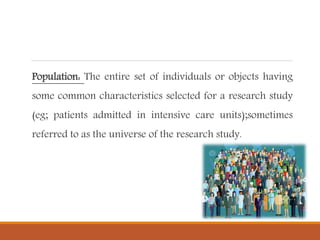
Population: The entire set of individuals or objects having
some common characteristics selected for a research study
(eg; patients admitted in intensive care units);sometimes
referred to as the universe of the research study.
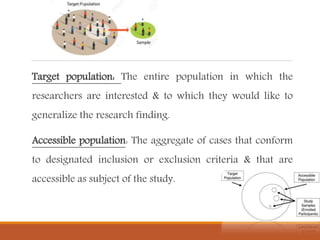
Target population: The entire population in which the
researchers are interested & to which they would like to
generalize the research finding.
Accessible population: The aggregate of cases that conform
to designated inclusion or exclusion criteria & that are
accessible as subject of the study.
Research study setting: The study setting is the location in
which the research is conducted – it could be natural, partially
controlled, or highly controlled. Natural or field setting is an
uncontrolled real-life situation. In a partially controlled
situation, environment is partially modified to control
extraneous variables, while in highly controlled situations,
study environment is fully controlled to combat the effect of
extraneous variables.
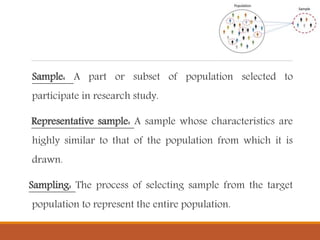
Sample: A part or subset of population selected to
participate in research study.
Representative sample: A sample whose characteristics are
highly similar to that of the population from which it is
drawn.
Sampling: The process of selecting sample from the target
population to represent the entire population.
Probability sampling: The selection of subjects or sampling units
from a population using random procedure; example include
simple random sampling, stratified random sampling, &
systematic sampling.
Non-probability sampling: The selection of subjects or sampling
units from a population using nonrandom procedures;
examples include convenient, purposive, & quota sampling.
Reliability: The degree of consistency or accuracy with
which an instrument measures the attribute it is designed
to measure.
Validity: The degree to which an instrument measures what
it is intended to measure.
Pilot study: Study carried out at the end of the planning
phase of research in order to explore & test the research
elements to make relevant to make modification in research
tools & methodology.
Analysis: Method of organizing, sorting, & scrutinizing data
in such a way that research question can be answered or
meaningful inferences can be drawn.
Basic research terminology

Basic research terminology

  • 1.
    BASIC RESEARCH TERMINOLOGY MS. PRIYANKAJ SOLANKI ASSISTANT PROFESSOR
  • 2.
    ABSTRACT A clear, concisesummary of the study that communicates the essential information about the study. In research journals, it is usually located at the beginning of an article.
  • 3.
    DATA Units of informationor any statistics, facts, figures, general material, evidence, or knowledge collected during the course of the study.
  • 4.
    VARIABLES Attributes or characteristicsthat can have more than one value, such as height or weight. In other words, variables are qualities, quantities, properties, or characteristics of people, things, or situations that change or vary.
  • 5.
    Dependent variables: Variablesthat change as the independent variable is manipulated by the researcher; sometimes called the criterion variables. Independent variables: Variables that are purposely manipulated or changed by the researcher; also called manipulated variables.
  • 6.
    Research variables: Theseare the qualities, properties, or characteristics which are observed or measured in a natural setting without manipulating & establishing cause- &-effect relationship
  • 7.
    Demographic variables: Thecharacteristics & attributes of the study subjects are considered demographic variables, for example, age, gender, educational status, religion, social class, marital status, habitat, occupation, income, medical diagnosis, &so on. Extraneous variables: Extraneous variables are the factors that are not the part of the study but may affect the measurement of the study variables.
  • 8.
    Operational definition: Theway by which a researcher clarifies & defines the variables under investigation. In addition, the researcher must also specify how the variables will be observed & measured in the actual research situation.
  • 9.
    Concept: A wordpicture or mental idea of phenomenon. Concepts are words or terms that symbolize some aspects of reality. For example, stress, pain, or love. Concepts are the building blocks of theory.
  • 10.
    Construct: A highlyabstract, complex phenomenon(concept) is denoted by a made-up or construed term. A construct term is used to indicate a phenomenon that cannot be directly observed but must be inferred by certain concrete or less-abstract indicators of the phenomenon. For example, wellness, mental health, & self-esteem are constructed, & they can only be measured through indefinable & measurable concept; for example, wellness can only be assessed through laboratory data.
  • 11.
    Proposition: A propositionis a statement or assertion of the relationship between concepts. For example, there is relationship between level of anxiety & performance; or virus causes acute illness. Proposition are drawn from theories or empirical data.
  • 12.
    Conceptual framework: Interrelatedconcepts or abstractions that are assembled together in some rational scheme by virtue of their relevance to a common theme; sometimes referred to as a conceptual theoretical framework if based on the concepts of an existing theory or theories.
  • 13.
    Assumption: Basic principlethat is accepted as being true on the basis of logic or reason, without proof or verification. Hypothesis: A statement of the predicted relationship between two or more variable in a research study; an educated or calculated guess by researcher.
  • 14.
    Literature review: Acritical summary or research on a topic of interest, generally prepared to put a research problem in context or to identify gaps & weaknesses in prior studies so as to justify a new investigation.
  • 15.
    Limitations: Restrictions ina study that may decrease the credibility & generalization of the research findings. Manipulation: An intervention or treatment introduced by the researcher in an experimental or quasi-experimental study; the researcher manipulates the independent variable to assess its impact on the dependent variable.
  • 16.
    Population: The entireset of individuals or objects having some common characteristics selected for a research study (eg; patients admitted in intensive care units);sometimes referred to as the universe of the research study.
  • 17.
    Target population: Theentire population in which the researchers are interested & to which they would like to generalize the research finding. Accessible population: The aggregate of cases that conform to designated inclusion or exclusion criteria & that are accessible as subject of the study.
  • 18.
    Research study setting:The study setting is the location in which the research is conducted – it could be natural, partially controlled, or highly controlled. Natural or field setting is an uncontrolled real-life situation. In a partially controlled situation, environment is partially modified to control extraneous variables, while in highly controlled situations, study environment is fully controlled to combat the effect of extraneous variables.
  • 19.
    Sample: A partor subset of population selected to participate in research study. Representative sample: A sample whose characteristics are highly similar to that of the population from which it is drawn. Sampling: The process of selecting sample from the target population to represent the entire population.
  • 20.
    Probability sampling: Theselection of subjects or sampling units from a population using random procedure; example include simple random sampling, stratified random sampling, & systematic sampling. Non-probability sampling: The selection of subjects or sampling units from a population using nonrandom procedures; examples include convenient, purposive, & quota sampling.
  • 21.
    Reliability: The degreeof consistency or accuracy with which an instrument measures the attribute it is designed to measure. Validity: The degree to which an instrument measures what it is intended to measure.
  • 22.
    Pilot study: Studycarried out at the end of the planning phase of research in order to explore & test the research elements to make relevant to make modification in research tools & methodology.
  • 23.
    Analysis: Method oforganizing, sorting, & scrutinizing data in such a way that research question can be answered or meaningful inferences can be drawn.