HERBAL INGREDIENTS
USED IN HAIR CARE
What are cosmetics
According to D & C Act 1940 :
 Any article intended to be rubbed, poured, sprinkled or
sprayed on or introduced to or applied to any part of human
body for cleansing, beautifying, promoting, attractiveness
or altering the appearance and includes any article
intended for use as component of cosmetics.
What are herbal cosmetics
 Herbal cosmetics is defined as the beauty products,
which posses desirable physiological activities, such as
skin healing, smoothening, appearance, enhancing and
conditioning properties with the help of herbal ingredients
Herbal ingredients used in the cosmetics
preparation for hair
 Anti-dandruff : soap nut ,shikakai , arnica, thyme , rosemary , Aloe Vera , parsley ,
kapur kachari, Birch, Gule-abbas, Stinging nettle
 Anti-lice : kachur-sugandhi ,sitaphal
 Hair tonic : Jatamansi , coconut oil, sesame oil , Brahmi , Amla , Hibiscus ,
rosemary ,Arnica, Mandukarparni, Nariyal, Bhringraj, Shatoot, jaborandi, Benajwain
 Hair wash : Amla , soap nut , shikakai , marigold , Methi, Bihi.
 Hair dye : Eclipta , Amla, Henna, Hibiscus , Sage, Chamomile, Bhringraj,
Patang
 Hair conditioner :Eclipta , rosemary ,fenugreek, henna ,Amla , hibiscus
 Shinning of hair : soap nut , shikakai , sage
 Reduce hair falls : Amla , arnica
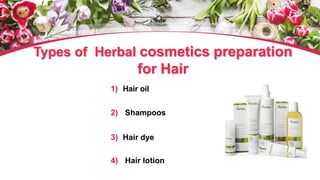
Types of Herbal cosmetics preparation
for Hair
1) Hair oil
2) Shampoos
3) Hair dye
4) Hair lotion
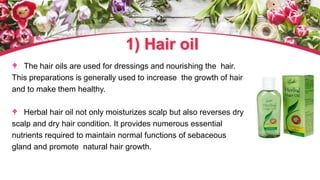
1) Hair oil
 The hair oils are used for dressings and nourishing the hair.
This preparations is generally used to increase the growth of hair
and to make them healthy.
 Herbal hair oil not only moisturizes scalp but also reverses dry
scalp and dry hair condition. It provides numerous essential
nutrients required to maintain normal functions of sebaceous
gland and promote natural hair growth.
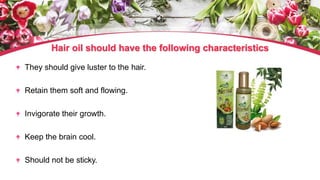
Hair oil should have the following characteristics
 They should give luster to the hair.
 Retain them soft and flowing.
 Invigorate their growth.
 Keep the brain cool.
 Should not be sticky.
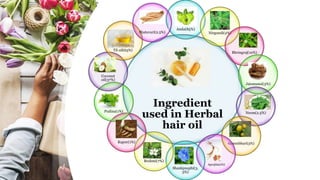
Ingredient
used in Herbal
hair oil
Amla(85%)
Nirgundi(2%)
Bhringraj(10%)
Jatamansi(3%)
Neem(2.5%)
Gammbhari(3%)
Aprajita(2%)
Shankpusphi(3.
5%)
Brahmi(7%)
Kapur(1%)
Pudina(1%)
Coconut
oil(37%)
Til oil(63%)
Shatavari(2.5%)
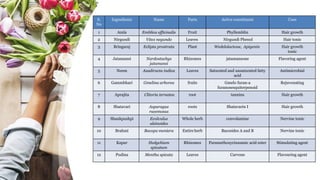
S.
No
Ingredients Name Parts Active constituent Uses
1 Amla Emblica officinalis Fruit Phyllemblin Hair growth
2 Nirgundi Vitex negundo Leaves Nirgundi Phenol Hair tonic
3 Bringaraj Eclipta prostrata Plant Wedelolactone, Apigenin Hair growth
tonic
4 Jatamansi Nardostachys
jatamansi
Rhizomes jatamansone Flavoring agent
5 Neem Azadiracta indica Leaves Saturated and unsaturated fatty
acid
Antimicrobial
6 Gammbhari Gmelina arborea fruits Gmelo furan-a
furanosesquiterpenoid
Rejuvenating
7 Aprajita Clitoria ternatea root tannins Hair growth
8 Shatavari Asparagus
racemosus
roots Shatavarin I Hair growth
9 Shankpushpi Evolvulus
alsinoides
Whole herb convolamine Nervine tonic
10 Brahmi Bacopa moniera Entire herb Bacosides A and B Nervine tonic
11 Kapur Hedychium
spicatum
Rhizomes Paramethoxycinnamic acid ester Stimulating agent
12 Pudina Mentha spicata Leaves Carvone Flavouring agent
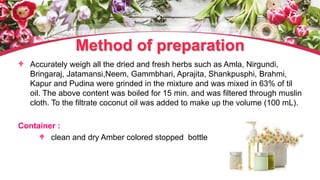
Method of preparation
 Accurately weigh all the dried and fresh herbs such as Amla, Nirgundi,
Bringaraj, Jatamansi,Neem, Gammbhari, Aprajita, Shankpusphi, Brahmi,
Kapur and Pudina were grinded in the mixture and was mixed in 63% of til
oil. The above content was boiled for 15 min. and was filtered through muslin
cloth. To the filtrate coconut oil was added to make up the volume (100 mL).
Container :
 clean and dry Amber colored stopped bottle
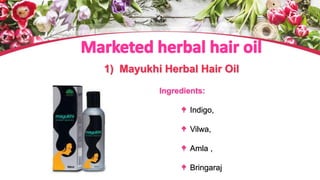
1) Mayukhi Herbal Hair Oil
Ingredients:
 Indigo,
 Vilwa,
 Amla ,
 Bringaraj
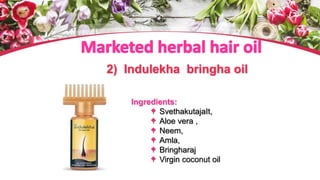
2) Indulekha bringha oil
Ingredients:
 SvethakutajaIt,
 Aloe vera ,
 Neem,
 Amla,
 Bringharaj
 Virgin coconut oil
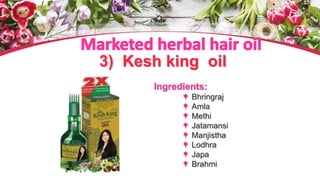
3) Kesh king oil
Ingredients:
 Bhringraj
 Amla
 Methi
 Jatamansi
 Manjistha
 Lodhra
 Japa
 Brahmi
Evaluation of herbal hair oil
 Sensitivity test
 Acid value
 Saponification value
 pH
 Viscosity
 Specific gravity
1. Sensitivity test: The prepared herbal hair oil was applied on 1 cm skin of
hand and exposed to sunlight for 4-5 min.
2. Acid value: Preparation of 0.1 molar solution: Weighed 0.56 g KOH pellets
and dissolved in 100 mL of distilled water and stirred continuously. The
prepared 0.1 molar KOH solution was filled in the burette. Preparation of
sample: Measured 10 mL oil and dissolved in 25 mL of ethanol and 25 mL of
ether mixture and shacked. Added 1 mL of phenolphthalein solution and
titrated with 0.1 molar KOH solution.
Evaluation of herbal hair oil
3. Saponification value: Accurately weighed 1 mL of oil into a 250 mL of
conical flask and 10 mL of ethanol : ether mixture (2 : 1) was added. To this
flask 25 mL of 0.5 N alcoholic KOH was. Kept the flask for 30 min. and the
flask was cooled. The cooled solution was titrated against 0.5 N HCl using
phenolphthalein indicator. Similarily the blank titration was performed
without taking oil (sample). Amount of KOH in mg used was calculated.
4. pH: The pH of herbal hair oil was determined using pH meter.
5. Viscosity: The viscosity was determined using Ostwald’s viscometer.
Evaluation of herbal hair oil
6. Specific gravity: Take the specific gravity bottle, rinsed it with distilled
water, dry it in oven for 15 minutes, cool, closed it with cap and weigh it
(a). Now fill the same specific gravity bottle with the sample and closed it
with cap and again weigh it (b). Determine the weight of sample per
milliliter by subtracting the weight (b-a).
Evaluation of herbal hair oil
2) SHAMPOO
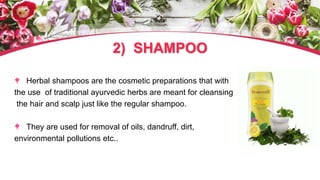
 Herbal shampoos are the cosmetic preparations that with
the use of traditional ayurvedic herbs are meant for cleansing
the hair and scalp just like the regular shampoo.
 They are used for removal of oils, dandruff, dirt,
environmental pollutions etc..
Functions
 Lubrication
 Conditioning
 Hair growth
 Maitainence of hair colour
 Medication
Advantages
 Pure and organic ingredients
 Free from side effects
 No synthetic additives
 No petroleum based ingredients
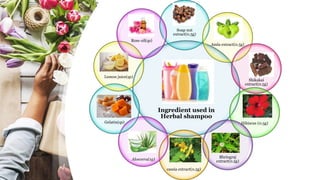
Ingredient used in
Herbal shampoo
Soap nut
extract(0.5g)
Amla extract(0.5g)
Shikakai
extract(0.5g)
Hibiscus (0.5g)
Bhringraj
extract(0.5g)
cassia extract(0.5g)
Aloevera(1g)
Gelatin(qs)
Lemon juice(qs)
Rose oil(qs)
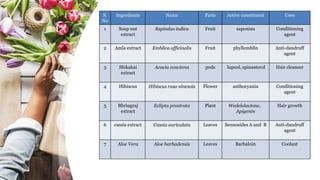
S.
No
Ingredients Name Parts Active constituent Uses
1 Soap nut
extract
Sapindus indica Fruit saponins Conditioning
agent
2 Amla extract Emblica officinalis Fruit phyllemblin Anti-dandruff
agent
3 Shikakai
extract
Acacia concinna pods lupeol, spinasterol Hair cleanser
4 Hibiscus Hibiscus rosa-sinensis Flower anthocyanin Conditioning
agent
5 Bhringraj
extract
Eclipta prostrata Plant Wedelolactone,
Apigenin
Hair growth
6 cassia extract Cassia auriculata Leaves Sennosides A and B Anti-dandruff
agent
7 Aloe Vera Aloe barbadensis Leaves Barbaloin Coolant
Preparation of extract
 About 100 g of each powdered plant materials,
namely H. rosa-sinensis, E. officinalis, A. concinna,
S. indica, E. prostrate, A. barbadensis, and C. auriculata,
were homogenized.
 The powdered material was extracted with distilled water
by boiling for 4 h. The extract of each plant material was
separated and evaporated.
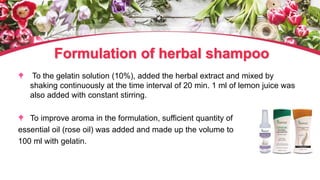
Formulation of herbal shampoo
 To the gelatin solution (10%), added the herbal extract and mixed by
shaking continuously at the time interval of 20 min. 1 ml of lemon juice was
also added with constant stirring.
 To improve aroma in the formulation, sufficient quantity of
essential oil (rose oil) was added and made up the volume to
100 ml with gelatin.
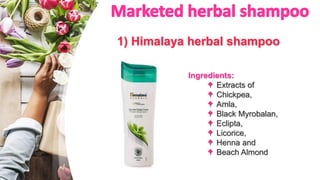
1) Himalaya herbal shampoo
Ingredients:
 Extracts of
 Chickpea,
 Amla,
 Black Myrobalan,
 Eclipta,
 Licorice,
 Henna and
 Beach Almond
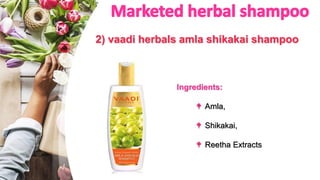
2) vaadi herbals amla shikakai shampoo
Ingredients:
 Amla,
 Shikakai,
 Reetha Extracts
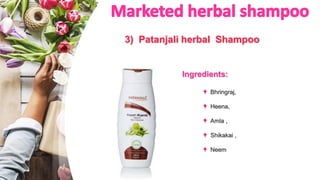
3) Patanjali herbal Shampoo
Ingredients:
 Bhringraj,
 Heena,
 Amla ,
 Shikakai ,
 Neem
Evaluation of herbal shampoo
 Visual assessment
 pH determination
 Determination of solid content percentage
 Surface tension measurement
 Testing of wetting
 Foam stability test
1. Visual assessment: The prepared formulation was assessed for color, clarity,
odor, and froth content.
2. pH determination: The pH of the prepared herbal shampoo in distilled water (10%
v/v) was evaluated by means of pH analyzer at room temperature
3. Determination of solid content percentage: The percentage of solid substance
was determined by weighing about 4 g of shampoo in a dry, clean, and evaporating
dish. To confirm the result, the procedure was repeated again. The liquid portion of
the shampoo was evaporated in a dish by placing on hot plate. The percentage and
the weight of the solid contents present in the shampoo were calculated after drying
completely
Evaluation of herbal shampoo
4. Surface tension measurement: The prepared shampoo in distilled water
(10% w/v) was evaluated for surface tension using stalagmometer in room
temperature.
5. Testing of wetting :Wetting time was calculated by noting the time required
by the canvas paper to sink completely [3]. A canvas paper weighing 0.44 g
was cut into a disc of diameter measuring 1-inch. Over the shampoo (1%
v/v) surface, the canvas paper disc was kept and the time taken for the
paper to sink was measured using the stopwatch.
Evaluation of herbal shampoo
6. Foam stability test :The stability of the foam was determined using
cylinder shake method. About 50 ml of formulated shampoo (1%) solution
was taken in a graduated cylinder of 250 ml capacity and shaken for 10
times vigorously. Foam stability was measured by recording the foam
volume of shake test after 1 min and 4 min, respectively . The total foam
volume was measured after 1 min of shaking.
Evaluation of herbal shampoo
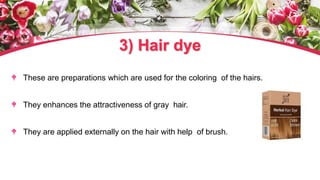
3) Hair dye
 These are preparations which are used for the coloring of the hairs.
 They enhances the attractiveness of gray hair.
 They are applied externally on the hair with help of brush.
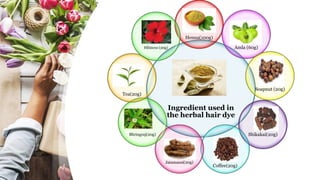
Ingredient used in
the herbal hair dye
Henna(100g)
Amla (60g)
Soapnut (20g)
Shikakai(20g)
Coffee(20g)
Jatamansi(20g)
Bhringraj(20g)
Tea(20g)
Hibiscus (20g)
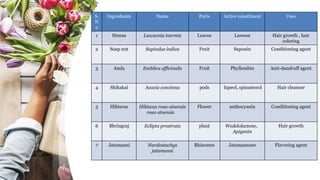
S.
N
o
Ingredients Name Parts Active constituent Uses
1 Henna Lawsonia inermis Leaves Lawson Hair growth , hair
coloring
2 Soap nut Sapindus indica Fruit Saponin Conditioning agent
3 Amla Emblica officinalis Fruit Phyllembin Anti-dandruff agent
4 Shikakai Acacia concinna pods lupeol, spinasterol Hair cleanser
5 Hibiscus Hibiscus rosa-sinensis
rosa-sinensis
Flower anthocyanin Conditioning agent
6 Bhringraj Eclipta prostrata plant Wedelolactone,
Apigenin
Hair growth
7 Jatamansi Nardostachys
jatamansi
Rhizomes Jatamansone Flavoring agent
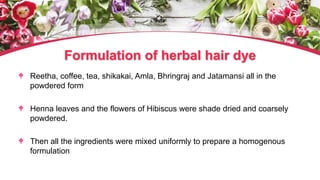
Formulation of herbal hair dye
 Reetha, coffee, tea, shikakai, Amla, Bhringraj and Jatamansi all in the
powdered form
 Henna leaves and the flowers of Hibiscus were shade dried and coarsely
powdered.
 Then all the ingredients were mixed uniformly to prepare a homogenous
formulation
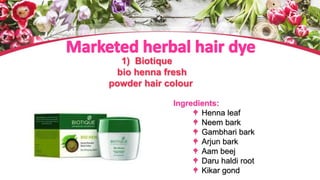
1) Biotique
bio henna fresh
powder hair colour
Ingredients:
 Henna leaf
 Neem bark
 Gambhari bark
 Arjun bark
 Aam beej
 Daru haldi root
 Kikar gond
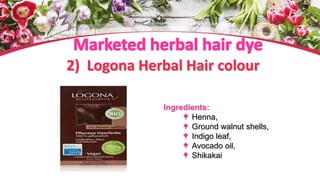
2) Logona Herbal Hair colour
Ingredients:
 Henna,
 Ground walnut shells,
 Indigo leaf,
 Avocado oil,
 Shikakai
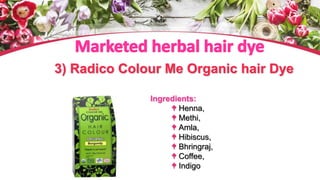
3) Radico Colour Me Organic hair Dye
Ingredients:
 Henna,
 Methi,
 Amla,
 Hibiscus,
 Bhringraj,
 Coffee,
 Indigo
Evaluation of herbal hair dye
1. Organoleptic Evaluation:
• Colour
• Odour
• Appearance
2. Physico-Chemical Evaluation
• pH
• L.O.D
• Ash value
3. Phytochemical evaluation of herbal dye:
• Foam test
• Molisch test
• Fehling test
• Hager test
4. Rheological evaluation of herbal dye.
• Bulk density
• Tapped density
• Angle of repose
• Carrs index
• Hausners ratio
5. Patch Test:
• Swelling
• Redness
• Irritation
6. Stability Test:
• Colour
• Odour
• pH
4) Hair lotion
 Hair lotion has a stimulating effect upon the hair follicles.
 They are generally perfumed with oil of rosemary and
others ascenes as it posses a good stimulating property.
QUALITIES OF AN IDEAL HAIR PRODUCT
It should:
 Protect the hair cuticle.
 Cleans without stripping natural oils.
 Replace lost protein, moisture, and nutrients.
 Condition without weighing down the hair.
 prevent moisture loss.
 Prevent intense drying from environment.
References
 https://shodhganga.inflibnet.achttps://benthamopen.com/FULLTEXT/TODJ-12-
 90.in/bitstream/10603/42604/13/13_chapter%208.pdf
 formulation and evaluation of herbal shampoo
 formulation and evaluation of herbal hair oil
HERBAL INGREDIENTS  USED IN HAIR CARE