Gene therapy
NUCLEIC ACID
 Nucleic acids are large molecules where genetic
information is stored. There are two types of nucleic acids:
deoxyribonucleic acid(DNA) and ribonucleic acid(RNA).
2
GENES
 Are the basic unit of heredity carried on a chromosome.
 Gene is a segment of DNA that contains the instruction for making
a particular protein .
 Mutation of Genes Results in-
• Failure to synthesize a particular protein.
• Synthesis of a defective Protein.
 These results in abnormalities Recognized as genetic disorders.
 Genetic disorders can be treated by Gene Therapy
3
GENE THERAPY
Gene therapy can be defined as an experimental
technique for
• correcting defective genes
• Inserting a normal gene to replace an
abnormal gene
4
GENE THERAPY
 The first attempt, an unsuccessful one, gene therapy was
performed by Martin Cline on 10 July 1980 for treating beta-
thalassemia.
 The first approved gene therapy clinical research in the US
took place on 14 September 1990, at the National Institutes
of Health (NIH), under the direction of William French
Anderson.
 Four-year-old Ashanti DeSilva received treatment for
a genetic defect that left her with ADA-SCID(Severe
combined immunodeficiency).
5
6
APPROACHES IN
GENE THERAPY
A. Types of gene therapy
1. somatic gene therapy
2. germ line gene therapy
B. Gene modification
1. gene replacement
2. gene correction
3. gene augmentation
C. Gene transfer methods
1. viral gene transfer (biological)
2. non viral gene transfer :
a.physical method
b.chemical method
7
A) TYPES OF
GENE THERAPY
8
TYPES OF SOMATIC GENE THERAPY
9
IN VIVO GENE THERAPY
10
EX VIVO GENE THERAPY
11
B) GENE MODIFICATION
1) GENE REPLACEMENT:
 Removal of a Mutant Gene sequence from the Host Genome
and its replacement with a normal Functional Gene.
2) GENE CORRECTION:
 Involves only defective portion of a mutant gene which is
altered to provide the Functional Gene.
3) GENE AUGMENTATION:
 Defective gene is modified by introducing a normal genetic
sequence into Host Genome without altering the defective
one.
12
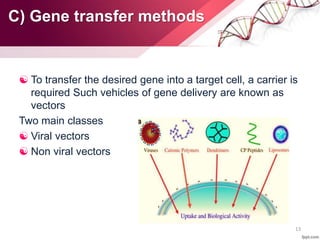
C) Gene transfer methods
 To transfer the desired gene into a target cell, a carrier is
required Such vehicles of gene delivery are known as
vectors
Two main classes
 Viral vectors
 Non viral vectors
13
14
1) VIRAL GENE TRANSFER
(BIOLOGICAL)
a) retrovirus vector system
 The First used ones
 Retroviruses are diploid, single-stranded, circular
enveloped RNA viruses
 Retroviruses cause diseases such as AIDS, leukemia,
and cancer
 Retroviruses are viruses that integrate with host genome
to produce viral proteins that are extracted during gene
delivery.
USE-In ex-vivo therapy
15
b) adenovirus vector system:
 Adenoviral vectors have a wide range of action and are
able to deliver nucleic acids to both dividing and non-
dividing cells.
 Adenoviruses are often responsible for respiratory,
gastrointestinal and eye infection that affect humans.
16
c) Adeno associated virus vector:
 It is a single stranded, non pathogenic small DNA virus.
 AAV enters host cell, becomes double stranded and gets integrated
into chromosome.
d)Herpex simplex virus vector:
 Viruses which have natural tendency to infect a particular type of
cell.
 Double stranded DNA virus that attack neurons (neurotropic)
 Helpful for gene delivery in CNS conditions
17
2) NON VIRAL VECTORS
a.PHYSICAL METHODS:
i.Electroporation:
 The cells are placed in a solution containing DNA and
subjected to electrical pulse to cause holes in the
membrane
 The foreign DNA fragments enter through holes into the
cytoplasm and then to nucleus .
Advantage-Simple and technically easy.
Disadvantage-High risk of contamination.
18
19
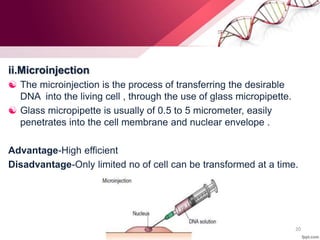
ii.Microinjection
 The microinjection is the process of transferring the desirable
DNA into the living cell , through the use of glass micropipette.
 Glass micropipette is usually of 0.5 to 5 micrometer, easily
penetrates into the cell membrane and nuclear envelope .
Advantage-High efficient
Disadvantage-Only limited no of cell can be transformed at a time.
20
iii. Gene Gun
 In this method DNA is coated with gold particles and
loaded into a device , which is similar to gun and it
generates force by which it can penetrate into cells.
21
b. CHEMICAL METHOD
i. Calcium phosphate mediated DNA transfer
 The process of transfection involves the admixture of
isolated DNA (10-100ug) with solution of calcium chloride
and potassium phosphate so precipitate of calcium
phosphate to be formed.
 Cells are then incubated with precipitated DNA either in
solution or in tissue culture dish.
 A fraction of cells will take up the calcium phosphate DNA
precipitate by endocytosis.
22
ii. Liposome mediated gene transfer
 Liposomes are spheres of lipids which can be used to
transport molecules into the cells.
 These are artificial vesicles that can act as delivery agents for
exogenous materials including transgenes.
 Promote transport after fusing with the cell membrane.
 Cationic lipids due to their positive charge, used to condense
negatively charged DNA so as to fascilitate encapsulation of
DNA into liposomes
 endocytosis of liposomes followed by lysis releases DNA into
cytoplasm
23
Potential target diseases for Gene Therapy
24
Type I diabetes is caused by the destruction of
insulin-producing pancreatic β cells by an
inappropriate autoimmune response.
Scientists used a recombinant adeno-associated
virus (rAAV) to insert a INS gene that results in the
expression of a single-chain insulin analogue (SIA)
into streptozotocin-induced diabetic rats.
GENE THERAPY USED
TO TREAT TYPE I DIABETES
25
GENE THERAPY USED
TO TREAT TYPE I DIABETES
 First, the gene was cloned under the L-type Pyruvate Kinase (LPK)
promoter, which regulates the expression of SIA in response to
glucose levels.
 The LPK- gene was then attached to a recombinant adeno-
associated virus and integrated into the host chromosomal DNA.
 After insertion of the rAV-LPK-gene , the rats displayed a drop in
glucose levels that reached a range of normoglycaemia within one
week of treatment.
 This form of gene therapy may provide a cure for type I diabetes for
humans in the future .
26
 The adenovirus containing the p53 tumor suppressor gene binds to the
receptor in the cell membrane of the cancer cell.
 The vesicle breaks down , releasing the adenovirus near the cell nucleus.
 The adenovirus injects its gene , which contain the p53 tumor suppressor
gene , into the cell nucleus.
 The cancer ell then makes p53 protein
 The p53 protein causes the cancer cell to self destruct without affecting
surrounding normal cells .
GENE THERAPY FOR
CANCER TREATMENT:
27
PARKINSON’S DISEASE
 Deliver the GAD gene into
patient’s subthalamic nucleus.
 The gene instructs cells to
begin making GABA
neurotransmitters to re-
establish the normal chemical
balance that becomes
dysfunctional as the disease
progresses.
28
GENE THERAPY
TREATMENT FOR ADA-SCID:
 ADA-SCID(Severe Combined Immune Deficiency) is also known as
the bubble boy disease.
 Affected children are born without an effective immune system and will
succumb to infections outside of the bubble without bone marrow
transplantation from matched donors.
 The therapeutic gene called ADA was introduced into the bone marrow
cells of such patients in the laboratory, followed by transplantation of the
genetically corrected cells back to the same patients.
29
GENE THERAPY FOR
CYSTIC FIBROSIS
 In patients with cystic fibrosis, a protein called cystic fibrosis
transmembrane regulator (CFTR) is absent due to a gene
defect.
 In the absence of CFTR chloride ions concentrate within the
cells.
 This leads to the accumulation of sticky mucous in
respiratory tract and lungs.
 Main symptom--- Difficulty in breathing.
 Treated by in vivo replacement of defective gene by
adenovirus vector.
30
31
32
HEMOPHILIA
 Autosomal recessive disorder due to absence of factor VIII leading
to bleeding tendencies
 Patients born with Hemophilia are not able to induce blood clots and
suffer from external and internal bleeding that can be life
threatening.
 In a clinical trial conducted in the United States , the therapeutic
gene was introduced into the liver of patients, who then acquired the
ability to have normal blood clotting .
33
34
BLINDNESS
 Leber's Congenital Amaurosis
(LCA) is a rare inherited eye
disease that appears at birth
or in the first few months of
life
 Researchers at Moorfields
Eye Hospital and University
College London in London
conducted the first gene
therapy clinical trial for
patients with RPE65 LCA.
35
ADVANTAGES
 Gene therapy has the potential to eliminate and prevent
hereditary disease such as cystic fibrosis, ADA-SCID etc.
 It is possible to cure heart disease, AIDS and cancer.
 It gives someone born with a genetic disease a chance to
life.
 It can be used to eradicate diseases from the future
generations.
36
DISADVANTAGES
Immune response to the transferred gene stimulates
a potential risk to gene therapy.
Viruses used as vectors for gene transfer may cause
toxicity, immune responses, and inflammatory
reactions in the host.
Disorders caused by defects in multiple genes cannot
be treated effectively using gene therapy.
37
REFERENCES:
 Nejm Gene therapy and novel drug delivery page 1-36
 Intechopem Gene therapy and viral and nonviral vectors 387-
402
 Japi.org Human gene therapy 1-17
 Anderson Germ line therapy spring 2013 1-25
 Nptel.ac.in gene therapy page 1-24
38
39

Gene therapy

  • 1.
  • 2.
    NUCLEIC ACID  Nucleicacids are large molecules where genetic information is stored. There are two types of nucleic acids: deoxyribonucleic acid(DNA) and ribonucleic acid(RNA). 2
  • 3.
    GENES  Are thebasic unit of heredity carried on a chromosome.  Gene is a segment of DNA that contains the instruction for making a particular protein .  Mutation of Genes Results in- • Failure to synthesize a particular protein. • Synthesis of a defective Protein.  These results in abnormalities Recognized as genetic disorders.  Genetic disorders can be treated by Gene Therapy 3
  • 4.
    GENE THERAPY Gene therapycan be defined as an experimental technique for • correcting defective genes • Inserting a normal gene to replace an abnormal gene 4
  • 5.
    GENE THERAPY  Thefirst attempt, an unsuccessful one, gene therapy was performed by Martin Cline on 10 July 1980 for treating beta- thalassemia.  The first approved gene therapy clinical research in the US took place on 14 September 1990, at the National Institutes of Health (NIH), under the direction of William French Anderson.  Four-year-old Ashanti DeSilva received treatment for a genetic defect that left her with ADA-SCID(Severe combined immunodeficiency). 5
  • 6.
  • 7.
    APPROACHES IN GENE THERAPY A.Types of gene therapy 1. somatic gene therapy 2. germ line gene therapy B. Gene modification 1. gene replacement 2. gene correction 3. gene augmentation C. Gene transfer methods 1. viral gene transfer (biological) 2. non viral gene transfer : a.physical method b.chemical method 7
  • 8.
  • 9.
    TYPES OF SOMATICGENE THERAPY 9
  • 10.
    IN VIVO GENETHERAPY 10
  • 11.
    EX VIVO GENETHERAPY 11
  • 12.
    B) GENE MODIFICATION 1)GENE REPLACEMENT:  Removal of a Mutant Gene sequence from the Host Genome and its replacement with a normal Functional Gene. 2) GENE CORRECTION:  Involves only defective portion of a mutant gene which is altered to provide the Functional Gene. 3) GENE AUGMENTATION:  Defective gene is modified by introducing a normal genetic sequence into Host Genome without altering the defective one. 12
  • 13.
    C) Gene transfermethods  To transfer the desired gene into a target cell, a carrier is required Such vehicles of gene delivery are known as vectors Two main classes  Viral vectors  Non viral vectors 13
  • 14.
    14 1) VIRAL GENETRANSFER (BIOLOGICAL)
  • 15.
    a) retrovirus vectorsystem  The First used ones  Retroviruses are diploid, single-stranded, circular enveloped RNA viruses  Retroviruses cause diseases such as AIDS, leukemia, and cancer  Retroviruses are viruses that integrate with host genome to produce viral proteins that are extracted during gene delivery. USE-In ex-vivo therapy 15
  • 16.
    b) adenovirus vectorsystem:  Adenoviral vectors have a wide range of action and are able to deliver nucleic acids to both dividing and non- dividing cells.  Adenoviruses are often responsible for respiratory, gastrointestinal and eye infection that affect humans. 16
  • 17.
    c) Adeno associatedvirus vector:  It is a single stranded, non pathogenic small DNA virus.  AAV enters host cell, becomes double stranded and gets integrated into chromosome. d)Herpex simplex virus vector:  Viruses which have natural tendency to infect a particular type of cell.  Double stranded DNA virus that attack neurons (neurotropic)  Helpful for gene delivery in CNS conditions 17
  • 18.
    2) NON VIRALVECTORS a.PHYSICAL METHODS: i.Electroporation:  The cells are placed in a solution containing DNA and subjected to electrical pulse to cause holes in the membrane  The foreign DNA fragments enter through holes into the cytoplasm and then to nucleus . Advantage-Simple and technically easy. Disadvantage-High risk of contamination. 18
  • 19.
  • 20.
    ii.Microinjection  The microinjectionis the process of transferring the desirable DNA into the living cell , through the use of glass micropipette.  Glass micropipette is usually of 0.5 to 5 micrometer, easily penetrates into the cell membrane and nuclear envelope . Advantage-High efficient Disadvantage-Only limited no of cell can be transformed at a time. 20
  • 21.
    iii. Gene Gun In this method DNA is coated with gold particles and loaded into a device , which is similar to gun and it generates force by which it can penetrate into cells. 21
  • 22.
    b. CHEMICAL METHOD i.Calcium phosphate mediated DNA transfer  The process of transfection involves the admixture of isolated DNA (10-100ug) with solution of calcium chloride and potassium phosphate so precipitate of calcium phosphate to be formed.  Cells are then incubated with precipitated DNA either in solution or in tissue culture dish.  A fraction of cells will take up the calcium phosphate DNA precipitate by endocytosis. 22
  • 23.
    ii. Liposome mediatedgene transfer  Liposomes are spheres of lipids which can be used to transport molecules into the cells.  These are artificial vesicles that can act as delivery agents for exogenous materials including transgenes.  Promote transport after fusing with the cell membrane.  Cationic lipids due to their positive charge, used to condense negatively charged DNA so as to fascilitate encapsulation of DNA into liposomes  endocytosis of liposomes followed by lysis releases DNA into cytoplasm 23
  • 24.
    Potential target diseasesfor Gene Therapy 24
  • 25.
    Type I diabetesis caused by the destruction of insulin-producing pancreatic β cells by an inappropriate autoimmune response. Scientists used a recombinant adeno-associated virus (rAAV) to insert a INS gene that results in the expression of a single-chain insulin analogue (SIA) into streptozotocin-induced diabetic rats. GENE THERAPY USED TO TREAT TYPE I DIABETES 25
  • 26.
    GENE THERAPY USED TOTREAT TYPE I DIABETES  First, the gene was cloned under the L-type Pyruvate Kinase (LPK) promoter, which regulates the expression of SIA in response to glucose levels.  The LPK- gene was then attached to a recombinant adeno- associated virus and integrated into the host chromosomal DNA.  After insertion of the rAV-LPK-gene , the rats displayed a drop in glucose levels that reached a range of normoglycaemia within one week of treatment.  This form of gene therapy may provide a cure for type I diabetes for humans in the future . 26
  • 27.
     The adenoviruscontaining the p53 tumor suppressor gene binds to the receptor in the cell membrane of the cancer cell.  The vesicle breaks down , releasing the adenovirus near the cell nucleus.  The adenovirus injects its gene , which contain the p53 tumor suppressor gene , into the cell nucleus.  The cancer ell then makes p53 protein  The p53 protein causes the cancer cell to self destruct without affecting surrounding normal cells . GENE THERAPY FOR CANCER TREATMENT: 27
  • 28.
    PARKINSON’S DISEASE  Deliverthe GAD gene into patient’s subthalamic nucleus.  The gene instructs cells to begin making GABA neurotransmitters to re- establish the normal chemical balance that becomes dysfunctional as the disease progresses. 28
  • 29.
    GENE THERAPY TREATMENT FORADA-SCID:  ADA-SCID(Severe Combined Immune Deficiency) is also known as the bubble boy disease.  Affected children are born without an effective immune system and will succumb to infections outside of the bubble without bone marrow transplantation from matched donors.  The therapeutic gene called ADA was introduced into the bone marrow cells of such patients in the laboratory, followed by transplantation of the genetically corrected cells back to the same patients. 29
  • 30.
    GENE THERAPY FOR CYSTICFIBROSIS  In patients with cystic fibrosis, a protein called cystic fibrosis transmembrane regulator (CFTR) is absent due to a gene defect.  In the absence of CFTR chloride ions concentrate within the cells.  This leads to the accumulation of sticky mucous in respiratory tract and lungs.  Main symptom--- Difficulty in breathing.  Treated by in vivo replacement of defective gene by adenovirus vector. 30
  • 31.
  • 32.
  • 33.
    HEMOPHILIA  Autosomal recessivedisorder due to absence of factor VIII leading to bleeding tendencies  Patients born with Hemophilia are not able to induce blood clots and suffer from external and internal bleeding that can be life threatening.  In a clinical trial conducted in the United States , the therapeutic gene was introduced into the liver of patients, who then acquired the ability to have normal blood clotting . 33
  • 34.
  • 35.
    BLINDNESS  Leber's CongenitalAmaurosis (LCA) is a rare inherited eye disease that appears at birth or in the first few months of life  Researchers at Moorfields Eye Hospital and University College London in London conducted the first gene therapy clinical trial for patients with RPE65 LCA. 35
  • 36.
    ADVANTAGES  Gene therapyhas the potential to eliminate and prevent hereditary disease such as cystic fibrosis, ADA-SCID etc.  It is possible to cure heart disease, AIDS and cancer.  It gives someone born with a genetic disease a chance to life.  It can be used to eradicate diseases from the future generations. 36
  • 37.
    DISADVANTAGES Immune response tothe transferred gene stimulates a potential risk to gene therapy. Viruses used as vectors for gene transfer may cause toxicity, immune responses, and inflammatory reactions in the host. Disorders caused by defects in multiple genes cannot be treated effectively using gene therapy. 37
  • 38.
    REFERENCES:  Nejm Genetherapy and novel drug delivery page 1-36  Intechopem Gene therapy and viral and nonviral vectors 387- 402  Japi.org Human gene therapy 1-17  Anderson Germ line therapy spring 2013 1-25  Nptel.ac.in gene therapy page 1-24 38
  • 39.