



GENERAL ANESTHETICS
BY
P.PAVITHRA
M.Pharm I Year
Dept. Of Pharmacology
GENERAL ANESTHETICS
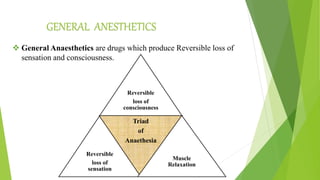
Reversible
loss of
consciousness
Reversible
loss of
sensation
Triad
of
Anaethesia
Muscle
Relaxation
 General Anaesthetics are drugs which produce Reversible loss of
sensation and consciousness.
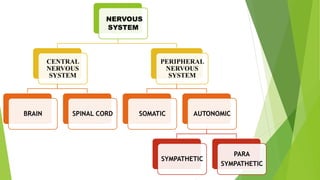
NERVOUS
SYSTEM
CENTRAL
NERVOUS
SYSTEM
BRAIN SPINAL CORD
PERIPHERAL
NERVOUS
SYSTEM
SOMATIC AUTONOMIC
SYMPATHETIC
PARA
SYMPATHETIC
STAGES OF GENERAL ANESTHESIA:
I. STAGE OF ANALGESIA:
 Starts from beginning of anesthetic inhalation and lasts up
to loss of consciousness.
 Patient remains conscious , can hear and see.
 Amnesia develops at the end of this stage.
 Reflexes and Respiration is normal.
II. STAGE OF DELIRIUM:
 From loss of consciousness to beginning of regular
Respiration.
 Patient may shout ,struggle.
 Heart rate and BP increases.
III.SURGICAL ANAESTHESIA:
 Extends from onset of regular respiration to cessation of Breathing.
 It may be distinguished into 4 planes
PLANE 1:Roving eye balls.This plane ends when eyes become
fixed.
PLANE 2:Loss of corneal and laryngeal reflexes.
PLANE 3:Pupil starts dilating and light reflex is lost.
PLANE 4:Intercostal paralysis ,shallow abdominal respiration ,
dilated pupil.
IV.MEDULLARY PARALYSIS:
Cessation of breathing to failure of circulation and death.
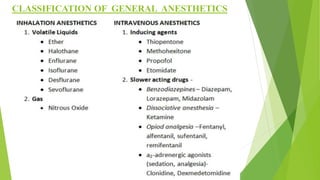
CLASSIFICATION OF GENERAL ANESTHETICS
inhalational anesthetics:
1.)volatile liquids:
A. ETHER:(Diethyl ether)
 It is a highly volatile liquid,
 produces irritating vapours and are inflammable and explosive.
Advantages:
 It can be used without any complicated apparatus.
 Potent anaesthetic and good analgesic.
Disadvantages:
 Slow induction and recovery.
 Cardiac arrest and convulsion in children.
 Cross placental barrier.
B. HALOTHANE:
 Flourinated volatile liquid with sweet odour.
 supplied in amber coloured bottle
Advantages:
 Potent anaesthetic
 Non-inflammable and non-irritant
 Rapid induction and recovery
Disadvantages:
 Requires special apparatus
 Hypotension and arrhythmia
 Poor analgesic and muscle relaxation.
C. ENFLURANE:
 Non-inflammable with mild sweet odour
 Similar to halothane in action
Disadvantages:
 Induces Seizures in deep anaesthesia and therefore not
used now.
 Renal toxicity.
D. ISOFLURANE:
 Isomer of enflurane and have similar properties but
slightly more potent
2.)GAS:
NITROUS OXIDE: LAUGHING GAS
 Colourless odourless inorganic gas with sweet taste
Advantages:
 Non-irritating and non-inflammable
 Rapid induction and recovery
 Very potent analgesic
 No nausea and vomiting
 Non-toxic to liver,kidney and brain
Disadvantages:
 Not potent alone(supplementation)
 Hypoxia
INTRAVENOUS ANAESTHETICS:
1.)INDUCING AGENTS:
A. THIOPENTONE SODIUM
 Ultra short acting barbiturate
 Highly soluble in water yielding a very alkaline solution ,which must be freshly
prepared before injection.
Advantages:
 Induction and recovery is rapid
Disadvantages:
 Poor analgesic ,Weak muscle relaxant
Uses:
 Thiopentone sodium is commonly used inducing agent.
 It can be employed as the sole anesthetic for short operations that are not
painful.
B. PROPOFOL:
 Oily liquid employed as 1% emulsion.
Advantages:
 Induction and recovery is rapid
 Lacks airway irritancy
Disadvantages:
 Fall in BP,Bradycardia
 It is not approved for use in children;
 prolonged sedation,severe metabolic effects and heart failure
even in adults.
Uses:
 It is the drug of choice for sedating intubating patients in ICU.
 Patient acceptability is good.
Benzodiazepines:
Diazepam :
 In addition to preanaesthetic medication ,BZD are now frequently
used for inducing , maintaining and supplementing anesthesia as
well as for conscious sedation .
 Relatively large doses are injected i.v produce sedation , amnesia
and then unconscious in 5-10 min .
2.) SLOWER ACTING DRUGS:
DISSOCIATIVE ANAESTHESIA:
KETAMINE:
 Is a Dissociative Anaesthetic as it produces a cataleptic state in which the
patient appear to be awake but is detached from the environment and is
unresponsive to pain.
 Unique drug ,because, it has Hypnotic, Analgesic and Amnesic efects
 No other drug has these 3 features.
Advantages:
Respiration is not depressed.
Disadvantages:
Heart rate , BP,Cardiac output increases.
Uses:
Used for operations on the head and neck.
OPIOID ANALGESIC:
FENTANYL:
 High Potent opioid analgesic(mu receptor agonist)
 Short duration of action
 Rapid onset of action
Disadvantages:
 Respiratory depression
Uses:
 Used as supplement anaesthetics in Balanced Anaesthesia.
 Ideal for children and un-cooperative patients.
ALPHA -2 AGONIST :
DEXMEDETOMIDINE and CLONIDINE:
 Action of central alpha-2 adrenergic receptor has been known to
cause sedation and analgesia
 Clonidine causes anaesthesia
Disadvantages:
 Respiratory depression.
 Hypotension ,dry mouth,bradycardia
Uses:
 Critically ill/ventilated patients in ICU.
General  anesthetics

General anesthetics

  • 1.
  • 2.
    GENERAL ANESTHETICS Reversible loss of consciousness Reversible lossof sensation Triad of Anaethesia Muscle Relaxation  General Anaesthetics are drugs which produce Reversible loss of sensation and consciousness.
  • 3.
  • 4.
    STAGES OF GENERALANESTHESIA: I. STAGE OF ANALGESIA:  Starts from beginning of anesthetic inhalation and lasts up to loss of consciousness.  Patient remains conscious , can hear and see.  Amnesia develops at the end of this stage.  Reflexes and Respiration is normal. II. STAGE OF DELIRIUM:  From loss of consciousness to beginning of regular Respiration.  Patient may shout ,struggle.  Heart rate and BP increases.
  • 5.
    III.SURGICAL ANAESTHESIA:  Extendsfrom onset of regular respiration to cessation of Breathing.  It may be distinguished into 4 planes PLANE 1:Roving eye balls.This plane ends when eyes become fixed. PLANE 2:Loss of corneal and laryngeal reflexes. PLANE 3:Pupil starts dilating and light reflex is lost. PLANE 4:Intercostal paralysis ,shallow abdominal respiration , dilated pupil. IV.MEDULLARY PARALYSIS: Cessation of breathing to failure of circulation and death.
  • 6.
  • 7.
    inhalational anesthetics: 1.)volatile liquids: A.ETHER:(Diethyl ether)  It is a highly volatile liquid,  produces irritating vapours and are inflammable and explosive. Advantages:  It can be used without any complicated apparatus.  Potent anaesthetic and good analgesic. Disadvantages:  Slow induction and recovery.  Cardiac arrest and convulsion in children.  Cross placental barrier.
  • 8.
    B. HALOTHANE:  Flourinatedvolatile liquid with sweet odour.  supplied in amber coloured bottle Advantages:  Potent anaesthetic  Non-inflammable and non-irritant  Rapid induction and recovery Disadvantages:  Requires special apparatus  Hypotension and arrhythmia  Poor analgesic and muscle relaxation.
  • 9.
    C. ENFLURANE:  Non-inflammablewith mild sweet odour  Similar to halothane in action Disadvantages:  Induces Seizures in deep anaesthesia and therefore not used now.  Renal toxicity. D. ISOFLURANE:  Isomer of enflurane and have similar properties but slightly more potent
  • 10.
    2.)GAS: NITROUS OXIDE: LAUGHINGGAS  Colourless odourless inorganic gas with sweet taste Advantages:  Non-irritating and non-inflammable  Rapid induction and recovery  Very potent analgesic  No nausea and vomiting  Non-toxic to liver,kidney and brain Disadvantages:  Not potent alone(supplementation)  Hypoxia
  • 11.
    INTRAVENOUS ANAESTHETICS: 1.)INDUCING AGENTS: A.THIOPENTONE SODIUM  Ultra short acting barbiturate  Highly soluble in water yielding a very alkaline solution ,which must be freshly prepared before injection. Advantages:  Induction and recovery is rapid Disadvantages:  Poor analgesic ,Weak muscle relaxant Uses:  Thiopentone sodium is commonly used inducing agent.  It can be employed as the sole anesthetic for short operations that are not painful.
  • 12.
    B. PROPOFOL:  Oilyliquid employed as 1% emulsion. Advantages:  Induction and recovery is rapid  Lacks airway irritancy Disadvantages:  Fall in BP,Bradycardia  It is not approved for use in children;  prolonged sedation,severe metabolic effects and heart failure even in adults. Uses:  It is the drug of choice for sedating intubating patients in ICU.  Patient acceptability is good.
  • 13.
    Benzodiazepines: Diazepam :  Inaddition to preanaesthetic medication ,BZD are now frequently used for inducing , maintaining and supplementing anesthesia as well as for conscious sedation .  Relatively large doses are injected i.v produce sedation , amnesia and then unconscious in 5-10 min .
  • 14.
    2.) SLOWER ACTINGDRUGS: DISSOCIATIVE ANAESTHESIA: KETAMINE:  Is a Dissociative Anaesthetic as it produces a cataleptic state in which the patient appear to be awake but is detached from the environment and is unresponsive to pain.  Unique drug ,because, it has Hypnotic, Analgesic and Amnesic efects  No other drug has these 3 features. Advantages: Respiration is not depressed. Disadvantages: Heart rate , BP,Cardiac output increases. Uses: Used for operations on the head and neck.
  • 15.
    OPIOID ANALGESIC: FENTANYL:  HighPotent opioid analgesic(mu receptor agonist)  Short duration of action  Rapid onset of action Disadvantages:  Respiratory depression Uses:  Used as supplement anaesthetics in Balanced Anaesthesia.  Ideal for children and un-cooperative patients.
  • 16.
    ALPHA -2 AGONIST: DEXMEDETOMIDINE and CLONIDINE:  Action of central alpha-2 adrenergic receptor has been known to cause sedation and analgesia  Clonidine causes anaesthesia Disadvantages:  Respiratory depression.  Hypotension ,dry mouth,bradycardia Uses:  Critically ill/ventilated patients in ICU.