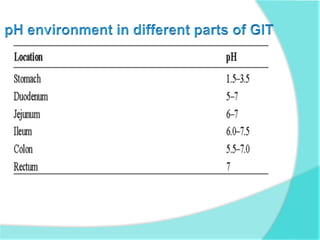
 Gastroretentivedrugdeliveryisan
approachto prolonggastricresidence
time,thereby targetingsite-specificdrug
releaseintheupper gastrointestinaltract
(GIT) forlocalorsystemic effects.
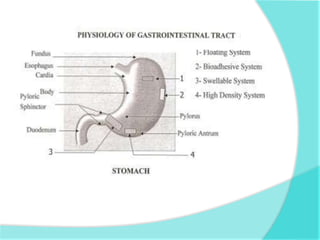
 Anatomically the stomach is divided
into 3 regions:
 Fundus
 Body and
 pylorus
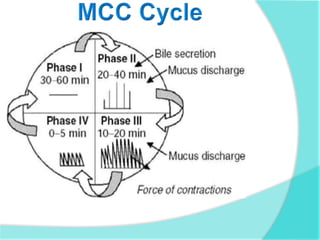
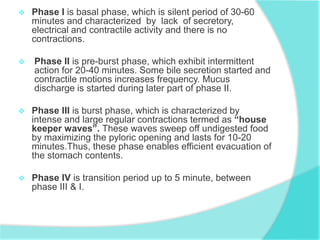
 Phase I is basal phase, which is silent period of 30-60
minutes and characterized by lack of secretory,
electrical and contractile activity and there is no
contractions.
 Phase II is pre-burst phase, which exhibit intermittent
action for 20-40 minutes. Some bile secretion started and
contractile motions increases frequency. Mucus
discharge is started during later part of phase II.
 Phase III is burst phase, which is characterized by
intense and large regular contractions termed as “house
keeper waves”. These waves sweep off undigested food
by maximizing the pyloric opening and lasts for 10-20
minutes.Thus, these phase enables efficient evacuation of
the stomach contents.
 Phase IV is transition period up to 5 minute, between
phase III & I.
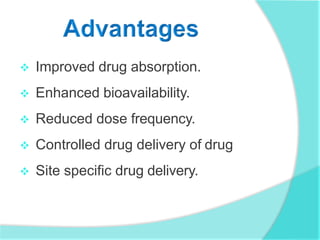
 Improved drug absorption.
 Enhanced bioavailability.
 Reduced dose frequency.
 Controlled drug delivery of drug
 Site specific drug delivery.
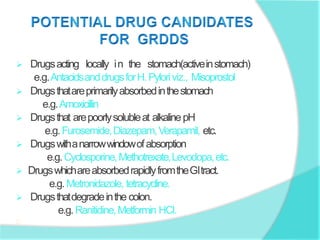
 Drugsacting locally in the stomach(activeinstomach)
e.g.AntacidsanddrugsforH.Pyloriviz., Misoprostol
 Drugsthatareprimarilyabsorbedinthestomach
e.g.Amoxicillin
 Drugsthat arepoorlysolubleat alkalinepH
e.g.Furosemide,Diazepam,Verapamil, etc.
 Drugswithanarrowwindowofabsorption
e.g.Cyclosporine,Methotrexate,Levodopa,etc.
 DrugswhichareabsorbedrapidlyfromtheGItract.
e.g.Metronidazole, tetracycline.
 Drugsthatdegradeinthe colon.
e.g.Ranitidine,Metformin HCl.
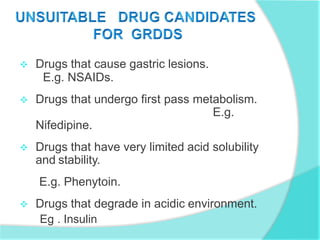
 Drugs that cause gastric lesions.
E.g. NSAIDs.
 Drugs that undergo first pass metabolism.
E.g.
Nifedipine.
 Drugs that have very limited acid solubility
and stability.
E.g. Phenytoin.
 Drugs that degrade in acidic environment.
Eg . Insulin
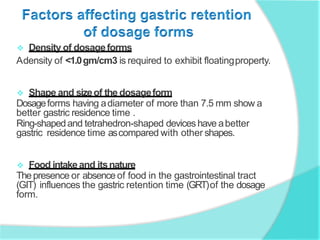
 Density of dosageforms
Adensity of <1.0gm/cm3 is required to exhibit floatingproperty.
 Shape and sizeof the dosageform
Dosageforms having adiameter of more than 7.5 mm show a
better gastric residence time .
Ring-shapedand tetrahedron-shaped devices have abetter
gastric residence time ascompared with other shapes.
 Food intakeand itsnature
Thepresence or absenceof food in the gastrointestinal tract
(GIT) influences the gastric retention time (GRT)of the dosage
form.
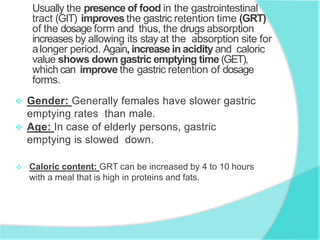
Usually the presence of food in the gastrointestinal
tract (GIT) improves the gastric retention time (GRT)
of the dosage form and thus, the drugs absorption
increases by allowing its stay at the absorption site for
alonger period. Again, increase in acidity and caloric
value shows down gastric emptying time (GET),
which can improve the gastric retention of dosage
forms.
 Gender: Generally females have slower gastric
emptying rates than male.
 Age: In case of elderly persons, gastric
emptying is slowed down.
 Caloric content: GRT can be increased by 4 to 10 hours
with a meal that is high in proteins and fats.
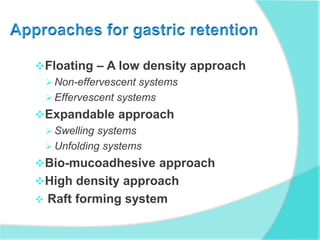
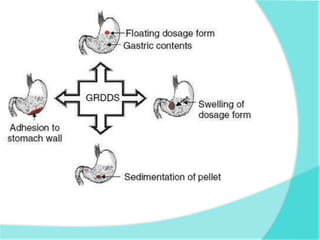
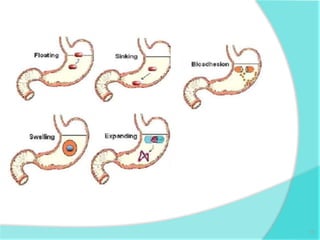
Floating – A low density approach
Non-effervescent systems
Effervescent systems
Expandable approach
 Swelling systems
 Unfolding systems
Bio-mucoadhesive approach
High density approach
 Raft forming system
15
 These are low density
systems.<1.0g/cm3
 Have ability to float over gastric
contents.
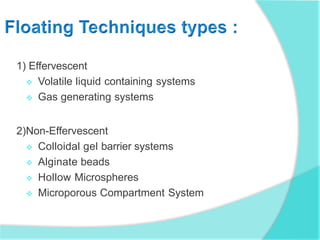
1) Effervescent
 Volatile liquid containing systems
 Gas generating systems
2)Non-Effervescent
 Colloidal gel barrier systems
 Alginate beads
 Hollow Microspheres
 Microporous Compartment System
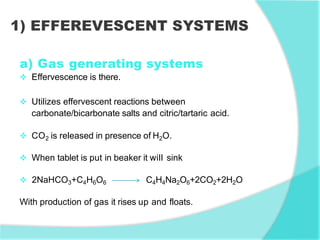
1) EFFEREVESCENT SYSTEMS
a) Gas generating systems
 Effervescence is there.
 Utilizes effervescent reactions between
carbonate/bicarbonate salts and citric/tartaric acid.
 CO2 is released in presence of H2O.
 When tablet is put in beaker it will sink
 2NaHCO3+C4H6O6 C4H4Na2O6+2CO2+2H2O
With production of gas it rises up and floats.
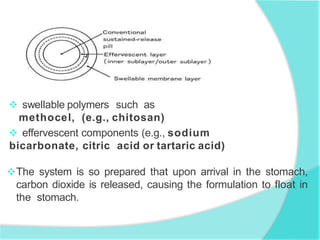
 swellable polymers such as
methocel, (e.g., chitosan)
 effervescent components (e.g., sodium
bicarbonate, citric acid or tartaric acid)
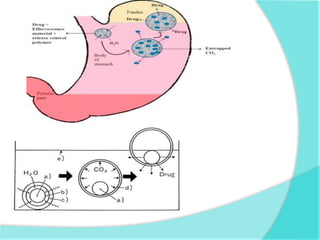
The system is so prepared that upon arrival in the stomach,
carbon dioxide is released, causing the formulation to float in
the stomach.
b) Volatile liquid containing system:
 These type of systems consist of two chambers
separated by an impermeable, pressure-
responsive,movable bladder.
 The first chamber contains the drug and the
second chamber contains the volatile liquid. The
device inflates, and the drug is continuously
released from the reservoir into the gastric fluid .
 An inflatable chamber ,which contains a liquid
e.g. Ether, cyclopentane, that gasifies at body
temperature to cause the inflatation of the
chamber in the stomach
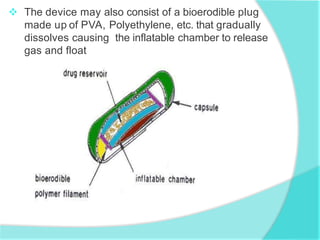
 The device may also consist of a bioerodible plug
made up of PVA, Polyethylene, etc. that gradually
dissolves causing the inflatable chamber to release
gas and float
2) NON-EFFERVESCENT SYSTEMS
a) Colloidal gel barrier systems
 Such systems contains drug with gel forming
hydrocolloids meant to remain buoyant on stomach
contents.
 These systems incorporate a high level of one or more gel
forming highly Swellable cellulose type hydrocolloids.
e.g.HEC, HPMC, NaCMC.
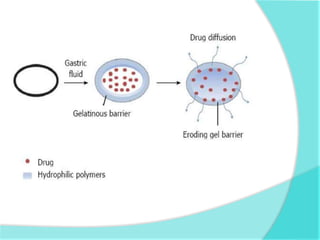
 On coming in contact with gastric fluids , hydrocolloid in the
system hydrate and form colloidal gel barrier around its surface.
 Density of system falls below 1gm/cm3. Then it starts floating
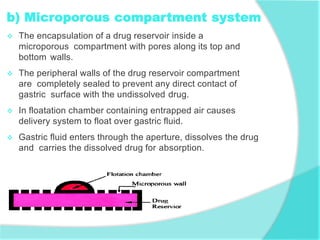
b) Microporous compartment system
 The encapsulation of a drug reservoir inside a
microporous compartment with pores along its top and
bottom walls.
 The peripheral walls of the drug reservoir compartment
are completely sealed to prevent any direct contact of
gastric surface with the undissolved drug.
 In floatation chamber containing entrapped air causes
delivery system to float over gastric fluid.
 Gastric fluid enters through the aperture, dissolves the drug
and carries the dissolved drug for absorption.
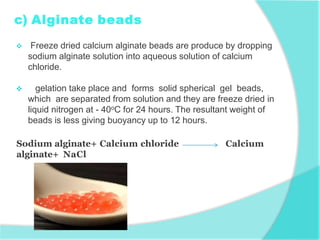
c) Alginate beads
 Freeze dried calcium alginate beads are produce by dropping
sodium alginate solution into aqueous solution of calcium
chloride.
 gelation take place and forms solid spherical gel beads,
which are separated from solution and they are freeze dried in
liquid nitrogen at - 40oC for 24 hours. The resultant weight of
beads is less giving buoyancy up to 12 hours.
Sodium alginate+ Calcium chloride Calcium
alginate+ NaCl
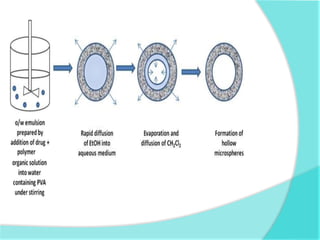
d) Hollow microspheres
 Microballoons / hollow microspheres loaded with
drugs are prepared by simple solvent evaporation
method.
 Commonly used polymers to develop these
systems are polycarbonate, cellulose acetate
,calcium alginate, Eudragit S , agar and pectin etc.
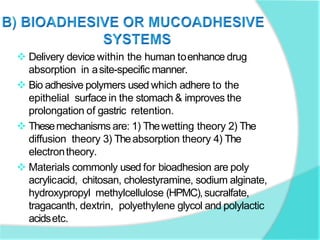
 Delivery device within the human toenhance drug
absorption in asite-specific manner.
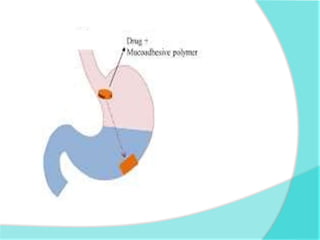
 Bio adhesive polymers used which adhere to the
epithelial surface in the stomach & improves the
prolongation of gastric retention.
 Thesemechanisms are: 1) Thewetting theory 2) The
diffusion theory 3) Theabsorption theory 4) The
electrontheory.
 Materials commonly used for bioadhesion are poly
acrylicacid, chitosan, cholestyramine, sodium alginate,
hydroxypropyl methylcellulose (HPMC),sucralfate,
tragacanth, dextrin, polyethylene glycol and polylactic
acidsetc.
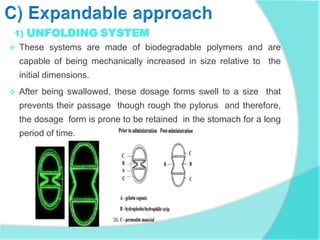
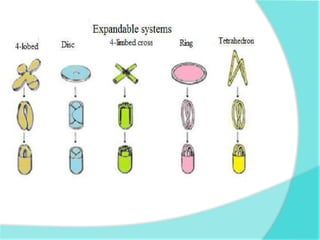
1) UNFOLDING SYSTEM
 These systems are made of biodegradable polymers and are
capable of being mechanically increased in size relative to the
initial dimensions.
 After being swallowed, these dosage forms swell to a size that
prevents their passage though rough the pylorus and therefore,
the dosage form is prone to be retained in the stomach for a long
period of time.
2) SWELLING SYSTEMS
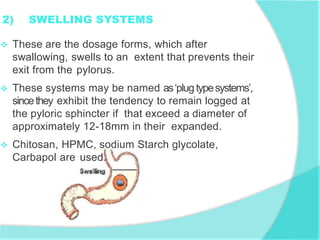
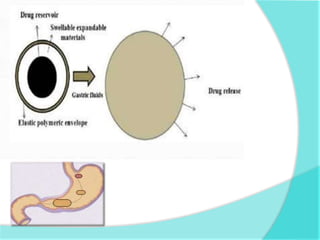
 These are the dosage forms, which after
swallowing, swells to an extent that prevents their
exit from the pylorus.
 These systems may be named as‘plugtypesystems’,
sincethey exhibit the tendency to remain logged at
the pyloric sphincter if that exceed a diameter of
approximately 12-18mm in their expanded.
 Chitosan, HPMC, sodium Starch glycolate,
Carbapol are used.
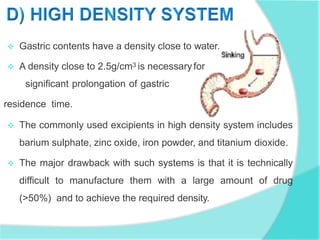
 Gastric contents have a density close to water.
 A density close to 2.5g/cm3 is necessaryfor
significant prolongation of gastric
residence time.
 The commonly used excipients in high density system includes
barium sulphate, zinc oxide, iron powder, and titanium dioxide.
 The major drawback with such systems is that it is technically
difficult to manufacture them with a large amount of drug
(>50%) and to achieve the required density.
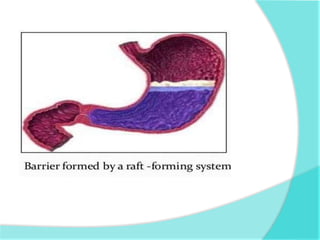
 Raft forming systems have received antacids and drug
delivery for treatment of gastrointestinal infection and
disorders.
 The mechanism involved in this system included the
formation of viscous gel in contact with gastric fluids,
wherein each portion of the liquid swells, forming a
continuous layer called RAFT.
 This raft floats on gastric fluids because of a low density
created by the formation of CO2. Usually this contains a
gel-forming agent (sodium alginate) and alkaline
bicarbonates or carbonates responsible for the formation
of CO2 to make the system less dense to float on the
gastric fluids.
i) Floating systems
a) Buoyancy Lag Time
It is determined in order to assess the time taken by the dosage
form to float on the top of the dissolution medium, after it is
placed in the medium. These parameters can be measured as a
part of the dissolution test.
b) Floating Time
Test for buoyancy is usually performed in SGF Simulated
Gastric Fluid maintained at 370C.The time for which the
dosage form continuously floats on the dissolution media is
termed as floating time.
c) Specific Gravity / Density
Density can be determined by the displacement method
using Benzene as displacement medium.
ii) Swelling systems
a) Swelling Index
After immersion of swelling dosage form into SGF at 37C,
dosage form is removed out at regular interval and
dimensional changes are measured in terms of increase in
tablet thickness / diameter with time.
b) Water Uptake :
It is an indirect measurement of swelling property of
swellable matrix. Here dosage form is removed out at
regular interval and weight changes are determined with
respect to time. So it is also termed as Weight Gain.
Water uptake = WU = (Wt –Wo) * 100 / Wo
Where, Wt = weight of dosage form at time t Wo = initial
weight of dosage form
 Radiology
 Scintigraphy
 Gastroscopy
 MagneticMarkerMonitoring
 Ultrasonography
 13C OctanoicAcidBreathTest
gastroretentive drug delivery system