NIV INTERFACES AND
TROUBLESHOOTING
MODERATOR – Dr. SANDEEP MAHAJAN
BY – Dr. KRISHNAGANTHAN G
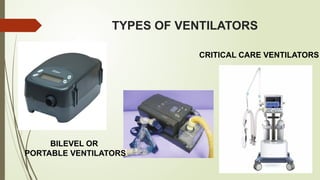
TYPES OF VENTILATORS
BILEVEL OR
PORTABLE VENTILATORS
CRITICAL CARE VENTILATORS
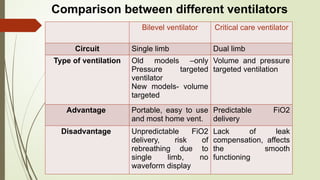
Bilevel ventilator Critical care ventilator
Circuit Single limb Dual limb
Type of ventilation Old models –only
Pressure targeted
ventilator
New models- volume
targeted
Volume and pressure
targeted ventilation
Advantage Portable, easy to use
and most home vent.
Predictable FiO2
delivery
Disadvantage Unpredictable FiO2
delivery, risk of
rebreathing due to
single limb, no
waveform display
Lack of leak
compensation, affects
the smooth
functioning
Comparison between different ventilators
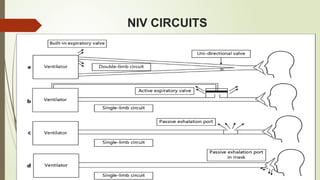
NIV CIRCUITS
Interfaces
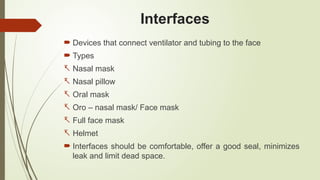
 Devices that connect ventilator and tubing to the face
 Types
- Nasal mask
- Nasal pillow
- Oral mask
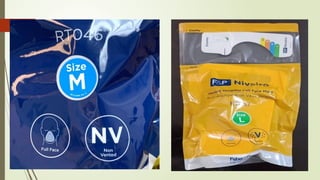
- Oro – nasal mask/ Face mask
- Full face mask
- Helmet
 Interfaces should be comfortable, offer a good seal, minimizes
leak and limit dead space.
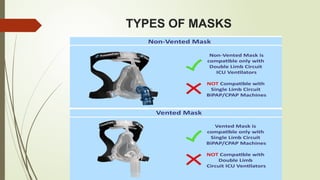
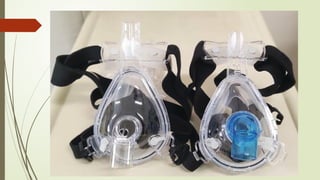
TYPES OF MASKS
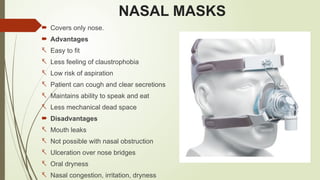
NASAL MASKS
 Covers only nose.
 Advantages
- Easy to fit
- Less feeling of claustrophobia
- Low risk of aspiration
- Patient can cough and clear secretions
- Maintains ability to speak and eat
- Less mechanical dead space
 Disadvantages
- Mouth leaks
- Not possible with nasal obstruction
- Ulceration over nose bridges
- Oral dryness
- Nasal congestion, irritation, dryness
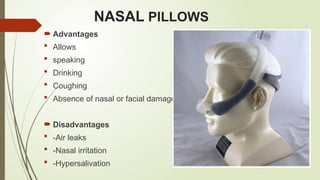
NASAL PILLOWS
 Advantages
 Allows
 speaking
 Drinking
 Coughing
 Absence of nasal or facial damages
 Disadvantages
 -Air leaks
 -Nasal irritation
 -Hypersalivation
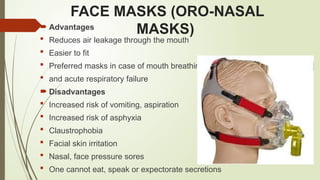
FACE MASKS (ORO-NASAL
MASKS)
 Advantages
 Reduces air leakage through the mouth
 Easier to fit
 Preferred masks in case of mouth breathing
 and acute respiratory failure
 Disadvantages
 Increased risk of vomiting, aspiration
 Increased risk of asphyxia
 Claustrophobia
 Facial skin irritation
 Nasal, face pressure sores
 One cannot eat, speak or expectorate secretions
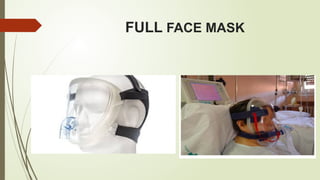
FULL FACE MASK
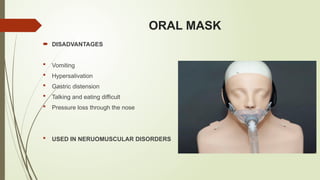
ORAL MASK
 DISADVANTAGES
 Vomiting
 Hypersalivation
 Gastric distension
 Talking and eating difficult
 Pressure loss through the nose
 USED IN NERUOMUSCULAR DISORDERS
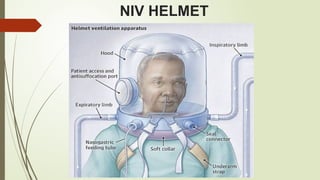
NIV HELMET
ADVANTAGES
 Ability to deliver higher PEEP levels for prolonged durations because
of minimal leak
 No skin lesions or pressure ulcers due to the helmet’s lack of contact
with the face
 Less resistance to flow
 Can be applied regardless of the facial contour, facial trauma or
edentulism
 Allows coughing
 Little cooperation required
 Better comfort
 Less interference with speech and less risk of aerosol dispersion
DISADVANTAGES
 CO2 rebreathing
 Can not measure tidal volumes
 Asynchronies – Trigger delay, slow pressurization
 Noise due to air flow
 Edema of the limbs
 Axillary skin damage
CHOICE OF MASK
 In ARF, patients often start mouth breathing to bypass the higher
resistance of the nose. This can result in mouth breathing and
compromise the efficacy of ventilation if nasal masks are used.
 All interfaces can be used to provide NIV successfully, but in the acute
setting interfaces covering the mouth and nose are advantageous.
 Try switching to a smaller interface once the patient is more stable.
 There is currently no strong scientific evidence that one type of
mask is necessarily or consistently better than others in terms of
clinical efficiency.
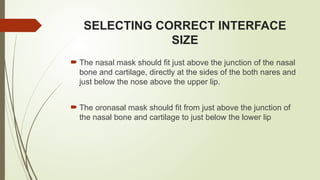
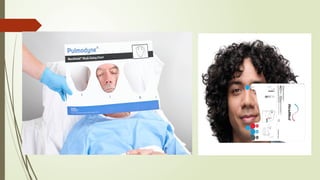
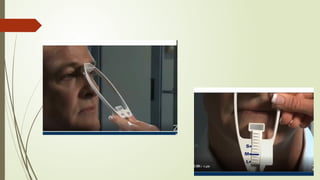
SELECTING CORRECT INTERFACE
SIZE
 The nasal mask should fit just above the junction of the nasal
bone and cartilage, directly at the sides of the both nares and
just below the nose above the upper lip.
 The oronasal mask should fit from just above the junction of
the nasal bone and cartilage to just below the lower lip
TROUBLESHOOTING DURING
NIV
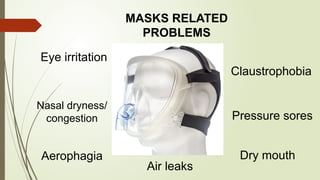
Eye irritation
Nasal dryness/
congestion
Dry mouth
Aerophagia
Air leaks
Pressure sores
Claustrophobia
MASKS RELATED
PROBLEMS
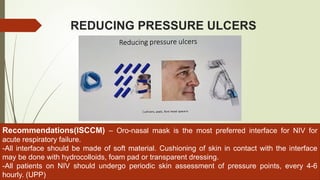
REDUCING PRESSURE ULCERS
Recommendations(ISCCM) – Oro-nasal mask is the most preferred interface for NIV for
acute respiratory failure.
-All interface should be made of soft material. Cushioning of skin in contact with the interface
may be done with hydrocolloids, foam pad or transparent dressing.
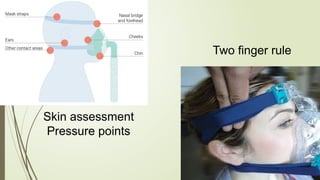
-All patients on NIV should undergo periodic skin assessment of pressure points, every 4-6
hourly. (UPP)
Two finger rule
Skin assessment
Pressure points
DRYNESS
 Nasal/oral dryness and nasal congestion usually indicates air leakage
through the mouth, which results in the loss of the nasal mucosal capacity
to heat and to humidify inspired air.
 Increased nasal congestion and nasal resistance reduced tidal volume and
causes patient discomfort
 Solutions – Heated humidification, reducing the leak, using oronasal masks
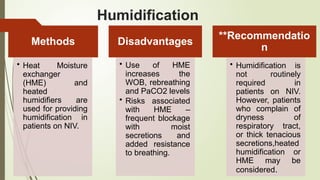
Humidification
Methods
• Heat Moisture
exchanger
(HME) and
heated
humidifiers are
used for providing
humidification in
patients on NIV.
Disadvantages
• Use of HME
increases the
WOB, rebreathing
and PaCO2 levels
• Risks associated
with HME –
frequent blockage
with moist
secretions and
added resistance
to breathing.
**Recommendatio
n
• Humidification is
not routinely
required in
patients on NIV.
However, patients
who complain of
dryness of
respiratory tract,
or thick tenacious
secretions,heated
humidification or
HME may be
considered.
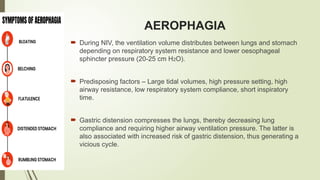
AEROPHAGIA
 During NIV, the ventilation volume distributes between lungs and stomach
depending on respiratory system resistance and lower oesophageal
sphincter pressure (20-25 cm H2O).
 Predisposing factors – Large tidal volumes, high pressure setting, high
airway resistance, low respiratory system compliance, short inspiratory
time.
 Gastric distension compresses the lungs, thereby decreasing lung
compliance and requiring higher airway ventilation pressure. The latter is
also associated with increased risk of gastric distension, thus generating a
vicious cycle.
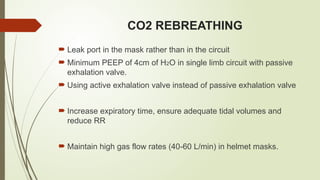
CO2 REBREATHING
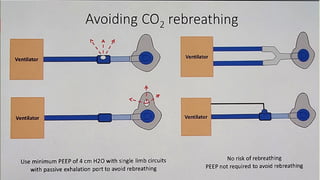
 Leak port in the mask rather than in the circuit
 Minimum PEEP of 4cm of H2O in single limb circuit with passive
exhalation valve.
 Using active exhalation valve instead of passive exhalation valve
 Increase expiratory time, ensure adequate tidal volumes and
reduce RR
 Maintain high gas flow rates (40-60 L/min) in helmet masks.
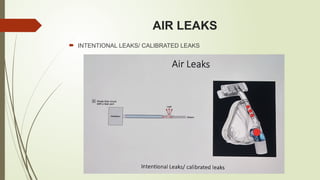
AIR LEAKS
 INTENTIONAL LEAKS/ CALIBRATED LEAKS
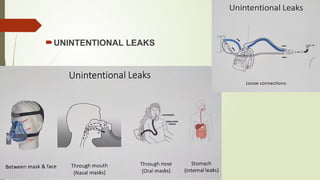
UNINTENTIONAL LEAKS
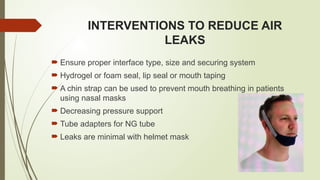
INTERVENTIONS TO REDUCE AIR
LEAKS
 Ensure proper interface type, size and securing system
 Hydrogel or foam seal, lip seal or mouth taping
 A chin strap can be used to prevent mouth breathing in patients
using nasal masks
 Decreasing pressure support
 Tube adapters for NG tube
 Leaks are minimal with helmet mask
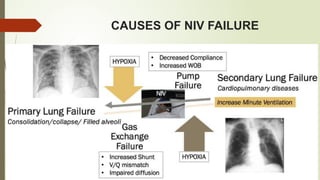
CAUSES OF NIV FAILURE
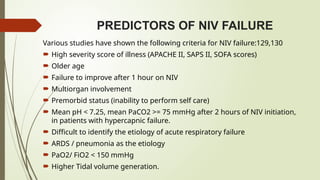
PREDICTORS OF NIV FAILURE
Various studies have shown the following criteria for NIV failure:129,130
 High severity score of illness (APACHE II, SAPS II, SOFA scores)
 Older age
 Failure to improve after 1 hour on NIV
 Multiorgan involvement
 Premorbid status (inability to perform self care)
 Mean pH < 7.25, mean PaCO2 >= 75 mmHg after 2 hours of NIV initiation,
in patients with hypercapnic failure.
 Difficult to identify the etiology of acute respiratory failure
 ARDS / pneumonia as the etiology
 PaO2/ FiO2 < 150 mmHg
 Higher Tidal volume generation.
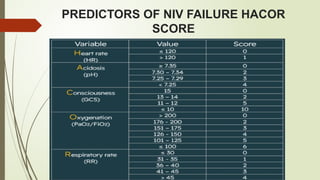
PREDICTORS OF NIV FAILURE HACOR
SCORE
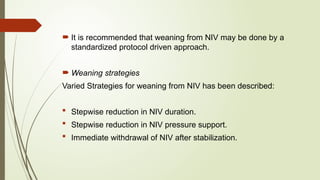
INFECTION TRANSMISSION WITH NIV
Apart from personal protective equipment (N95 mask, gown, gloves,
eye protection) and hand hygiene, it is recommended that following
precautions to be taken when using NIV on a patient with infectious
disease:
 Minimize leaks in the circuit.
 Non-vented face mask, or a helmet – with the best fit to the facial
contour.
 Secure the mask, prior to turning on the ventilator. Turn off the
ventilator before removing the mask.
 A viral/bacterial filter (to filter particles 0.3 mm in size) at the outlet of
the ventilator and also at the expiratory side of the circuit.
 Complete decontamination of the ventilator before use in other
patients.
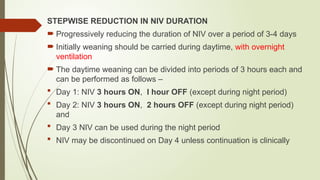
WEANING FROM NIV
Clinical criteria to be met by patients before Weaning is attempted.
Measure Character
1. Arterial pH ≥ 7.35
2. SpO2 > 90%
3. Respiratory Rate ≤ 25 / min
4. Heart rate ≤ 120 / min
5. Systolic blood pressure ≥ 90 mmHg
6. Signs of respiratory distress No agitation, diaphoresis,
anxiety
 It is recommended that weaning from NIV may be done by a
standardized protocol driven approach.
 Weaning strategies
Varied Strategies for weaning from NIV has been described:
 Stepwise reduction in NIV duration.
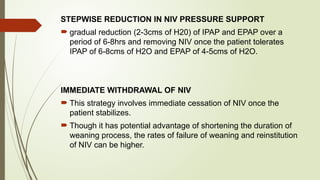
 Stepwise reduction in NIV pressure support.
 Immediate withdrawal of NIV after stabilization.
STEPWISE REDUCTION IN NIV DURATION
 Progressively reducing the duration of NIV over a period of 3-4 days
 Initially weaning should be carried during daytime, with overnight
ventilation
 The daytime weaning can be divided into periods of 3 hours each and
can be performed as follows –
 Day 1: NIV 3 hours ON, I hour OFF (except during night period)
 Day 2: NIV 3 hours ON, 2 hours OFF (except during night period)
and
 Day 3 NIV can be used during the night period
 NIV may be discontinued on Day 4 unless continuation is clinically
STEPWISE REDUCTION IN NIV PRESSURE SUPPORT
 gradual reduction (2-3cms of H20) of IPAP and EPAP over a
period of 6-8hrs and removing NIV once the patient tolerates
IPAP of 6-8cms of H2O and EPAP of 4-5cms of H2O.
IMMEDIATE WITHDRAWAL OF NIV
 This strategy involves immediate cessation of NIV once the
patient stabilizes.
 Though it has potential advantage of shortening the duration of
weaning process, the rates of failure of weaning and reinstitution
of NIV can be higher.
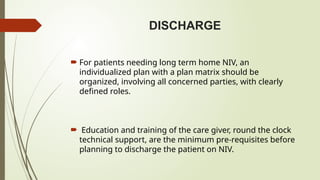
DISCHARGE
 For patients needing long term home NIV, an
individualized plan with a plan matrix should be
organized, involving all concerned parties, with clearly
defined roles.
 Education and training of the care giver, round the clock
technical support, are the minimum pre-requisites before
planning to discharge the patient on NIV.
NIV Interface and troubleshooting.pptxxx

NIV Interface and troubleshooting.pptxxx

  • 1.
    NIV INTERFACES AND TROUBLESHOOTING MODERATOR– Dr. SANDEEP MAHAJAN BY – Dr. KRISHNAGANTHAN G
  • 2.
    TYPES OF VENTILATORS BILEVELOR PORTABLE VENTILATORS CRITICAL CARE VENTILATORS
  • 3.
    Bilevel ventilator Criticalcare ventilator Circuit Single limb Dual limb Type of ventilation Old models –only Pressure targeted ventilator New models- volume targeted Volume and pressure targeted ventilation Advantage Portable, easy to use and most home vent. Predictable FiO2 delivery Disadvantage Unpredictable FiO2 delivery, risk of rebreathing due to single limb, no waveform display Lack of leak compensation, affects the smooth functioning Comparison between different ventilators
  • 4.
  • 5.
    Interfaces  Devices thatconnect ventilator and tubing to the face  Types - Nasal mask - Nasal pillow - Oral mask - Oro – nasal mask/ Face mask - Full face mask - Helmet  Interfaces should be comfortable, offer a good seal, minimizes leak and limit dead space.
  • 6.
  • 8.
    NASAL MASKS  Coversonly nose.  Advantages - Easy to fit - Less feeling of claustrophobia - Low risk of aspiration - Patient can cough and clear secretions - Maintains ability to speak and eat - Less mechanical dead space  Disadvantages - Mouth leaks - Not possible with nasal obstruction - Ulceration over nose bridges - Oral dryness - Nasal congestion, irritation, dryness
  • 9.
    NASAL PILLOWS  Advantages Allows  speaking  Drinking  Coughing  Absence of nasal or facial damages  Disadvantages  -Air leaks  -Nasal irritation  -Hypersalivation
  • 10.
    FACE MASKS (ORO-NASAL MASKS) Advantages  Reduces air leakage through the mouth  Easier to fit  Preferred masks in case of mouth breathing  and acute respiratory failure  Disadvantages  Increased risk of vomiting, aspiration  Increased risk of asphyxia  Claustrophobia  Facial skin irritation  Nasal, face pressure sores  One cannot eat, speak or expectorate secretions
  • 11.
  • 12.
    ORAL MASK  DISADVANTAGES Vomiting  Hypersalivation  Gastric distension  Talking and eating difficult  Pressure loss through the nose  USED IN NERUOMUSCULAR DISORDERS
  • 13.
  • 14.
    ADVANTAGES  Ability todeliver higher PEEP levels for prolonged durations because of minimal leak  No skin lesions or pressure ulcers due to the helmet’s lack of contact with the face  Less resistance to flow  Can be applied regardless of the facial contour, facial trauma or edentulism  Allows coughing  Little cooperation required  Better comfort  Less interference with speech and less risk of aerosol dispersion
  • 15.
    DISADVANTAGES  CO2 rebreathing Can not measure tidal volumes  Asynchronies – Trigger delay, slow pressurization  Noise due to air flow  Edema of the limbs  Axillary skin damage
  • 16.
    CHOICE OF MASK In ARF, patients often start mouth breathing to bypass the higher resistance of the nose. This can result in mouth breathing and compromise the efficacy of ventilation if nasal masks are used.  All interfaces can be used to provide NIV successfully, but in the acute setting interfaces covering the mouth and nose are advantageous.  Try switching to a smaller interface once the patient is more stable.  There is currently no strong scientific evidence that one type of mask is necessarily or consistently better than others in terms of clinical efficiency.
  • 17.
    SELECTING CORRECT INTERFACE SIZE The nasal mask should fit just above the junction of the nasal bone and cartilage, directly at the sides of the both nares and just below the nose above the upper lip.  The oronasal mask should fit from just above the junction of the nasal bone and cartilage to just below the lower lip
  • 21.
  • 22.
    Eye irritation Nasal dryness/ congestion Drymouth Aerophagia Air leaks Pressure sores Claustrophobia MASKS RELATED PROBLEMS
  • 23.
    REDUCING PRESSURE ULCERS Recommendations(ISCCM)– Oro-nasal mask is the most preferred interface for NIV for acute respiratory failure. -All interface should be made of soft material. Cushioning of skin in contact with the interface may be done with hydrocolloids, foam pad or transparent dressing. -All patients on NIV should undergo periodic skin assessment of pressure points, every 4-6 hourly. (UPP)
  • 24.
    Two finger rule Skinassessment Pressure points
  • 25.
    DRYNESS  Nasal/oral drynessand nasal congestion usually indicates air leakage through the mouth, which results in the loss of the nasal mucosal capacity to heat and to humidify inspired air.  Increased nasal congestion and nasal resistance reduced tidal volume and causes patient discomfort  Solutions – Heated humidification, reducing the leak, using oronasal masks
  • 26.
    Humidification Methods • Heat Moisture exchanger (HME)and heated humidifiers are used for providing humidification in patients on NIV. Disadvantages • Use of HME increases the WOB, rebreathing and PaCO2 levels • Risks associated with HME – frequent blockage with moist secretions and added resistance to breathing. **Recommendatio n • Humidification is not routinely required in patients on NIV. However, patients who complain of dryness of respiratory tract, or thick tenacious secretions,heated humidification or HME may be considered.
  • 27.
    AEROPHAGIA  During NIV,the ventilation volume distributes between lungs and stomach depending on respiratory system resistance and lower oesophageal sphincter pressure (20-25 cm H2O).  Predisposing factors – Large tidal volumes, high pressure setting, high airway resistance, low respiratory system compliance, short inspiratory time.  Gastric distension compresses the lungs, thereby decreasing lung compliance and requiring higher airway ventilation pressure. The latter is also associated with increased risk of gastric distension, thus generating a vicious cycle.
  • 28.
    CO2 REBREATHING  Leakport in the mask rather than in the circuit  Minimum PEEP of 4cm of H2O in single limb circuit with passive exhalation valve.  Using active exhalation valve instead of passive exhalation valve  Increase expiratory time, ensure adequate tidal volumes and reduce RR  Maintain high gas flow rates (40-60 L/min) in helmet masks.
  • 30.
    AIR LEAKS  INTENTIONALLEAKS/ CALIBRATED LEAKS
  • 31.
  • 32.
    INTERVENTIONS TO REDUCEAIR LEAKS  Ensure proper interface type, size and securing system  Hydrogel or foam seal, lip seal or mouth taping  A chin strap can be used to prevent mouth breathing in patients using nasal masks  Decreasing pressure support  Tube adapters for NG tube  Leaks are minimal with helmet mask
  • 33.
  • 34.
    PREDICTORS OF NIVFAILURE Various studies have shown the following criteria for NIV failure:129,130  High severity score of illness (APACHE II, SAPS II, SOFA scores)  Older age  Failure to improve after 1 hour on NIV  Multiorgan involvement  Premorbid status (inability to perform self care)  Mean pH < 7.25, mean PaCO2 >= 75 mmHg after 2 hours of NIV initiation, in patients with hypercapnic failure.  Difficult to identify the etiology of acute respiratory failure  ARDS / pneumonia as the etiology  PaO2/ FiO2 < 150 mmHg  Higher Tidal volume generation.
  • 35.
    PREDICTORS OF NIVFAILURE HACOR SCORE
  • 36.
    INFECTION TRANSMISSION WITHNIV Apart from personal protective equipment (N95 mask, gown, gloves, eye protection) and hand hygiene, it is recommended that following precautions to be taken when using NIV on a patient with infectious disease:  Minimize leaks in the circuit.  Non-vented face mask, or a helmet – with the best fit to the facial contour.  Secure the mask, prior to turning on the ventilator. Turn off the ventilator before removing the mask.  A viral/bacterial filter (to filter particles 0.3 mm in size) at the outlet of the ventilator and also at the expiratory side of the circuit.  Complete decontamination of the ventilator before use in other patients.
  • 37.
    WEANING FROM NIV Clinicalcriteria to be met by patients before Weaning is attempted. Measure Character 1. Arterial pH ≥ 7.35 2. SpO2 > 90% 3. Respiratory Rate ≤ 25 / min 4. Heart rate ≤ 120 / min 5. Systolic blood pressure ≥ 90 mmHg 6. Signs of respiratory distress No agitation, diaphoresis, anxiety
  • 38.
     It isrecommended that weaning from NIV may be done by a standardized protocol driven approach.  Weaning strategies Varied Strategies for weaning from NIV has been described:  Stepwise reduction in NIV duration.  Stepwise reduction in NIV pressure support.  Immediate withdrawal of NIV after stabilization.
  • 39.
    STEPWISE REDUCTION INNIV DURATION  Progressively reducing the duration of NIV over a period of 3-4 days  Initially weaning should be carried during daytime, with overnight ventilation  The daytime weaning can be divided into periods of 3 hours each and can be performed as follows –  Day 1: NIV 3 hours ON, I hour OFF (except during night period)  Day 2: NIV 3 hours ON, 2 hours OFF (except during night period) and  Day 3 NIV can be used during the night period  NIV may be discontinued on Day 4 unless continuation is clinically
  • 40.
    STEPWISE REDUCTION INNIV PRESSURE SUPPORT  gradual reduction (2-3cms of H20) of IPAP and EPAP over a period of 6-8hrs and removing NIV once the patient tolerates IPAP of 6-8cms of H2O and EPAP of 4-5cms of H2O. IMMEDIATE WITHDRAWAL OF NIV  This strategy involves immediate cessation of NIV once the patient stabilizes.  Though it has potential advantage of shortening the duration of weaning process, the rates of failure of weaning and reinstitution of NIV can be higher.
  • 41.
    DISCHARGE  For patientsneeding long term home NIV, an individualized plan with a plan matrix should be organized, involving all concerned parties, with clearly defined roles.  Education and training of the care giver, round the clock technical support, are the minimum pre-requisites before planning to discharge the patient on NIV.

Editor's Notes

  • #6 Vented mask – one or multiple holes for CO2 removal Non vented mask used in dual limb circuit or single limb circuit with active exhalation valve
  • #11 Dryness of eyes
  • #34 SAPS II >34 , SOFA score >= 5
  • #35 A score of 5 or below suggests a low risk of niv failure while a score more than 5 indicates a high risk of niv failure
  • #37 Weaning needs to be started only when primary condition is better, and patient meets the clinical criteria shown