INTRODUCTION
DEFINATION:
Non-invasive ventilation (NIV) is the delivery of oxygen (ventilation support)
via a face mask and therefore eliminating the need of an endotracheal airway.
• NIV achieves comparative physiological benefits to conventional
mechanical ventilation by reducing the work of breathing and improving gas
exchange.
• NIV works by creating a positive airway pressure - the pressure outside the
lungs being greater than the pressure inside of the lungs.
• This causes air to be forced into the lungs (down the
pressure gradient), lessening the respiratory effort and
reducing the work of breathing.
• It also helps to keep the chest and lungs expanded by
increasing the functional residual capacity .There are two
types of NIV non-invasive positive-pressure (NIPPV) and
Negative-Pressure Ventilation (NPV).
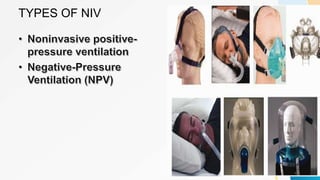
TYPES OF NIV
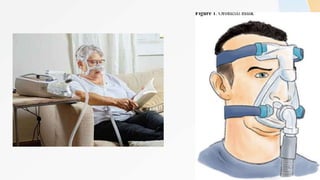
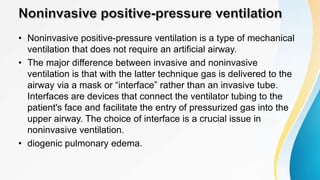
• Noninvasive positive-pressure ventilation is a type of mechanical
ventilation that does not require an artificial airway.
• The major difference between invasive and noninvasive
ventilation is that with the latter technique gas is delivered to the
airway via a mask or “interface” rather than an invasive tube.
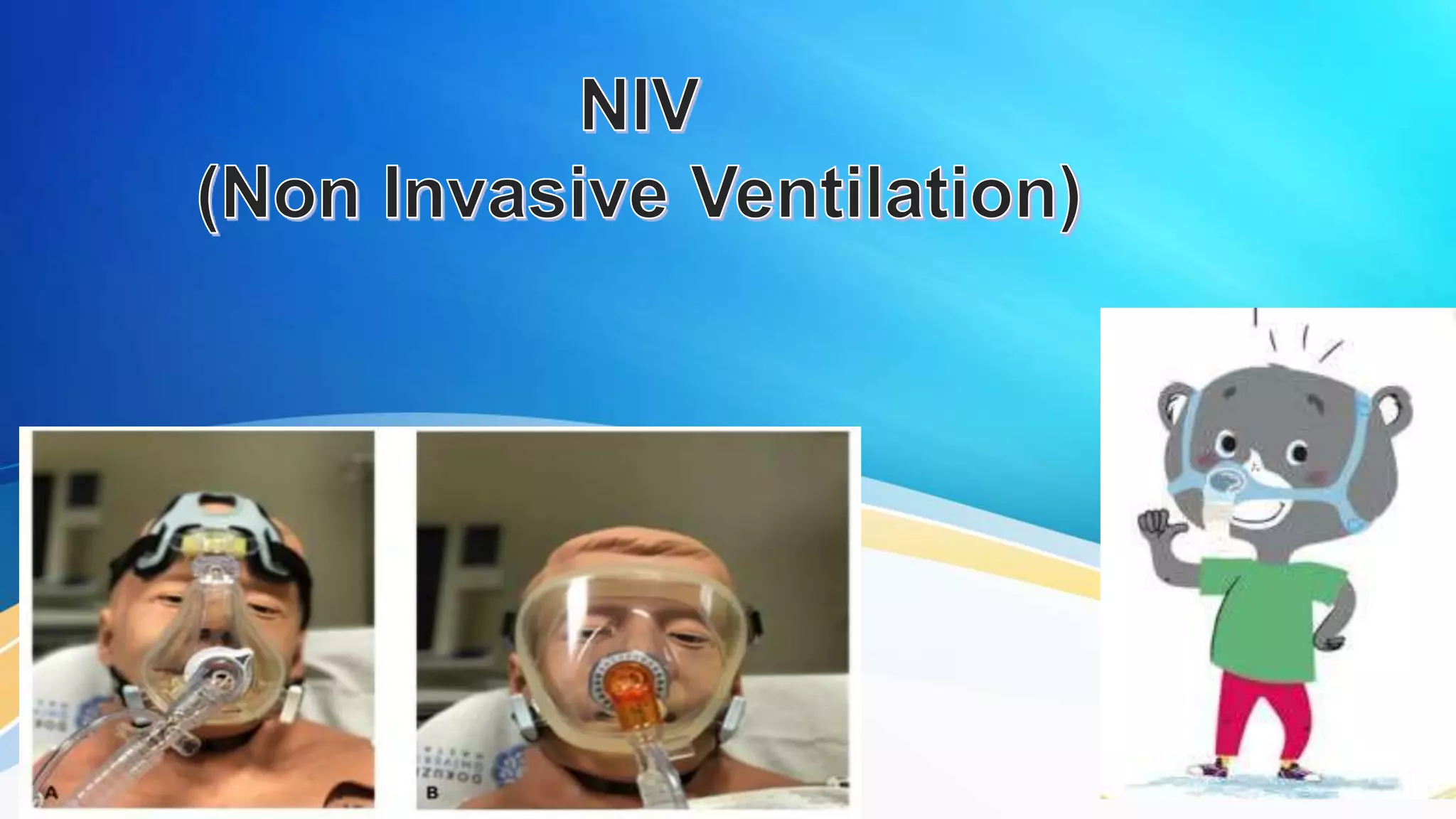
Interfaces are devices that connect the ventilator tubing to the
patient's face and facilitate the entry of pressurized gas into the
upper airway. The choice of interface is a crucial issue in
noninvasive ventilation.
• diogenic pulmonary edema.
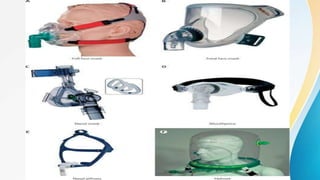
• Currently available interfaces include nasal, oronasal and
facial masks, mouthpieces and helmets.
• The best results (decreased need for intubation and
decreased mortality) have been reported among patients
with exacerbations of chronic obstructive pulmonary
disease and car
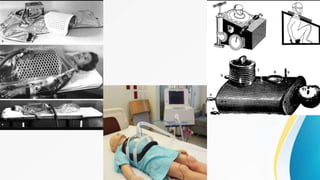
• Negative-pressure ventilators provide ventilatory support using a
device that encases the thoracic cage, such as the iron lung.
Although not seen as much in today's society they were popular in
the first half of the twentieth century during the polio epidemic.
They work by lowering the pressure surrounding the thorax,
creating subatmospheric pressure which passively expands the
chest wall to inflate the lungs. Exhalation occurs with passive
recoil of the chest wall. Their use is still indicated in chronic
respiratory failure. The three types used each with their own
advantages and disadvantages.
• The earliest version is the tank ventilator, more commonly
known as the iron lung. It is a large cylindrical device that
encases the patient's body with only the head visible, a
neck collar provides an airtight seal
• The poncho-wrap is an airtight bodysuit using a rigid
metal framework covered with an airtight nylon parker that
surrounds the trunk
• The cuirass is made up of a rigid fibreglass shell which fits
over the chest wall and upper abdomen
• Coma
• Undrained pneumothorax
• Frank haemoptysis
• Vomiting blood
(haematemesis)
• Facial fractures
• Cardiovascular system
instability
• Cardiac Arrest
• Respiratory Failure
• Raised ICP
• Recent upper GI surgery
• Active Tuberculosis
• Lung abscess
• No additional
contraindications in the
paediatric population
• Emphysema - check chest x-ray for bullae
• Patient compliance
• Skin integrity
• Airway obstruction
• 1)Do not set up NIV unless you are familiar with the equipment,
circuits, masks, etc.and are confident as to how safely to establish
the patient on NIV and appropriately respond to blood gas results.
• (A blood gas test measures the amount of oxygen and carbon
dioxide in the blood.)
• 2)The decision to use NIV and the settings must always be made
with the medical and nursing team looking after the patient.
• (Nurses must monitor patients' respiratory rate, chest wall movement and
accessory muscle use and comfort every 15 minutes after NIV starts and this
can be reduced as their condition improves)
• Introduce the treatment to the patient slowly.
• Patients need to keep their mouth closed if using a nasal mask.
• 3)NIV should generally be used in ICU/HDU(high dependency
unit)environments -
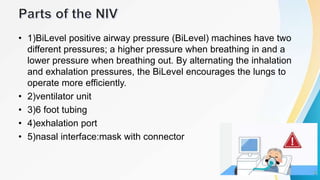
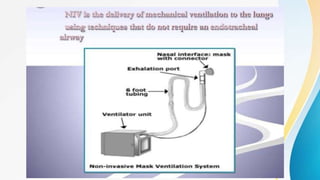
• 1)BiLevel positive airway pressure (BiLevel) machines have two
different pressures; a higher pressure when breathing in and a
lower pressure when breathing out. By alternating the inhalation
and exhalation pressures, the BiLevel encourages the lungs to
operate more efficiently.
• 2)ventilator unit
• 3)6 foot tubing
• 4)exhalation port
• 5)nasal interface:mask with connector
• Instructions on Using the Ventilator
• -Introduce the patient slowly to the equipment and all its parts.
• -Ensure the mask fits comfortably
• -Allow the patient the opportunity to practice breathing with the
ventilator, either by holding the mask in place or allowing them to
hold it in place.
• -Adjust the settings initially for comfort and establish whether the
patient can relax comfortably in a sleeping position.
• -Ask the patient for feedback for any discomfort
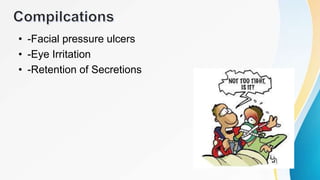
• -Facial pressure ulcers
• -Eye Irritation
• -Retention of Secretions
COVID19 is transmitted from person to person via small respiratory
droplets.
These are generated when a person with the virus exhales, talks,
coughs, or sneezes. You can contract the virus if you breathe in these
droplets.
Additionally, respiratory droplets containing the virus can land on various
objects or surfaces.
It’s possible that you could acquire SARS-CoV-2 if you touch your
mouth, nose, or eyes after touching a surface or object that has the virus
on it. However, this is not thought to be the main way that the virus
spreads
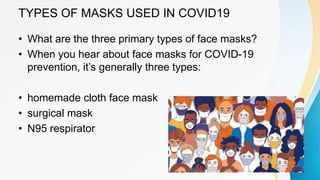
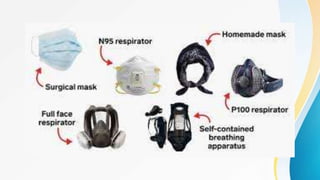
TYPES OF MASKS USED IN COVID19
• What are the three primary types of face masks?
• When you hear about face masks for COVID-19
prevention, it’s generally three types:
• homemade cloth face mask
• surgical mask
• N95 respirator
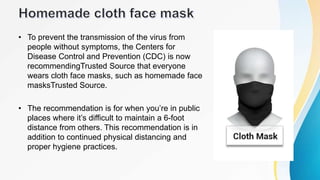
• To prevent the transmission of the virus from
people without symptoms, the Centers for
Disease Control and Prevention (CDC) is now
recommendingTrusted Source that everyone
wears cloth face masks, such as homemade face
masksTrusted Source.
• The recommendation is for when you’re in public
places where it’s difficult to maintain a 6-foot
distance from others. This recommendation is in
addition to continued physical distancing and
proper hygiene practices.
BENEFITS
• Cloth face masks can be made at
home from common materials, so
there’s an unlimited supply.
• They may lower the risk of people
without symptoms transmitting the
virus through speaking, coughing,
or sneezing.
• They’re better than not using any
mask and offer some protection,
especially where physical
distancing is hard to maintain.
RISKS
• They may provide a false sense of
security. While homemade face masks
offer some degree of protection, they
offer a lot less protection than surgical
masks or respirators. One 2008 study
indicated that homemade face masks
may be half as effective as surgical
masks and up to 50 times less
effective than N95 respirators.
• They don’t replace or reduce the need
for other protective measures. Proper
hygiene practices and physical
distancing are still the best methods of
keeping yourself safe.
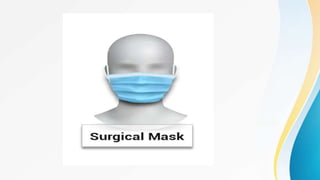
• Surgical masks are disposable, loose-fitting face masks that cover your nose,
mouth, and chin. They’re typically used to:
• protect the wearer from sprays, splashes, and large-particle droplets
• prevent the transmission of potentially infectious respiratory secretions from
the wearer to others
• Surgical masks can vary in design, but the mask itself is often flat and
rectangular in shape with pleats or folds. The top of the mask contains a
metal strip that can be formed to your nose.
• Elastic bands or long, straight ties help hold a surgical mask in place while
you’re wearing it. These can either be looped behind your ears or tied behind
your head.
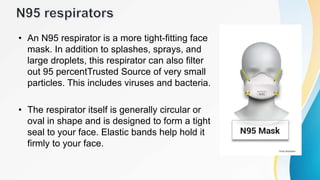
• An N95 respirator is a more tight-fitting face
mask. In addition to splashes, sprays, and
large droplets, this respirator can also filter
out 95 percentTrusted Source of very small
particles. This includes viruses and bacteria.
• The respirator itself is generally circular or
oval in shape and is designed to form a tight
seal to your face. Elastic bands help hold it
firmly to your face.
Some types may have an attachment called an exhalation valve, which can
help with breathing and the buildup of heat and humidity.
N95 respirators aren’t one-size-fits-all. They actually must be fit-tested before
use to make sure that a proper seal is formed. If the mask doesn’t seal
effectively to your face, you won’t receive the appropriate protection.
After being fit-tested, users of N95 respirators must continue to perform a seal
check each time they put one on.
It’s also important to note that a tight seal can’t be achieved in some groups.
These include children and people with facial hair
Non Invasive Ventilation and Masks

Non Invasive Ventilation and Masks

  • 3.
    INTRODUCTION DEFINATION: Non-invasive ventilation (NIV)is the delivery of oxygen (ventilation support) via a face mask and therefore eliminating the need of an endotracheal airway. • NIV achieves comparative physiological benefits to conventional mechanical ventilation by reducing the work of breathing and improving gas exchange. • NIV works by creating a positive airway pressure - the pressure outside the lungs being greater than the pressure inside of the lungs.
  • 5.
    • This causesair to be forced into the lungs (down the pressure gradient), lessening the respiratory effort and reducing the work of breathing. • It also helps to keep the chest and lungs expanded by increasing the functional residual capacity .There are two types of NIV non-invasive positive-pressure (NIPPV) and Negative-Pressure Ventilation (NPV).
  • 6.
  • 7.
    • Noninvasive positive-pressureventilation is a type of mechanical ventilation that does not require an artificial airway. • The major difference between invasive and noninvasive ventilation is that with the latter technique gas is delivered to the airway via a mask or “interface” rather than an invasive tube. Interfaces are devices that connect the ventilator tubing to the patient's face and facilitate the entry of pressurized gas into the upper airway. The choice of interface is a crucial issue in noninvasive ventilation. • diogenic pulmonary edema.
  • 8.
    • Currently availableinterfaces include nasal, oronasal and facial masks, mouthpieces and helmets. • The best results (decreased need for intubation and decreased mortality) have been reported among patients with exacerbations of chronic obstructive pulmonary disease and car
  • 10.
    • Negative-pressure ventilatorsprovide ventilatory support using a device that encases the thoracic cage, such as the iron lung. Although not seen as much in today's society they were popular in the first half of the twentieth century during the polio epidemic. They work by lowering the pressure surrounding the thorax, creating subatmospheric pressure which passively expands the chest wall to inflate the lungs. Exhalation occurs with passive recoil of the chest wall. Their use is still indicated in chronic respiratory failure. The three types used each with their own advantages and disadvantages.
  • 11.
    • The earliestversion is the tank ventilator, more commonly known as the iron lung. It is a large cylindrical device that encases the patient's body with only the head visible, a neck collar provides an airtight seal • The poncho-wrap is an airtight bodysuit using a rigid metal framework covered with an airtight nylon parker that surrounds the trunk • The cuirass is made up of a rigid fibreglass shell which fits over the chest wall and upper abdomen
  • 13.
    • Coma • Undrainedpneumothorax • Frank haemoptysis • Vomiting blood (haematemesis) • Facial fractures • Cardiovascular system instability • Cardiac Arrest • Respiratory Failure • Raised ICP • Recent upper GI surgery • Active Tuberculosis • Lung abscess • No additional contraindications in the paediatric population
  • 14.
    • Emphysema -check chest x-ray for bullae • Patient compliance • Skin integrity • Airway obstruction
  • 15.
    • 1)Do notset up NIV unless you are familiar with the equipment, circuits, masks, etc.and are confident as to how safely to establish the patient on NIV and appropriately respond to blood gas results. • (A blood gas test measures the amount of oxygen and carbon dioxide in the blood.) • 2)The decision to use NIV and the settings must always be made with the medical and nursing team looking after the patient.
  • 16.
    • (Nurses mustmonitor patients' respiratory rate, chest wall movement and accessory muscle use and comfort every 15 minutes after NIV starts and this can be reduced as their condition improves) • Introduce the treatment to the patient slowly. • Patients need to keep their mouth closed if using a nasal mask. • 3)NIV should generally be used in ICU/HDU(high dependency unit)environments -
  • 17.
    • 1)BiLevel positiveairway pressure (BiLevel) machines have two different pressures; a higher pressure when breathing in and a lower pressure when breathing out. By alternating the inhalation and exhalation pressures, the BiLevel encourages the lungs to operate more efficiently. • 2)ventilator unit • 3)6 foot tubing • 4)exhalation port • 5)nasal interface:mask with connector
  • 19.
    • Instructions onUsing the Ventilator • -Introduce the patient slowly to the equipment and all its parts. • -Ensure the mask fits comfortably • -Allow the patient the opportunity to practice breathing with the ventilator, either by holding the mask in place or allowing them to hold it in place. • -Adjust the settings initially for comfort and establish whether the patient can relax comfortably in a sleeping position. • -Ask the patient for feedback for any discomfort
  • 20.
    • -Facial pressureulcers • -Eye Irritation • -Retention of Secretions
  • 21.
    COVID19 is transmittedfrom person to person via small respiratory droplets. These are generated when a person with the virus exhales, talks, coughs, or sneezes. You can contract the virus if you breathe in these droplets. Additionally, respiratory droplets containing the virus can land on various objects or surfaces. It’s possible that you could acquire SARS-CoV-2 if you touch your mouth, nose, or eyes after touching a surface or object that has the virus on it. However, this is not thought to be the main way that the virus spreads
  • 22.
    TYPES OF MASKSUSED IN COVID19 • What are the three primary types of face masks? • When you hear about face masks for COVID-19 prevention, it’s generally three types: • homemade cloth face mask • surgical mask • N95 respirator
  • 24.
    • To preventthe transmission of the virus from people without symptoms, the Centers for Disease Control and Prevention (CDC) is now recommendingTrusted Source that everyone wears cloth face masks, such as homemade face masksTrusted Source. • The recommendation is for when you’re in public places where it’s difficult to maintain a 6-foot distance from others. This recommendation is in addition to continued physical distancing and proper hygiene practices.
  • 25.
    BENEFITS • Cloth facemasks can be made at home from common materials, so there’s an unlimited supply. • They may lower the risk of people without symptoms transmitting the virus through speaking, coughing, or sneezing. • They’re better than not using any mask and offer some protection, especially where physical distancing is hard to maintain. RISKS • They may provide a false sense of security. While homemade face masks offer some degree of protection, they offer a lot less protection than surgical masks or respirators. One 2008 study indicated that homemade face masks may be half as effective as surgical masks and up to 50 times less effective than N95 respirators. • They don’t replace or reduce the need for other protective measures. Proper hygiene practices and physical distancing are still the best methods of keeping yourself safe.
  • 26.
    • Surgical masksare disposable, loose-fitting face masks that cover your nose, mouth, and chin. They’re typically used to: • protect the wearer from sprays, splashes, and large-particle droplets • prevent the transmission of potentially infectious respiratory secretions from the wearer to others • Surgical masks can vary in design, but the mask itself is often flat and rectangular in shape with pleats or folds. The top of the mask contains a metal strip that can be formed to your nose. • Elastic bands or long, straight ties help hold a surgical mask in place while you’re wearing it. These can either be looped behind your ears or tied behind your head.
  • 28.
    • An N95respirator is a more tight-fitting face mask. In addition to splashes, sprays, and large droplets, this respirator can also filter out 95 percentTrusted Source of very small particles. This includes viruses and bacteria. • The respirator itself is generally circular or oval in shape and is designed to form a tight seal to your face. Elastic bands help hold it firmly to your face.
  • 29.
    Some types mayhave an attachment called an exhalation valve, which can help with breathing and the buildup of heat and humidity. N95 respirators aren’t one-size-fits-all. They actually must be fit-tested before use to make sure that a proper seal is formed. If the mask doesn’t seal effectively to your face, you won’t receive the appropriate protection. After being fit-tested, users of N95 respirators must continue to perform a seal check each time they put one on. It’s also important to note that a tight seal can’t be achieved in some groups. These include children and people with facial hair