Next-generation sequencing
(NGS) technologies have
progressive advantages in
terms of cost-effectiveness,
unprecedented sequencing
speed, high resolution and
accuracy in genomic analy-
ses, thus are playing an
increasing important role in
fields of oncology and immu-
nology.
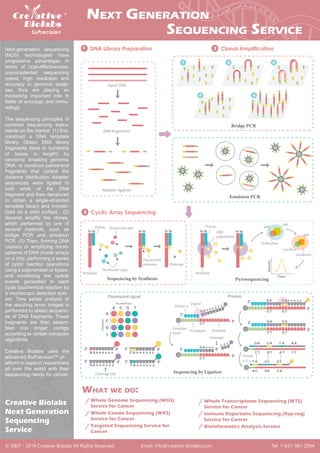
The sequencing principles of
common sequencing instru-
ments on the market: (1) first,
construct a DNA template
library. Obtain DNA library
fragments (tens to hundreds
of bases in length) by
randomly breaking genomic
DNA, or construct paired-end
fragments that control the
distance distribution. Adapter
sequences were ligated to
both ends of the DNA
fragment and then denatured
to obtain a single-stranded
template library and immobi-
lized on a solid surface. (2)
Second, amplify the clones,
which performed by one of
several methods, such as
bridge PCR and emulsion
PCR. (3) Then, forming DNA
clusters or amplifying micro-
spheres of DNA cluster arrays
on a chip, performing a series
of cyclic reaction operations
using a polymerase or ligase,
and monitoring the optical
events generated in each
cycle biochemical reaction by
a microscopic detection syst-
em. Time series analysis of
the resulting array images is
performed to obtain sequenc-
es of DNA fragments. These
fragments are then assem-
bled into longer contigs
according to certain computer
algorithms.
Creative Biolabs uses the
advanced SuPrecision™ pl-
atform to support researchers
all over the world with their
sequencing needs for cancer.
NEXT GENERATION
SEQUENCING SERVICE
Creative Biolabs
Next Generation
Sequencing
Service
© 2007 - 2019 Creative-Biolabs All Rights Reserved Email: info@creative-biolabs.com Tel: 1-631-381-2994
WHAT WE DO:
Whole Genome Sequencing (WGS)
Service for Cancer
Whole Exome Sequencing (WES)
Service for Cancer
Targeted Sequencing Service for
Cancer
Whole Transcriptome Sequencing (WTS)
Service for Cancer
Immune Repertoire Sequencing (Rep-seq)
Service for Cancer
Bioinformatics Analysis Service

Ngs technology

  • 1.
    Next-generation sequencing (NGS) technologieshave progressive advantages in terms of cost-effectiveness, unprecedented sequencing speed, high resolution and accuracy in genomic analy- ses, thus are playing an increasing important role in fields of oncology and immu- nology. The sequencing principles of common sequencing instru- ments on the market: (1) first, construct a DNA template library. Obtain DNA library fragments (tens to hundreds of bases in length) by randomly breaking genomic DNA, or construct paired-end fragments that control the distance distribution. Adapter sequences were ligated to both ends of the DNA fragment and then denatured to obtain a single-stranded template library and immobi- lized on a solid surface. (2) Second, amplify the clones, which performed by one of several methods, such as bridge PCR and emulsion PCR. (3) Then, forming DNA clusters or amplifying micro- spheres of DNA cluster arrays on a chip, performing a series of cyclic reaction operations using a polymerase or ligase, and monitoring the optical events generated in each cycle biochemical reaction by a microscopic detection syst- em. Time series analysis of the resulting array images is performed to obtain sequenc- es of DNA fragments. These fragments are then assem- bled into longer contigs according to certain computer algorithms. Creative Biolabs uses the advanced SuPrecision™ pl- atform to support researchers all over the world with their sequencing needs for cancer. NEXT GENERATION SEQUENCING SERVICE Creative Biolabs Next Generation Sequencing Service © 2007 - 2019 Creative-Biolabs All Rights Reserved Email: info@creative-biolabs.com Tel: 1-631-381-2994 WHAT WE DO: Whole Genome Sequencing (WGS) Service for Cancer Whole Exome Sequencing (WES) Service for Cancer Targeted Sequencing Service for Cancer Whole Transcriptome Sequencing (WTS) Service for Cancer Immune Repertoire Sequencing (Rep-seq) Service for Cancer Bioinformatics Analysis Service
  • 2.
    DNA Library Preparation 1Clonal Amplification 2 Cyclic Array Sequencing 3 T 5' 5' 3' 3' T 5' 3' T C A A A n A n z n z z C G T T 5' 3' A A T 5' 3' A G A A A A A T 5' 3' A A A A
  • 3.
    1 4 5 2 3 A C G T 5' 3' An G n z n z z 5' 5' 3' A n T n z n z z 3' 3' T n C A G n z n z z n A C n z n z 5' 3' A n C n z n z z
  • 4.
     3' 3' T n C A G n n z z z 3' 3' T CT G A G A C 3' 3' T C T G A G A C T C T T T G G T A A G A A A T C C C C T GG A G A T