Introduction
What is sequencing??
Decipheringthe code hidden in biological sequences like DNA,
polypeptides etc.
Methods and technologies that enables us to determine the order
of nucleotides and amino acids in DNA and Polypeptide
respectively.
3.
Traditional methods ofSequencing
Maxam-Gilbert Method
Use of radioactive labels.
Sanger Method
It utilize the fluorescent dye for labeling.
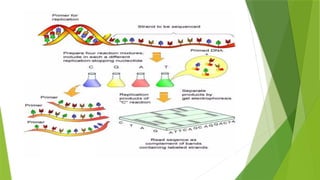
Separation of extended fragments of DNA with the addition of di-
deoxynucleotides (lack a 3’-OH group) thus, chain termination.
Limitation
Slow
High cost per run.
4.
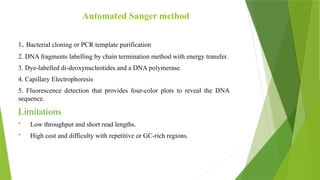
Automated Sanger method
1.Bacterial cloning or PCR template purification
2. DNA fragments labelling by chain termination method with energy transfer.
3. Dye-labelled di-deoxynucleotides and a DNA polymerase.
4. Capillary Electrophoresis
5. Fluorescence detection that provides four-color plots to reveal the DNA
sequence.
Limitations
Low throughput and short read lengths.
High cost and difficulty with repetitive or GC-rich regions.
6.
Next Generation Sequencing
Also known as High throughput sequencing or Ultra-deep
sequencing or Massively parallel sequencing.
Technologies developed after Automated Sanger sequencing are known
as next generation sequencing.
NGS enables the sequencing of biological codes at a very rapid pace
with low cost per operation.
This is the primary advantage over conventional methods.
Example;
Billions of short reads can be sequenced in one operation.
7.
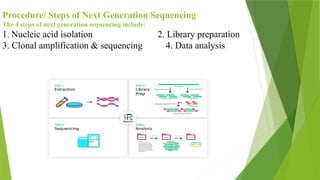
Procedure/ Steps ofNext Generation Sequencing
The 4 steps of next generation sequencing include:
1. Nucleic acid isolation 2. Library preparation
3. Clonal amplification & sequencing 4. Data analysis
8.
Nucleic acid extractionand isolation is a vital first step in
next generation sequencing. The extraction method that is
used will depend on the starting material. It is crucial to
choose an extraction protocol that’s optimize to yield the
maximum amount and highest purity of nucleic acid from the
respective sample type. The yield, quality and integrity of
isolated nucleic acids are critical for successful sequencing
and must be assessed before proceeding to the next step.
Nucleic Acid Isolation
9.
Library preparation involvespreparing DNA or RNA samples so they
can be processed and read by sequencers. This is done by fragmenting
the samples to yield a pool of appropriately sized targets, then adding
specialized adapters at both ends, which will later interact with NGS
platform. These prepared, ready to sequence samples are called
“libraries”. A library represents a collection of molecules that can be
sequenced. The exact library preparation procedure may differ
depending on the reagents and methods used. Regardless of procedure
used, the final prepared NGS libraries must contain DNA fragments of
desired lengths with adapters at both ends.
Library Preparation
10.
Clonal amplification involvesamplifying DNA fragments to be sequenced by
binding to ion surfaces, beads or flow cells. This helps develop strong florescent
signals that can be detected by the sequencers.
Sequencing by synthesis is the next step after clonal amplification. In this step
library is loaded onto the sequencer, which then ‘reads’ or detects the nucleotides
one by one.
Clonal Amplification and Sequencing
11.
Data Analysis usingBioinformatics
This final step involves three stages- processing, analysis and
interpretation of the raw sequencing data generated. A variety of
bioinformatics tools are used to process, analyze and interpret the raw
sequencing data and convert it into meaningful information. The exact
tools used as well as how the data is processed and analyze depends on
the applications and goals of the NGS assay.
12.
Potential uses ofNGS in Clinical Practice
1. Clinical Genetic Diagnostics
NGS enables comprehensive analysis of a patient’s genome or exome,
transforming genetic disorder diagnosis.
Utilizes whole exome sequencing (WES) to identify genetic variants.
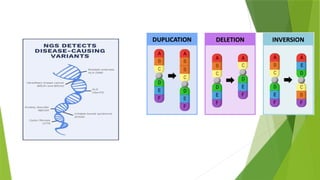
Detects rare variants, including single nucleotide variants (SNVs),
insertions, deletions, and structural changes.
Performs analysis without prior knowledge of specific genes, allowing for
discovery of unexpected variants.
Particularly effective in diagnosing complex or unexplained syndromes by
revealing de novo mutations and mosaic mutations that traditional methods
may overlook.
14.
2. Cancer Genomicsand Personalized Medicine
NGS plays a pivotal role in oncology by enabling the detailed
characterization of cancer genomes.
Identification of somatic mutations, gene fusion and other alterations that
drive tumorigenesis.
Aids in the classification of cancers and the identification of “drug-able”
targets.
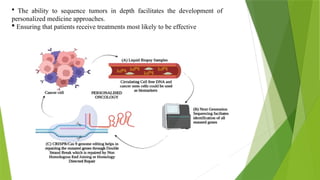
NGS-based liquid biopsies can detect circulating tumor DNA (ctDNA).
This providing a minimally invasive method for monitoring tumor
evolution, treatment response, and minimal residual disease.
15.
The abilityto sequence tumors in depth facilitates the development of
personalized medicine approaches.
Ensuring that patients receive treatments most likely to be effective
16.
3. Non-Invasive PrenatalTesting (NIPT):
Non –invasive prenatal testing is a revolutionary screening method that analyzes
fetal DNA present in the maternal bloodstream to detect chromosomal
abnormalities early in pregnancy.
Next generation sequencing plays a crucial role in making NIPT highly accurate,
sensitive and efficient.
It can detect common chromosomal aneuploidies like Trisomy 21, sex
chromosome abnormalities like turner syndrome, microdeletions and duplications
and fetal sex determination.
It has high sensitivity and specificity, non-invasive and gives rapid results. As
compared to other traditional sequencing methods, it has low false-positive rates.
It reduces the need for invasive procedures like amniocentesis and chorionic villus
sampling.
17.
4. Neurological andPsychiatric Disorders:
Next-generation sequencing (NGS) has revolutionized the diagnosis and understanding of
neurological and psychiatric disorder by enabling comprehensive genetic analysis.
Many of these conditions have complex genetic underpinnings, and NGS helps identify
causative mutations, aiding in diagnosis, prognosis and personalized treatment strategies.
Next-generation sequencing helps identify genetic mutations responsible for early onset
neurological conditions such as Epilepsy, Autism spectrum Disorder and Intellectual
disability.
Next-generation sequencing enables early detection and assessment of progressive brain
disorders including: Alzheimer’s Disease, Parkinson’s Disease and Huntington’s Disease.
Next-generation sequencing has identified genetic variants related to serotonin signaling
and stress response, which influence depression susceptibility.
Next-generation sequencing helps to identified the mutations that leads to schizophrenia
18.
Limitations of NGS
Infrastructure
The main disadvantage of NGS in the clinical setting is
putting in place the required infrastructure, such as computer capacity
and storage.
Human skills
Personnel expertise are required to thoroughly analyze
and understand the resulting data.
Data management
The data must be skillfully managed in order to
extract clinically significant information.
19.
Cost of NGS
Actual cost of NGS sequencing is very low.
Example;
A single Sanger read usually costs less than one pound.
A state of art NGS platform can generate approximately 15 million
reads for around 1000 pounds.
How to make NGS cost effective?
To make NGS cost effective, one must run large batches of sample
which may require supra-regional centralization.
20.
Conclusion
Next GenerationSequencing enables the sequencing of biological
codes at a rapid pace. It has mainly four steps including extraction of
nucleic acid, library preparation, amplification and sequencing, data
analysis.
NGS has potential uses in clinical practice including genetic diagnosis,
personalized medicine, and prenatal testing. It also has some
limitations like management and running of larger batches to make it
cost effective.