bhavyaraval2839@outlook.com
NEXT GENERATION
SEQUENCING
NEXT GENERATION SEQUENCING
BHAVYA RAVAL
NEXT GENERATION SEQUENCING
Next-generation sequencing (NGS), also known as high-
throughput sequencing, is a revolutionary technology
that allows the rapid and cost-effective sequencing of
DNA and RNA. NGS has transformed genomics and
molecular biology by enabling the analysis of entire
genomes, transcriptomes, and epigenomes. Here is a
detailed overview of the key steps involved in the NGS
process:
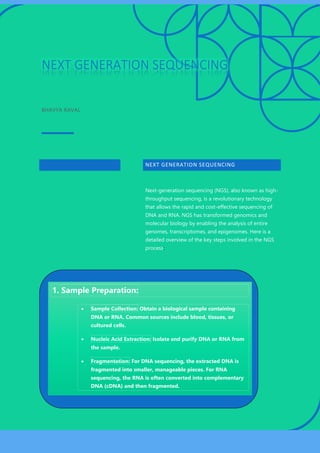
1. Sample Preparation:
• Sample Collection: Obtain a biological sample containing
DNA or RNA. Common sources include blood, tissues, or
cultured cells.
• Nucleic Acid Extraction: Isolate and purify DNA or RNA from
the sample.
• Fragmentation: For DNA sequencing, the extracted DNA is
fragmented into smaller, manageable pieces. For RNA
sequencing, the RNA is often converted into complementary
DNA (cDNA) and then fragmented.
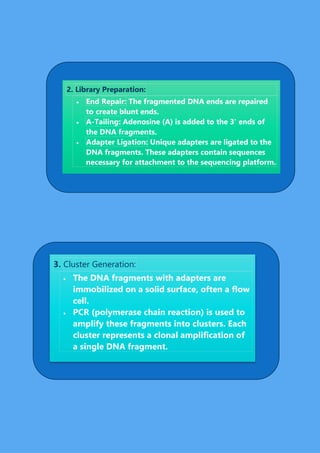
2. Library Preparation:
• End Repair: The fragmented DNA ends are repaired
to create blunt ends.
• A-Tailing: Adenosine (A) is added to the 3' ends of
the DNA fragments.
• Adapter Ligation: Unique adapters are ligated to the
DNA fragments. These adapters contain sequences
necessary for attachment to the sequencing platform.
3. Cluster Generation:
• The DNA fragments with adapters are
immobilized on a solid surface, often a flow
cell.
• PCR (polymerase chain reaction) is used to
amplify these fragments into clusters. Each
cluster represents a clonal amplification of
a single DNA fragment.
4. Sequencing:
• Chemistry and Platforms: Different sequencing platforms
employ various chemistries. Illumina uses reversible
terminator chemistry, while others like Ion Torrent or Pacific
Biosciences use different methods.
• Cyclic Sequencing: The sequencing process involves iterative
cycles where fluorescently labeled nucleotides are added and
imaged. The sequence is determined by detecting the
emitted light signal during each cycle.
• Real-Time Sequencing: Some platforms, like PacBio, perform
sequencing in real-time without the need for cyclic imaging.
5. Base Calling:
• Raw sequencing data is processed to convert fluorescence
signals into nucleotide sequences.
• Quality scores are assigned to each base call to indicate the
confidence level.
6. Data Analysis:
• Read Alignment: Sequenced reads are aligned to a reference
genome for DNA-seq or a transcriptome for RNA-seq.
• Variant Calling: Identify genetic variations, such as single
nucleotide polymorphisms (SNPs) or insertions/deletions
(indels).
• Quantification: For RNA-seq, determine gene expression levels.
7. Annotation:
• Annotate identified variants with information about genes,
functional consequences, and known databases.
8. Data Interpretation:
• Correlate genetic variations with phenotypes or diseases.
• Identify potential functional implications of genetic findings.
9. Reporting:
• Generate a comprehensive report summarizing the
sequencing results, including identified variants and
their potential clinical or research significance.
10. Storage and Archiving:
• Store raw and processed data in secure databases for
future reference.
• Adhere to data management and privacy
regulations.
NGS has been applied to a wide range of biological
research and clinical applications, including genomics,
transcriptomics, epigenomics, and metagenomics. The
continuous development of new sequencing technologies
and bioinformatics tools further enhances the capabilities
and applications of NGS.

NGS- next generation sequencing methodology

  • 1.
  • 2.
    NEXT GENERATION SEQUENCING BHAVYARAVAL NEXT GENERATION SEQUENCING Next-generation sequencing (NGS), also known as high- throughput sequencing, is a revolutionary technology that allows the rapid and cost-effective sequencing of DNA and RNA. NGS has transformed genomics and molecular biology by enabling the analysis of entire genomes, transcriptomes, and epigenomes. Here is a detailed overview of the key steps involved in the NGS process: 1. Sample Preparation: • Sample Collection: Obtain a biological sample containing DNA or RNA. Common sources include blood, tissues, or cultured cells. • Nucleic Acid Extraction: Isolate and purify DNA or RNA from the sample. • Fragmentation: For DNA sequencing, the extracted DNA is fragmented into smaller, manageable pieces. For RNA sequencing, the RNA is often converted into complementary DNA (cDNA) and then fragmented.
  • 3.
    2. Library Preparation: •End Repair: The fragmented DNA ends are repaired to create blunt ends. • A-Tailing: Adenosine (A) is added to the 3' ends of the DNA fragments. • Adapter Ligation: Unique adapters are ligated to the DNA fragments. These adapters contain sequences necessary for attachment to the sequencing platform. 3. Cluster Generation: • The DNA fragments with adapters are immobilized on a solid surface, often a flow cell. • PCR (polymerase chain reaction) is used to amplify these fragments into clusters. Each cluster represents a clonal amplification of a single DNA fragment.
  • 4.
    4. Sequencing: • Chemistryand Platforms: Different sequencing platforms employ various chemistries. Illumina uses reversible terminator chemistry, while others like Ion Torrent or Pacific Biosciences use different methods. • Cyclic Sequencing: The sequencing process involves iterative cycles where fluorescently labeled nucleotides are added and imaged. The sequence is determined by detecting the emitted light signal during each cycle. • Real-Time Sequencing: Some platforms, like PacBio, perform sequencing in real-time without the need for cyclic imaging. 5. Base Calling: • Raw sequencing data is processed to convert fluorescence signals into nucleotide sequences. • Quality scores are assigned to each base call to indicate the confidence level. 6. Data Analysis: • Read Alignment: Sequenced reads are aligned to a reference genome for DNA-seq or a transcriptome for RNA-seq. • Variant Calling: Identify genetic variations, such as single nucleotide polymorphisms (SNPs) or insertions/deletions (indels). • Quantification: For RNA-seq, determine gene expression levels.
  • 5.
    7. Annotation: • Annotateidentified variants with information about genes, functional consequences, and known databases. 8. Data Interpretation: • Correlate genetic variations with phenotypes or diseases. • Identify potential functional implications of genetic findings. 9. Reporting: • Generate a comprehensive report summarizing the sequencing results, including identified variants and their potential clinical or research significance. 10. Storage and Archiving: • Store raw and processed data in secure databases for future reference. • Adhere to data management and privacy regulations. NGS has been applied to a wide range of biological research and clinical applications, including genomics, transcriptomics, epigenomics, and metagenomics. The continuous development of new sequencing technologies and bioinformatics tools further enhances the capabilities and applications of NGS.