Sample to Insight
Introduction to Next-Generation Sequencing (NGS)
Wolfgang Krebs, R&D Scientist, QIAGEN
1Intro to NGS, 11.30.2016
Sample to Insight
2
Overview of NGS technologies and innovative NGS library
prep methods
Part 1: Introduction to next-generation sequencing (NGS)
technology
Part 2: Innovative NGS library construction technology
Part 3: Advanced NGS library prep for challenging samples
Welcome to a 3-part series: NGS technology and applications
Intro to NGS, 11.30.2016
Sample to Insight
QIAGEN® products shown here are intended for molecular biology
applications. These products are not intended for the diagnosis,
prevention or treatment of a disease.
For up-to-date licensing information and product-specific disclaimers,
see the respective QIAGEN kit handbook or user manual. QIAGEN
kit handbooks and user manuals are available at www.qiagen.com
or can be requested from QIAGEN Technical Services or your local
distributor.
Legal disclaimer
3Intro to NGS, 11.30.2016
Sample to Insight
4
• NGS background
• NGS workflow
• NGS technologies
• NGS applications
1
2
3
4
Agenda
Intro to NGS, 11.30.2016
Sample to Insight
5
• NGS background
• NGS workflow
• NGS technologies
• NGS applications
1
Agenda
Intro to NGS, 11.30.2016
2
3
4
Sample to Insight
6
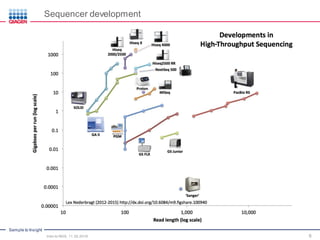
Sequencer development
Intro to NGS, 11.30.2016
-
Sample to Insight
7
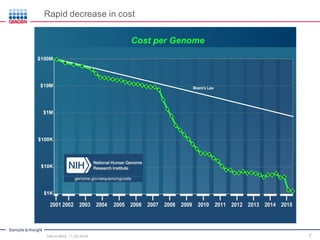
Rapid decrease in cost
Intro to NGS, 11.30.2016
Sample to Insight
8
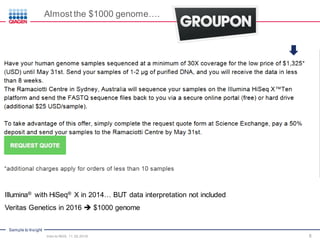
Illumina® with HiSeq® X in 2014… BUT data interpretation not included
Veritas Genetics in 2016  $1000 genome
Almost the $1000 genome….
Intro to NGS, 11.30.2016
Sample to Insight
9
• NGS background
• NGS workflow
• NGS technologies
• NGS applications
2
Agenda
Intro to NGS, 11.30.2016
3
4
1
Sample to Insight
10
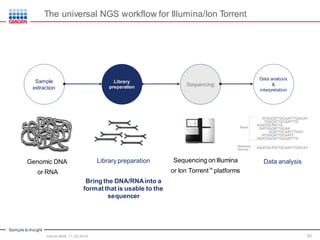
Data analysis
&
interpretation
Sequencing
Sample
extraction
Library
preparation
Genomic DNA
or RNA
Library preparation
Bring the DNA/RNA into a
format that is usable to the
sequencer
Sequencing on Illumina
or Ion Torrent™ platforms
Data analysis
The universal NGS workflow for Illumina/Ion Torrent
Intro to NGS, 11.30.2016
Sample to Insight
11
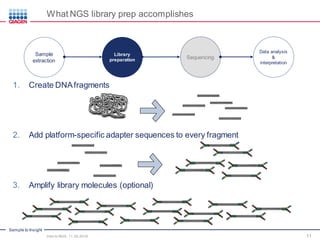
1. Create DNA fragments
2. Add platform-specific adapter sequences to every fragment
3. Amplify library molecules (optional)
Library
preparation
Data analysis
&
interpretation
Sequencing
Sample
extraction
What NGS library prep accomplishes
Intro to NGS, 11.30.2016
Sample to Insight
12
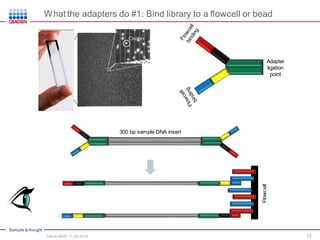
300 bp sample DNA insert
Adapter
ligation
point
Flowcell
What the adapters do #1: Bind library to a flowcell or bead
Intro to NGS, 11.30.2016
Sample to Insight
13
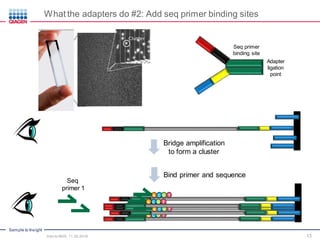
Adapter
ligation
point
A C TG
A C TG
A C TG
A C TG
A C TG
Seq
primer 1
Seq primer
binding site
Bridge amplification
to form a cluster
Bind primer and sequence
What the adapters do #2: Add seq primer binding sites
Intro to NGS, 11.30.2016
Sample to Insight
14
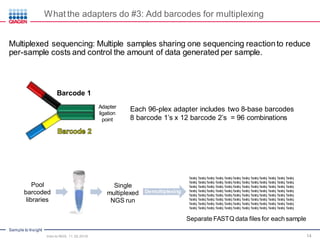
Barcode 1
Each 96-plex adapter includes two 8-base barcodes
8 barcode 1’s x 12 barcode 2’s = 96 combinations
Pool
barcoded
libraries
Single
multiplexed
NGS run
Demultiplexing
fastq fastq fastq fastq fastq fastq fastq fastq fastq fastq fastq fastq
Separate FASTQ data files for each sample
Multiplexed sequencing: Multiple samples sharing one sequencing reaction to reduce
per-sample costs and control the amount of data generated per sample.
Adapter
ligation
point
What the adapters do #3: Add barcodes for multiplexing
Intro to NGS, 11.30.2016
Sample to Insight
15
Adapter – A short double-stranded DNA fragment that is ligated to the sample DNA
fragments prior to sequencing.
Barcode – Unique molecular identifiers included in adapter sequences
.
Library complexity – A measure of the proportion of unique molecules within a library.
More complexity is better, and a high-complexity library is generally free of PCR
duplicates, adapter-dimers and other artifacts.
Multiplexing – Combining several different samples in one sequencing run.
Demultiplexing – The act of separating reads from an NGS run into separate piles
based on their index or barcode reads.
Key NGS vocabulary
Intro to NGS, 11.30.2016
Sample to Insight
16
• NGS background
• NGS workflow
• NGS technologies
• NGS applications
3
Agenda
Intro to NGS, 11.30.2016
2
4
1
Sample to Insight
17
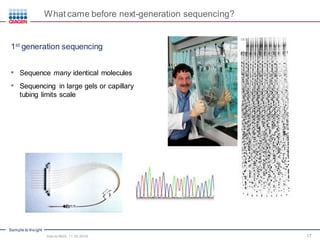
1st generation sequencing
• Sequence many identical molecules
• Sequencing in large gels or capillary
tubing limits scale
What came before next-generation sequencing?
Intro to NGS, 11.30.2016
Sample to Insight
18
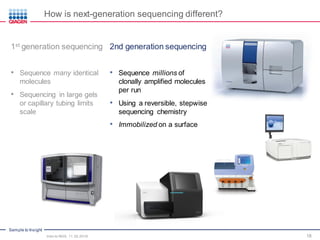
How is next-generation sequencing different?
Intro to NGS, 11.30.2016
1st generation sequencing
• Sequence many identical
molecules
• Sequencing in large gels
or capillary tubing limits
scale
2nd generation sequencing
• Sequence millions of
clonally amplified molecules
per run
• Using a reversible, stepwise
sequencing chemistry
• Immobilized on a surface
Sample to Insight
19
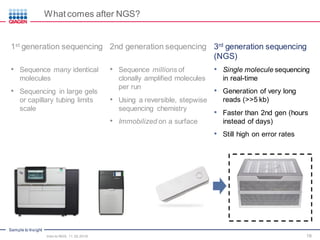
What comes after NGS?
Intro to NGS, 11.30.2016
3rd generation sequencing
(NGS)
• Single molecule sequencing
in real-time
• Generation of very long
reads (>>5 kb)
• Faster than 2nd gen (hours
instead of days)
• Still high on error rates
1st generation sequencing
• Sequence many identical
molecules
• Sequencing in large gels
or capillary tubing limits
scale
2nd generation sequencing
• Sequence millions of
clonally amplified molecules
per run
• Using a reversible, stepwise
sequencing chemistry
• Immobilized on a surface
Sample to Insight
20
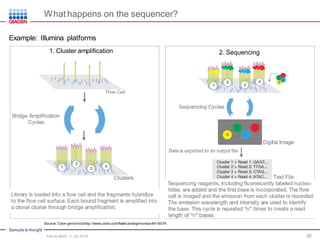
Example: Illumina platforms
1. Cluster amplification 2. Sequencing
What happens on the sequencer?
Intro to NGS, 11.30.2016
Source: Cram genomics http://www.cram.com/flashcards/genomics-6416574
Sample to Insight
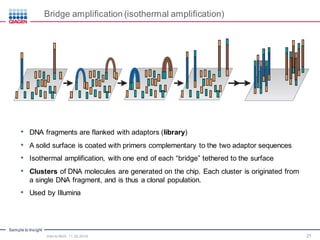
• DNA fragments are flanked with adaptors (library)
• A solid surface is coated with primers complementary to the two adaptor sequences
• Isothermal amplification, with one end of each “bridge” tethered to the surface
• Clusters of DNA molecules are generated on the chip. Each cluster is originated from
a single DNA fragment, and is thus a clonal population.
• Used by Illumina
21
Bridge amplification (isothermal amplification)
Intro to NGS, 11.30.2016
Sample to Insight
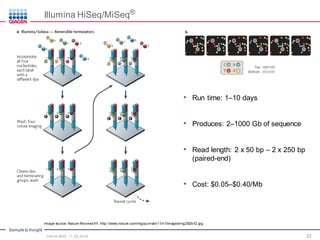
• Run time: 1–10 days
• Produces: 2–1000 Gb of sequence
• Read length: 2 x 50 bp – 2 x 250 bp
(paired-end)
• Cost: $0.05–$0.40/Mb
22
Illumina HiSeq/MiSeq®
Intro to NGS, 11.30.2016
Image source: Nature Reviews 11. http://www.nature.com/nrg/journal/v11/n1/images/nrg2626-f2.jpg
Sample to Insight
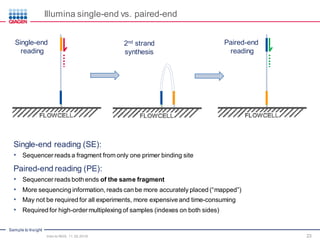
Single-end reading (SE):
• Sequencer reads a fragment from only one primer binding site
Paired-end reading (PE):
• Sequencer reads both ends of the same fragment
• More sequencing information, reads can be more accurately placed (“mapped”)
• May not be required for all experiments, more expensive and time-consuming
• Required for high-order multiplexing of samples (indexes on both sides)
Single-end
reading
2nd strand
synthesis
Paired-end
reading
23
Illumina single-end vs. paired-end
Intro to NGS, 11.30.2016
Sample to Insight
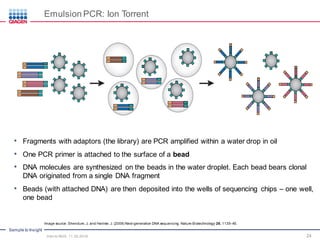
• Fragments with adaptors (the library) are PCR amplified within a water drop in oil
• One PCR primer is attached to the surface of a bead
• DNA molecules are synthesized on the beads in the water droplet. Each bead bears clonal
DNA originated from a single DNA fragment
• Beads (with attached DNA) are then deposited into the wells of sequencing chips – one well,
one bead
24
Emulsion PCR: Ion Torrent
Intro to NGS, 11.30.2016
Image source: Shendure, J. and Hanlee, J. (2008) Next-generation DNA sequencing. Nature Biotechnology 26, 1135–45.
Sample to Insight
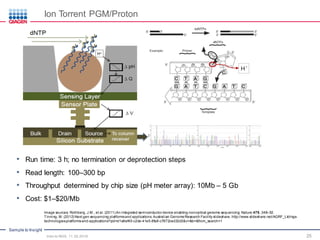
• Run time: 3 h; no termination or deprotection steps
• Read length: 100–300 bp
• Throughput determined by chip size (pH meter array): 10Mb – 5 Gb
• Cost: $1–$20/Mb
25
Ion Torrent PGM/Proton
Intro to NGS, 11.30.2016
Image sources: Rothberg, J.M., et al. (2011) An integrated semiconductor device enabling non-optical genome sequencing. Nature 475, 348–52.
Tinning, M. (2012) Next gen sequencing platforms and applications. Australian Genome Research Facility slideshare. http://www.slideshare.net/AGRF_Ltd/ngs-
technologies-platforms-and-applications?qid=d1e6ef45-c2de-41e5-8fa8-c7872ced32d3&v=&b=&from_search=1
Sample to Insight
26
NGS – Next-generation sequencing.
Flow cell – Name of the Illumina sample chip. Ready-to-sequence libraries are
bound to the flow cell and bridge amplified prior to sequencing. Depending on the
type of sequencer and the number of samples, different flow cell sizes are
available.
FASTQ file – default file format for sequencer output.
Alignment – the act of “matching” reads to a reference genome.
Key NGS vocabulary
Intro to NGS, 11.30.2016
Sample to Insight
27
• NGS background
• NGS workflow
• NGS technologies
• NGS applications
Agenda
Intro to NGS, 11.30.2016
2
1
4
3
Sample to Insight
28
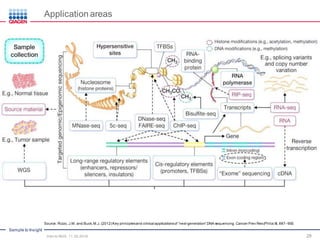
Application areas
Intro to NGS, 11.30.2016
Source: Rizzo, J.M. and Buck, M.J. (2012) Key principles and clinical applications of “next-generation” DNA sequencing. Cancer Prev Res (Phila) 5, 887–900.
Sample to Insight
29
www.Illumina.com
All you seq…
Intro to NGS, 11.30.2016
Sample to Insight
30
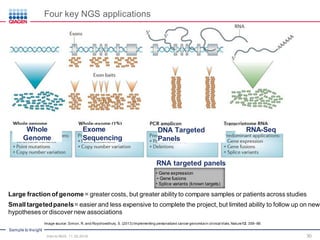
Large fraction of genome = greater costs, but greater ability to compare samples or patients across studies
Small targeted panels = easier and less expensive to complete the project, but limited ability to follow up on new
hypotheses or discover new associations
Whole
Genome
Exome
Sequencing
DNA Targeted
Panels
RNA-Seq
RNA targeted panels
• Gene expression
• Gene fusions
• Splice variants (known targets)
Four key NGS applications
Intro to NGS, 11.30.2016
Image source: Simon, R. and Roychowdhury, S. (2013) Implementing personalized cancer genomics in clinical trials. Nature 12, 358–69.
Sample to Insight
31
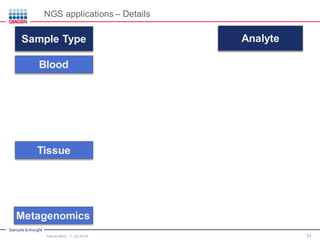
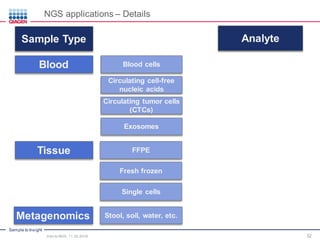
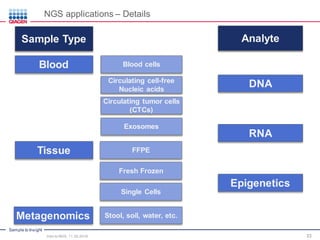
AnalyteSample Type
Blood
Tissue
Metagenomics
NGS applications – Details
Intro to NGS, 11.30.2016
Sample to Insight
32
AnalyteSample Type
Blood
Tissue
Metagenomics
Blood cells
Circulating cell-free
nucleic acids
Circulating tumor cells
(CTCs)
Exosomes
FFPE
Fresh frozen
Single cells
Stool, soil, water, etc.
NGS applications – Details
Intro to NGS, 11.30.2016
Sample to Insight
33
AnalyteSample Type
Blood
Tissue
Metagenomics
Blood cells
Circulating cell-free
Nucleic acids
Circulating tumor cells
(CTCs)
Exosomes
DNA
RNA
Epigenetics
FFPE
Fresh Frozen
Single Cells
Stool, soil, water, etc.
NGS applications – Details
Intro to NGS, 11.30.2016
Sample to Insight
34
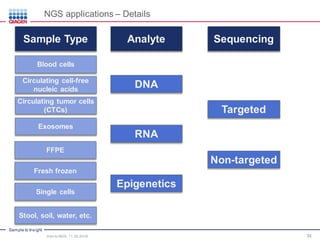
AnalyteSample Type
Blood cells
Circulating cell-free
nucleic acids
Circulating tumor cells
(CTCs)
Exosomes
DNA
RNA
Epigenetics
FFPE
Fresh frozen
Single cells
Stool, soil, water, etc.
Sequencing
Targeted
Non-targeted
NGS applications – Details
Intro to NGS, 11.30.2016
Sample to Insight
35
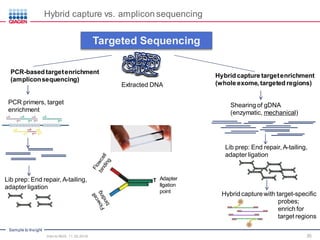
Targeted Sequencing
PCR-based target enrichment
(amplicon sequencing)
Hybrid capture target enrichment
(whole exome, targeted regions)
Lib prep: End repair, A-tailing,
adapter ligation
PCR primers, target
enrichment
Adapter
llgation
point
T
Shearing of gDNA
(enzymatic, mechanical)
Lib prep: End repair, A-tailing,
adapter ligation
Hybrid capture with target-specific
probes;
enrich for
target regions
Extracted DNA
Hybrid capture vs. amplicon sequencing
Intro to NGS, 11.30.2016
Sample to Insight
36
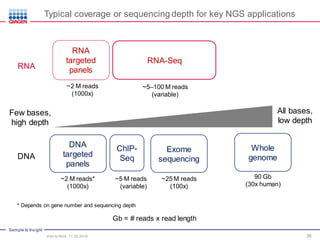
Whole
genome
Exome
sequencing
RNA-Seq
DNA
targeted
panels
All bases,
low depth
~5–100 M reads
(variable)
RNA
targeted
panels
90 Gb
(30x human)
~25 M reads
(100x)
~2 M reads*
(1000x)
Few bases,
high depth
ChIP-
Seq
~5 M reads
(variable)
~2 M reads
(1000x)
RNA
DNA
Gb = # reads x read length
* Depends on gene number and sequencing depth
Typical coverage or sequencing depth for key NGS applications
Intro to NGS, 11.30.2016
Sample to Insight
37
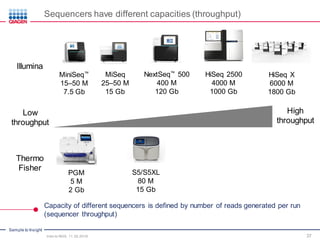
Capacity of different sequencers is defined by number of reads generated per run
(sequencer throughput)
Illumina
Thermo
Fisher
MiniSeq™
15–50 M
7.5 Gb
MiSeq
25–50 M
15 Gb
NextSeq™ 500
400 M
120 Gb
HiSeq 2500
4000 M
1000 Gb
HiSeq X
6000 M
1800 Gb
PGM
5 M
2 Gb
S5/S5XL
80 M
15 Gb
Low
throughput
High
throughput
Sequencers have different capacities (throughput)
Intro to NGS, 11.30.2016
Sample to Insight
38
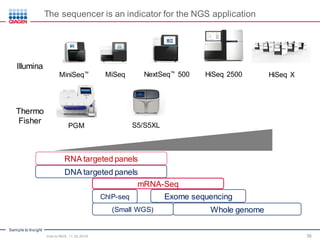
RNA targeted panels
DNA targeted panels
mRNA-Seq
ChIP-seq Exome sequencing
Whole genome(Small WGS)
The sequencer is an indicator for the NGS application
Intro to NGS, 11.30.2016
Illumina
MiniSeq™ MiSeq NextSeq™ 500 HiSeq 2500 HiSeq X
Thermo
Fisher
PGM S5/S5XL
Sample to Insight
39
Coverage – The proportion of a reference genome that has reads aligned to it.
Sequencing depths – Refers to the number of reads that cover a given position in a
reference.
Whole genome sequencing – Sequencing as much of the genome as possible to either
assemble a draft genome for new organisms or to identify sequence variants, chromosomal
rearrangements or other structural variants for organisms with a reference.
Exome sequencing = hybrid capture sequencing – Sequence only a subset of the genome
containing features of interest, which are selected out of a whole genome library using hybrid
capture.
Targeted panel sequencing = amplicon panel sequencing = targeted resequencing –
Regions of interest are amplified from gDNA or cDNA via PCR, and the amplicons are
sequenced. Offers greater sequencing depth than WGS, but focus on a small set of genomic
regions.
Key NGS vocabulary
Intro to NGS, 11.30.2016
Sample to Insight
40
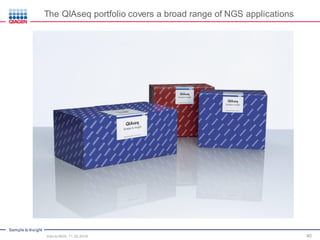
The QIAseq portfolio covers a broad range of NGS applications
Intro to NGS, 11.30.2016
Sample to Insight
41
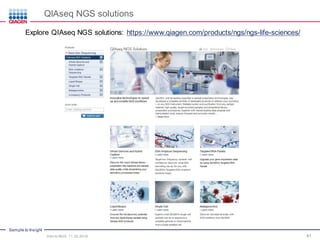
Explore QIAseq NGS solutions: https://www.qiagen.com/products/ngs/ngs-life-sciences/
Intro to NGS, 11.30.2016
QIAseq NGS solutions
Sample to Insight
42
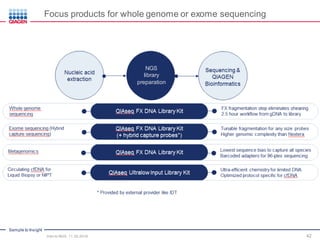
Focus products for whole genome or exome sequencing
Intro to NGS, 11.30.2016
NGS
Library
preparation
NGS
library
preparation
Sample to Insight
43
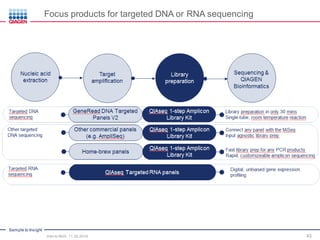
Focus products for targeted DNA or RNA sequencing
Intro to NGS, 11.30.2016
Sample to Insight
44
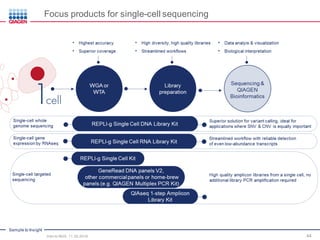
Focus products for single-cell sequencing
Intro to NGS, 11.30.2016
Sample to Insight
45
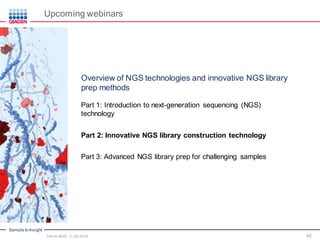
Overview of NGS technologies and innovative NGS library
prep methods
Part 1: Introduction to next-generation sequencing (NGS)
technology
Part 2: Innovative NGS library construction technology
Part 3: Advanced NGS library prep for challenging samples
Upcoming webinars
Intro to NGS, 11.30.2016
Sample to Insight
46
Questions?
All our solutions from Sample to Insight on:
QIAGEN.com
Contact QIAGEN technical service
Call: 1-800-426-8157 for US
Call: +49 2103-29-12400 EU
Email:
techservice-na@QIAGEN.com
techservice-eu@QIAGEN.com
QIASeq.NGS@QIAGEN.com
QIAwebinars@QIAGEN.com
Thank you for attending!
Intro to NGS, 11.30.2016

Introduction to Next-Generation Sequencing (NGS) Technology

  • 1.
    Sample to Insight Introductionto Next-Generation Sequencing (NGS) Wolfgang Krebs, R&D Scientist, QIAGEN 1Intro to NGS, 11.30.2016
  • 2.
    Sample to Insight 2 Overviewof NGS technologies and innovative NGS library prep methods Part 1: Introduction to next-generation sequencing (NGS) technology Part 2: Innovative NGS library construction technology Part 3: Advanced NGS library prep for challenging samples Welcome to a 3-part series: NGS technology and applications Intro to NGS, 11.30.2016
  • 3.
    Sample to Insight QIAGEN®products shown here are intended for molecular biology applications. These products are not intended for the diagnosis, prevention or treatment of a disease. For up-to-date licensing information and product-specific disclaimers, see the respective QIAGEN kit handbook or user manual. QIAGEN kit handbooks and user manuals are available at www.qiagen.com or can be requested from QIAGEN Technical Services or your local distributor. Legal disclaimer 3Intro to NGS, 11.30.2016
  • 4.
    Sample to Insight 4 •NGS background • NGS workflow • NGS technologies • NGS applications 1 2 3 4 Agenda Intro to NGS, 11.30.2016
  • 5.
    Sample to Insight 5 •NGS background • NGS workflow • NGS technologies • NGS applications 1 Agenda Intro to NGS, 11.30.2016 2 3 4
  • 6.
    Sample to Insight 6 Sequencerdevelopment Intro to NGS, 11.30.2016 -
  • 7.
    Sample to Insight 7 Rapiddecrease in cost Intro to NGS, 11.30.2016
  • 8.
    Sample to Insight 8 Illumina®with HiSeq® X in 2014… BUT data interpretation not included Veritas Genetics in 2016  $1000 genome Almost the $1000 genome…. Intro to NGS, 11.30.2016
  • 9.
    Sample to Insight 9 •NGS background • NGS workflow • NGS technologies • NGS applications 2 Agenda Intro to NGS, 11.30.2016 3 4 1
  • 10.
    Sample to Insight 10 Dataanalysis & interpretation Sequencing Sample extraction Library preparation Genomic DNA or RNA Library preparation Bring the DNA/RNA into a format that is usable to the sequencer Sequencing on Illumina or Ion Torrent™ platforms Data analysis The universal NGS workflow for Illumina/Ion Torrent Intro to NGS, 11.30.2016
  • 11.
    Sample to Insight 11 1.Create DNA fragments 2. Add platform-specific adapter sequences to every fragment 3. Amplify library molecules (optional) Library preparation Data analysis & interpretation Sequencing Sample extraction What NGS library prep accomplishes Intro to NGS, 11.30.2016
  • 12.
    Sample to Insight 12 300bp sample DNA insert Adapter ligation point Flowcell What the adapters do #1: Bind library to a flowcell or bead Intro to NGS, 11.30.2016
  • 13.
    Sample to Insight 13 Adapter ligation point AC TG A C TG A C TG A C TG A C TG Seq primer 1 Seq primer binding site Bridge amplification to form a cluster Bind primer and sequence What the adapters do #2: Add seq primer binding sites Intro to NGS, 11.30.2016
  • 14.
    Sample to Insight 14 Barcode1 Each 96-plex adapter includes two 8-base barcodes 8 barcode 1’s x 12 barcode 2’s = 96 combinations Pool barcoded libraries Single multiplexed NGS run Demultiplexing fastq fastq fastq fastq fastq fastq fastq fastq fastq fastq fastq fastq fastq fastq fastq fastq fastq fastq fastq fastq fastq fastq fastq fastq fastq fastq fastq fastq fastq fastq fastq fastq fastq fastq fastq fastq fastq fastq fastq fastq fastq fastq fastq fastq fastq fastq fastq fastq fastq fastq fastq fastq fastq fastq fastq fastq fastq fastq fastq fastq fastq fastq fastq fastq fastq fastq fastq fastq fastq fastq fastq fastq fastq fastq fastq fastq fastq fastq fastq fastq fastq fastq fastq fastq fastq fastq fastq fastq fastq fastq fastq fastq fastq fastq fastq fastq Separate FASTQ data files for each sample Multiplexed sequencing: Multiple samples sharing one sequencing reaction to reduce per-sample costs and control the amount of data generated per sample. Adapter ligation point What the adapters do #3: Add barcodes for multiplexing Intro to NGS, 11.30.2016
  • 15.
    Sample to Insight 15 Adapter– A short double-stranded DNA fragment that is ligated to the sample DNA fragments prior to sequencing. Barcode – Unique molecular identifiers included in adapter sequences . Library complexity – A measure of the proportion of unique molecules within a library. More complexity is better, and a high-complexity library is generally free of PCR duplicates, adapter-dimers and other artifacts. Multiplexing – Combining several different samples in one sequencing run. Demultiplexing – The act of separating reads from an NGS run into separate piles based on their index or barcode reads. Key NGS vocabulary Intro to NGS, 11.30.2016
  • 16.
    Sample to Insight 16 •NGS background • NGS workflow • NGS technologies • NGS applications 3 Agenda Intro to NGS, 11.30.2016 2 4 1
  • 17.
    Sample to Insight 17 1stgeneration sequencing • Sequence many identical molecules • Sequencing in large gels or capillary tubing limits scale What came before next-generation sequencing? Intro to NGS, 11.30.2016
  • 18.
    Sample to Insight 18 Howis next-generation sequencing different? Intro to NGS, 11.30.2016 1st generation sequencing • Sequence many identical molecules • Sequencing in large gels or capillary tubing limits scale 2nd generation sequencing • Sequence millions of clonally amplified molecules per run • Using a reversible, stepwise sequencing chemistry • Immobilized on a surface
  • 19.
    Sample to Insight 19 Whatcomes after NGS? Intro to NGS, 11.30.2016 3rd generation sequencing (NGS) • Single molecule sequencing in real-time • Generation of very long reads (>>5 kb) • Faster than 2nd gen (hours instead of days) • Still high on error rates 1st generation sequencing • Sequence many identical molecules • Sequencing in large gels or capillary tubing limits scale 2nd generation sequencing • Sequence millions of clonally amplified molecules per run • Using a reversible, stepwise sequencing chemistry • Immobilized on a surface
  • 20.
    Sample to Insight 20 Example:Illumina platforms 1. Cluster amplification 2. Sequencing What happens on the sequencer? Intro to NGS, 11.30.2016 Source: Cram genomics http://www.cram.com/flashcards/genomics-6416574
  • 21.
    Sample to Insight •DNA fragments are flanked with adaptors (library) • A solid surface is coated with primers complementary to the two adaptor sequences • Isothermal amplification, with one end of each “bridge” tethered to the surface • Clusters of DNA molecules are generated on the chip. Each cluster is originated from a single DNA fragment, and is thus a clonal population. • Used by Illumina 21 Bridge amplification (isothermal amplification) Intro to NGS, 11.30.2016
  • 22.
    Sample to Insight •Run time: 1–10 days • Produces: 2–1000 Gb of sequence • Read length: 2 x 50 bp – 2 x 250 bp (paired-end) • Cost: $0.05–$0.40/Mb 22 Illumina HiSeq/MiSeq® Intro to NGS, 11.30.2016 Image source: Nature Reviews 11. http://www.nature.com/nrg/journal/v11/n1/images/nrg2626-f2.jpg
  • 23.
    Sample to Insight Single-endreading (SE): • Sequencer reads a fragment from only one primer binding site Paired-end reading (PE): • Sequencer reads both ends of the same fragment • More sequencing information, reads can be more accurately placed (“mapped”) • May not be required for all experiments, more expensive and time-consuming • Required for high-order multiplexing of samples (indexes on both sides) Single-end reading 2nd strand synthesis Paired-end reading 23 Illumina single-end vs. paired-end Intro to NGS, 11.30.2016
  • 24.
    Sample to Insight •Fragments with adaptors (the library) are PCR amplified within a water drop in oil • One PCR primer is attached to the surface of a bead • DNA molecules are synthesized on the beads in the water droplet. Each bead bears clonal DNA originated from a single DNA fragment • Beads (with attached DNA) are then deposited into the wells of sequencing chips – one well, one bead 24 Emulsion PCR: Ion Torrent Intro to NGS, 11.30.2016 Image source: Shendure, J. and Hanlee, J. (2008) Next-generation DNA sequencing. Nature Biotechnology 26, 1135–45.
  • 25.
    Sample to Insight •Run time: 3 h; no termination or deprotection steps • Read length: 100–300 bp • Throughput determined by chip size (pH meter array): 10Mb – 5 Gb • Cost: $1–$20/Mb 25 Ion Torrent PGM/Proton Intro to NGS, 11.30.2016 Image sources: Rothberg, J.M., et al. (2011) An integrated semiconductor device enabling non-optical genome sequencing. Nature 475, 348–52. Tinning, M. (2012) Next gen sequencing platforms and applications. Australian Genome Research Facility slideshare. http://www.slideshare.net/AGRF_Ltd/ngs- technologies-platforms-and-applications?qid=d1e6ef45-c2de-41e5-8fa8-c7872ced32d3&v=&b=&from_search=1
  • 26.
    Sample to Insight 26 NGS– Next-generation sequencing. Flow cell – Name of the Illumina sample chip. Ready-to-sequence libraries are bound to the flow cell and bridge amplified prior to sequencing. Depending on the type of sequencer and the number of samples, different flow cell sizes are available. FASTQ file – default file format for sequencer output. Alignment – the act of “matching” reads to a reference genome. Key NGS vocabulary Intro to NGS, 11.30.2016
  • 27.
    Sample to Insight 27 •NGS background • NGS workflow • NGS technologies • NGS applications Agenda Intro to NGS, 11.30.2016 2 1 4 3
  • 28.
    Sample to Insight 28 Applicationareas Intro to NGS, 11.30.2016 Source: Rizzo, J.M. and Buck, M.J. (2012) Key principles and clinical applications of “next-generation” DNA sequencing. Cancer Prev Res (Phila) 5, 887–900.
  • 29.
    Sample to Insight 29 www.Illumina.com Allyou seq… Intro to NGS, 11.30.2016
  • 30.
    Sample to Insight 30 Largefraction of genome = greater costs, but greater ability to compare samples or patients across studies Small targeted panels = easier and less expensive to complete the project, but limited ability to follow up on new hypotheses or discover new associations Whole Genome Exome Sequencing DNA Targeted Panels RNA-Seq RNA targeted panels • Gene expression • Gene fusions • Splice variants (known targets) Four key NGS applications Intro to NGS, 11.30.2016 Image source: Simon, R. and Roychowdhury, S. (2013) Implementing personalized cancer genomics in clinical trials. Nature 12, 358–69.
  • 31.
    Sample to Insight 31 AnalyteSampleType Blood Tissue Metagenomics NGS applications – Details Intro to NGS, 11.30.2016
  • 32.
    Sample to Insight 32 AnalyteSampleType Blood Tissue Metagenomics Blood cells Circulating cell-free nucleic acids Circulating tumor cells (CTCs) Exosomes FFPE Fresh frozen Single cells Stool, soil, water, etc. NGS applications – Details Intro to NGS, 11.30.2016
  • 33.
    Sample to Insight 33 AnalyteSampleType Blood Tissue Metagenomics Blood cells Circulating cell-free Nucleic acids Circulating tumor cells (CTCs) Exosomes DNA RNA Epigenetics FFPE Fresh Frozen Single Cells Stool, soil, water, etc. NGS applications – Details Intro to NGS, 11.30.2016
  • 34.
    Sample to Insight 34 AnalyteSampleType Blood cells Circulating cell-free nucleic acids Circulating tumor cells (CTCs) Exosomes DNA RNA Epigenetics FFPE Fresh frozen Single cells Stool, soil, water, etc. Sequencing Targeted Non-targeted NGS applications – Details Intro to NGS, 11.30.2016
  • 35.
    Sample to Insight 35 TargetedSequencing PCR-based target enrichment (amplicon sequencing) Hybrid capture target enrichment (whole exome, targeted regions) Lib prep: End repair, A-tailing, adapter ligation PCR primers, target enrichment Adapter llgation point T Shearing of gDNA (enzymatic, mechanical) Lib prep: End repair, A-tailing, adapter ligation Hybrid capture with target-specific probes; enrich for target regions Extracted DNA Hybrid capture vs. amplicon sequencing Intro to NGS, 11.30.2016
  • 36.
    Sample to Insight 36 Whole genome Exome sequencing RNA-Seq DNA targeted panels Allbases, low depth ~5–100 M reads (variable) RNA targeted panels 90 Gb (30x human) ~25 M reads (100x) ~2 M reads* (1000x) Few bases, high depth ChIP- Seq ~5 M reads (variable) ~2 M reads (1000x) RNA DNA Gb = # reads x read length * Depends on gene number and sequencing depth Typical coverage or sequencing depth for key NGS applications Intro to NGS, 11.30.2016
  • 37.
    Sample to Insight 37 Capacityof different sequencers is defined by number of reads generated per run (sequencer throughput) Illumina Thermo Fisher MiniSeq™ 15–50 M 7.5 Gb MiSeq 25–50 M 15 Gb NextSeq™ 500 400 M 120 Gb HiSeq 2500 4000 M 1000 Gb HiSeq X 6000 M 1800 Gb PGM 5 M 2 Gb S5/S5XL 80 M 15 Gb Low throughput High throughput Sequencers have different capacities (throughput) Intro to NGS, 11.30.2016
  • 38.
    Sample to Insight 38 RNAtargeted panels DNA targeted panels mRNA-Seq ChIP-seq Exome sequencing Whole genome(Small WGS) The sequencer is an indicator for the NGS application Intro to NGS, 11.30.2016 Illumina MiniSeq™ MiSeq NextSeq™ 500 HiSeq 2500 HiSeq X Thermo Fisher PGM S5/S5XL
  • 39.
    Sample to Insight 39 Coverage– The proportion of a reference genome that has reads aligned to it. Sequencing depths – Refers to the number of reads that cover a given position in a reference. Whole genome sequencing – Sequencing as much of the genome as possible to either assemble a draft genome for new organisms or to identify sequence variants, chromosomal rearrangements or other structural variants for organisms with a reference. Exome sequencing = hybrid capture sequencing – Sequence only a subset of the genome containing features of interest, which are selected out of a whole genome library using hybrid capture. Targeted panel sequencing = amplicon panel sequencing = targeted resequencing – Regions of interest are amplified from gDNA or cDNA via PCR, and the amplicons are sequenced. Offers greater sequencing depth than WGS, but focus on a small set of genomic regions. Key NGS vocabulary Intro to NGS, 11.30.2016
  • 40.
    Sample to Insight 40 TheQIAseq portfolio covers a broad range of NGS applications Intro to NGS, 11.30.2016
  • 41.
    Sample to Insight 41 ExploreQIAseq NGS solutions: https://www.qiagen.com/products/ngs/ngs-life-sciences/ Intro to NGS, 11.30.2016 QIAseq NGS solutions
  • 42.
    Sample to Insight 42 Focusproducts for whole genome or exome sequencing Intro to NGS, 11.30.2016 NGS Library preparation NGS library preparation
  • 43.
    Sample to Insight 43 Focusproducts for targeted DNA or RNA sequencing Intro to NGS, 11.30.2016
  • 44.
    Sample to Insight 44 Focusproducts for single-cell sequencing Intro to NGS, 11.30.2016
  • 45.
    Sample to Insight 45 Overviewof NGS technologies and innovative NGS library prep methods Part 1: Introduction to next-generation sequencing (NGS) technology Part 2: Innovative NGS library construction technology Part 3: Advanced NGS library prep for challenging samples Upcoming webinars Intro to NGS, 11.30.2016
  • 46.
    Sample to Insight 46 Questions? Allour solutions from Sample to Insight on: QIAGEN.com Contact QIAGEN technical service Call: 1-800-426-8157 for US Call: +49 2103-29-12400 EU Email: techservice-na@QIAGEN.com techservice-eu@QIAGEN.com QIASeq.NGS@QIAGEN.com QIAwebinars@QIAGEN.com Thank you for attending! Intro to NGS, 11.30.2016

Editor's Notes

  • #6 In the past (10–15 years ago), sequencing may have been a more rarely used academic method – or a method only reserved for rich people desiring a personalized diagnostic. In 2016, the technique has become a standardized method to detect genetic diseases or cancer and has revolutionized the biomedical research and personalized healthcare. McKinsey listed next-generation sequencing (NGS) as one of the 12 technologies that will transform our lives.
  • #7 HiSeq 2000  0.2 10E+9 Kb HiSeq X System  0.9-1.8 10E+9 Kb  almost 10 times more than HiSeq2000
  • #8 Drastic decrease in sequencing costs per genome. To illustrate the nature of the reductions in DNA sequencing costs, each graph also shows hypothetical data reflecting Moore's Law, which describes a long-term trend in the computer hardware industry that involves the doubling of “computer power” every two years (See: Moore's Law [wikipedia.org]). Technology improvements that keep up with Moore's Law are widely regarded to be doing exceedingly well, making it useful for comparison. Moore’s law square.
  • #10 A very high proportion of current NGS sequencers use platforms from Illumina and Ion Torrent. Thus, I will describe a general NGS workflow applicable for these two sequencer types – which require a library preparation step, followed by performance of the sequencing reaction, itself, with sequencing-by-synthesis technology.
  • #12 Due to less efficient library construction – or due to the multiple PCR cycles required for library amplification – complexity can potentially decrease. A higher complexity means more unique molecules within an NGS library, which is always preferred to a lower complexity.
  • #15 [Mention our CLC Analysis software] Makes our Sample to Insight mission possible.
  • #18 Used either chemical or enzymatic methods to generate a nested set of DNA fragments. Used electrophoretic methods to separate the fragments. Required lots of DNA (100s of ng to 1 ug), so it typically involved cloning and/or PCR. Limited scale and throughput.
  • #19 Sequencers on the picture: Life Technologies/Applied Biosystems; now part of Thermo Fisher Scientific, SOLID 5500 Illumina MiSeq Ion Torrent PGM, also now part of Thermo Fisher Scientific Roche / 454 Pyrosequencer QIAGEN GeneReader
  • #20 --Pacific Biosciences RS II System / Sequel System (pictures 1+2) with the SMRT (single molecule real-time) sequencing technology Zero-Mode Waveguides (ZMWs) allow light to illuminate only the bottom of a well in which a DNA polymerase/template complex is immobilized. Phospholinked nucleotides allow observation of the immobilized complex as the DNA polymerase produces a completely natural DNA strand  Allows simultaneous epigenetic characterization (modified vs. unmodified bases) --Oxford Nanopore (pictures 3+4, “Pocket-sized” minION and “Desktop” PromethION [not available, only in early access program]) The Nanopore system uses a technique that passes intact DNA polymers through a protein nanopore, sequencing in real time as the DNA translocates the pore. DNA is sequenced by measuring the change in current across the membrane when the DNA passes through the pore; different base pairs have different conductance, and thus different signals.
  • #33 FFPE = Formalin-fixed paraffin-embedded
  • #37 Especially for targeted panels, the read counts and sequencing depth depends not only on the type of the panel with a lower or higher number of target regions but also on the type of analysis. A very sensitive variant calling analysis with 1% detection threshold needs a higher sequencing converage in comparison to a 5% threshold analysis.