Merkel cell
Dr. Shareefh Shaker
Student. Ala’a Al-Ruwaisan
Objectives
1. Introduction.
2. History.
3. What is the Merkel cell.
4. Location's Merkel cell.
5. Nervous system With Merkel cell.
6. Function of Merkel cell.
7. Polyoma virus morphology and genome structure.
8. Polyoma virus with Merkel cell.
9. Summary.
10. Reference.
Introduction
• I chose the topic " to me it's one of the names of diseases of the cancer, and the
proportion of, to the name of the world the discoverer of this disease . Later, however,
during the search and poll in the same thread I learned new information for the first
time read about it . And I liked that taking it to you through this presentation simple.
History of Merkel cell
1. Mer·kel  Friedrich Siegmund (1845–1919), German anatomist. A professor of anatomy, Merkel produced
a multivolume work on human anatomy.
2. He also introduced the use of Xylene and Celloidin into histological techniques and was the first to use
in anatomical illustration the now-standard color scheme: red for the arteries, blue for the veins, and
yellow for the nerves.
3. In 1880 he described the composite nervous and epithelial structures that are known as Merkel's disks
or corpuscles. The epithelial cells associated with these structures are now commonly called Merkel cells.
[a.2]
What is the Merkel cell Definition
• Merkel’s disks are slowly adapting Mechano receptors that respond through small receptive
fields to pressure and touch, particularly to indentation of the skin. [a.1]
• Other names Receptors, Merkels; Receptors. [b.1]
Location of Merkel cell
• Courtesy: James K Avery; Nancy Avery; Pauline F
Steele, editors. Oral Development and Histology.
• New York: Stuttgart: Thieme Medical Publishers, 2002) .[C.1]
•Merkel cells are found in the skin and some parts of the
mucosa of all vertebrates.
• In mammalian skin, they are clear cells found in the
stratum basale.
Anatomy of the skin showing the
epidermis and Merkel cell location
Hair shaft
Sensory nerves
DermisEpidermis
Sebaceous gland
sweat gland
Skin and Cutaneous Receptors [a.1]
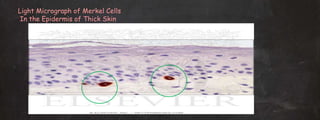
Light Micrograph of Merkel Cells
In the Epidermis of Thick Skin
Structural of Merkel cell ( Biology cell ):
Detail of Merkel’s disk [a.1]
Basal epithelial cells
Cytoplasmic protrusion
Merkel cell
Mitochondria
Desmosomes
Lobulated Nucleus
Granulated vesicles
Expanded axon terminal
Schwann cell
Nervous system With Merkel cell (Neurology):
1. The peripheral nervous system can be subdivided into somatic
and autonomic components.
2. The somatic nervous system contains motor nerves and
sensory nerves innervating skin and muscle.
3. The soma (cell bodies) of motor nerves and sensory nerves
are located in the gray matter of the anterior horn of the
spinal cord and in the dorsal root ganglia, respectively.[a.1]
Somatic Component of the Peripheral Nervous System [a.1]
Function of Merkel cell
1. “Touch cells" but this proposed function has been controversial as it has been hard to prove.
2. Sometimes considered APUD because they contain dense core granules, and thus may also have
a neuroendocrine function
• APUD cells (amine precursor uptake and decarboxylation)
 a group of apparently unrelated cells that secrete most of the body's hormones, with the exception of steroids.
 Included are both specialized neurons and other endocrine cells that synthesize structurally related polypeptides and biogenic
amines.
 The name comes from the fact that polypeptide production is linked to the uptake of a precursor amino acid and its
decarboxylation in the cell to produce an amine.
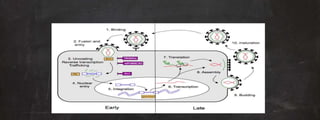
Polyoma virus morphology and genome structure (PVM)
• The virions are small non-enveloped icosahedral particles of 40–45 nm diameter, with a
circular double-stranded DNA genome.
• The particles are stable enduring high temperatures with little loss of infectivity.
• PyV genomes can be divided into different functional parts.
• The non-coding control region (NCCR) harbors the origin of replication, the transcription start sites as well as
promoter/enhancer elements with a multitude of seemingly redundant consensus sequences for DNA binding proteins
and transcription factors.
• The NCCR regulates the expression of the viral early and late genes in concert with the activation and
differentiation state of the host cell.
Merkel Cell Carcinoma (MCC)
1. The human markel cell polomaviruse (MCPyV or MCV)was discovered in 2008 and found
to be clonally integrated into markel cell carcinomas(MCCs), establishing it as first
oncovirus from the polomavirus family.
2. Merkel Cell Carcinoma (MCC) is a rare, aggressive neoplasm, which commonly involves the skin,
but can subsequently to lymph nodes and other organs.[a.3]
1. These tumors are believed to arise from Neuroendocrine -derived mechanoreceptor Merkel
cells, located in the basal layer of the epidermis, that form synapse-like contacts with enlarged
nerve terminals.[a.3]
Merkel Cell Carcinoma (MCC)
• By all accounts, the virus is obtained during early childhood via transmission by either fecal-oral, respiratory, or
cutaneous routes and results in a mostly asymptomatic primary infection.
• The virus is maintained as part of the normal microflora of mainly the skin, where it is chronically shed in the
form of encapsidated virions.
• Localized or systemic compromises to the immune system, brought on by UV radiation, natural aging, AIDS, or
drug-induced suppression of the immune system such as occurs in organ transplant recipients, are likely to lead
to less effective host immune surveil- lance and subsequent virus reactivation.
 At least two mutational events occur that are critical steps in the proposed model of MCPyV-induced
carcinogenesis
• acquired immune deficiency syndrome (AIDS)
Merkel Cell Carcinoma (MCC)
• One mutational event is the integration of the viral genome into the host chromosome, The exogenous
forces responsible for this event range from UV and ionizing radiation exposure to a defect in the virus
itself.[a.3]
• An additional event important in MCPyV-induced carcinogenesis is mutation of the viral genome in a
manner that renders the virus unable to replicate. The most common mutations occur in the carboxy
terminus of LT, which generate a truncated LT that lacks the helicase domain required for replication yet
preserve its oncogenic functions.[a.3]
• Persistent expression of truncated LT and sT from the integrated MCPyV genome can inactivate pRb
tumor suppressor function and promote and/or deregulate cap-dependent translation initiation,
respectively. [a.3]
• Ultimately, the cells in which integration of a replication-defective MCPyV is successful become addicted
to viral oncogene expression and undergo clonal expansion and neoplastic progression to cause
development of MCC.[a.3]
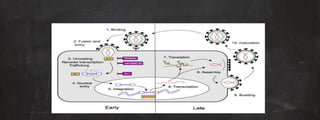
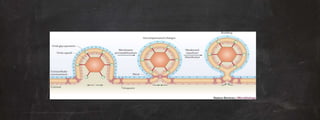
Merkel cell polyomavirus (MCV), which has tumour-specific
truncation mutations, illustrates common features among the human
tumour viruses involving immunity, virus replication and tumour
suppressor targeting. Although MCV is a common infection, loss of
immune surveillance through ageing, AIDS or transplantation and
subsequent treatment with immunosuppressive drugs may lead to
resurgent MCV replication in skin cells. If a rare integration
mutation into the host cell genome occurs, the MCV T antigen can
activate independent DNA replication from the integrated viral
origin that will cause DNA strand breaks in the proto-tumour cell.
A second mutation that truncates the T antigen, eliminating its
viral replication functions but sparing its RB1 tumour suppressor
targeting domains, is required for the survival of the nascent
Merkel tumour cell. Exposure to sunlight (possibly ultraviolet (UV)
irradiation) and other environmental mutagens may enhance the
sequential mutation events that turn this asymptomatic viral
infection into a cancer virus.
The molecular evolution of a human tumour virus [b.2]
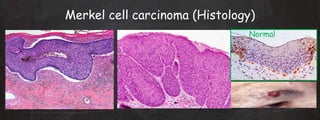
Merkel cell carcinoma (Histology)
Normal
Reference
a. Books
1. NETTER’S ESSENTIAL PHYSIOLOGY , E. Mulroney, PhD , K. Myers, PhD
2. Merriam-webster's Medical Dictionary
3. Virology , Merkel cell polyomavirus: A newly discovered human virus with oncogenic potential
b. Website
1. http://www.reference.md/files/D018/mD018862.html (pub med)
2. http://www.nature.com/nrc/journal/v10/n12/fig_tab/nrc2961_F4.html Nature Reviews Cancer
C. Publications
1. Pathophysiology of merkel cell , Prashant Balasaheb Munde, Shubhangi P Khandekar, Alka A Dive, Aparna Sharma
2. Merkel cell polyomavirus: A newly discovered human virus with oncogenic potential
Any question
Thank you

Merkel cell

  • 1.
    Merkel cell Dr. ShareefhShaker Student. Ala’a Al-Ruwaisan
  • 2.
    Objectives 1. Introduction. 2. History. 3.What is the Merkel cell. 4. Location's Merkel cell. 5. Nervous system With Merkel cell. 6. Function of Merkel cell. 7. Polyoma virus morphology and genome structure. 8. Polyoma virus with Merkel cell. 9. Summary. 10. Reference.
  • 3.
    Introduction • I chosethe topic " to me it's one of the names of diseases of the cancer, and the proportion of, to the name of the world the discoverer of this disease . Later, however, during the search and poll in the same thread I learned new information for the first time read about it . And I liked that taking it to you through this presentation simple.
  • 4.
    History of Merkelcell 1. Mer·kel Friedrich Siegmund (1845–1919), German anatomist. A professor of anatomy, Merkel produced a multivolume work on human anatomy. 2. He also introduced the use of Xylene and Celloidin into histological techniques and was the first to use in anatomical illustration the now-standard color scheme: red for the arteries, blue for the veins, and yellow for the nerves. 3. In 1880 he described the composite nervous and epithelial structures that are known as Merkel's disks or corpuscles. The epithelial cells associated with these structures are now commonly called Merkel cells. [a.2]
  • 5.
    What is theMerkel cell Definition • Merkel’s disks are slowly adapting Mechano receptors that respond through small receptive fields to pressure and touch, particularly to indentation of the skin. [a.1] • Other names Receptors, Merkels; Receptors. [b.1]
  • 6.
    Location of Merkelcell • Courtesy: James K Avery; Nancy Avery; Pauline F Steele, editors. Oral Development and Histology. • New York: Stuttgart: Thieme Medical Publishers, 2002) .[C.1] •Merkel cells are found in the skin and some parts of the mucosa of all vertebrates. • In mammalian skin, they are clear cells found in the stratum basale.
  • 7.
    Anatomy of theskin showing the epidermis and Merkel cell location Hair shaft Sensory nerves DermisEpidermis Sebaceous gland sweat gland Skin and Cutaneous Receptors [a.1]
  • 8.
    Light Micrograph ofMerkel Cells In the Epidermis of Thick Skin
  • 9.
    Structural of Merkelcell ( Biology cell ): Detail of Merkel’s disk [a.1] Basal epithelial cells Cytoplasmic protrusion Merkel cell Mitochondria Desmosomes Lobulated Nucleus Granulated vesicles Expanded axon terminal Schwann cell
  • 10.
    Nervous system WithMerkel cell (Neurology): 1. The peripheral nervous system can be subdivided into somatic and autonomic components. 2. The somatic nervous system contains motor nerves and sensory nerves innervating skin and muscle. 3. The soma (cell bodies) of motor nerves and sensory nerves are located in the gray matter of the anterior horn of the spinal cord and in the dorsal root ganglia, respectively.[a.1] Somatic Component of the Peripheral Nervous System [a.1]
  • 11.
    Function of Merkelcell 1. “Touch cells" but this proposed function has been controversial as it has been hard to prove. 2. Sometimes considered APUD because they contain dense core granules, and thus may also have a neuroendocrine function • APUD cells (amine precursor uptake and decarboxylation)  a group of apparently unrelated cells that secrete most of the body's hormones, with the exception of steroids.  Included are both specialized neurons and other endocrine cells that synthesize structurally related polypeptides and biogenic amines.  The name comes from the fact that polypeptide production is linked to the uptake of a precursor amino acid and its decarboxylation in the cell to produce an amine.
  • 12.
    Polyoma virus morphologyand genome structure (PVM) • The virions are small non-enveloped icosahedral particles of 40–45 nm diameter, with a circular double-stranded DNA genome. • The particles are stable enduring high temperatures with little loss of infectivity. • PyV genomes can be divided into different functional parts. • The non-coding control region (NCCR) harbors the origin of replication, the transcription start sites as well as promoter/enhancer elements with a multitude of seemingly redundant consensus sequences for DNA binding proteins and transcription factors. • The NCCR regulates the expression of the viral early and late genes in concert with the activation and differentiation state of the host cell.
  • 15.
    Merkel Cell Carcinoma(MCC) 1. The human markel cell polomaviruse (MCPyV or MCV)was discovered in 2008 and found to be clonally integrated into markel cell carcinomas(MCCs), establishing it as first oncovirus from the polomavirus family. 2. Merkel Cell Carcinoma (MCC) is a rare, aggressive neoplasm, which commonly involves the skin, but can subsequently to lymph nodes and other organs.[a.3] 1. These tumors are believed to arise from Neuroendocrine -derived mechanoreceptor Merkel cells, located in the basal layer of the epidermis, that form synapse-like contacts with enlarged nerve terminals.[a.3]
  • 16.
    Merkel Cell Carcinoma(MCC) • By all accounts, the virus is obtained during early childhood via transmission by either fecal-oral, respiratory, or cutaneous routes and results in a mostly asymptomatic primary infection. • The virus is maintained as part of the normal microflora of mainly the skin, where it is chronically shed in the form of encapsidated virions. • Localized or systemic compromises to the immune system, brought on by UV radiation, natural aging, AIDS, or drug-induced suppression of the immune system such as occurs in organ transplant recipients, are likely to lead to less effective host immune surveil- lance and subsequent virus reactivation.  At least two mutational events occur that are critical steps in the proposed model of MCPyV-induced carcinogenesis • acquired immune deficiency syndrome (AIDS)
  • 17.
    Merkel Cell Carcinoma(MCC) • One mutational event is the integration of the viral genome into the host chromosome, The exogenous forces responsible for this event range from UV and ionizing radiation exposure to a defect in the virus itself.[a.3] • An additional event important in MCPyV-induced carcinogenesis is mutation of the viral genome in a manner that renders the virus unable to replicate. The most common mutations occur in the carboxy terminus of LT, which generate a truncated LT that lacks the helicase domain required for replication yet preserve its oncogenic functions.[a.3] • Persistent expression of truncated LT and sT from the integrated MCPyV genome can inactivate pRb tumor suppressor function and promote and/or deregulate cap-dependent translation initiation, respectively. [a.3] • Ultimately, the cells in which integration of a replication-defective MCPyV is successful become addicted to viral oncogene expression and undergo clonal expansion and neoplastic progression to cause development of MCC.[a.3]
  • 18.
    Merkel cell polyomavirus(MCV), which has tumour-specific truncation mutations, illustrates common features among the human tumour viruses involving immunity, virus replication and tumour suppressor targeting. Although MCV is a common infection, loss of immune surveillance through ageing, AIDS or transplantation and subsequent treatment with immunosuppressive drugs may lead to resurgent MCV replication in skin cells. If a rare integration mutation into the host cell genome occurs, the MCV T antigen can activate independent DNA replication from the integrated viral origin that will cause DNA strand breaks in the proto-tumour cell. A second mutation that truncates the T antigen, eliminating its viral replication functions but sparing its RB1 tumour suppressor targeting domains, is required for the survival of the nascent Merkel tumour cell. Exposure to sunlight (possibly ultraviolet (UV) irradiation) and other environmental mutagens may enhance the sequential mutation events that turn this asymptomatic viral infection into a cancer virus. The molecular evolution of a human tumour virus [b.2]
  • 20.
    Merkel cell carcinoma(Histology) Normal
  • 21.
    Reference a. Books 1. NETTER’SESSENTIAL PHYSIOLOGY , E. Mulroney, PhD , K. Myers, PhD 2. Merriam-webster's Medical Dictionary 3. Virology , Merkel cell polyomavirus: A newly discovered human virus with oncogenic potential b. Website 1. http://www.reference.md/files/D018/mD018862.html (pub med) 2. http://www.nature.com/nrc/journal/v10/n12/fig_tab/nrc2961_F4.html Nature Reviews Cancer C. Publications 1. Pathophysiology of merkel cell , Prashant Balasaheb Munde, Shubhangi P Khandekar, Alka A Dive, Aparna Sharma 2. Merkel cell polyomavirus: A newly discovered human virus with oncogenic potential
  • 22.
  • 23.