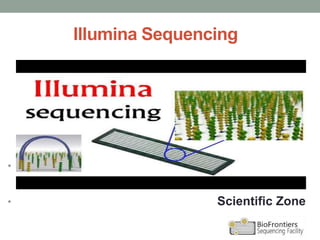
Illumina Sequencing
•
• Scientific Zone
Introduction to Illumina Sequencing
• Overview of Next-gen sequencing
• Introduction to Illumina sequencing
• Multiplexing
• Sequencing run statistics
Next-Gen Sequencing
• Millions of reactions performed in parallel
• Shorter read lengths, higher error rate
• Sample/library prep is required
• Many different approaches
• Illumina sequencing-by-synthesis (Solexa technology)
• Roche 454 pyrosequencing
• AB SOLID color-based sequencing by ligation
• Ion Torrent semiconductor sequencing
• Single-molecule sequencing (PacBio, MinION, etc)
Some general terminology
• SR: single-read sequencing, sequence from only one end
• PE: paired-end sequencing, sequence from both ends
• Adapters: DNA added to the ends of DNA/RNA fragments
to be sequenced. The adapters allow the DNA/RNA to
attach to the flowcell
• Index/barcode: used interchangeable to indicate
sequence identifier for multiplexing
• PhiX: commercially available genomic library of PhiX
bacteriophage DNA, commonly spiked into libraries
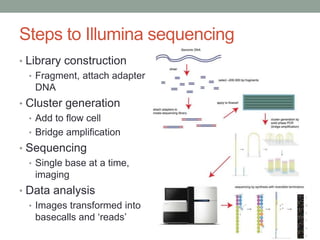
Steps to Illumina sequencing
• Library construction
• Fragment, attach adapter
DNA
• Cluster generation
• Add to flow cell
• Bridge amplification
• Sequencing
• Single base at a time,
imaging
• Data analysis
• Images transformed into
basecalls and ‘reads’
Illumina sequencing
• SBS chemistry video
• http://www.illumina.com/technology/next-generation-
sequencing/sequencing-technology.html
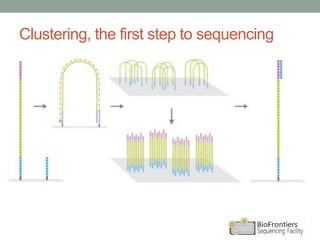
Clustering, the first step to sequencing
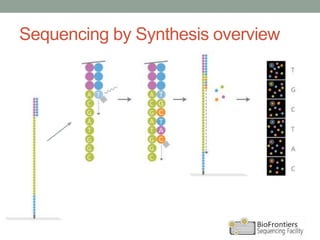
Sequencing by Synthesis overview
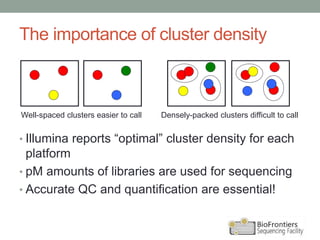
The importance of cluster density
• Illumina reports “optimal” cluster density for each
platform
• pM amounts of libraries are used for sequencing
• Accurate QC and quantification are essential!
Well-spaced clusters easier to call Densely-packed clusters difficult to call
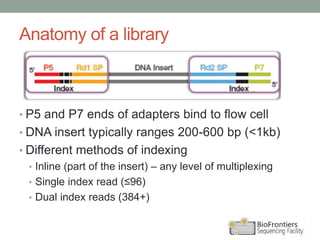
Anatomy of a library
• P5 and P7 ends of adapters bind to flow cell
• DNA insert typically ranges 200-600 bp (<1kb)
• Different methods of indexing
• Inline (part of the insert) – any level of multiplexing
• Single index read (≤96)
• Dual index reads (384+)
5 This content is for research use only, not for diagnostic purposes
The aim of the sample prep step is to obtain nucleic
acid fragments with adapters attached on both ends
Dual Index Library shown
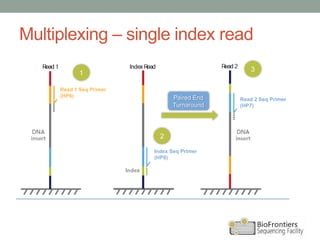
Multiplexing – single index read
38 FOR RESEARCH USE ONLY
Read 2 Seq Primer
(HP7)
Read 1 Seq Primer
(HP6)
Index Seq Primer
(HP8)
1
2
3
Multiplex Sequencing Utilizes 3 Sequencing Reads
Paired End
Turnaround
Single Index Sequencing Utilizes 3 Sequencing Reads
Sequencing with Paired Ends
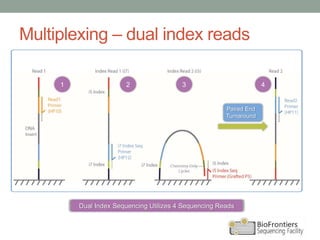
Multiplexing – dual index reads
• hf
40 FOR RESEARCH USE ONLY
1 2 3
Paired End
Turnaround
4
Dual Index Sequencing Utilizes 4 Sequencing Reads
Sequencing Paired End Libraries with Dual Index Read
Some terminology
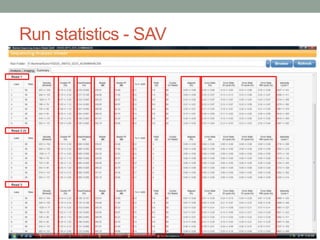
• Clusters (raw): number of clusters detected through imaging
• Reads: the number of reads – some people refer to a cluster as a read (a DNA
molecule), others refer to the number of sequences so for PE data this is 2 x DNA
molecules
• % passed-filter (%PF): % of clusters or reads that pass a chastity filter (the useable
clusters)
• %>=Q30: % of bases that have a quality score greater than 30 (e.g. high-quality reads)
• % aligned: percent of PF reads uniquely aligned to PhiX genome (should be close to
the %PhiX spiked in)
• Error rate: calculated error rate based on alignment to PhiX
• Phasing/Prephasing: percentage of molecules in a cluster that fall behind (phasing) or
ahead (prephasing) of the current cycle during sequencing
Run statistics - SAV
• df
Considerations for your library
• The first 25 bases of a read are used by the
instrument
• Bases 1-4 used to create cluster ‘map’ – high diversity
is critical
• Bases 1-12 used for phasing/prephasing calculations
• Quality scores and alignment to PhiX start at cycle 26
• Phasing/prephasing increases with read length
• Cluster images grow with read length and PE
turnaround
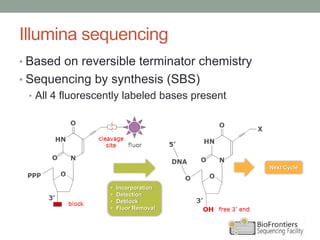
Illumina sequencing
• Based on reversible terminator chemistry
• Sequencing by synthesis (SBS)
• All 4 fluorescently labeled bases present
24 FOR RESEARCH USE ONLY
• All 4 labeled nucleotides in 1 reaction
• Higher accuracy
• No problems with homopolymer repeats
• Incorporation
• Detection
• Deblock
• Fluor Removal
Next Cycle
Reversible Terminator Chemistry

Intro to illumina sequencing

  • 1.
  • 2.
    Introduction to IlluminaSequencing • Overview of Next-gen sequencing • Introduction to Illumina sequencing • Multiplexing • Sequencing run statistics
  • 3.
    Next-Gen Sequencing • Millionsof reactions performed in parallel • Shorter read lengths, higher error rate • Sample/library prep is required • Many different approaches • Illumina sequencing-by-synthesis (Solexa technology) • Roche 454 pyrosequencing • AB SOLID color-based sequencing by ligation • Ion Torrent semiconductor sequencing • Single-molecule sequencing (PacBio, MinION, etc)
  • 4.
    Some general terminology •SR: single-read sequencing, sequence from only one end • PE: paired-end sequencing, sequence from both ends • Adapters: DNA added to the ends of DNA/RNA fragments to be sequenced. The adapters allow the DNA/RNA to attach to the flowcell • Index/barcode: used interchangeable to indicate sequence identifier for multiplexing • PhiX: commercially available genomic library of PhiX bacteriophage DNA, commonly spiked into libraries
  • 5.
    Steps to Illuminasequencing • Library construction • Fragment, attach adapter DNA • Cluster generation • Add to flow cell • Bridge amplification • Sequencing • Single base at a time, imaging • Data analysis • Images transformed into basecalls and ‘reads’
  • 6.
    Illumina sequencing • SBSchemistry video • http://www.illumina.com/technology/next-generation- sequencing/sequencing-technology.html
  • 7.
    Clustering, the firststep to sequencing
  • 8.
  • 9.
    The importance ofcluster density • Illumina reports “optimal” cluster density for each platform • pM amounts of libraries are used for sequencing • Accurate QC and quantification are essential! Well-spaced clusters easier to call Densely-packed clusters difficult to call
  • 10.
    Anatomy of alibrary • P5 and P7 ends of adapters bind to flow cell • DNA insert typically ranges 200-600 bp (<1kb) • Different methods of indexing • Inline (part of the insert) – any level of multiplexing • Single index read (≤96) • Dual index reads (384+) 5 This content is for research use only, not for diagnostic purposes The aim of the sample prep step is to obtain nucleic acid fragments with adapters attached on both ends Dual Index Library shown
  • 11.
    Multiplexing – singleindex read 38 FOR RESEARCH USE ONLY Read 2 Seq Primer (HP7) Read 1 Seq Primer (HP6) Index Seq Primer (HP8) 1 2 3 Multiplex Sequencing Utilizes 3 Sequencing Reads Paired End Turnaround Single Index Sequencing Utilizes 3 Sequencing Reads Sequencing with Paired Ends
  • 12.
    Multiplexing – dualindex reads • hf 40 FOR RESEARCH USE ONLY 1 2 3 Paired End Turnaround 4 Dual Index Sequencing Utilizes 4 Sequencing Reads Sequencing Paired End Libraries with Dual Index Read
  • 13.
    Some terminology • Clusters(raw): number of clusters detected through imaging • Reads: the number of reads – some people refer to a cluster as a read (a DNA molecule), others refer to the number of sequences so for PE data this is 2 x DNA molecules • % passed-filter (%PF): % of clusters or reads that pass a chastity filter (the useable clusters) • %>=Q30: % of bases that have a quality score greater than 30 (e.g. high-quality reads) • % aligned: percent of PF reads uniquely aligned to PhiX genome (should be close to the %PhiX spiked in) • Error rate: calculated error rate based on alignment to PhiX • Phasing/Prephasing: percentage of molecules in a cluster that fall behind (phasing) or ahead (prephasing) of the current cycle during sequencing
  • 14.
    Run statistics -SAV • df
  • 15.
    Considerations for yourlibrary • The first 25 bases of a read are used by the instrument • Bases 1-4 used to create cluster ‘map’ – high diversity is critical • Bases 1-12 used for phasing/prephasing calculations • Quality scores and alignment to PhiX start at cycle 26 • Phasing/prephasing increases with read length • Cluster images grow with read length and PE turnaround
  • 16.
    Illumina sequencing • Basedon reversible terminator chemistry • Sequencing by synthesis (SBS) • All 4 fluorescently labeled bases present 24 FOR RESEARCH USE ONLY • All 4 labeled nucleotides in 1 reaction • Higher accuracy • No problems with homopolymer repeats • Incorporation • Detection • Deblock • Fluor Removal Next Cycle Reversible Terminator Chemistry