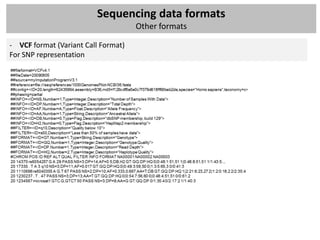
The workshop covers the main principles and data formats in sequencing data analysis, detailing steps from sample preparation to high-level analysis including various file types like fastq, bam, and vcf. It emphasizes cost considerations in next-generation sequencing (NGS) studies and provides practical exercises involving data retrieval and manipulation using command line tools. The document also discusses mapping techniques and common data formats used in genomic analysis, highlighting their applications in downstream analysis and visualization.
Sequencing data analysis
Workshop– part 1 / main principles and data formats
Outline
Introduction
Sequencing flow
Main data formats throughout this flow
Maté Ongenaert
Introduction
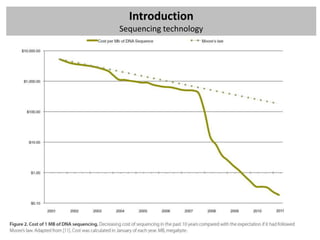
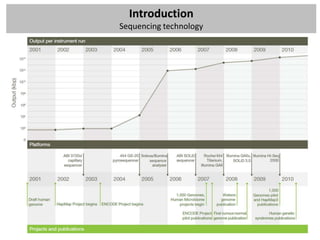
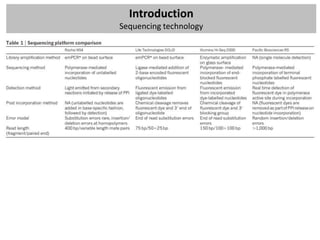
Sequencing technology
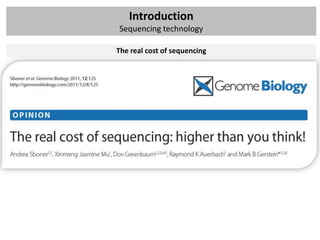
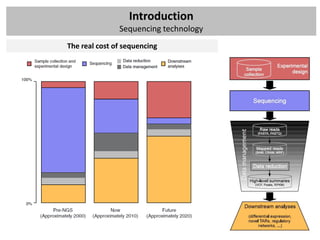
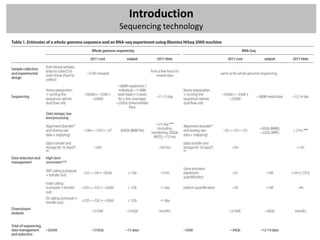
The real cost of sequencing
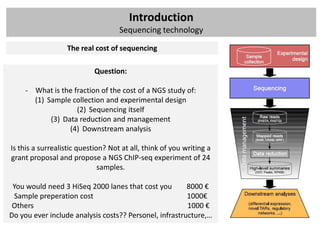
Question:
- What is the fraction of the cost of a NGS study of:
(1) Sample collection and experimental design
(2) Sequencing itself
(3) Data reduction and management
(4) Downstream analysis
Is this a surrealistic question? Not at all, think of you writing a
grant proposal and propose a NGS ChIP-seq experiment of 24
samples.
You would need 3 HiSeq 2000 lanes that cost you 8000 €
Sample preperation cost 1000€
Others 1000 €
Do you ever include analysis costs?? Personel, infrastructure,…
4.
Introduction
Sequencing technology
The real cost of sequencing
Sequencing data analysis
Workshop– part 1 / main principles and data formats
Outline
Introduction
Sequencing flow
Main data formats throughout this flow
Maté Ongenaert
11.
Sequencing flow
Steps insequencing experiments
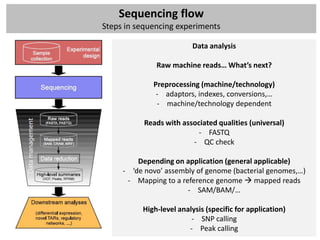
Data analysis
Raw machine reads… What’s next?
Preprocessing (machine/technology)
- adaptors, indexes, conversions,…
- machine/technology dependent
Reads with associated qualities (universal)
- FASTQ
- QC check
Depending on application (general applicable)
- ‘de novo’ assembly of genome (bacterial genomes,…)
- Mapping to a reference genome mapped reads
- SAM/BAM/…
High-level analysis (specific for application)
- SNP calling
- Peak calling
Sequencing data analysis
Workshop– part 1 / main principles and data formats
Outline
Introduction
Sequencing flow
Main data formats throughout this flow
Maté Ongenaert
14.
Sequencing flow
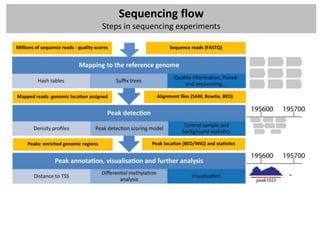
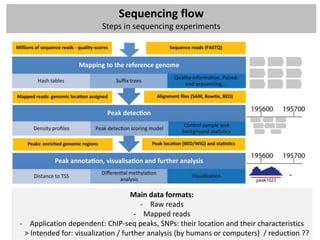
Steps in sequencing experiments
Main data formats:
- Raw reads
- Mapped reads
- Application dependent: ChIP-seq peaks, SNPs: their location and their characteristics
> Intended for: visualization / further analysis (by humans or computers) / reduction ??
15.
Sequencing data formats
Raw reads
Raw sequence reads:
- Represent the sequence ~ FASTA
>SEQUENCE_IDENTIFIER
GATTTGGGGTTCAAAGCAGTATCGATCAAATAGTAAATCCATTTGTTCAACTCACAGTTT
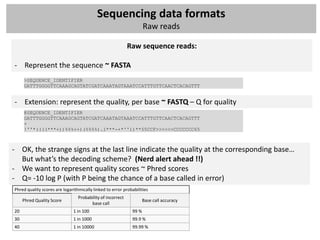
- Extension: represent the quality, per base ~ FASTQ – Q for quality
@SEQUENCE_IDENTIFIER
GATTTGGGGTTCAAAGCAGTATCGATCAAATAGTAAATCCATTTGTTCAACTCACAGTTT
+
!''*((((***+))%%%++)(%%%%).1***-+*''))**55CCF>>>>>>CCCCCCC65
- OK, the strange signs at the last line indicate the quality at the corresponding base…
But what’s the decoding scheme? (Nerd alert ahead !!)
- We want to represent quality scores ~ Phred scores
- Q= -10 log P (with P being the chance of a base called in error)
Phred quality scores are logarithmically linked to error probabilities
Probability of incorrect
Phred Quality Score Base call accuracy
base call
20 1 in 100 99 %
30 1 in 1000 99.9 %
40 1 in 10000 99.99 %
16.
Sequencing data formats
Raw reads
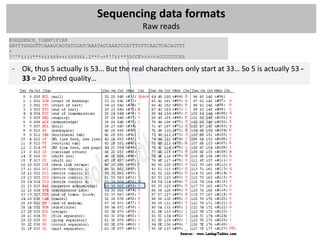
- Phred scores thus typically have 2 digits – you want one digit to allow correspondance
in the file… What would a nerd do? Use ASCII as lookup-table of course! one
character ~ one decimal number
17.
Sequencing data formats
Raw reads
@SEQUENCE_IDENTIFIER
GATTTGGGGTTCAAAGCAGTATCGATCAAATAGTAAATCCATTTGTTCAACTCACAGTTT
+
!''*((((***+))%%%++)(%%%%).1***-+*''))**55CCF>>>>>>CCCCCCC65
- Ok, thus 5 actually is 53… But the real charachters only start at 33… So 5 is actually 53 -
33 = 20 phred quality…
18.
Sequencing data formats
Raw reads
@SEQUENCE_IDENTIFIER
GATTTGGGGTTCAAAGCAGTATCGATCAAATAGTAAATCCATTTGTTCAACTCACAGTTT
+
!''*((((***+))%%%++)(%%%%).1***-+*''))**55CCF>>>>>>CCCCCCC65
Example of the identifier line for Illumina data (non-multiplexed):
#@machine_id:lane:tile:x:y:multiplex:pair
@HWUSI-EAS100R:6:73:941:1973#0/1
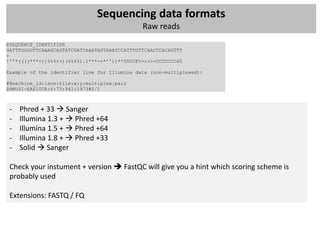
- Phred + 33 Sanger
- Illumina 1.3 + Phred +64
- Illumina 1.5 + Phred +64
- Illumina 1.8 + Phred +33
- Solid Sanger
Check your instument + version FastQC will give you a hint which scoring scheme is
probably used
Extensions: FASTQ / FQ
19.
Sequencing data formats
Raw reads
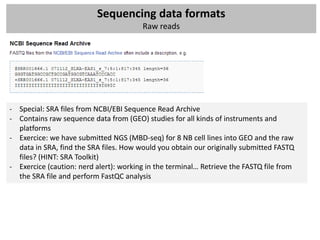
- Special: SRA files from NCBI/EBI Sequence Read Archive
- Contains raw sequence data from (GEO) studies for all kinds of instruments and
platforms
- Exercice: we have submitted NGS (MBD-seq) for 8 NB cell lines into GEO and the raw
data in SRA, find the SRA files. How would you obtain our originally submitted FASTQ
files? (HINT: SRA Toolkit)
- Exercice (caution: nerd alert): working in the terminal… Retrieve the FASTQ file from
the SRA file and perform FastQC analysis
20.
Linux… for humanbeings?
The terminal
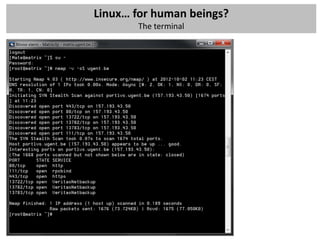
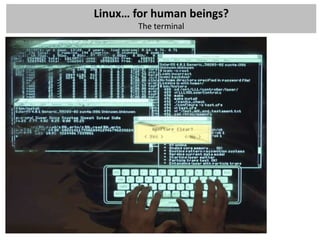
What they show in ‘The matrix’ is a real Linux-terminal and
real commands…
Linux… for humanbeings?
The terminal
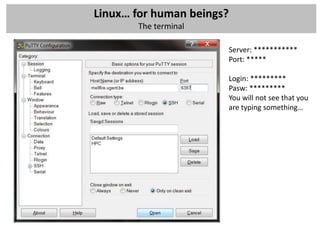
Server: ***********
Port: *****
Login: *********
Pasw: *********
You will not see that you
are typing something…
23.
Linux… for humanbeings?
The terminal
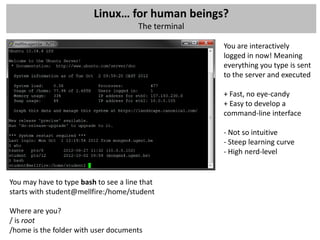
You are interactively
logged in now! Meaning
everything you type is sent
to the server and executed
+ Fast, no eye-candy
+ Easy to develop a
command-line interface
- Not so intuitive
- Steep learning curve
- High nerd-level
You may have to type bash to see a line that
starts with student@mellfire:/home/student
Where are you?
/ is root
/home is the folder with user documents
24.
Linux… for humanbeings?
The terminal
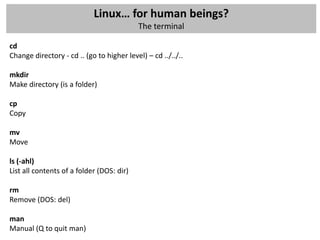
cd
Change directory - cd .. (go to higher level) – cd ../../..
mkdir
Make directory (is a folder)
cp
Copy
mv
Move
ls (-ahl)
List all contents of a folder (DOS: dir)
rm
Remove (DOS: del)
man
Manual (Q to quit man)
25.
Linux… for humanbeings?
The terminal
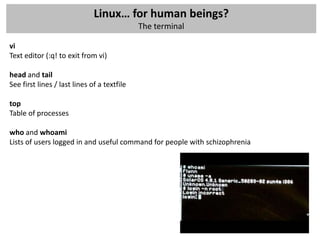
vi
Text editor (:q! to exit from vi)
head and tail
See first lines / last lines of a textfile
top
Table of processes
who and whoami
Lists of users logged in and useful command for people with schizophrenia
Sequencing data formats
Mapped reads
- Mapping: ‘align’ these raw reads to a reference genome
- Single-end or paired-end data?
- How would you align a short read to the reference?
- Old-school: Smith-Watherman, BLAST, BLAT,…
- Now: mapping tools for short reads that use intelligent indexing and allow mismatches
Algorithm
Other features
Hash table Suffix tree Merge sorting
Hash Hash Enhanced
Program Reference Suffix tree FM-index Merge sorting Colorspace 454 Quality Paired end Long reads Bisulfite
reference reads suffix array
SOAP [51] X X X X
MAQ [54] X X X X X
Mosaik X X X X X
Eland X X
SSAHA2 [61] X X X
Bowtie [67] X X X X
BWA [69] X X X X
BWA-SW [69] X X X X X
SOAP2 [70] X X X X X
28.
Sequencing data formats
Mapped reads
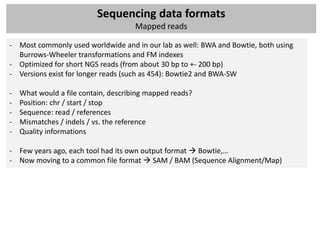
- Most commonly used worldwide and in our lab as well: BWA and Bowtie, both using
Burrows-Wheeler transformations and FM indexes
- Optimized for short NGS reads (from about 30 bp to +- 200 bp)
- Versions exist for longer reads (such as 454): Bowtie2 and BWA-SW
- What would a file contain, describing mapped reads?
- Position: chr / start / stop
- Sequence: read / references
- Mismatches / indels / vs. the reference
- Quality informations
- Few years ago, each tool had its own output format Bowtie,…
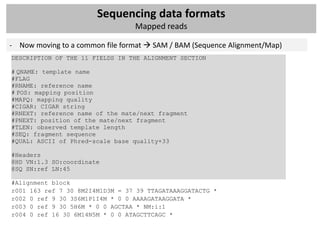
- Now moving to a common file format SAM / BAM (Sequence Alignment/Map)
29.
Sequencing data formats
Mapped reads
- Now moving to a common file format SAM / BAM (Sequence Alignment/Map)
DESCRIPTION OF THE 11 FIELDS IN THE ALIGNMENT SECTION
# QNAME: template name
#FLAG
#RNAME: reference name
# POS: mapping position
#MAPQ: mapping quality
#CIGAR: CIGAR string
#RNEXT: reference name of the mate/next fragment
#PNEXT: position of the mate/next fragment
#TLEN: observed template length
#SEQ: fragment sequence
#QUAL: ASCII of Phred-scale base quality+33
#Headers
@HD VN:1.3 SO:coordinate
@SQ SN:ref LN:45
#Alignment block
r001 163 ref 7 30 8M2I4M1D3M = 37 39 TTAGATAAAGGATACTG *
r002 0 ref 9 30 3S6M1P1I4M * 0 0 AAAAGATAAGGATA *
r003 0 ref 9 30 5H6M * 0 0 AGCTAA * NM:i:1
r004 0 ref 16 30 6M14N5M * 0 0 ATAGCTTCAGC *
30.
Sequencing data formats
Mapped reads
- BAM: binary version of SAM: not human readable but indexed for fast access for other
tools / visualisation / …
- Exercise: view a BAM file in IGV
31.
Sequencing data formats
Other formats
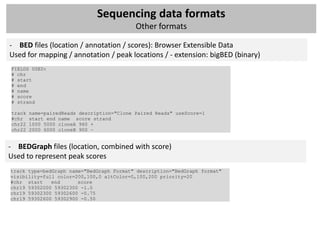
- BED files (location / annotation / scores): Browser Extensible Data
Used for mapping / annotation / peak locations / - extension: bigBED (binary)
FIELDS USED:
# chr
# start
# end
# name
# score
# strand
track name=pairedReads description="Clone Paired Reads" useScore=1
#chr start end name score strand
chr22 1000 5000 cloneA 960 +
chr22 2000 6000 cloneB 900 –
- BEDGraph files (location, combined with score)
Used to represent peak scores
track type=bedGraph name="BedGraph Format" description="BedGraph format"
visibility=full color=200,100,0 altColor=0,100,200 priority=20
#chr start end score
chr19 59302000 59302300 -1.0
chr19 59302300 59302600 -0.75
chr19 59302600 59302900 -0.50
32.
Sequencing data formats
Other formats
- WIG files (location / annotation / scores): wiggle
Used for visulization or summarize data, in most cases count data or normalized count
data (RPKM) – extension: BigWig – binary versions (often used in GEO for ChIP-seq peaks)
browser position chr19:59304200-59310700
browser hide all
#150 base wide bar graph at arbitrarily spaced positions,
#threshold line drawn at y=11.76
#autoScale off viewing range set to [0:25]
#priority = 10 positions this as the first graph
track type=wiggle_0 name="variableStep" description="variableStep format"
visibility=full autoScale=off viewLimits=0.0:25.0 color=50,150,255
yLineMark=11.76 yLineOnOff=on priority=10
variableStep chrom=chr19 span=150
59304701 10.0
59304901 12.5
59305401 15.0
59305601 17.5
59305901 20.0
59306081 17.5
33.
Sequencing data formats
Other formats
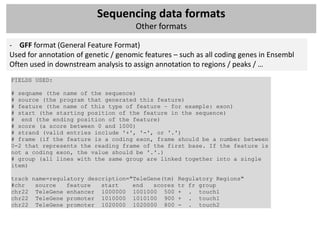
- GFF format (General Feature Format)
Used for annotation of genetic / genomic features – such as all coding genes in Ensembl
Often used in downstream analysis to assign annotation to regions / peaks / …
FIELDS USED:
# seqname (the name of the sequence)
# source (the program that generated this feature)
# feature (the name of this type of feature – for example: exon)
# start (the starting position of the feature in the sequence)
# end (the ending position of the feature)
# score (a score between 0 and 1000)
# strand (valid entries include '+', '-', or '.')
# frame (if the feature is a coding exon, frame should be a number between
0-2 that represents the reading frame of the first base. If the feature is
not a coding exon, the value should be '.'.)
# group (all lines with the same group are linked together into a single
item)
track name=regulatory description="TeleGene(tm) Regulatory Regions"
#chr source feature start end scores tr fr group
chr22 TeleGene enhancer 1000000 1001000 500 + . touch1
chr22 TeleGene promoter 1010000 1010100 900 + . touch1
chr22 TeleGene promoter 1020000 1020000 800 - . touch2
Sequencing data formats
Other formats
- http://genome.ucsc.edu/FAQ/FAQformat.html
- UCSC brower data formats, including all most commonly used formats that are
accepted and widely used
- In addition, ENCODE data formats (narrowPeak / broadPEAK)