Surya Saha ss2489@cornell.edu
BTI PGRP Summer Internship Program 2014
Slides: https://bitly.com/BioinfoInternEx2014
Quality Control of NGS Data
1. Evaluation
2. Preprocessing
Quality Control of NGS Data
7/8/2014 BTI PGRP Summer Internship Program 2014 2
Slide credit: Aureliano Bombarely
Goal:
Learn the use of read evaluation programs keeping
attention in relevant parameters such as quality score and
length distributions and reads duplications.
Data:
(Illumina data for two tomato ripening stages)
/home/bioinfo/Data/ch4_demo_dataset.tar.gz
Tools:
tar -zxvf (command line, untar and unzip the files)
head (command line, take a quick look of the files)
mv (command line, change the name of the files)
grep (command line, find/count patterns in files)
FASTX toolkit (command line, process fasta/fastq)
FastQC (gui, to calculate several stats for each file)
Evaluation
7/8/2014 BTI PGRP Summer Internship Program 2014 3
Slide credit: Aureliano Bombarely
Exercise 1:
1. Untar and Unzip the file:
/home/bioinfo/Data/ch4_demo_dataset.tar.gz
2. Raw data will be found in two dirs: breaker and
immature_fruit. Print the first 10 lines for the files:
SRR404331_ch4.fq, SRR404333_ch4.fq,
SRR404334_ch4.fq and SRR404336_ch4.fq.
Question 1.1: Do these files have fastq format?
3. Change the extension of the .fq files to .fastq
Evaluation
7/8/2014 BTI PGRP Summer Internship Program 2014 4
Slide credit: Aureliano Bombarely
Exercise 1:
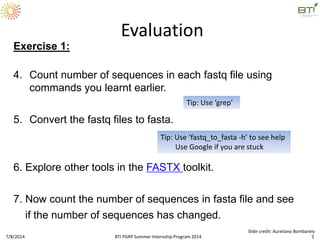
4. Count number of sequences in each fastq file using
commands you learnt earlier.
5. Convert the fastq files to fasta.
6. Explore other tools in the FASTX toolkit.
7. Now count the number of sequences in fasta file and see
if the number of sequences has changed.
Evaluation
Tip: Use ‘grep’
Tip: Use ‘fastq_to_fasta -h’ to see help
Use Google if you are stuck
7/8/2014 BTI PGRP Summer Internship Program 2014 5
Slide credit: Aureliano Bombarely
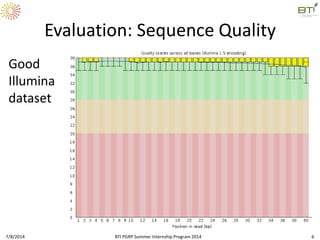
Evaluation: Sequence Quality
Good
Illumina
dataset
7/8/2014 BTI PGRP Summer Internship Program 2014 6
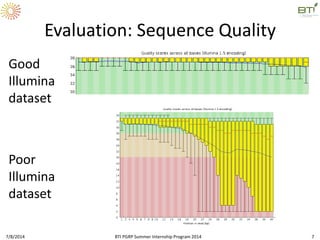
Evaluation: Sequence Quality
7/8/2014 BTI PGRP Summer Internship Program 2014 7
Good
Illumina
dataset
Poor
Illumina
dataset
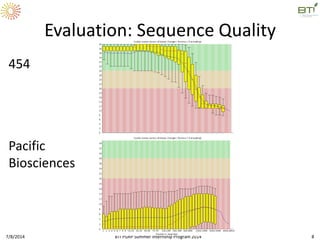
Evaluation: Sequence Quality
7/8/2014 BTI PGRP Summer Internship Program 2014 8
454
Pacific
Biosciences
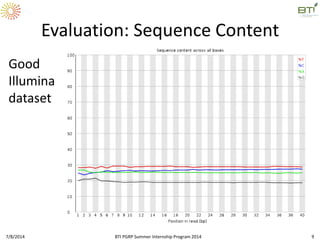
Evaluation: Sequence Content
Good
Illumina
dataset
7/8/2014 BTI PGRP Summer Internship Program 2014 9
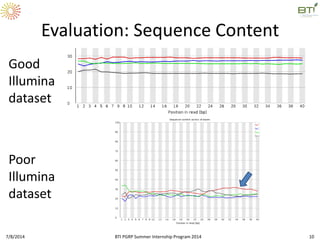
Evaluation: Sequence Content
7/8/2014 BTI PGRP Summer Internship Program 2014 10
Good
Illumina
dataset
Poor
Illumina
dataset
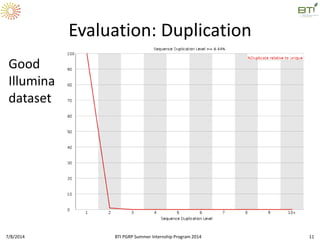
Evaluation: Duplication
Good
Illumina
dataset
7/8/2014 BTI PGRP Summer Internship Program 2014 11
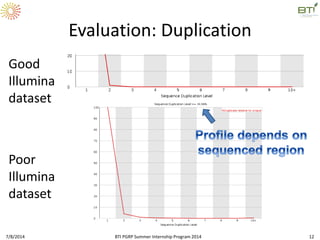
Evaluation: Duplication
7/8/2014 BTI PGRP Summer Internship Program 2014 12
Good
Illumina
dataset
Poor
Illumina
dataset
Evaluation: Overrepresented Sequences
Good
Illumina
dataset
7/8/2014 BTI PGRP Summer Internship Program 2014 13
Evaluation: Overrepresented Sequences
7/8/2014 BTI PGRP Summer Internship Program 2014 14
Good
Illumina
dataset
Poor
Illumina
dataset
Evaluation: Kmer content
Good
Illumina
dataset
7/8/2014 BTI PGRP Summer Internship Program 2014 15
Evaluation: Kmer content
7/8/2014 BTI PGRP Summer Internship Program 2014 16
Good
Illumina
dataset
Poor
Illumina
dataset
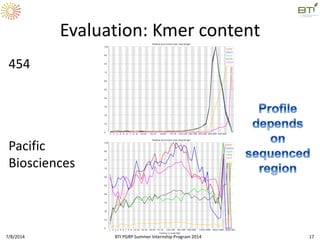
Evaluation: Kmer content
7/8/2014 BTI PGRP Summer Internship Program 2014 17
454
Pacific
Biosciences
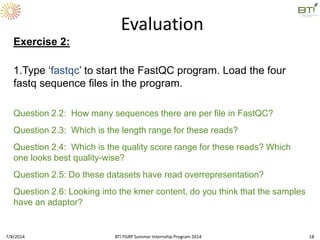
Question 2.2: How many sequences there are per file in FastQC?
Question 2.3: Which is the length range for these reads?
Question 2.4: Which is the quality score range for these reads? Which
one looks best quality-wise?
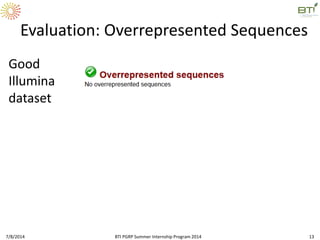
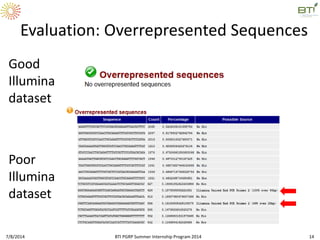
Question 2.5: Do these datasets have read overrepresentation?
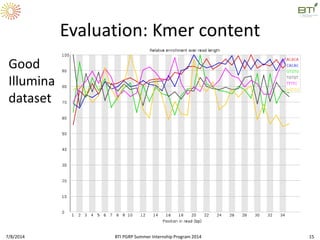
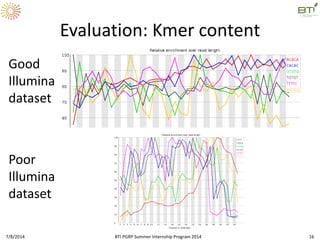
Question 2.6: Looking into the kmer content, do you think that the samples
have an adaptor?
Evaluation
Exercise 2:
1.Type ‘fastqc’ to start the FastQC program. Load the four
fastq sequence files in the program.
7/8/2014 BTI PGRP Summer Internship Program 2014 18
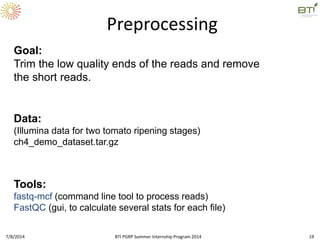
Goal:
Trim the low quality ends of the reads and remove
the short reads.
Data:
(Illumina data for two tomato ripening stages)
ch4_demo_dataset.tar.gz
Tools:
fastq-mcf (command line tool to process reads)
FastQC (gui, to calculate several stats for each file)
Preprocessing
7/8/2014 BTI PGRP Summer Internship Program 2014 19
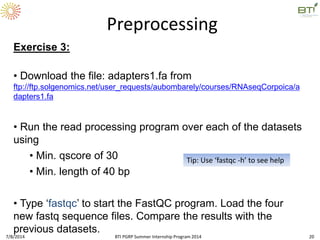
Exercise 3:
• Download the file: adapters1.fa from
ftp://ftp.solgenomics.net/user_requests/aubombarely/courses/RNAseqCorpoica/a
dapters1.fa
• Run the read processing program over each of the datasets
using
• Min. qscore of 30
• Min. length of 40 bp
• Type ‘fastqc’ to start the FastQC program. Load the four
new fastq sequence files. Compare the results with the
previous datasets.
Preprocessing
Tip: Use ‘fastqc -h’ to see help
7/8/2014 BTI PGRP Summer Internship Program 2014 20
Need Help??
7/8/2014 BTI PGRP Summer Internship Program 2014 21
Solutions: https://bitly.com/BioinfoInternExSol2014

Quality Control of NGS Data

  • 1.
    Surya Saha ss2489@cornell.edu BTIPGRP Summer Internship Program 2014 Slides: https://bitly.com/BioinfoInternEx2014 Quality Control of NGS Data
  • 2.
    1. Evaluation 2. Preprocessing QualityControl of NGS Data 7/8/2014 BTI PGRP Summer Internship Program 2014 2 Slide credit: Aureliano Bombarely
  • 3.
    Goal: Learn the useof read evaluation programs keeping attention in relevant parameters such as quality score and length distributions and reads duplications. Data: (Illumina data for two tomato ripening stages) /home/bioinfo/Data/ch4_demo_dataset.tar.gz Tools: tar -zxvf (command line, untar and unzip the files) head (command line, take a quick look of the files) mv (command line, change the name of the files) grep (command line, find/count patterns in files) FASTX toolkit (command line, process fasta/fastq) FastQC (gui, to calculate several stats for each file) Evaluation 7/8/2014 BTI PGRP Summer Internship Program 2014 3 Slide credit: Aureliano Bombarely
  • 4.
    Exercise 1: 1. Untarand Unzip the file: /home/bioinfo/Data/ch4_demo_dataset.tar.gz 2. Raw data will be found in two dirs: breaker and immature_fruit. Print the first 10 lines for the files: SRR404331_ch4.fq, SRR404333_ch4.fq, SRR404334_ch4.fq and SRR404336_ch4.fq. Question 1.1: Do these files have fastq format? 3. Change the extension of the .fq files to .fastq Evaluation 7/8/2014 BTI PGRP Summer Internship Program 2014 4 Slide credit: Aureliano Bombarely
  • 5.
    Exercise 1: 4. Countnumber of sequences in each fastq file using commands you learnt earlier. 5. Convert the fastq files to fasta. 6. Explore other tools in the FASTX toolkit. 7. Now count the number of sequences in fasta file and see if the number of sequences has changed. Evaluation Tip: Use ‘grep’ Tip: Use ‘fastq_to_fasta -h’ to see help Use Google if you are stuck 7/8/2014 BTI PGRP Summer Internship Program 2014 5 Slide credit: Aureliano Bombarely
  • 6.
    Evaluation: Sequence Quality Good Illumina dataset 7/8/2014BTI PGRP Summer Internship Program 2014 6
  • 7.
    Evaluation: Sequence Quality 7/8/2014BTI PGRP Summer Internship Program 2014 7 Good Illumina dataset Poor Illumina dataset
  • 8.
    Evaluation: Sequence Quality 7/8/2014BTI PGRP Summer Internship Program 2014 8 454 Pacific Biosciences
  • 9.
    Evaluation: Sequence Content Good Illumina dataset 7/8/2014BTI PGRP Summer Internship Program 2014 9
  • 10.
    Evaluation: Sequence Content 7/8/2014BTI PGRP Summer Internship Program 2014 10 Good Illumina dataset Poor Illumina dataset
  • 11.
    Evaluation: Duplication Good Illumina dataset 7/8/2014 BTIPGRP Summer Internship Program 2014 11
  • 12.
    Evaluation: Duplication 7/8/2014 BTIPGRP Summer Internship Program 2014 12 Good Illumina dataset Poor Illumina dataset
  • 13.
  • 14.
    Evaluation: Overrepresented Sequences 7/8/2014BTI PGRP Summer Internship Program 2014 14 Good Illumina dataset Poor Illumina dataset
  • 15.
    Evaluation: Kmer content Good Illumina dataset 7/8/2014BTI PGRP Summer Internship Program 2014 15
  • 16.
    Evaluation: Kmer content 7/8/2014BTI PGRP Summer Internship Program 2014 16 Good Illumina dataset Poor Illumina dataset
  • 17.
    Evaluation: Kmer content 7/8/2014BTI PGRP Summer Internship Program 2014 17 454 Pacific Biosciences
  • 18.
    Question 2.2: Howmany sequences there are per file in FastQC? Question 2.3: Which is the length range for these reads? Question 2.4: Which is the quality score range for these reads? Which one looks best quality-wise? Question 2.5: Do these datasets have read overrepresentation? Question 2.6: Looking into the kmer content, do you think that the samples have an adaptor? Evaluation Exercise 2: 1.Type ‘fastqc’ to start the FastQC program. Load the four fastq sequence files in the program. 7/8/2014 BTI PGRP Summer Internship Program 2014 18
  • 19.
    Goal: Trim the lowquality ends of the reads and remove the short reads. Data: (Illumina data for two tomato ripening stages) ch4_demo_dataset.tar.gz Tools: fastq-mcf (command line tool to process reads) FastQC (gui, to calculate several stats for each file) Preprocessing 7/8/2014 BTI PGRP Summer Internship Program 2014 19
  • 20.
    Exercise 3: • Downloadthe file: adapters1.fa from ftp://ftp.solgenomics.net/user_requests/aubombarely/courses/RNAseqCorpoica/a dapters1.fa • Run the read processing program over each of the datasets using • Min. qscore of 30 • Min. length of 40 bp • Type ‘fastqc’ to start the FastQC program. Load the four new fastq sequence files. Compare the results with the previous datasets. Preprocessing Tip: Use ‘fastqc -h’ to see help 7/8/2014 BTI PGRP Summer Internship Program 2014 20
  • 21.
    Need Help?? 7/8/2014 BTIPGRP Summer Internship Program 2014 21 Solutions: https://bitly.com/BioinfoInternExSol2014