Programming	
  
The	
  Network	
  Data	
  Plane	
  in	
  P4	


Changhoon	
  Kim	
  (chang@barefootnetworks.com)	
  
P4	
  Language	
  Consor9um	
  –	
  www.p4.org	
  
Status	
  quo	
  
2	
  
Switch	
  OS	
  
Run-­‐<me	
  API	
  
Driver	
  “This	
  is	
  roughly	
  how	
  I	
  process	
  
packets	
  …”	
  	
  
Fixed-­‐func<on	
  ASIC	
  
in	
  English	
  
•  Prone	
  to	
  bugs	
  
•  Very	
  long	
  and	
  unpredictable	
  lead	
  9me	
  
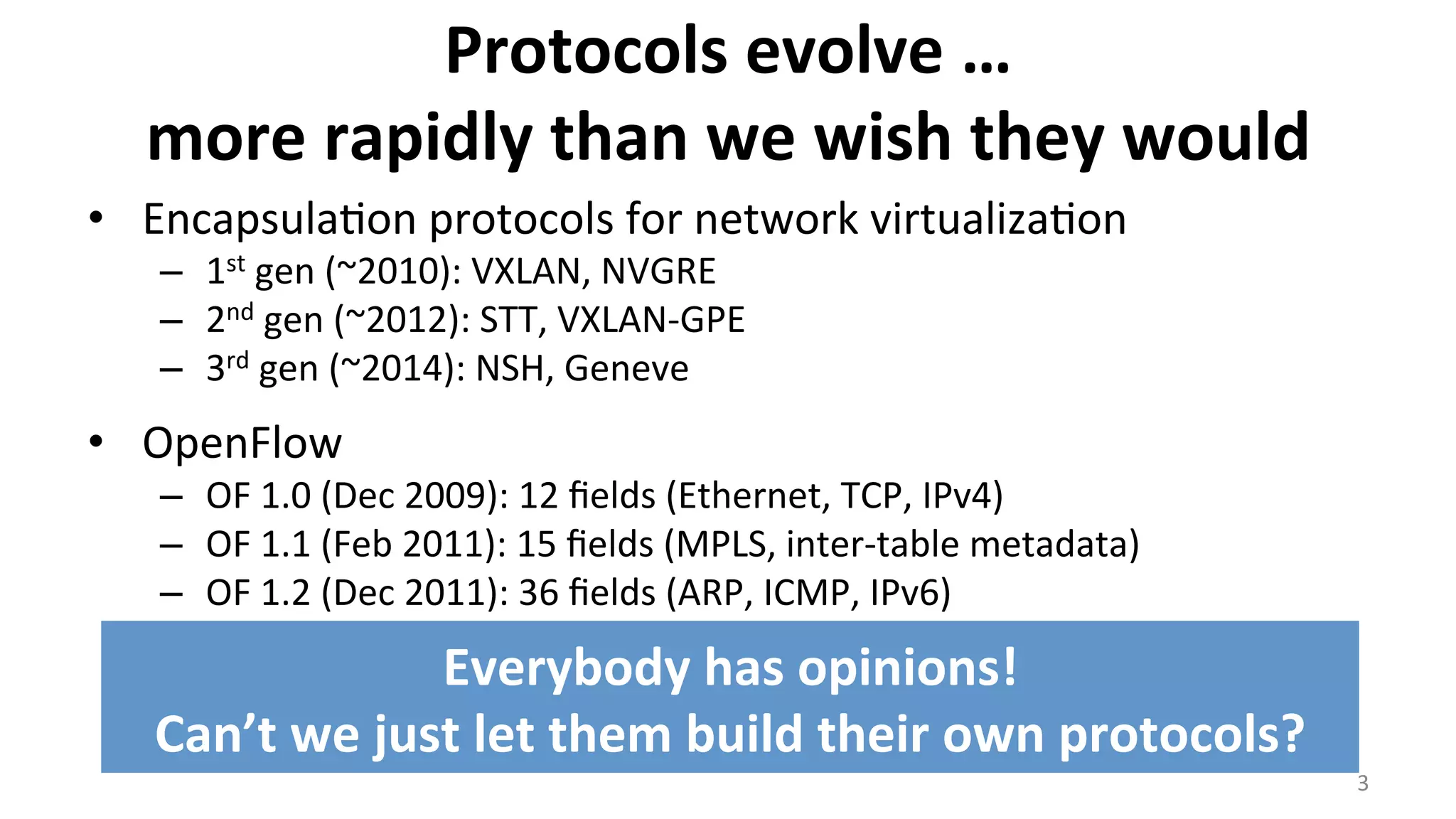
Protocols	
  evolve	
  …	
  
more	
  rapidly	
  than	
  we	
  wish	
  they	
  would	
  	
  
•  Encapsula<on	
  protocols	
  for	
  network	
  virtualiza<on	
  
–  1st	
  gen	
  (~2010):	
  VXLAN,	
  NVGRE	
  
–  2nd	
  gen	
  (~2012):	
  STT,	
  VXLAN-­‐GPE	
  
–  3rd	
  gen	
  (~2014):	
  NSH,	
  Geneve	
  
•  OpenFlow	
  
–  OF	
  1.0	
  (Dec	
  2009):	
  12	
  fields	
  (Ethernet,	
  TCP,	
  IPv4)	
  
–  OF	
  1.1	
  (Feb	
  2011):	
  15	
  fields	
  (MPLS,	
  inter-­‐table	
  metadata)	
  
–  OF	
  1.2	
  (Dec	
  2011):	
  36	
  fields	
  (ARP,	
  ICMP,	
  IPv6)	
  
–  OF	
  1.3	
  (Jun	
  2012):	
  40	
  fields	
  
–  OF	
  1.4	
  (Oct	
  2013):	
  41	
  fields	
  
–  OF	
  1.5	
  (Dec	
  2014):	
  44	
  fields	
  
3	
  
Everybody	
  has	
  opinions!	
  
Can’t	
  we	
  just	
  let	
  them	
  build	
  their	
  own	
  protocols?	
  
Programmable	
  network	
  devices	
  
•  Some	
  devices	
  are	
  or	
  will	
  be	
  more	
  programmable	
  than	
  
fixed-­‐func<on	
  ASICs	
  
•  CPUs:	
  10s	
  of	
  Gb/s	
  
•  FPGAs,	
  NPUs:	
  100s	
  of	
  Gb/s	
  
•  Protocol-­‐independent	
  switch	
  ASICs:	
  a	
  few	
  Tb/s	
  
–  RMT	
  [SIGCOMM’13]	
  and	
  a	
  few	
  emerging	
  solu<ons	
  
–  Merchant	
  silicon	
  with	
  fully	
  programmable	
  parser	
  and	
  
generic	
  match-­‐ac<on	
  logic	
  
–  In	
  next	
  few	
  years	
  this	
  kind	
  of	
  silicon	
  will	
  dominate	
  
4	
  
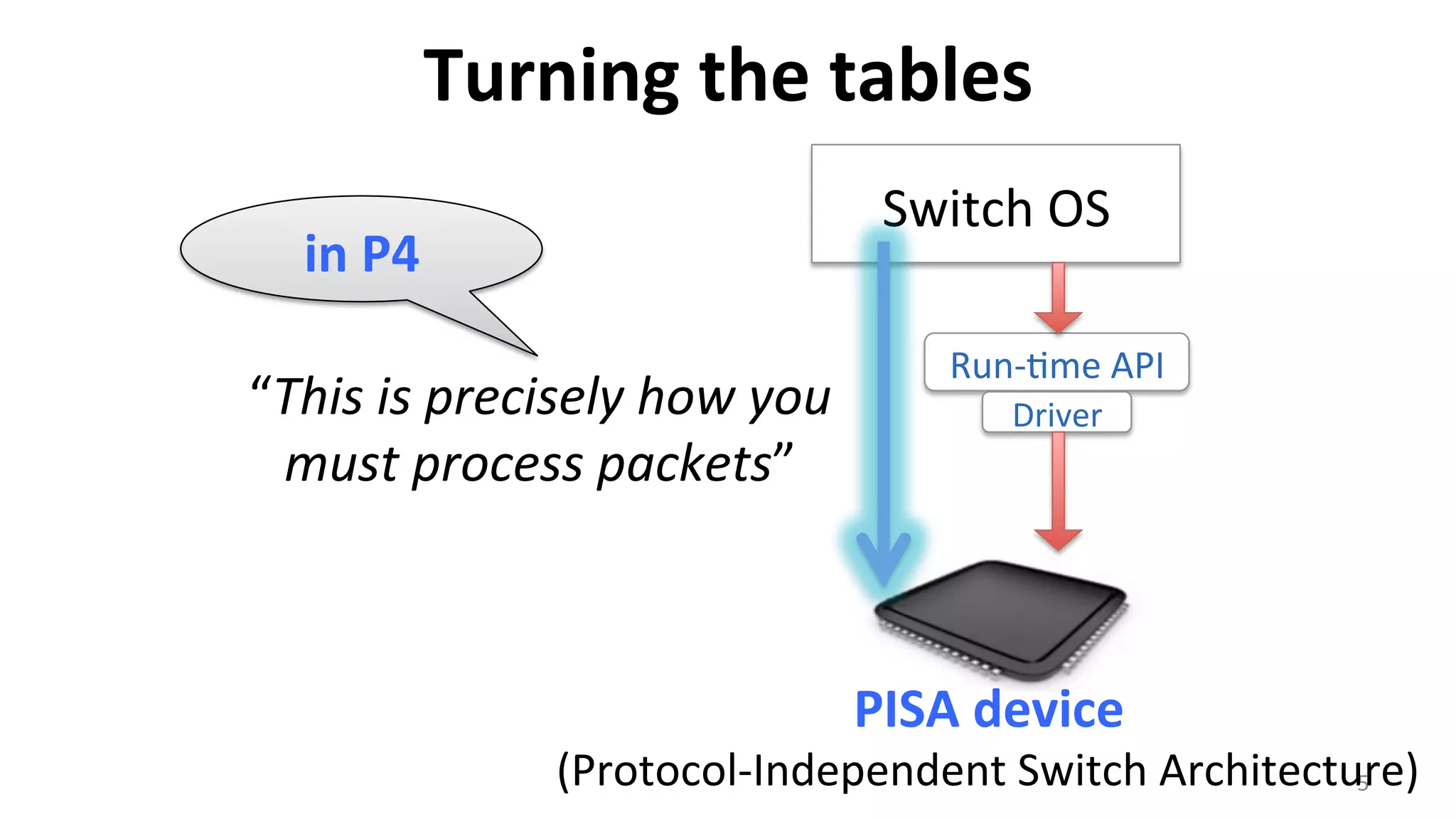
Turning	
  the	
  tables	
  
5	
  
Switch	
  OS	
  
Run-­‐<me	
  API	
  
Driver	
  
PISA	
  device	
  
(Protocol-­‐Independent	
  Switch	
  Architecture)	
  
“This	
  is	
  precisely	
  how	
  you	
  
must	
  process	
  packets”	
  
in	
  P4	
  
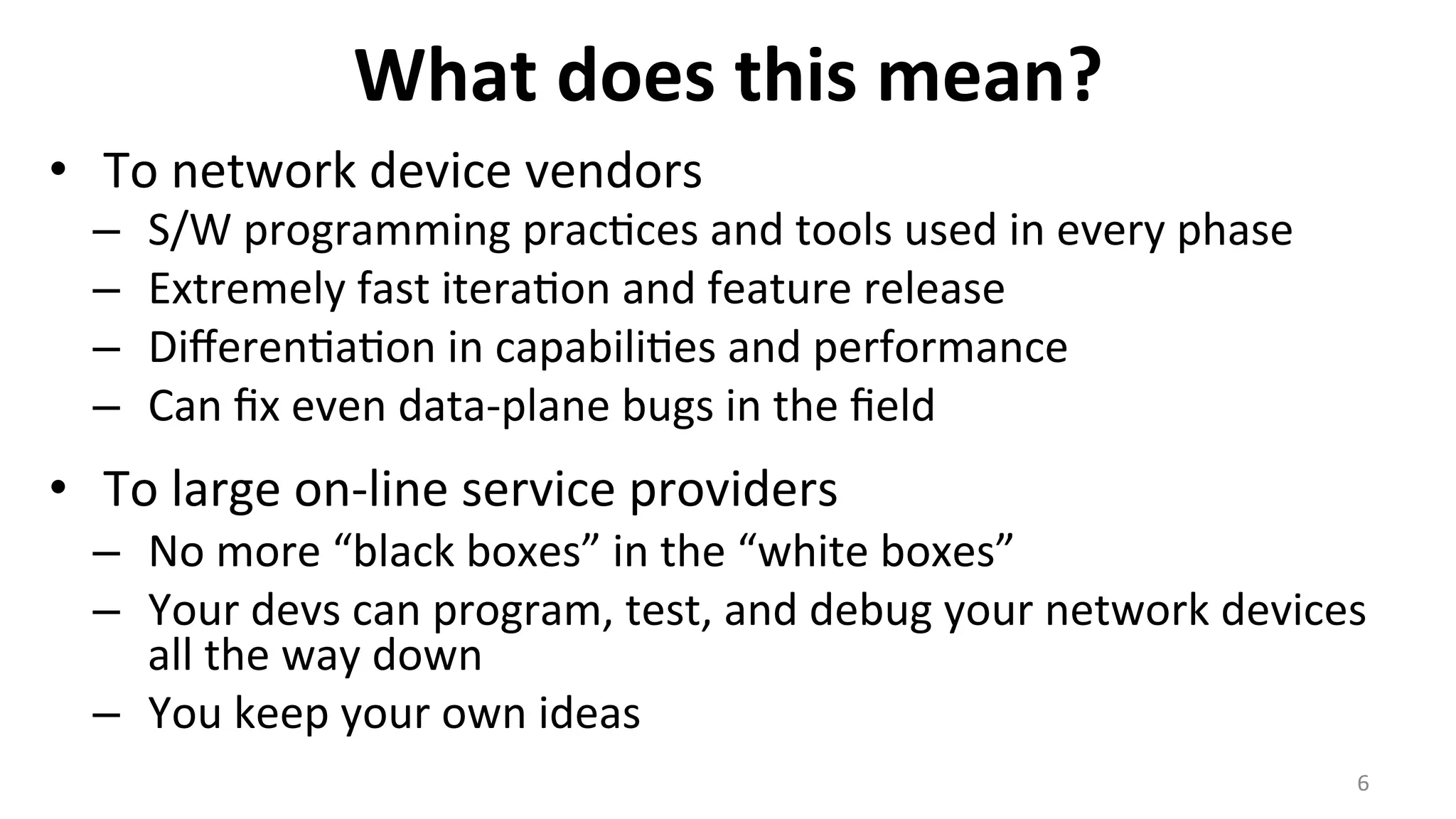
What	
  does	
  this	
  mean?	
  
•  To	
  network	
  device	
  vendors	
  
–  S/W	
  programming	
  prac<ces	
  and	
  tools	
  used	
  in	
  every	
  phase	
  
–  Extremely	
  fast	
  itera<on	
  and	
  feature	
  release	
  
–  Differen<a<on	
  in	
  capabili<es	
  and	
  performance	
  
–  Can	
  fix	
  even	
  data-­‐plane	
  bugs	
  in	
  the	
  field	
  
•  To	
  large	
  on-­‐line	
  service	
  providers	
  
–  No	
  more	
  “black	
  boxes”	
  in	
  the	
  “white	
  boxes”	
  
–  Your	
  devs	
  can	
  program,	
  test,	
  and	
  debug	
  your	
  network	
  devices	
  
all	
  the	
  way	
  down	
  
–  You	
  keep	
  your	
  own	
  ideas	
  
6	
  
7	
  
Why	
  we	
  call	
  it	
  
protocol-­‐independent	
  packet	
  
processing	
  
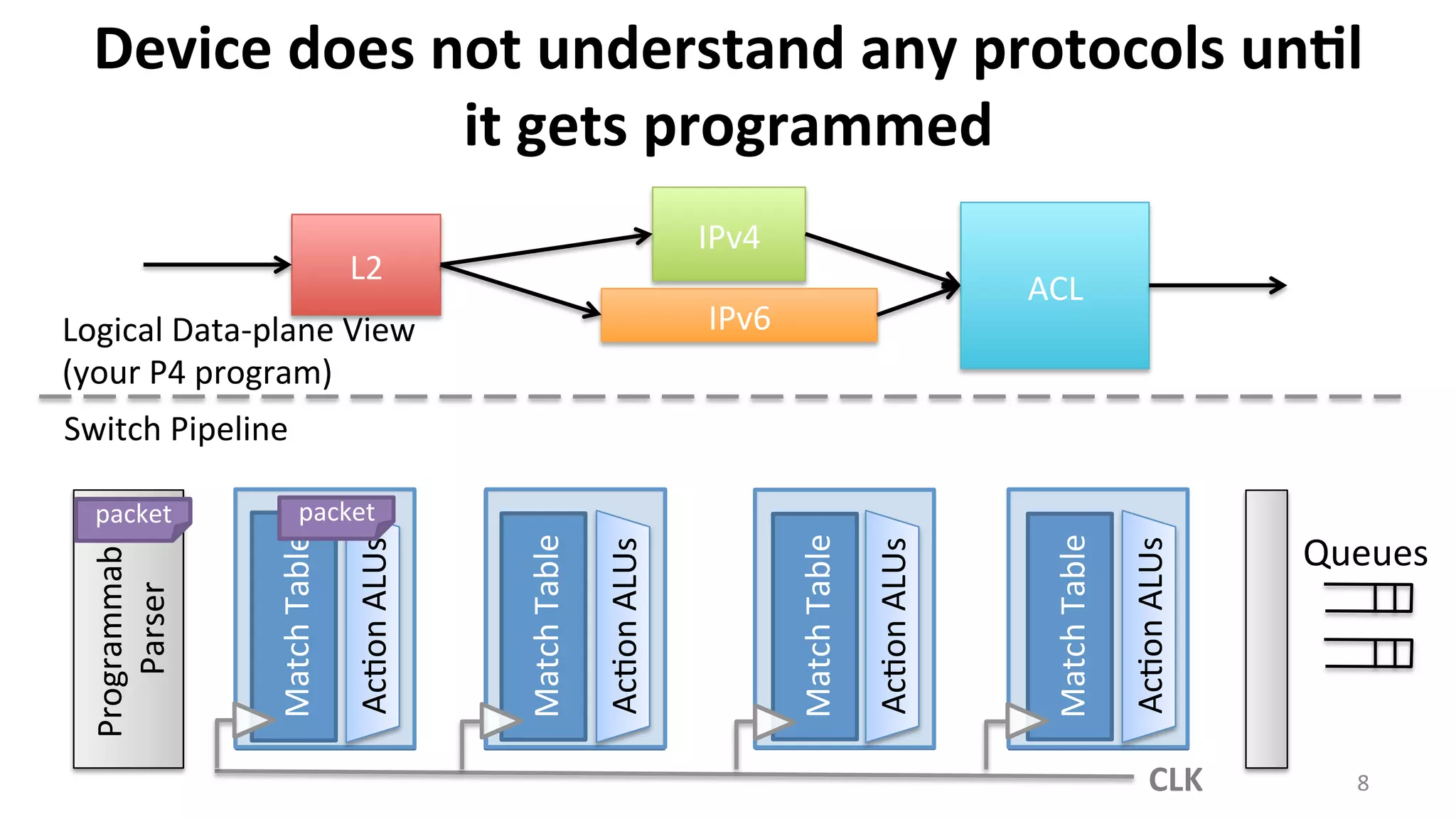
Logical	
  Data-­‐plane	
  View	
  
(your	
  P4	
  program)	
  
Switch	
  Pipeline	
  
Device	
  does	
  not	
  understand	
  any	
  protocols	
  un9l	
  
it	
  gets	
  programmed	
  
Queues	
  
Programmable	
  
Parser	
  
Fixed	
  Ac<on	
  
Match	
  Table	
  
Match	
  Table	
  
Match	
  Table	
  
Match	
  Table	
  
L2	
  
IPv4	
  
IPv6	
  
ACL	
  
Ac<on	
  ALUs	
  
Ac<on	
  ALUs	
  
Ac<on	
  ALUs	
  
Ac<on	
  ALUs	
  
8	
  
packet	
  packet	
   packet	
  packet	
  
CLK	
  
Match	
  Table	
  
Ac<on	
  ALUs	
  
Mapping	
  logical	
  data-­‐plane	
  design	
  to	
  
physical	
  resources	
  
Queues	
  
Match	
  Table	
  
Match	
  Table	
  
Match	
  Table	
  
L2	
  Table	
  
IPv4	
  Table	
  
IPv6	
  Table	
  
ACL	
  Table	
  
Ac<on	
  ALUs	
  
Ac<on	
  ALUs	
  
Ac<on	
  ALUs	
  
L2	
  
IPv4	
  
IPv6	
  
ACL	
  
Logical	
  Data-­‐plane	
  View	
  
(your	
  P4	
  program)	
  
Switch	
  Pipeline	
  
L2	
  
IPv6	
  
ACL	
  
IPv4	
  
L2	
  Ac<on	
  Macro	
  
v4	
  Ac<on	
  Macro	
  
v6	
  Ac<on	
  Macro	
  	
  
ACL	
  Ac<on	
  Macro	
  
9	
  
Programmable	
  
Parser	
  
CLK	
  
Re-­‐configurability	
  
L2	
  Table	
  
IPv4	
  Table	
  
ACL	
  Table	
  
IPv6	
  Table	
  
MyEn
cap	
  
L2	
  
IPv4	
  
IPv6	
  
ACL	
  
MyEncap	
  
L2	
  Ac<on	
  Macro	
  
v4	
  Ac<on	
  Macro	
  
ACL	
  Ac<on	
  Macro	
  
Ac<on	
  
MyEncap	
  
v6	
  Ac<on	
  Macro	
  
IPv4	
  
Ac<on	
  
IPv4	
  
Ac<on	
  
10	
  
IPv6	
  
Ac<on	
  
IPv6	
  
Programmable	
  
Parser	
  
CLK	
  
Logical	
  Data-­‐plane	
  View	
  
(your	
  P4	
  program)	
  
Switch	
  Pipeline	
  
Queues	
  
What	
  does	
  a	
  P4	
  program	
  look	
  like?	
  
11	
  
L2	
  
IPv4	
  
ACL	
  MyEncap	
  MyEncap	
  
IPv6	
  
header_type ethernet_t {
fields {
dstAddr : 48;
srcAddr : 48;
etherType : 16;
}
}
parser parse_ethernet {
extract(ethernet);
return select(latest.etherType) {
0x8100 : parse_vlan;
0x800 : parse_ipv4;
0x86DD : parse_ipv6;
}
}
TCP	
  
IPv4	
   IPv6	
  
MyEncap	
  Eth	
  
header_type my_encap_t {
fields {
foo : 12;
bar : 8;
baz : 4;
qux : 4;
next_protocol : 4;
}
}
What	
  does	
  a	
  P4	
  program	
  look	
  like?	
  
12	
  
L2	
  
IPv4	
  
ACL	
  MyEncap	
  MyEncap	
  
IPv6	
  
TCP	
  
IPv4	
   IPv6	
  
MyEncap	
  Eth	
  
header_type ipv4_t {
fields {
version : 4;
ihl : 4;
diffserv : 8;
totalLen : 16;
identification : 16;
flags : 3;
fragOffset : 13;
ttl : 8;
protocol : 8;
hdrChecksum : 16;
srcAddr : 32;
dstAddr : 32;
options : *;
}
length : (ihl << 2);
max_length : 60;
}
What	
  does	
  a	
  P4	
  program	
  look	
  like?	
  
13	
  
L2	
  
IPv4	
  
ACL	
  MyEncap	
  MyEncap	
  
IPv6	
  
table ipv4_lpm
{
reads {
ipv4.dstAddr : lpm;
}
actions {
set_next_hop; drop;
}
}
action set_next_hop(nhop_ipv4_addr, port)
{
modify_field(metadata.nhop_ipv4_addr, nhop_ipv4_addr);
modify_field(standard_metadata.egress_port, port);
add_to_field(ipv4.ttl, -1);
}
control ingress
{
apply(l2);
apply(my_encap);
if (valid(ipv4) {
apply(ipv4_lpm);
} else {
apply(ipv6_lpm);
}
apply(acl);
}
/* Example: A typical IPv4 routing table */
table ipv4_lpm {
reads {
ingress_metadata.vrf : exact;
ipv4.dstAddr : lpm;
}
actions {
nop;
l3_l2_switch;
l3_multicast;
l3_nexthop;
l3_ecmp;
l3_drop;
}
size : 65536;
}
What	
  does	
  a	
  P4	
  program	
  look	
  like?	
  
14	
  
vrf	
   ipv4.dstAddr	
  /	
  prefix	
   ac9on	
   data	
  
1	
   192.168.1.0	
  	
  /	
  24	
   l3_l2_switch	
   port_id=64	
  
10	
   10.0.16.0	
  /	
  22	
   l3_ecmp	
   ecmp_index=12	
  
1	
   192.168.0.0	
  /	
  16	
   l3_nexthop	
   nexthop_index=451	
  
1	
   0.0.0.0	
  /	
  0	
   l3_nexthop	
   nexthop_index=1	
  
These	
  are	
  the	
  only	
  possible	
  ac<ons.	
  
Each	
  par<cular	
  entry	
  in	
  the	
  table	
  is	
  
associated	
  with	
  ONE	
  of	
  these	
  
What	
  does	
  a	
  P4	
  program	
  look	
  like?	
  
•  Match	
  seman<cs	
  
–  exact
•  port_index	
  :	
  exact	
  
–  ternary
•  ethernet.srcAddr	
  :	
  ternary	
  
–  valid
•  vlan_tag[0]	
  :	
  valid	
  
–  lpm	
  
•  ipv4.dstAddr	
  :	
  lpm	
  
–  range
•  udp.dstPort	
  :	
  range	
  
15	
  
What	
  does	
  a	
  P4	
  program	
  look	
  like?	
  
•  Primi<ve	
  ac<ons	
  
–  modify_field, add_to_field, add,
set_field_to_hash_index
–  add_header, remove_header, copy_header
–  push, pop
–  count, meter
–  generate_digest, truncate
–  resubmit, recirculate
–  clone_*
–  no_op, drop
	
   16	
  
My	
  (running)	
  switch	
  
MyNetVirtualiza9on	
  (your	
  new	
  protocol)	
  
Forwarding	
  Logic	
  (P4)	
  
Table	
  Popula<on	
   Tenant	
  Isola<on	
  
Logic	
  
Linux	
  
Switch	
  Chip	
  Driver	
  
Switch	
  Run<me	
  API	
  
Table	
  Popula<on	
  
Tenant	
  Isola<on	
  Logic	
  
Compiled	
  
Forwarding	
  Logic	
  
Parser	
  
Program	
  
Control	
  Flow	
  
Match	
  Tables	
  
+	
  Ac9ons	
  
Compiler	
  
PISA	
  	
  chip	
  
Add/delete	
  
(run	
  <me)	
  Program	
  
(boot	
  or	
  init	
  <me)	
  
DEMO!	
  
18	
  
In-­‐band	
  Network	
  Telemetry	
  (INT)	
  
hnp://p4.org/p4/inband-­‐network-­‐telemetry/	


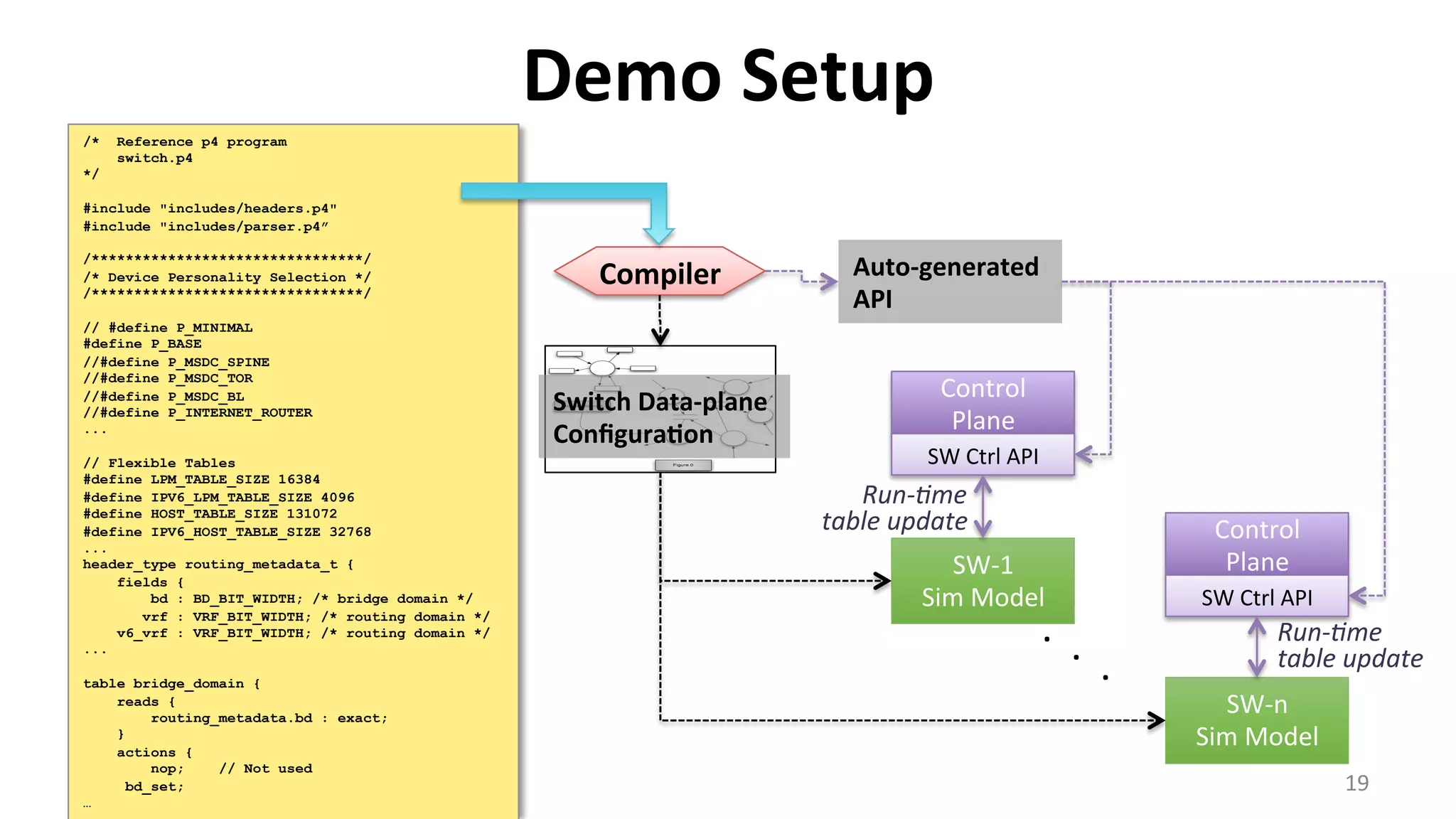
Demo	
  Setup	
  
19	
  
SW-­‐n	
  
Sim	
  Model	
  
SW-­‐1	
  
Sim	
  Model	
  	
  
Control	
  
Plane	
  
Compiler	
  
SW	
  Ctrl	
  API	
  
/* Reference p4 program
switch.p4
*/
#include "includes/headers.p4"
#include "includes/parser.p4”
/********************************/
/* Device Personality Selection */
/********************************/
// #define P_MINIMAL
#define P_BASE
//#define P_MSDC_SPINE
//#define P_MSDC_TOR
//#define P_MSDC_BL
//#define P_INTERNET_ROUTER
...
// Flexible Tables
#define LPM_TABLE_SIZE 16384
#define IPV6_LPM_TABLE_SIZE 4096
#define HOST_TABLE_SIZE 131072
#define IPV6_HOST_TABLE_SIZE 32768
...
header_type routing_metadata_t {
fields {
bd : BD_BIT_WIDTH; /* bridge domain */
vrf : VRF_BIT_WIDTH; /* routing domain */
v6_vrf : VRF_BIT_WIDTH; /* routing domain */
...
table bridge_domain {
reads {
routing_metadata.bd : exact;
}
actions {
nop; // Not used
bd_set;
…
Switch	
  Data-­‐plane	
  
Configura9on	
  
Auto-­‐generated	
  
API	
  
.	


  .	


  .	
  
Control	
  
Plane	
  
SW	
  Ctrl	
  API	
  
Run-­‐;me	
  
table	
  update	
  
Run-­‐;me	
  
table	
  update	
  
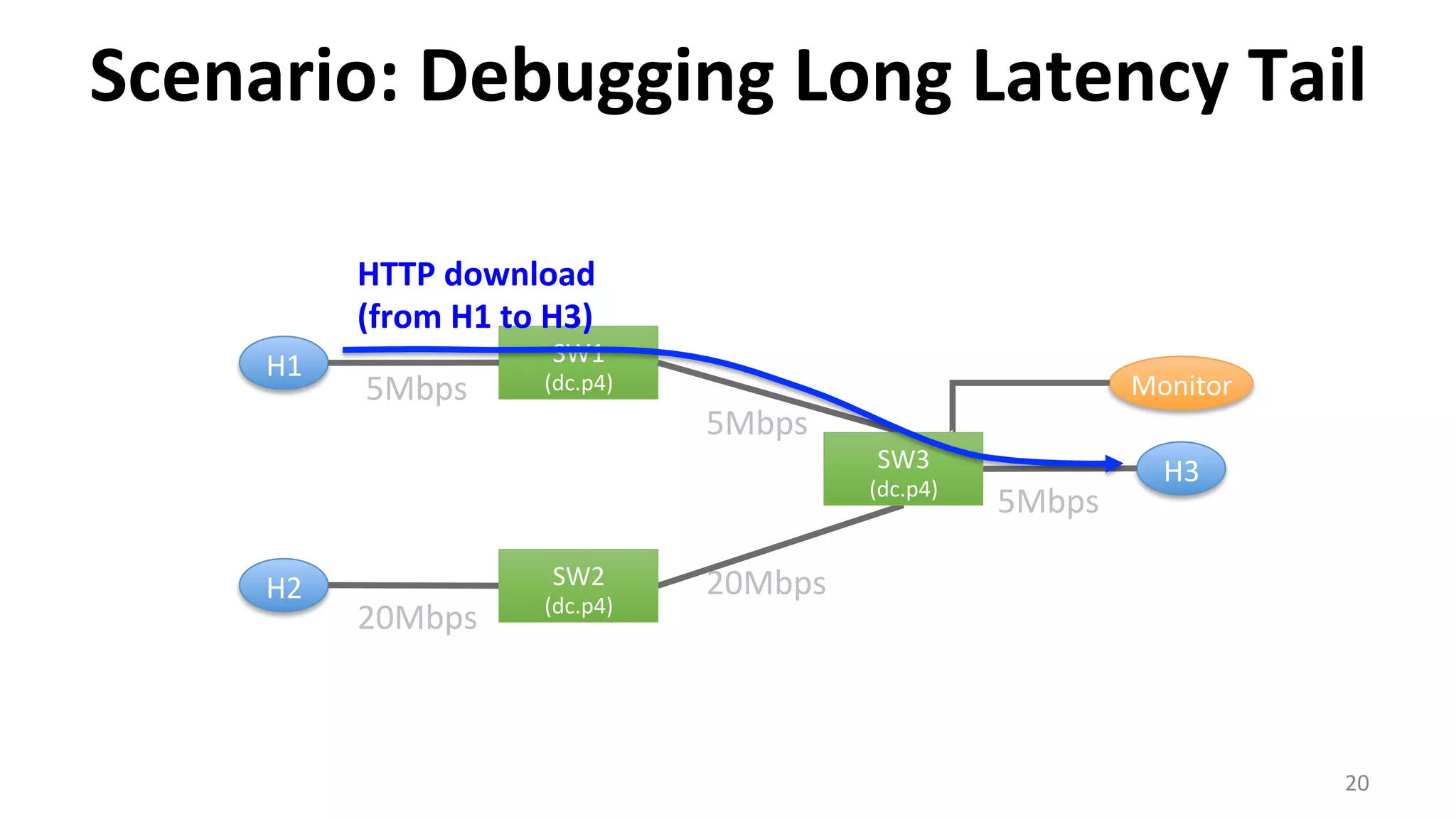
Scenario:	
  Debugging	
  Long	
  Latency	
  Tail	
  
20	
  
SW1	
  
(dc.p4)	
  
H1	
  
H2	
  
H3	
  
5Mbps	
  
SW2	
  
(dc.p4)	
  
20Mbps	
  
Monitor	
  5Mbps	
  
20Mbps	
  
5Mbps	
  
SW3	
  
(dc.p4)	
  
HTTP	
  download	
  
(from	
  H1	
  to	
  H3)	
  
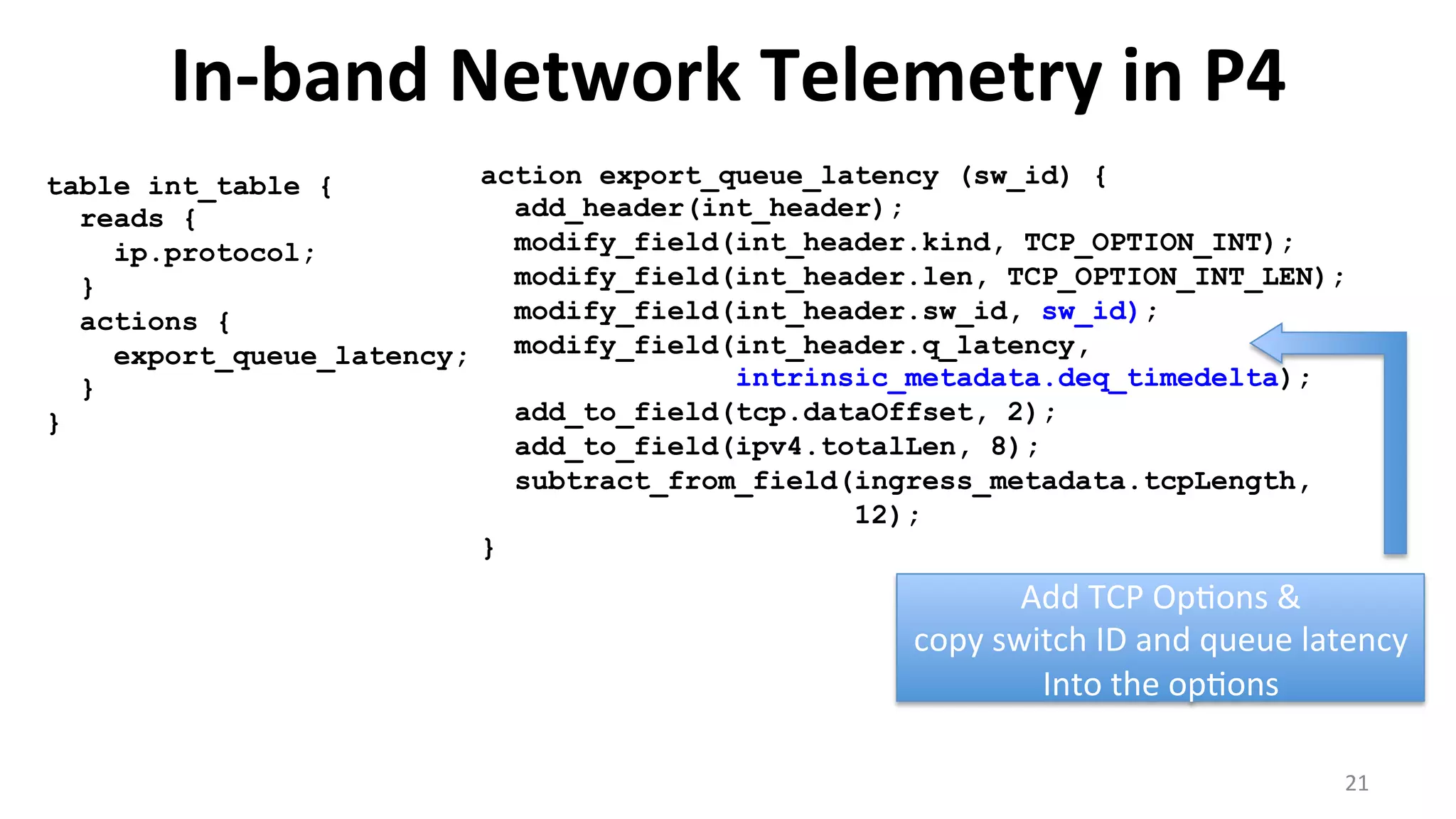
In-­‐band	
  Network	
  Telemetry	
  in	
  P4	
  
21	
  
table int_table {
reads {
ip.protocol;
}
actions {
export_queue_latency;
}
}
Add	
  TCP	
  Op<ons	
  &	
  
copy	
  switch	
  ID	
  and	
  queue	
  latency	
  
Into	
  the	
  op<ons	
  
action export_queue_latency (sw_id) {
add_header(int_header);
modify_field(int_header.kind, TCP_OPTION_INT);
modify_field(int_header.len, TCP_OPTION_INT_LEN);
modify_field(int_header.sw_id, sw_id);
modify_field(int_header.q_latency,
intrinsic_metadata.deq_timedelta);
add_to_field(tcp.dataOffset, 2);
add_to_field(ipv4.totalLen, 8);
subtract_from_field(ingress_metadata.tcpLength,
12);
}
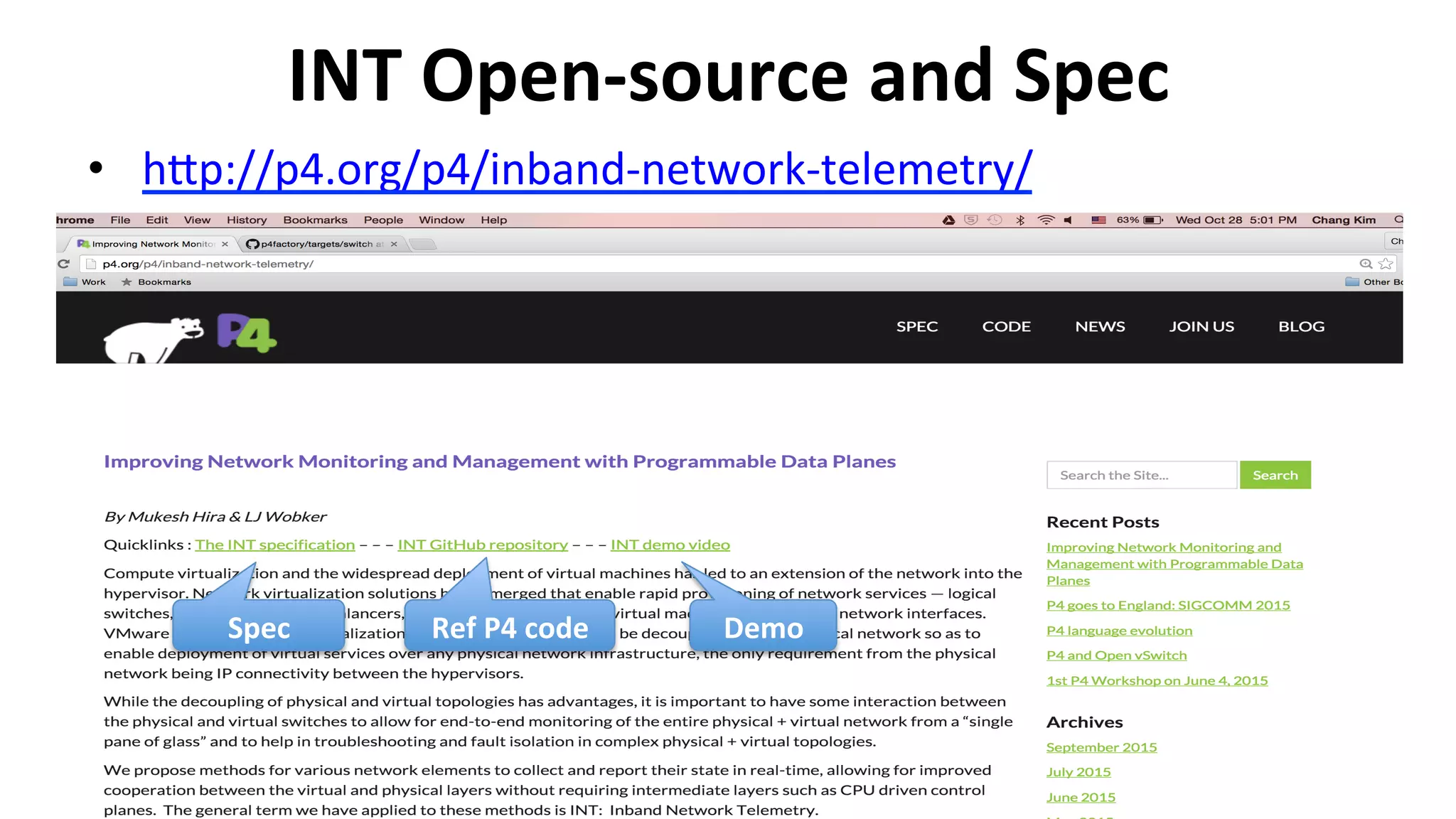
INT	
  Open-­‐source	
  and	
  Spec	
  
•  hnp://p4.org/p4/inband-­‐network-­‐telemetry/	
  
22	
  
Spec	
   Ref	
  P4	
  code	
   Demo	
  
This	
  will	
  accelerate	
  innova9ons	
  
•  Areas	
  of	
  innova<on	
  (just	
  to	
  name	
  a	
  few)	
  
–  Reducing	
  feature	
  set	
  à	
  “biggest	
  bang	
  for	
  buck”	
  
–  Network	
  monitoring,	
  analysis,	
  and	
  diagnos<cs	
  
–  Tunnel-­‐splicing	
  gateways	
  
–  Load	
  balancing	
  
–  Anack	
  detec<on	
  and	
  mi<ga<on	
  
–  Host-­‐stack	
  offloading	
  
•  Across	
  various	
  types	
  of	
  network	
  devices	
  
–  Hardware	
  and	
  sosware	
  devices	
  (OVS,	
  eBPF,	
  etc.)	
  
–  Switches,	
  NICs,	
  middle-­‐boxes,	
  etc.	
  
23	
  
This	
  will	
  create	
  lots	
  of	
  significant	
  R&D	
  and	
  
business	
  opportuni9es	
  
•  Novel	
  network	
  and	
  protocol	
  designs	
  
–  Take	
  advantage	
  of	
  unprecedented	
  amount	
  of	
  visibility	
  and	
  
control	
  into	
  the	
  network	
  
–  Joint	
  design	
  and	
  op<miza<on	
  between	
  hosts	
  and	
  network	
  
•  Development	
  tools	
  
–  Compilers,	
  debuggers,	
  sta<c	
  analyzers,	
  profilers,	
  etc.	
  
–  P4-­‐programming	
  assistance	
  tools	
  
•  Network	
  verifica<on,	
  test,	
  and	
  simula<on	
  
•  Many	
  more	
  …	
  
24	
  
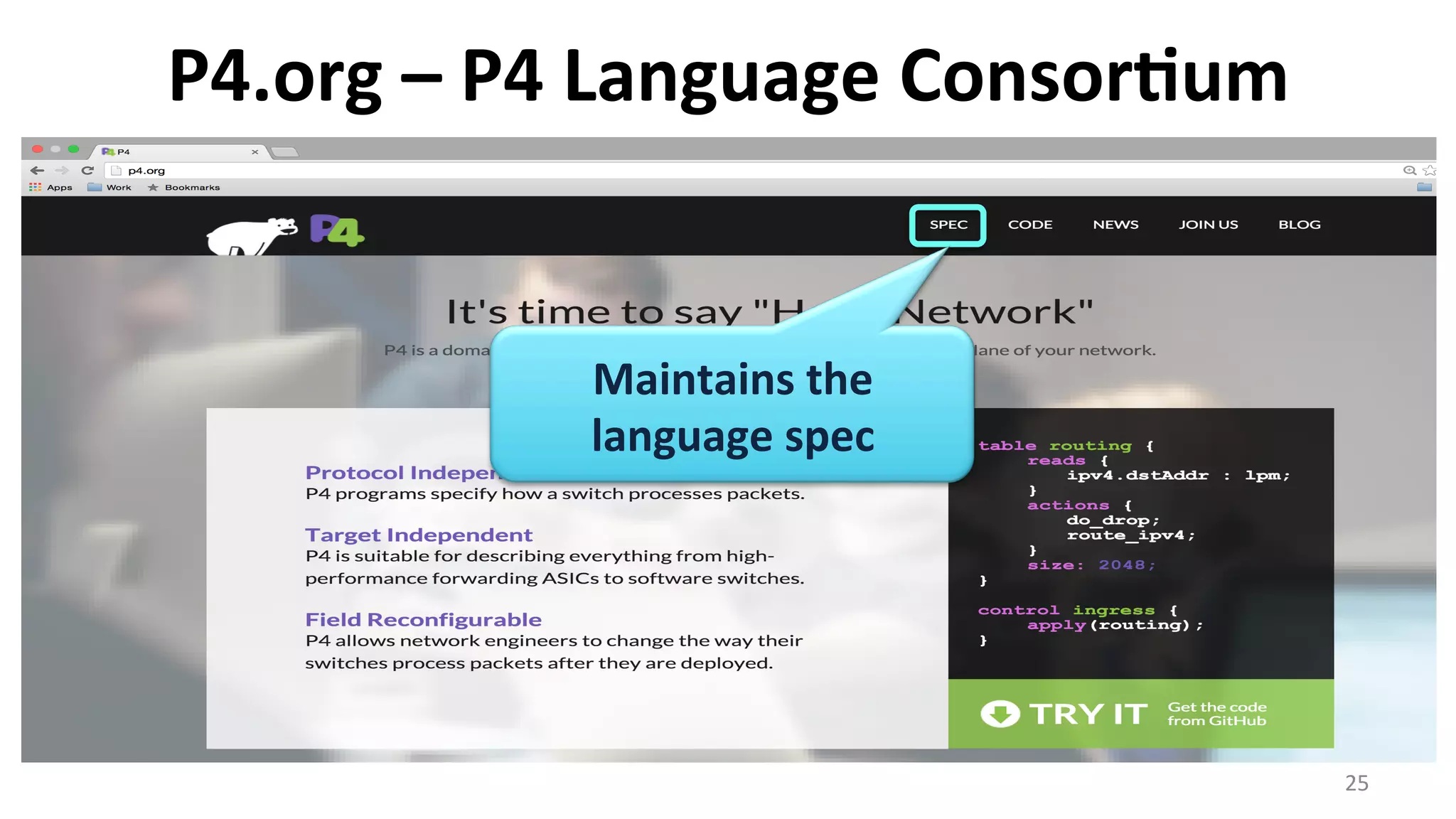
P4.org	
  –	
  P4	
  Language	
  Consor9um	
  
25	
  
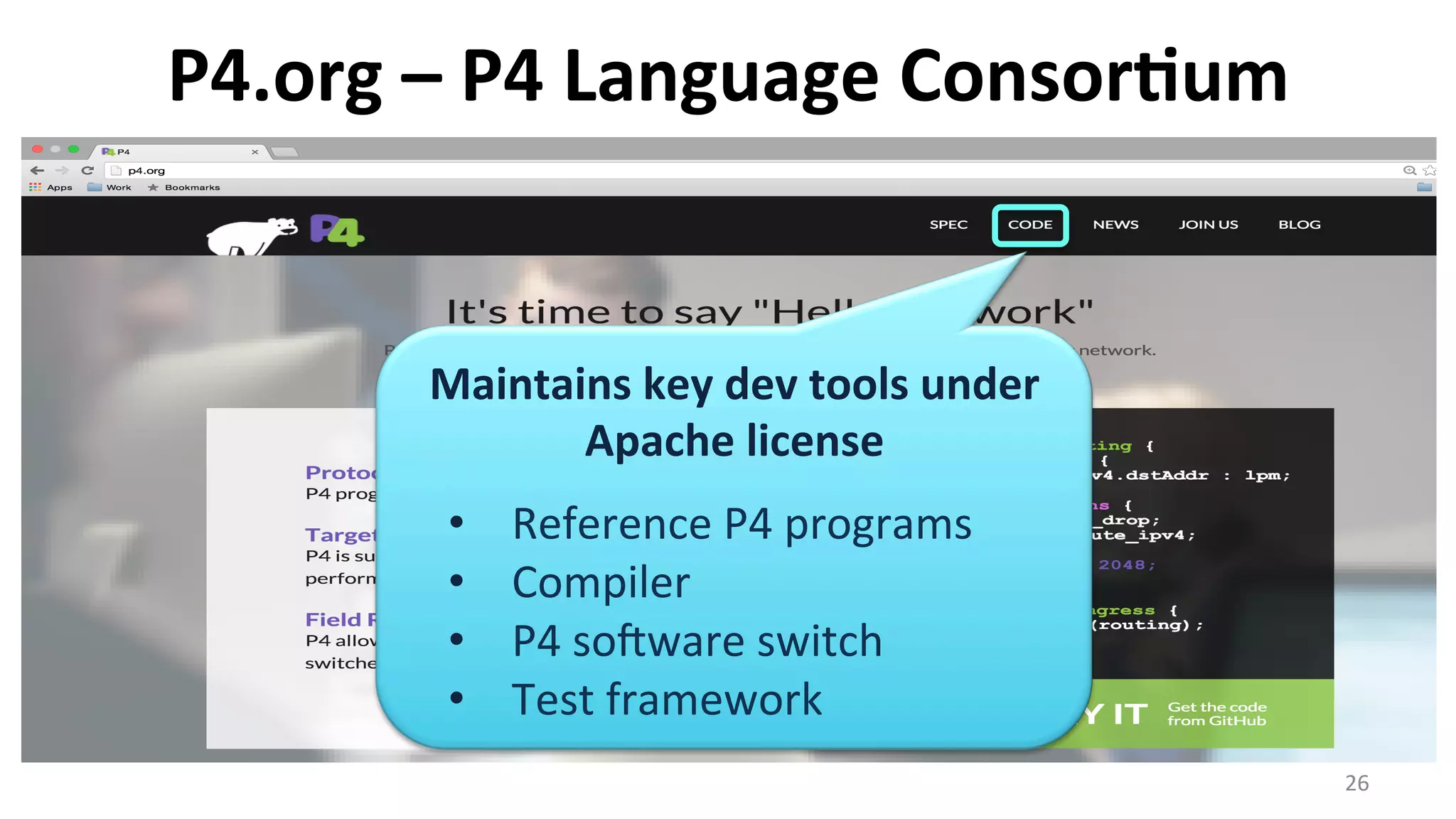
Maintains	
  the	
  
language	
  spec	
  
P4.org	
  –	
  P4	
  Language	
  Consor9um	
  
26	
  
Maintains	
  key	
  dev	
  tools	
  under	
  
Apache	
  license	


•  Reference	
  P4	
  programs	
  
•  Compiler	
  
•  P4	
  sosware	
  switch	
  
•  Test	
  framework	
  
P4.org	
  –	
  P4	
  Language	
  Consor9um	
  
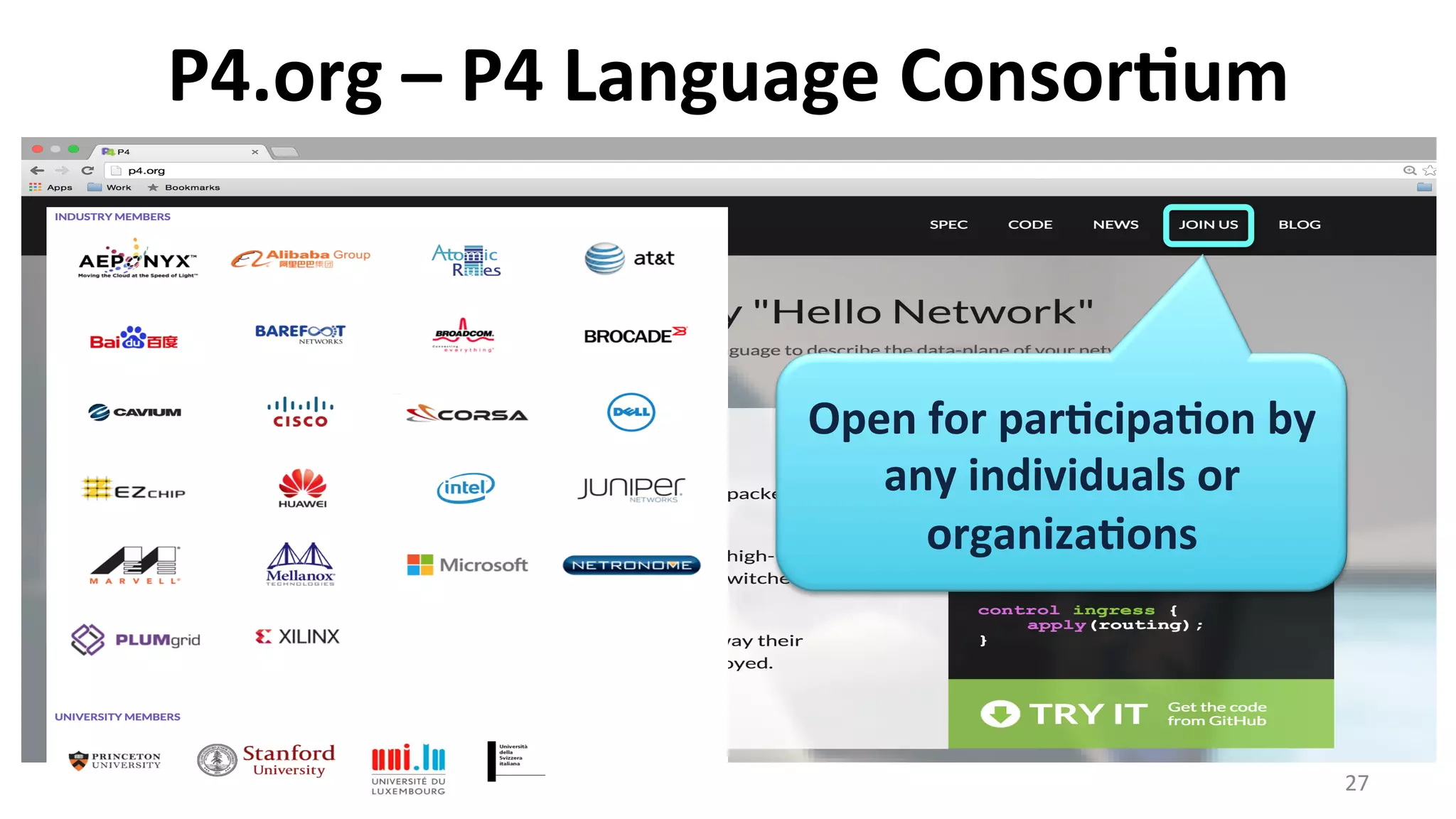
27	
  
Open	
  for	
  par9cipa9on	
  by	
  
any	
  individuals	
  or	
  
organiza9ons	
  
P4.org	
  –	
  P4	
  Language	
  Consor9um	
  
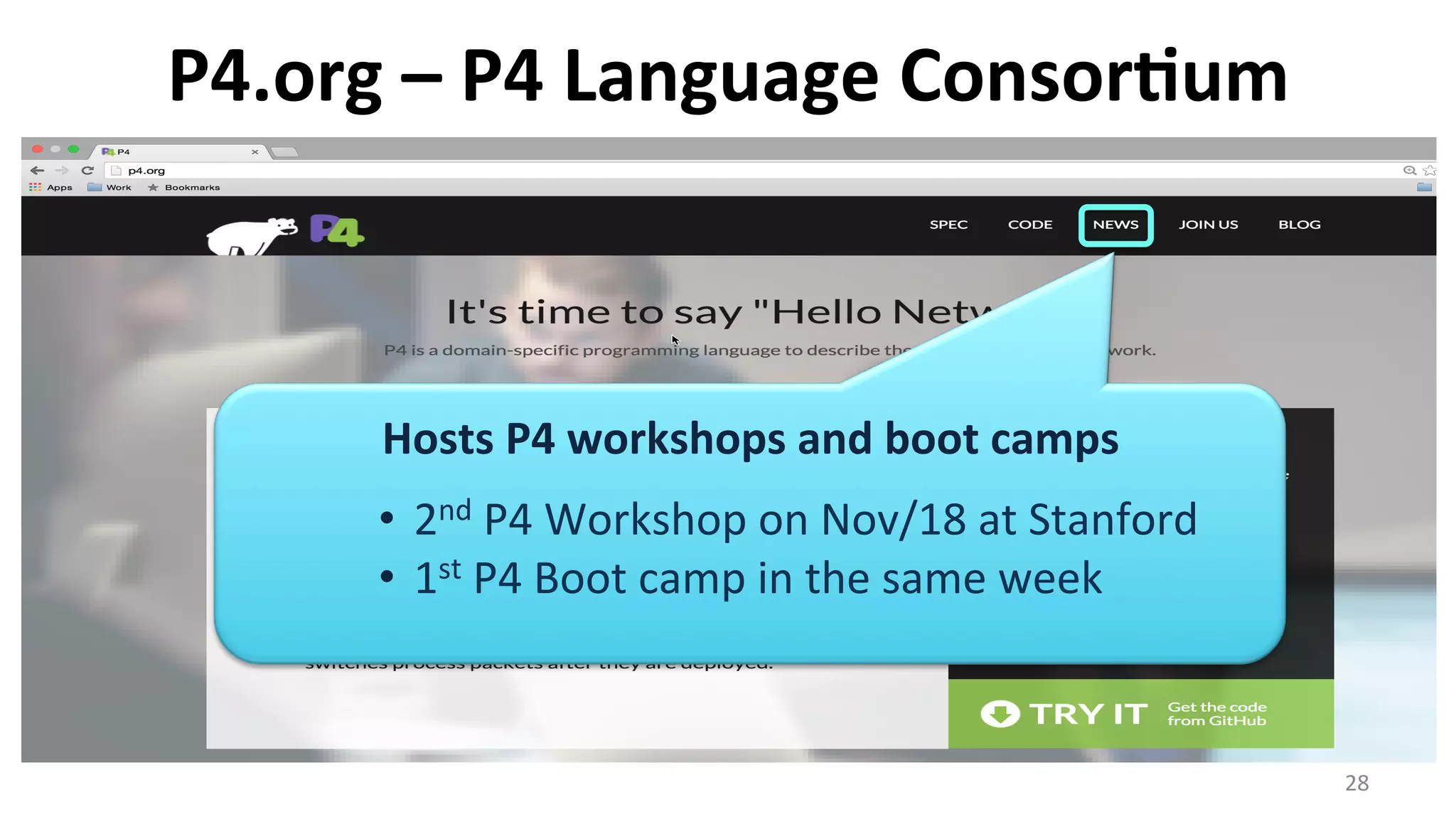
28	
  
Hosts	
  P4	
  workshops	
  and	
  boot	
  camps	


•  2nd	
  P4	
  Workshop	
  on	
  Nov/18	
  at	
  Stanford	
  
•  1st	
  P4	
  Boot	
  camp	
  in	
  the	
  same	
  week	
  
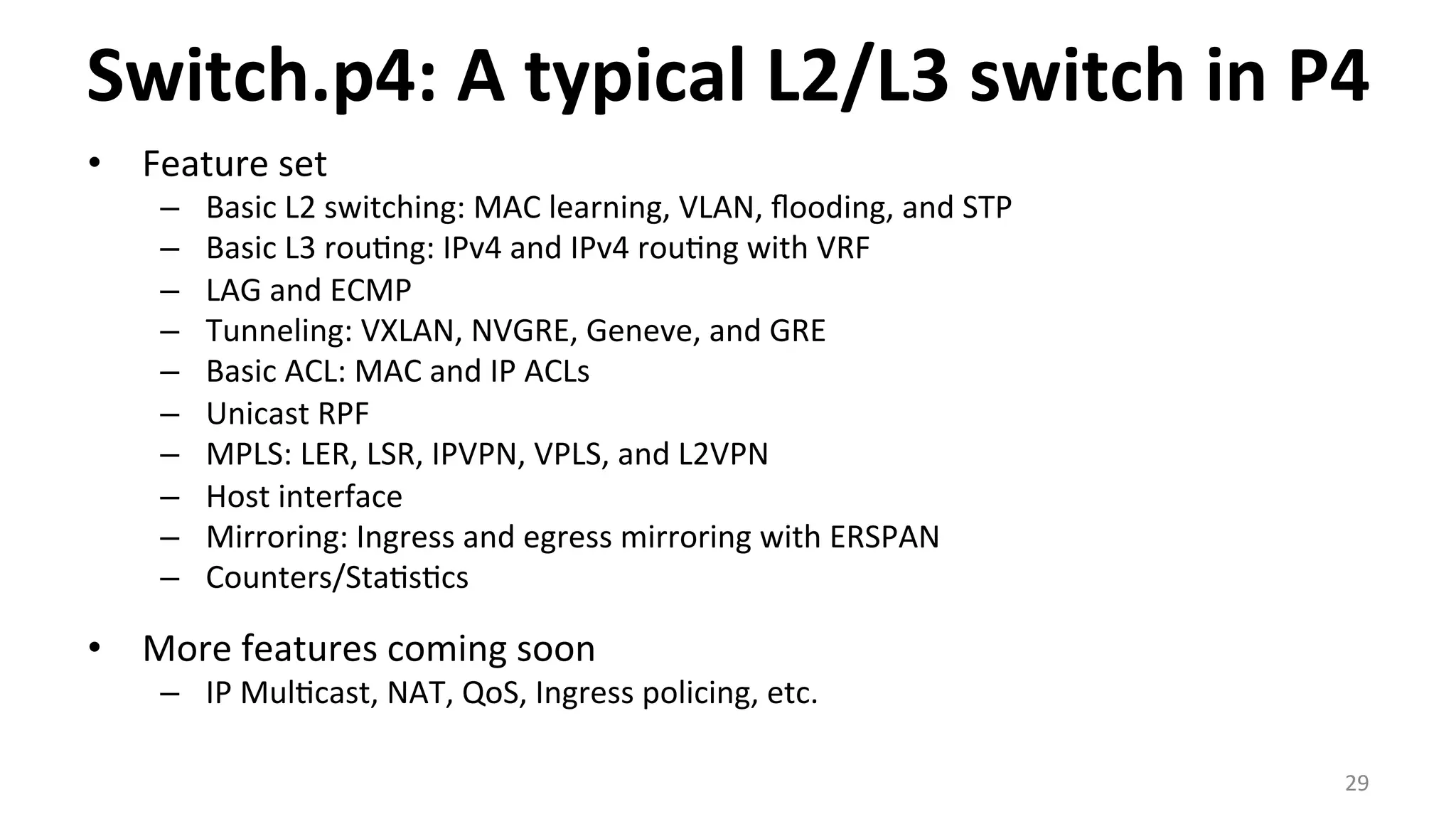
Switch.p4:	
  A	
  typical	
  L2/L3	
  switch	
  in	
  P4	
  
•  Feature	
  set	
  
–  Basic	
  L2	
  switching:	
  MAC	
  learning,	
  VLAN,	
  flooding,	
  and	
  STP	
  
–  Basic	
  L3	
  rou<ng:	
  IPv4	
  and	
  IPv4	
  rou<ng	
  with	
  VRF	
  
–  LAG	
  and	
  ECMP	
  
–  Tunneling:	
  VXLAN,	
  NVGRE,	
  Geneve,	
  and	
  GRE	
  
–  Basic	
  ACL:	
  MAC	
  and	
  IP	
  ACLs	
  
–  Unicast	
  RPF	
  
–  MPLS:	
  LER,	
  LSR,	
  IPVPN,	
  VPLS,	
  and	
  L2VPN	
  
–  Host	
  interface	
  
–  Mirroring:	
  Ingress	
  and	
  egress	
  mirroring	
  with	
  ERSPAN	
  
–  Counters/Sta<s<cs	
  
•  More	
  features	
  coming	
  soon	
  
–  IP	
  Mul<cast,	
  NAT,	
  QoS,	
  Ingress	
  policing,	
  etc.	
  
29	
  
Summary	
  
•  In	
  next	
  few	
  years	
  data-­‐plane	
  programmability	
  will	
  
quickly	
  become	
  commonplace	
  
•  This	
  will	
  accelerate	
  innova<ons	
  in	
  networking	
  
•  No	
  more	
  “black	
  boxes”	
  in	
  “white	
  boxes”	
  
•  As	
  the	
  common	
  industry-­‐wide	
  forwarding	
  language,	
  
P4	
  will	
  play	
  crucial	
  roles	
  
•  Lots	
  of	
  R&D	
  and	
  business	
  opportuni<es	
  opening	
  up	
  –	
  
join	
  and	
  contribute!	
  
30	
  
How	
  to	
  keep	
  in	
  touch?	
  
•  Join	
  P4.org	
  
–  p4-­‐dev@p4.org	
  
–  p4-­‐discuss@p4.org	
  
–  p4-­‐announce@p4.org	
  
•  Assign	
  engineers	
  to	
  get	
  familiar	
  with	
  P4	
  
•  Start	
  playing	
  tools,	
  language,	
  and	
  sample	
  P4	
  code	
  
•  Contribute	
  back	
  to	
  P4.org	
  
31	
  

[Webinar Slides] Programming the Network Dataplane in P4

  • 1.
    Programming   The  Network  Data  Plane  in  P4     Changhoon  Kim  (chang@barefootnetworks.com)   P4  Language  Consor9um  –  www.p4.org  
  • 2.
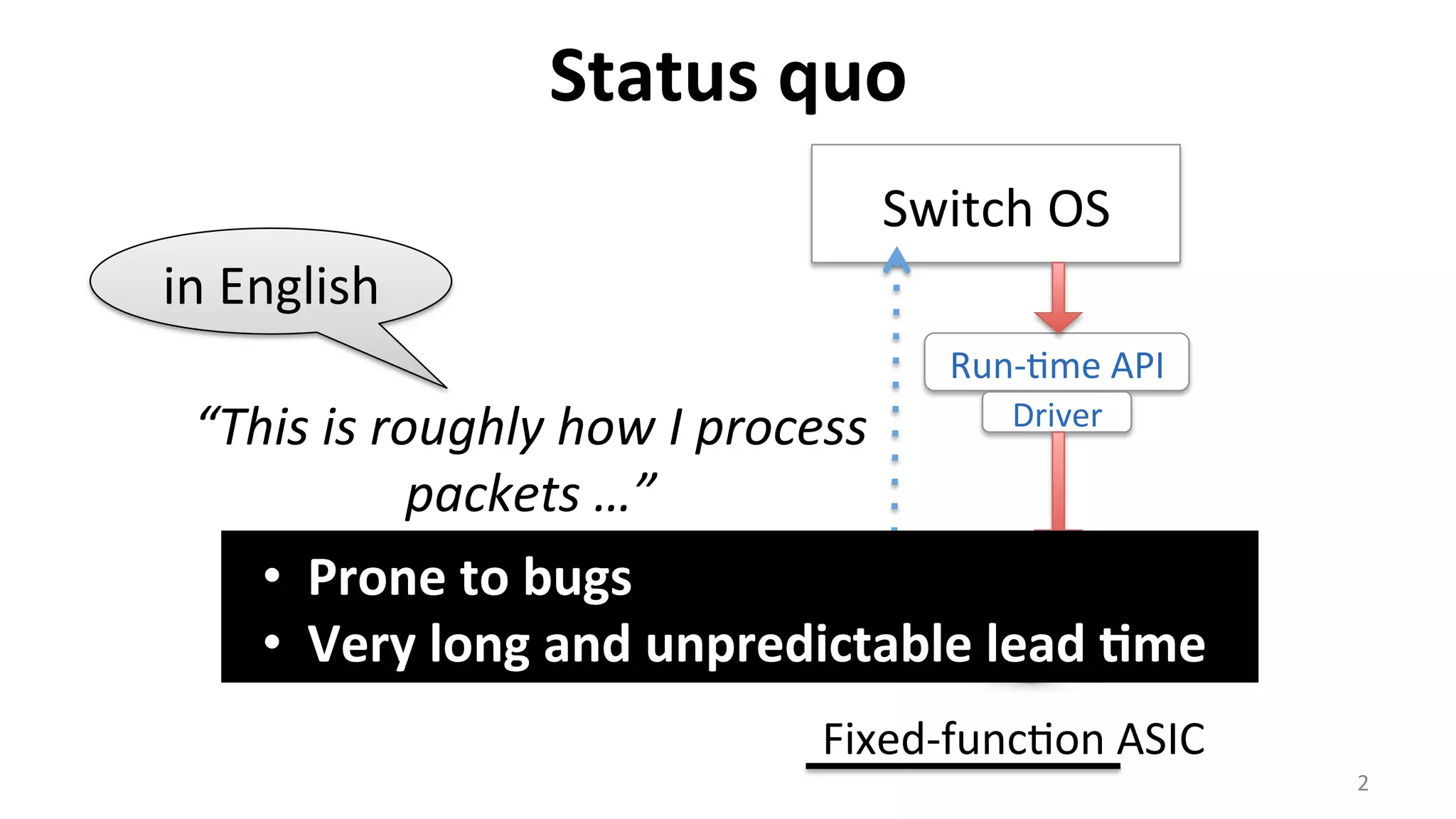
    Status  quo   2   Switch  OS   Run-­‐<me  API   Driver  “This  is  roughly  how  I  process   packets  …”     Fixed-­‐func<on  ASIC   in  English   •  Prone  to  bugs   •  Very  long  and  unpredictable  lead  9me  
  • 3.
    Protocols  evolve  …   more  rapidly  than  we  wish  they  would     •  Encapsula<on  protocols  for  network  virtualiza<on   –  1st  gen  (~2010):  VXLAN,  NVGRE   –  2nd  gen  (~2012):  STT,  VXLAN-­‐GPE   –  3rd  gen  (~2014):  NSH,  Geneve   •  OpenFlow   –  OF  1.0  (Dec  2009):  12  fields  (Ethernet,  TCP,  IPv4)   –  OF  1.1  (Feb  2011):  15  fields  (MPLS,  inter-­‐table  metadata)   –  OF  1.2  (Dec  2011):  36  fields  (ARP,  ICMP,  IPv6)   –  OF  1.3  (Jun  2012):  40  fields   –  OF  1.4  (Oct  2013):  41  fields   –  OF  1.5  (Dec  2014):  44  fields   3   Everybody  has  opinions!   Can’t  we  just  let  them  build  their  own  protocols?  
  • 4.
    Programmable  network  devices   •  Some  devices  are  or  will  be  more  programmable  than   fixed-­‐func<on  ASICs   •  CPUs:  10s  of  Gb/s   •  FPGAs,  NPUs:  100s  of  Gb/s   •  Protocol-­‐independent  switch  ASICs:  a  few  Tb/s   –  RMT  [SIGCOMM’13]  and  a  few  emerging  solu<ons   –  Merchant  silicon  with  fully  programmable  parser  and   generic  match-­‐ac<on  logic   –  In  next  few  years  this  kind  of  silicon  will  dominate   4  
  • 5.
    Turning  the  tables   5   Switch  OS   Run-­‐<me  API   Driver   PISA  device   (Protocol-­‐Independent  Switch  Architecture)   “This  is  precisely  how  you   must  process  packets”   in  P4  
  • 6.
    What  does  this  mean?   •  To  network  device  vendors   –  S/W  programming  prac<ces  and  tools  used  in  every  phase   –  Extremely  fast  itera<on  and  feature  release   –  Differen<a<on  in  capabili<es  and  performance   –  Can  fix  even  data-­‐plane  bugs  in  the  field   •  To  large  on-­‐line  service  providers   –  No  more  “black  boxes”  in  the  “white  boxes”   –  Your  devs  can  program,  test,  and  debug  your  network  devices   all  the  way  down   –  You  keep  your  own  ideas   6  
  • 7.
    7   Why  we  call  it   protocol-­‐independent  packet   processing  
  • 8.
    Logical  Data-­‐plane  View   (your  P4  program)   Switch  Pipeline   Device  does  not  understand  any  protocols  un9l   it  gets  programmed   Queues   Programmable   Parser   Fixed  Ac<on   Match  Table   Match  Table   Match  Table   Match  Table   L2   IPv4   IPv6   ACL   Ac<on  ALUs   Ac<on  ALUs   Ac<on  ALUs   Ac<on  ALUs   8   packet  packet   packet  packet   CLK  
  • 9.
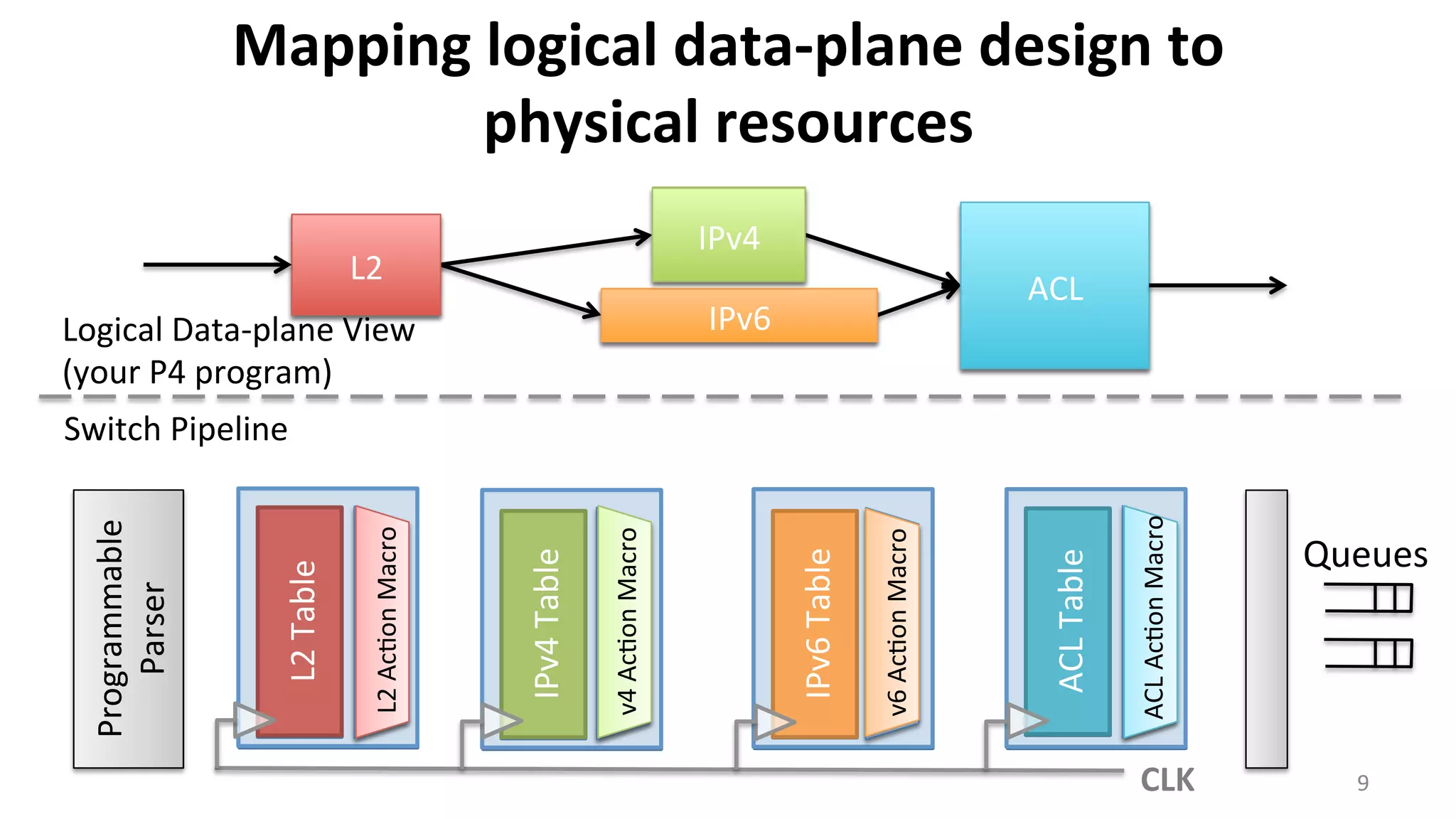
    Match  Table   Ac<on  ALUs   Mapping  logical  data-­‐plane  design  to   physical  resources   Queues   Match  Table   Match  Table   Match  Table   L2  Table   IPv4  Table   IPv6  Table   ACL  Table   Ac<on  ALUs   Ac<on  ALUs   Ac<on  ALUs   L2   IPv4   IPv6   ACL   Logical  Data-­‐plane  View   (your  P4  program)   Switch  Pipeline   L2   IPv6   ACL   IPv4   L2  Ac<on  Macro   v4  Ac<on  Macro   v6  Ac<on  Macro     ACL  Ac<on  Macro   9   Programmable   Parser   CLK  
  • 10.
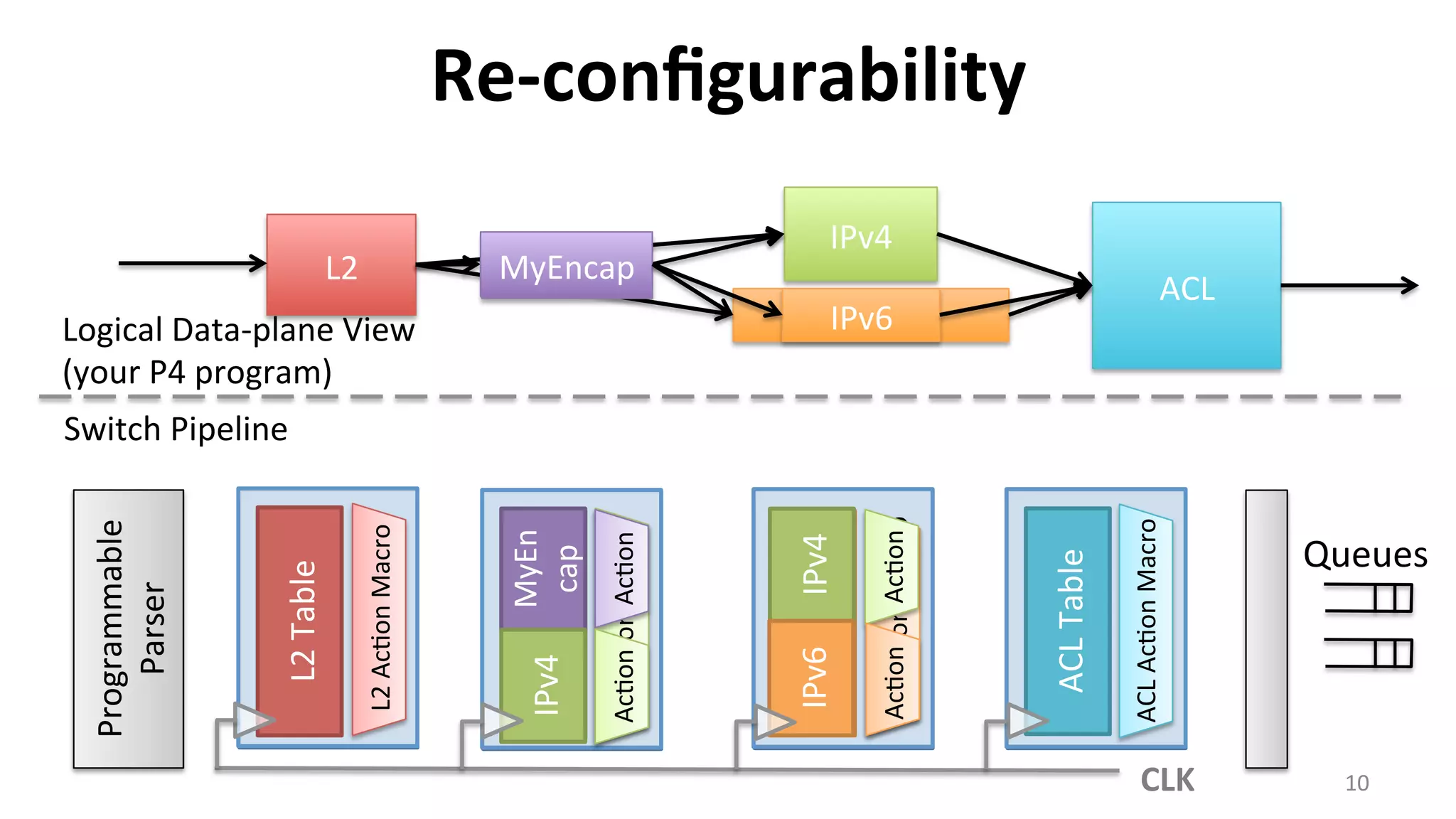
    Re-­‐configurability   L2  Table   IPv4  Table   ACL  Table   IPv6  Table   MyEn cap   L2   IPv4   IPv6   ACL   MyEncap   L2  Ac<on  Macro   v4  Ac<on  Macro   ACL  Ac<on  Macro   Ac<on   MyEncap   v6  Ac<on  Macro   IPv4   Ac<on   IPv4   Ac<on   10   IPv6   Ac<on   IPv6   Programmable   Parser   CLK   Logical  Data-­‐plane  View   (your  P4  program)   Switch  Pipeline   Queues  
  • 11.
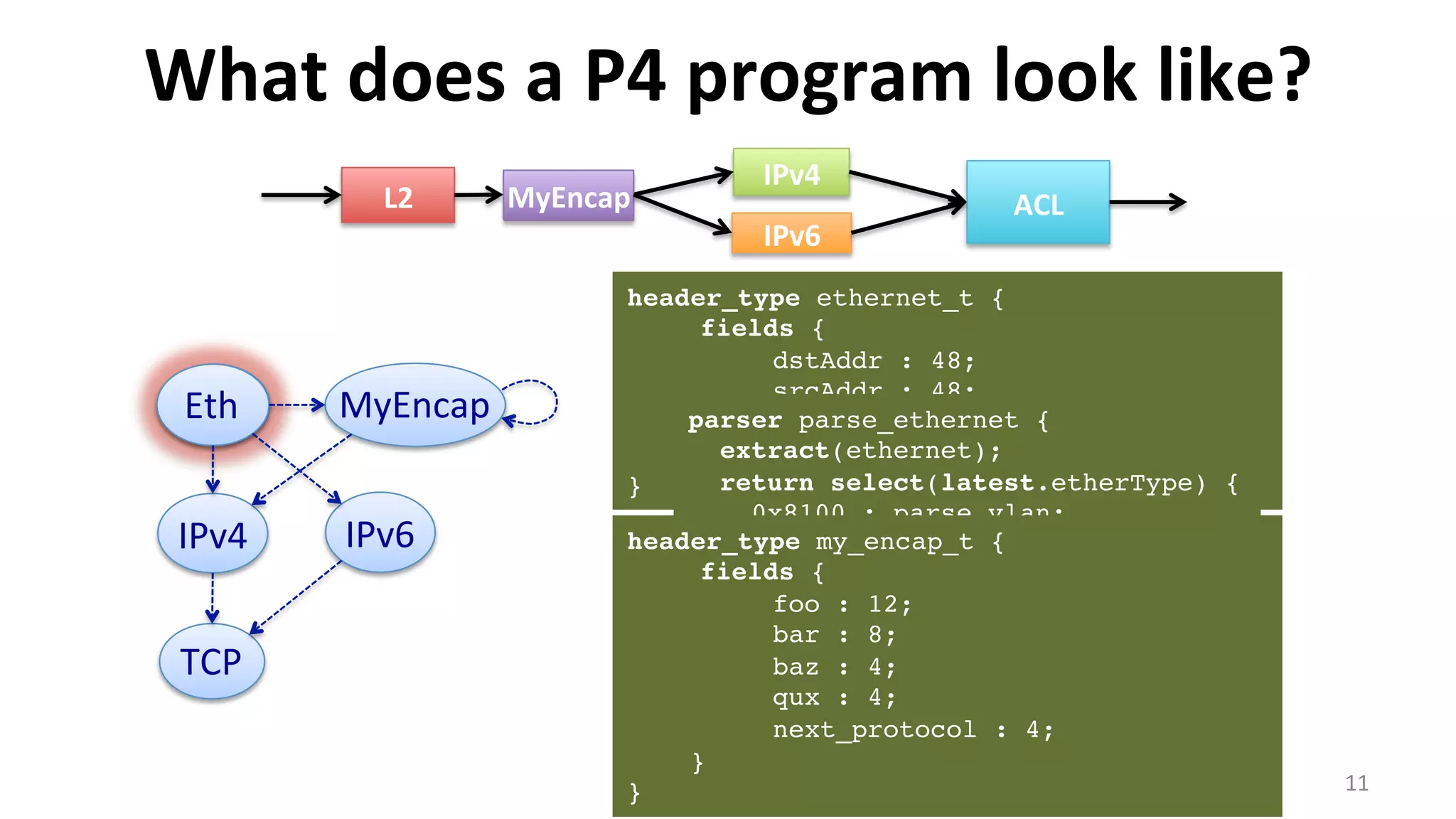
    What  does  a  P4  program  look  like?   11   L2   IPv4   ACL  MyEncap  MyEncap   IPv6   header_type ethernet_t { fields { dstAddr : 48; srcAddr : 48; etherType : 16; } } parser parse_ethernet { extract(ethernet); return select(latest.etherType) { 0x8100 : parse_vlan; 0x800 : parse_ipv4; 0x86DD : parse_ipv6; } } TCP   IPv4   IPv6   MyEncap  Eth   header_type my_encap_t { fields { foo : 12; bar : 8; baz : 4; qux : 4; next_protocol : 4; } }
  • 12.
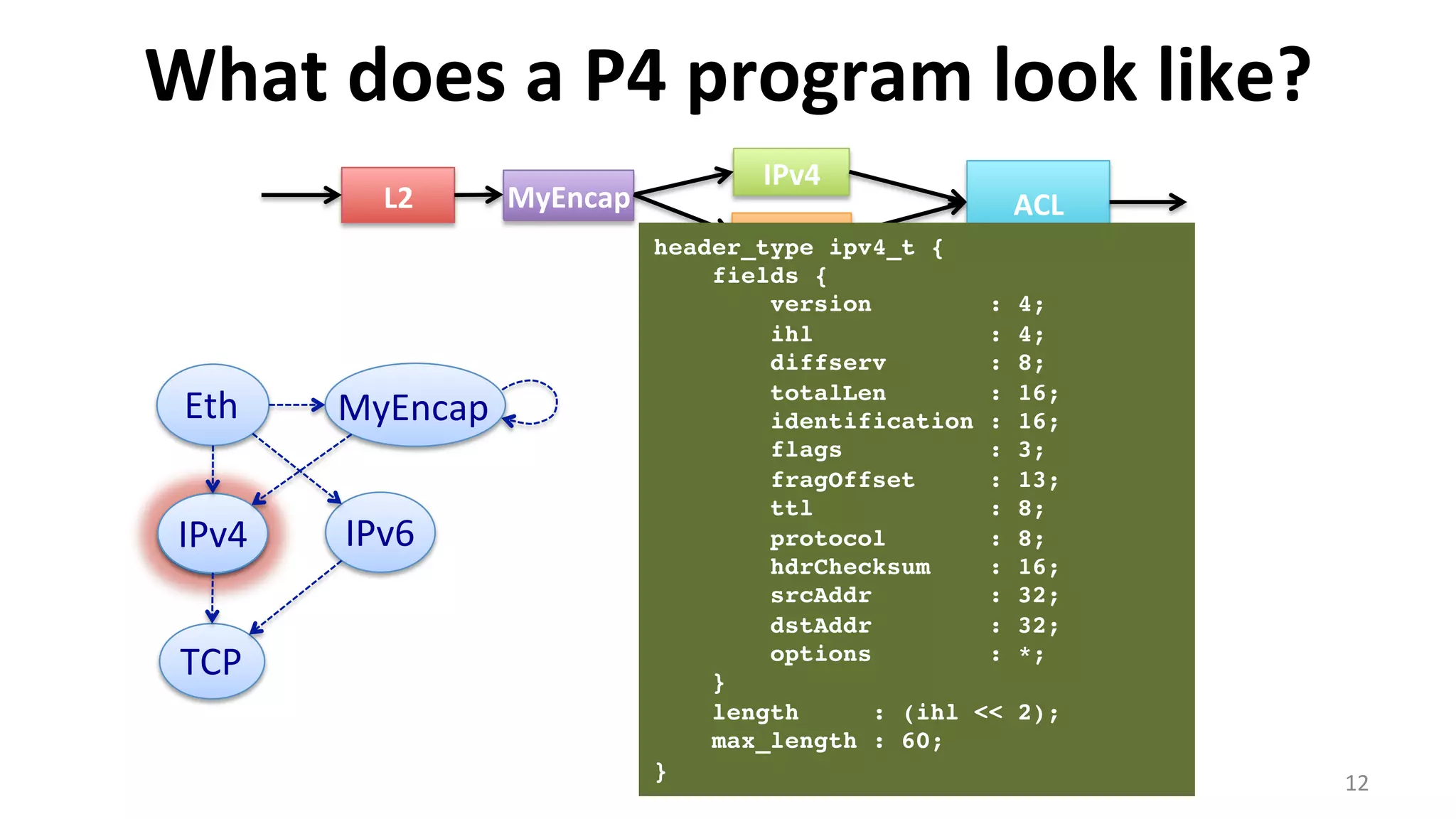
    What  does  a  P4  program  look  like?   12   L2   IPv4   ACL  MyEncap  MyEncap   IPv6   TCP   IPv4   IPv6   MyEncap  Eth   header_type ipv4_t { fields { version : 4; ihl : 4; diffserv : 8; totalLen : 16; identification : 16; flags : 3; fragOffset : 13; ttl : 8; protocol : 8; hdrChecksum : 16; srcAddr : 32; dstAddr : 32; options : *; } length : (ihl << 2); max_length : 60; }
  • 13.
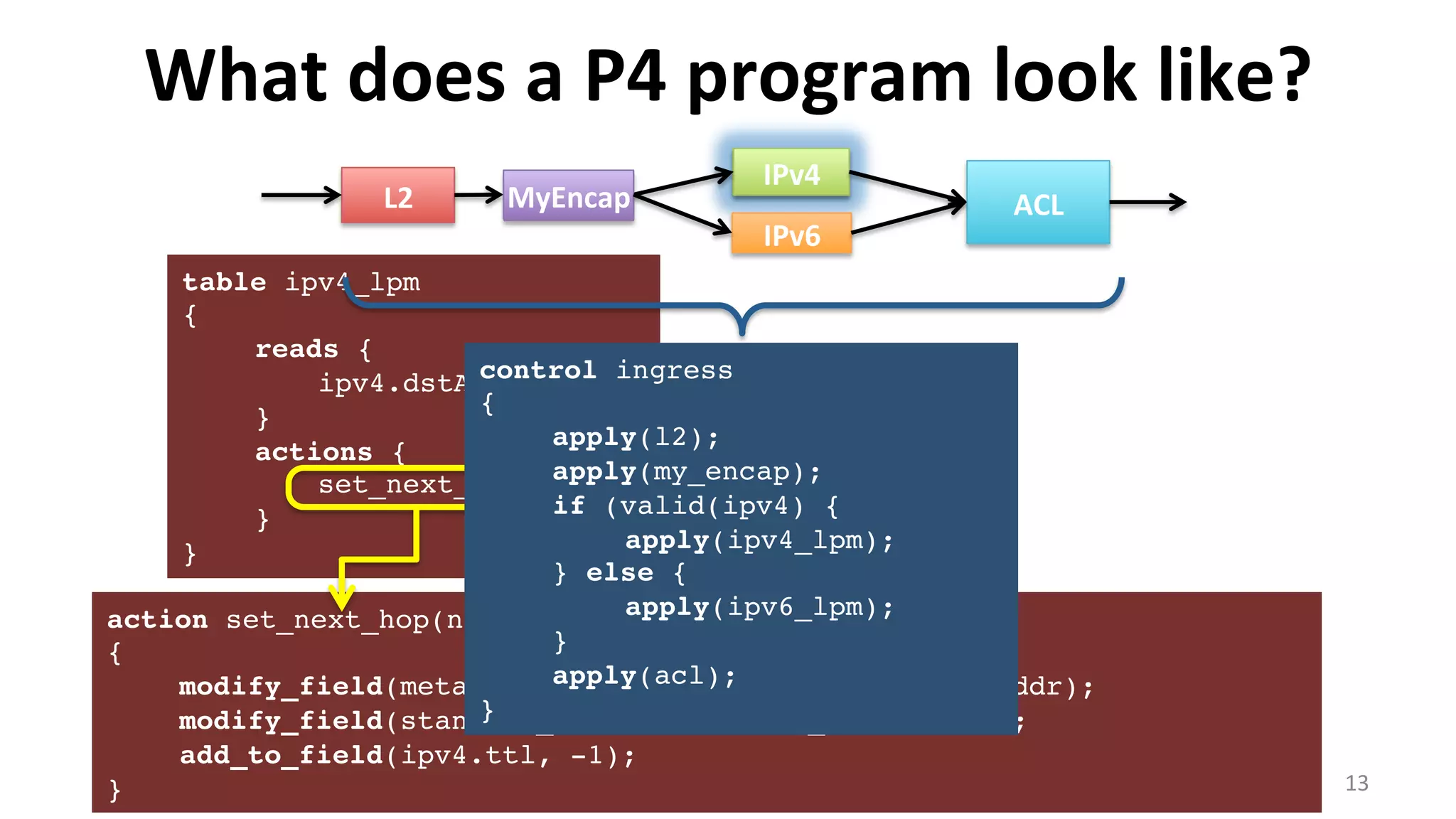
    What  does  a  P4  program  look  like?   13   L2   IPv4   ACL  MyEncap  MyEncap   IPv6   table ipv4_lpm { reads { ipv4.dstAddr : lpm; } actions { set_next_hop; drop; } } action set_next_hop(nhop_ipv4_addr, port) { modify_field(metadata.nhop_ipv4_addr, nhop_ipv4_addr); modify_field(standard_metadata.egress_port, port); add_to_field(ipv4.ttl, -1); } control ingress { apply(l2); apply(my_encap); if (valid(ipv4) { apply(ipv4_lpm); } else { apply(ipv6_lpm); } apply(acl); }
  • 14.
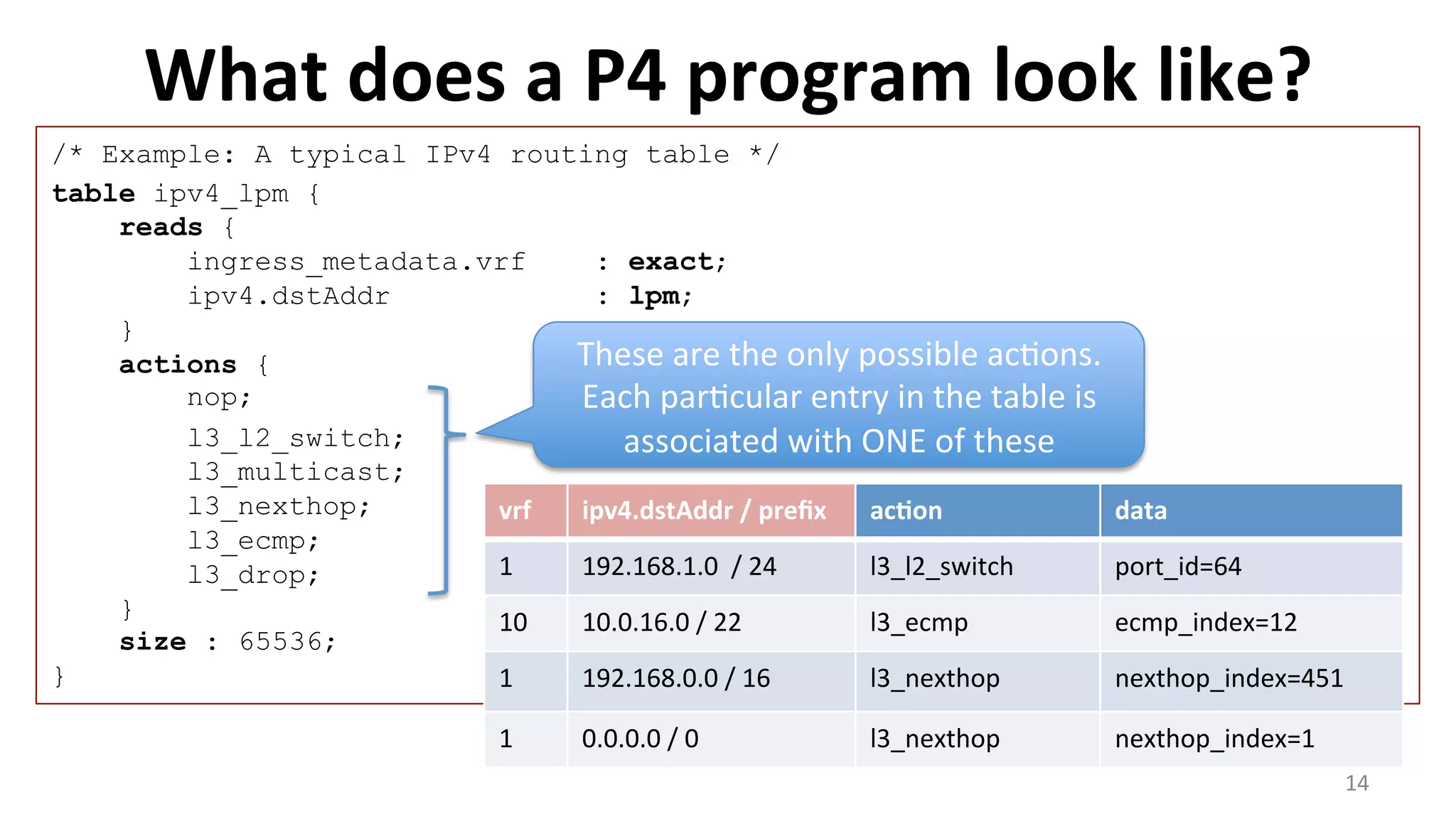
    /* Example: Atypical IPv4 routing table */ table ipv4_lpm { reads { ingress_metadata.vrf : exact; ipv4.dstAddr : lpm; } actions { nop; l3_l2_switch; l3_multicast; l3_nexthop; l3_ecmp; l3_drop; } size : 65536; } What  does  a  P4  program  look  like?   14   vrf   ipv4.dstAddr  /  prefix   ac9on   data   1   192.168.1.0    /  24   l3_l2_switch   port_id=64   10   10.0.16.0  /  22   l3_ecmp   ecmp_index=12   1   192.168.0.0  /  16   l3_nexthop   nexthop_index=451   1   0.0.0.0  /  0   l3_nexthop   nexthop_index=1   These  are  the  only  possible  ac<ons.   Each  par<cular  entry  in  the  table  is   associated  with  ONE  of  these  
  • 15.
    What  does  a  P4  program  look  like?   •  Match  seman<cs   –  exact •  port_index  :  exact   –  ternary •  ethernet.srcAddr  :  ternary   –  valid •  vlan_tag[0]  :  valid   –  lpm   •  ipv4.dstAddr  :  lpm   –  range •  udp.dstPort  :  range   15  
  • 16.
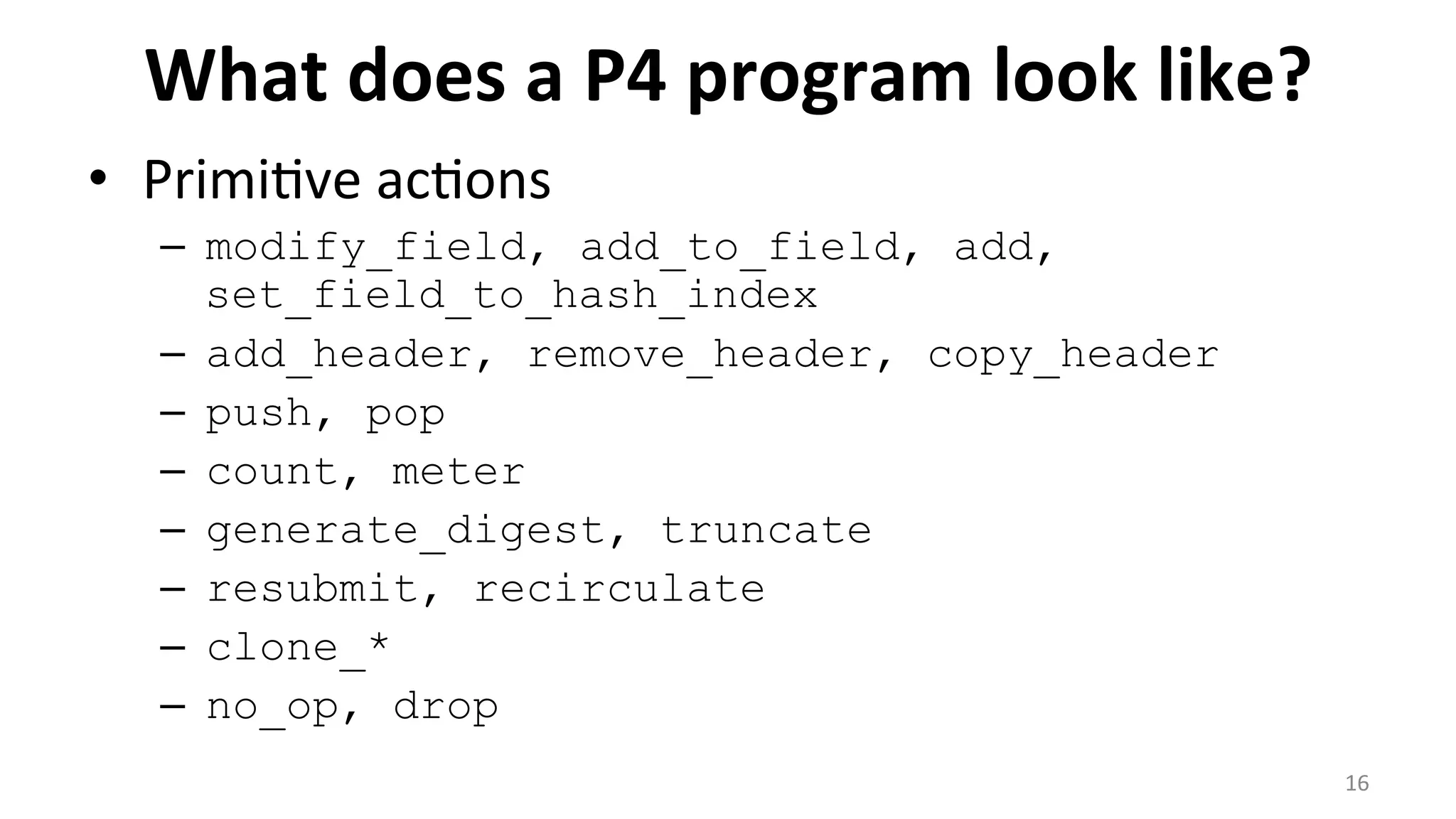
    What  does  a  P4  program  look  like?   •  Primi<ve  ac<ons   –  modify_field, add_to_field, add, set_field_to_hash_index –  add_header, remove_header, copy_header –  push, pop –  count, meter –  generate_digest, truncate –  resubmit, recirculate –  clone_* –  no_op, drop   16  
  • 17.
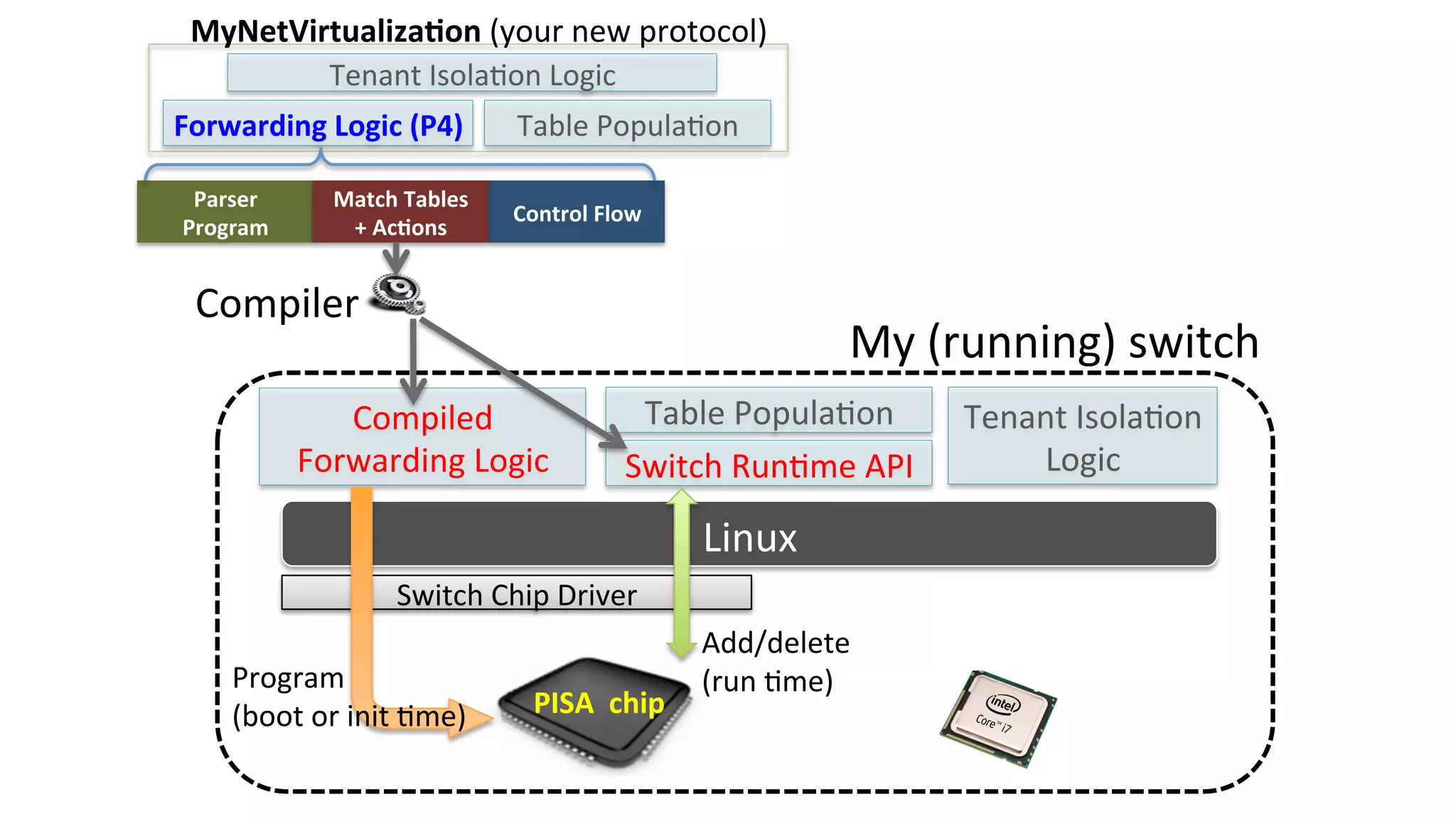
    My  (running)  switch   MyNetVirtualiza9on  (your  new  protocol)   Forwarding  Logic  (P4)   Table  Popula<on   Tenant  Isola<on   Logic   Linux   Switch  Chip  Driver   Switch  Run<me  API   Table  Popula<on   Tenant  Isola<on  Logic   Compiled   Forwarding  Logic   Parser   Program   Control  Flow   Match  Tables   +  Ac9ons   Compiler   PISA    chip   Add/delete   (run  <me)  Program   (boot  or  init  <me)  
  • 18.
    DEMO!   18   In-­‐band  Network  Telemetry  (INT)   hnp://p4.org/p4/inband-­‐network-­‐telemetry/    
  • 19.
    Demo  Setup   19   SW-­‐n   Sim  Model   SW-­‐1   Sim  Model     Control   Plane   Compiler   SW  Ctrl  API   /* Reference p4 program switch.p4 */ #include "includes/headers.p4" #include "includes/parser.p4” /********************************/ /* Device Personality Selection */ /********************************/ // #define P_MINIMAL #define P_BASE //#define P_MSDC_SPINE //#define P_MSDC_TOR //#define P_MSDC_BL //#define P_INTERNET_ROUTER ... // Flexible Tables #define LPM_TABLE_SIZE 16384 #define IPV6_LPM_TABLE_SIZE 4096 #define HOST_TABLE_SIZE 131072 #define IPV6_HOST_TABLE_SIZE 32768 ... header_type routing_metadata_t { fields { bd : BD_BIT_WIDTH; /* bridge domain */ vrf : VRF_BIT_WIDTH; /* routing domain */ v6_vrf : VRF_BIT_WIDTH; /* routing domain */ ... table bridge_domain { reads { routing_metadata.bd : exact; } actions { nop; // Not used bd_set; … Switch  Data-­‐plane   Configura9on   Auto-­‐generated   API   .          .                  .   Control   Plane   SW  Ctrl  API   Run-­‐;me   table  update   Run-­‐;me   table  update  
  • 20.
    Scenario:  Debugging  Long  Latency  Tail   20   SW1   (dc.p4)   H1   H2   H3   5Mbps   SW2   (dc.p4)   20Mbps   Monitor  5Mbps   20Mbps   5Mbps   SW3   (dc.p4)   HTTP  download   (from  H1  to  H3)  
  • 21.
    In-­‐band  Network  Telemetry  in  P4   21   table int_table { reads { ip.protocol; } actions { export_queue_latency; } } Add  TCP  Op<ons  &   copy  switch  ID  and  queue  latency   Into  the  op<ons   action export_queue_latency (sw_id) { add_header(int_header); modify_field(int_header.kind, TCP_OPTION_INT); modify_field(int_header.len, TCP_OPTION_INT_LEN); modify_field(int_header.sw_id, sw_id); modify_field(int_header.q_latency, intrinsic_metadata.deq_timedelta); add_to_field(tcp.dataOffset, 2); add_to_field(ipv4.totalLen, 8); subtract_from_field(ingress_metadata.tcpLength, 12); }
  • 22.
    INT  Open-­‐source  and  Spec   •  hnp://p4.org/p4/inband-­‐network-­‐telemetry/   22   Spec   Ref  P4  code   Demo  
  • 23.
    This  will  accelerate  innova9ons   •  Areas  of  innova<on  (just  to  name  a  few)   –  Reducing  feature  set  à  “biggest  bang  for  buck”   –  Network  monitoring,  analysis,  and  diagnos<cs   –  Tunnel-­‐splicing  gateways   –  Load  balancing   –  Anack  detec<on  and  mi<ga<on   –  Host-­‐stack  offloading   •  Across  various  types  of  network  devices   –  Hardware  and  sosware  devices  (OVS,  eBPF,  etc.)   –  Switches,  NICs,  middle-­‐boxes,  etc.   23  
  • 24.
    This  will  create  lots  of  significant  R&D  and   business  opportuni9es   •  Novel  network  and  protocol  designs   –  Take  advantage  of  unprecedented  amount  of  visibility  and   control  into  the  network   –  Joint  design  and  op<miza<on  between  hosts  and  network   •  Development  tools   –  Compilers,  debuggers,  sta<c  analyzers,  profilers,  etc.   –  P4-­‐programming  assistance  tools   •  Network  verifica<on,  test,  and  simula<on   •  Many  more  …   24  
  • 25.
    P4.org  –  P4  Language  Consor9um   25   Maintains  the   language  spec  
  • 26.
    P4.org  –  P4  Language  Consor9um   26   Maintains  key  dev  tools  under   Apache  license     •  Reference  P4  programs   •  Compiler   •  P4  sosware  switch   •  Test  framework  
  • 27.
    P4.org  –  P4  Language  Consor9um   27   Open  for  par9cipa9on  by   any  individuals  or   organiza9ons  
  • 28.
    P4.org  –  P4  Language  Consor9um   28   Hosts  P4  workshops  and  boot  camps     •  2nd  P4  Workshop  on  Nov/18  at  Stanford   •  1st  P4  Boot  camp  in  the  same  week  
  • 29.
    Switch.p4:  A  typical  L2/L3  switch  in  P4   •  Feature  set   –  Basic  L2  switching:  MAC  learning,  VLAN,  flooding,  and  STP   –  Basic  L3  rou<ng:  IPv4  and  IPv4  rou<ng  with  VRF   –  LAG  and  ECMP   –  Tunneling:  VXLAN,  NVGRE,  Geneve,  and  GRE   –  Basic  ACL:  MAC  and  IP  ACLs   –  Unicast  RPF   –  MPLS:  LER,  LSR,  IPVPN,  VPLS,  and  L2VPN   –  Host  interface   –  Mirroring:  Ingress  and  egress  mirroring  with  ERSPAN   –  Counters/Sta<s<cs   •  More  features  coming  soon   –  IP  Mul<cast,  NAT,  QoS,  Ingress  policing,  etc.   29  
  • 30.
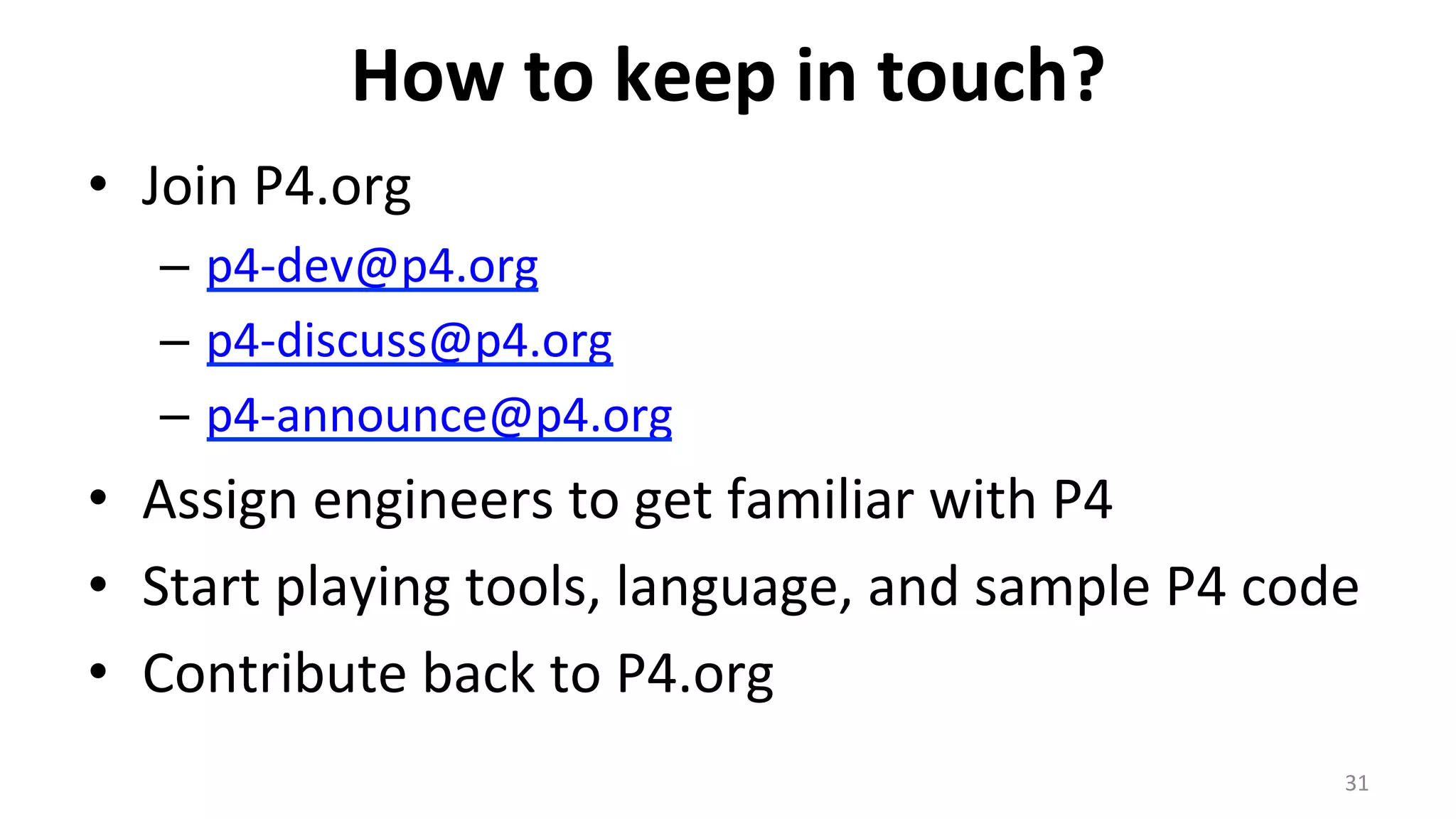
    Summary   •  In  next  few  years  data-­‐plane  programmability  will   quickly  become  commonplace   •  This  will  accelerate  innova<ons  in  networking   •  No  more  “black  boxes”  in  “white  boxes”   •  As  the  common  industry-­‐wide  forwarding  language,   P4  will  play  crucial  roles   •  Lots  of  R&D  and  business  opportuni<es  opening  up  –   join  and  contribute!   30  
  • 31.
    How  to  keep  in  touch?   •  Join  P4.org   –  p4-­‐dev@p4.org   –  p4-­‐discuss@p4.org   –  p4-­‐announce@p4.org   •  Assign  engineers  to  get  familiar  with  P4   •  Start  playing  tools,  language,  and  sample  P4  code   •  Contribute  back  to  P4.org   31