Taylor SeriesJohn Weiss
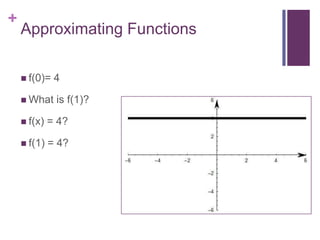
Approximating Functionsf(0)= 4What is f(1)?f(x) = 4?f(1) = 4?
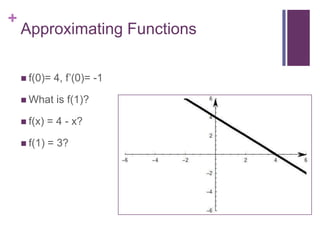
Approximating Functionsf(0)= 4, f’(0)= -1What is f(1)?f(x) = 4 - x?f(1) = 3?
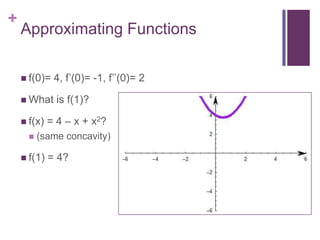
Approximating Functionsf(0)= 4, f’(0)= -1, f’’(0)= 2What is f(1)?f(x) = 4 – x + x2? (same concavity)f(1) = 4?
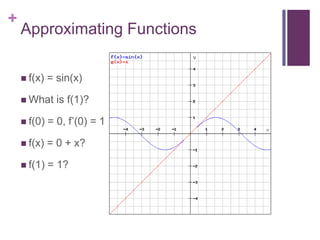
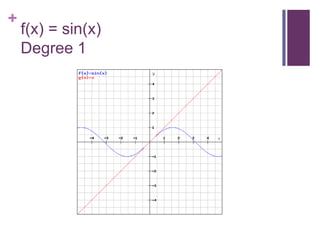
Approximating Functionsf(x) = sin(x)What is f(1)?f(0) = 0, f’(0) = 1f(x) = 0 + x?f(1) = 1?
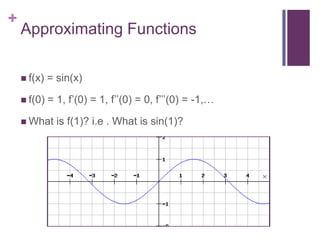
Approximating Functionsf(x) = sin(x)f(0) = 1, f’(0) = 1, f’’(0) = 0, f’’’(0) = -1,…What is f(1)? i.e . What is sin(1)?
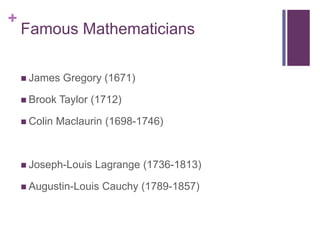
Famous MathematiciansJames Gregory (1671)Brook Taylor (1712)Colin Maclaurin (1698-1746)Joseph-Louis Lagrange (1736-1813)Augustin-Louis Cauchy (1789-1857)
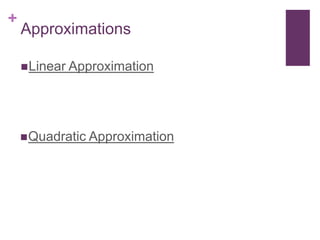
ApproximationsLinear ApproximationQuadratic Approximation
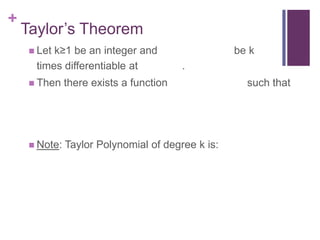
Taylor’s TheoremLet k≥1 be an integer and                          be k     times differentiable at               .Then there exists a function                           such thatNote: Taylor Polynomial of degree k is:
Works for Linear Approximations
Works for Quadratic Approximations
f(x) = sin(x)Degree 1
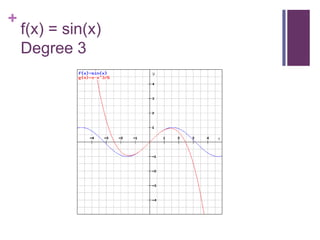
f(x) = sin(x)Degree 3
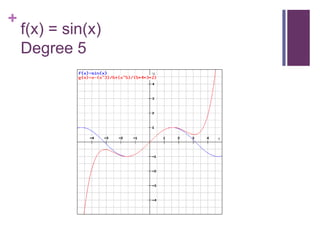
f(x) = sin(x)Degree 5
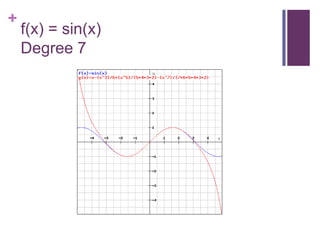
f(x) = sin(x)Degree 7
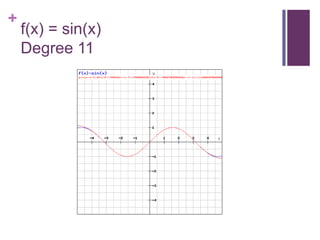
f(x) = sin(x)Degree 11
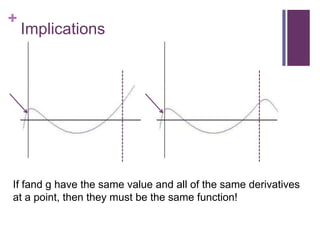
ImplicationsIf fand g have the same value and all of the same derivatives at a point, then they must be the same function!
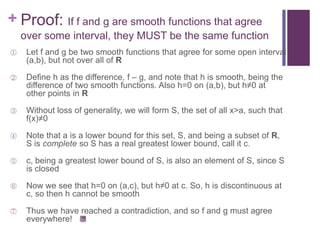
Proof: If f and g are smooth functions that agree over some interval, they MUST be the same functionLet f and g be two smooth functions that agree for some open interval (a,b), but not over all of RDefine h as the difference, f – g, and note that h is smooth, being the difference of two smooth functions. Also h=0 on (a,b), but h≠0 at other points in RWithout loss of generality, we will form S, the set of all x>a, such that f(x)≠0 Note that a is a lower bound for this set, S, and being a subset of R, S is complete so S has a real greatest lower bound, call it c.c, being a greatest lower bound of S, is also an element of S, since S is closedNow we see that h=0 on (a,c), but h≠0 at c. So, h is discontinuous at c, so then h cannot be smoothThus we have reached a contradiction, and so f and g must agree everywhere!
Suppose f(x) can be rewritten as a power series…
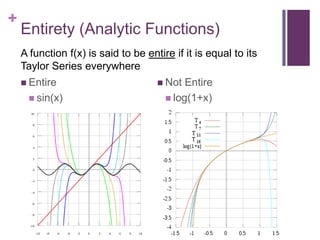
Entirety (Analytic Functions)A function f(x) is said to be entire if it is equal to its Taylor Series everywhereEntiresin(x)Not Entirelog(1+x)
Proof: sin(x) is entireMaclaurin Seriessin(0)=0sin’(0)=1sin’’(0)=0sin’’’(0)=-1sin’’’’(0)=0sin’’’’’(0)=1sin’’’’’’(0)=0… etc.
Proof: sin(x) is entireLagrange formula for the remainder:Let                      be k+1 times differentiable on (a,x) and continuous on [a,x]. Then 	for some z in (a,x)
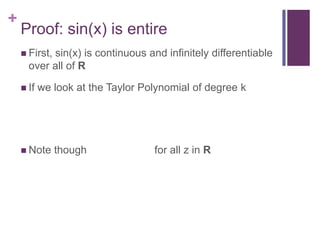
Proof: sin(x) is entire First, sin(x) is continuous and infinitely differentiable over all of RIf we look at the Taylor Polynomial of degree kNote though                       for all z in R
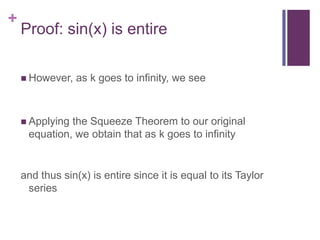
Proof: sin(x) is entireHowever, as k goes to infinity, we seeApplying the Squeeze Theorem to our original equation, we obtain that as k goes to infinityand thus sin(x) is entire since it is equal to its Taylor series
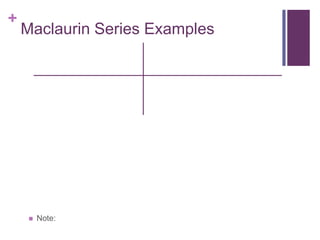
Maclaurin Series ExamplesNote:
ApplicationsPhysicsSpecial Relativity EquationFermat’s Principle (Optics)Resistivity of WiresElectric DipolesPeriods of PendulumsSurveying (Curvature of the Earth)
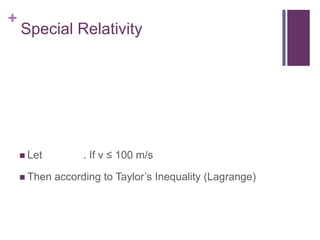
Special RelativityLet 		. If v ≤ 100 m/sThen according to Taylor’s Inequality (Lagrange)
Lagrange RemainderLagrange formula for the remainder:Let                      be k+1 times differentiable on (a,x) and continuous on [a,x]. Then 	for some z in (a,x)
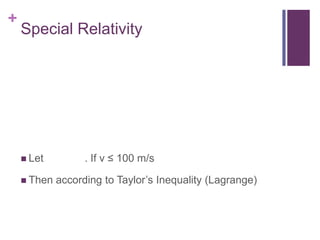
Special RelativityLet 		. If v ≤ 100 m/sThen according to Taylor’s Inequality (Lagrange)
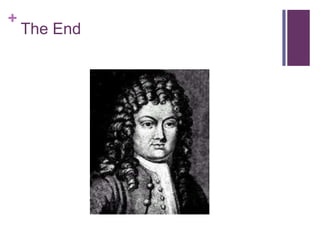
The End

Taylor series