Share Collaborate and Exchange, reshaping education through technology: the EdShare experiencepresentation to HEA-ICS Autumn 2009Su White, Hugh Davis,Thanassis Tiropanis, Les Carr, Dave MillardAutumn 2009
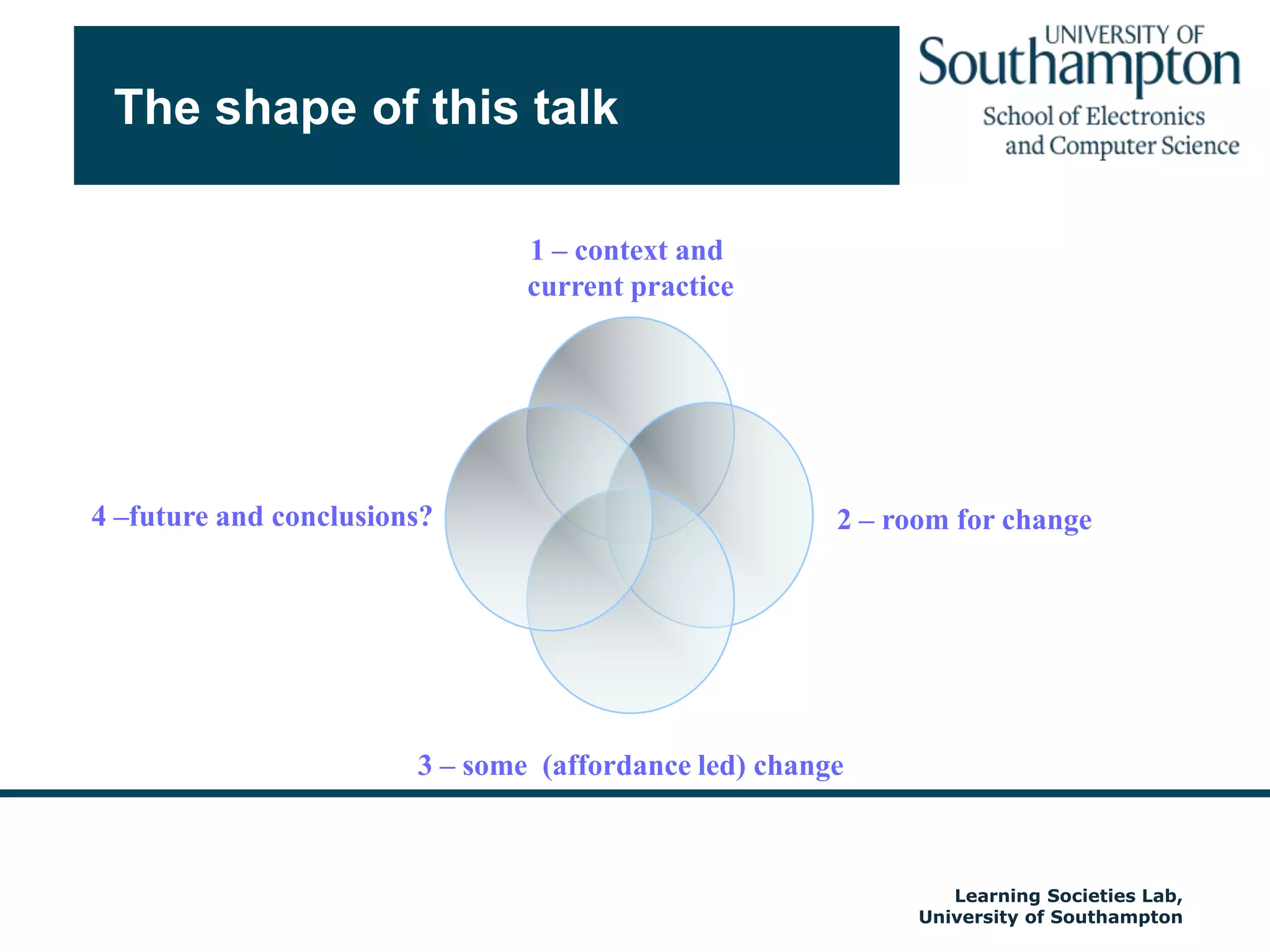
1 – context and current practice2 – room for change4 –future and conclusions?3 – some  (affordance led) changeThe shape of this talkAutumn 2009
and Current PracticeContextAutumn 2009
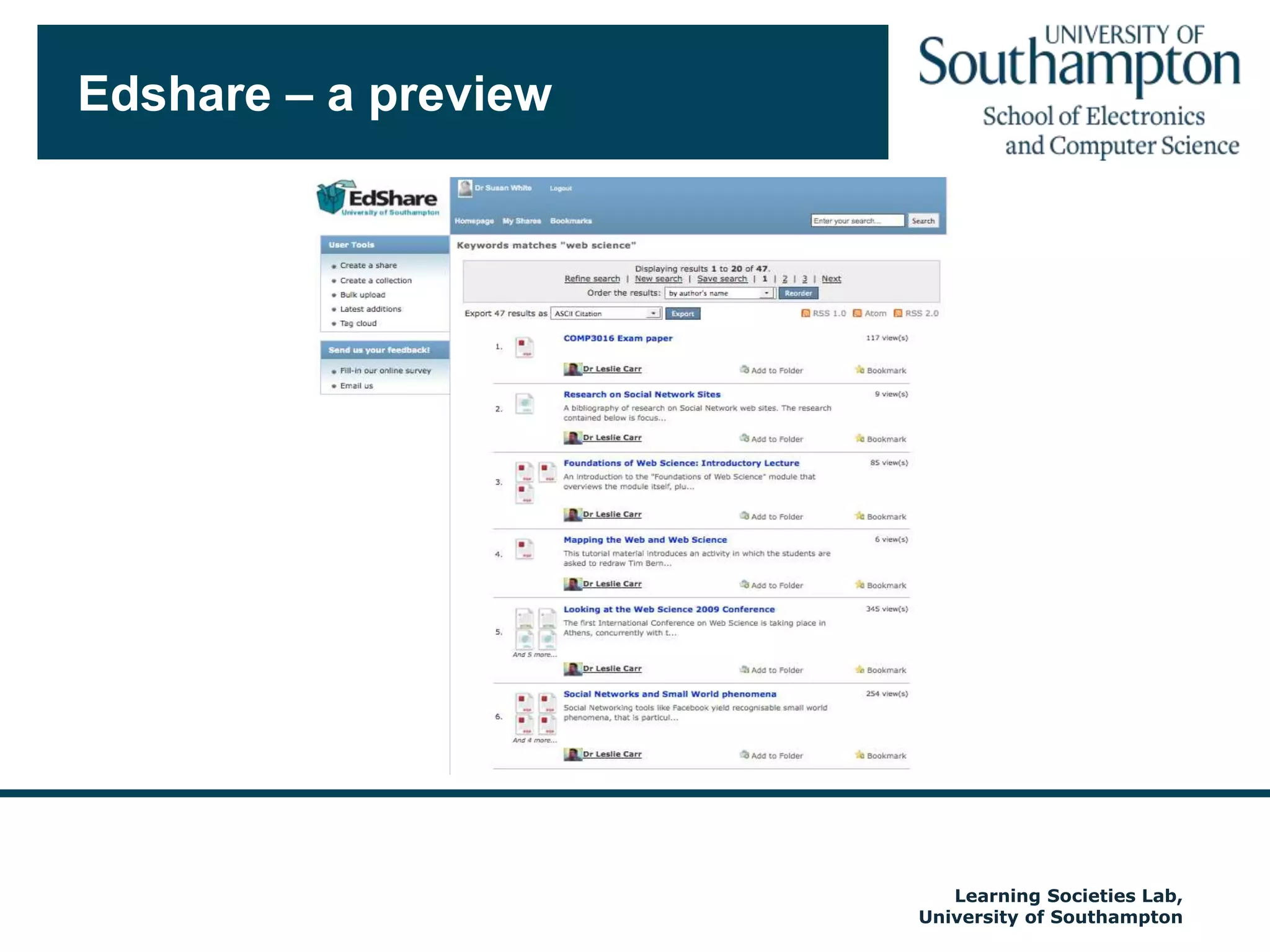
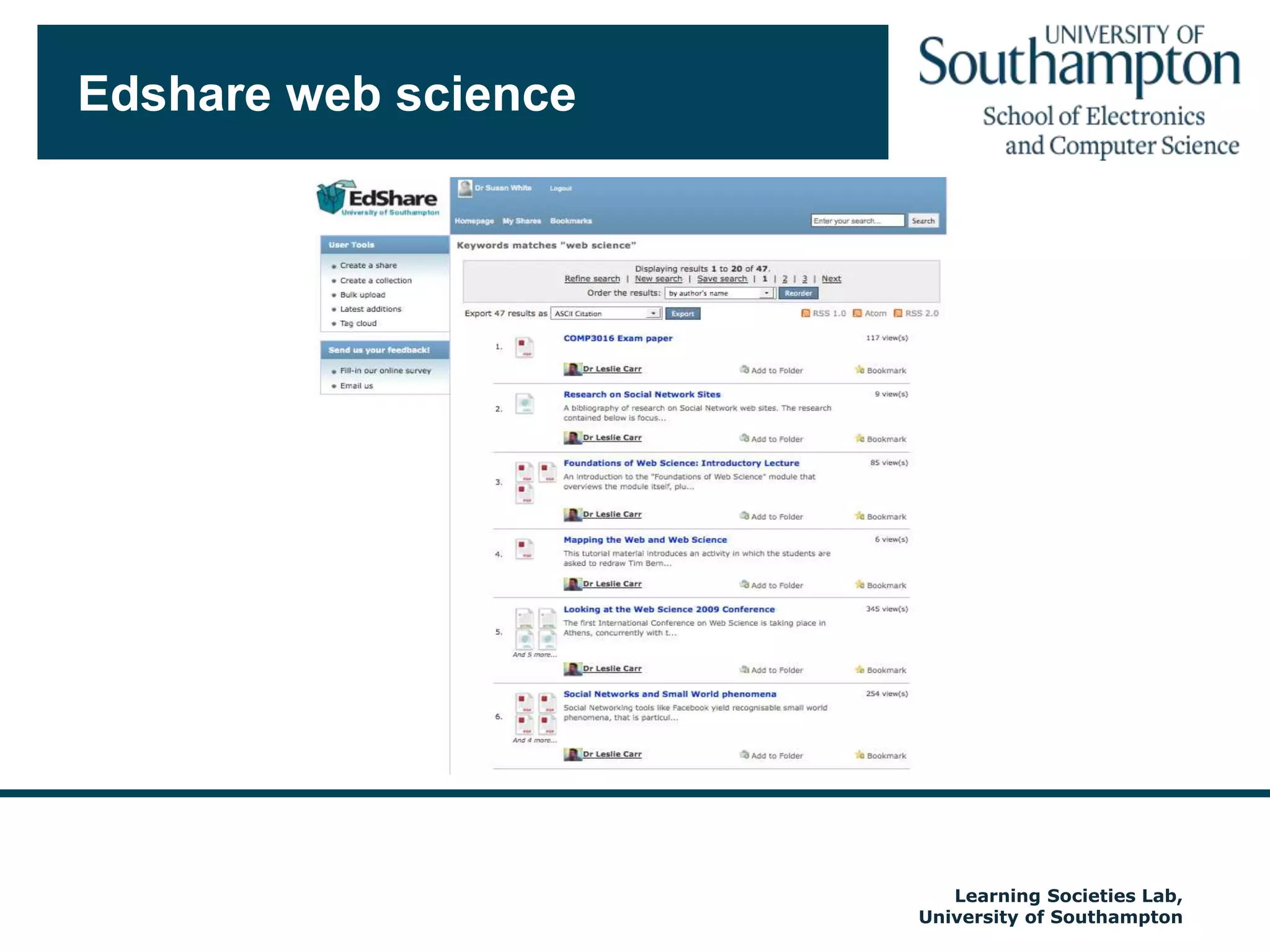
Edshare – a previewAutumn 2009
Universities and knowledge	The HumboldtianIdealIn universities, learning should not be [defined] in terms of the passing on of well established knowledge, but always in terms of not yet completely solved problems.”Humboldt, 1807Thanks to Lewis EltonAutumn 2009Web 2.0affordances?
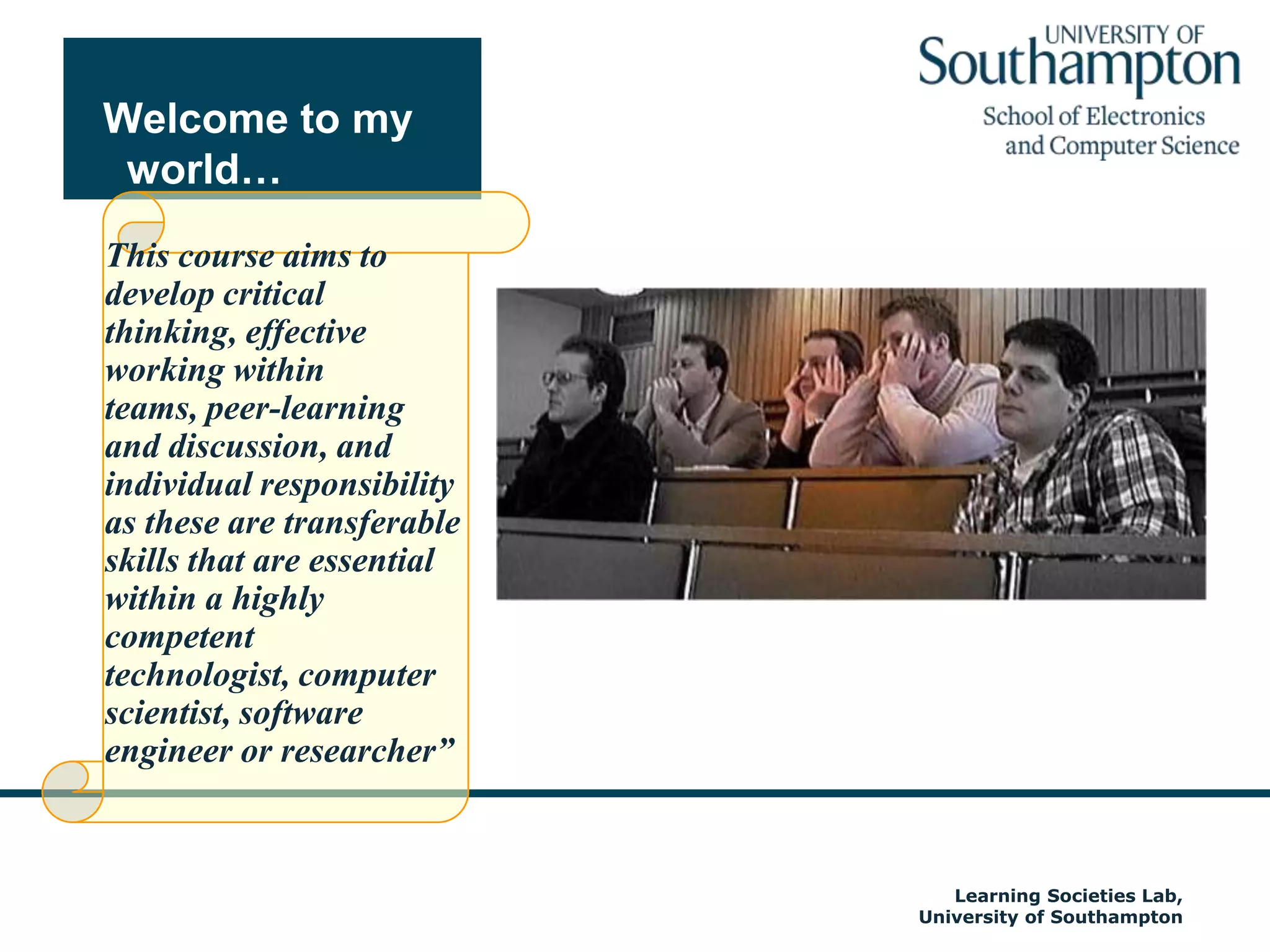
Welcome to my world…This course aims to develop critical thinking, effective working within teams, peer-learning and discussion, and individual responsibility as these are transferable skills that are essential within a highly competent technologist, computer scientist, software engineer or researcher”Autumn 2009
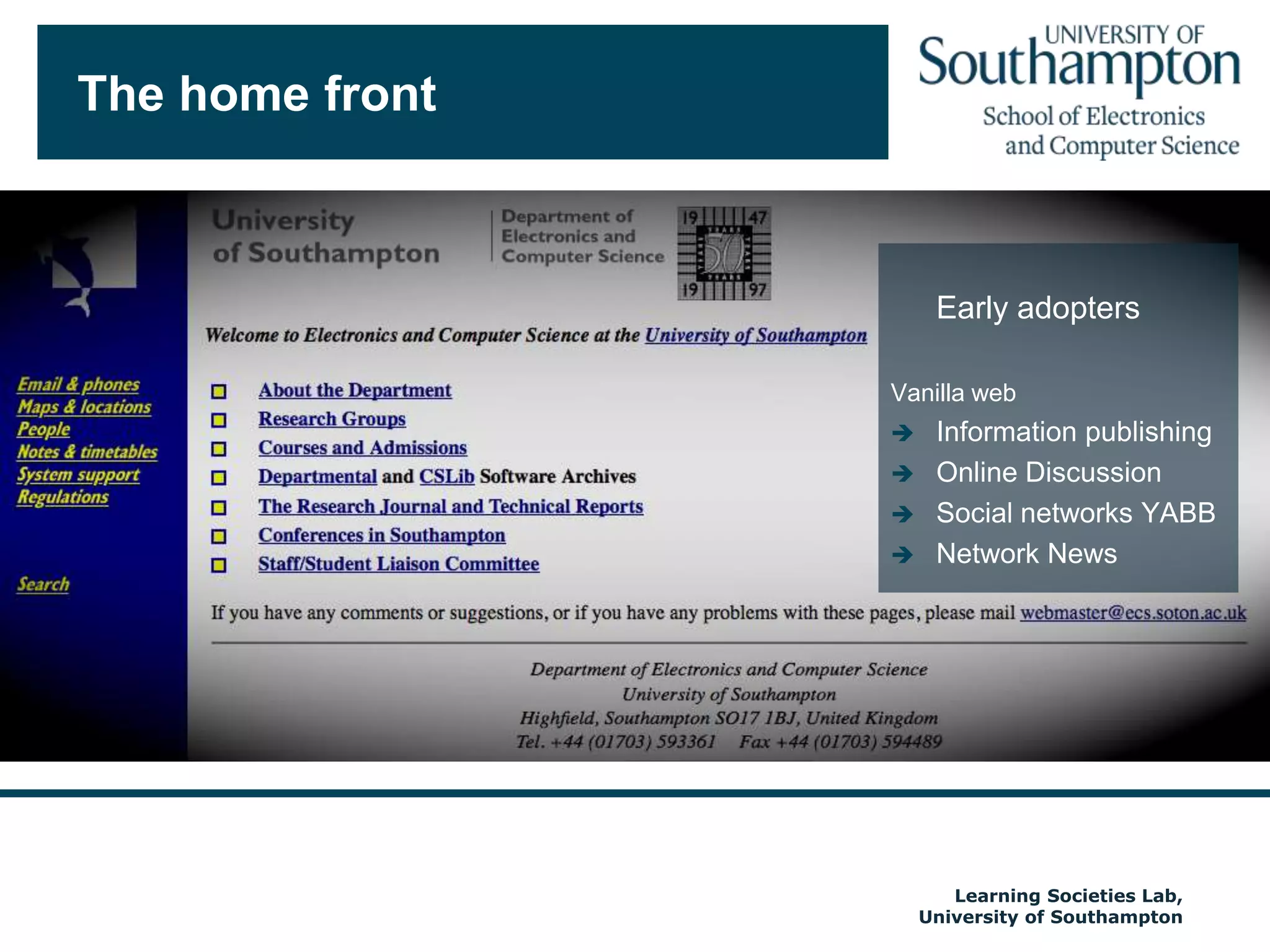
The home frontEarly adoptersVanilla webInformation publishingOnline DiscussionSocial networks YABBNetwork News Autumn 2009
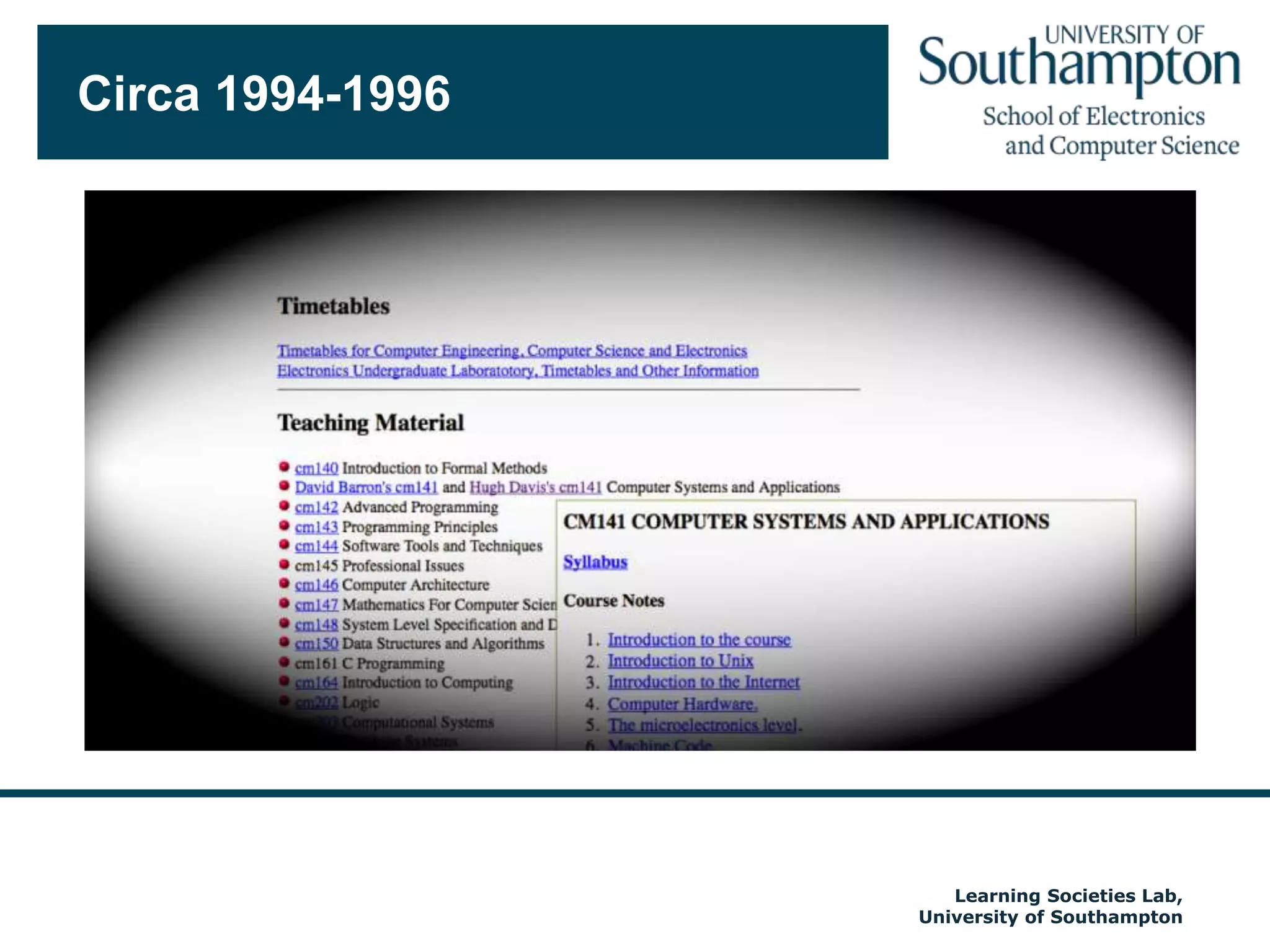
Circa 1994-1996Autumn 2009
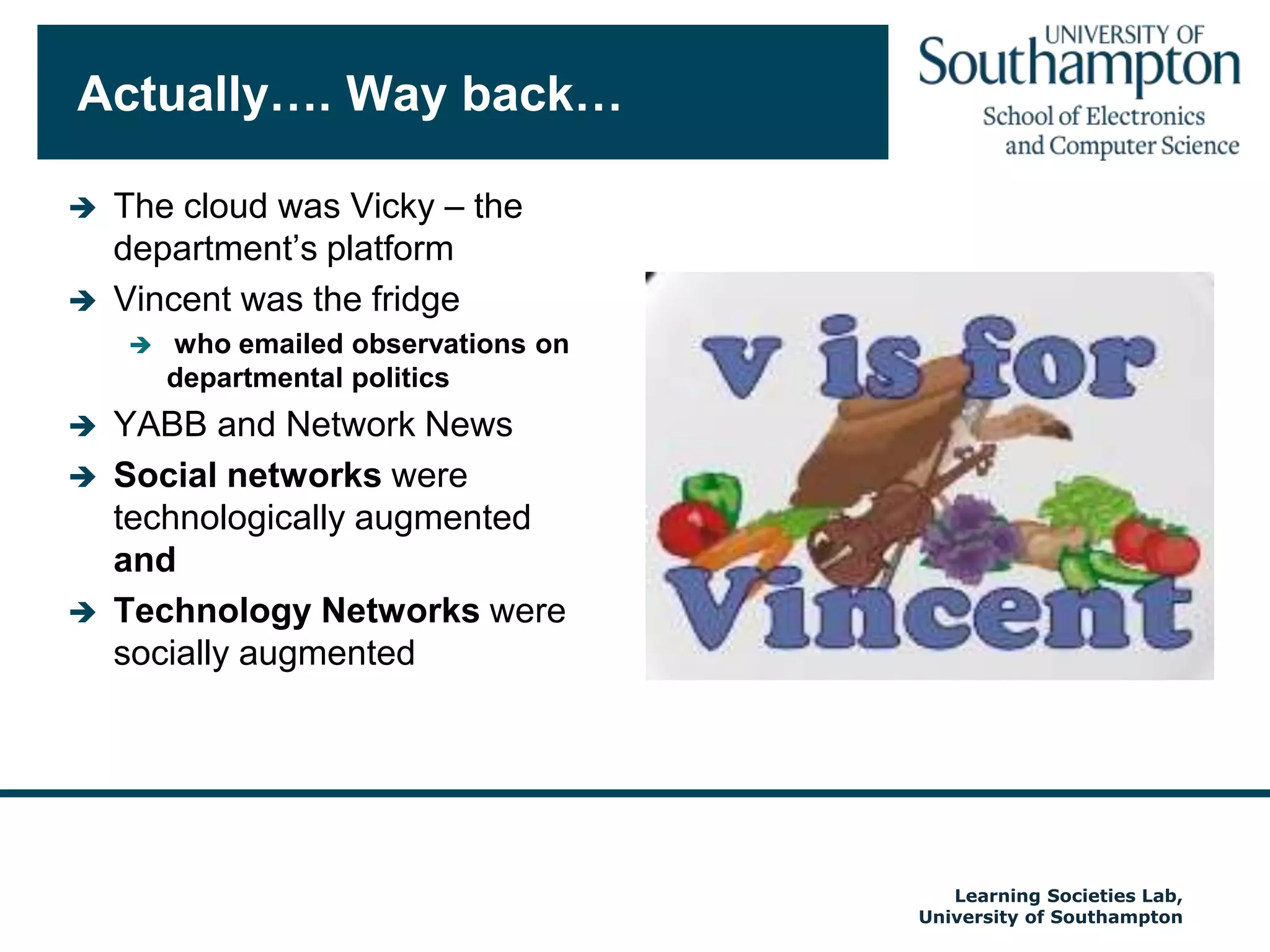
Actually…. Way back…The cloud was Vicky – the department’s platformVincent was the fridge who emailed observations on departmental politicsYABB and Network NewsSocial networks were technologically augmentedandTechnology Networks were socially augmentedAutumn 2009
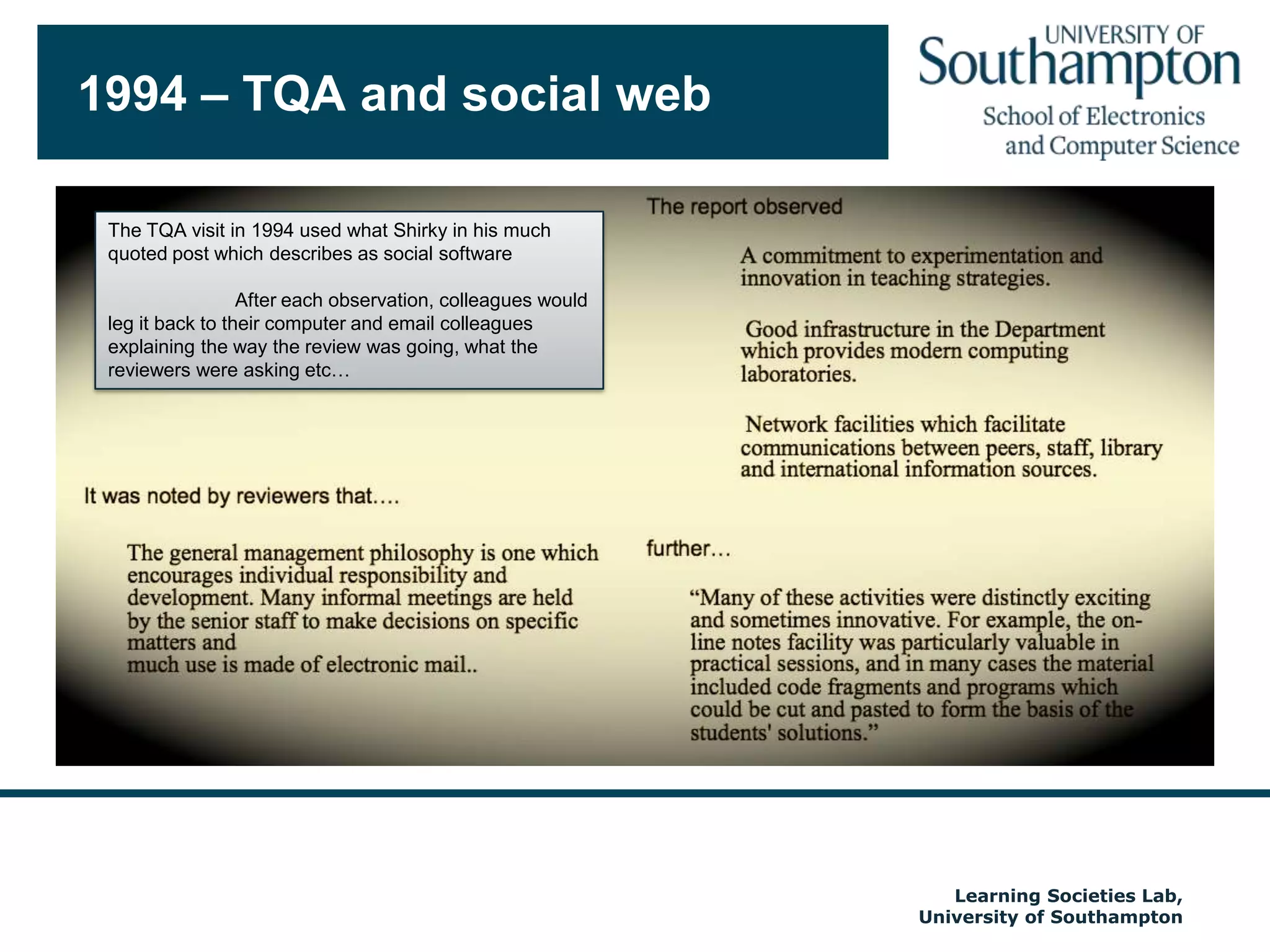
1994 – TQA and social webAutumn 2009The TQA visit in 1994 used what Shirky in his much quoted post which describes as social software	After each observation, colleagues would leg it back to their computer and email colleagues explaining the way the review was going, what the reviewers were asking etc…
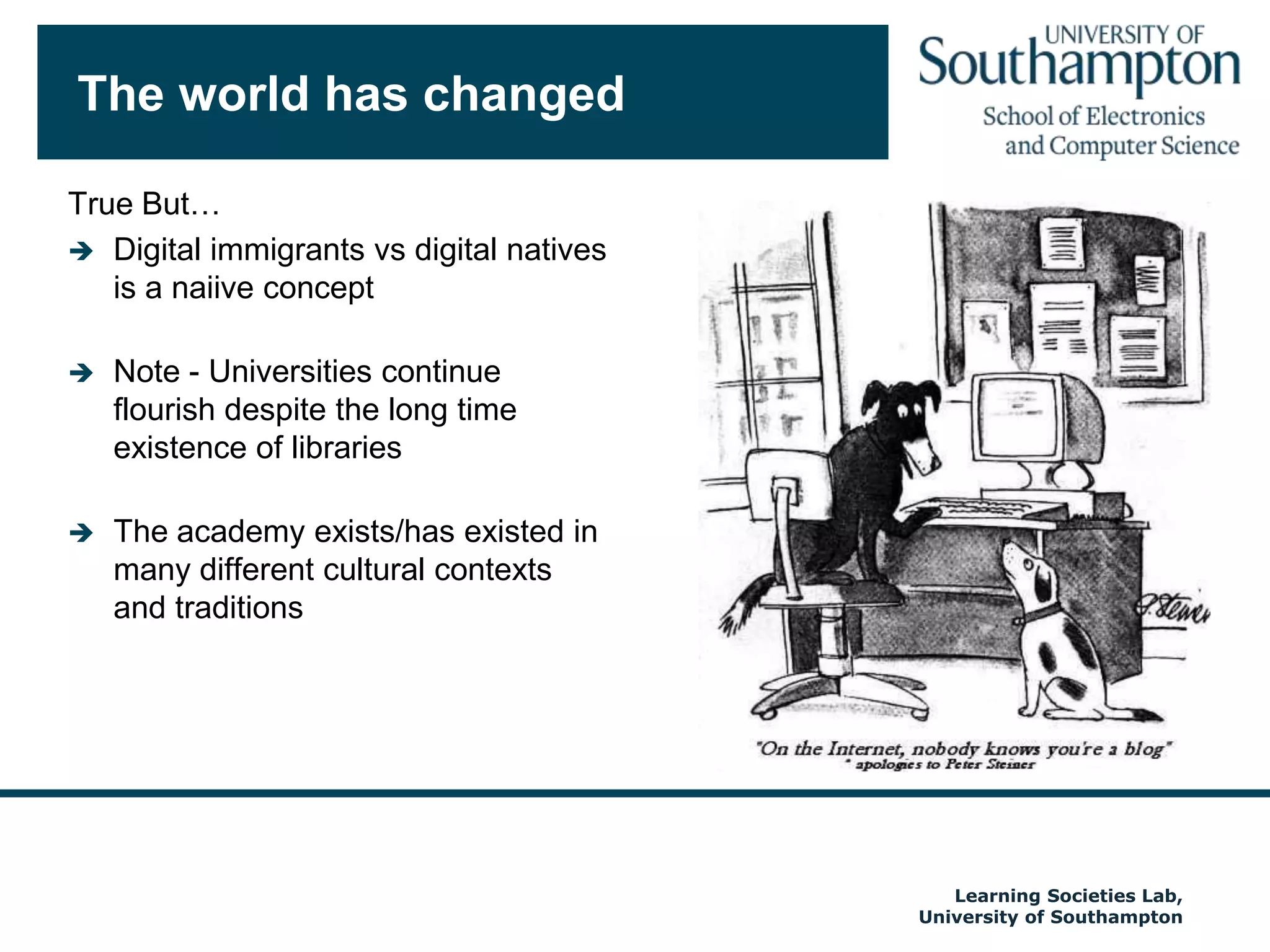
The world has changedTrue But…Digital immigrants vs digital natives is a naiive conceptNote - Universities continue flourish despite the long time existence of librariesThe academy exists/has existed in many different cultural contexts and traditionsAutumn 2009
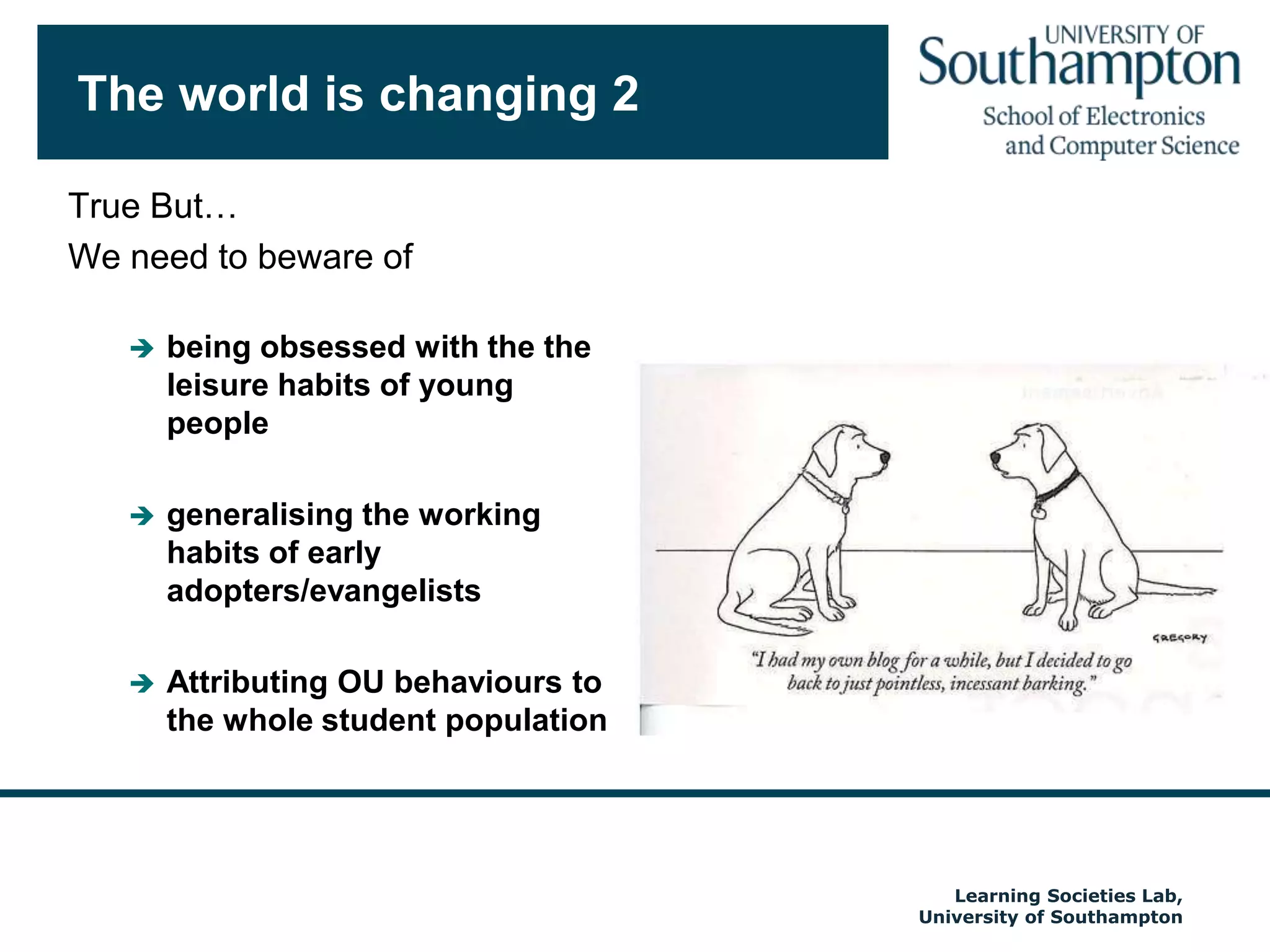
The world is changing 2True But…We need to beware ofbeing obsessed with the the leisure habits of young peoplegeneralising the working habits of early adopters/evangelistsAttributing OU behaviours to the whole student populationAutumn 2009
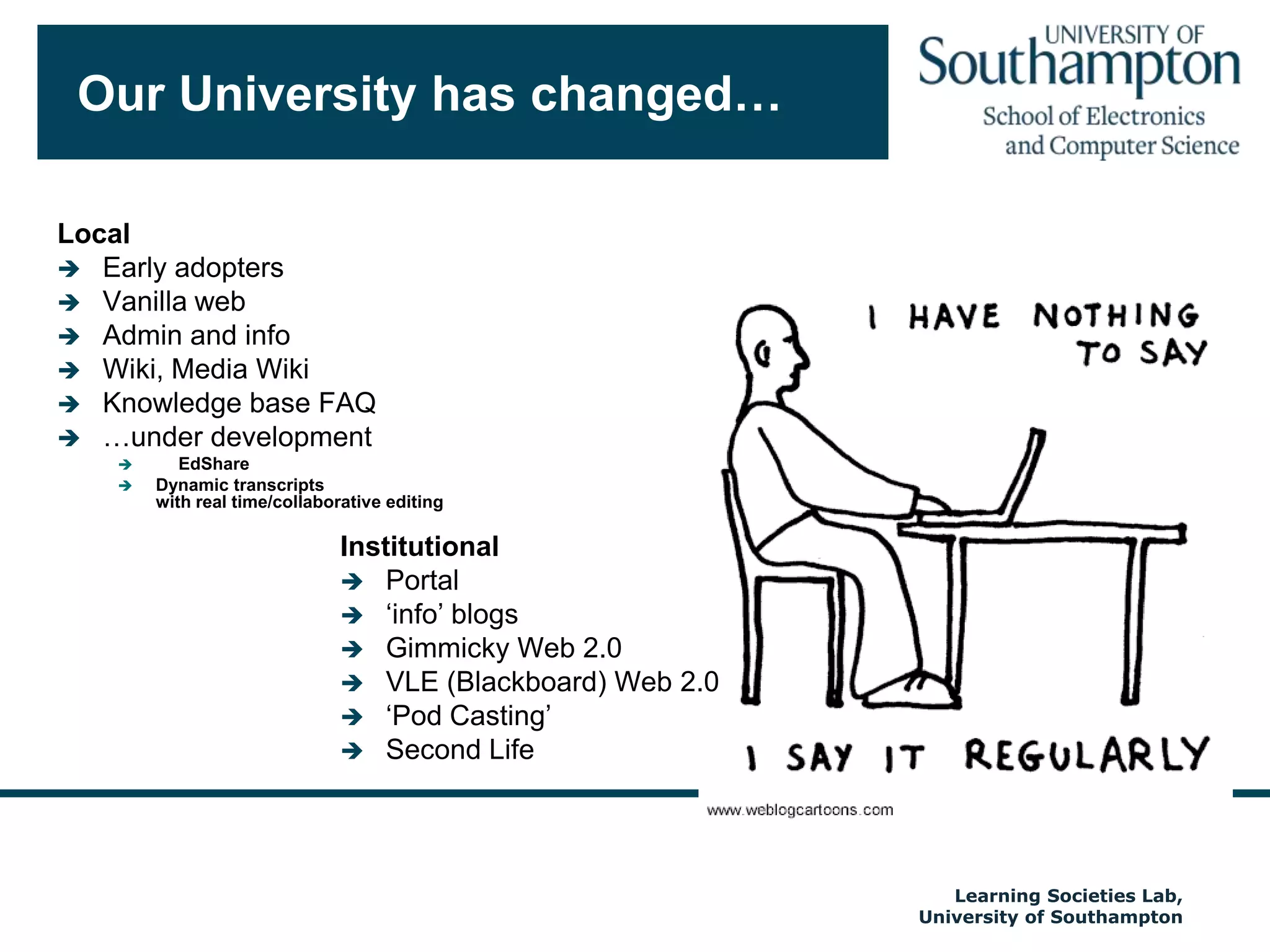
Our University has changed…LocalEarly adoptersVanilla webAdmin and infoWiki, Media WikiKnowledge base FAQ…under development	EdShareDynamic transcriptswith real time/collaborative editingInstitutionalPortal
‘info’ blogs
Gimmicky Web 2.0
VLE (Blackboard) Web 2.0
‘Pod Casting’
Second LifeAutumn 2009
The home frontEducational innovation (1990s->)Microcosm, notesAuthentic assessmentOnline open web examsZappers - the teachers learnAdmin and Education (1998->)SkywritingWiki for adviceWiki for knowledge capture and sharingWiki for assessment (them and us)Latterly	Mixed Mode, mixed purposeECS-TV, Student BlogSelf study groups - mixed environmentsStudent practice (2007, 2008, 2009)Facebook, facebook, facebookWikipediaPortal confusion/Portal distaste Del.icio.us, digg, cite-u-like etc- small It’s a learning journeyDifferent timesDifferent peopleSocially augmented communicationAutumn 2009
For ChangeRoomAutumn 2009
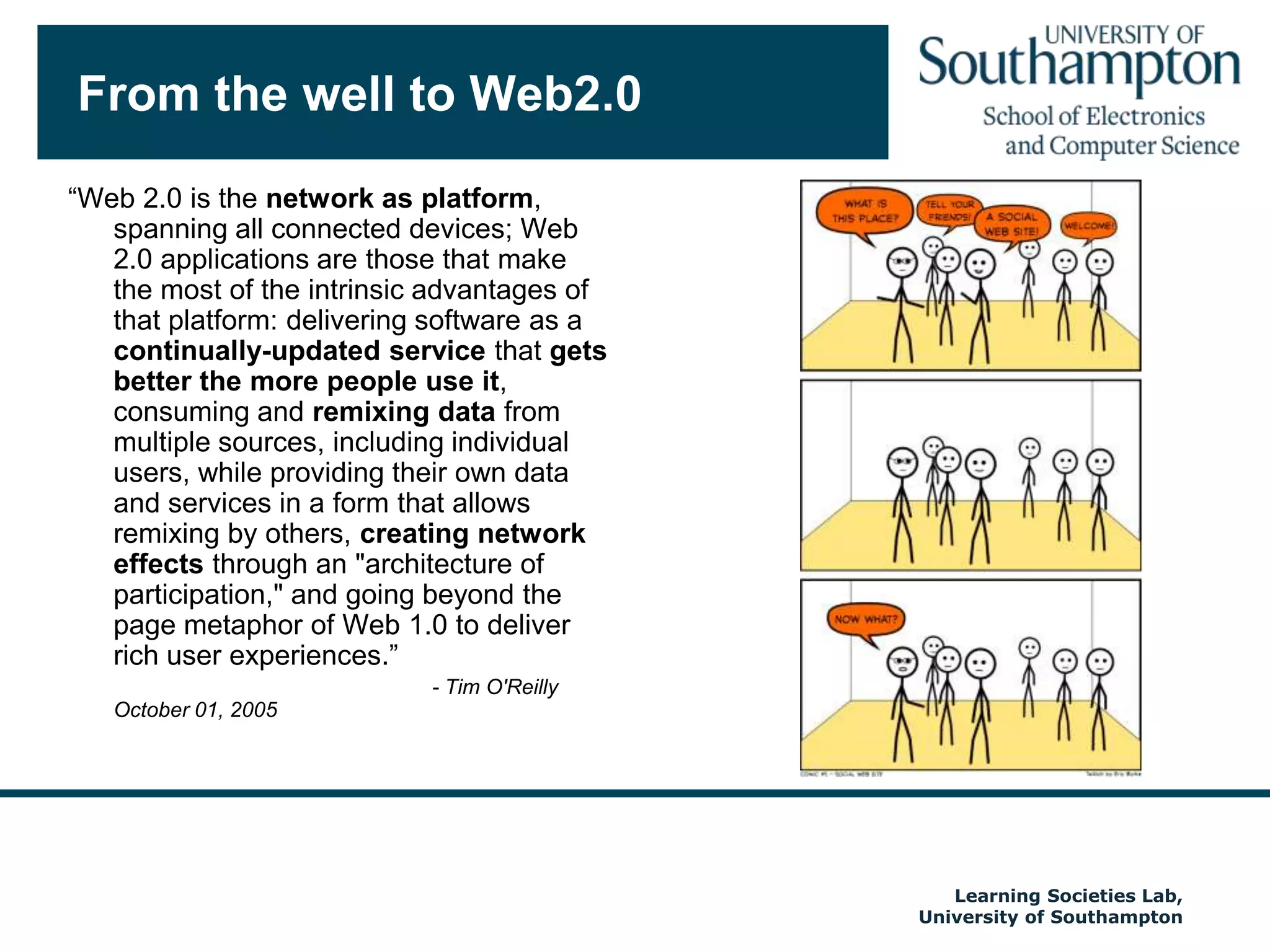
From the well to Web2.0“Web 2.0 is the network as platform, spanning all connected devices; Web 2.0 applications are those that make the most of the intrinsic advantages of that platform: delivering software as a continually-updated service that gets better the more people use it, consuming and remixing data from multiple sources, including individual users, while providing their own data and services in a form that allows remixing by others, creating network effects through an "architecture of participation," and going beyond the page metaphor of Web 1.0 to deliver rich user experiences.” 				- Tim O'Reilly October 01, 2005Autumn 2009
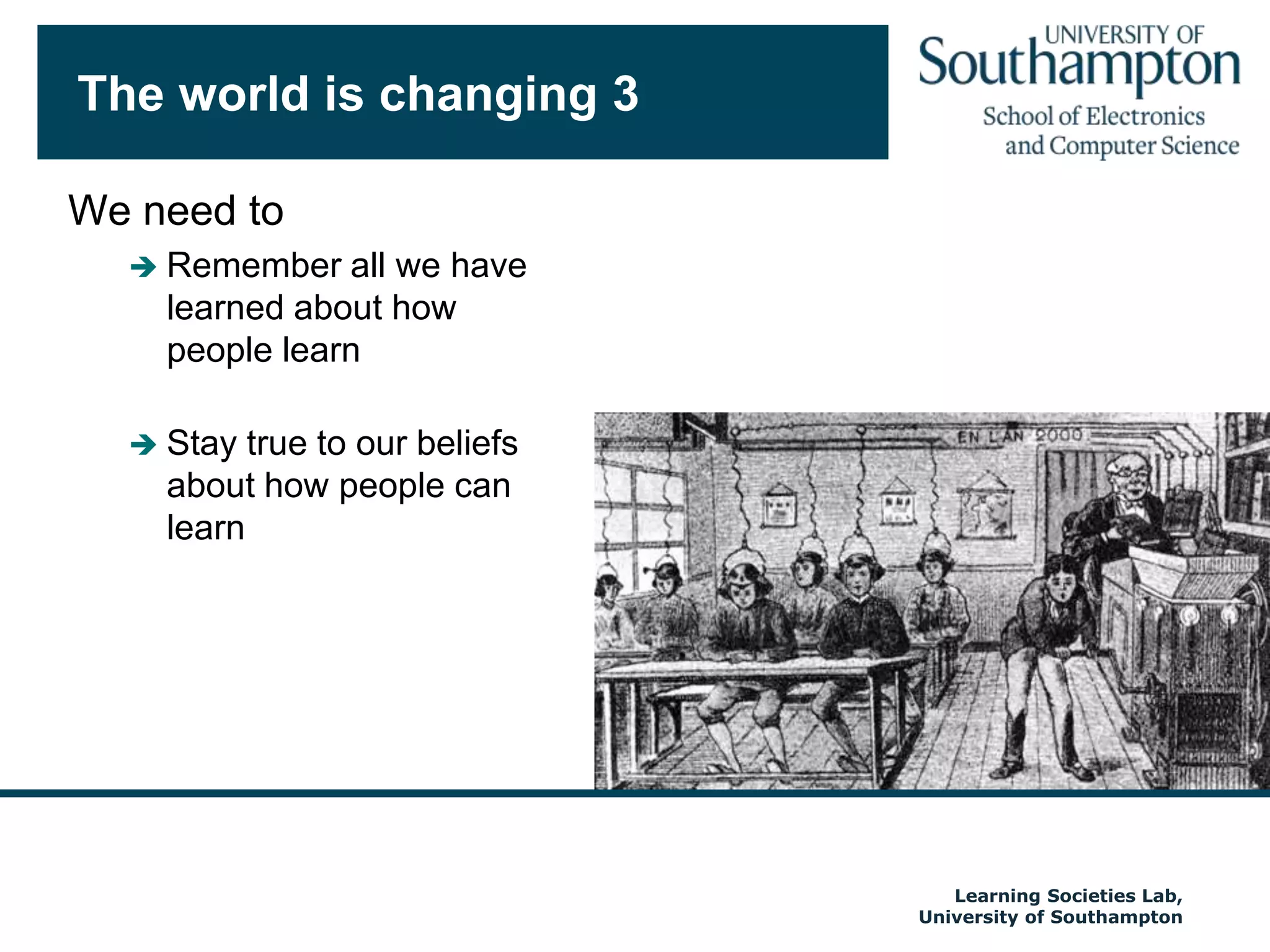
The world is changing 3We need toRemember all we have learned about how people learnStay true to our beliefs about how people can learnAutumn 2009
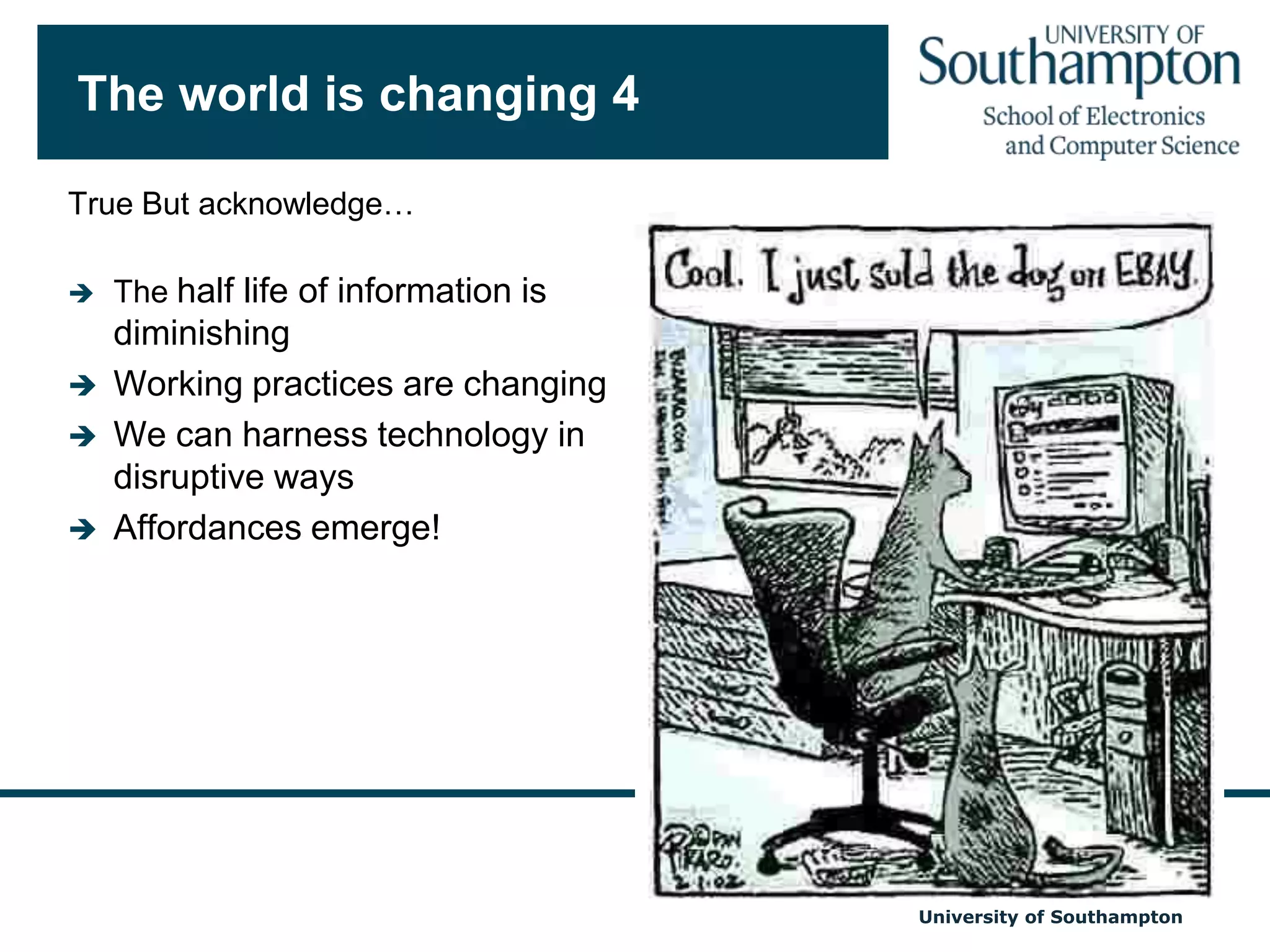
The world is changing 4True But acknowledge…The half life of information is diminishingWorking practices are changingWe can harness technology in disruptive waysAffordances emerge!Autumn 2009
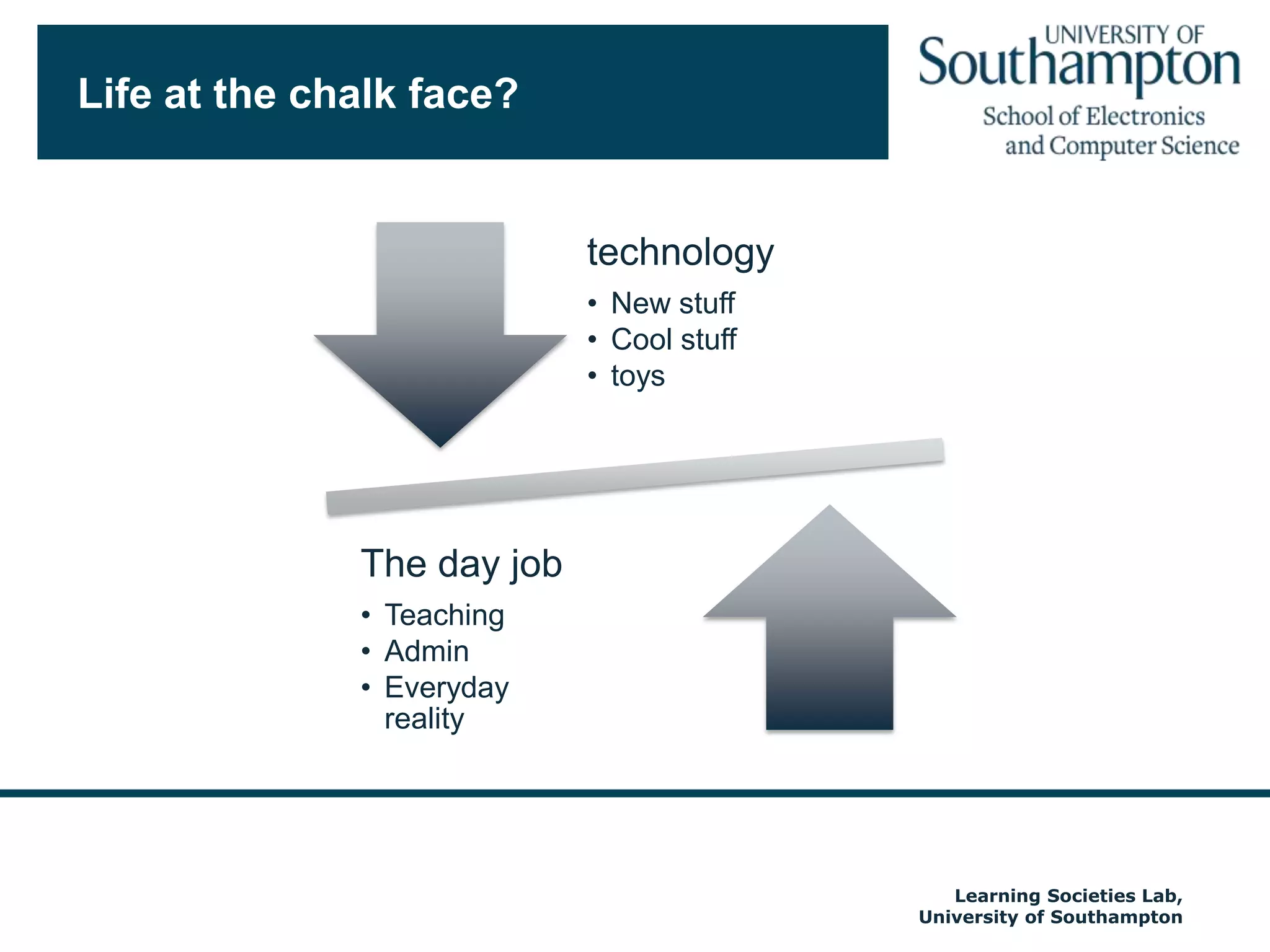
Life at the chalk face?Autumn 2009
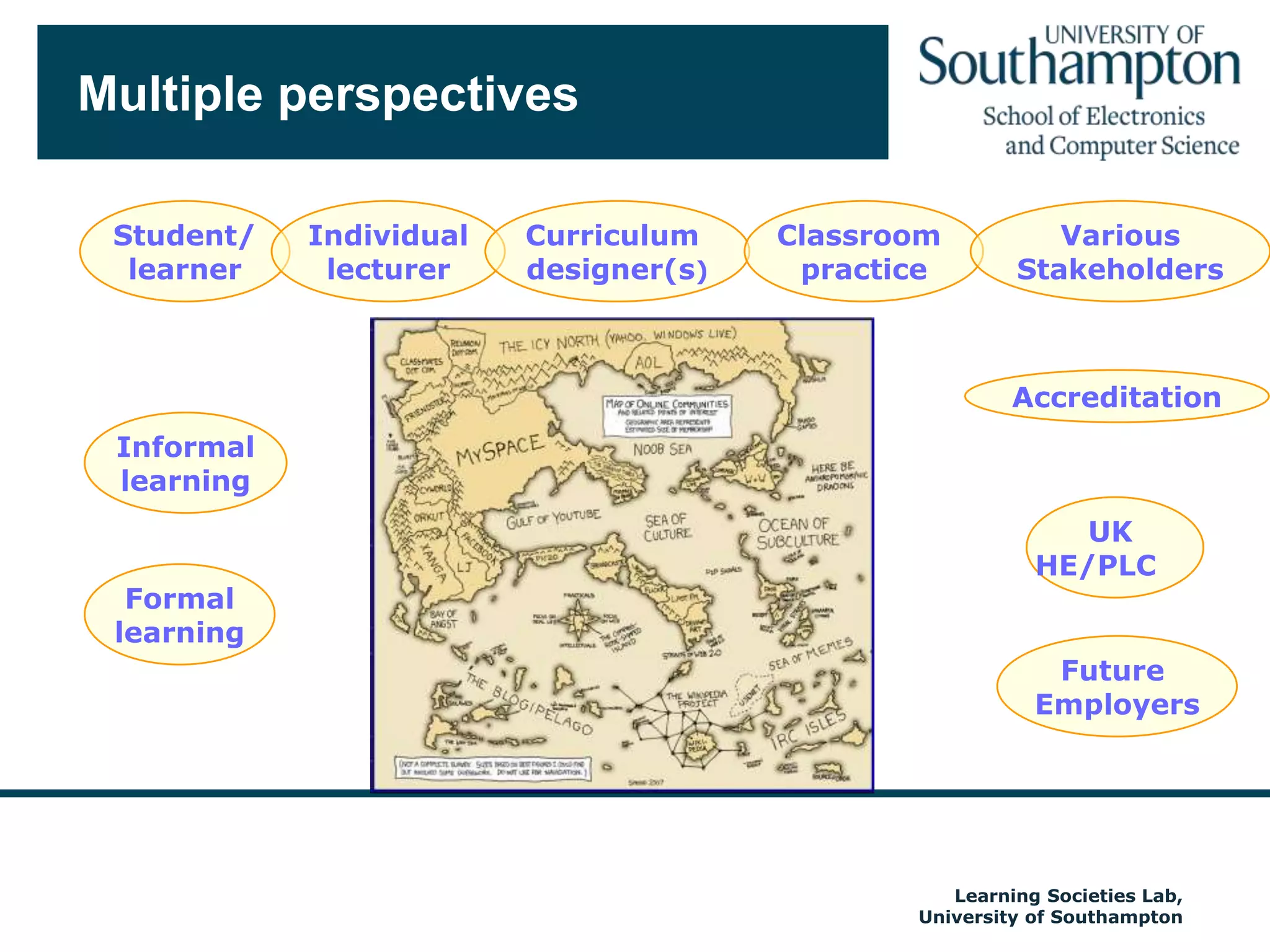
VariousStakeholdersStudent/learnerIndividuallecturerCurriculum designer(s)Classroom practiceAccreditationInformal learningUK HE/PLC    FormallearningFuture EmployersMultiple perspectivesAutumn 2009
Consider disciplinary differencesSurvey(s) of students attitudestheir experience and perceptions of TELIdentify user needsCompare experience with theoryBecauseDisciplinary differences literatureAd hoc development of e-learning resourcesOpinions on Web2.0Cost of developing TEL resourcesSometimes structural barriers to changeAutumn 2009
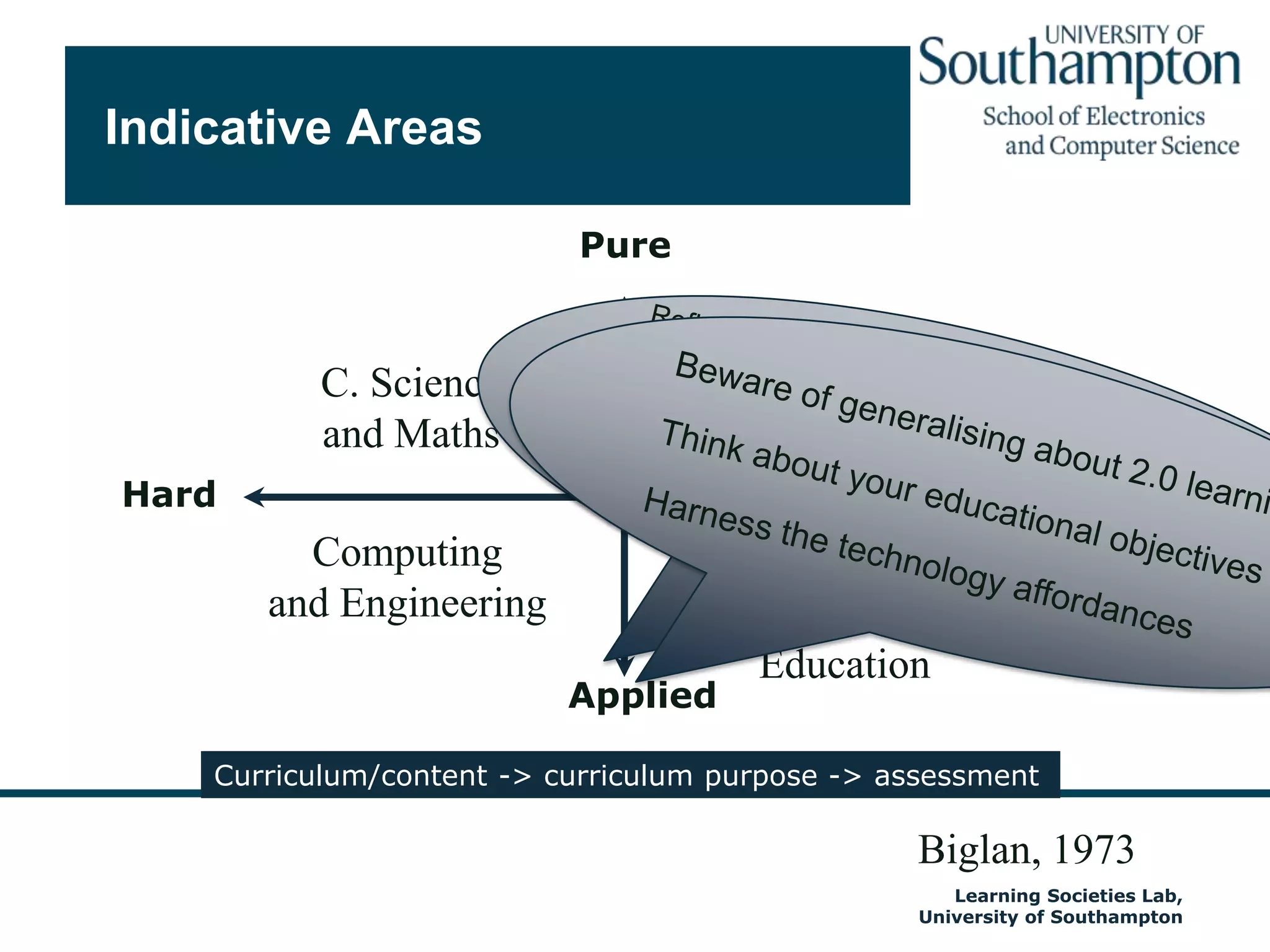
Indicative AreasPureReflecting on Biglan “a sound understanding of key aspects of teaching and learning must depend on the recognition of the distinctive features of different knowledge domains and their social mileiux” (Neumann, Parry and Beecher 2002)C. Scienceand MathsS Sciences andHumanitiesBeware of generalising about 2.0 learningThink about your educational objectivesHarness the technology affordancesHardSoftComputingand EngineeringNursing orEducationAppliedCurriculum/content -> curriculum purpose -> assessmentBiglan, 1973Autumn 2009
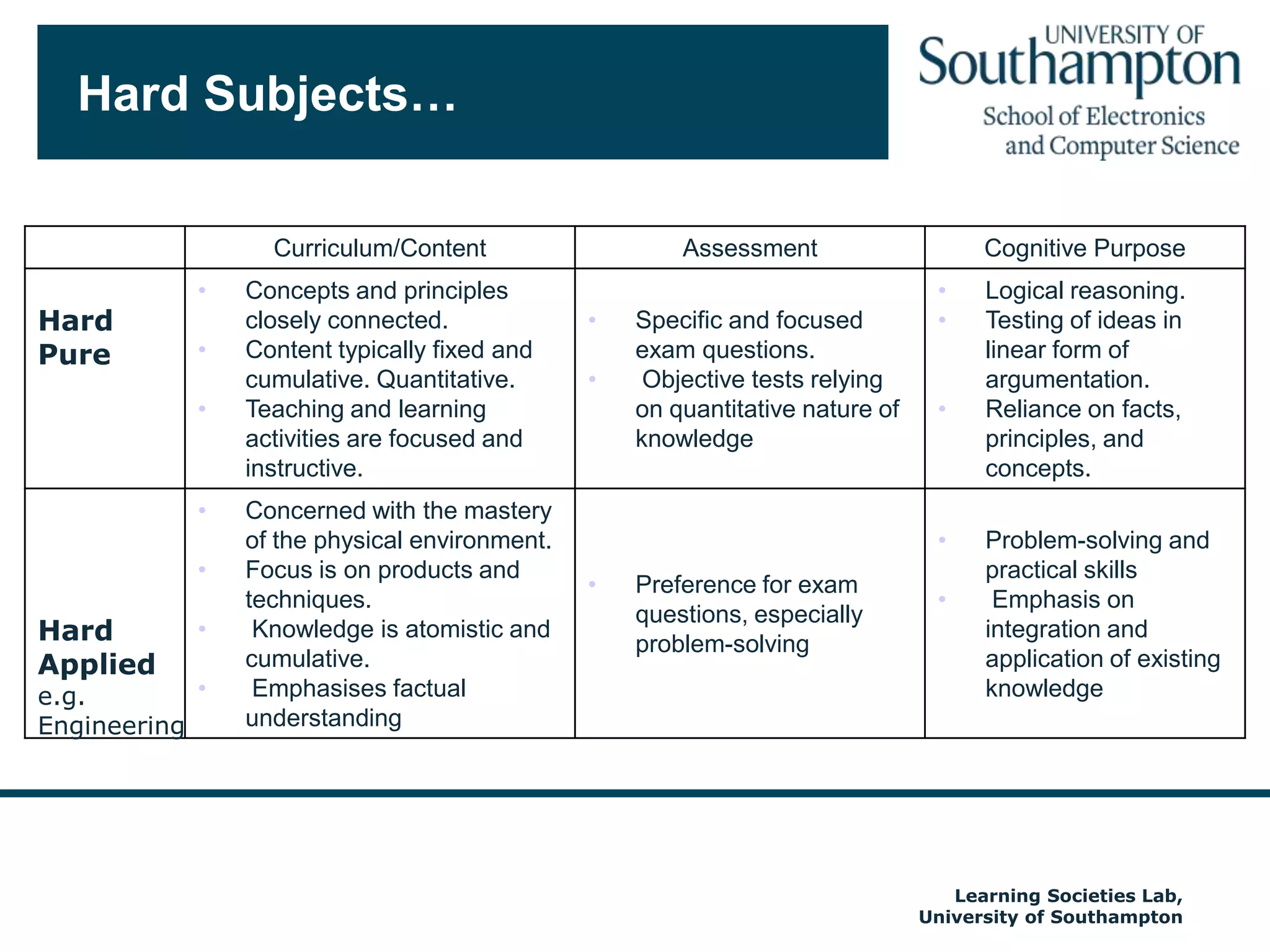
Hard PureHard Appliede.g.EngineeringHard Subjects…Autumn 2009
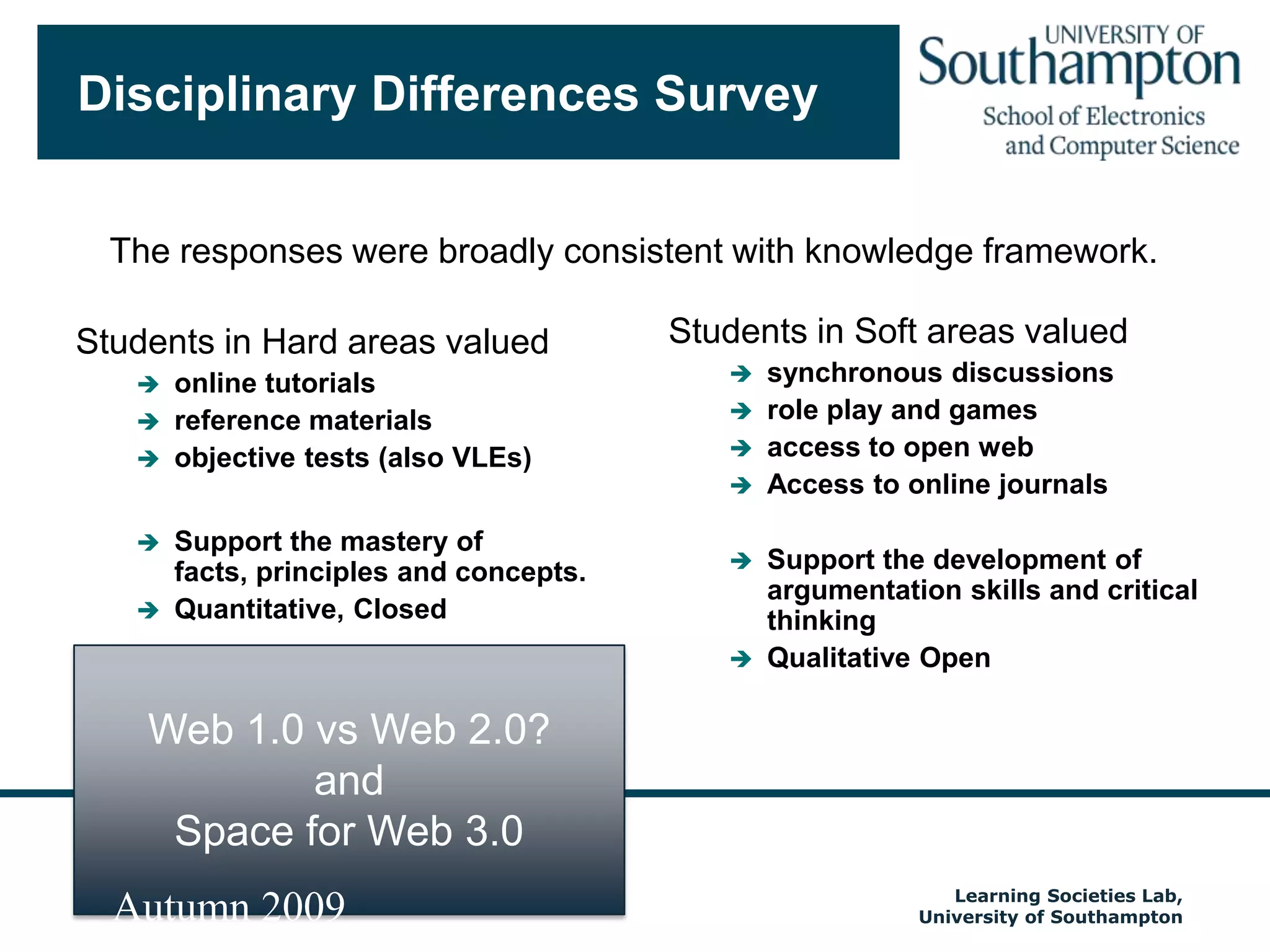
Disciplinary Differences SurveyThe responses were broadly consistent with knowledge framework.Students in Soft areas valuedsynchronous discussionsrole play and gamesaccess to open webAccess to online journalsSupport the development of  argumentation skills and critical thinkingQualitative Open Students in Hard areas valuedonline tutorialsreference materialsobjective tests (also VLEs)Support the mastery of  facts, principles and concepts. Quantitative, ClosedWeb 1.0 vs Web 2.0?and Space for Web 3.0Autumn 2009
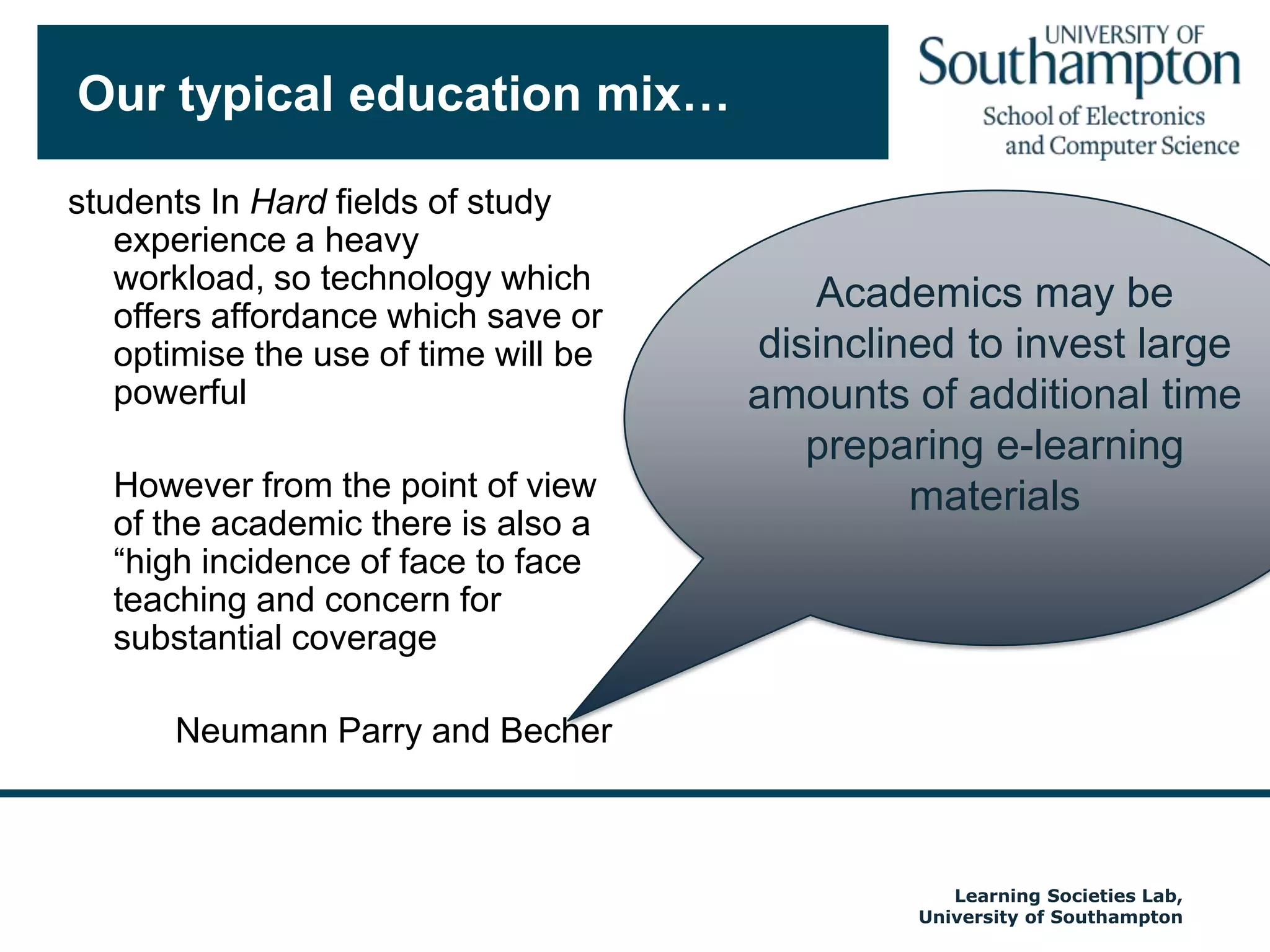
Our typical education mix…students In Hard fields of study experience a heavy workload, so technology which offers affordance which save or optimise the use of time will be powerful	However from the point of view of the academic there is also a “high incidence of face to face teaching and concern for substantial coverageNeumann Parry and BecherAcademics may be disinclined to invest large amounts of additional time preparing e-learning materials Autumn 2009
TEL/Web2/Linked Data?Blended/Web 2.0/Linked Data  approaches… allow systematic/automated  selection of activities to best meet range of requirementssupporting student learningmaking good use of faculty timestreamline administrative tasks(monitoring and recording student progression and achievement)
Our recent surveyAcross Soton90% facebook, once a week or more - check98% students use textsConscious act not to use them – not digital divideIn ECSMajority have laptops – 2009: the year of the laptopAutumn 2009
Affordance led changesomeAutumn 2009
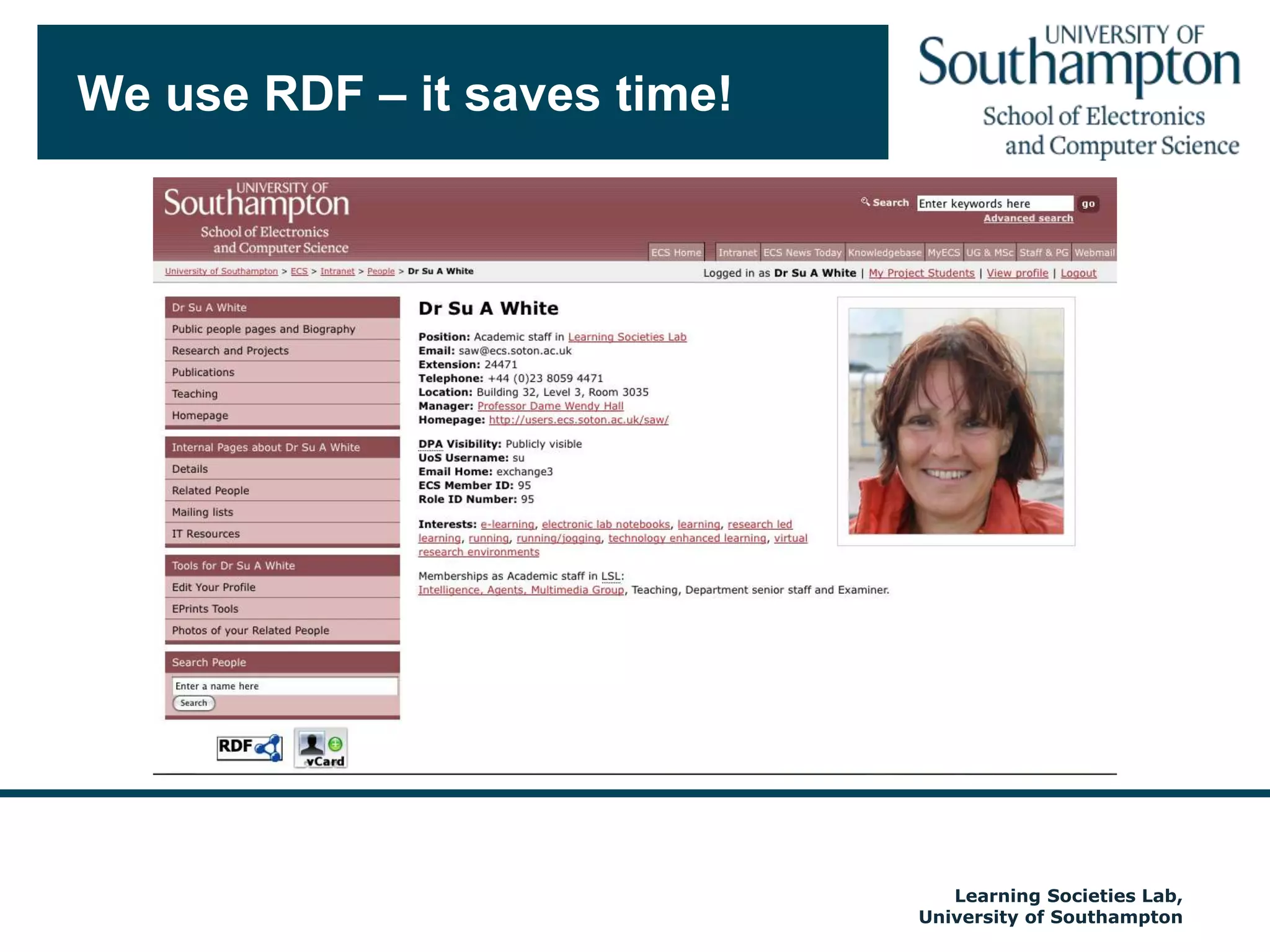
We use RDF – it saves time!Autumn 2009
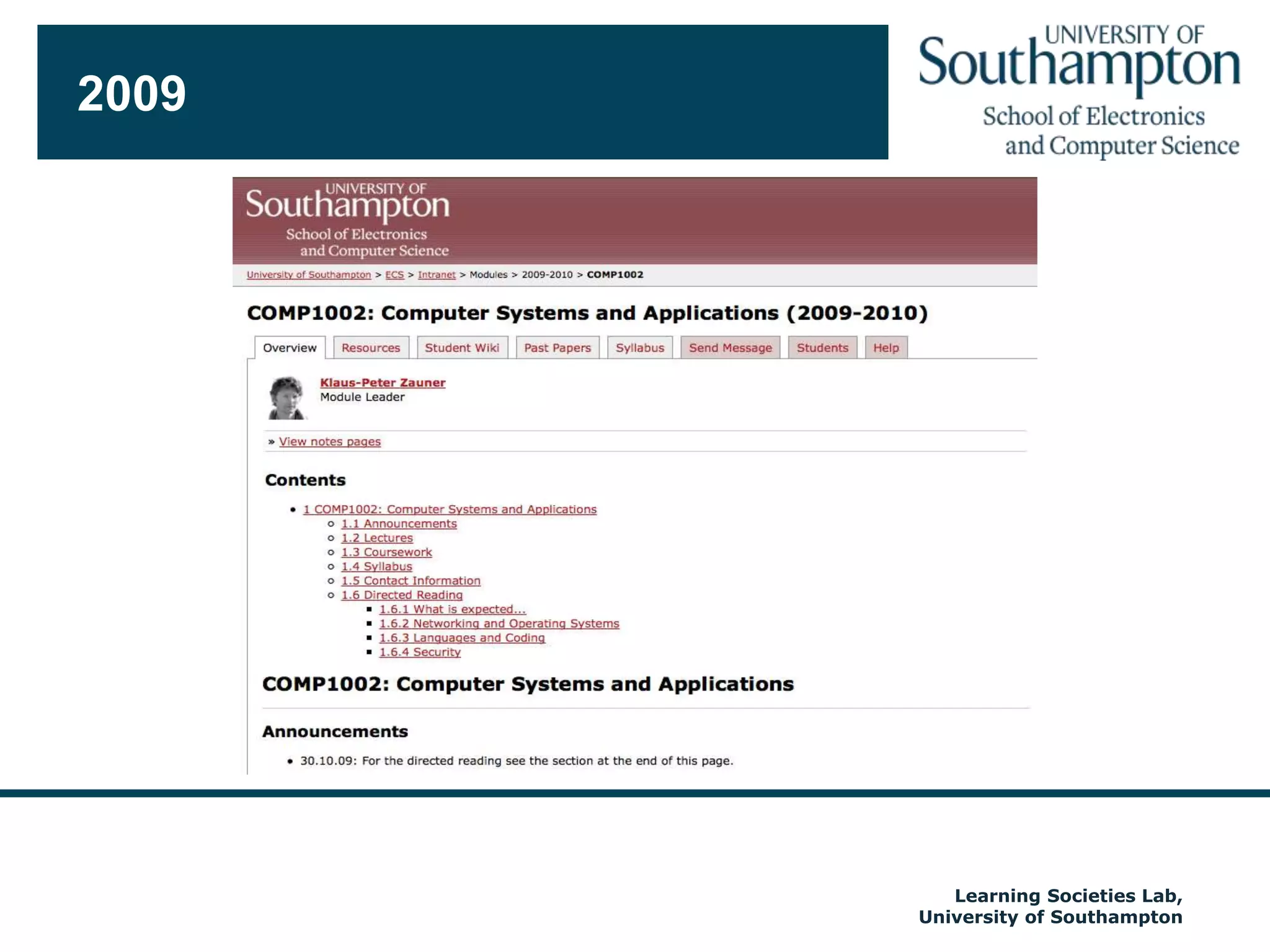
2009Autumn 2009
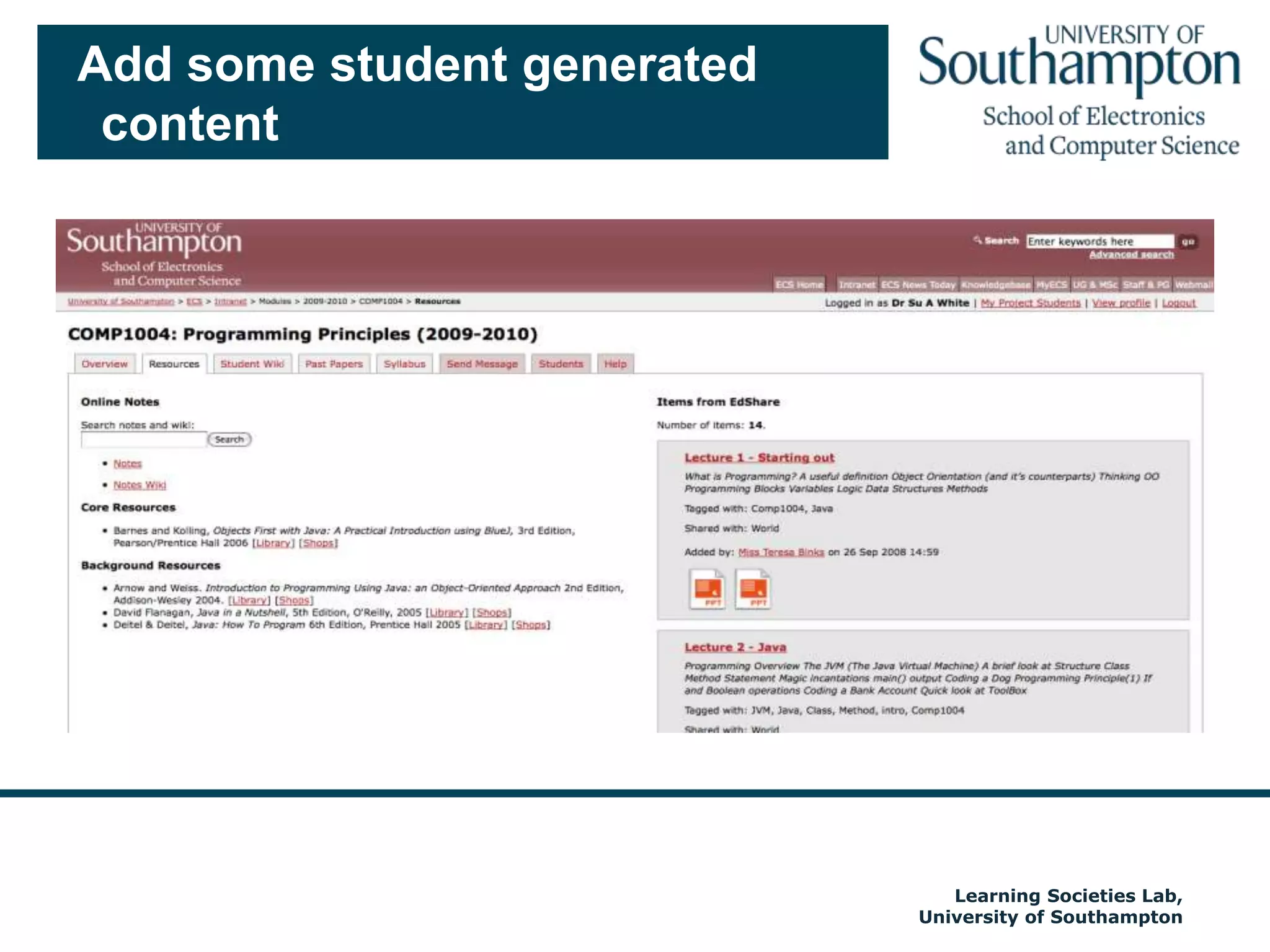
Add some student generated contentAutumn 2009
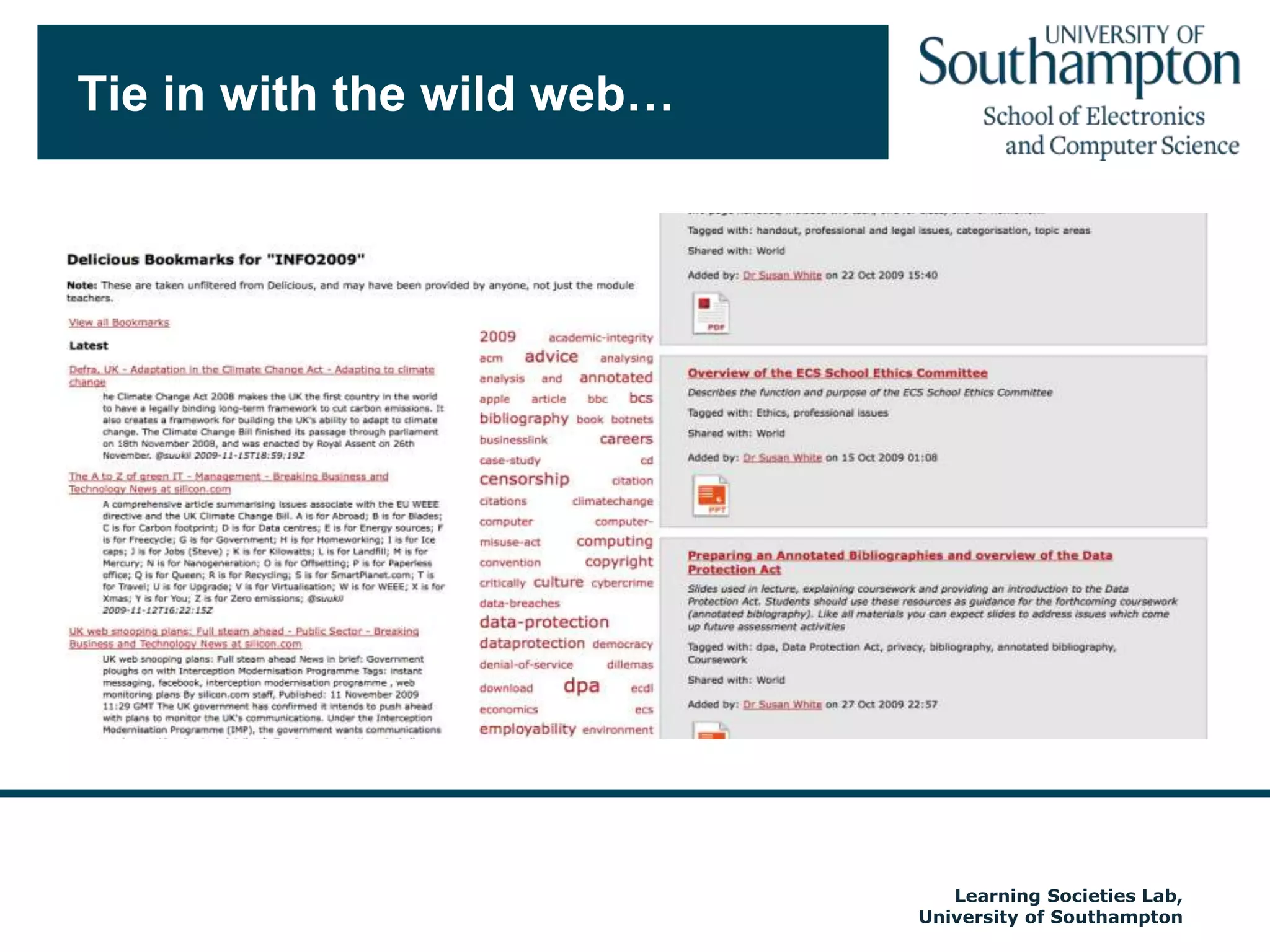
Tie in with the wild web…Autumn 2009
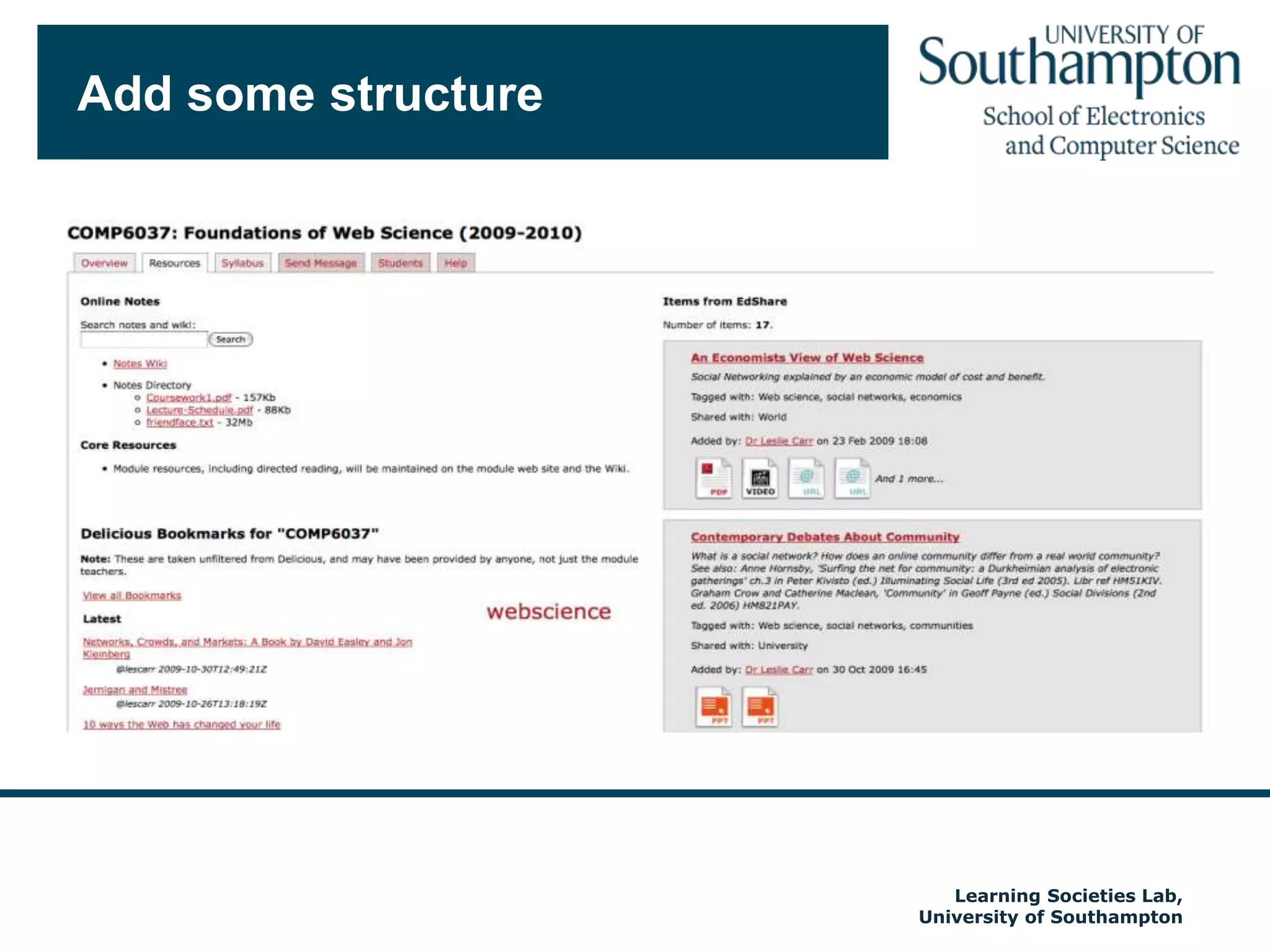
Add some structureAutumn 2009
Edshare web scienceAutumn 2009
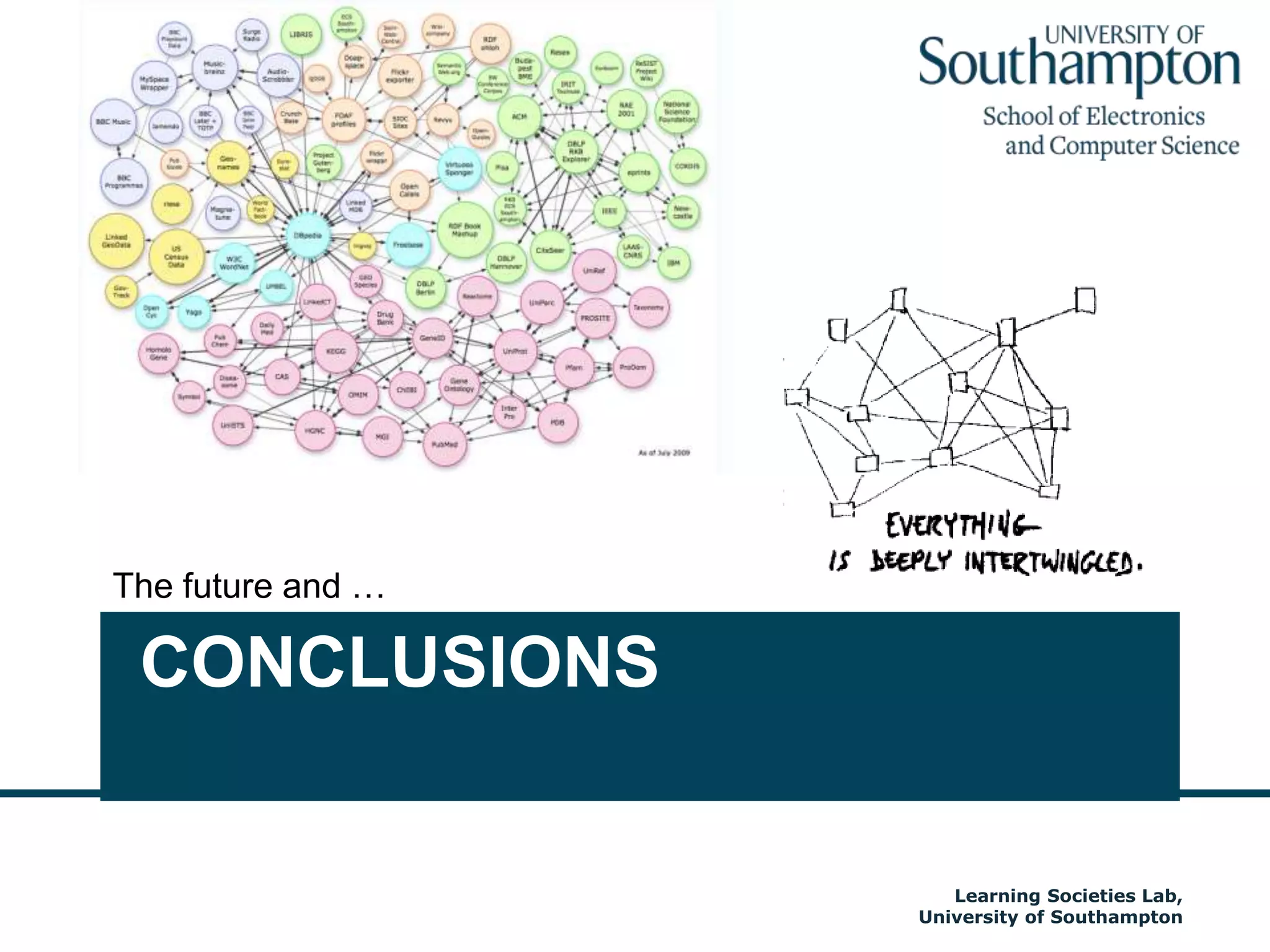
ConclusionsThe future and …Autumn 2009
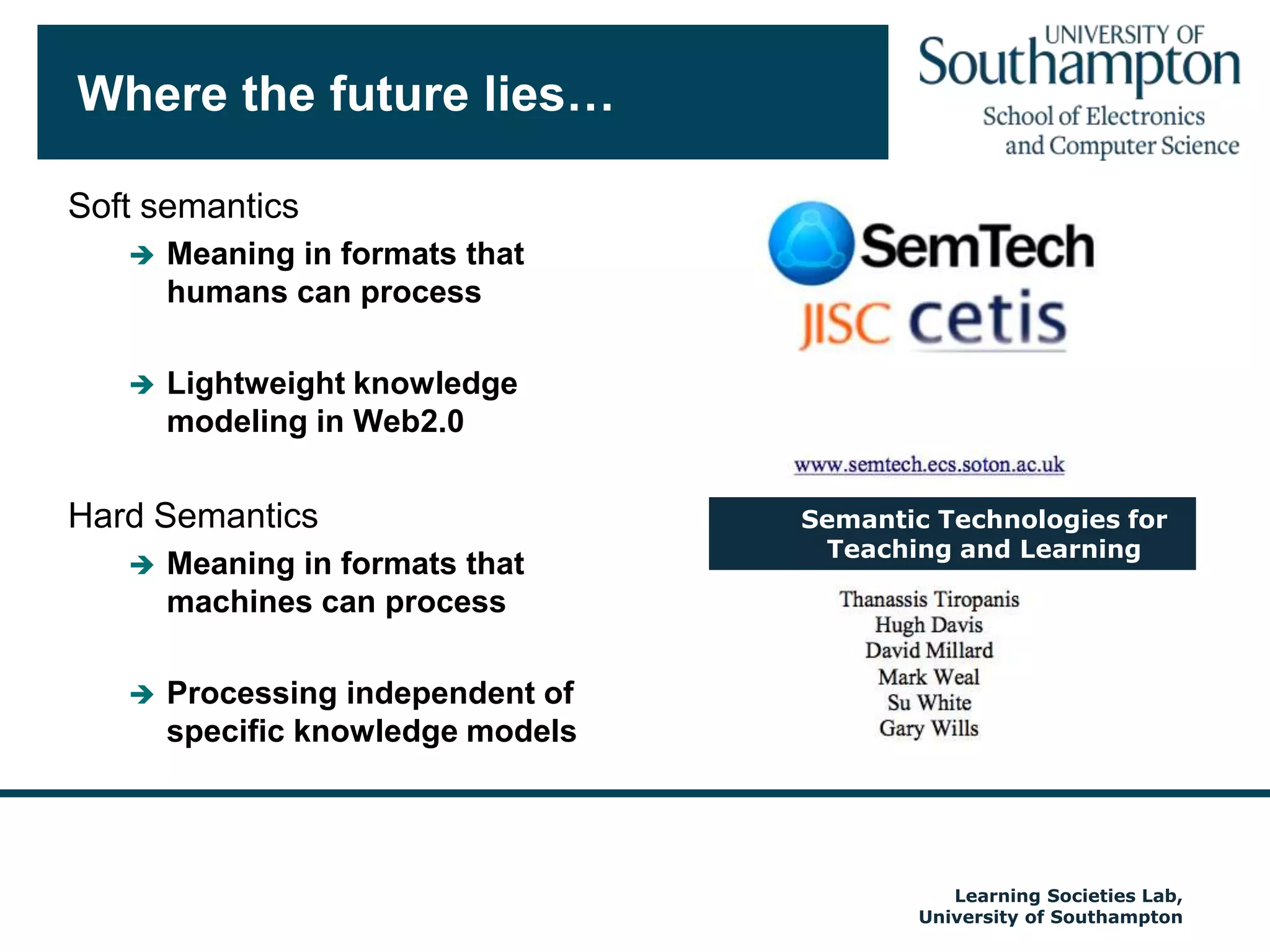
Where the future lies…Soft semanticsMeaning in formats that humans can processLightweight knowledge modeling in Web2.0Hard SemanticsMeaning in formats that machines can processProcessing independent of specific knowledge modelsSemantic Technologies for Teaching and LearningAutumn 2009
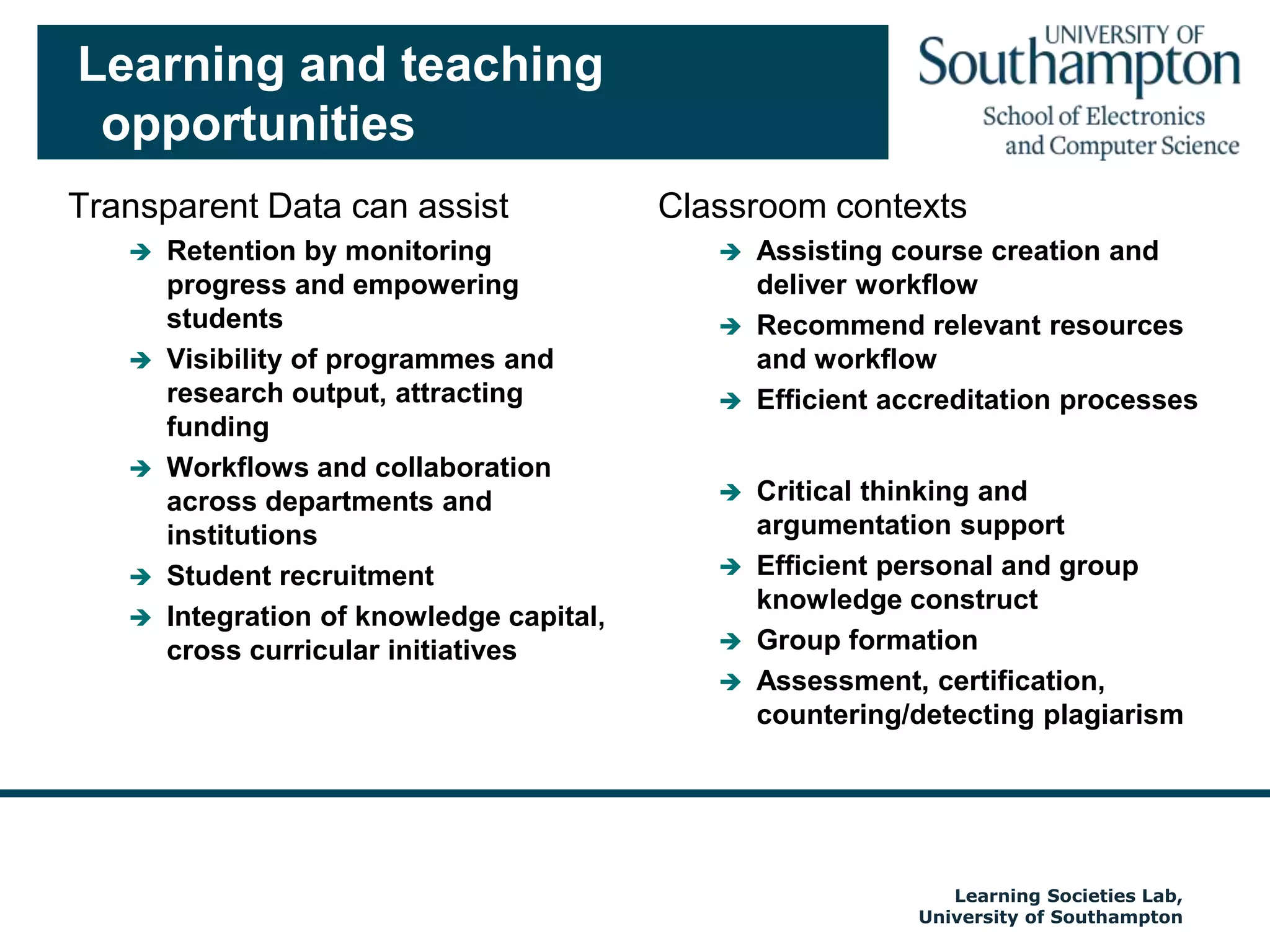
Learning and teaching opportunitiesTransparent Data can assistRetention by monitoring progress and empowering studentsVisibility of programmes and research output, attracting fundingWorkflows and collaboration across departments and institutionsStudent recruitmentIntegration of knowledge capital, cross curricular initiativesClassroom contextsAssisting course creation and deliver workflowRecommend relevant resources and workflowEfficient accreditation processesCritical thinking and argumentation supportEfficient personal and group knowledge constructGroup formationAssessment, certification, countering/detecting plagiarismAutumn 2009
Thank You Questions?Acknowledge:Contributions of colleagues at our respective institutionsAutumn 2009
Thank You Dr Su WhiteLearning Societies LabUniversity of Southamptonsaw@ecs.soton.ac.ukAutumn 2009
Major referenceSemantic Technologies in Learning and Teaching (SemTech) - JISC ReportTiropanis, T., Davis, H., Millard, D., Weal, M., White, S. and Wills, G. (2009) Semantic Technologies in Learning and Teaching (SemTech) - JISC Report.Autumn 2009
ReferencesBoyer E. Scholarship reconsidered: Priorities of the Professoriate 1990.Boyer Commission on Educating Undergraduates in the Research University. Reinventing Undergraduate Education: A Blueprint for America's Research Universities. New York: Stony Brook: State University of New York at Stony Brook; 1998.Boyer Commission on Educating Undergraduates in the Research University. Reinventing Undergraduate Education, Three Years After the Boyer Report. New York: Stony Brook: State University of New York at Stony Brook; 2002.Brew A, Boud D. Teaching and research: establishing the vital link with learning. Higher Education. 1995;29(3):261-73.Carter J, Jenkins T. Gender and programming: what's going on?  ACM ITiCSE. Leeds: ACM Press New York, NY, USA 1999:1-4.Committee on Higher Education. Higher Education: Report of the Committee Appointed by the Prime Minister Under the Chairmanship of Lord Robbins, 1961-63. London: HMSO; 1963.Davis HC, White S. A research-led curriculum in multimedia: learning about convergence.  10th annual SIGCSE conference on Innovation and technology in computer science education 2005; Lisbon, Portugal; 2005. p. 29 - 33.Davy J, Jenkins T. Research-led innovation in teaching and learning programming.  ACM ITiCSE. Leeds, UK: ACM Press New York, NY, USA 1999:5-8.Dempster JA. Developing and Supporting Research-Based Learning and Teaching Through Technology. In: Ghaou C, ed. Usability Evaluation Of Online Learning Programs. USA.: Information Science Publishing, Idea Group Inc 2003:128-58.Elton L. Research and teaching: symbiosis or conflict? Higher Education. 1986;15:299 - 304.Fasli M. On the Research Teaching Nexus. In: HEA-ICS, editor. 8th Annual Conference of the Subject Centre for Information and Computer Science; 2007 28th – 30th August 2007; University of Southampton: HEA-ICS, University of Ulster; 2007. p. 77-81.Gibbs G. Institutional strategies for linking research and teaching. Exchange. 2002;3.Hatch A, Burd L, Ashurst C, Jessop A. Project Management Patterns and the Research-Teaching Nexus. In: HEA-ICS, editor. 8th Annual Conference of the Subject Centre for Information and Computer Science; 2007 28th – 30th August 2007; University of Southampton: HEA-ICS, University of Ulster; 2007. p. 68-71.Hattie J, Marsh HW. One journey to unravel the relationship between research and teaching.  Research and teaching: Closing the divide? An International Colloquium; 2004 March 18-19, 2004; Winchester; 2004.Autumn 2009
Hattie J, Marsh HW. The Relationship between Research and Teaching: A Meta-Analysis. Review of Educational Research. 1996;66(4):507-42.Healey M. Linking research and teaching: exploring disciplinary spaces and the role of inquiry-based learning; 2005.Hoare T, Milner R, eds. Grand Challenges in Computing: British Computer Society 2004.Jenkins A, Healey M, Zetter R. Linking of staff disciplinary research and student learning. York: Higher Education Academy; 2007.Jenkins A, Healey M. Institutional Strategies to link teaching and research. York: Higher Education Academy; 2005.McGettrick A, Boyle R, Ibbett R, Lloyd J, Lovegrove G, Mander K. Grand challenges in computing education: British Computer Society; 2004.Neumann R. Perceptions of the Teaching-Research Nexus: A Framework for Analysis. Higher Education. 1992;23(2):159-71.Neumann R. The Teaching-Research Nexus: Applying a Framework to University Students' Learning Experiences. European Journal Of Higher Education. 1994;29(3):323-38.Ramsden P, Moses I. Associations Between Research and Teaching in Australian Higher Education. Higher Education. 1992 April 1992;23(3):273-95.Roach M, Blackmore P, Dempster JA. Supporting High-Level Learning through Research-Based Methods: A Framework for Course Development. Innovations in Education and Teaching International. 2001;38(4):369-82.Strazdins P. Research based education in computer science teaching. Canberra: Australian National University; 2007.Thomas RC, Mancy R. Use of Large Databases for Group Projects at the Nexus of Teaching and Research.  ACM SIGCSE 2004; Portland: ACM; 2004. p. 161-5Tiropanis, T., Davis, H., Millard, D., Weal, M., White, S. and Wills, G. (2009) Semantic Technologies in Learning and Teaching (SemTech) - JISC Report.Wirth A, Bertolacci M. New algorithms research for first year students.  Proceedings of the 11th annual SIGCSE conference on Innovation and technology in computer science education; 2006; Bologna, Italy: ACM Press New York, NY, USA; 2006. p. 128-32.Autumn 2009
Autumn 2009
Not used, but referredAutumn 2009
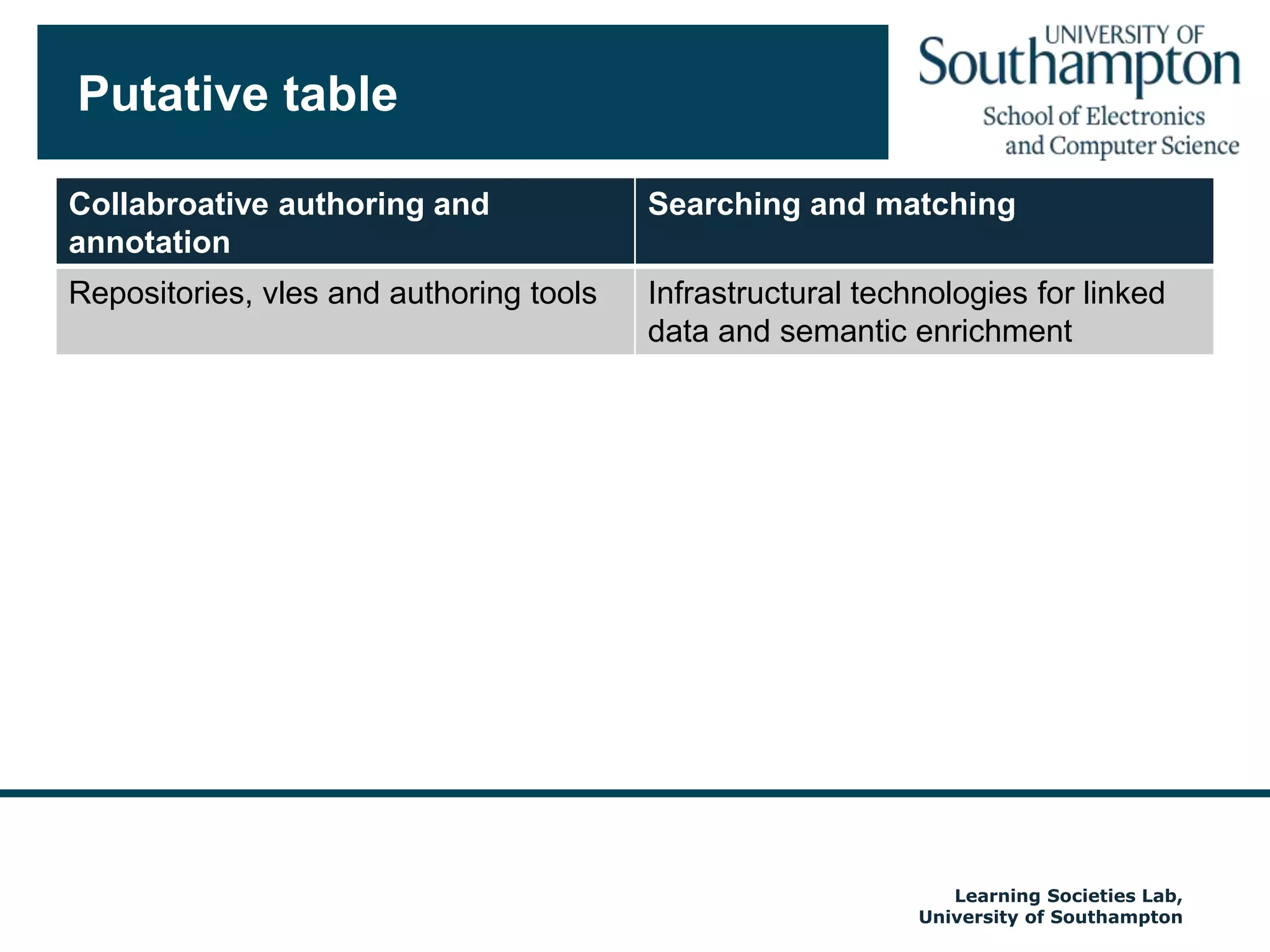
Putative tableAutumn 2009

Web2.0 hea ics-demontfortnov2009finalfinal

  • 1.
    Share Collaborate andExchange, reshaping education through technology: the EdShare experiencepresentation to HEA-ICS Autumn 2009Su White, Hugh Davis,Thanassis Tiropanis, Les Carr, Dave MillardAutumn 2009
  • 2.
    1 – contextand current practice2 – room for change4 –future and conclusions?3 – some (affordance led) changeThe shape of this talkAutumn 2009
  • 3.
  • 4.
    Edshare – apreviewAutumn 2009
  • 5.
    Universities and knowledge TheHumboldtianIdealIn universities, learning should not be [defined] in terms of the passing on of well established knowledge, but always in terms of not yet completely solved problems.”Humboldt, 1807Thanks to Lewis EltonAutumn 2009Web 2.0affordances?
  • 6.
    Welcome to myworld…This course aims to develop critical thinking, effective working within teams, peer-learning and discussion, and individual responsibility as these are transferable skills that are essential within a highly competent technologist, computer scientist, software engineer or researcher”Autumn 2009
  • 7.
    The home frontEarlyadoptersVanilla webInformation publishingOnline DiscussionSocial networks YABBNetwork News Autumn 2009
  • 8.
  • 9.
    Actually…. Way back…Thecloud was Vicky – the department’s platformVincent was the fridge who emailed observations on departmental politicsYABB and Network NewsSocial networks were technologically augmentedandTechnology Networks were socially augmentedAutumn 2009
  • 10.
    1994 – TQAand social webAutumn 2009The TQA visit in 1994 used what Shirky in his much quoted post which describes as social software After each observation, colleagues would leg it back to their computer and email colleagues explaining the way the review was going, what the reviewers were asking etc…
  • 11.
    The world haschangedTrue But…Digital immigrants vs digital natives is a naiive conceptNote - Universities continue flourish despite the long time existence of librariesThe academy exists/has existed in many different cultural contexts and traditionsAutumn 2009
  • 12.
    The world ischanging 2True But…We need to beware ofbeing obsessed with the the leisure habits of young peoplegeneralising the working habits of early adopters/evangelistsAttributing OU behaviours to the whole student populationAutumn 2009
  • 13.
    Our University haschanged…LocalEarly adoptersVanilla webAdmin and infoWiki, Media WikiKnowledge base FAQ…under development EdShareDynamic transcriptswith real time/collaborative editingInstitutionalPortal
  • 14.
  • 15.
  • 16.
  • 17.
  • 18.
  • 19.
    The home frontEducationalinnovation (1990s->)Microcosm, notesAuthentic assessmentOnline open web examsZappers - the teachers learnAdmin and Education (1998->)SkywritingWiki for adviceWiki for knowledge capture and sharingWiki for assessment (them and us)Latterly Mixed Mode, mixed purposeECS-TV, Student BlogSelf study groups - mixed environmentsStudent practice (2007, 2008, 2009)Facebook, facebook, facebookWikipediaPortal confusion/Portal distaste Del.icio.us, digg, cite-u-like etc- small It’s a learning journeyDifferent timesDifferent peopleSocially augmented communicationAutumn 2009
  • 20.
  • 21.
    From the wellto Web2.0“Web 2.0 is the network as platform, spanning all connected devices; Web 2.0 applications are those that make the most of the intrinsic advantages of that platform: delivering software as a continually-updated service that gets better the more people use it, consuming and remixing data from multiple sources, including individual users, while providing their own data and services in a form that allows remixing by others, creating network effects through an "architecture of participation," and going beyond the page metaphor of Web 1.0 to deliver rich user experiences.” - Tim O'Reilly October 01, 2005Autumn 2009
  • 22.
    The world ischanging 3We need toRemember all we have learned about how people learnStay true to our beliefs about how people can learnAutumn 2009
  • 23.
    The world ischanging 4True But acknowledge…The half life of information is diminishingWorking practices are changingWe can harness technology in disruptive waysAffordances emerge!Autumn 2009
  • 24.
    Life at thechalk face?Autumn 2009
  • 25.
    VariousStakeholdersStudent/learnerIndividuallecturerCurriculum designer(s)Classroom practiceAccreditationInformallearningUK HE/PLC FormallearningFuture EmployersMultiple perspectivesAutumn 2009
  • 26.
    Consider disciplinary differencesSurvey(s)of students attitudestheir experience and perceptions of TELIdentify user needsCompare experience with theoryBecauseDisciplinary differences literatureAd hoc development of e-learning resourcesOpinions on Web2.0Cost of developing TEL resourcesSometimes structural barriers to changeAutumn 2009
  • 27.
    Indicative AreasPureReflecting onBiglan “a sound understanding of key aspects of teaching and learning must depend on the recognition of the distinctive features of different knowledge domains and their social mileiux” (Neumann, Parry and Beecher 2002)C. Scienceand MathsS Sciences andHumanitiesBeware of generalising about 2.0 learningThink about your educational objectivesHarness the technology affordancesHardSoftComputingand EngineeringNursing orEducationAppliedCurriculum/content -> curriculum purpose -> assessmentBiglan, 1973Autumn 2009
  • 28.
  • 29.
    Disciplinary Differences SurveyTheresponses were broadly consistent with knowledge framework.Students in Soft areas valuedsynchronous discussionsrole play and gamesaccess to open webAccess to online journalsSupport the development of argumentation skills and critical thinkingQualitative Open Students in Hard areas valuedonline tutorialsreference materialsobjective tests (also VLEs)Support the mastery of facts, principles and concepts. Quantitative, ClosedWeb 1.0 vs Web 2.0?and Space for Web 3.0Autumn 2009
  • 30.
    Our typical educationmix…students In Hard fields of study experience a heavy workload, so technology which offers affordance which save or optimise the use of time will be powerful However from the point of view of the academic there is also a “high incidence of face to face teaching and concern for substantial coverageNeumann Parry and BecherAcademics may be disinclined to invest large amounts of additional time preparing e-learning materials Autumn 2009
  • 31.
    TEL/Web2/Linked Data?Blended/Web 2.0/LinkedData approaches… allow systematic/automated selection of activities to best meet range of requirementssupporting student learningmaking good use of faculty timestreamline administrative tasks(monitoring and recording student progression and achievement)
  • 32.
    Our recent surveyAcrossSoton90% facebook, once a week or more - check98% students use textsConscious act not to use them – not digital divideIn ECSMajority have laptops – 2009: the year of the laptopAutumn 2009
  • 33.
  • 34.
    We use RDF– it saves time!Autumn 2009
  • 35.
  • 36.
    Add some studentgenerated contentAutumn 2009
  • 37.
    Tie in withthe wild web…Autumn 2009
  • 38.
  • 39.
  • 40.
  • 41.
    Where the futurelies…Soft semanticsMeaning in formats that humans can processLightweight knowledge modeling in Web2.0Hard SemanticsMeaning in formats that machines can processProcessing independent of specific knowledge modelsSemantic Technologies for Teaching and LearningAutumn 2009
  • 42.
    Learning and teachingopportunitiesTransparent Data can assistRetention by monitoring progress and empowering studentsVisibility of programmes and research output, attracting fundingWorkflows and collaboration across departments and institutionsStudent recruitmentIntegration of knowledge capital, cross curricular initiativesClassroom contextsAssisting course creation and deliver workflowRecommend relevant resources and workflowEfficient accreditation processesCritical thinking and argumentation supportEfficient personal and group knowledge constructGroup formationAssessment, certification, countering/detecting plagiarismAutumn 2009
  • 43.
    Thank You Questions?Acknowledge:Contributionsof colleagues at our respective institutionsAutumn 2009
  • 44.
    Thank You DrSu WhiteLearning Societies LabUniversity of Southamptonsaw@ecs.soton.ac.ukAutumn 2009
  • 45.
    Major referenceSemantic Technologiesin Learning and Teaching (SemTech) - JISC ReportTiropanis, T., Davis, H., Millard, D., Weal, M., White, S. and Wills, G. (2009) Semantic Technologies in Learning and Teaching (SemTech) - JISC Report.Autumn 2009
  • 46.
    ReferencesBoyer E. Scholarshipreconsidered: Priorities of the Professoriate 1990.Boyer Commission on Educating Undergraduates in the Research University. Reinventing Undergraduate Education: A Blueprint for America's Research Universities. New York: Stony Brook: State University of New York at Stony Brook; 1998.Boyer Commission on Educating Undergraduates in the Research University. Reinventing Undergraduate Education, Three Years After the Boyer Report. New York: Stony Brook: State University of New York at Stony Brook; 2002.Brew A, Boud D. Teaching and research: establishing the vital link with learning. Higher Education. 1995;29(3):261-73.Carter J, Jenkins T. Gender and programming: what's going on? ACM ITiCSE. Leeds: ACM Press New York, NY, USA 1999:1-4.Committee on Higher Education. Higher Education: Report of the Committee Appointed by the Prime Minister Under the Chairmanship of Lord Robbins, 1961-63. London: HMSO; 1963.Davis HC, White S. A research-led curriculum in multimedia: learning about convergence. 10th annual SIGCSE conference on Innovation and technology in computer science education 2005; Lisbon, Portugal; 2005. p. 29 - 33.Davy J, Jenkins T. Research-led innovation in teaching and learning programming. ACM ITiCSE. Leeds, UK: ACM Press New York, NY, USA 1999:5-8.Dempster JA. Developing and Supporting Research-Based Learning and Teaching Through Technology. In: Ghaou C, ed. Usability Evaluation Of Online Learning Programs. USA.: Information Science Publishing, Idea Group Inc 2003:128-58.Elton L. Research and teaching: symbiosis or conflict? Higher Education. 1986;15:299 - 304.Fasli M. On the Research Teaching Nexus. In: HEA-ICS, editor. 8th Annual Conference of the Subject Centre for Information and Computer Science; 2007 28th – 30th August 2007; University of Southampton: HEA-ICS, University of Ulster; 2007. p. 77-81.Gibbs G. Institutional strategies for linking research and teaching. Exchange. 2002;3.Hatch A, Burd L, Ashurst C, Jessop A. Project Management Patterns and the Research-Teaching Nexus. In: HEA-ICS, editor. 8th Annual Conference of the Subject Centre for Information and Computer Science; 2007 28th – 30th August 2007; University of Southampton: HEA-ICS, University of Ulster; 2007. p. 68-71.Hattie J, Marsh HW. One journey to unravel the relationship between research and teaching. Research and teaching: Closing the divide? An International Colloquium; 2004 March 18-19, 2004; Winchester; 2004.Autumn 2009
  • 47.
    Hattie J, MarshHW. The Relationship between Research and Teaching: A Meta-Analysis. Review of Educational Research. 1996;66(4):507-42.Healey M. Linking research and teaching: exploring disciplinary spaces and the role of inquiry-based learning; 2005.Hoare T, Milner R, eds. Grand Challenges in Computing: British Computer Society 2004.Jenkins A, Healey M, Zetter R. Linking of staff disciplinary research and student learning. York: Higher Education Academy; 2007.Jenkins A, Healey M. Institutional Strategies to link teaching and research. York: Higher Education Academy; 2005.McGettrick A, Boyle R, Ibbett R, Lloyd J, Lovegrove G, Mander K. Grand challenges in computing education: British Computer Society; 2004.Neumann R. Perceptions of the Teaching-Research Nexus: A Framework for Analysis. Higher Education. 1992;23(2):159-71.Neumann R. The Teaching-Research Nexus: Applying a Framework to University Students' Learning Experiences. European Journal Of Higher Education. 1994;29(3):323-38.Ramsden P, Moses I. Associations Between Research and Teaching in Australian Higher Education. Higher Education. 1992 April 1992;23(3):273-95.Roach M, Blackmore P, Dempster JA. Supporting High-Level Learning through Research-Based Methods: A Framework for Course Development. Innovations in Education and Teaching International. 2001;38(4):369-82.Strazdins P. Research based education in computer science teaching. Canberra: Australian National University; 2007.Thomas RC, Mancy R. Use of Large Databases for Group Projects at the Nexus of Teaching and Research. ACM SIGCSE 2004; Portland: ACM; 2004. p. 161-5Tiropanis, T., Davis, H., Millard, D., Weal, M., White, S. and Wills, G. (2009) Semantic Technologies in Learning and Teaching (SemTech) - JISC Report.Wirth A, Bertolacci M. New algorithms research for first year students. Proceedings of the 11th annual SIGCSE conference on Innovation and technology in computer science education; 2006; Bologna, Italy: ACM Press New York, NY, USA; 2006. p. 128-32.Autumn 2009
  • 48.
  • 49.
    Not used, butreferredAutumn 2009
  • 50.
  • 51.
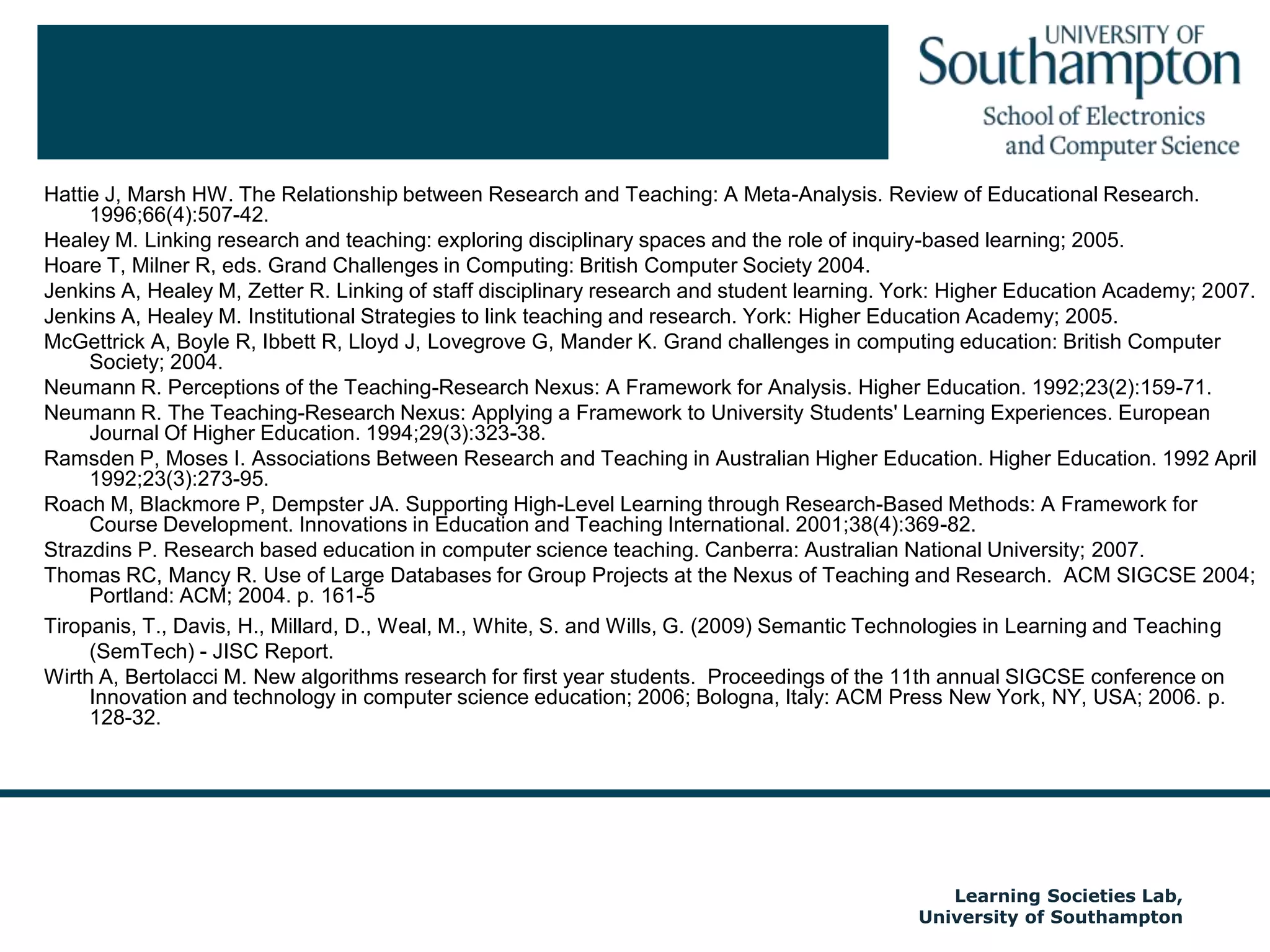
    From semtech reportTheinitial value of semantic technology will be in scale first before reasoningThe emergence of linked data fields across related repositories could enable applications and value for the identified HE challengesSemantic lools and services that map linked data to application specific ontologies will increase linked data value and impactEncouragemen of community afreedontologies to empower semantic applicationsalongside application specific ontologiesEmpressive semantics to enable pedagogoy aware applicationsAutumn 2009
  • 52.
    ChallengesBarriers to exposinginstitutional data in RDFAutumn 2009
  • 53.
    Most of fheidentifiredhe challenges can be addressed by querying across institutional repositories (databases, web pages, VLSs)Significant learning and teaching challenges can be addressed by accesing resources across departments, schools, institutionsArgumentation and critical thinking could benefit from advance reasoning over large scale of resourcesCould we adopt a bottom up approach starting from linked data which can be related to (layers of) ontologieslarer in the context of specific applications. Autumn 2009
  • 54.
    Looking at ourdataAutumn 2009
  • 55.
    Further QuestionsHow caninsight into disciplinary differences assist the selection of effective TEL (and therefore Web1.0->3.0) approaches?How can understanding disciplinary preferences help identify ways of working with faculty to successfully embed TEL and develop blended approaches?What are the technology affordances of e-learning which might best be used in computing, engineering and our cognate areas?http://fie.engrng.pitt.edu/fie2006/papers/1784.pdfAutumn 2009

Editor's Notes

  • #4 This talk is about the social web, web2.0, the read write web and the way in which you can do cool things and smart things by taking a strategic approach to using web resources in a Higher Education Context.The presentation gives an account of the way we go about working with the web smartly in one academic school, and in one university, but it also aims to explain how that approach can be taken at any university or other educational institution. This slide gives you a preview of the EdShare system which we have established as a place to put stuff (teaching stuff) so that we can do stuff (cool stuff) with a minimal effort. It will look at web2.0 in terms of what it and its successors can do for academics, and university admin, although all these activities are designed ultimately to benefit the student.Edshare is a project at Southampton, funded by JISC initially, but fully supported by the institution. The EdShare is a single secure place to store and share educational resources. Items stored in EdShare can be identified and their descriptions can be indexed by search engines such as google (although access rights are always specified by the depositor). By adding tagging and comments to the documents
  • #8 Like many institutions we have designed administrative systems to support our different agendas, as an department who had a healthy chunk of research in hypertext and the web, we were there from the beginning with simple vanilla web applications which solved problems in a pragmatic way.
  • #9 This use of web2.0 is actually in the spirit what clay shirkey was talking about as social software in this 2003 post on xxxx which is quoted at the beginning the HEFCE report
  • #15 Surveys
  • #16 Roots of online communities and social web lie in the deadheads who populated the well and endlessly discussed grateful dead….