eLearning: emerging trends and issues Thursday, August 30 th Michael Coghlan
My Story ESL classroom teacher 1987 – 1997 1997 – went online Blended ESL teaching 1997 – 2000 ESL online 1997 – 2004 eLearning Facilitator for TAFE SA, Aust Flexible Learning Framework 2004 – 7 Independent elearning consultant 2006 - 7
 
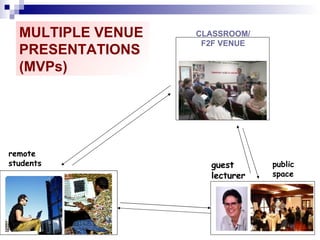
MULTIPLE VENUE PRESENTATIONS (MVPs) remote  students guest lecturer CLASSROOM/ F2F VENUE public space
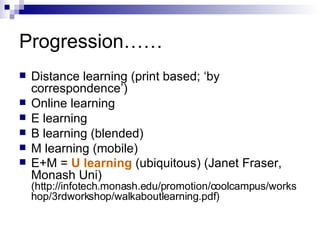
Progression…… Distance learning (print based; ‘by correspondence’) Online learning E learning B learning (blended) M learning (mobile) E+M =  U learning  (ubiquitous) (Janet Fraser, Monash Uni)  (http://infotech.monash.edu/promotion/coolcampus/workshop/3rdworkshop/walkaboutlearning.pdf)
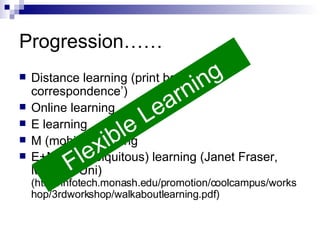
Progression…… Distance learning (print based; ‘by correspondence’) Online learning E learning M (mobile) learning E+M = U (ubiquitous) learning (Janet Fraser, Monash Uni)  (http://infotech.monash.edu/promotion/coolcampus/workshop/3rdworkshop/walkaboutlearning.pdf) Flexible Learning
BLENDED LEARNING The predominant model Elearning + face to face (f2f) instruction (in any proportion) Can be as simple as email + f2f, or Email, plus websites, + f2f The most common: Learning Management System* (LMS) + f2f *Learning Management Systems: Blackboard, WebCT, Janison, Moodle
Other Models: Next/Back Learning Content for whole course prepared and loaded upfront (expensive) Minimal input from instructors; essentially unfacilitated Self-paced; individualised Suitable for compliance or product training, or for highly motivated students
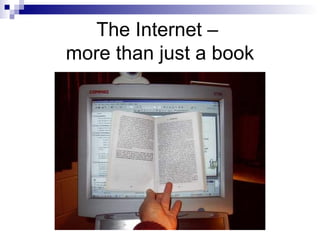
The Internet –  more than just a book
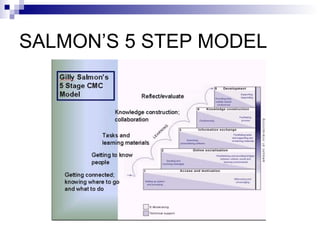
SALMON’S 5 STEP MODEL
Other Models: Facilitated Learning Involves processing of content PLUS Communication activities (discussion) with fellow students and facilitator Strong social and/or collaborative component
How do you feel about elearning? Overblown importance? A necessary evil? A valuable complement to VET teaching and learning? Undecided?
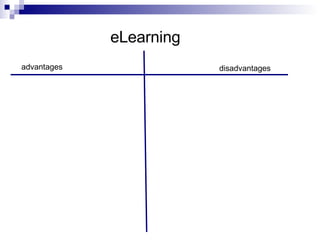
eLearning advantages disadvantages
THE VET CONTEXT The average age of a TAFE student has been about 31 for the last three years. The largest group of TAFE NSW students is aged between 20 and 29 but the fastest growing group of students is aged between 40 and 49. The number of students aged 50 to 64 has also grown quickly and this trend is expected to continue.  (Issues paper, NSW DET,2004)   UPDATE: 2006: average age = 34 http://www.education.vic.gov.au/tafecourses/Adult_Learners.htm
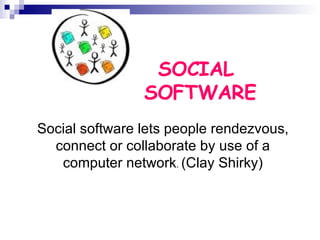
SOCIAL  SOFTWARE Social software lets people rendezvous, connect or collaborate by use of a computer network .  (Clay Shirky)
SOCIAL SOFTWARE TOOLS Instant Messaging (Skype) Virtual classrooms (Centra, Elluminate, Adobe Connect) Blogs (blogger.com, edublogs.org) Photo Sharing  (flickr.com) Wikis   (Wikispaces.com) – collaborative workspace Social Bookmarking  ( http://del.icio.us/ ) Personalised learning environments, or PLEs  ( http://elgg.org/ ) Social Networking sites (MySpace, Facebook) Many of these sites encourage contributing content (text and media) to the  read/write web.
eLearning 2.0/Web 2.0 (Stephen Downes) Elearning 1.0: static packaged content  little true interactivity and learner input  very little contact with teacher represented by Learner Management Systems. (eg WebCT, Blackboard)  Elearning 2.0: more student-centred students  generate and share content .  they  interact   not only with teachers and their peers, but  with anyone in the world they can learn from . (this description courtesy of Sean Fitzgerald)
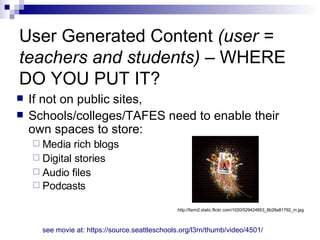
User Generated Content  (user = teachers and students)  – WHERE DO YOU PUT IT? If not on public sites, Schools/colleges/TAFES need to enable their own spaces to store: Media rich blogs Digital stories Audio files Podcasts  see movie at: https://source.seattleschools.org/l3rn/thumb/video/4501/ http://farm2.static.flickr.com/1020/529424853_8b28a81792_m.jpg
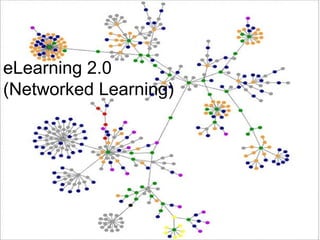
eLearning 2.0 (Networked Learning)
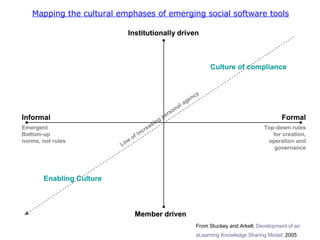
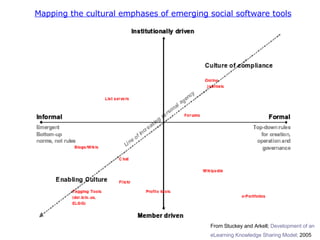
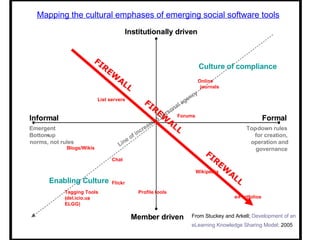
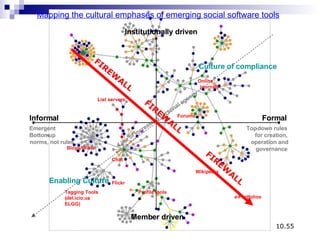
Mapping the cultural emphases of emerging social software tools From Stuckey and Arkell;  Development of an  eLearning Knowledge Sharing Model;  2005
Line of increasing personal agency Institutionally driven Member driven Formal Informal Top - down rules  for creation,  operation and  governance Emergent Bottom - up  norms, not rules Enabling Culture Culture of compliance Institutionally driven Member driven Formal Informal Top - down rules  for creation,  operation and  governance Emergent Bottom  - norms, not rules Mapping the cultural emphases of emerging social software tools Wikipedia e - Portfolios Profile tools Blogs/Wikis Flickr Chat Tagging Tools  ( del.icio.us ,  ELGG) List servers Forums Online journals FIREWALL FIREWALL FIREWALL From Stuckey and Arkell;  Development of an  eLearning Knowledge Sharing Model;  2005
Line of increasing personal agency Institutionally driven Member driven Formal Informal Top - down rules  for creation,  operation and  governance Emergent Bottom - up  norms, not rules Enabling Culture Culture of compliance Institutionally driven Member driven Formal Informal Top - down rules  for creation,  operation and  governance Emergent Bottom  - norms, not rules Mapping the cultural emphases of emerging social software tools Wikipedia e - Portfolios Profile tools Blogs/Wikis Flickr Chat Tagging Tools  ( del.icio.us ,  ELGG) List servers Forums Online journals FIREWALL FIREWALL FIREWALL 10.55
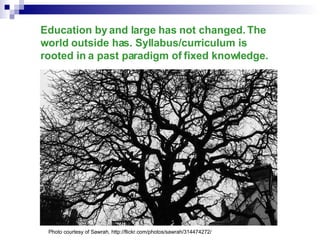
Education by and large has not changed. The world outside has. Syllabus/curriculum is rooted in a past paradigm of fixed knowledge. Photo courtesy of Sawrah, http://flickr.com/photos/sawrah/314474272/
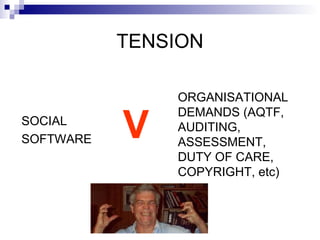
TENSION SOCIAL SOFTWARE ORGANISATIONAL DEMANDS (AQTF, AUDITING, ASSESSMENT, DUTY OF CARE, COPYRIGHT, etc) V
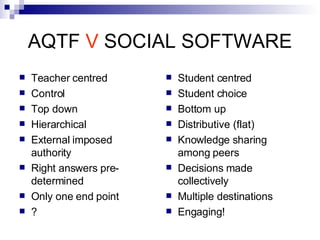
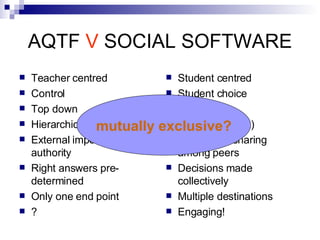
AQTF  V  SOCIAL SOFTWARE Teacher centred Control Top down Hierarchical External imposed authority Right answers pre-determined Only one end point ? Student centred Student choice Bottom up Distributive (flat) Knowledge sharing among peers Decisions made collectively Multiple destinations Engaging!
AQTF  V  SOCIAL SOFTWARE Teacher centred Control Top down Hierarchical External imposed authority Right answers pre-determined Only one end point ? Student centred Student choice Bottom up Distributive (flat) Knowledge sharing among peers Decisions made collectively Multiple destinations Engaging! mutually exclusive?
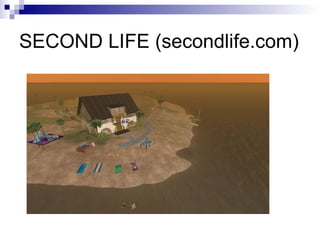
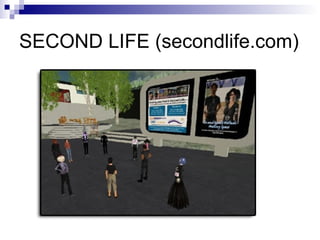
SECOND LIFE (secondlife.com)
The Dark Side of the Web
Are we sociologically ready? What are ethical responsibilities as educators?
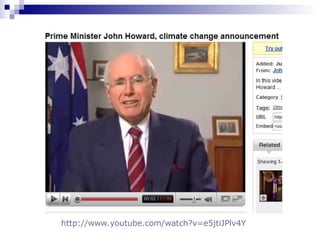
http:// www.youtube.com/watch?v =e5jtiJPlv4Y
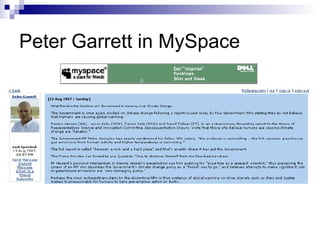
Peter Garrett in MySpace
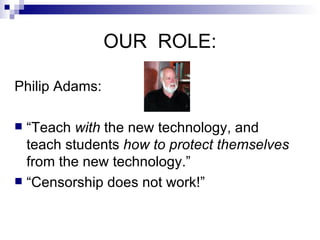
OUR  ROLE: Philip Adams: “ Teach  with  the new technology, and teach students  how to protect themselves  from the new technology.” “ Censorship does not work!”
The cost of elearning: does  it save you money? not necessarily….. Static content, unfacilitated online models can recoup costs in the longer term Blended learning (online and f2f) can be cost neutral  Solely online facilitated models  FACT: it takes longer to effectively teach 15 people online than it does to teach the same amount of content to the same number of people in a classroom Costs can be offset by employing Open Source software (eg Moodle) and not investing in developing whole course content for preloading
Proprietary v Open Source Proprietary Expensive Locked in to fixed product for extended periods Open Source Free or very cheap Host can modify product as often as desired
The Virtual Classroom Saves travel time and teleconferencing costs Offers remote synchronous instruction/meeting space Recordings can be accessed (repeatedly) asynchronously after the event This model of elearning is sustainable and cost effective
Issues: The debilitating influence of organisational networks Whither the innovator? Knowledge gatekeeper > knowledge facilitator Employability skills – is elearning a valid (better?) alternative
Resources Designing eLearning - http://designing.flexiblelearning.net.au/ Practical Guide to eLearning for Industry -  http://industry.flexiblelearning.net.au/Guide/default.htm
Michael Coghlan [email_address]
Learning Management Systems – LMS  (or Course Management Systems – CMS, or Platforms) Blackboard (now incorporates WebCT) Janison, Moodle They comprise: Learning materials (content) Communication tools (mail, chat, Instant Messaging, Forum/discussions, blogs) The Back End: Tracking tools – student profiles, grades, attendance patterns

eLearning: emerging trends and issues

  • 1.
    eLearning: emerging trendsand issues Thursday, August 30 th Michael Coghlan
  • 2.
    My Story ESLclassroom teacher 1987 – 1997 1997 – went online Blended ESL teaching 1997 – 2000 ESL online 1997 – 2004 eLearning Facilitator for TAFE SA, Aust Flexible Learning Framework 2004 – 7 Independent elearning consultant 2006 - 7
  • 3.
  • 4.
    MULTIPLE VENUE PRESENTATIONS(MVPs) remote students guest lecturer CLASSROOM/ F2F VENUE public space
  • 5.
    Progression…… Distance learning(print based; ‘by correspondence’) Online learning E learning B learning (blended) M learning (mobile) E+M = U learning (ubiquitous) (Janet Fraser, Monash Uni) (http://infotech.monash.edu/promotion/coolcampus/workshop/3rdworkshop/walkaboutlearning.pdf)
  • 6.
    Progression…… Distance learning(print based; ‘by correspondence’) Online learning E learning M (mobile) learning E+M = U (ubiquitous) learning (Janet Fraser, Monash Uni) (http://infotech.monash.edu/promotion/coolcampus/workshop/3rdworkshop/walkaboutlearning.pdf) Flexible Learning
  • 7.
    BLENDED LEARNING Thepredominant model Elearning + face to face (f2f) instruction (in any proportion) Can be as simple as email + f2f, or Email, plus websites, + f2f The most common: Learning Management System* (LMS) + f2f *Learning Management Systems: Blackboard, WebCT, Janison, Moodle
  • 8.
    Other Models: Next/BackLearning Content for whole course prepared and loaded upfront (expensive) Minimal input from instructors; essentially unfacilitated Self-paced; individualised Suitable for compliance or product training, or for highly motivated students
  • 9.
    The Internet – more than just a book
  • 10.
  • 11.
    Other Models: FacilitatedLearning Involves processing of content PLUS Communication activities (discussion) with fellow students and facilitator Strong social and/or collaborative component
  • 12.
    How do youfeel about elearning? Overblown importance? A necessary evil? A valuable complement to VET teaching and learning? Undecided?
  • 13.
  • 14.
    THE VET CONTEXTThe average age of a TAFE student has been about 31 for the last three years. The largest group of TAFE NSW students is aged between 20 and 29 but the fastest growing group of students is aged between 40 and 49. The number of students aged 50 to 64 has also grown quickly and this trend is expected to continue. (Issues paper, NSW DET,2004) UPDATE: 2006: average age = 34 http://www.education.vic.gov.au/tafecourses/Adult_Learners.htm
  • 15.
    SOCIAL SOFTWARESocial software lets people rendezvous, connect or collaborate by use of a computer network . (Clay Shirky)
  • 16.
    SOCIAL SOFTWARE TOOLSInstant Messaging (Skype) Virtual classrooms (Centra, Elluminate, Adobe Connect) Blogs (blogger.com, edublogs.org) Photo Sharing (flickr.com) Wikis (Wikispaces.com) – collaborative workspace Social Bookmarking ( http://del.icio.us/ ) Personalised learning environments, or PLEs ( http://elgg.org/ ) Social Networking sites (MySpace, Facebook) Many of these sites encourage contributing content (text and media) to the read/write web.
  • 17.
    eLearning 2.0/Web 2.0(Stephen Downes) Elearning 1.0: static packaged content little true interactivity and learner input very little contact with teacher represented by Learner Management Systems. (eg WebCT, Blackboard) Elearning 2.0: more student-centred students generate and share content . they interact not only with teachers and their peers, but with anyone in the world they can learn from . (this description courtesy of Sean Fitzgerald)
  • 18.
    User Generated Content (user = teachers and students) – WHERE DO YOU PUT IT? If not on public sites, Schools/colleges/TAFES need to enable their own spaces to store: Media rich blogs Digital stories Audio files Podcasts see movie at: https://source.seattleschools.org/l3rn/thumb/video/4501/ http://farm2.static.flickr.com/1020/529424853_8b28a81792_m.jpg
  • 19.
  • 20.
    Mapping the culturalemphases of emerging social software tools From Stuckey and Arkell; Development of an eLearning Knowledge Sharing Model; 2005
  • 21.
    Mapping the culturalemphases of emerging social software tools From Stuckey and Arkell; Development of an eLearning Knowledge Sharing Model; 2005
  • 22.
    Line of increasingpersonal agency Institutionally driven Member driven Formal Informal Top - down rules for creation, operation and governance Emergent Bottom - up norms, not rules Enabling Culture Culture of compliance Institutionally driven Member driven Formal Informal Top - down rules for creation, operation and governance Emergent Bottom - norms, not rules Mapping the cultural emphases of emerging social software tools Wikipedia e - Portfolios Profile tools Blogs/Wikis Flickr Chat Tagging Tools ( del.icio.us , ELGG) List servers Forums Online journals FIREWALL FIREWALL FIREWALL From Stuckey and Arkell; Development of an eLearning Knowledge Sharing Model; 2005
  • 23.
    Line of increasingpersonal agency Institutionally driven Member driven Formal Informal Top - down rules for creation, operation and governance Emergent Bottom - up norms, not rules Enabling Culture Culture of compliance Institutionally driven Member driven Formal Informal Top - down rules for creation, operation and governance Emergent Bottom - norms, not rules Mapping the cultural emphases of emerging social software tools Wikipedia e - Portfolios Profile tools Blogs/Wikis Flickr Chat Tagging Tools ( del.icio.us , ELGG) List servers Forums Online journals FIREWALL FIREWALL FIREWALL 10.55
  • 24.
    Education by andlarge has not changed. The world outside has. Syllabus/curriculum is rooted in a past paradigm of fixed knowledge. Photo courtesy of Sawrah, http://flickr.com/photos/sawrah/314474272/
  • 25.
    TENSION SOCIAL SOFTWAREORGANISATIONAL DEMANDS (AQTF, AUDITING, ASSESSMENT, DUTY OF CARE, COPYRIGHT, etc) V
  • 26.
    AQTF V SOCIAL SOFTWARE Teacher centred Control Top down Hierarchical External imposed authority Right answers pre-determined Only one end point ? Student centred Student choice Bottom up Distributive (flat) Knowledge sharing among peers Decisions made collectively Multiple destinations Engaging!
  • 27.
    AQTF V SOCIAL SOFTWARE Teacher centred Control Top down Hierarchical External imposed authority Right answers pre-determined Only one end point ? Student centred Student choice Bottom up Distributive (flat) Knowledge sharing among peers Decisions made collectively Multiple destinations Engaging! mutually exclusive?
  • 28.
  • 29.
  • 30.
    The Dark Sideof the Web
  • 31.
    Are we sociologicallyready? What are ethical responsibilities as educators?
  • 32.
  • 33.
  • 34.
    OUR ROLE:Philip Adams: “ Teach with the new technology, and teach students how to protect themselves from the new technology.” “ Censorship does not work!”
  • 35.
    The cost ofelearning: does it save you money? not necessarily….. Static content, unfacilitated online models can recoup costs in the longer term Blended learning (online and f2f) can be cost neutral Solely online facilitated models FACT: it takes longer to effectively teach 15 people online than it does to teach the same amount of content to the same number of people in a classroom Costs can be offset by employing Open Source software (eg Moodle) and not investing in developing whole course content for preloading
  • 36.
    Proprietary v OpenSource Proprietary Expensive Locked in to fixed product for extended periods Open Source Free or very cheap Host can modify product as often as desired
  • 37.
    The Virtual ClassroomSaves travel time and teleconferencing costs Offers remote synchronous instruction/meeting space Recordings can be accessed (repeatedly) asynchronously after the event This model of elearning is sustainable and cost effective
  • 38.
    Issues: The debilitatinginfluence of organisational networks Whither the innovator? Knowledge gatekeeper > knowledge facilitator Employability skills – is elearning a valid (better?) alternative
  • 39.
    Resources Designing eLearning- http://designing.flexiblelearning.net.au/ Practical Guide to eLearning for Industry - http://industry.flexiblelearning.net.au/Guide/default.htm
  • 40.
  • 41.
    Learning Management Systems– LMS (or Course Management Systems – CMS, or Platforms) Blackboard (now incorporates WebCT) Janison, Moodle They comprise: Learning materials (content) Communication tools (mail, chat, Instant Messaging, Forum/discussions, blogs) The Back End: Tracking tools – student profiles, grades, attendance patterns