Powerful Web  2.0 tools for the ELT Classroom Best Affiliates’ Presentations TESOL Convention – New Orleans, March 16-19, 2011 Evelyn Izquierdo VenezuelaTESOL (VenTESOL) http://ventesol.ning.com
Aim This presentation offers an introduction to Web 2.0 tools (blogs, wikis, podcasts, social networking, etc) as a way to empower our ELT practice.
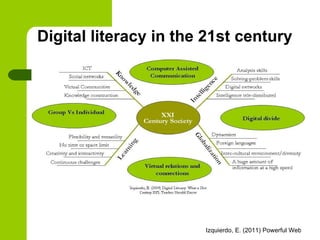
Digital literacy in the 21st century
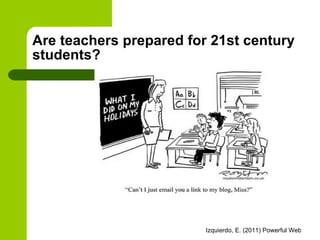
Are teachers prepared for 21st century students?
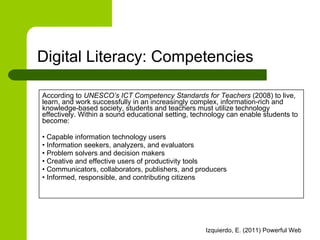
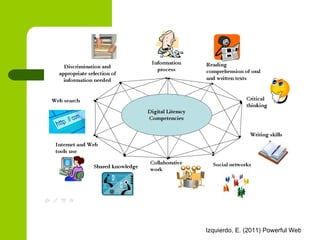
According to  UNESCO’s ICT Competency Standards for Teachers  (2008) to live, learn, and work successfully in an increasingly complex, information-rich and knowledge-based society, students and teachers must utilize technology effectively. Within a sound educational setting, technology can enable students to become: •  Capable information technology users •  Information seekers, analyzers, and evaluators •  Problem solvers and decision makers •  Creative and effective users of productivity tools •  Communicators, collaborators, publishers, and producers •  Informed, responsible, and contributing citizens Digital Literacy: Competencies
 
Web 2.0 Web 2.0 facilitates communication, information exchange and collaboration under a dynamic environment where users participate in the design and production of the site. Web 2.0 sites allow the use of multiple artifacts, being able to generate and share information, organize social networks, exchange videos  photos, wikis, blogs, podcasts, and folksonomies among other advantages.
Some tools for listening and speaking Video calls:  Skype Podcasts Webbased recorders: Pod -O- matic Chirbit Voki Spreaker Software: Audacity Voice tools: Voicethread Voxopop Voki Images Videos: YouTube
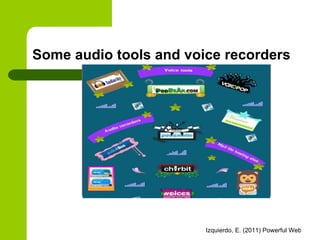
Some audio tools and voice recorders
Samples Blogs Podcasts Glogster Digital  coursebook Twitter Literature   on   Webheads  in  action’s   site
Some tools for storytelling Images: Flickr Photopeach Fotobabble Glogster : Text, images, music, videos Phrasr Cartoon Voice/video tool:  xtranormal
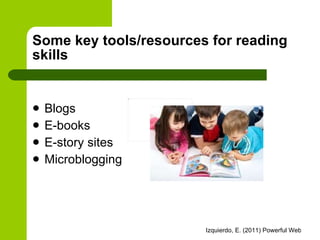
Some key tools/resources for reading skills Blogs E-books E-story sites Microblogging
Some tools for writing skills Blogs: Blogger Wordpress Posterous Penzu
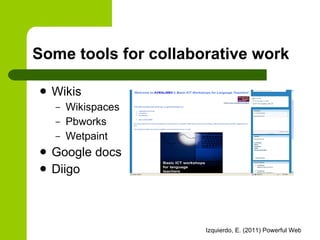
Some tools for collaborative work Wikis Wikispaces Pbworks Wetpaint Google docs Diigo
Popular storage, online back up and sharing  sites Dropbox Google  docs BlipTV Scribd
Some bookmarking tools Del.icio.us Diigo Others
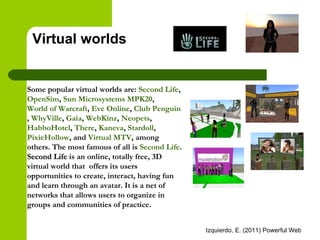
Virtual worlds Some popular virtual worlds are:  Second Life ,  OpenSim ,  Sun Microsystems MPK20 ,  World of Warcraft ,  Eve Online ,  Club Penguin ,  WhyVille ,  Gaia ,  WebKinz ,  Neopets ,  HabboHotel ,  There ,  Kaneva ,  Stardoll ,  PixieHollow , and  Virtual MTV , among others. The most famous of all is  Second Life .  Second Life  is an online, totally free, 3D virtual world that  offers its users opportunities to create, interact, having fun and learn through an avatar. It is a net of networks that allows users to organize in groups and communities of practice.
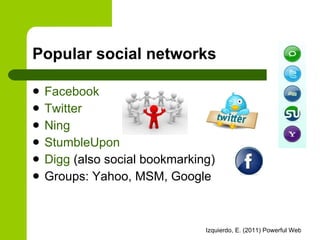
Popular social networks Facebook Twitter Ning StumbleUpon Digg  (also social bookmarking) Groups: Yahoo, MSM, Google
Other popular tools Social networks:  MySpace ,  Sonico ,  Hi5 ,  Tagged ,  Orkut ,  Bebo   Sites to storage and share audio, create podcasts, leave audio messages or make phone calls:  Podbean ,  Skype , etc. Photos:  Flickr ,  Bubbleshare ,  Picassa ,  Photobucket  etc. Videos:  You Tube ,  TeacherTube ,  Bliptv ,  Metacafe , etc. Blogs (blogs):  Blogger ,  Wordpress , etc. Microblogging:  Twitter ,  Crowdstatus , etc. Wikis:  Wikipedia ,  Wikieducator ,   Wetpaint ,  Wikispaces Doc and PPT storage sites:  Thinkfree ,  Box.net ,  Google docs ,  Slideshare ,  Dropbox Learning environments, platforms or virtual rooms:  Learning Times ,  Tapped in ,  Elluminate ,  WiZiQ ,  Moodle   Virtual worlds:  Second Life   and others already mentioned; and  Board markers:  Wallwisher , etc
Further resources American Association for Higher Education (October, 1999) and the Council of Independent Colleges (February, 2004).  Information Literacy Competency Standards of Higher Education.   [Online] Available at:  http:// www.ala.org /ala/ mgrps / divs / acrl /standards/ standards.pdf  Retrieved April 15, 2009.  Downes, S. (2007)  What connectivism is . [En línea] Blog: Half an hour. [Online] Available at :  http:// halfanhour.blogspot.com /2007/02/ what - connectivism - is.html  Retrieved November 23,  2008 Educational Testing Service, International ICT Literacy Panel (2002).  Digital transformation: A framework for ICT literacy (A report of the International  ICT Literacy Panel).  Princeton, NJ: Educational Testing Service. [Online] Disponible en:  http:// www.ets.org /Media/ Research / pdf / ictreport.pdf  Retrieved March 18, 2009  Izquierdo, E. y Verschoor, J. (2009).  Social Bookmarks . Integrating Technology for Instruction and Learning. [Online] Available at:  http:// www.slideshare.net / EvelynIzquierdo /social- bookmarking -1293488  Retrieved April 3, 2009 UNESCO (2008, en Eduteka).  ICT Competency Standards for Teachers[Online, Eduteka Website] Available at  http:// www.eduteka.org/EstandaresDocentesUnesco.php   Retrieved January 18, 2009
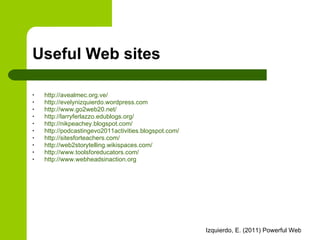
Useful Web sites http:// avealmec.org.ve / http://evelynizquierdo.wordpress.com http://www.go2web20.net/   http://larryferlazzo.edublogs.org/   http://nikpeachey.blogspot.com/   http://podcastingevo2011activities.blogspot.com/   http://sitesforteachers.com/   http://web2storytelling.wikispaces.com/ http://www.toolsforeducators.com/ http://www.webheadsinaction.org
Thank you! Evelyn Izquierdo  MS in EFL,  ESP teacher  at  Universidad Central de Venezuela , e-tutor, Web 2.0 trainer, current  president of  Avealmec  (Venezuela CALL association),  Webhead , e- moderator of   several social networks and  VenTESOL ’Communications Coordinator.  Contact information:  Universidad Central de Venezuela Email:  [email_address] Skype: evelyn.izquierdo Twitter: @eveweb Second Life: Evelyn Michalski http://evelynizquierdo.wordpress.com/

Powerful web20 tools

  • 1.
    Powerful Web 2.0 tools for the ELT Classroom Best Affiliates’ Presentations TESOL Convention – New Orleans, March 16-19, 2011 Evelyn Izquierdo VenezuelaTESOL (VenTESOL) http://ventesol.ning.com
  • 2.
    Aim This presentationoffers an introduction to Web 2.0 tools (blogs, wikis, podcasts, social networking, etc) as a way to empower our ELT practice.
  • 3.
    Digital literacy inthe 21st century
  • 4.
    Are teachers preparedfor 21st century students?
  • 5.
    According to UNESCO’s ICT Competency Standards for Teachers (2008) to live, learn, and work successfully in an increasingly complex, information-rich and knowledge-based society, students and teachers must utilize technology effectively. Within a sound educational setting, technology can enable students to become: • Capable information technology users • Information seekers, analyzers, and evaluators • Problem solvers and decision makers • Creative and effective users of productivity tools • Communicators, collaborators, publishers, and producers • Informed, responsible, and contributing citizens Digital Literacy: Competencies
  • 6.
  • 7.
    Web 2.0 Web2.0 facilitates communication, information exchange and collaboration under a dynamic environment where users participate in the design and production of the site. Web 2.0 sites allow the use of multiple artifacts, being able to generate and share information, organize social networks, exchange videos photos, wikis, blogs, podcasts, and folksonomies among other advantages.
  • 8.
    Some tools forlistening and speaking Video calls: Skype Podcasts Webbased recorders: Pod -O- matic Chirbit Voki Spreaker Software: Audacity Voice tools: Voicethread Voxopop Voki Images Videos: YouTube
  • 9.
    Some audio toolsand voice recorders
  • 10.
    Samples Blogs PodcastsGlogster Digital coursebook Twitter Literature on Webheads in action’s site
  • 11.
    Some tools forstorytelling Images: Flickr Photopeach Fotobabble Glogster : Text, images, music, videos Phrasr Cartoon Voice/video tool: xtranormal
  • 12.
    Some key tools/resourcesfor reading skills Blogs E-books E-story sites Microblogging
  • 13.
    Some tools forwriting skills Blogs: Blogger Wordpress Posterous Penzu
  • 14.
    Some tools forcollaborative work Wikis Wikispaces Pbworks Wetpaint Google docs Diigo
  • 15.
    Popular storage, onlineback up and sharing sites Dropbox Google docs BlipTV Scribd
  • 16.
    Some bookmarking toolsDel.icio.us Diigo Others
  • 17.
    Virtual worlds Somepopular virtual worlds are: Second Life , OpenSim , Sun Microsystems MPK20 , World of Warcraft , Eve Online , Club Penguin , WhyVille , Gaia , WebKinz , Neopets , HabboHotel , There , Kaneva , Stardoll , PixieHollow , and Virtual MTV , among others. The most famous of all is Second Life . Second Life is an online, totally free, 3D virtual world that offers its users opportunities to create, interact, having fun and learn through an avatar. It is a net of networks that allows users to organize in groups and communities of practice.
  • 18.
    Popular social networksFacebook Twitter Ning StumbleUpon Digg (also social bookmarking) Groups: Yahoo, MSM, Google
  • 19.
    Other popular toolsSocial networks: MySpace , Sonico , Hi5 , Tagged , Orkut , Bebo Sites to storage and share audio, create podcasts, leave audio messages or make phone calls: Podbean , Skype , etc. Photos: Flickr , Bubbleshare , Picassa , Photobucket etc. Videos: You Tube , TeacherTube , Bliptv , Metacafe , etc. Blogs (blogs): Blogger , Wordpress , etc. Microblogging: Twitter , Crowdstatus , etc. Wikis: Wikipedia , Wikieducator , Wetpaint , Wikispaces Doc and PPT storage sites: Thinkfree , Box.net , Google docs , Slideshare , Dropbox Learning environments, platforms or virtual rooms: Learning Times , Tapped in , Elluminate , WiZiQ , Moodle Virtual worlds: Second Life and others already mentioned; and Board markers: Wallwisher , etc
  • 20.
    Further resources AmericanAssociation for Higher Education (October, 1999) and the Council of Independent Colleges (February, 2004). Information Literacy Competency Standards of Higher Education. [Online] Available at: http:// www.ala.org /ala/ mgrps / divs / acrl /standards/ standards.pdf Retrieved April 15, 2009. Downes, S. (2007) What connectivism is . [En línea] Blog: Half an hour. [Online] Available at : http:// halfanhour.blogspot.com /2007/02/ what - connectivism - is.html Retrieved November 23, 2008 Educational Testing Service, International ICT Literacy Panel (2002). Digital transformation: A framework for ICT literacy (A report of the International ICT Literacy Panel). Princeton, NJ: Educational Testing Service. [Online] Disponible en: http:// www.ets.org /Media/ Research / pdf / ictreport.pdf Retrieved March 18, 2009 Izquierdo, E. y Verschoor, J. (2009). Social Bookmarks . Integrating Technology for Instruction and Learning. [Online] Available at: http:// www.slideshare.net / EvelynIzquierdo /social- bookmarking -1293488 Retrieved April 3, 2009 UNESCO (2008, en Eduteka). ICT Competency Standards for Teachers[Online, Eduteka Website] Available at http:// www.eduteka.org/EstandaresDocentesUnesco.php Retrieved January 18, 2009
  • 21.
    Useful Web siteshttp:// avealmec.org.ve / http://evelynizquierdo.wordpress.com http://www.go2web20.net/ http://larryferlazzo.edublogs.org/ http://nikpeachey.blogspot.com/ http://podcastingevo2011activities.blogspot.com/ http://sitesforteachers.com/ http://web2storytelling.wikispaces.com/ http://www.toolsforeducators.com/ http://www.webheadsinaction.org
  • 22.
    Thank you! EvelynIzquierdo MS in EFL, ESP teacher at Universidad Central de Venezuela , e-tutor, Web 2.0 trainer, current president of Avealmec (Venezuela CALL association), Webhead , e- moderator of several social networks and VenTESOL ’Communications Coordinator. Contact information: Universidad Central de Venezuela Email: [email_address] Skype: evelyn.izquierdo Twitter: @eveweb Second Life: Evelyn Michalski http://evelynizquierdo.wordpress.com/