Web 2.0 Environments: Challenges and Opportunities for Learning and Teaching Ludmilla Smirnova, Ph.D. With discussion by Terri Hall, Ed.D, Michael Edelstein, Ph.D.  CAE  2007,  Learning Together: Pedagogy, Technology & Course redesign VII
What is this Workshop About? Learning and Teaching in the Informational Age Web 2.0 defined Web 1.0 vs. Web 2.0 Web 2.0:Three Facets  = Learning 2.0 Paradigm Shift Let’s Experience the Difference
Learning and Teaching in the Informational Age What is Learning in the new educational context? The process of acquiring, exploring, inquiring and applying new concepts through sharing the info with an audience; it results in personal change in behavior, attitudes, values, and thinking. What is Teaching in the Information Age? The process of constant learning of how to create conditions   for students’ learning & surviving in contemporary world. What is  Web 2.0 ?  (9.5 million citations on Google) CAE  2007,  Learning Together: Pedagogy, Technology & Course redesign VII
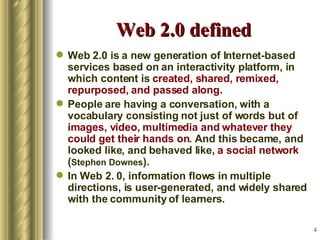
Web 2.0 defined Web 2.0 is a new generation of Internet-based  services based on an interactivity platform, in which content is  created, shared, remixed, repurposed, and passed along.   People are having a conversation, with a vocabulary consisting not just of words but of  images, video, multimedia and whatever they could get their hands on . And this became, and looked like, and behaved like,  a social network  ( Stephen Downes ). In Web 2. 0, information flows in multiple directions, is user-generated, and widely shared with the community of learners.
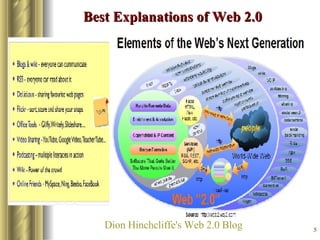
Dion   Hinchcliffe's  Web 2.0  Blog   Best Explanations of Web 2.0
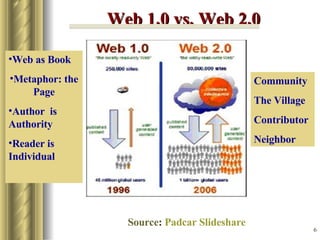
Web 1.0 vs. Web 2.0 Source :  Padcar   Slideshare Web as Book Metaphor: the Page Author  is  Authority  Reader is  Individual Community The Village  Contributor Neighbor
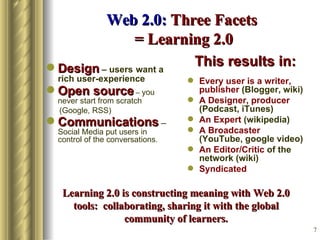
Web 2.0:  Three Facets  = Learning 2.0 Design  – users   want a rich user-experience Open source  –  you never start from scratch  (Google, RSS) Communications  –  Social Media put users in control of the conversations . This results in: Every user is a writer, publisher  (Blogger, wiki) A Designer, producer  (Podcast, iTunes) An Expert  (wikipedia) A Broadcaster  (YouTube, google video) An Editor/Critic  of the network   (wiki) Syndicated Learning 2.0 is constructing meaning with Web 2.0 tools:  collaborating, sharing it with the global community of learners.
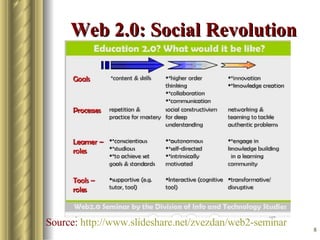
Web 2.0: Social Revolution Source :  http://www.slideshare.net/zvezdan/web2-seminar
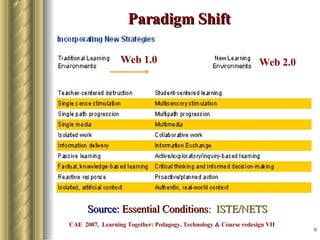
Paradigm Shift Incorporating New Strategies Traditional Learning CAE  2007,  Learning Together: Pedagogy, Technology & Course redesign VII Source:  Essential Conditions :   ISTE/NETS Web 1.0 Web 2.0
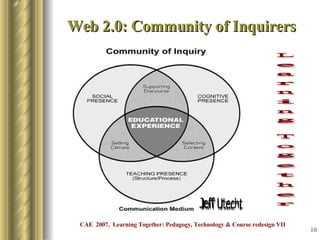
Web 2.0: Community of Inquirers   CAE  2007,  Learning Together: Pedagogy, Technology & Course redesign VII L e a r n i n g  T o g e t h e r Jeff Utecht
Let’s Experience the Difference Ludmilla’s   wiki : * Writing, publishing, sharing Stories with Web 1.0 & Web 2.0 tools Resources: *  Chris  SmithEdublog *  Top 25 Web 2.0 Applications * More on the wiki CAE  2007,  Learning Together: Pedagogy, Technology & Course redesign VII

Web20

  • 1.
    Web 2.0 Environments:Challenges and Opportunities for Learning and Teaching Ludmilla Smirnova, Ph.D. With discussion by Terri Hall, Ed.D, Michael Edelstein, Ph.D. CAE 2007, Learning Together: Pedagogy, Technology & Course redesign VII
  • 2.
    What is thisWorkshop About? Learning and Teaching in the Informational Age Web 2.0 defined Web 1.0 vs. Web 2.0 Web 2.0:Three Facets = Learning 2.0 Paradigm Shift Let’s Experience the Difference
  • 3.
    Learning and Teachingin the Informational Age What is Learning in the new educational context? The process of acquiring, exploring, inquiring and applying new concepts through sharing the info with an audience; it results in personal change in behavior, attitudes, values, and thinking. What is Teaching in the Information Age? The process of constant learning of how to create conditions for students’ learning & surviving in contemporary world. What is Web 2.0 ? (9.5 million citations on Google) CAE 2007, Learning Together: Pedagogy, Technology & Course redesign VII
  • 4.
    Web 2.0 definedWeb 2.0 is a new generation of Internet-based services based on an interactivity platform, in which content is created, shared, remixed, repurposed, and passed along. People are having a conversation, with a vocabulary consisting not just of words but of images, video, multimedia and whatever they could get their hands on . And this became, and looked like, and behaved like, a social network ( Stephen Downes ). In Web 2. 0, information flows in multiple directions, is user-generated, and widely shared with the community of learners.
  • 5.
    Dion Hinchcliffe's Web 2.0 Blog Best Explanations of Web 2.0
  • 6.
    Web 1.0 vs.Web 2.0 Source : Padcar Slideshare Web as Book Metaphor: the Page Author is Authority Reader is Individual Community The Village Contributor Neighbor
  • 7.
    Web 2.0: Three Facets = Learning 2.0 Design – users want a rich user-experience Open source – you never start from scratch (Google, RSS) Communications – Social Media put users in control of the conversations . This results in: Every user is a writer, publisher (Blogger, wiki) A Designer, producer (Podcast, iTunes) An Expert (wikipedia) A Broadcaster (YouTube, google video) An Editor/Critic of the network (wiki) Syndicated Learning 2.0 is constructing meaning with Web 2.0 tools: collaborating, sharing it with the global community of learners.
  • 8.
    Web 2.0: SocialRevolution Source : http://www.slideshare.net/zvezdan/web2-seminar
  • 9.
    Paradigm Shift IncorporatingNew Strategies Traditional Learning CAE 2007, Learning Together: Pedagogy, Technology & Course redesign VII Source: Essential Conditions : ISTE/NETS Web 1.0 Web 2.0
  • 10.
    Web 2.0: Communityof Inquirers CAE 2007, Learning Together: Pedagogy, Technology & Course redesign VII L e a r n i n g T o g e t h e r Jeff Utecht
  • 11.
    Let’s Experience theDifference Ludmilla’s wiki : * Writing, publishing, sharing Stories with Web 1.0 & Web 2.0 tools Resources: * Chris SmithEdublog * Top 25 Web 2.0 Applications * More on the wiki CAE 2007, Learning Together: Pedagogy, Technology & Course redesign VII