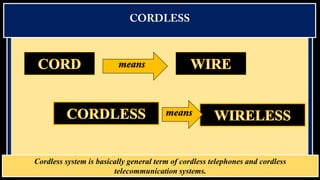
Cordless system is basically general term of cordless telephones and cordless
telecommunication systems.
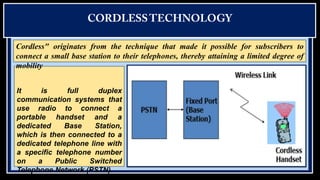
Cordless" originates from the technique that made it possible for subscribers to
connect a small base station to their telephones, thereby attaining a limited degree of
mobility
It
is
full
duplex
communication systems that
use radio to connect a
portable handset and a
dedicated
Base
Station,
which is then connected to a
dedicated telephone line with
a specific telephone number
on
a
Public
Switched
Telephone Network (PSTN).
 Cordless telephone is a telephone with a wireless handset that
communicates via radio waves with a base station connected to a
fixed telephone line, usually within a limited range of its base station
(which has the handset cradle).

 There
are
various
generations
CT0,CT1,CT2,DECT and PHP.

of

cordless

system
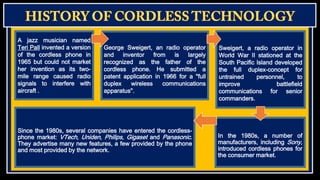
A jazz musician named
Teri Pall invented a version
of the cordless phone in
1965 but could not market
her invention as its twomile range caused radio
signals to interfere with
aircraft .

George Sweigert, an radio operator
and
inventor
from
is
largely
recognized as the father of the
cordless phone. He submitted a
patent application in 1966 for a "full
duplex
wireless
communications
apparatus".

Since the 1980s, several companies have entered the cordlessphone market: VTech, Uniden, Philips, Gigaset and Panasonic.
They advertise many new features, a few provided by the phone
and most provided by the network.

Sweigert, a radio operator in
World War II stationed at the
South Pacific Island developed
the full duplex-concept for
untrained
personnel,
to
improve
battlefield
communications for senior
commanders.

In the 1980s, a number of
manufacturers, including Sony,
introduced cordless phones for
the consumer market.





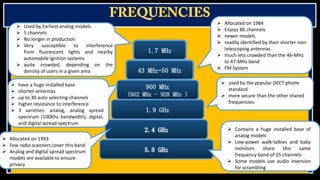
Used by Earliest analog models
5 channels
No longer in production
Very susceptible to interference
from fluorescent lights and nearby
automobile ignition systems
 quite crowded, depending on the
density of users in a given area






have a huge installed base
shorter antennas
up to 30 auto selecting channels
higher resistance to interference
3 varieties: analog, analog spread
spectrum (100Khz bandwidth), digital,
and digital spread spectrum

 Allocated on 1993
 Few radio scanners cover this band
 Analog and digital spread spectrum
models are available to ensure
privacy






1.7 MHz
43 MHz–50 MHz
900 MHz
(902 MHz - 928 MHz )

Allocated on 1984
Enjoys 80 channels
newer models
readily identified by their shorter nontelescoping antennas
 much less crowded than the 46-MHz
to 47-MHz band
 FM System
 used by the popular DECT phone
standard
 more secure than the other shared
frequencies.

1.9 GHz
 Contains a huge installed base of
analog models
 Low-power walk-talkies and baby
monitors
share
this
same
frequency band of 25 channels
 Some models use audio inversion
for scrambling
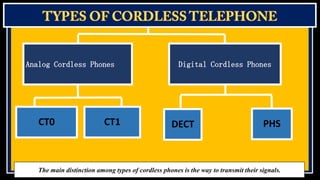
Analog Cordless Phones

CT0

CT1

Digital Cordless Phones

DECT

PHS

The main distinction among types of cordless phones is the way to transmit their signals.
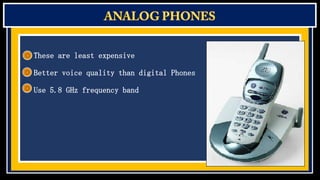
These are least expensive
Better voice quality than digital Phones
Use 5.8 GHz frequency band
Are of shorter rang than digital phones
This is not a secure transmission
We can listen voices by using RF scanner (Radio Frequency) or any
comparable device
Conference calls are not allowed
Analog phones are typically more open to outside interference, and their sound
quality is not as good as that of digital cordless models. Analog cordless signals are
easily intercepted by many radio scanners.
Digital cordless phones, on the other hand, have a much better sound quality than
analog phones, and their signals are much more secure. Many digital phones
manufactured after 1995 included digital spread spectrum (DSS) technology, which
spreads a phone's signal out over several frequencies in pieces. This feature made it
nearly impossible to intercept a cordless phone's signal.
CT1 - Cordless telephone generation 1
CT1 uses two radio frequencies and analogue technology to provide a full duplex speech path
between the handset and the base station. The two frequencies are spaced well apart; in the
direction base to handset the frequency is 1.7 MHz, and in the direction handset to base the
frequency is 47 MHz.
The CT1 system has a number of disadvantages:
o
o
o
o

The quality of the received speech is not very good.
Transmissions can be received by a sound broadcast radio receiver.
Only eight R. F. channels are allocated.
A telephone has no ability to search for a free channel and hence it can easily be blocked off
by another cordless telephone that has been set to use the same channel.
o The range is limited to about 50 m.
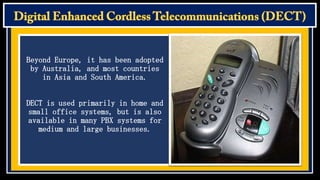
Beyond Europe, it has been adopted
by Australia, and most countries
in Asia and South America.

DECT is used primarily in home and
small office systems, but is also
available in many PBX systems for
medium and large businesses.
Domestic cordless telephony, using a single base station to
connect one or more handsets to the public telecoms network.

Enterprise premises cordless PABXs and wireless LANs, using many
base stations for coverage. Calls continue as users move between
different coverage cells, through a mechanism called handover.
Calls can be both within the system and to the public telecoms
network.
Public access, using large numbers of base stations to provide
high capacity building or urban area coverage as part of a public
telecoms network.
DECT has also been used for Fixed Wireless Access as a substitute
for copper pairs in countries such as India and South Africa. By
using directional antennas and sacrificing some traffic capacity,
coverage could extend to over 10 km.
The standard is also used in electronic cash terminals, traffic
lights, and remote door openers
Multiple handsets to one base station and one phone line socket.
This allows several cordless telephones to be placed around the
house, all operating from the same telephone jack.
Interference-free wireless operation to around 100 meters
(109 yards) outdoors, much less indoors when separated by walls .
For instance, generally immune to interference from other DECT
systems, Wi-Fi networks, video senders, Bluetooth technology,
baby monitors and other wireless devices.
Talk time several hours and standby time of several days on one
battery charge.

Some systems offer:
● A longer range between the telephone and base
station (usable further from the base).
●
24
hours.

Extended battery talk-time, sometimes up to
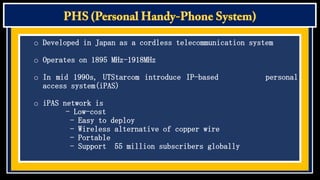
o Developed in Japan as a cordless telecommunication system
o Operates on 1895 MHz-1918MHz

o In mid 1990s, UTStarcom introduce IP-based
access system(iPAS)
o iPAS network is
- Low-cost
- Easy to deploy
- Wireless alternative of copper wire
- Portable
- Support 55 million subscribers globally

personal
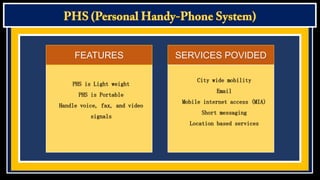
FEATURES

SERVICES POVIDED

Cordless Technology

  • 2.
    Cordless system isbasically general term of cordless telephones and cordless telecommunication systems.
  • 3.
    Cordless" originates fromthe technique that made it possible for subscribers to connect a small base station to their telephones, thereby attaining a limited degree of mobility It is full duplex communication systems that use radio to connect a portable handset and a dedicated Base Station, which is then connected to a dedicated telephone line with a specific telephone number on a Public Switched Telephone Network (PSTN).
  • 4.
     Cordless telephoneis a telephone with a wireless handset that communicates via radio waves with a base station connected to a fixed telephone line, usually within a limited range of its base station (which has the handset cradle).  There are various generations CT0,CT1,CT2,DECT and PHP. of cordless system
  • 5.
    A jazz musiciannamed Teri Pall invented a version of the cordless phone in 1965 but could not market her invention as its twomile range caused radio signals to interfere with aircraft . George Sweigert, an radio operator and inventor from is largely recognized as the father of the cordless phone. He submitted a patent application in 1966 for a "full duplex wireless communications apparatus". Since the 1980s, several companies have entered the cordlessphone market: VTech, Uniden, Philips, Gigaset and Panasonic. They advertise many new features, a few provided by the phone and most provided by the network. Sweigert, a radio operator in World War II stationed at the South Pacific Island developed the full duplex-concept for untrained personnel, to improve battlefield communications for senior commanders. In the 1980s, a number of manufacturers, including Sony, introduced cordless phones for the consumer market.
  • 6.
        Used by Earliestanalog models 5 channels No longer in production Very susceptible to interference from fluorescent lights and nearby automobile ignition systems  quite crowded, depending on the density of users in a given area      have a huge installed base shorter antennas up to 30 auto selecting channels higher resistance to interference 3 varieties: analog, analog spread spectrum (100Khz bandwidth), digital, and digital spread spectrum  Allocated on 1993  Few radio scanners cover this band  Analog and digital spread spectrum models are available to ensure privacy     1.7 MHz 43 MHz–50 MHz 900 MHz (902 MHz - 928 MHz ) Allocated on 1984 Enjoys 80 channels newer models readily identified by their shorter nontelescoping antennas  much less crowded than the 46-MHz to 47-MHz band  FM System  used by the popular DECT phone standard  more secure than the other shared frequencies. 1.9 GHz  Contains a huge installed base of analog models  Low-power walk-talkies and baby monitors share this same frequency band of 25 channels  Some models use audio inversion for scrambling
  • 7.
    Analog Cordless Phones CT0 CT1 DigitalCordless Phones DECT PHS The main distinction among types of cordless phones is the way to transmit their signals.
  • 8.
    These are leastexpensive Better voice quality than digital Phones Use 5.8 GHz frequency band
  • 9.
    Are of shorterrang than digital phones This is not a secure transmission We can listen voices by using RF scanner (Radio Frequency) or any comparable device Conference calls are not allowed
  • 10.
    Analog phones aretypically more open to outside interference, and their sound quality is not as good as that of digital cordless models. Analog cordless signals are easily intercepted by many radio scanners. Digital cordless phones, on the other hand, have a much better sound quality than analog phones, and their signals are much more secure. Many digital phones manufactured after 1995 included digital spread spectrum (DSS) technology, which spreads a phone's signal out over several frequencies in pieces. This feature made it nearly impossible to intercept a cordless phone's signal.
  • 11.
    CT1 - Cordlesstelephone generation 1 CT1 uses two radio frequencies and analogue technology to provide a full duplex speech path between the handset and the base station. The two frequencies are spaced well apart; in the direction base to handset the frequency is 1.7 MHz, and in the direction handset to base the frequency is 47 MHz. The CT1 system has a number of disadvantages: o o o o The quality of the received speech is not very good. Transmissions can be received by a sound broadcast radio receiver. Only eight R. F. channels are allocated. A telephone has no ability to search for a free channel and hence it can easily be blocked off by another cordless telephone that has been set to use the same channel. o The range is limited to about 50 m.
  • 12.
    Beyond Europe, ithas been adopted by Australia, and most countries in Asia and South America. DECT is used primarily in home and small office systems, but is also available in many PBX systems for medium and large businesses.
  • 13.
    Domestic cordless telephony,using a single base station to connect one or more handsets to the public telecoms network. Enterprise premises cordless PABXs and wireless LANs, using many base stations for coverage. Calls continue as users move between different coverage cells, through a mechanism called handover. Calls can be both within the system and to the public telecoms network. Public access, using large numbers of base stations to provide high capacity building or urban area coverage as part of a public telecoms network.
  • 14.
    DECT has alsobeen used for Fixed Wireless Access as a substitute for copper pairs in countries such as India and South Africa. By using directional antennas and sacrificing some traffic capacity, coverage could extend to over 10 km. The standard is also used in electronic cash terminals, traffic lights, and remote door openers
  • 15.
    Multiple handsets toone base station and one phone line socket. This allows several cordless telephones to be placed around the house, all operating from the same telephone jack. Interference-free wireless operation to around 100 meters (109 yards) outdoors, much less indoors when separated by walls . For instance, generally immune to interference from other DECT systems, Wi-Fi networks, video senders, Bluetooth technology, baby monitors and other wireless devices.
  • 16.
    Talk time severalhours and standby time of several days on one battery charge. Some systems offer: ● A longer range between the telephone and base station (usable further from the base). ● 24 hours. Extended battery talk-time, sometimes up to
  • 17.
    o Developed inJapan as a cordless telecommunication system o Operates on 1895 MHz-1918MHz o In mid 1990s, UTStarcom introduce IP-based access system(iPAS) o iPAS network is - Low-cost - Easy to deploy - Wireless alternative of copper wire - Portable - Support 55 million subscribers globally personal
  • 18.